What Is Marketing Funnel

More website traffic is not the same as more golf club members. A Facebook enquiry, a form submission, or a referral only creates an opportunity. If nobody responds promptly, records the lead, answers the prospect's questions, and books the next step, the club has paid for attention without building membership.
That's why the useful answer to what is a marketing funnel isn't “a journey from awareness to purchase”. For a UK golf club, it's a managed process that turns interest into an enquiry, an enquiry into a visit, and a visit into a membership conversation. GolfRep approaches growth from that practical position, focusing on the pipeline between the first click and the signed member.
Why Most Golf Clubs Leak Enquiries Before They Become Members
The common assumption is that a club needs more traffic before it needs better follow-up. Managers are often encouraged to increase social activity, promote another offer, or send more people to the website. Those activities can help, but they won't solve a funnel that loses prospects after they enquire.
A golf club can receive a healthy flow of interest and still produce disappointing membership results. Enquiries sit in an inbox, voicemails go unanswered, and a spreadsheet records names without showing who owns the next action. By the time someone calls, the prospect may have compared other clubs or moved on.
Practical rule: Treat every enquiry as a stage in a process, not as a message waiting for an occasional reply.
The funnel gives managers a way to locate that leakage. It asks practical questions:
- Who owns the lead? A named person needs responsibility for the next action.
- How quickly is the first response sent? Speed matters before the prospect's interest fades.
- What happens after the first reply? A clear sequence should move the golfer towards a visit.
- Where is the stage recorded? The club needs to distinguish a new enquiry from a booked visit, a trial round, and a membership decision.
Google's clickstream research found that some customer journeys last a month or more, that one in three conversions happens 30 days after research begins, and that 70% of purchasers use search at some point in the journey (Google's clickstream research). It also found that 48% of purchasers switch between brand and generic search terms, so a golfer may discover a club through one channel and return through several others before joining.
That pattern makes a simple last-click view unreliable. A club must measure the chain of interactions, not just the final form or phone call. The most valuable improvement may sit in the middle of the funnel, where the club responds, qualifies the golfer, and creates a reason to visit.
UK golf clubs also operate in a narrow conversion environment. Whito Research reported an average UK ecommerce conversion rate of 1.51% in January 2026, compared with 1.75% a year earlier, and a market median of 1.45% (Whito Research's UK conversion-rate benchmark). Ecommerce isn't the same as club membership, but the comparison reinforces a useful point: many people can enter a buying journey while only a small share complete the transaction.
For clubs, the answer isn't automatically more enquiries. It's a visible, organised process for converting the demand already being created.
The Marketing Funnel Explained for Golf Clubs
A marketing funnel is a stage-based model of the journey from first awareness to purchase. It narrows because more people discover a club than enquire, more enquire than visit, and more visit than sign up.
Consider a realistic UK club journey. A golfer sees a Facebook advert for a taster round or society day. That's the awareness stage. The advert needs to make the opportunity clear and direct the golfer to a relevant landing page, rather than a general homepage where the next action is unclear.
The golfer submits an enquiry. This is the interest stage, because they've moved beyond passive attention and provided contact details. The club now needs to record the source, understand what the golfer wants, and send an acknowledgement that confirms what happens next.
The next conversation creates consideration. A membership manager or automated sequence can answer questions about playing opportunities, fees, access, social events, and suitability. The message should reflect the enquiry. Someone asking about flexible membership shouldn't receive the same follow-up as someone interested in joining a regular competition section.
The golfer books a taster round or visit. That shows intent. A booking creates a specific opportunity for the club to deliver a good experience and prepare the right person to welcome the prospect.
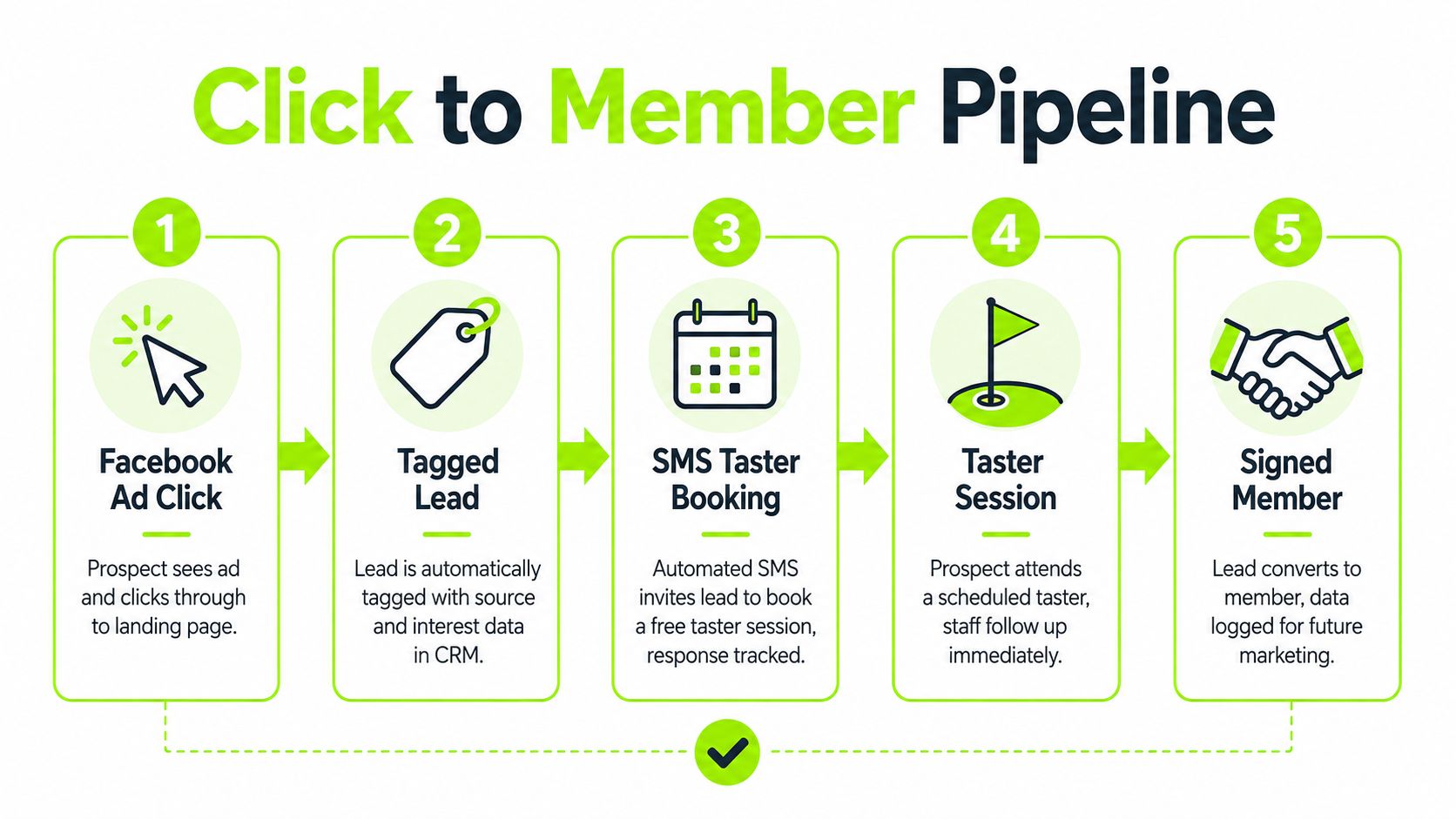
The stages need owners
The visit leads to conversion, when the golfer joins or agrees the next step towards membership. Conversion doesn't always happen on the first visit, which is why the club should keep the prospect in a defined follow-up stage instead of marking the enquiry as lost.
The funnel therefore becomes an operating model:
- Awareness: The golfer discovers the club.
- Enquiry: The golfer submits details or makes contact.
- Qualification: The club identifies fit, needs, and timing.
- Visit: The golfer experiences the course and club.
- Membership: The prospect joins or enters a structured decision sequence.
This is also why pipeline management matters. Clubs looking at ownership, stage movement, and follow-up can use GolfRep's guide to pipeline management as a practical reference. The same discipline can apply to other seasonal campaigns, and these 2026 holiday budget allocation tips offer a useful example of how campaign planning can connect spend with specific outcomes.
The funnel isn't a diagram for a presentation. It tells the secretary who acts, what they say, when they say it, and how the club knows whether the prospect progressed.
Key Metrics and KPIs at Every Funnel Stage
A funnel becomes useful when the club records movement between stages. Impressions and clicks can show whether an advert attracts attention, but they won't explain why a promising enquiry never becomes a visit.
Start with the top of the funnel. Track the source of each enquiry, the cost of generating it where paid advertising is used, and the proportion of relevant visitors who complete the enquiry action. Source data lets a manager compare Facebook, search, referrals, email, and offline activity without relying on memory.
The middle of the funnel needs closer operational measurement. Record response time, whether the lead received a call, whether the conversation happened, and whether a visit was booked. A club should also separate an unanswered enquiry from an unsuitable enquiry. Those are different problems requiring different fixes.
GolfRep's golf-club sales analysis cited an average enquiry response time of 47 hours and 32 minutes, while an enquiry answered within one hour was five times more likely to convert than one left for 24 hours (GolfRep's golf club membership analysis). Those figures make response time a commercial KPI, not merely an administrative detail.
A practical scorecard
| Funnel Stage | Key Metric | What Good Looks Like |
|---|---|---|
| Awareness | Reach, clicks, source activity | The club knows which channels create relevant attention |
| Enquiry | Enquiry volume and source | Every contact is captured with a clear origin |
| Response | First-response time and contact rate | The club responds promptly and records the outcome |
| Consideration | Enquiry-to-call and call-to-visit movement | Staff guide suitable prospects towards a specific visit |
| Visit | Booked visit attendance | The diary shows confirmed appointments and no-shows |
| Conversion | Visit-to-membership progression | Every visitor receives a recorded next step |
| Retention | Onboarding and referral activity | New members receive a clear start and future engagement |
A useful benchmark isn't one universal percentage. It's a reliable baseline for the club, followed by improvement at the weakest stage. A club with strong enquiry volume but poor enquiry-to-visit movement should fix qualification and follow-up before increasing advertising.
The GolfRep guide to measuring marketing effectiveness can help managers connect marketing activity with pipeline outcomes. For teams reviewing the operational side of automation, the AdCrunch ad operations toolkit provides broader context on organising campaign processes.
Keep the scorecard simple enough to review every month. If a metric doesn't lead to a decision, it probably doesn't belong in the manager's core dashboard.
How GolfRep-Style Systems Turn Clicks Into Sign-Ups
A practical club funnel starts before the advert runs. The advert should send the golfer to a dedicated landing page that matches the promise in the creative. A taster-round advert should lead to a taster page, not force the prospect to search through a general membership menu.
The form then captures the lead and records useful context, such as the campaign source and the golfer's stated interest. That information gives the club a starting point for the first message and makes later reporting more accurate.
A GolfRep-style system can trigger an acknowledgement by SMS and email within five minutes, while the club's team receives a visible record for follow-up. GolfRep's enquiry-management guidance recommends a five-minute first-touch target for web leads, a 30-minute target for phone and walk-in records, and a structured seven-day follow-up sequence (GolfRep's enquiry-management guidance).
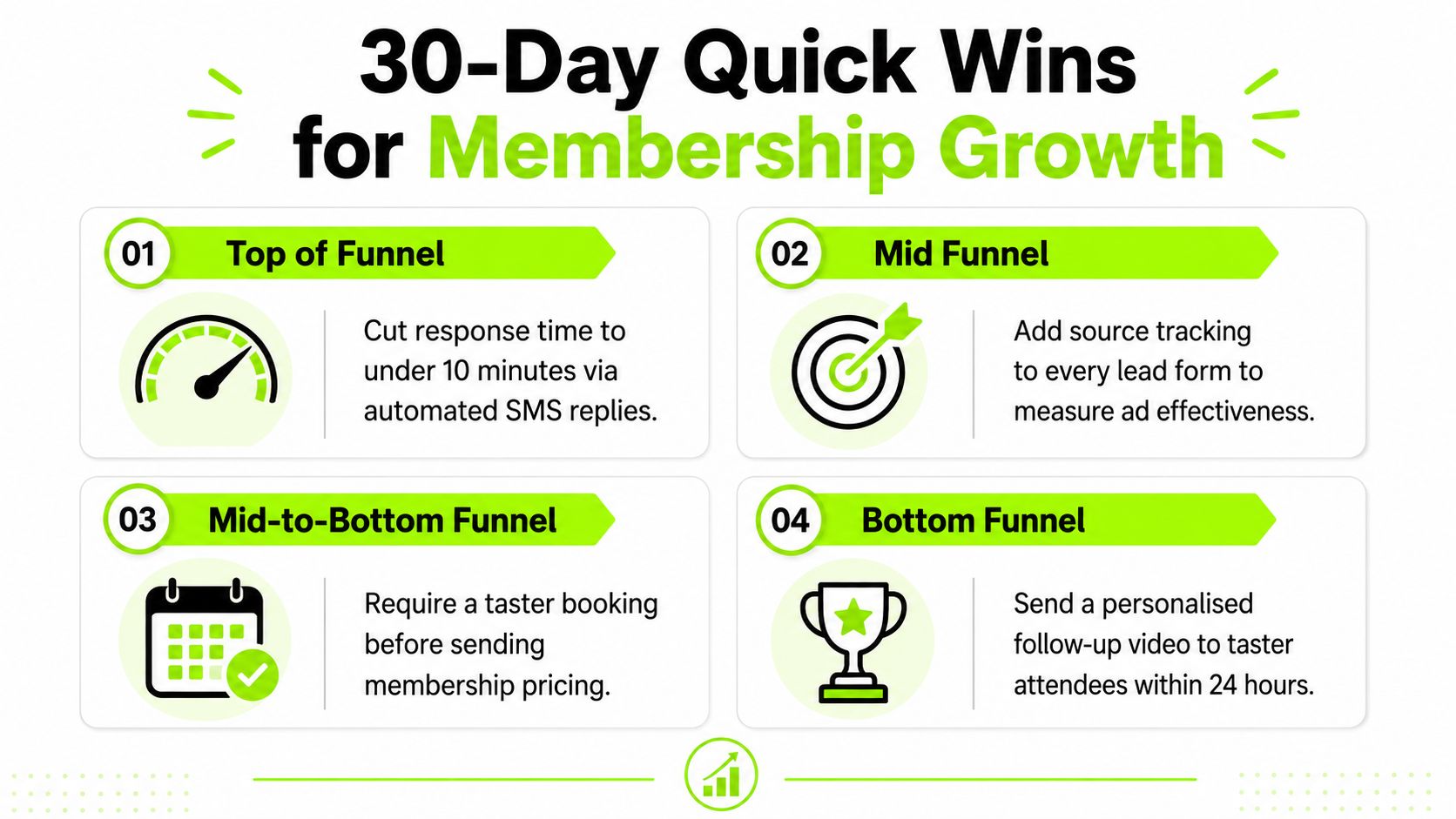
The pipeline in practice
The process can be organised into a sequence:
- Click to landing page: The page presents one relevant offer and one clear action.
- Lead capture: The CRM stores contact details, campaign source, and enquiry type.
- Immediate acknowledgement: An SMS confirms receipt and provides the next step.
- Booking: A diary-linked process makes it easy to arrange a taster or visit.
- Visit follow-up: Staff record attendance, questions, and the agreed next action.
- Nurture: Prospects who aren't ready receive relevant, timed messages instead of disappearing.
- Decision prompt: A suitable membership invitation follows when the golfer has enough information.
The system doesn't replace personal contact. It protects personal contact from being delayed or forgotten. It also gives a committee-led club a shared view of the pipeline when the person who normally handles enquiries isn't available.
CRM design should reflect the club's real categories. A new golfer, a lapsed member, a flexible-member enquiry, and a society organiser may need different messages and different owners. GolfRep's golf club CRM and operating-system overview explains how a structured system can connect lead capture, ownership, follow-up, and reporting.
Short videos can support the decision stage by showing the clubhouse, course, practice facilities, and welcome a visitor can expect. Clubs considering that format may find the ClipCreator.ai guide to conversion videos useful when planning concise, action-focused content.
The key design choice is simple: automation should make the next action unavoidable and visible.
Real Club Examples of Funnel Fixes That Worked
Bidston Golf Club illustrates what happens when a club treats membership growth as a pipeline rather than a collection of adverts. GolfRep's publisher information describes Bidston as a club revived from a difficult position, with more than double membership and six-figure recurring revenue. The important lesson isn't the headline outcome. It's the operating change behind it, a clearer route from enquiry to action, supported by structured follow-up and visible stages.
Addington Palace provides a different example. Its challenge was ongoing pipeline development rather than a single burst of attention. A dedicated journey can help a club distinguish new interest from active prospects, route enquiries to the right person, and continue the conversation when a golfer isn't ready to decide immediately.
Downes Crediton shows why speed and campaign structure matter. A rapid membership campaign works better when the club can capture enquiries, respond promptly, and see which prospects have booked, attended, or gone quiet. Without those stages, staff can confuse activity with progress.
These examples are useful because the leaks are familiar:
- The enquiry arrives, but ownership is unclear.
- The club attracts attention, but the landing page doesn't create a visit.
- A prospect attends, but nobody records the follow-up conversation.
- A golfer needs more time, but the club has no nurture sequence.
The fix usually isn't another creative idea. It's a defined next step after every meaningful interaction.
The GolfRep membership-marketing guidance describes the new-enquiry stage as a process of capture, logging, ownership assignment, and first response (GolfRep's membership-marketing guidance). That sequence is transferable to clubs of different sizes because it addresses the operational gap between marketing activity and membership revenue.
Managers should study their own examples with the same questions. Where did the prospect first appear? Who contacted them? How long did it take? What was the next booked action? Which stage remained unchanged?
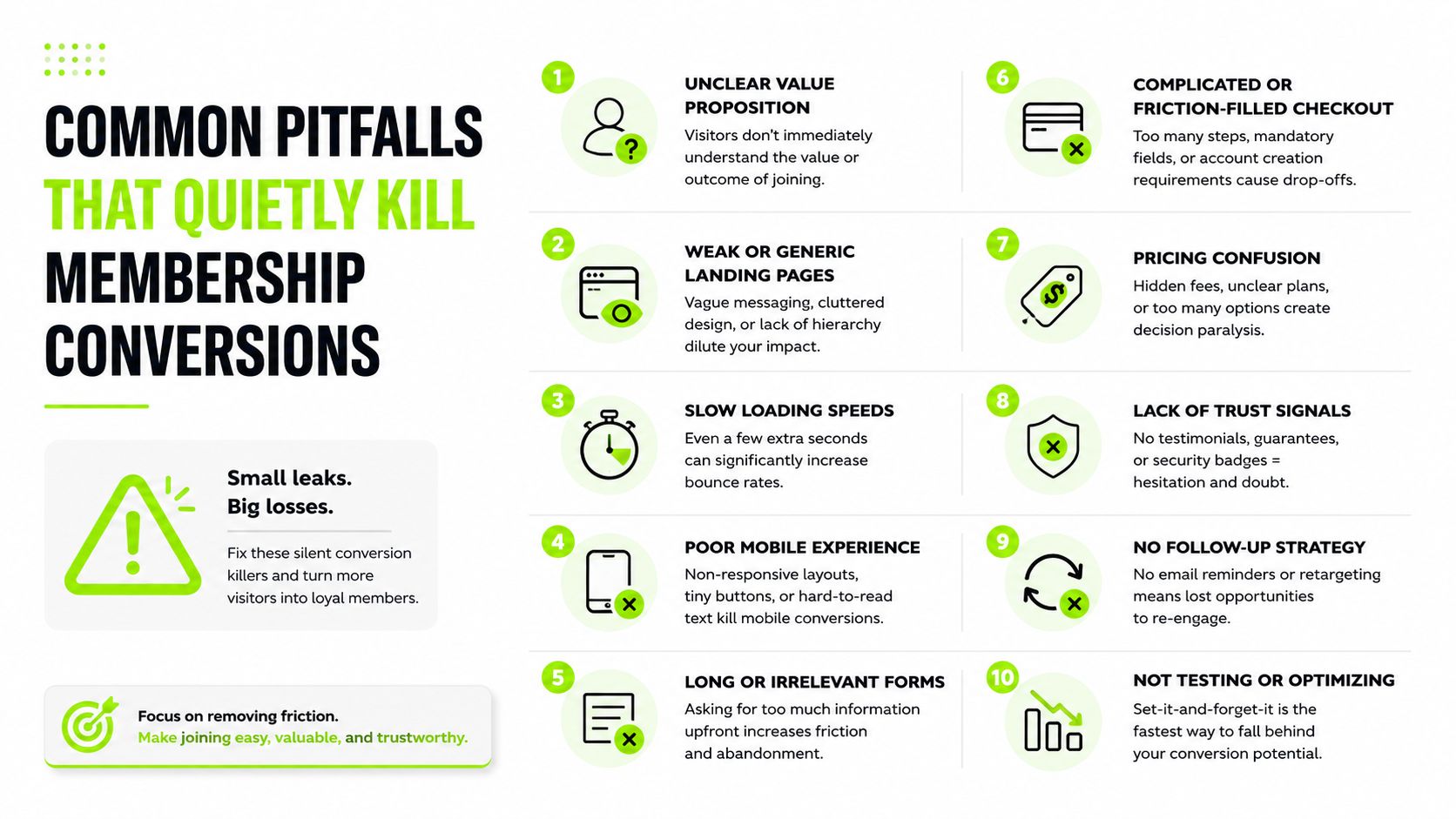
Common Pitfalls That Quietly Kill Membership Conversions
A club can have a busy marketing calendar and a weak funnel. The following mistakes often hide behind respectable enquiry numbers.
- Slow response: A prospect who waits may compare alternatives before anyone speaks to them.
- No source tracking: Without the source, managers can't tell whether a lead came from a referral, advert, search result, or campaign.
- One message for everyone: A society organiser and a beginner looking for a social club have different questions.
- Email-only follow-up: Email can be missed, especially when the next action needs a quick reply.
- No taster step: Asking for membership before the golfer experiences the club creates avoidable commitment.
- No follow-up cadence: One unanswered call isn't a process. The club needs planned actions across the decision period.
- No visit outcome: A booked visit without an attendance record leaves the team guessing.
- No membership conversation: Staff may provide a pleasant visit but fail to ask whether the golfer wants to proceed.
- Unclear ownership: A lead assigned to “the office” often belongs to nobody in practice.
- Manual reporting: Rebuilding the pipeline from inboxes and spreadsheets makes gaps hard to see.
The industry context makes this especially relevant. Hillier Hopkins' 2024/25 UK golf-club survey reported that member referrals remained the most used marketing activity at 71%, while social media and email marketing had become more common (Hillier Hopkins' UK golf-club survey). England Golf reported 750,071 club members in 2025, compared with 730,602 in 2024 (England Golf membership figures). The market can grow while individual clubs still lose prospects through weak handling.
Audit the last set of enquiries. Look for missing response times, unassigned records, visits without outcomes, and leads marked “cold” without evidence of a proper sequence. Fixing those gaps may be more productive than buying additional traffic.
Quick Wins Clubs Can Apply This Month
A club doesn't need to rebuild every marketing activity at once. It needs to repair the stages where prospects currently stop.
Start with speed and visibility
Set an operational target for the first response and use automation to acknowledge web enquiries when staff are on the course, at an event, or away from the office. GolfRep's lead-management guidance identifies the five-minute golden window and recommends systems, reminders, and consistent reporting rather than ad hoc follow-up (GolfRep's lead-management guide).
Then make every lead visible in one pipeline. Add the source, enquiry type, owner, current stage, last contact, and next action. The manager should be able to see which leads need attention without checking several inboxes.
Repair the handover to a visit
Add one useful triage question to the enquiry form, such as the golfer's playing experience, preferred membership type, or reason for enquiring. The answer gives staff context and helps route the lead to the right conversation.
Create a dedicated membership landing page with a clear taster or visit action. Keep pricing information accurate and pair it with practical details about the experience, access, playing opportunities, and how the club welcomes new members.
Set up a two-step CRM nurture flow. The first message confirms the enquiry and offers the next action. The second provides a relevant reason to visit, such as a short course video, an explanation of the taster experience, or answers to common questions.
Make the visit count
Record a short, genuine club video. It doesn't need polished production. It should show the places and people a new golfer wants to understand before arriving.
After the visit, record attendance and send a personal follow-up. Ask what the golfer thought, answer the outstanding question, and make the membership route clear. A prospect shouldn't have to guess whether the club wants them to join.
Review the pipeline monthly from enquiry to visit. Count how many records progressed, how many stalled, and why. The purpose isn't to create a complicated report. It's to select one leak and assign one person to fix it.
The fastest return usually comes from reducing response time and making ownership visible. Those two changes improve the middle of the funnel before the club spends more on attracting people at the top.
GolfRep helps UK golf clubs build predictable membership pipelines by combining lead generation with CRM visibility, prompt automation, and structured nurture from enquiry through booked visit and sign-up. Visit GolfRep to see how your club can turn more of its existing enquiries into well-managed membership opportunities.
Ready to tap into our proven growth system?