Golf Club Lead Management: A Practical Implementation Guide

Most golf clubs do not have a lead problem. They have a handling problem.
The instinct is to chase more enquiries, more ads, more traffic, more open days. In practice, the clubs that grow consistently usually do a better job of replying quickly, keeping every enquiry visible, and moving the right people into a visit or a conversation before interest cools. GolfRep's UK data points in the same direction, with response speed and follow-up discipline doing more work than lead volume on its own, especially in committee-led environments where ownership is often unclear and enquiries slip between inboxes, phones, and spreadsheets GolfRep's membership lead management guide.
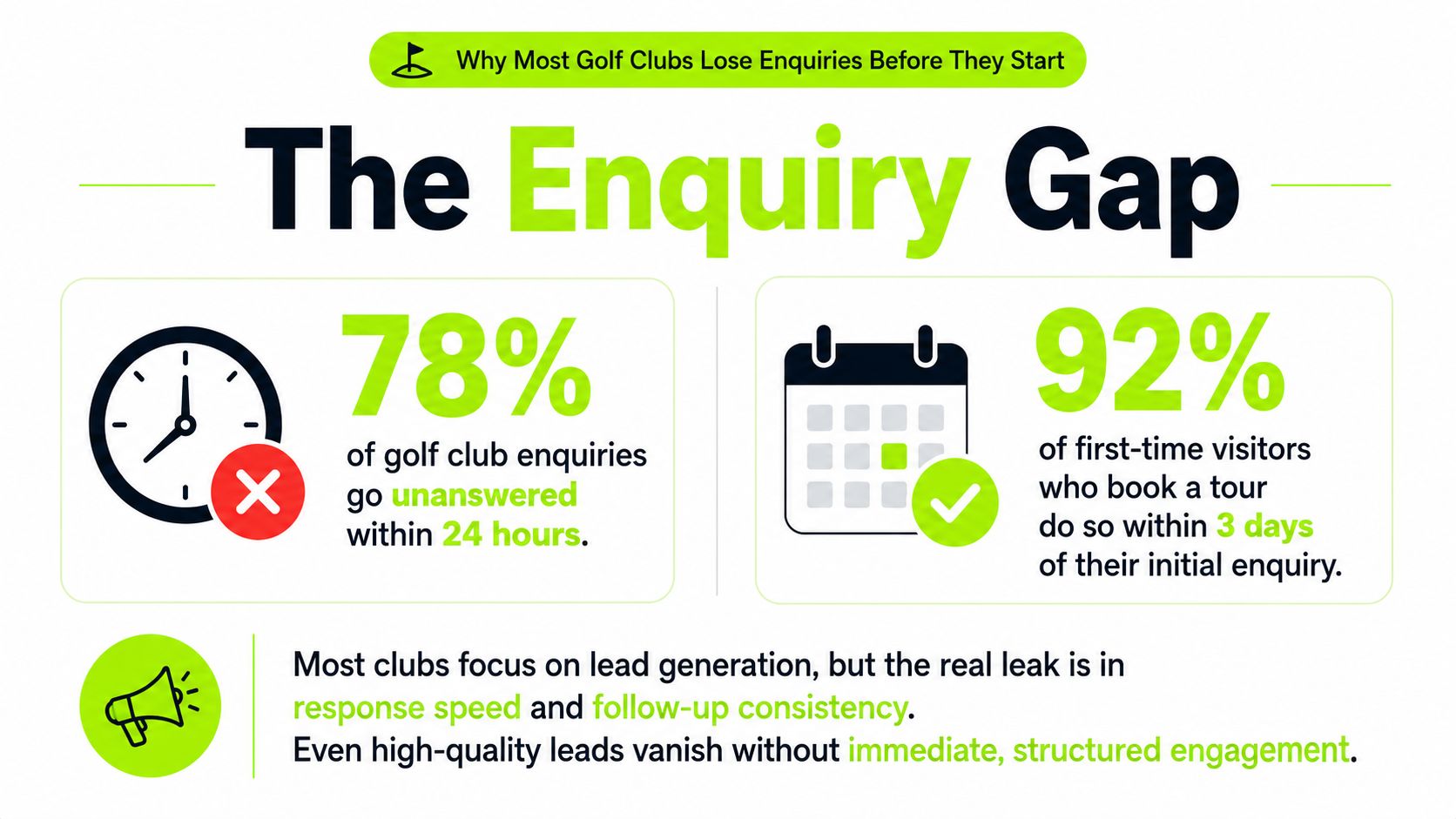
Why Most Golf Clubs Lose Enquiries Before They Start
The common mistake is to treat enquiry generation as the finish line. For most clubs, the primary leak is what happens after someone clicks, calls, or fills in the form.
GolfRep's UK marketing-analytics note says the average response time for membership enquiries is 47 hours and 32 minutes, and that a membership lead answered within one hour is five times more likely to convert than one left for 24 hours GolfRep's membership lead generation article. That gap matters because a club can run a decent campaign and still lose the enquiry before a conversation begins. The same source estimates UK golf clubs lose approximately 30% of membership enquiries before a proper discussion even starts because handling is slow, inconsistent, or invisible after arrival.

The hidden cost of invisible pipelines
A club that cannot see an enquiry from first contact to join date does not have a sales process, it has admin fragments. Someone answers the phone, someone else sees the email, and a third person assumes the follow-up has happened. That is how good leads disappear without anyone noticing.
Practical rule: if a committee member, office manager, or pro cannot tell you where an enquiry is right now, the system is already failing.
The UK membership picture reinforces the point. In GolfRep's UK guide, the share of members' clubs with more than 600 playing members rose from 56% in 2023 to 59% in 2024, while waiting lists sat at 48% of members' clubs and leavers increased from 56 to 63 on average GolfRep's UK lead management guide. Those numbers show demand exists, but they also show clubs are operating close enough to capacity that handling quality decides whether demand becomes stable growth or wasted interest.
What separates better-run clubs
Better-run clubs do not necessarily get more enquiries. They reply faster, assign ownership earlier, and keep a simple view of what happened to each lead. That creates follow-up discipline, which matters more than clever wording or a busier campaign calendar.
The internal question is not “How do we get more leads?” It is “How do we stop losing the ones we already paid for?” That shift changes the operating model. It also changes where budget goes, because fixing response time usually beats pouring more money into top-of-funnel traffic.
For a deeper breakdown of the leak itself, see how most golf clubs lose 30% of enquiries without realising.
Mapping Your Lead Sources and Membership Personas
A club cannot manage lead quality if it treats every enquiry the same. The first useful task is to identify where leads come from, what they want, and how much effort they deserve.
Start by listing every live enquiry source, not just the obvious ones. That includes website forms, phone calls, social media messages, referral introductions, walk-ins, open day sign-ups, and direct email replies. Then tag each lead at the point of capture so the source stays attached all the way through the pipeline. Without that, source-to-member yield becomes guesswork.
The clearest way to make the list usable is to connect it to a simple persona map. A returning member is not the same as a corporate prospect. A junior development family needs different follow-up from a flexible-format seeker who wants a less formal route into the club.
Build personas that match club reality
The point of personas is not marketing theatre. It is to help staff decide what to say next and how urgently to say it. A club that understands the difference between a curious local golfer and a business contact looking for hosting options can route the same enquiry to the right conversation faster.
The internal segmentation article, what is market segmentation, is useful reading here because it frames the same problem in plain terms. Clubs often think segmentation is for big brands, but if your club has mixed membership types, mixed price sensitivity, and mixed intent, one generic message will always underperform a personalized one.
A useful persona set usually stays close to the actual decision paths inside the club. Office staff need to know whether the person is exploring full membership, a flexible option, a junior place, or a corporate arrangement. Committee members need enough context to judge where an enquiry fits without turning every case into a debate. That is where Noota's AI CRM analysis is relevant, because the issue is not just recording data, it is making sure the right information is visible when someone has to act quickly.
Use a simple source log
A workable source log does not need to be complicated. It needs to be consistent.
- Website forms: record page, campaign, and enquiry type so you can see which pages attract serious prospects.
- Phone calls: record who answered, what was asked, and whether a follow-up task was created.
- Referrals: record the referrer if you want to preserve that channel.
- Walk-ins and open days: record the reason for visit, because in-person interest often converts differently from digital enquiry.
- Social messages: record the channel and the first question asked, since that usually signals intent.
A simple source tag applied at the first touchpoint is often enough to expose which channels bring qualified prospects and which ones create work without moving people forward.
That source map does more than improve reporting. It tells you where to invest staff time, where to automate, and where to be cautious about overloading the team with weak-fit enquiries. In committee-run clubs, that matters because the same person is often handling multiple jobs, and the lead system has to support that reality instead of assuming a full-time sales desk.
Choosing and Configuring the Right CRM for Your Club
A golf club CRM only works if the people using it can keep using it on a busy day. That sounds obvious, but it is where many clubs get stuck. They buy something powerful, then underconfigure it because the team does not have time to learn a full sales platform.
The practical selection criteria are simple. Staff need to be able to see the lead, update the lead, and trust that nobody else is missing context. If that cannot happen quickly, the CRM becomes another place where information goes to die.
Ease of use matters more in committee-led clubs because handovers are frequent and admin capacity is limited. Mobile access matters for PGA pros and course managers who are not sitting at a desk all day. Integration with booking systems matters because enquiry data should connect to visits, not sit in a separate silo. Automation matters because the club will not always have a person available to send the first response.
What to prioritise, and what to avoid
The right CRM for golf club lead management should help the team do less manual work, not more. That means a simple pipeline, a visible owner on every lead, and tags that show source and intent. Overcomplicated status lists usually slow adoption, especially when office staff and volunteers use the system at different times.
Common mistakes are predictable. Clubs create too many stages, use free-text notes where tags should be, or store lead data in the CRM but keep the actual follow-up in personal inboxes. That breaks visibility, which is the whole point of moving away from spreadsheets.
A practical reference point is GolfRep's CRM software guide, which focuses on how clubs keep pipeline visibility without turning daily operations into data entry. If you want a broader comparison lens, Noota's AI CRM analysis is useful for understanding how AI features are being positioned in CRM tools more generally, although clubs still need to judge every platform against real staffing and process constraints.
A usable setup checklist
- One record per lead: no duplicate entries across inboxes and notebooks.
- Clear ownership: every lead needs a named person or role.
- Simple stages: new, contacted, booked, attended, won, lost is usually enough.
- Source and intent tags: these should be attached at capture, not later.
- Visible next action: the system should show what happens next and when.
GolfRep's own approach is to combine CRM structure with lead handling rather than treating software as the entire answer. That distinction matters because clubs do not need more screens, they need a process that keeps response speed and ownership under control.
Building Lead Capture and Qualification Rules That Work
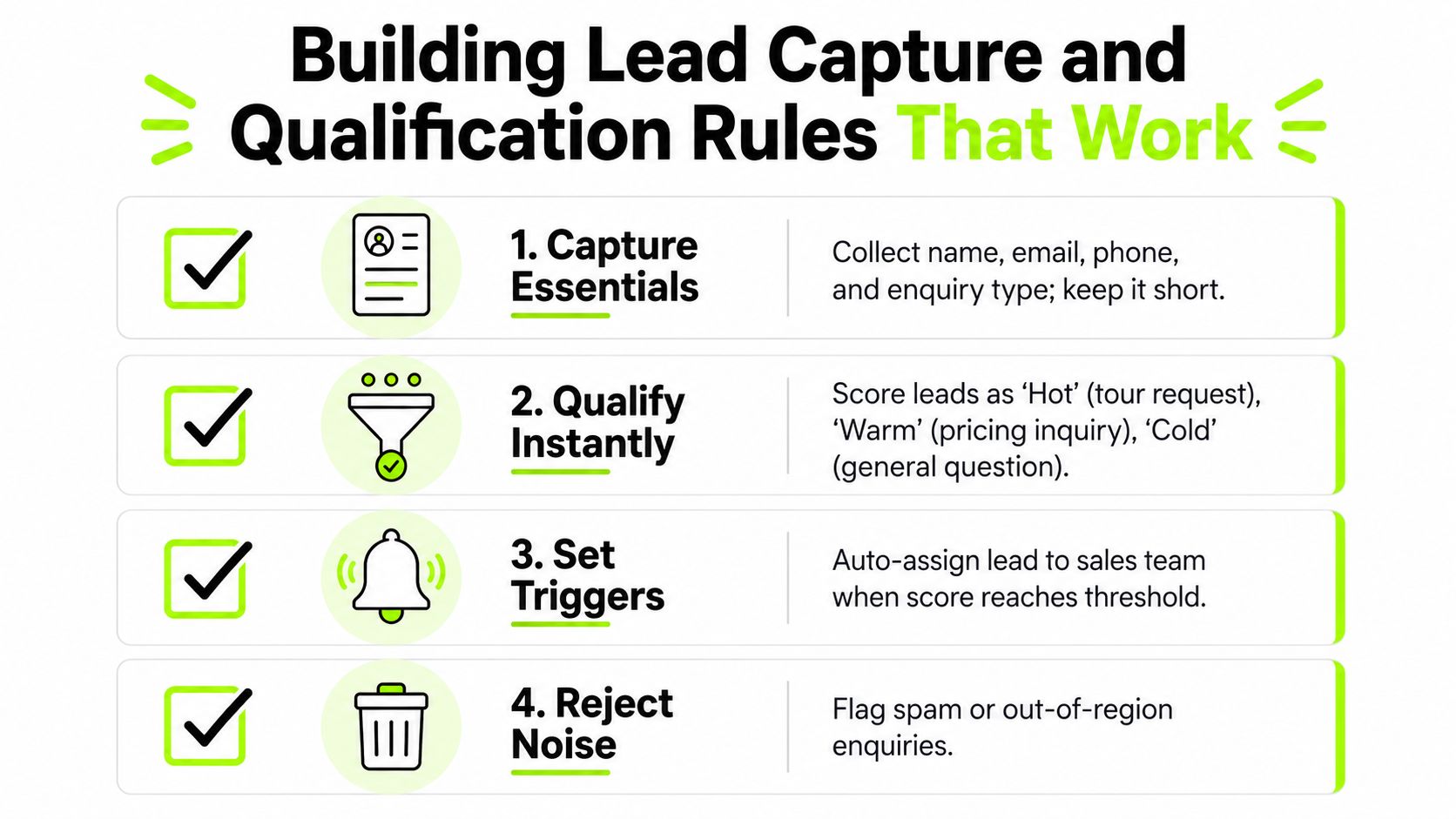
A good capture form does two jobs at once. It gathers enough information to qualify the lead, and it keeps the friction low enough that people still submit it.
The mistake clubs make is asking for too much too early. If the form feels like admin, some prospects drop out before the enquiry even lands. If it asks for too little, staff waste time chasing basic details later. The answer is usually a short form with the essentials, then a qualification layer that happens immediately after submission.
Capture enough, but no more
The essentials are usually name, email, phone number, and enquiry type. That gives a club enough to contact the prospect and classify the conversation without turning the form into a survey. Anything beyond that should earn its place.
Qualification should start the moment the enquiry arrives. GolfRep's recommended stage model is intentionally simple, new, contacted, booked, attended, won, lost, because complex pipelines tend to create confusion rather than clarity GolfRep's lead generation system. That simplicity helps in clubs where one person handles admin in the morning and another picks it up later in the day.
Use response speed as a rule, not a hope
The practical standard is to treat the first few minutes as the golden window. GolfRep's course-management guide says the golden window is five minutes, and that responding within five minutes is the single biggest lever for improving conversion rates GolfRep's course management guide. I agree with that operationally, because a fast acknowledgement buys time for a proper human follow-up later.
That does not mean every reply has to solve every question. It means every enquiry should get an immediate acknowledgement, a clear next step, and a reason to stay in the funnel. The club can then prioritise the person most likely to visit soon, rather than treating all leads as equal.
Score for intent, then route by capacity
A simple scoring model should look at source, stated intent, and the quality of the handoff. A tour request is hotter than a general question. A pricing enquiry is warmer than someone asking for opening times. A spam submission or out-of-region lead should be filtered out before it consumes staff time.
Operational rule: if a lead is sales-ready, the system should create a task or alert automatically. If it is not, the club should still acknowledge it and decide whether nurture is appropriate.
Lead management becomes useful for capacity-constrained clubs. It helps the team spend time where there is a genuine chance of conversion, instead of reacting to every enquiry with the same manual effort.
Automating Nurture Flows and Managing the Sales Handoff
Manual follow-up wastes good intent fast. In a busy club office, one person assumes another has replied, the prospect hears nothing, and the enquiry goes cold before anyone has logged a proper next step.
A stronger setup uses automation to keep the conversation moving until a human handover makes sense. That matters in clubs with limited staff or committee-led oversight, because the first response can still go out even when nobody has time to draft a custom reply on the spot.
One practical model is to send an immediate acknowledgement, then move the enquiry into a short nurture sequence based on intent. A visitor interested in membership might receive an introduction, a member story, a simple event invitation, and then a tour prompt over a short period. A corporate prospect needs different language, because the buying trigger is different and the follow-up should reflect that. The same principle is covered in what is revenue intelligence software, but a golf club still has to adapt the workflow to membership sales rather than a generic B2B process.
Keep automation helpful, not robotic
The value is consistency, not volume. Automation should answer common questions, point people to the next step, and alert staff when a lead shows enough intent to justify a call. Anything that feels like an endless drip campaign will backfire, especially in a committee-run club where members notice tone quickly.
Handoff matters just as much as the nurture flow itself. The person taking over should know the source, the latest action, and whether the lead has already booked something. Without that context, the prospect gets contacted twice, or not at all.
GolfRep's own system combines lead generation with structured follow-up and CRM handling, so the enquiry is captured, tagged, acknowledged, and routed in a controlled way.
A handoff that preserves trust
The handoff should happen only when the lead is warm enough to justify it. That avoids wasting staff time on cold enquiries and keeps the conversation personal where it matters. It also prevents duplicate contact, which is a common problem when the office, the pro shop, and the membership lead all think they own the same prospect.
Write down who replies first, who owns the booking step, and who closes the loop after the visit. That sounds basic, but many clubs never document it. Once they do, the team stops relying on memory and starts relying on the process.
Tracking Performance and Optimising Your Pipeline
Clubs often measure activity because it is easy to count. The harder question is whether that activity turns enquiries into visits and visits into members.
The numbers worth watching are response time, lead-to-visit conversion, visit-to-join rate, source yield, and pipeline velocity. Those measures show whether the club is handling demand properly or just collecting enquiries. Tee-sheet capacity needs to sit beside them, because a club that cannot absorb more visits has to shape lead volume carefully instead of chasing growth without regard for operations.
| KPI | What It Measures | Target Benchmark | Why It Matters |
|---|---|---|---|
| Response time | How quickly the club replies to an enquiry | Within the five-minute golden window where possible | Faster replies keep prospects engaged and reduce drop-off |
| Lead-to-visit conversion | How many enquiries turn into booked visits | Track by source and persona | Shows whether the front of the funnel is producing usable prospects |
| Visit-to-join rate | How many visits become members | Track by campaign and follow-up path | Reveals whether the sales conversation is working |
| Source yield | Which channels produce members, not just leads | Compare by source tag | Stops spend going to channels that create noise |
| Pipeline velocity | How quickly leads move from enquiry to decision | Monitor stage progression | Highlights bottlenecks and slow handoffs |
Report what helps the club decide
A committee does not need a crowded dashboard. It needs a short view of what is happening, where leads are stalling, and which source is worth repeating. That keeps the discussion on evidence rather than opinion.
what is revenue intelligence software is a useful external reference here because it shows the wider logic of using pipeline data to guide decisions instead of relying on instinct alone. Golf clubs do not need enterprise complexity, but they do need the discipline of reviewing the same few numbers every week and acting on them consistently.
Optimise one bottleneck at a time
A/B testing should stay practical. Test reply timing, the first-message wording, or the booking prompt, then watch the funnel stage where the problem appears. If enquiries are landing but not booking, the problem is not traffic. If visits are happening but not joining, the problem is the follow-up conversation or the way the offer is presented.
The cleanest optimisation work in golf club lead management starts with one question, where exactly are prospects dropping out?
That question keeps the club focused. It also stops teams from changing five things at once and learning nothing from the result. For clubs that want the process itself to hold up under pressure, GolfRep's course management guide is a practical reminder that lead handling has to fit the club's wider operating rhythm, not compete with it.
Ready to tap into our proven growth system?