How to Start a Golf Simulator Business in the UK

You're standing in two empty units on the same afternoon. One is a bright high-street shop with passing trade and a rent that makes you wince. The other is a cheaper warehouse with plenty of parking, a low ceiling in one corner, and houses at the back. The agent wants an answer, a supplier has sent a glowing launch monitor quote, and you're tempted to decide on rent and hardware. Don't. Those two decisions won't save a site that can't legally trade the hours you need, contain the noise you make, or clear break-even on a wet Tuesday.
A Realistic Starting Point for a UK Simulator Operator
If you're learning how to start a golf simulator business, start with the site, not the simulator. A premium launch monitor in the wrong building gives you accurate data and an empty booking diary. The right building with mid-range, reliable technology gives you bookable hours, comfortable customers, and a chance to build repeat trade.
The high-street unit may bring visibility, evening footfall, and easier staff recruitment. It may also bring higher rent, business rates, shopfront restrictions, and neighbours above you. The warehouse may offer space and parking, but poor insulation, weak heating, limited passing trade, and planning questions can erase the saving quickly.
The decisions that matter first
Make four decisions before you sign a lease or pay a deposit.
- Demand: Who within a realistic drive time will book, how often, and for what occasion
- Site suitability: Whether ceiling height, acoustics, access, parking, toilets, ventilation, and electrical capacity support the offer
- Planning and licensing: Whether the use, opening hours, alcohol service, external works, and signage can be approved
- Unit economics: Whether each bay breaks even at conservative occupancy after every fixed cost is included
Only then should you choose the launch monitor, software, projector, and finish.
Buy the technology last. A lease is harder to reverse than a launch monitor order.
Write these assumptions into one document before you speak seriously to a landlord or lender. If you're building that document from scratch, a UK business plan template guide can help you structure the market, operations, and financial sections in a format UK funders expect. Your plan doesn't need glossy language. It needs local evidence, a credible downside case, and clear reasons for choosing this site, this many bays, and this customer mix.
Treat the launch as an operating business from day one. You'll need booking and payment systems, staff routines, cleaning, safety checks, maintenance cover, and a plan for quiet weekday hours. Social golf may fill Friday evenings, but lessons, leagues, fittings, practice memberships, and corporate bookings are what make the week work. Design for the whole week before you commit to the building.
Sizing the UK Opportunity Before You Sign Anything
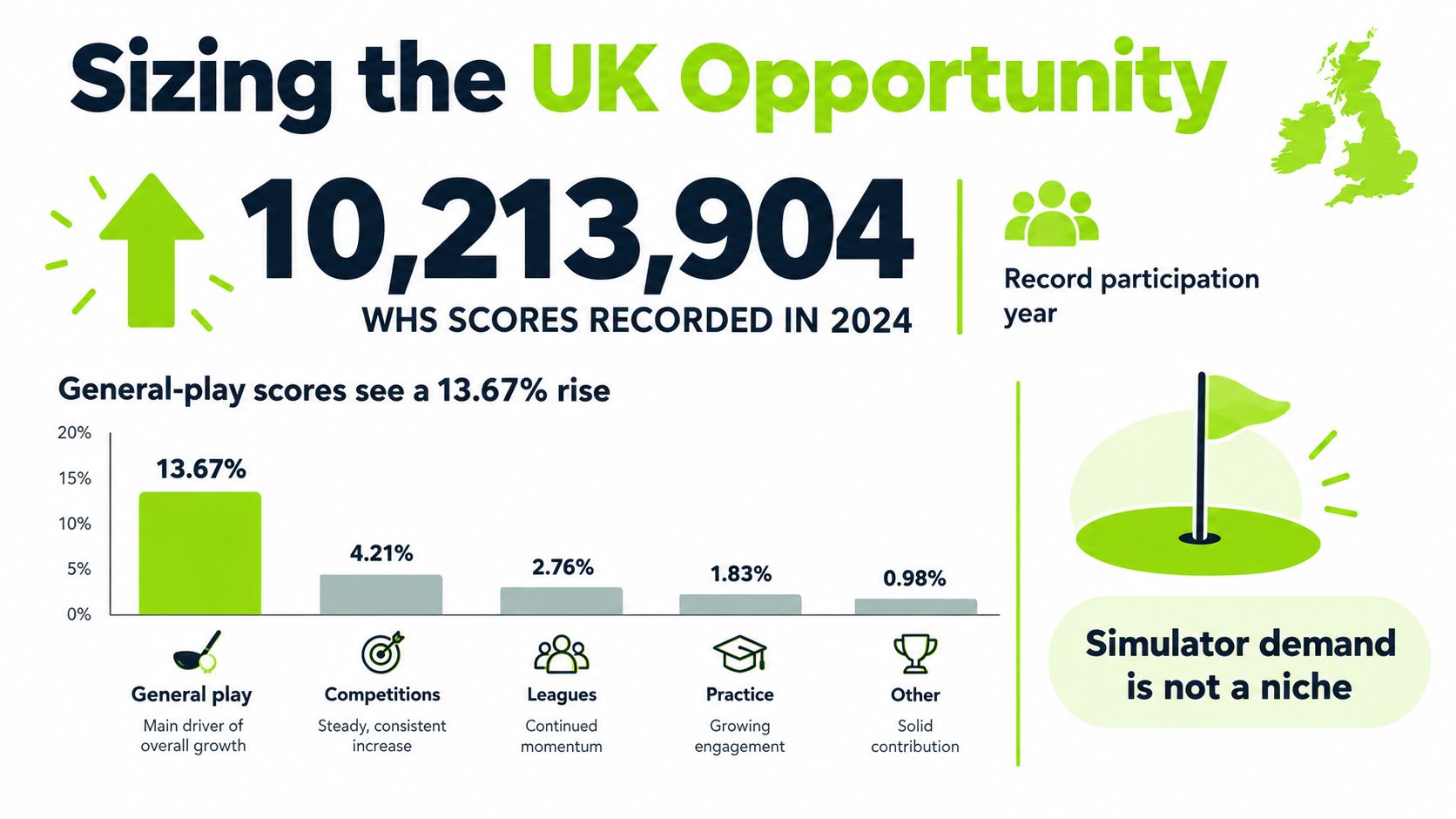
A strong national golf market can still leave a simulator venue empty on a Tuesday afternoon. England Golf reported 10,213,894 scores submitted through the World Handicap System in 2024, the highest annual total since its launch. General-play scores rose 13.67% and nine-hole scores 17.89%, according to 2024 participation reporting. Those trends suit flexible, shorter sessions. They do not prove that a specific town can support another venue.
England has approximately 2,423 golf courses, including 1,735 affiliated with England Golf, according to the same 2024 participation reporting. Course density matters more than the national total. Nearby clubs bring golfers, coaches, societies, and potential partners, while also posing competition if they add simulator bays.
Segments worth designing for
- Club members: Winter practice, swing checks, lessons, and club fitting when daylight is short or the course is closed
- Independent golfers: Pay-as-you-play sessions without a membership commitment
- Newcomers and social groups: Beginner-friendly games, food and drink, and hosted group sessions
- Corporate and society organisers: Weatherproof events with catering and simple scoring
The customer base extends beyond club membership. England's iGolf programme had more than 55,000 subscribers, representing about 7% of golfers with a Handicap Index. Those golfers submitted nearly 494,000 scores during 2024, according to England Golf participation data on changing member demographics. The same reporting says the average age of male club members in its dataset fell from 54.98 to 53.78, and the average age of female members fell from 64.65 to 62.98. Build for different ages, abilities, and reasons to play, not one assumed customer profile.
Off-course golf broadens the potential audience. Recent England data estimates 5.3 million adults take part in formats such as driving ranges, simulators, and adventure golf, compared with 7.3 million who play nine or 18 holes, according to UK golf trends covering off-course participation. That figure is a market signal, not a forecast of simulator customers. Offer entry points such as beginner sessions, short-format leagues, women's and junior sessions, and social bookings.
Use national figures to decide whether local research is worth doing, then test the catchment before signing. Speak with golfers, PGA professionals, club managers, employers, and society organisers near each candidate site. For a structured approach to comparing customer groups and competitors, seek practical UK market entry advice.
Validating the Site, Planning Class and Local Demand
A staged feasibility process protects you from the most expensive mistake in indoor golf, signing for a unit that looks right but trades badly. Work through local demand, daypart utilisation, the physical building, and planning in that order. If one stage fails, stop and find another site.
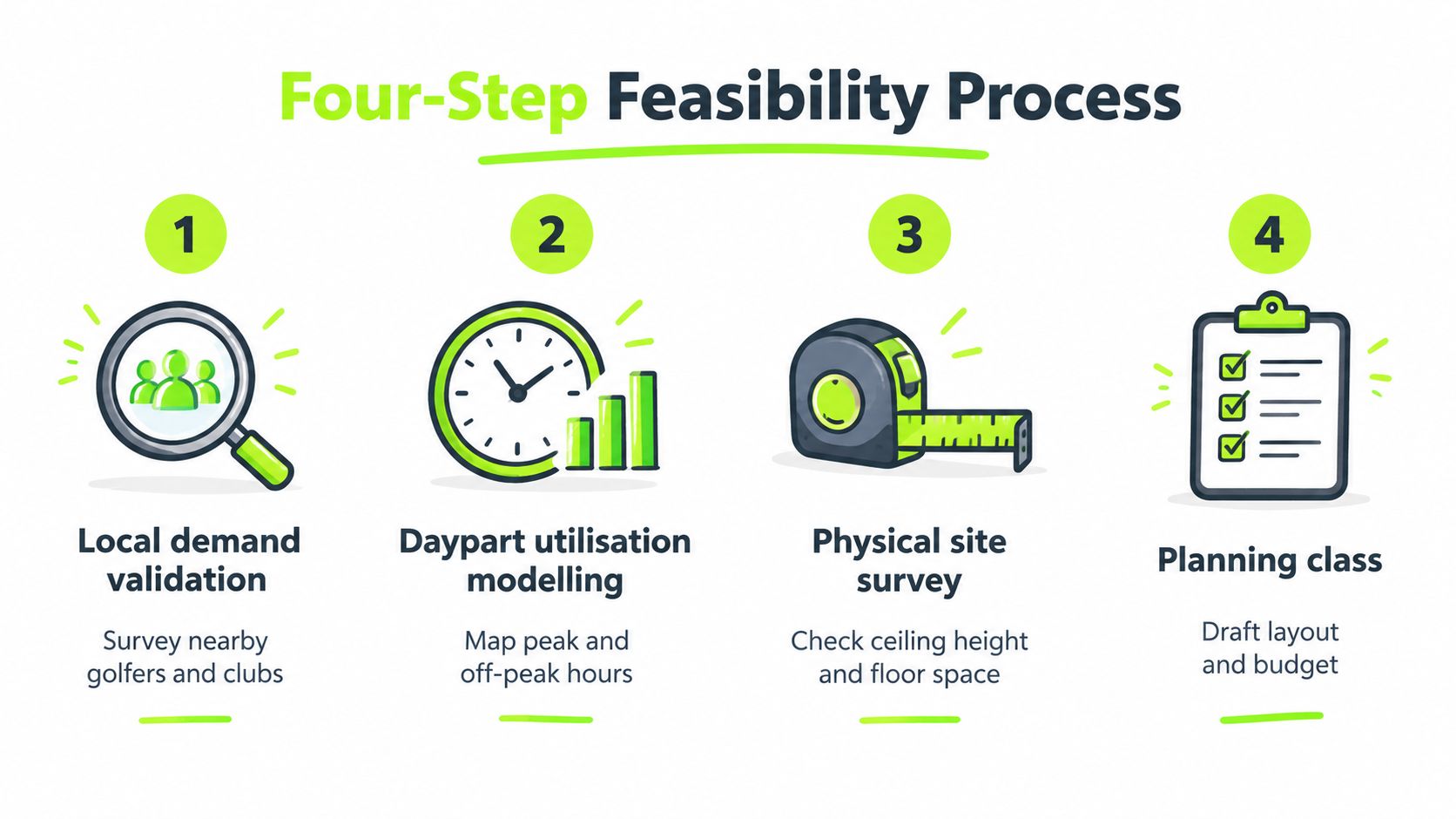
A practical feasibility checklist
- Validate demand: Speak to local golfers, clubs, coaches, corporate groups, and off-course players. Ask what they'd book, when, and at what price, then seek deposits or expressions of interest where possible.
- Model dayparts: Forecast weekday daytime, weekday evening, and weekend use separately. Never assume full capacity across every opening hour.
- Survey the premises: Check ceiling height, impact-screen clearance, electrical capacity, ventilation, acoustics, accessibility, toilets, fire exits, and parking.
- Confirm planning in writing: Ask the local planning authority to confirm use class, opening hours, external works, and whether change of use is required.
UK planning guidance indicates that indoor golf in a vacant shop can often fall within Class E(d), but Class E(d) use and separate approvals for experience venues still need checking against bar operations, plant, flues, shopfront alterations, noise, and licensing. Don't let an agent settle that question with a verbal assurance. Get the planning position, licence requirements, and any restrictions confirmed before the lease becomes binding.
Noise deserves more attention than most operators give it. Ball impact, raised voices, music, vibration, and late departures can affect neighbours even when play is indoors. A simulator may need roughly 3 metres of internal clearance for a full swing, and a recent Barnsley application proposed only two to three bookings per day, a maximum of three users and restricted weekday and Saturday hours, with pollution, noise, vibration and nuisance assessed as planning considerations. Those limits may suit a small private operation. They would destroy the economics of a venue relying on evening leagues and group bookings.
Decision rule: Calculate your maximum saleable bay-hours after planning, staffing, and neighbour constraints. If the remaining inventory can't cover fixed costs in the downside case, walk away.
This is why a cheap suburban or garden-based site can be worse value than a higher-rent commercial unit. Soundproofing, restricted hours, parking complaints, and planning delays reduce the hours you can sell. Test acoustic transmission with the building construction in mind, not after the screens are installed. Ask who lives nearby, what's above and beside you, where customers will wait, and how sound travels through shared walls and ceilings. The best site is the one that lets you trade profitably without fighting the building or the street.
Specifying Each Bay from Room Geometry to Launch Monitor
Measure the room before you compare brands. Start with the swing envelope, ceiling clearance, screen position, projector throw, lighting, and customer circulation. A bay that technically fits but restricts a taller player's backswing will generate poor reviews and limit group bookings.
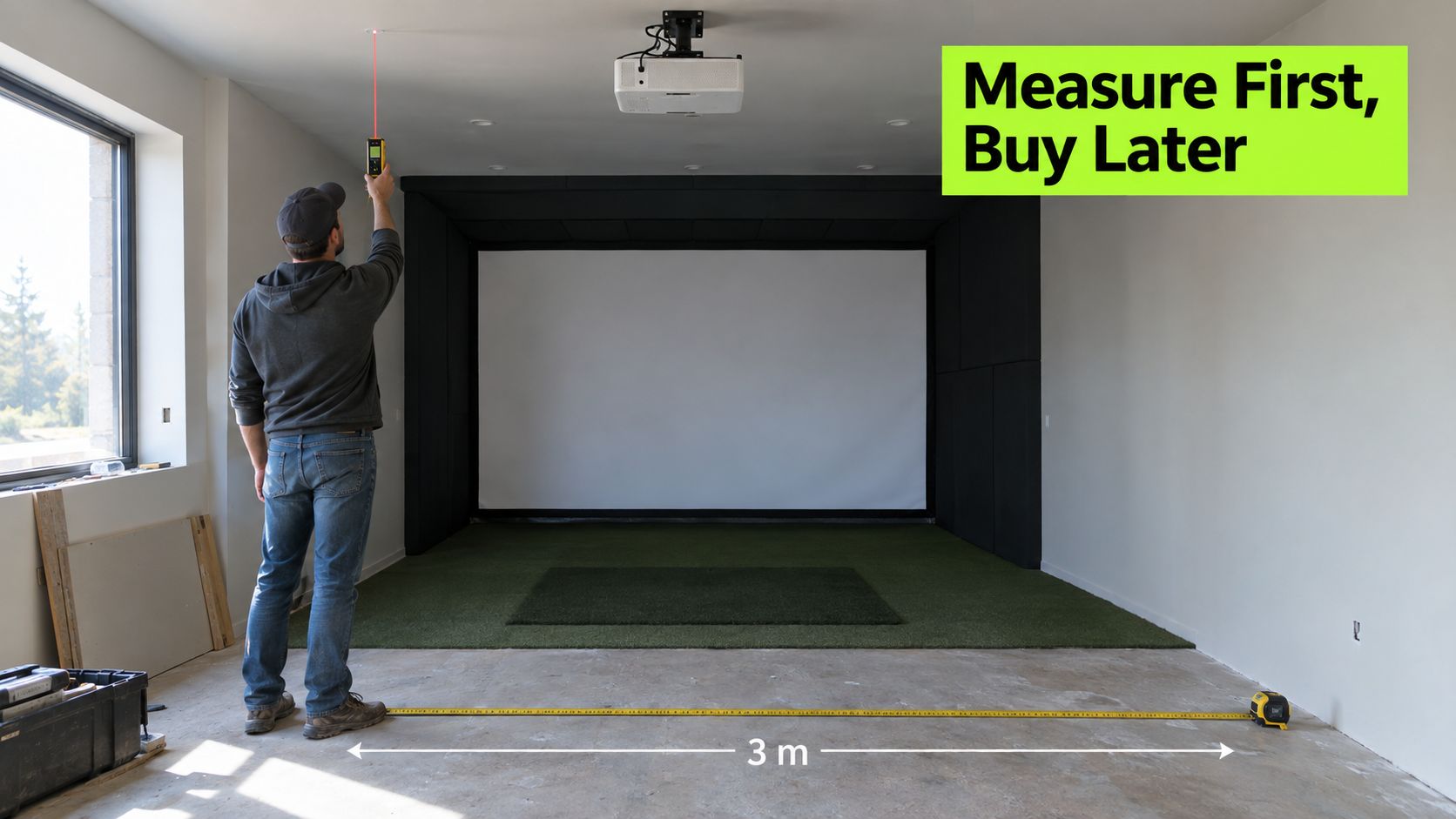
UK installation guidance indicates that a standard 3-metre-wide single garage generally suits an enclosure approximately 2.5 to 2.7 metres wide, while a double garage can accommodate an enclosure around 3.5 to 4 metres wide, according to UK garage simulator dimensions and conversion costs. The same guidance estimates a complete UK garage conversion, including insulation, electrical work, flooring and simulator equipment, at roughly £3,200 to £9,500, with equipment alone ranging from about £2,600 to £7,800. Use those figures only as a domestic benchmark. A commercial venue also needs durable flooring, impact protection, ventilation, accessibility, reception or bar space, CCTV, and replacement reserves.
Specify the complete bay
- Tracking and display: Commercial launch monitor, gaming PC, projector or display, and software licence
- Playing structure: Enclosure, impact screen, hitting surface, safe ball containment, and marked swing zones
- Environment: Lighting that supports tracking, acoustic treatment, heating, ventilation, and non-slip flooring
- Operations: Calibration routine, spare balls and tees, inspection schedule, cleaning access, and warranty support
UK market benchmarks place commercial-grade equipment at roughly £5,000 to £30,000-plus per bay, with room build-out commonly adding £3,000 to £15,000 per bay, according to UK commercial simulator equipment and build-out benchmarks. Compare suppliers on measured accuracy, left and right-handed usability, latency, minimum room dimensions, software compatibility, data export, warranty response times, and annual subscription terms. Headline hardware price tells you very little about total cost or customer experience.
Commission the system with the actual balls, mats, lighting, and screen you'll use in trade. Record carry distances and dispersion against a known outdoor baseline, and keep that calibration record with your maintenance log. If a coach will sell lessons from the bay, involve them in testing. They'll spot data and workflow problems that a sales demonstration can hide.
Don't over-specify features your local customers won't pay for. Premium graphics and novelty games don't compensate for poor sound control, harsh lighting, cramped seating, or unreliable booking software. Customers stay longer when the room feels comfortable and the technology works without staff intervention. Operators comparing indoor bays with outdoor technology should also consider how a digital driving range model changes customer expectations around ball tracking, games, and repeat practice.
Building a Bay-by-Bay Break-Even You Can Trust
Treat every bay as a separate investment case. A venue doesn't break even in the abstract. Each bay must earn enough, after its share of rent, staffing, software, maintenance, and replacement costs, to justify the floor space it occupies.
A polished two-bay UK town-centre venue can reach £80,000 to £150,000-plus before opening, and a dedicated three-to-eight-bay venue typically falls between £50,000 and £200,000 including fit-out, according to the UK simulator cost benchmarks cited in the previous section. Those are wide ranges because building condition, acoustic work, washrooms, bar fit-out, and technology choices change the bill quickly. Model working capital separately for the pre-opening and ramp-up period. Opening with no cash reserve is not lean, it's fragile.
Costs that must sit in the model
| Cost area | What to include |
|---|---|
| Premises | Rent, service charge, utilities, insurance, repairs, business rates |
| Bay operation | Software, balls, screens, mats, projector lamps or replacements, calibration |
| People | Staffing, coaching revenue share, cleaning, training, management time |
| Commercial | Booking system, card fees, local advertising, CRM, website, promotions |
| Protection | Maintenance reserve, equipment replacement fund, contingency |
Business rates need explicit treatment. Business rates apply to non-domestic properties such as shops, offices, restaurants, warehouses and factories, are set and collected by the relevant local council, and the bill is calculated by multiplying the property's rateable value by the applicable multiplier, as explained in UK guidance on business rates for non-domestic property. Check the rateable value and relief eligibility before you sign. Rates don't fall because Tuesday afternoon is quiet.
Build the break-even from available bay-hours. Start with permitted opening hours, subtract maintenance, lessons that block casual hire, cleaning, and realistic changeover time, then apply conservative occupancy by daypart. Test winter and weekday demand separately. Annual revenue can look healthy while several months fail to cover fixed premises costs.
Practical rule: If break-even only works at peak pricing and strong occupancy from month one, the plan doesn't work yet.
Use the model to decide bay count. Adding another bay adds equipment, screens, flooring, acoustic treatment, software, and replacement liability, but it may not add profitable demand outside peak hours. A smaller venue with strong utilisation, coaching, and events can outperform a larger room carrying empty bays. The wider question of how golf clubs make money is useful here because simulators should support several income streams, not rely on hourly hire alone.
Pricing, Marketing and the Off-Course-to-Club Pathway
Price the occasion, not just the hour. A coaching customer, a competitive fourball, a family group, and a corporate organiser value different things. If you sell them all the same undifferentiated bay hour, you'll compete on price and struggle to explain why peak slots cost more.
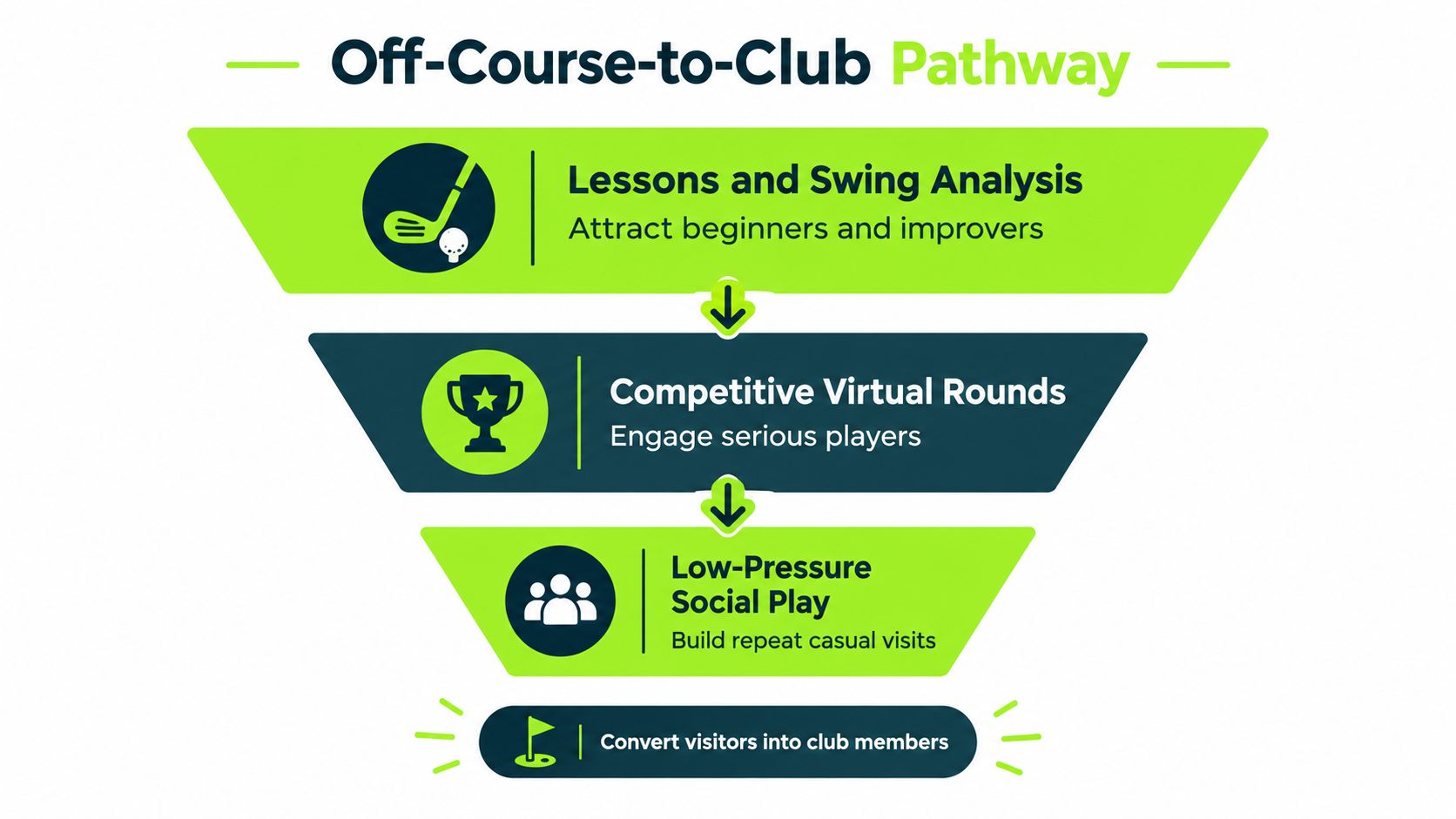
BBC Sport, citing Sporting Insight statistics supplied by The R&A, reports that 82% of traditional golfers in Britain and Ireland have tried an alternative format, while 36% of people in England played an alternative format before experiencing a golf course, according to BBC Sport reporting on alternative golf formats. That supports separate journeys. Offer lessons and swing analysis for existing golfers, structured virtual competitions for regular players, and hosted, low-pressure games for newcomers. Many users want to analyse a swing, take a lesson, or play famous holes socially, not complete a full virtual round.
Build the pathway into booking
Capture consent and intent at the point of booking. Record playing experience, lesson interest, group size, preferred times, and whether the customer belongs to a club. Then follow up with a relevant next step, such as a beginner series, winter league, fitting evening, flexible membership trial, or a hosted visit to a partner club. Don't send every customer the same discount message.
A simulator becomes more than a rental product under these conditions. For a club operator, it can introduce independent and beginner golfers to coaching, social membership, and flexible playing rights. For a standalone venue, partnerships with nearby clubs can create reciprocal value if the data-sharing, consent, and commercial terms are clear. Approaches to growing indoor golf membership are relevant because recurring access, leagues, and priority booking can smooth weekday utilisation without training customers to wait for offers.
Local visibility matters more than national reach. Keep your website booking-led, with clear prices, group packages, lesson information, parking details, and opening hours. Use Google Business Profile optimization tips to improve how the venue appears in local search, and keep photos, categories, attributes, and review responses current. Build relationships with employers, sports clubs, hotels, and PGA professionals. A well-run league night or employer event can create repeat groups faster than broad social media posting.
Launch Sequence, First 90 Days and Warning Signs
Launch in sequence. Complete feasibility, planning, and break-even first, then specify equipment, fit out, test, and soft launch. Where possible, pilot with one bay or pop-up sessions before committing to a larger bay count. Use the soft launch to test prices, session lengths, staffing, food and drink demand, and customer briefing routines.
Track the same measures every week from opening.
- Bookings and no-shows: By bay, daypart, customer type, and booking channel
- Repeat rate: Whether first-time customers return or join a league, lesson plan, or membership
- Revenue per available bay-hour: The clearest view of whether pricing and utilisation are working together
- Contribution margin: Revenue after staffing, consumables, payment fees, and direct operating costs
Warning signs are usually visible early. Weak midweek occupancy, slow repeat bookings, poor food and beverage attach, frequent technology faults, and follow-up sitting unfinished all point to a specific constraint. Fix that constraint before buying more traffic or more equipment. A quiet Tuesday may need a league, coaching block, school programme, or corporate package, not a cheaper bay rate.
The commercial lesson is simple. Launch monitors rarely decide whether an indoor golf business survives. Saleable hours, comfortable rooms, credible break-even maths, and repeat customer journeys do.
If you're planning an indoor venue or adding simulator bays to an existing club, GolfRep can help you map the customer journey from first booking to repeat visit, membership enquiry, and recurring revenue. We work with UK golf businesses on acquisition, CRM, follow-up, and conversion, so the demand you create in the bay has a clear commercial next step.
Ready to tap into our proven growth system?