Golf Club Enquiry Management: A Practical Playbook
Most golf clubs don't have an enquiry problem. They have a handling problem.
The popular advice is to generate more leads, run another membership campaign, or improve the website. That advice misses the commercial leak. If a club takes too long to reply, sends every enquiry into one inbox, or leaves ownership unclear, more demand creates more unworked opportunities.
That's why golf club enquiry management should sit inside the club's operating model, not be treated as a marketing task. The system needs to capture every contact, identify intent, assign responsibility, prompt the next action, and show what reaches revenue. GolfRep works from that operational position because predictable growth depends on what happens after the first click.
Why Most UK Golf Clubs Are Quietly Losing Enquiries
A slow response isn't a minor service issue. It's a revenue failure.
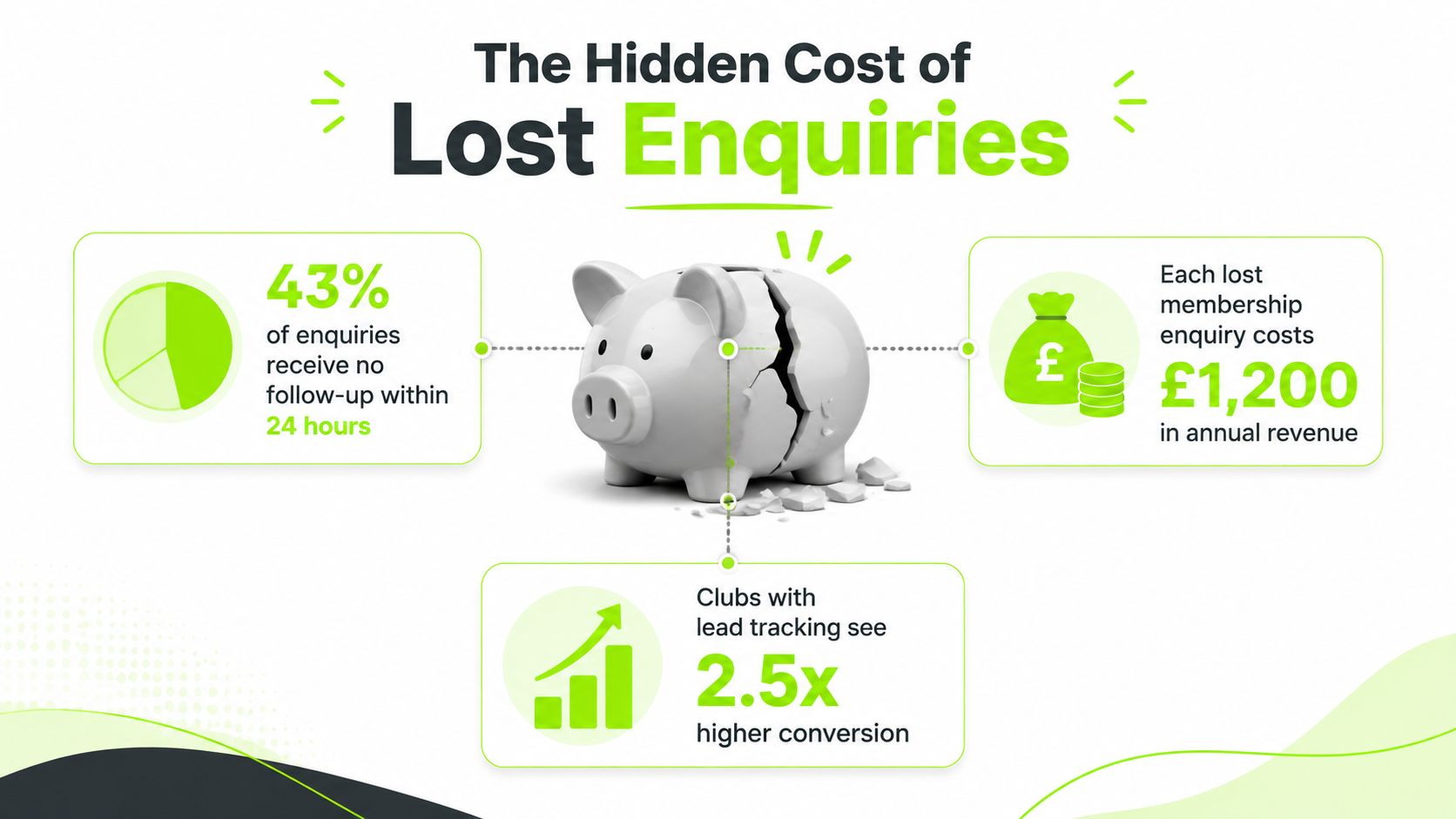
UK golf clubs reportedly take an average of 47 hours and 32 minutes to respond to membership enquiries, according to GolfRep's analysis of golf club sales processes. A separate GolfRep source reports that a lead answered within one hour is five times more likely to convert than one left for 24 hours, so speed directly affects the chance of reaching a useful conversation (GolfRep membership marketing research).
The pattern is familiar inside UK clubs:
- After-hours enquiries wait until Monday. A prospective member submits a form on Friday evening, then receives no acknowledgement or personal response while they compare clubs.
- Several people reply without a shared record. One staff member quotes one membership condition, another gives different information, and nobody knows which conversation is current.
- Every intent lands in one inbox. A society organiser, wedding prospect, visitor, and membership lead all compete for attention, despite having different urgency and buying journeys.
- Nobody can see pipeline value. The club knows enquiries arrived, but not which source created them, who owns them, what happens next, or how much potential revenue sits unworked.
England Golf reported membership growth from 730,602 in 2024 to 750,071 in 2025 (England Golf coverage cited by GolfRep). Demand exists. The leakage happens between enquiry and conversation.
Golf membership fees also aren't consistently published online. An analysis of 868 English clubs found that only 28.6% displayed a joining fee, and clubs that did publish one showed substantial variation, from under £500 to above £2,000 in some cases (Golf Membership Finder). That makes the first conversation especially important. Prospects often need answers about price, availability, waiting lists, and joining conditions before they can decide whether a visit is worthwhile.
For a useful wider explanation of the impacto de la lentitud en ventas, look at response delay as a commercial process failure rather than a copywriting issue. The practical fixes are straightforward: set a response standard, route by intent, assign one owner, and track every next action. Clubs can also use GolfRep's analysis of how most golf clubs lose 30% of enquiries without realising to audit where their own pipeline is disappearing.
Capturing Enquiries Across Every Channel That Matters
A contact form isn't an enquiry system. It's one entrance to the system.
A club should capture enquiries from the website, phone, reception, pro shop, social media, and referral partners, then place every record into one shared queue. The source must stay attached to the record, because a club can't improve channel performance if staff copy details between personal inboxes and spreadsheets.
Build the capture stack around real club behaviour
Website forms should ask only for information that helps someone respond properly. At minimum, capture name, contact details, enquiry type, preferred contact method, timing, and a short description of what the prospect wants. A live chat tool should create the same record as a form, not a separate conversation that disappears when the chat closes.
Phone calls need a simple procedure. Whoever answers should create the record while speaking to the prospect, select the intent tag, and schedule the next action before ending the call. Walk-in visitors need the same treatment at reception and the pro shop. A handwritten note or personal phone contact is not a pipeline.
Facebook and Instagram direct messages deserve a shared process too. Staff should move the conversation into an approved contact route, record consent where relevant, and preserve the original channel tag. WhatsApp and personal email need particular discipline, because information stored only on an employee's device leaves the club exposed when that person is unavailable.
Partner referrals from county associations, hotels, and member get-a-friend schemes should carry a referral source tag. That lets the club see which partnerships create useful conversations, rather than relying on memory.
| Channel capture matrix | Capture Tool | Mandatory Fields | Tag | Routes To |
|---|---|---|---|---|
| Website form | CRM-connected form | Name, contact details, intent, timing, preferred contact method | Website, campaign, landing page | Membership or commercial queue |
| Phone | Call record or CRM form | Caller details, intent, urgency, next action | Phone, staff member | Named duty owner |
| Walk-in | Reception or pro shop record | Name, contact details, reason for visit, follow-up permission | Reception, pro shop | Membership or visitor owner |
| Social media | Shared social inbox | Profile name, contact details, intent, source | Facebook or Instagram | Central enquiry queue |
| Partner referral | Referral form | Referrer, prospect details, intent, timing | County, hotel, member referral | Partnership or relevant intent owner |
Use campaign and source tags consistently. UTM data can preserve the origin of digital traffic, while staff-selected tags cover phone, walk-in, and partner activity. The rule is simple: one enquiry, one record, one visible owner.
Qualifying and Routing Leads in the First Five Minutes
The first five minutes should be automated wherever possible, then owned by a person.
An incoming enquiry needs enough structure to determine what happens next. The CRM should capture intent type, decision timeline, household size, current club status, and budget band. It should also record the prospect's preferred contact method, because a person asking for a phone call shouldn't receive an impersonal sequence as the first response.
Behaviour adds context. A person who completes a detailed membership form and returns repeatedly to the membership or pricing page deserves different priority from someone who asks a general question. Scoring shouldn't replace judgement, but it should help staff see which records need immediate attention.
Route by intent, geography, and value
A membership enquiry might route to the Membership Secretary. A society day should go to the events or commercial owner. A visitor enquiry may need a booking response from the pro shop, while a wedding enquiry needs someone who can discuss availability, catering, and a site visit.
Geography can help allocate responsibility where clubs operate across areas or multiple sites. Value and urgency can also guide the queue, but the routing rule must remain understandable. If staff can't explain why a record went to them, the system is too complicated.
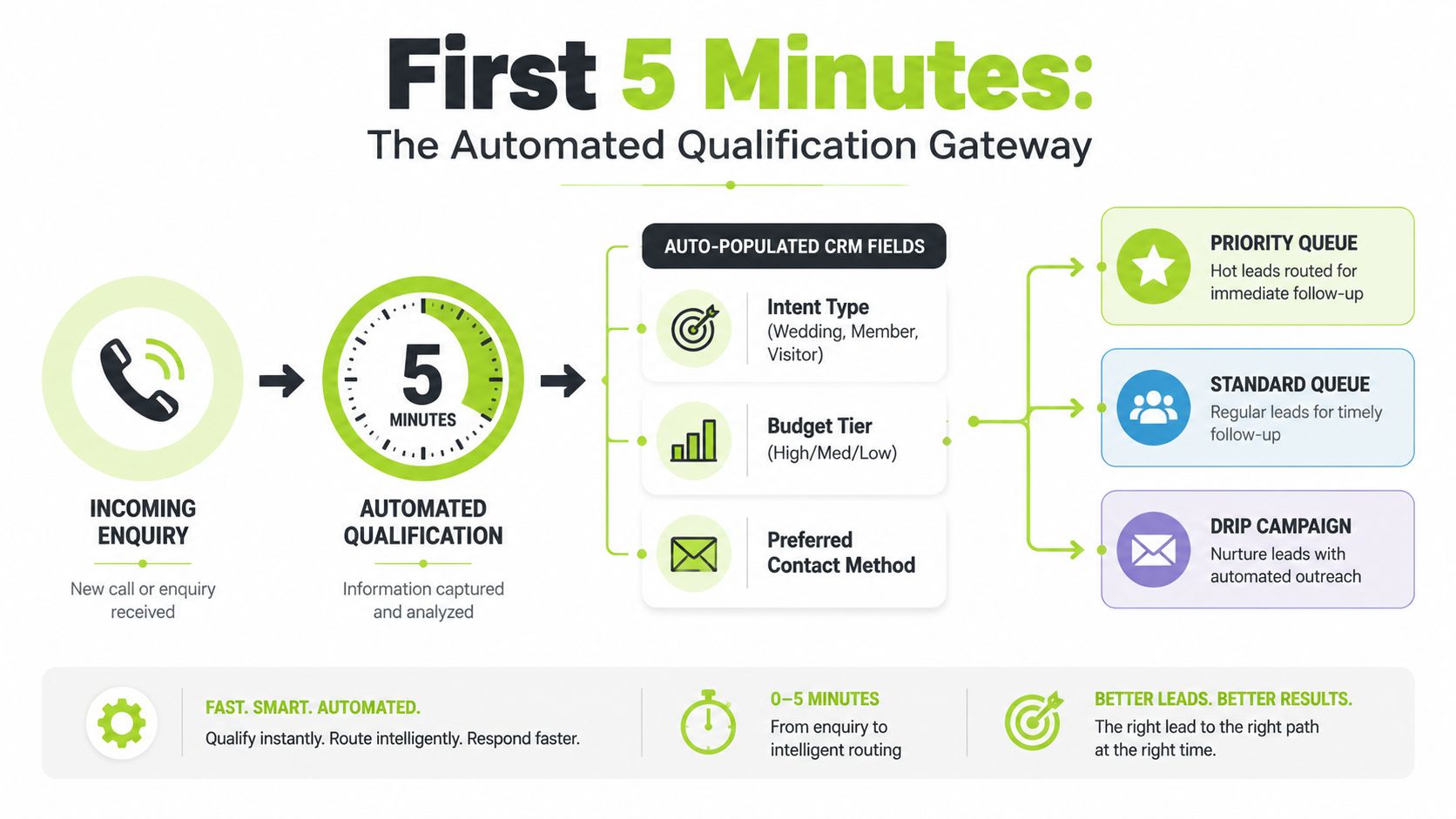
Set a service-level clock. During office hours, a web enquiry should trigger an alert if no owner responds within five minutes. Out of hours, the system should acknowledge the enquiry, identify the next available contact, and escalate according to the club's agreed cover. A five-minute target isn't a claim that every conversation will finish immediately. It's a requirement that the club confirms receipt and starts human ownership quickly.
Routing rule: Don't ask one inbox to understand five different buying journeys.
The difference between member, society, visitor, event, and retail intent matters because each requires different questions and a different next action. A society organiser may need a proposal. A membership prospect may need a visit. A visitor may need a tee-time option. The GolfRep guide to golf club speed to lead sets out why that first response should be treated as a defined operating responsibility, not an informal favour.
Building the CRM and Automation Backbone
A CRM shouldn't be a digital address book. It should be the club's operating plumbing.
Start with five pipeline stages:
- New Enquiry, captured and awaiting ownership.
- Qualified, with intent, timing, fit, and next action recorded.
- Visit Booked, with a date, responsible person, and preparation notes.
- Trial or Membership Decision, where the prospect is considering the next step.
- Won or Lost, with a reason that can be reviewed later.
Every record needs one named owner. Multiple owners create polite confusion, because each person assumes someone else will make the next contact. Status fields should use fixed choices rather than free text, so reports remain usable.
Keep the technology lightweight
A club without a marketing hire can still run a sound stack. The essential components are a CRM, a form connector, email and SMS automation, a calendar booking link, and a simple reporting view. The system should create the record, tag the source, route the intent, send an acknowledgement, and alert staff when an SLA is missed.
Useful marketing automation tools can support these tasks, but the club should choose based on workflow fit rather than feature count. A large platform won't solve unclear ownership or neglected dashboards.
| Minimum CRM Pipeline Configuration | Owner | SLA | Required Next Action |
|---|---|---|---|
| New Enquiry | Duty owner | Immediate acknowledgement, human review within agreed window | Confirm intent and contact method |
| Qualified | Membership or commercial owner | Same working day | Record fit, timing, and next step |
| Visit Booked | Visit host | Before the visit | Confirm appointment and prepare notes |
| Trial or Membership Decision | Membership owner | Agreed follow-up date | Answer objections and confirm decision path |
| Won or Lost | CRM owner | On outcome | Record result, value, and reason |
The minimum field set should include source, persona tag, qualification score, last touch, next action date, and revenue potential in pounds. GolfRep can be considered as one operational option through GolfRep's golf club CRM approach, where the emphasis is on receiving, assigning, progressing, and reporting on enquiries in one place.
Review the dashboard regularly. A report nobody opens is decoration, not management information.
Follow-Up Cadences, Scripts, and the Visit Booking Step
A follow-up sequence should reflect what the prospect is trying to buy.
Membership prospects need confidence, clarity, and a reason to visit. Society and event organisers need a prompt response with enough commercial detail to keep planning moving. Visitor enquiries need practical booking help, not a heavy sales sequence.
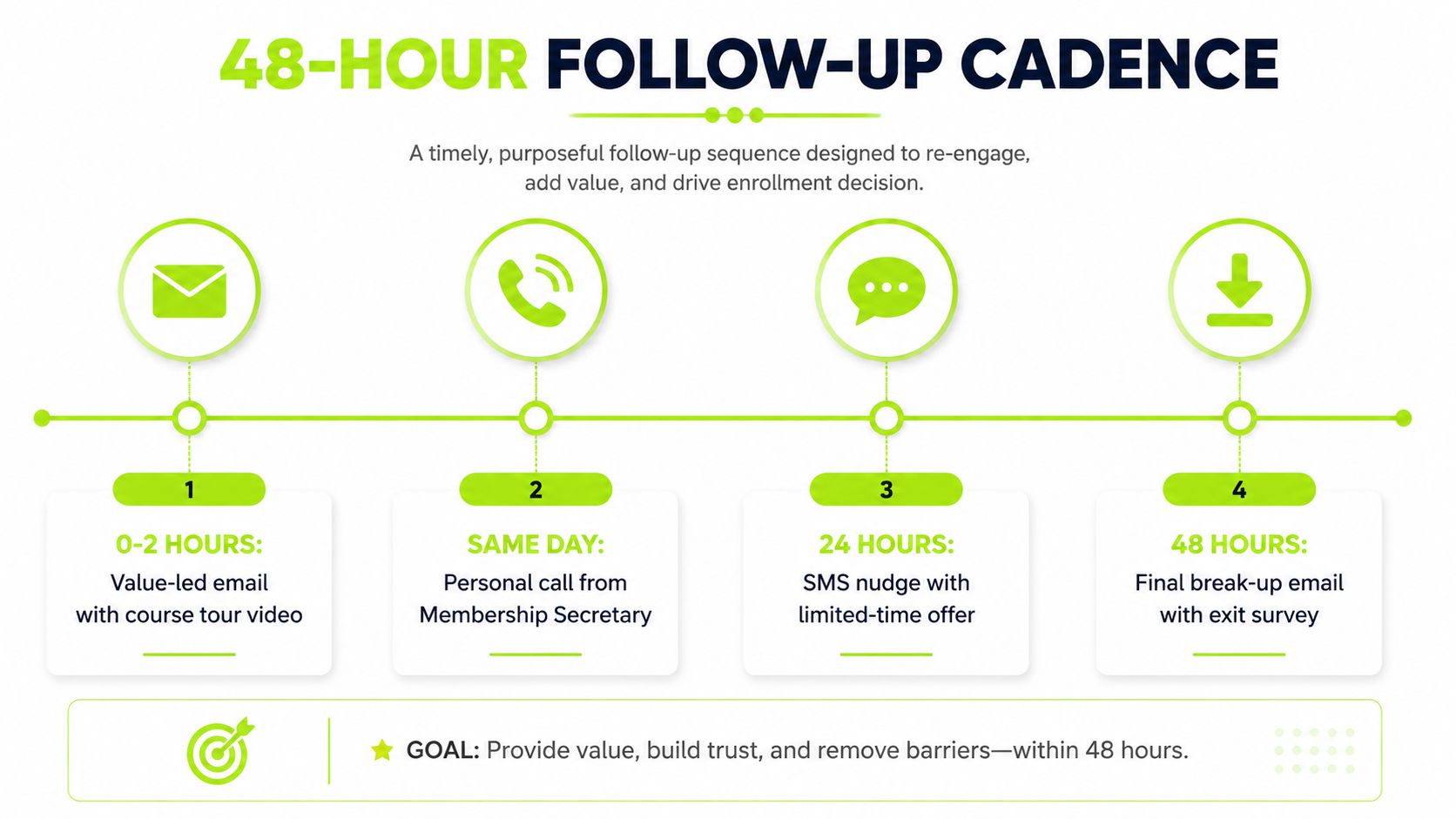
For a membership enquiry, send a value-led email within two hours, make a same-day call, send an SMS nudge at 24 hours if there's no reply, and issue a final message at day seven that leaves the door open. The sequence should answer the questions that block a visit, such as membership category, availability, playing opportunities, and what the prospect can expect when they arrive.
A society or event enquiry needs a quote or proposal within four hours, followed by a call the next morning. The owner should confirm date flexibility, group requirements, catering expectations, and decision timing. A visitor enquiry should focus on the booking: availability, course information, arrival details, and a clear way to reserve.
Use scripts that create a next step
The first membership call can be direct:
“Thanks for getting in touch. I'd like to understand what you're looking for, then I can tell you whether we have the right membership option. What's prompted you to consider joining now?”
The qualification conversation should stay useful rather than interrogative:
“If the club feels right, what would you need to see or understand before making a decision?”
The booking close should be specific:
“The best next step is a short visit so we can show you the facilities and talk through availability. Would you prefer to come on [option] or [option]?”
Every touch should have a benefit, a question, and a next action. “Just checking in” fails because it gives the prospect no reason to respond. A short course tour video, a clear explanation of membership access, or a visit with the right staff member creates a more useful exchange.
The objective isn't to send more messages. It's to move curiosity into a booked and attended visit, then give the prospect a well-managed decision experience.
KPIs, Reporting, and Continuous Optimisation
A club can't improve enquiry handling by looking only at the number of leads received. That figure says nothing about speed, ownership, follow-up, visits, or revenue.
Put four measures into one weekly view.
The operating dashboard
Speed to Lead measures the time between form submission or contact and the first human response. A slow result usually points to an after-hours gap, poor routing, or unclear ownership.
Follow-Up Completion Rate shows how consistently the team contacts enquiries within the agreed SLA. If the rate is weak, the club has a process discipline problem, not necessarily a demand problem.
Visit-to-Member Conversion is memberships won divided by completed visits. This exposes the quality of the visit experience, the suitability of qualification, and the strength of the membership conversation.
Enquiry-to-Revenue Yield expresses revenue in pounds per enquiry, segmented by source and persona. It helps the committee understand whether a channel creates valuable membership conversations or just activity.
The brief does not provide verified baseline figures for year-one KPI targets, so clubs should establish their own starting point from current records and set improvement targets after the first review period. Don't invent a target before you can measure the baseline.
| Headline KPIs and Year-One Targets | Definition | Year-One Target |
|---|---|---|
| Speed to Lead | Time from enquiry to first human response | Club-defined improvement from recorded baseline |
| Follow-Up Completion Rate | Enquiries contacted within the agreed SLA | Club-defined improvement from recorded baseline |
| Visit-to-Member Conversion | Memberships won divided by completed visits | Club-defined improvement from recorded baseline |
| Enquiry-to-Revenue Yield | Revenue in pounds per enquiry by source and persona | Clear upward trend by priority source |
Use the dashboard to ask operational questions. Which records waited longest? Which intent types lack an owner? Which source produces visits but few decisions? Which staff member completes follow-up reliably, and what can others copy?
A monthly meeting should include sales, operations, and the secretary. Choose one process change per cycle, record the result, and avoid changing everything at once. A quarterly channel review should connect spend to enquiry quality and revenue, so the club invests according to evidence rather than habit. For broader context on key metrics for sales training, focus on measures that change behaviour, not vanity figures.
Turning Enquiry Management Into a Predictable Revenue System
Enquiry handling belongs on the club's P&L because it influences membership income, society bookings, visitor revenue, and events. It shouldn't be buried inside marketing administration or left to whichever employee happens to open the inbox.
Two owners are essential.
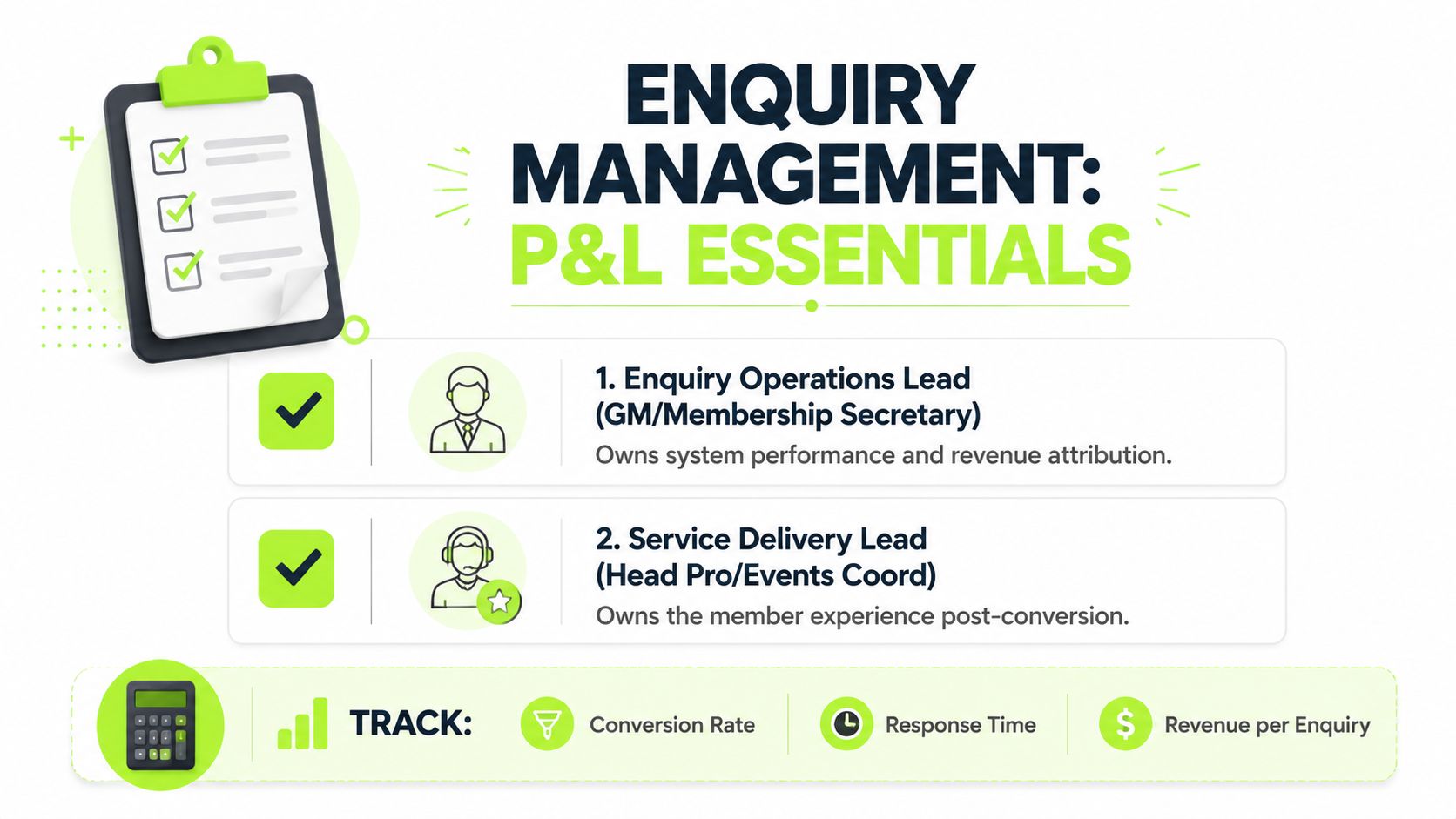
The Enquiry Operations Lead, usually the General Manager or Membership Secretary, owns system performance, response standards, pipeline visibility, and revenue attribution. The CRM Owner keeps records clean, checks automations, manages fields, and makes sure staff complete the next action. The person responsible for the member experience after conversion may be the Head Professional or Events Coordinator, but that role shouldn't replace ownership of the enquiry system itself.
Set policy, not informal expectations
Adopt a five-minute first-touch target for web leads, a 30-minute target for phone and walk-in records, and a structured seven-day follow-up sequence. These are operating policies that need cover, escalation, and review. If the club can't meet them at weekends or evenings, decide who will handle acknowledgement and when the human follow-up will occur.
Report pipeline numbers, conversion rates, and revenue attribution alongside bar takings and green-fee income. That comparison changes the conversation. Enquiry management stops looking like an administrative burden and starts looking like a controllable commercial process.
Use this Monday-morning checklist:
- Appoint the owners: Name the Enquiry Operations Lead and CRM Owner.
- Instrument every channel: Connect forms, phone records, reception, pro shop, social messages, and referrals to one visible queue.
- Set the SLAs: Agree response and follow-up standards, including out-of-hours cover.
- Switch on the automations: Use source tagging, intent routing, acknowledgements, calendar booking, and breach alerts.
- Book the first review: Put the monthly pipeline meeting in the diary before the workflow launches.
Golf club enquiry management works when the club treats every contact as an accountable commercial record. GolfRep helps clubs combine lead generation with structured follow-up and CRM systems, so enquiries can be captured, qualified, assigned, and progressed towards booked visits and membership outcomes. Visit GolfRep to discuss how your club can build a clearer, more predictable enquiry pipeline.
Ready to tap into our proven growth system?