How to Increase Club Membership in 2026: A Practical Guide

You've got a committee asking for growth, a captain asking for younger members, and a treasurer asking for predictable subscriptions. Those aren't three separate jobs. They're one commercial job, and it starts when you stop counting joiners in isolation and start managing net membership as a system.
The Real Question Behind How to Increase Club Membership
A club reports a strong year for recruitment at the AGM. The room applauds. Then someone asks how many members left, and the mood changes. If joiners and leavers are almost level, you haven't grown. You've worked hard to stand still.
That's the uncomfortable starting point for any honest discussion about how to increase club membership. The question isn't how you generate more applause lines at the AGM. It's where your current constraint sits. For some clubs it's the product. For others it's conversion. For others it's that new members never become settled members.
Four constraints, one outcome
Work through these in order before you spend on promotion:
- Product and positioning: Is there a category that fits how your target golfer plays?
- Campaign planning: Are you making a specific offer to a specific segment, or a general appeal to anyone?
- Conversion and onboarding: Do enquiries become visits quickly, and do joiners become regular players?
- Measurement: Can you see joiners, leavers and renewal risk on one page every month?
England's wider context should give you confidence, not complacency. Membership rose to 750,071 in 2025, up 2.66% year on year from 730,602 in 2024, across roughly 1,735 affiliated clubs, an increase of 19,469 members reported in coverage of England Golf figures. Demand didn't collapse after the pandemic surge. It kept growing.
General market growth doesn't guarantee your growth. Your catchment, your categories and your follow-up decide whether you take your share.
Treat this as an operating problem, not a marketing slogan. Identify the constraint, fix it, measure the result, then move to the next one. That's how private clubs build recurring revenue they can forecast, rather than relying on a busy open day and hoping the renewals hold.
Why Net Membership Growth Is Your True Score
Recruitment is visible. Retention is quieter. That doesn't make it less commercial. If you only report joiners, you're reporting effort, not outcome.
UK data makes the point clearly. Members' clubs averaged 75 joiners during 2024 but also averaged 63 leavers, and 22% reported more leavers than joiners, according to Hillier Hopkins data summarised in GolfRep's membership growth analysis. Run the arithmetic and the strategy changes.
The net growth calculation
- Start with honesty: Net growth equals joiners minus leavers for the same period, by category, not just in total.
- Split the leavers: Record reason, length of membership, category and last recorded engagement for every resignation.
- Compare the levers: Adding ten joiners and preventing ten leavers produce the same net result, but the second route usually costs less and protects experience on the tee sheet.
Take the example in that analysis. A club that lifts joiners from 75 to 85 and cuts leavers from 63 to 53 adds 20 net members. A club that only chases the extra joiners adds ten. Same campaign energy, double the outcome, because someone owned retention as a growth task.
Don't park waiting lists and lapsed members outside this plan either. They're part of the same pipeline. A waiting list that never hears from you is wasted demand. A lapsed member who left for a fixable reason, such as tee time access or a life stage change, is a warmer prospect than a cold enquiry who has never visited.
Working definition: Net membership growth is the change in paying members after joiners, leavers, category transfers and reactivations in a defined period.
Report that number first at committee. Then explain it. When the committee sees net growth by category every month, arguments about discounts, joining fees and campaign spend get sharper, because everyone is finally looking at the same score.
Defining the Membership You Are Trying to Grow
A target like "more members" fails because it gives no one a decision to make. It doesn't tell your professional who to coach, your office who to follow up, or your bar and catering team who is arriving on a Friday evening.
Start by mapping the members you already have. Group them by playing frequency, life stage, household and category. Look at who plays enough to perceive value, who barely plays, and who joined as a couple or family. Your best future members often look like your most settled current ones.
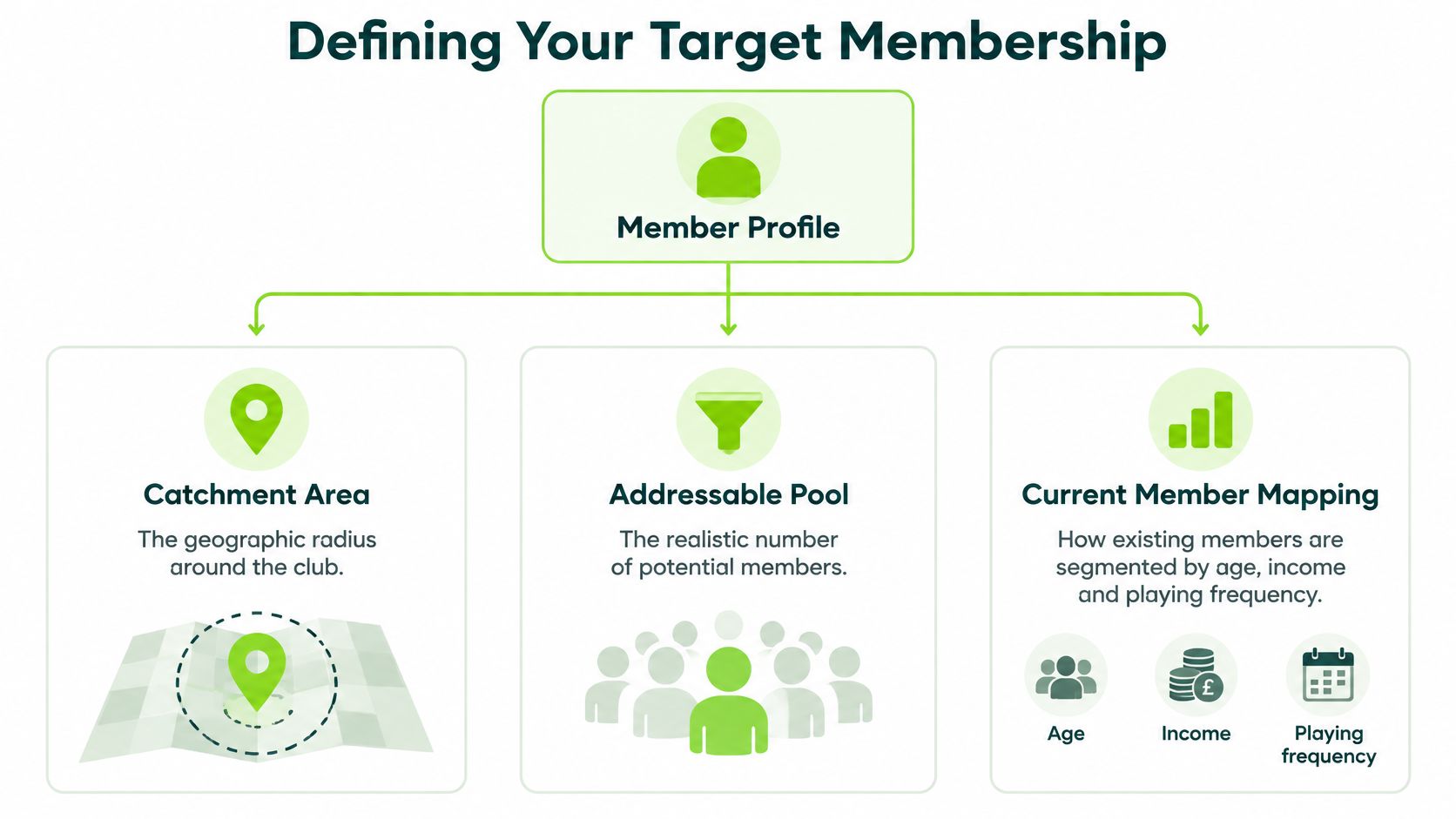
From that map, run one working session with your committee this week. Plot current members by postcode and travel time, noting where they cluster and where competitors sit. Then size the addressable pool: combine local knowledge with national participation context, and discount heavily for golfers who will never join a private club. Pick two or three priority segments you can serve well, such as returning golfers, time poor professionals, women coming back after a break, or families. Write the target properly: a net number by segment and season, owned by a named person.
The audience is also getting younger. England Golf's 2024 data put the overall average member age at 54.99, down from 56.18 in 2023, with the average male age falling to 53.78 and female age to 62.98, figures reported alongside Hillier Hopkins' annual survey launch. Keep your core categories. Alongside them, test propositions for working age golfers: twilight access, shorter commitments, family formats and enquiry handling outside office hours.
The wider picture backs the segmentation approach. England had 750,071 club members in 2025 while wider participation reached 12.6 million adults in some form, as set out in National Club Golfer's reporting on England Golf participation. Plenty of golfers play without belonging. Chasing all of them burns budget. Identify the local golfers whose playing habits, budget and social needs fit what your club does well, and spend your campaign money on them alone.
Planning Campaigns Around Offers, Not Discounts
A club cuts the joining fee, enquiries jump, and by renewal the same households are asking what comes off next.
That is margin leakage dressed as recruitment. Build the campaign as a capacity and product decision before media is booked. Price answers how much. The offer answers who it is for, which tee times or facilities they can use, what commitment they are making, and what changes after the first term.
Objective, audience, access rules, money path, next step. If one is blank, the campaign is not ready.
Use structure to protect yield. A cheaper entry point earns its place only when the rights are limited, the upgrade route is explicit, and the front desk can explain it in one breath. If a flexible category lets regular players move payments toward full membership after proven use, say so inside the offer. If peak access is protected, say that too. Ambiguity creates complaints at the bar and soft renewals later.
Creative needs the same discipline. A busy general manager should grasp the category, the access and the deadline from the headline alone, and details such as email subject line capitalization keep a premium club from looking rushed. Before launch, compare the categories against practical thinking on structuring golf club membership offers and cut anything the clubhouse cannot describe plainly.
Test offers in small, controlled runs. Change one variable at a time: access window, commitment length, coaching element, guest rights, or upgrade milestone. Keep the full price anchored and make every incentive time bound, capacity bound, or behaviour bound. A reward for playing often is cleaner than a reward for signing quickly.
Skip the generic open day. Run a category event with a playing format that matches the rights being sold, one defined follow-up path and a closing date. Hospitality with leaflets fills a room. A designed offer fills a ledger.
Converting Enquiries Through a Tight Response System
Demand generation without a conversion system creates waste. A strong conversion system without enough demand can't create growth either. You need both, sequenced properly.
Set a published response standard and assign ownership. Every enquiry gets a named owner, a first response within your agreed window during operating hours, and a next step that isn't "let us know". Offer two visit times. Confirm by phone where possible. Record the outcome in your CRM, whether that's a dedicated system, your booking platform notes, or a controlled pipeline your office maintains.

Qualify on first contact
Ask questions that help you place the golfer, not interrogate them:
- Playing pattern: How often do you play now, and when would you realistically play here?
- Current situation: Are you a member elsewhere, a nomadic golfer, or returning after a break?
- What matters most: Competition, social golf, practice facilities, family access, or course quality?
- Timing: Are you looking now, at renewal elsewhere, or for next season?
Then run a simple follow up sequence for people who aren't ready. A personal call, a relevant playing invitation, and a final clear check in beats sporadic newsletters. Broader customer communication strategy frameworks can help you map who gets what message and when, but keep the golf version practical. Different messages for a society organiser, a lesson pupil and a membership prospect.
Don't ignore the golfers already under your nose. England golfers submitted more than 10.2 million scores through the World Handicap System in 2024, including 4.4 million general play scores, up from 3.9 million in 2023, according to England Golf figures reported by Golf Business News. A visitor recording repeated general play, booking lessons or returning with guests is signalling intent. Connect booking, visitor and lesson records where you can, and invite repeat engagers personally.
For the workflow itself, GolfRep's guide to golf club enquiry conversion is a useful reference for tightening enquiry to visit to application. Tools such as GolfRepOS can sit alongside your existing office processes to track pipeline stages and follow ups, but the discipline comes first. Speed, ownership and a specific next step convert. Software only makes good discipline easier to sustain on busy weekends.
Onboarding New Members for Their Second Subscription Cycle
A new member joins in April, plays twice in May, then disappears from the tee sheet. By renewal time the club calls it a retention problem. The cause sat twelve weeks earlier, when nobody intervened.
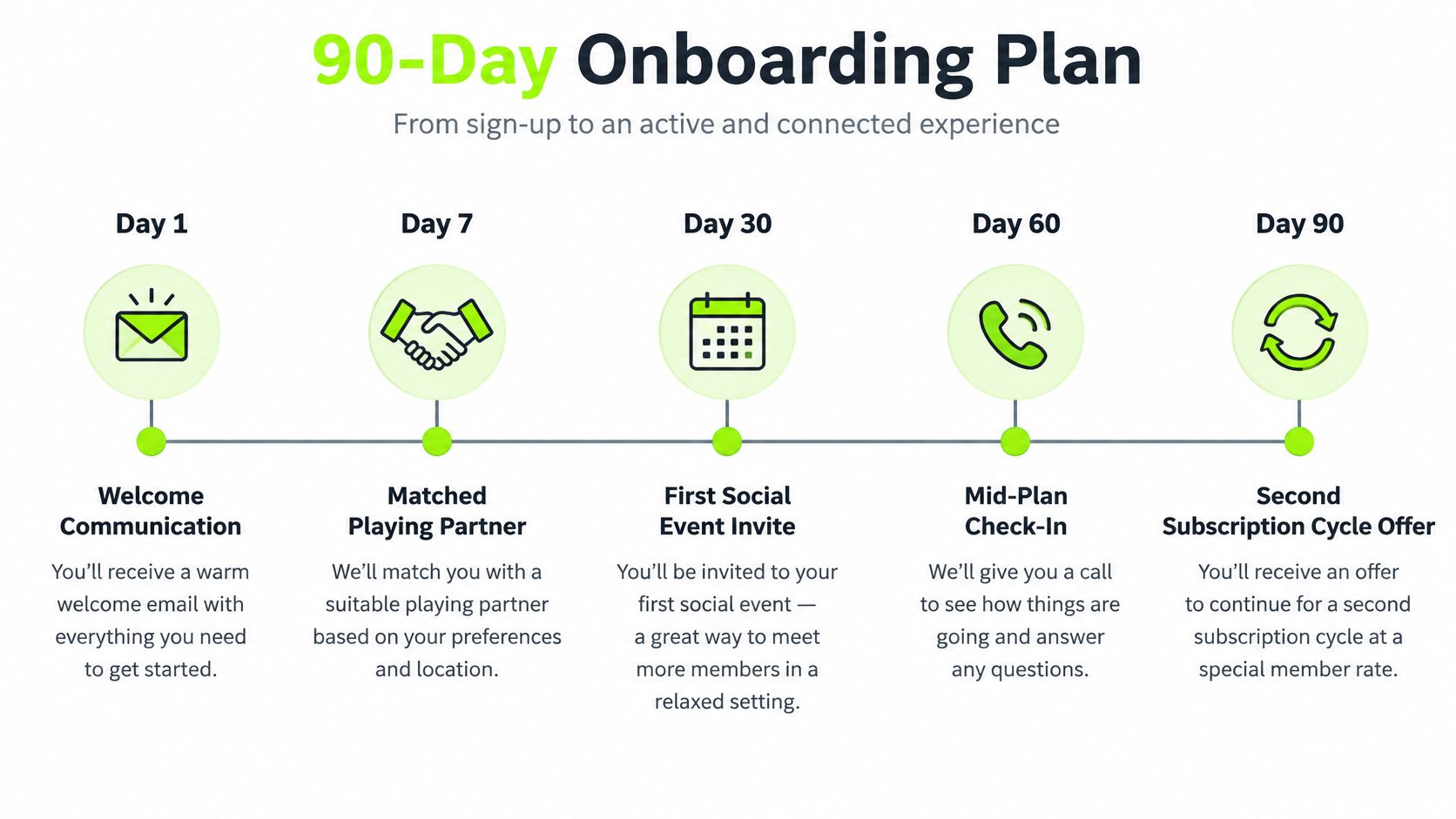
The sale isn't finished when the application is signed. It's finished when a new member plays regularly, knows people, and renews without a rescue conversation. Design your onboarding backwards from the second subscription cycle, and that April joiner gets a very different first year.
UK committees may underestimate the pressure. A 2025 UK survey found 84% of surveyed golfers planned to renew, but 14% remained undecided and 70% were concerned about fee increases, as reported in the Hillier Hopkins Golf Clubs Survey Report 2025/26. The undecided members make their minds up long before the renewal letter arrives.
The first 90 days, with named owners
Onboarding fails when everyone assumes someone else is doing it. Split the window into three phases and give each one an owner.
| Phase | Owner | What must happen |
|---|---|---|
| Week 1 | Office or professional | Personal welcome, plus guidance on booking, handicaps, competitions and clubhouse basics |
| Weeks 2 to 6 | Membership lead | Playing partner or roll up matched to their standard and preferred times, first round and first competition explanation booked |
| Weeks 7 to 13 | Whoever reads the tee sheet | Usage check, personal invitations, early grumbles answered before they harden |
Then work the triggers. A new member absent from the tee sheet after the welcome period gets a call. A member who plays but never enters anything social gets a specific invitation by name. A couple where only one partner plays gets asked what would bring the other one in. Small interventions, made early, cost far less than a rescue conversation in month eleven.
Some clubs flinch at this, worrying it feels like sales pressure. Done with the right tone, it is community building with commercial intent. This guide to loyal communities for marketers covers the principle well; translate it into golf. Loyalty at a club means names known in the pro shop, a regular fourball, and a member who can see the subscription being used.
For what happens after day 90, GolfRep's guidance on golf club membership retention maps the system that follows onboarding. Review first year leavers separately every quarter. The same few drift moments appear again and again. Fix those moments and next year's recruitment target shrinks.
Measuring What Predicts Net Growth
Committees don't need more reports. They need one page they understand, reviewed monthly, with actions attached. If a number doesn't predict net growth or trigger a decision, move it off the front page.
Earlier UK survey data shows why the front page must join acquisition and retention together. The Hillier Hopkins 2023/24 survey reported clubs welcomed an average of 94 new members during 2023, while female membership rose to 18% from 15% and 46% of clubs had waiting lists averaging 51 people, figures cited in GolfRep's golf course marketing analysis. Recruitment, segmentation and pipeline management were already linked then. They still are.
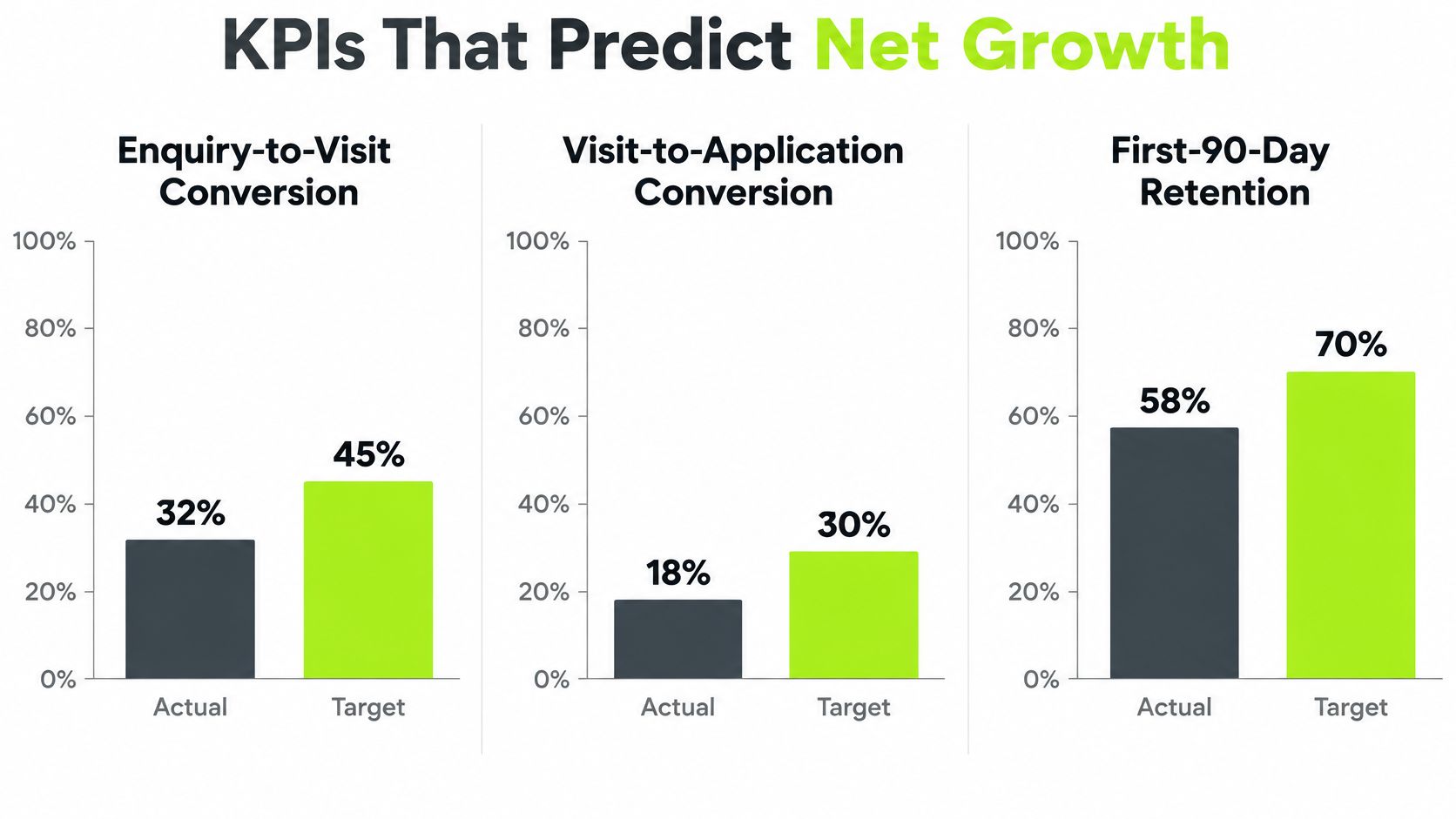
The five KPIs to review monthly
- Enquiry to visit conversion: Shows whether response speed, qualification and invitation quality are working.
- Visit to application conversion: Shows whether the product, tour, playing experience and follow up match the promise.
- First 90 day rounds per new member: Your earliest warning of renewal risk. Low usage needs intervention, not a renewal invoice and hope.
- Leavers by reason and category: Separates unavoidable losses, such as relocation or ill health, from fixable losses, such as tee access, value perception or poor integration.
- Renewal pipeline by category: Confirmed, undecided and at risk members, with named owners for conversations well before renewal date.
Add event participation and secondary spend where you can measure them reliably. A member who plays, brings guests, uses catering and enters social formats is demonstrating value to themselves. A member who does none of those things may be a headline member today and a leaver at renewal.
Run a quarterly rhythm, not a one off push
| Quarter focus | Question to answer | Decision required |
|---|---|---|
| Product review | Do categories still fit playing patterns and capacity? | Keep, amend or retire each category |
| Campaign planning | Which segment gives the best net return next? | Offer, budget, owner and closing date |
| Conversion audit | Where do enquiries stall before application? | Response standard and follow up fixes |
| Onboarding review | Which new members aren't playing or integrating? | Personal interventions by named staff |
Growth becomes predictable when you review the same few numbers every month and act on what they show.
Take this checklist into your next committee meeting. Confirm your net target by category. Name the owner for enquiries, onboarding and at risk renewals. Agree the one page report. Set the next product review date. Then stop debating general awareness and start managing the constraint in front of you.
That's the practical answer to how to increase club membership in a UK private club. Attract the right golfers, nurture them with relevant contact, convert them through a clear visit and application process, and retain them by making the first year feel like belonging. Do those four things in sequence, measure them, and net growth stops being a hope in the annual report. It becomes a number you manage.
If you'd like help identifying whether your biggest constraint is product, campaign planning, conversion or renewal risk, talk to GolfRep about mapping your membership pipeline from first enquiry to second subscription. We'll help you build a measurable system for net growth across membership, visitors, societies and events, without relying on discounts to do the work.
Ready to tap into our proven growth system?