Golf Club Marketing Playbook for Predictable Growth

Most golf clubs don't need more marketing noise. They need to stop losing the enquiries they already generate.
That's the uncomfortable truth behind golf club marketing in the UK. A prospect fills in a form, asks for membership details, or shows interest after visiting the website, then the club takes too long to reply, replies without context, or never connects that enquiry to a clear next step. GolfRep's analysis says UK golf clubs take an average of 47 hours and 32 minutes to respond to membership enquiries, which is long enough for a serious prospect to cool off, compare alternatives, or disappear altogether, especially when instant acknowledgement and automated follow-up are missing (GolfRep analysis).
That's why the conversion gap isn't traffic. It's handling.
A club can run social posts, send newsletters, and update the website, yet still miss the outcome that matters, a booked visit, a trial round, or a membership sign-up. If the first reply is slow, vague, or inconsistent, the enquiry never becomes a sales process. It becomes inbox clutter.
Why Most Golf Clubs Waste the Enquiries They Already Get
Most clubs assume the weak point is awareness. In practice, it is usually follow-up discipline.
A golfer who enquires about membership is rarely just browsing. They have already moved from interest to intent, which makes the first response a conversion moment rather than a courtesy. The GolfRep analysis of UK response times shows how much room there is for leakage before anyone speaks to the prospect, and that delay gives a serious lead time to cool off, compare options, or move on (GolfRep analysis). By the time a staff member replies, the opportunity has often lost momentum.
The usual leak points
The pattern is familiar inside clubs of every size. A form submission lands in a shared inbox, someone sees it later in the day, then it waits for a committee answer, a manual callback, or a follow-up email that says too little. The result is a queue, not a pipeline.
Practical rule: if an enquiry can sit untouched, it will.
The operational fix is simple in theory and harder in habit. Every source of interest should create a visible record, every record should have an owner, and every owner should know the next action. That is the difference between marketing that looks busy and marketing that books visits.
The quickest way to see the gap is to track the journey from first contact to outcome. If a club cannot tell how many enquiries were acknowledged, how many were chased, and how many became visits, it is not managing demand. It is hoping. GolfRep has also documented the common failure points in how most golf clubs lose enquiries without realising.
What committees often miss
Committee members often judge activity, not conversion. A busy month of posts, newsletters, and open day promotion can feel productive even if enquiry handling is weak. That creates a dangerous illusion because the club sees motion but not money.
The better question is whether the club can reliably turn interest into a booked conversation. If not, more traffic just creates more waste. That is why systems matter more than bursts of effort.
Defining Measurable Goals and Understanding Your Audience
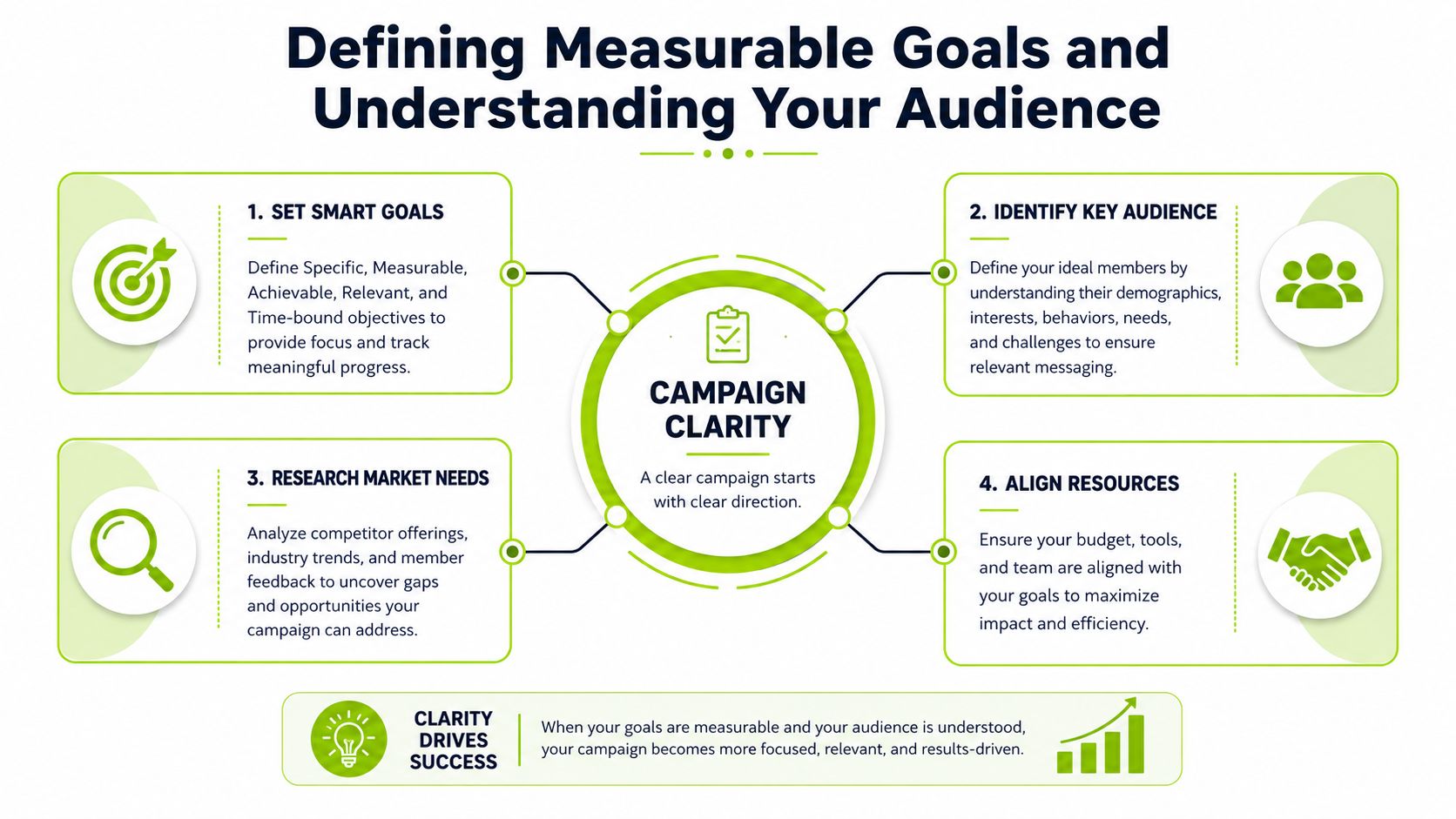
A strong marketing plan starts with a target, not a tactic. The Australian Golf Industry marketing guidance says clubs should define where they are now, what's happening with members and visitors, what competitors are doing, what they want to achieve, how stakeholders will support it, what budget is available, and how success will be measured (source).
Start with measurable outcomes the club can count
A private club might need to replace departing members, improve waiting-list quality, or increase midweek use. A resort or multi-purpose venue may care more about enquiries, trial rounds, and event bookings. Choose one primary business outcome first, then build the marketing around it.
That choice gives the committee a shared reference point. Without it, every campaign gets judged through a different lens, which usually leads to weak decisions and a lot of noise.
Identify the members you're not speaking to properly
The most common messaging mistake in golf club marketing is the default appeal to the “serious golfer”. That message may still have a place, but it does not reflect the full market.
UK demographic evidence points to a bigger opportunity among time-poor, family-first golfers. The ONS reported that in 2025 only 47% of adults in Great Britain were living in a couple with children under 16, while more adults were in one-person households or non-traditional setups than older club messaging often assumes (GolfN insight). That matters because many prospects are not weighing clubs on prestige alone. They are looking at whether the club fits school runs, work patterns, family time, and flexibility.
A club should answer practical questions in its content, not just promotional ones.
- Can I join if I only play once a week? That speaks to flexibility.
- Is there junior access or family social value? That speaks to household fit.
- What membership structure suits variable work patterns? That speaks to relevance.
- Can I understand the offer quickly on mobile? That speaks to convenience.
Why this matters before any campaign goes live
When the audience is defined properly, the club can write better landing pages, choose better follow-up messages, and spend less time guessing. It also stops the committee from forcing every prospect into the same mould.
The strongest planning gives the club a clear outcome, a clear audience, and a message that matches how people now evaluate clubs.
Building a Data-Led Capture System Across Your Website
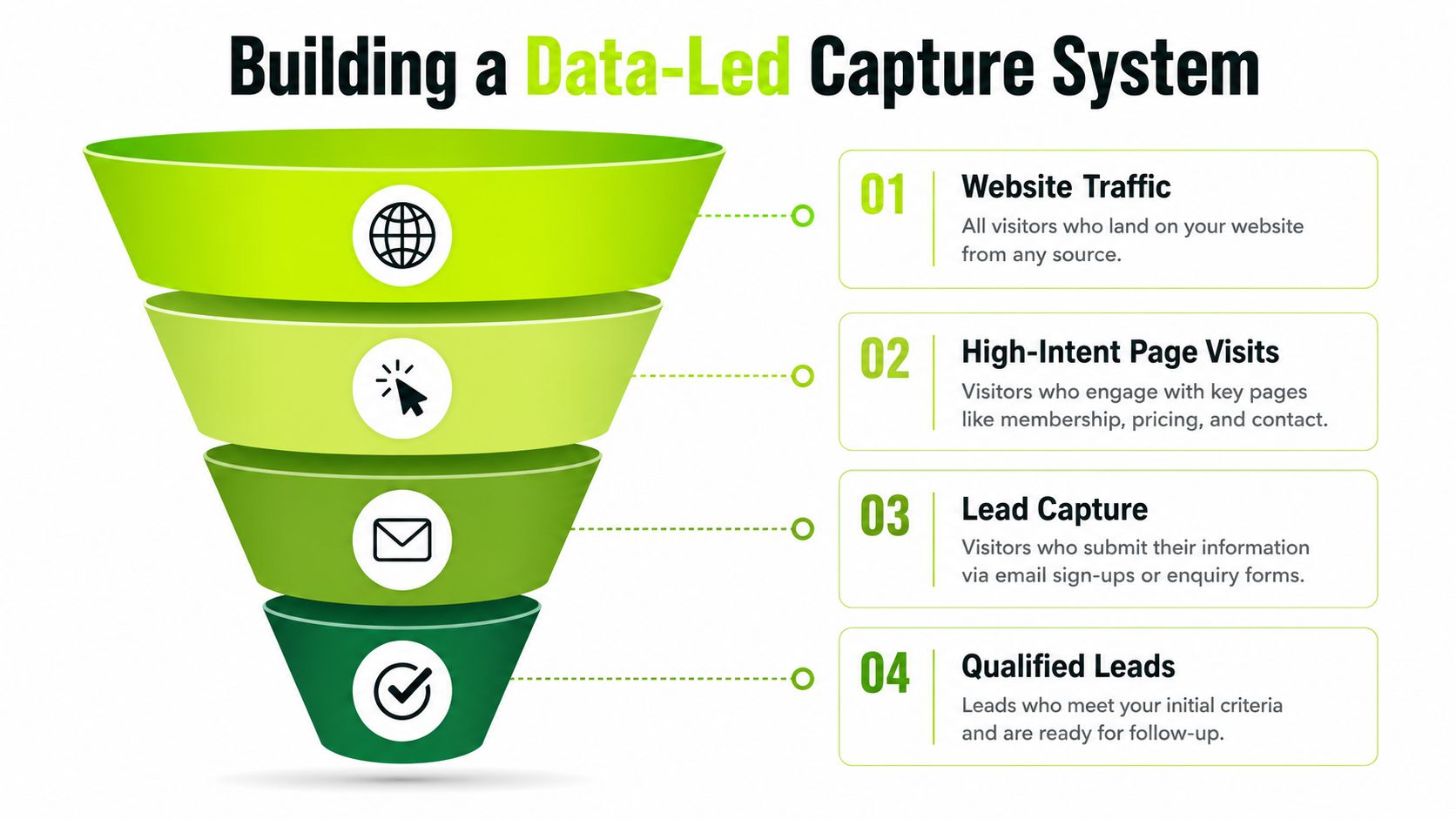
A club website should work as a lead engine across the day, because most clubs lose enquiries after the visitor has already shown interest. The problem is rarely traffic alone. It is the way the site handles capture, attribution, and follow-up once someone has raised their hand.
GolfRep's database marketing guidance says clubs should place at least five distinct capture opportunities across key pages, including membership availability, special offers, coaching days, pro-shop offers, and monthly competitions, because it improves the odds that high-intent visitors self-identify before they leave the site (GolfRep guidance).
Put capture points where intent is already high
The mistake most clubs make is leaving one generic enquiry form in the footer and expecting it to carry the whole site. That misses the moment when a visitor is ready to act. A membership page should have a membership-specific form. A coaching page should have a coaching enquiry route. A special offer should carry a call to action tied to that offer.
Every high-interest page needs a clear reason for the visitor to raise their hand.
That does not mean asking for too much data too soon. It means making the route to contact obvious, relevant, and easy to complete on mobile.
Make the CRM the single source of truth
Every form, email capture point, and enquiry route should flow into one record. That record needs source attribution, so the club can tell whether a lead came from membership content, a promotion, a coaching page, or a social click. Once that is in place, staff can see which pages produce enquiries and which ones only attract browsing.
Good capture is invisible to the visitor and visible to the team.
Clubs that want to improve website conversion can start with how to improve website conversion, then decide how to connect forms, contacts, and follow-up without creating extra work for staff.
This also sets the standard for measurement. GolfRep's database guidance says modern golf marketing should be judged by actions such as membership sign-ups, tee-time bookings, equipment purchases, and event registrations, rather than clicks or impressions (GolfRep guidance). That is the right yardstick for clubs that want to know whether the site is producing revenue, not just attention.
What to avoid
A lot of clubs still treat website traffic as success. That is the wrong signal. Traffic matters only if it turns into captured, qualified, trackable demand. If the website cannot do that, it is not yet an acquisition system.
GolfRep's practical view is that the website should show who is interested, where they came from, and what happened next. That gives a club better decisions on content, offers, and follow-up.
Qualifying Leads Instantly with Automation

A membership enquiry doesn't need a perfect sales script in the first minute. It needs acknowledgment, clarity, and a route to the next step. The UK response benchmark of 47 hours and 32 minutes makes one thing clear, clubs that rely on manual replies are competing with time itself (GolfRep analysis).
The first response should do three jobs
It should confirm the enquiry arrived. It should tell the prospect what happens next. It should move the conversation towards a visit, call, or quick qualification step.
That first touch doesn't need to be long. It does need to be immediate and specific. A generic “thanks, we'll be in touch” message usually wastes momentum because it doesn't help the prospect understand timing or expectations.
Route different enquiries to different people
A membership prospect, a society organiser, and someone asking about coaching are not the same lead. They shouldn't be handled by the same default process. The CRM should route each enquiry type to the right owner, so the right person can respond without delay.
That's where automation protects the team. It handles the instant acknowledgment, creates the task, and keeps the lead warm until a person steps in. For clubs considering AI-assisted qualification and appointment setting, the close deals with AI voice agents resource gives a useful wider view of how automated voice can support speed and consistency.
Practical rule: automation should buy time for staff, not replace the human conversation.
GolfRep's own approach to this problem is built around lead capture, qualification, follow-up, and pipeline visibility, including automated emails, SMS, reminders, and staff tasks. Clubs can read more in AI lead qualification for golf clubs, but the core principle is straightforward. No enquiry should sit untouched while someone “gets round to it”.
What a good automated first response includes
It should use the prospect's name where possible, reference the enquiry type, and offer a simple next action. That might be a link to book a call, arrange a tour, or choose a visit slot. It can also answer the basic questions that often stop people from replying, such as opening hours, who they'll speak to, or what information they should bring.
The aim isn't cleverness. It's momentum.
If the club can combine instant acknowledgment with clean routing and quick human follow-up, it stops losing prospects during the most fragile phase of the journey. That's where a lot of membership revenue is won or lost.
Nurturing Prospects Through to Booked Visits and Sign-Ups
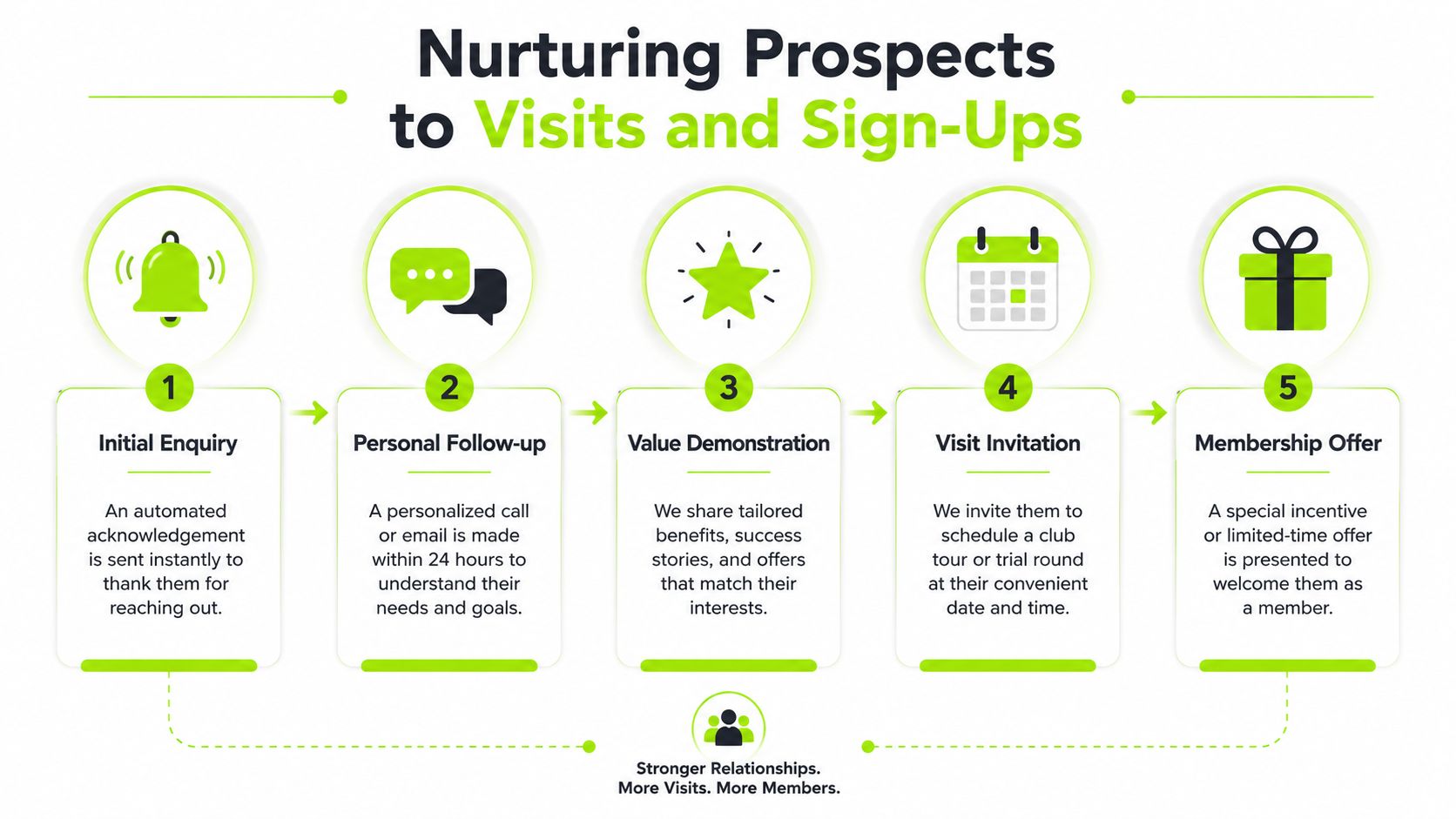
Many golf clubs keep chasing more traffic while the core problem sits in plain sight. They already have enquiries. What they lose is the conversation after the first response, the follow-up that keeps interest warm, and the booking process that turns a curious prospect into a visit.
Segment by interest, not just by contact status
A useful nurture flow starts with why someone got in touch. Membership interest needs a different response from social interest, lesson interest, or a past enquiry that has gone quiet. Once the database reflects those differences, communication feels relevant instead of generic, and the club stops sending messages that people ignore.
Industry guidance from the National Golf Course Owners Association says proactive email marketing should be sent frequently, as much as weekly, to a loyalty-built database (GolfRep ROI guidance). The point is not to blast every prospect with the same volume. It is to keep the club visible to people who have already shown intent, while matching the cadence to the level of interest.
Move prospects through a clear sequence
A strong sequence usually begins with an acknowledgement, then a personal follow-up, then useful content that answers the questions the prospect has not yet asked directly, then an invitation to visit. After that comes a membership offer or next-step prompt that fits the level of engagement.
The sequence should reduce hesitation. It should not create pressure.
If the club wants a practical model for message timing and progression, the onboarding email sequence best practices resource is a useful reference point for how structured email journeys support confidence and action.
Keep the messages personal enough to matter
A prospect should feel that the club understood what they asked for. Relevance, recognition, and a plain human tone do that work. If someone asked about flexible membership, the follow-up should address flexible use directly. If they asked about family fit, the reply should speak to family use without drifting into generic brochure language.
A visit invitation works best when it is easy to accept. A trial round, a tour, or a conversation with the membership lead gives the prospect a concrete next step. Once that visit is booked, the nurture process changes from persuasion to reassurance.
Clubs lose fewer interested golfers when they stop relying on the first enquiry to close the sale. A structured follow-up sequence keeps the conversation moving until the prospect is ready to act.
Tracking Metrics That Drive Membership Revenue
A club cannot improve what it cannot see. Budget, attribution, and conversion tracking matter more than marketing activity on its own, because activity does not pay the bills unless it turns into enquiries, visits, and joins.
Industry guidance for golf clubs commonly recommends allocating 5% to 7% of gross revenue to marketing, with 10% or more suggested for new launches or aggressive growth phases (GolfManager guidance). The figure matters less than the discipline behind it. Marketing needs a planned budget, a defined purpose, and a clear way to show what it generated.
The framework belongs in the CRM, not in a spreadsheet alone
Every enquiry should be tied to a source, a stage, and an owner. That gives the club a clean view of which pages, campaigns, or channels create real opportunities, and which ones only create noise. It also makes it easier to compare response speed, visit bookings, and membership conversions over time.
| Metric | What It Measures | Target Benchmark |
|---|---|---|
| Enquiry response time | How quickly the club acknowledges and follows up | Faster than the UK average of 47 hours and 32 minutes (GolfRep analysis) |
| Source-level conversion rate | Which channels produce real enquiries and sign-ups | Measured by channel, not in aggregate |
| Visit-to-member ratio | How effectively visits convert into joins | Tracked per campaign and offer type |
| Renewal tracking | Whether retention activity protects recurring revenue | Reviewed alongside membership communication |
| Data completeness | Whether records contain source and owner details | Every key enquiry should be traceable |
| Campaign outcome tracking | Whether activity leads to bookings or sign-ups | Measured against actual conversion events |
Watch the traps that distort performance
One common failure is sending the same message to every member or prospect. Another is poor data hygiene, which leaves the CRM full of duplicates, missing fields, and unclear ownership. A third is measuring reach while ignoring bookings.
Clubs should measure return through enquiries and conversions, as noted earlier in GolfRep ROI guidance. That is the standard a committee can use to see where money is working and where it is being wasted.
Build a reporting rhythm the club can trust
Reporting should be regular, simple, and tied to the actual decisions the club needs to make. If a campaign generated interest but not visits, the issue may be the offer, the follow-up, or the page experience. If response time is slow, the issue may be staffing or workflow, not creative.
The best dashboards do more than show activity. They make the lost revenue visible when enquiries sit untouched or follow-up stalls.
Real Club Blueprints That Prove the System Works
Bidston Golf Club is a clear example of what changes when a club stops relying on hope and starts running a structured growth system. GolfRep reports that Bidston was brought back from near-closure, doubled membership, and built six-figure recurring revenue by combining acquisition, follow-up, and pipeline control.
The result did not come from a single advert or a lucky campaign. It came from tightening the path from enquiry to visit to sign-up.
Centralised CRM changes the operating rhythm
At Macdonald Hotels & Resorts, GolfRep centralised CRM activity and automated follow-ups across sites. The value of that setup is straightforward, each site no longer has to improvise its own process, and leadership can see what is happening across the group. That matters when multiple venues are competing for the same attention, budget, and management time.
The clubs that scale well do not ask staff to remember everything. They design the system so staff do not have to.
Addington Palace shows a different blueprint, steady pipeline growth built through consistent handling rather than splashy promotion. Downes Crediton shows that rapid, profitable membership growth can happen without discounting when the offer, follow-up, and conversion path are aligned.
The common thread
Each of these examples points to the same operational truth. The win is not merely acquiring enquiries, it is making them visible, actionable, and measurable. Once a club can do that, the same marketing spend usually works harder.
That is why GolfRep's work sits at the intersection of lead generation, automation, and CRM. Clubs do not just need more interest. They need a system that turns interest into visits and visits into recurring membership revenue.
If you want a clearer handle on why enquiries are slipping through the cracks, GolfRep can help you map the full path from first click to signed membership and show where the handover is breaking down. Visit GolfRep to see how the Fully Booked Blueprint builds a predictable pipeline for UK golf clubs.
Ready to tap into our proven growth system?