What Is Pipeline Management for Golf Clubs

More enquiries won't fix a golf club's membership problem if the club can't handle the enquiries already arriving. That advice is uncomfortable because marketing is visible, while follow-up is usually scattered across inboxes, phone notes, spreadsheets and the memory of whoever happened to answer the call.
At GolfRep, we've seen the same operational pattern across clubs. A campaign creates interest, a prospective member asks about joining, and then the opportunity moves between the secretary, general manager, membership chair and golf operations team without a clear owner. The club believes it has a marketing problem. In reality, it has a pipeline management problem.
In the UK, the consequences of disorganisation have been documented clearly. A 2018 survey reported that 26% of sales teams still relied on pen and paper to manage their pipeline, while 1 in 4 companies lost sales by failing to follow up with leads, with respondents estimating an average monthly loss of almost £15,000 from disorganisation and inaccuracies. These figures come from research into disorganised and inaccurate UK sales activity, but the operational lesson applies directly to membership enquiries.
The Real Growth Problem at Most Golf Clubs
A club can generate plenty of interest and still struggle to grow. The enquiry is only the beginning. The commercially important work starts when someone asks about membership, requests a joining pack, books a trial or wants to visit the course.
Consider a typical introductory campaign. The club receives 40 enquiries, but nobody has agreed how those enquiries should be handled. One staff member replies with pricing. Another promises a call. A volunteer records names in a spreadsheet. Someone else sends a membership PDF without booking a next step. The club reports healthy demand, yet only a small number of prospects attend a visit.
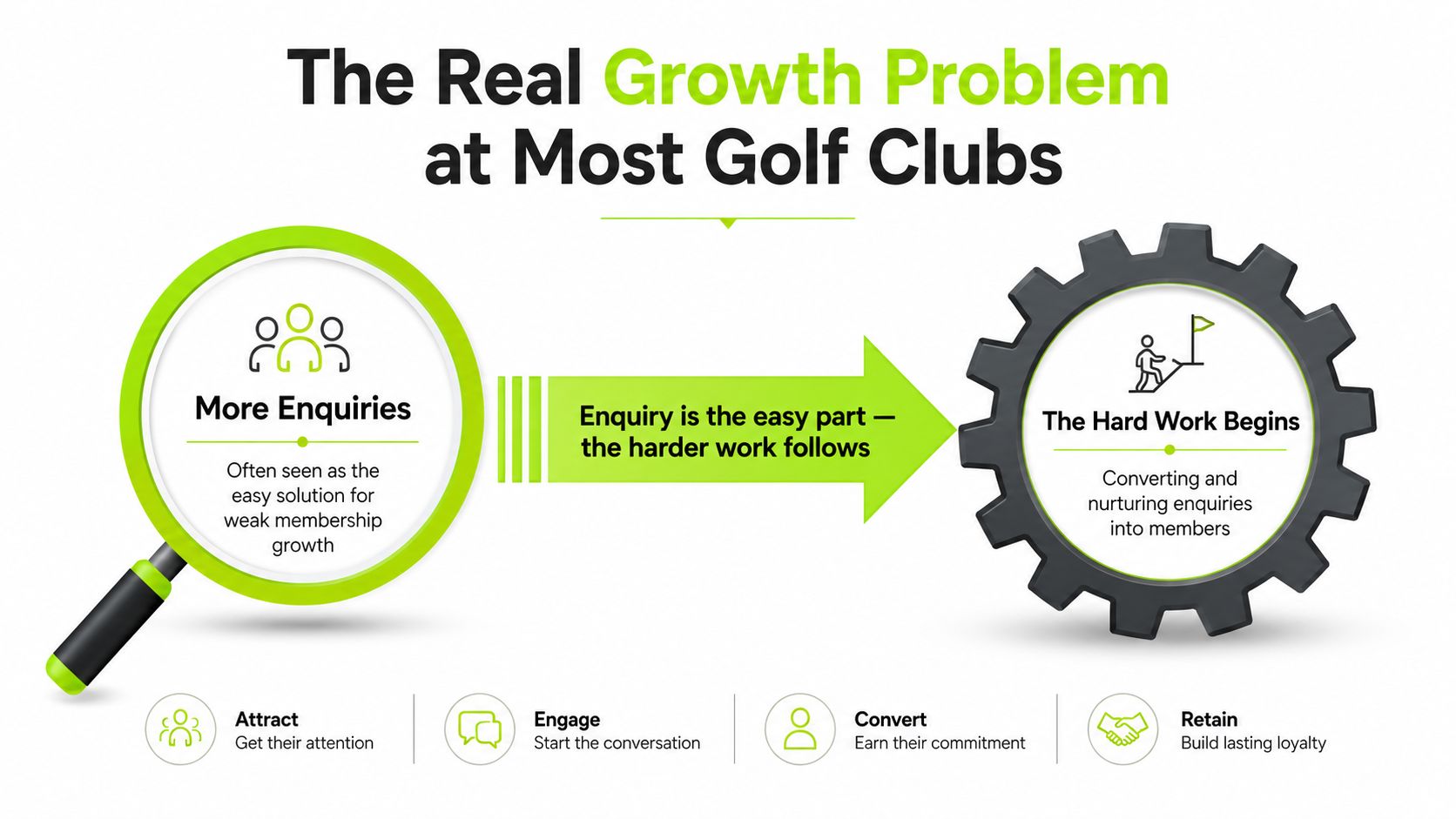
The issue isn't effort. People at clubs work hard, often while covering several responsibilities. The issue is that each person follows a different process, or no process at all. An enquiry can sit in a personal inbox while someone is on annual leave, or remain marked as “interested” for weeks with no recorded next action.
Enquiries need ownership
Pipeline management gives every opportunity three basic controls:
- Visibility: The club can see every active enquiry in one place.
- Ownership: One named person is responsible for moving it forward.
- Next action: The record states what must happen next and when.
That structure exposes practical bottlenecks. Perhaps tours are offered only during working hours. Perhaps the membership chair must approve applications but meets infrequently. Perhaps the club sends information promptly but never asks the prospect to book a visit.
Practical rule: If a prospect's record doesn't show an owner and a next action, the club doesn't have a managed opportunity. It has a contact detail.
Marketing creates attention. Pipeline management turns that attention into a conversation, a visit, an application and eventually a paid membership. It also gives committee members a more honest view of growth because they can see where prospective members are disappearing, rather than relying on enquiry totals.
The objective isn't to turn club staff into aggressive salespeople. It's to make the joining experience organised, personal and easy to use. A prompt response, a suitable tour time and a clear follow-up can communicate more about a club's professionalism than another promotional post.
What Pipeline Management Actually Means
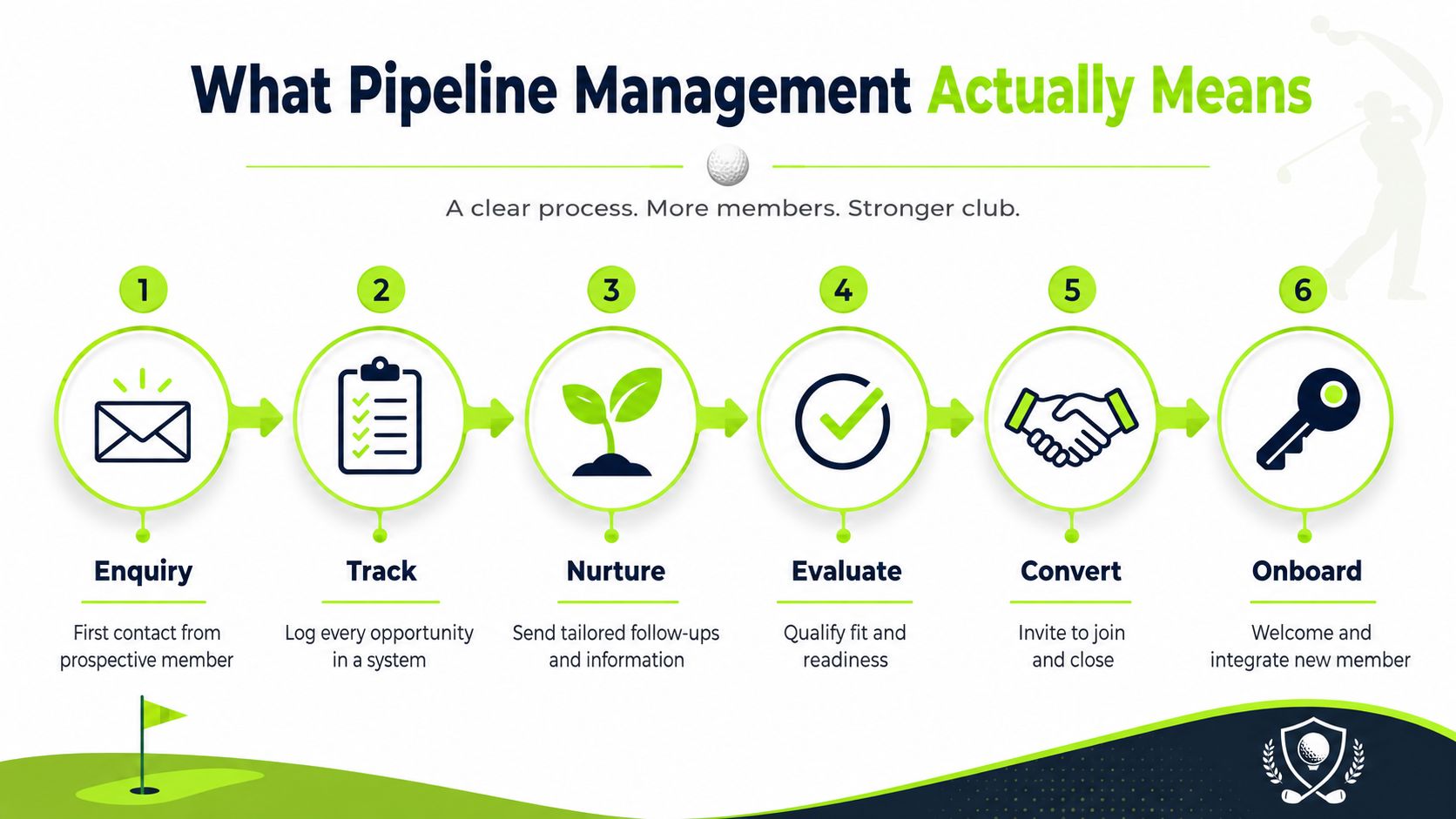
Pipeline management is the structured process of organising, tracking and improving prospective members as they move through defined stages from first contact to joining. It answers practical questions that a list of names cannot answer:
- Who has enquired?
- Who has replied?
- Who needs a call?
- Who has booked a visit?
- Who is waiting for an application?
- Which opportunities have stalled?
- Who is responsible for the next step?
A useful golf club pipeline follows the membership journey, not a generic sales template.
The stages should reflect member behaviour
A practical sequence could look like this:
- New enquiry: A prospective member contacts the club through a form, phone call, social message, email or walk-in.
- Qualified enquiry: The club understands the prospect's needs, preferred playing pattern, location, family circumstances and likely membership category.
- Visit or trial booked: The prospect has a confirmed date, time and named club contact.
- Visit or trial completed: The club records what was discussed, what interested the prospect and what questions remain.
- Application sent: The prospect has the relevant information, pricing and application route.
- Application approved or joined: The opportunity reaches a clear membership outcome. Onboarding and renewal should then sit in separate processes.
“Interested in joining” is too vague to manage. “Tour booked”, “trial completed” and “application sent” create accountability because each stage has a visible meaning.
Every handoff needs an agreed standard
A prompt acknowledgement should confirm that the enquiry has reached the club. A qualified prospect should receive information relevant to their situation, rather than an indiscriminate document dump. A booked visit should be confirmed, and the club should know whether the prospect attended.
The same discipline applies after the tour. Someone must follow up while the conversation is fresh, record any objection and set the next action. A good pipeline doesn't pressure a prospect. It prevents the club from forgetting them.
For clubs refining their process, this practical resource on improving sales velocity with Double My Leads offers useful context on how opportunities move through a managed journey. The principle is straightforward: the club should always know what happened, what happens next and who will make it happen.
The KPIs That Predict Membership Revenue
Website visits, social impressions and membership-pack downloads can help diagnose interest, but they don't pay a joining fee. A golf club needs to measure movement towards membership revenue, not just activity at the top of the funnel.
Start with response time. A prospective member who receives a useful reply promptly has a better chance of continuing the conversation than someone who waits while the club searches for the right person. Research into lead response found that nearly 10% of firms replied within 5 minutes, while more than 46% replied within an hour. The UK lead response study makes response speed a measurable operational issue for golf clubs, not an administrative preference.
A separate widely cited study reported that contacting an enquiry within 5 minutes made businesses 21 times more likely to qualify the lead than waiting 30 minutes, with qualification falling sharply after an hour or more, as described in this lead response time analysis.
Track the journey, not isolated activity
The core dashboard should include:
| KPI Group | Metrics to Track | What It Reveals |
|---|---|---|
| Volume | Active enquiries by source and membership category | Where current demand comes from |
| Velocity | Response time and time in each stage | Where delay is reducing momentum |
| Conversion | Contact, visit booking, attendance, application and joining rates | Where prospects drop out |
| Value | Expected first-year membership value and pipeline value | Which opportunities matter commercially |
A simple planning formula is:
Qualified enquiries × conversion rate × average first-year membership value = expected membership revenue.
Use transparent assumptions. A family membership, weekday category and junior pathway won't have the same value or buying journey. Report active opportunities weekly, then review broader trends monthly.
The GolfRep guide to measuring marketing effectiveness is useful when a committee wants to distinguish marketing activity from commercial outcomes. The central question is not whether a campaign generated attention. It's whether the club can trace that attention through visits, applications and paid memberships.
A rising response time combined with a falling application rate is an early warning. It may indicate limited staff capacity, weak follow-up, inconvenient tour availability or friction in the joining process. Compare the club with its own previous performance rather than chasing arbitrary external benchmarks.
CRM, Automation and the Case for Systems Over Spreadsheets
A spreadsheet records activity. It does not run a live membership pipeline.
Rows go stale, notes lose context and different team members create competing versions. Email threads remain in personal inboxes. When the secretary takes leave, the club may know a prospect exists without knowing what was promised, who owns the next call or when that action is due. That is the operational gap pipeline management must close after the enquiry arrives.
Poor data also weakens any CRM. A 2026 UK business survey reported low trust in CRM data, widespread inaccuracy and substantial time spent on non-selling tasks, with some users reporting revenue loss linked to poor data quality, as outlined in this UK pipeline management explainer. The lesson for a club is practical: a system only helps if the team keeps records current and uses the same process.
The minimum useful record
Every enquiry should contain:
- Source: Website, phone, social media, referral or walk-in.
- Stage: The prospect's current position in the membership journey.
- Last contact: What the club and prospect discussed.
- Next action: A specific task, such as calling after a tour, not “follow up”.
- Owner: The person accountable for completing it.
A CRM should gather enquiries from the channels the club uses, display membership status clearly and give the secretary, GM and membership committee one shared view. For a practical outline of the information a club CRM should manage, use this GolfRep guide to golf club CRM systems. The pipeline should show each opportunity, its owner, stage, next action and blocker, consistent with this CRM pipeline visibility guidance.
Automation must support judgement
Automation should remove repetitive admin while leaving the relationship with a person. Useful examples include an immediate enquiry acknowledgement, a reminder before a booked tour, a three-day or seven-day follow-up prompt and a post-visit nurture sequence. Generic messages sent to the wrong stage create more work and make the club feel careless.
A CRM without automation leaves avoidable tasks with the secretary. Automation without CRM context sends irrelevant messages. The club needs shared records, sensible automation and human follow-up working together.
Clear stages and one source of truth are also central to this CRM workflow guidance for centralised lead management. GolfRep can provide this operating model through GolfRepOS CRM, giving clubs one place to receive, qualify, assign and progress membership enquiries.
How to Build a Membership Pipeline in Your Club
A club doesn't need a lengthy transformation programme. It needs a process that a secretary can run during a busy week and that a committee can understand without technical training.
Start with the evidence
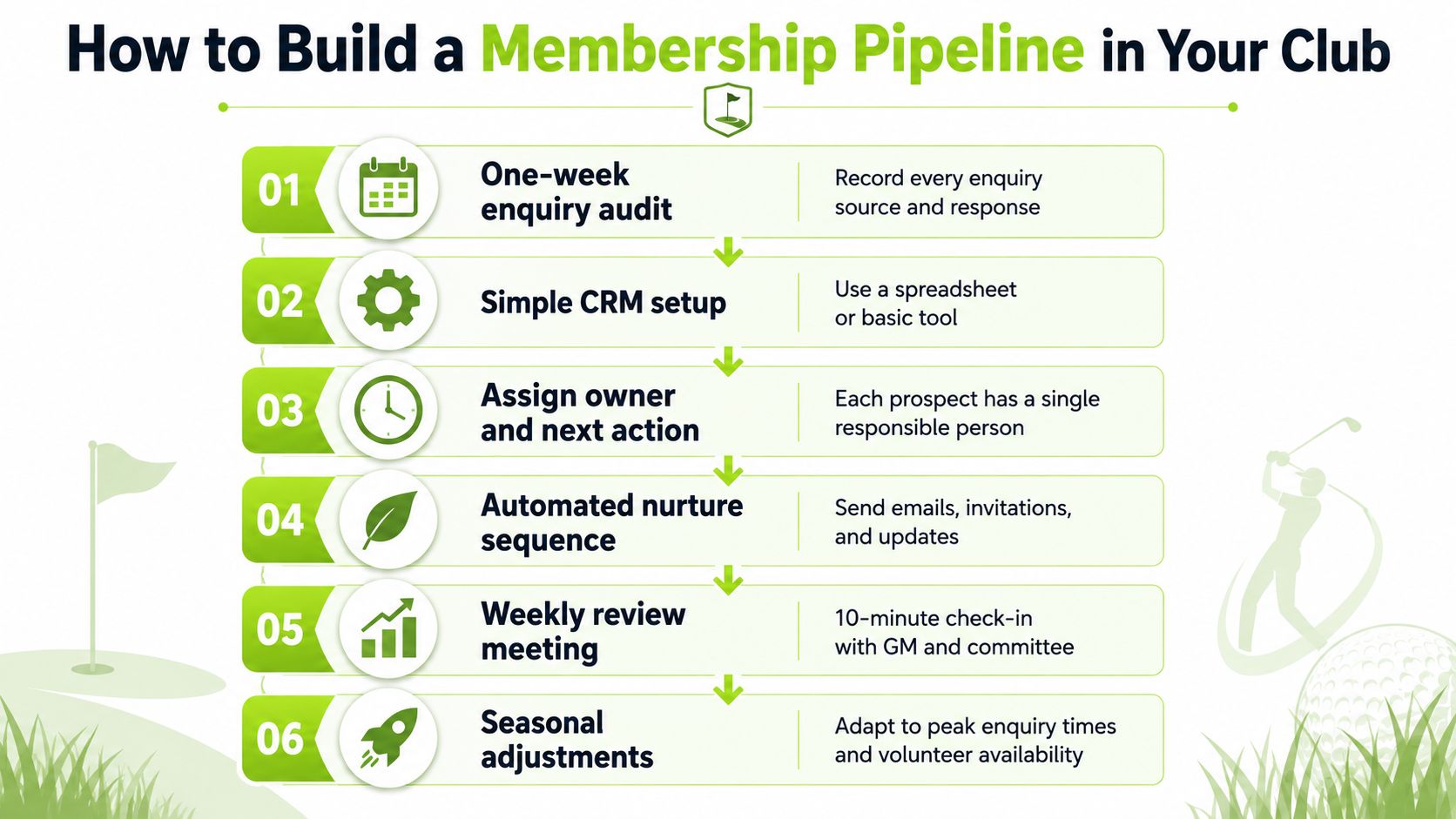
Step one is a one-week enquiry audit. Pull recent contacts from website forms, phone logs, emails, social messages and walk-ins. Record the date received, response date, current status and outcome. Don't judge the team while doing this. Find the points where enquiries stop moving.
Step two is stage definition. Choose four or five stages that match the club's actual journey. For example:
- New enquiry
- Tour booked
- Tour completed
- Application sent
- Member
Write an exit rule for each stage. “Tour booked” means the prospect has agreed a date and time. “Application sent” means the correct information has been delivered and the next decision is known.
Add the system around the process
Step three is CRM selection and setup. Choose a system a non-technical secretary can use confidently. Connect the enquiry sources that matter, then create the required fields, owners and stages before importing old contacts.
Step four is focused automation. Start with a small number of sequences:
- Immediate acknowledgement after an enquiry
- Follow-up after a few days if no conversation has occurred
- Tour confirmation and reminder
- Post-tour information and invitation to take the next step
Don't build dozens of workflows before the team understands the basics. Automation should remove predictable admin while leaving personal decisions with staff.
Make review part of normal club management
Step five is a weekly pipeline review. A short meeting with the GM and membership chair should focus on stalled enquiries, upcoming tours and applications waiting for action. Don't read every record aloud. Discuss exceptions and assign specific tasks.
Step six is a monthly committee report. Show conversion rate, cost per new member and pipeline value by source, using clearly stated assumptions. This allows future marketing spend to follow evidence rather than instinct.
The GolfRep guide to building a golf club sales pipeline provides a useful framework for connecting enquiry generation with structured progression. The process should adapt to seasonal demand and volunteer availability, but the ownership rules must remain consistent.
What Good Looks Like in Practice
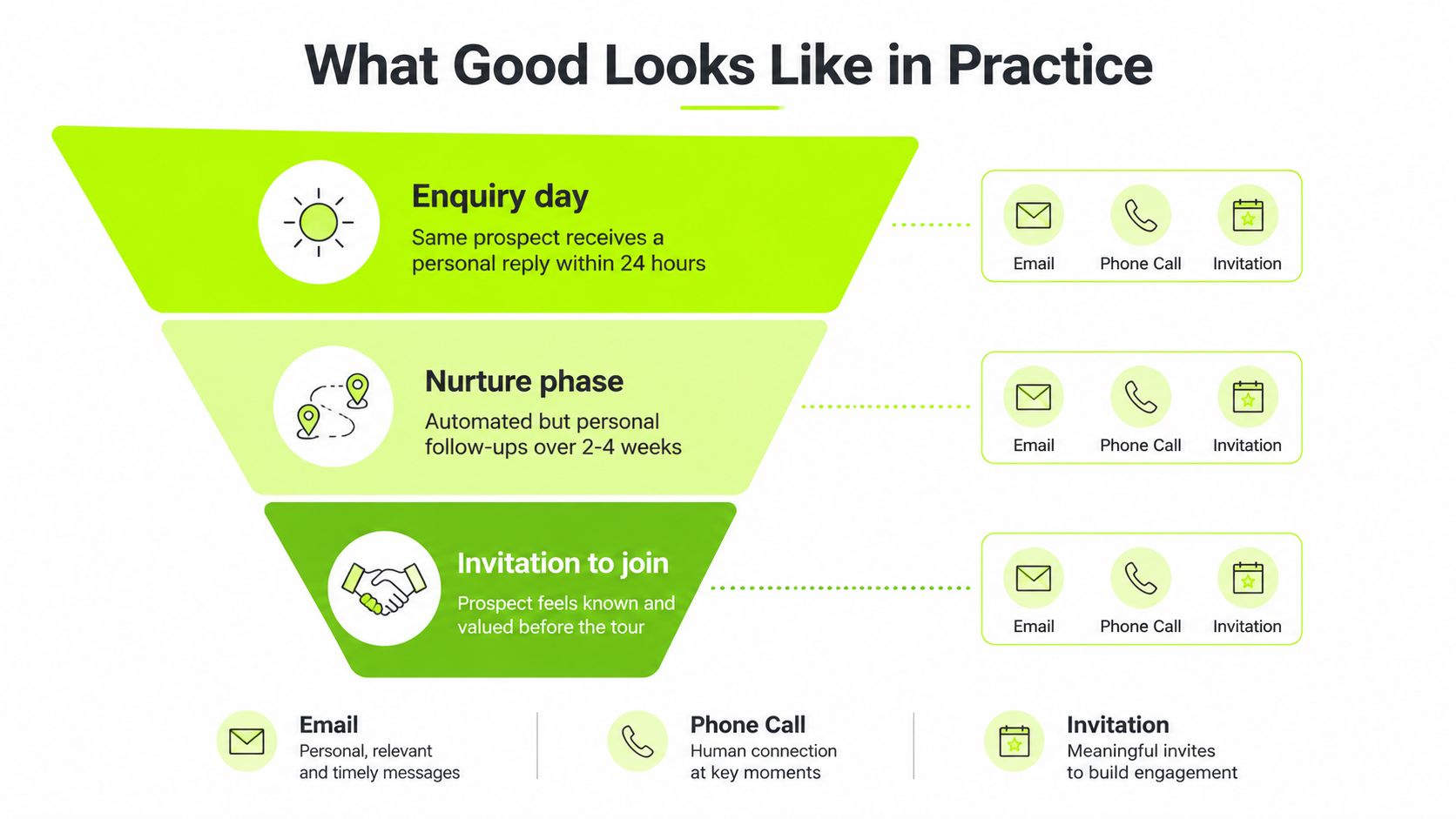
A well-managed enquiry day feels calm, even when demand is busy. The prospect receives a personal reply within hours, the message answers the question they asked and the next step is clear. If a visit is appropriate, the club offers a suitable slot rather than leaving the prospect to chase availability.
The membership manager arrives at the tour prepared. They know the prospect's handicap, family situation, preferred playing pattern and the membership category discussed online. That preparation doesn't make the interaction scripted. It makes the conversation feel attentive.
The pipeline remains visible after the visit
After the tour, the system records the conversation, questions and agreed next step. A relevant follow-up can then run automatically, while a staff member intervenes where the prospect has a specific concern about fees, playing rights, family access or committee approval.
Some clubs set internal targets such as an enquiry-to-tour rate above 50% or a tour-to-application rate above 35%. Those are operating targets, not universal benchmarks, and they should be treated as club-specific measures rather than guaranteed outcomes.
The important improvement is visibility. A committee can see how many prospects are active, which stage contains the greatest number of stalled records and whether applications are being handled promptly. It can also distinguish a trial visit from a conversion. A trial is a meaningful step, but it isn't a member.
Without that discipline, the club has a busy inbox, occasional walk-ins and no shared view of how the year is tracking. Consistent execution over several months creates a more dependable picture of membership demand. It also gives the team a way to improve the joining experience without relying on guesswork.
Common Pipeline Mistakes Clubs Still Make
The same failures appear repeatedly, and none requires a major strategic error. They are small operational choices that become expensive when repeated.
- Delayed replies: A response measured in days gives enthusiasm time to disappear. Set an owner and a response standard that staff can meet.
- Personal inboxes: If the only record sits with one employee, holiday cover becomes a revenue risk. Move enquiries into a shared system.
- Stale spreadsheets: A spreadsheet records information, but it rarely enforces the next action. Require a current stage, owner and deadline for every open opportunity.
- Treating trials as wins: A visit is progress, not conversion. Keep the prospect active until they apply, join or clearly decide not to proceed.
- Unclear handoffs: A secretary may send the pack while the PGA professional expects to make the call. Agree who owns each stage before the next campaign begins.
- No closure reason: An opportunity that disappears without an outcome teaches the club nothing. Record whether the prospect joined, deferred, chose another club or stopped responding.
- Confusing pipeline and membership: Prospects belong in the pipeline. Paid members belong in the membership records. Mixing the two makes both views unreliable.
A club doesn't need more goodwill from staff. It needs fewer opportunities that depend on memory.
The fix is straightforward: centralise the record, define stage criteria and review stalled opportunities. A simple process followed consistently will outperform an advanced system that nobody trusts.
Turning This Into a Predictable Membership Pipeline
Use the next 30 days to make five decisions.
Agree the stages. Write down the membership journey from new enquiry to joined member. Keep the language specific enough that two people would place the same prospect in the same stage.
Choose the CRM. Pick a system that captures enquiries, assigns ownership, records contact history and shows the next action. If the team can't use it during a normal working day, it won't become the club's operating system.
Set the KPI list. Review response time, active opportunities by stage, visit attendance, applications and joining outcomes. Add value by source once the underlying data is reliable.
Assign responsibility. Every new enquiry needs one owner. Others can support the process, but shared responsibility without a named person usually means nobody acts.
Book the review meeting. Put a short weekly pipeline review in the calendar and a monthly committee report on the governance schedule. Look at stalled prospects and upcoming actions, not just headline enquiry volume.
Pipeline management isn't a one-off software project. It's the club's ongoing method for making interest visible, moving prospects forward and learning where the joining experience loses momentum. The clubs that manage it well don't necessarily create the most noise. They respond consistently, prepare properly and make sure every genuine opportunity receives a fair chance to become a member.
GolfRep helps UK golf clubs build predictable membership pipelines by combining lead generation with structured follow-up, CRM visibility and automated nurture. If your club wants to see where enquiries are being lost and put a practical system around the opportunities already arriving, visit GolfRep to start the conversation.
Ready to tap into our proven growth system?