How to Measure Marketing Effectiveness for Golf Clubs

More enquiries don't automatically mean better marketing. A club can attract plenty of form fills, clicks and phone calls, yet still finish the month with the same membership total because the leak sits after the enquiry arrives.
That's why how to measure marketing effectiveness for a golf club starts with the operating process, not an attribution dashboard. The useful questions are practical. How quickly did someone respond? Was the prospect suitable for the club? Did they book a visit, submit an application and eventually join? Could the team trace that journey back to its source?
Marketing measurement also needs to reflect the three connected effects identified in the IAB Europe digital advertising effectiveness measurement framework: media effectiveness, brand effectiveness and sales effectiveness. For a golf club, those layers only become useful when they connect to a visible, well-managed enquiry pipeline.
Why Enquiry Volume Is the Wrong Place to Start
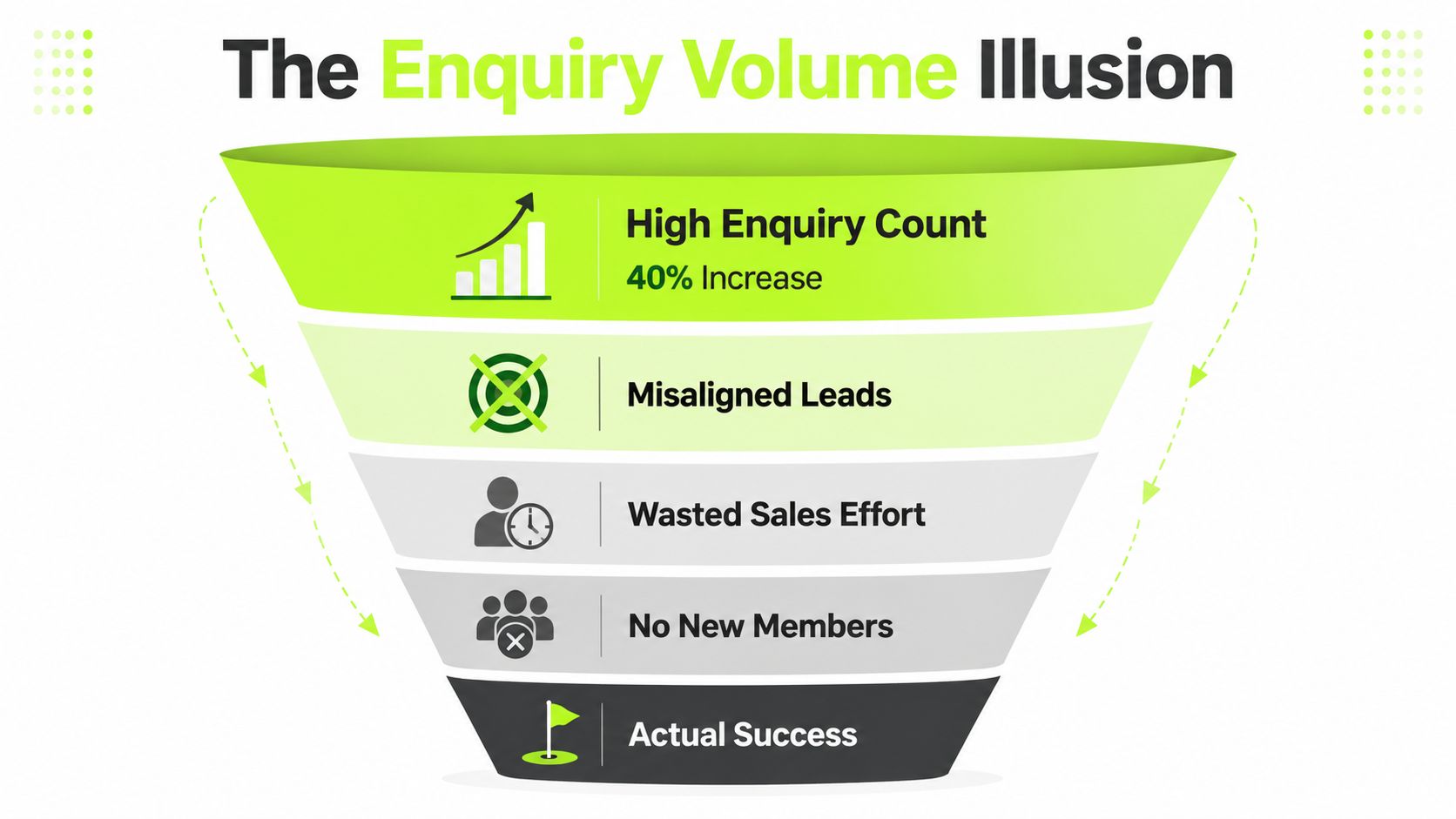
A committee sees website enquiries rise in March and celebrates. A few weeks later, membership conversions remain flat, tours haven't increased and the marketing budget comes under scrutiny. The problem may not be the campaign. It may be that staff responded slowly, leads weren't qualified, or nobody recorded what happened after the first contact.
The exact number of additional enquiries matters less than the stages those enquiries pass through. Volume is an entry metric, not a success metric. It tells you that people took an initial action, but it doesn't tell you whether they were suitable prospects, whether the club contacted them, or whether they moved towards membership.
The marketing ROI measurement guide is useful background for separating activity from commercial outcomes. For clubs, that distinction means moving beyond clicks and form submissions to measure the full route from first contact to signed application. GolfRep's guide to improving lead quality is relevant here because a smaller number of well-matched enquiries can create less work and a healthier pipeline than a larger volume of poorly aligned prospects.
Start after the form is submitted
A useful measurement path includes:
- Response: How long did the prospect wait for acknowledgement or personal contact?
- Qualification: Did the club record playing needs, location, budget fit and preferred membership category?
- Visit: Did the enquiry become a tour, open-day booking or conversation with the membership lead?
- Application: Did the prospect submit an application or reach a defined joining stage?
- Outcome: Did they join, remain in nurture, or become a documented lost opportunity?
Those stages expose where the pipeline breaks. If enquiries are high but tours are low, the club may have a qualification or follow-up problem. If tours are healthy but applications remain weak, the issue may sit in the visit experience, offer clarity or internal sales process.
A reliable system should let the committee ask, “What happened to every enquiry?” and receive an answer without searching inboxes, spreadsheets and front-desk notes. That's the foundation for measuring effectiveness.
Set the Objective and Choose Your Core KPIs
Start with one commercial objective. “Improve awareness” or “generate more leads” gives a team direction, but neither tells the membership manager what success looks like. A stronger objective connects marketing activity to a business result, such as increasing net new members, filling a specific membership category or supporting recurring membership revenue.
The IAB Europe framework separates measurement into media, brand and sales effectiveness, with practical metrics for each layer. A club doesn't need a crowded dashboard. Choose one core KPI per layer, record the baseline and review the same definitions consistently.
Use one measure for each layer
| Layer | Single KPI | Worked Example |
|---|---|---|
| Media | Cost per qualified enquiry | Campaign spend divided by enquiries that meet the club's agreed qualification criteria |
| Brand | Aided awareness or direct brand search | Compare awareness responses or branded search activity against the club's baseline |
| Sales | Membership close rate | Members joined divided by qualified enquiries or completed tours, with the denominator documented |
A club might set an objective of 45 net new full members in 12 months. That figure should then sit above the three KPIs, rather than being hidden beneath a collection of platform metrics. Media reporting can show whether the club is buying suitable attention efficiently, brand reporting can indicate whether the club is becoming more familiar to local golfers, and sales reporting can show whether the commercial process converts that demand.
The calculation doesn't need to be complicated. If a campaign produces 20 qualified enquiries and four members join, the close rate is 4 divided by 20. If the same campaign costs £1,000, cost per qualified enquiry is £1,000 divided by 20. Record the definitions beside the figures, because “enquiry” and “qualified enquiry” shouldn't mean different things in different meetings.
Practical rule: Name one owner for each KPI, keep the definitions visible and discuss exceptions rather than changing the formula whenever a result looks uncomfortable.
Measure lift, not only attributed activity
Last-click reporting can show which interaction appeared closest to a conversion. It can't, on its own, prove that marketing created the membership. The IAB Europe framework treats reach, frequency, awareness and incrementality as distinct parts of effectiveness, so a club should compare campaign results with its baseline and, where practical, use controlled activity.
The objective comes first. The KPI follows. The reporting format comes last.
Instrument Every Enquiry Source into Your CRM
A club can't measure a journey it hasn't recorded. Website forms, paid advertising, organic search, telephone calls, walk-ins, member referrals and third-party partners all need to create or update a single CRM record.
Each record should carry a consistent minimum set of fields:
- Source: Google Ads, organic search, member referral, phone, walk-in or partner.
- Campaign: The named promotion, open day or membership offer.
- Status: New, Qualifying, Tour Booked, Applied, Joined or Lost.
- Owner: The person responsible for the next action.
- Next step: The agreed follow-up action and due date.
A practical worked example might look like this. A member referral form enters HubSpot with a hidden referrer ID. Google Ads sends an offline conversion event through a tracked thank-you URL after the club confirms a meaningful action. A front-desk call is logged against the contact record within 24 hours, even if the caller never completed a web form.
The GolfRep golf club CRM guide covers why structured records matter in a sector where enquiries can arrive through several routes. The same principle applies whether a club uses HubSpot, another CRM or a carefully designed system built around its existing software. The tool matters less than the discipline.

Make source data usable
UTM naming should be agreed before campaigns launch. Use stable conventions for source, medium and campaign, and don't allow each staff member to invent their own labels. If call volume justifies the cost, use dedicated phone numbers for important channels. If it doesn't, make manual logging quick enough that staff will do it.
The Mediahawk conversion tracking guidance is a useful reference because conversion tracking needs to include valuable actions such as calls, forms, purchases and enquiries, rather than form fills alone. That broader view is essential for clubs, where a prospect may phone after seeing an advert, visit the reception desk after speaking to a member or make contact through an event.
The CRM should also show missing data. An enquiry without a source, owner or next step isn't merely untidy. It's a measurement gap and a sales risk.
Measure What Happens After the Enquiry Arrives
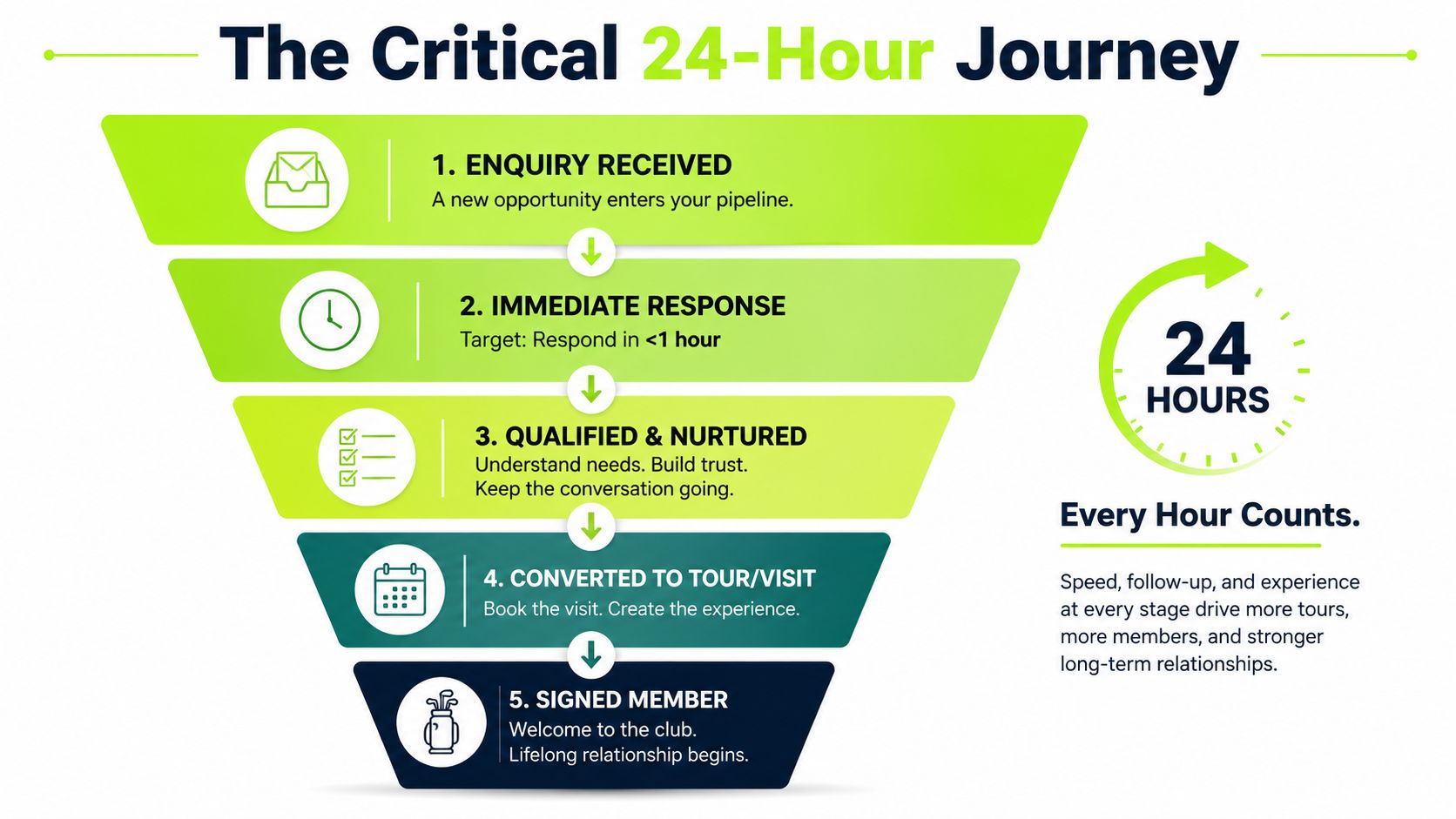
Marketing effectiveness is often decided in the period immediately after an enquiry lands. The advertising platform may have generated the contact, but club staff determine whether that contact receives a useful response, moves into a conversation and reaches a visit.
The GolfRep membership enquiry guidance highlights the operational measures that matter: total enquiries, response time and tour booking rate. A strong acknowledgement should confirm receipt, answer common questions such as membership categories and a pricing guide, and explain who will follow up and when.
Four stages need four measures
Response is the first test. The source citing Harvard Business Review reports that leads are 10 times less likely to respond after five minutes, while conversion rates are 98% higher when follow-up happens within five minutes (source on enquiry response time). Clubs should measure median response time, the share of enquiries receiving a first response within the agreed target and the number left untouched.
Qualification tells the team whether the enquiry fits the club. Record location, playing needs, desired membership category, timing and any relevant budget information. Avoid complicated scoring models unless staff can apply them consistently. A clear status sequence, assigned owner and next action usually create more value than a complex score that nobody trusts.
Conversion covers the steps from contacted prospect to tour, application and joined member. The CRM should show where each prospect sits, not just whether the original form was completed.
Retention completes the commercial picture. A new member who attends an induction, uses the club and remains engaged has a different value from someone who joins but disengages quickly. Connect acquisition records to membership and booking data where the systems allow it.
The ad creates an opportunity. The follow-up process decides whether the opportunity becomes a member.
Link pipeline value to spend
Consider a club that runs two open-day campaigns per quarter, spends £4,000, receives 60 enquiries, converts 12 to tours and gains 5 new members, producing £35,000 in first-year revenue. The pipeline-to-spend ratio is 8.75x, calculated as £35,000 divided by £4,000.
That figure is useful, but it isn't the whole answer. The club should also record cost per enquiry, cost per tour, cost per joined member and the time taken by staff to handle the pipeline. A campaign can look efficient at enquiry level while consuming disproportionate sales effort.
Segmentation adds another layer of clarity. Compare corporate, family and student enquiries by qualification, tour booking, application and joining outcomes. Don't move budget solely because one segment produces more contacts. Move it when the records show that a segment produces suitable prospects and sustainable membership outcomes.
For practical conversion testing ideas, the conversion rate optimisation playbook can help teams think beyond traffic acquisition and inspect the steps that follow the initial response.
Calculate ROI, Lifetime Value, and True Incrementality
Membership marketing has a longer, less predictable route to revenue than an online purchase. Measurement still works, provided the club defines the investment, records what happens after each enquiry and separates observed results from assumptions.
Start with first-year ROI:
(First-year membership revenue minus marketing cost) divided by marketing cost
Using the campaign figures above, £35,000 in first-year revenue and £4,000 in marketing cost produce 8.75x revenue-to-spend. Net ROI is (£35,000 minus £4,000) divided by £4,000, or 7.75x. Label both measures clearly. Revenue-to-spend shows the revenue returned for each pound spent. ROI shows the return after subtracting the defined cost.
The MakeAutomation ROI guide offers general guidance on tying return calculations to a defined investment. For a golf club, state whether that investment includes media only, or also creative, software, staff time and external support. If staff handle enquiries, excluding their time can make a campaign appear more profitable than it is.
Treat membership value as a cohort question
Lifetime value should come from the behaviour of members acquired through a campaign. Track:
- Membership tenure: How long acquired members remain active.
- Annual subscription value: The membership revenue associated with that cohort.
- Secondary spend: Relevant food and beverage, events or other recorded purchases.
- Retention: Whether members from the campaign stay engaged over time.
If your club's records show an average tenure of six to nine years, that evidence can support an LTV calculation. It should remain a club-specific finding, not a universal UK benchmark. Use conservative assumptions where the cohort is still young, then update the estimate as retention data accumulates.
| Source | Enquiries | Tours | Members Joined | First-Year Revenue | Marketing Cost | ROI | Est. LTV |
|---|---|---|---|---|---|---|---|
| Open-day campaign | 60 | 12 | 5 | £35,000 | £4,000 | 7.75x net ROI | Validate from cohort data |
| Member referral | Record actuals | Record actuals | Record actuals | Record actuals | Record actuals | Calculate consistently | Validate from cohort data |
| Organic search | Record actuals | Record actuals | Record actuals | Record actuals | Record actuals | Include agreed costs | Validate from cohort data |
For a deeper examination of club economics, GolfRep's guide to the real ROI of golf club marketing provides a relevant reference point.
Challenge last-click credit
Last-click reporting often assigns too much value to direct traffic and paid search. A prospect may have first encountered the club through brand activity, a referral, an event or a conversation with a member. Use three checks together:
- First-touch source, showing what introduced the prospect.
- CRM progression, showing which sources produce movement through each stage.
- Quarterly member survey, asking how the new member first heard about the club.
Incrementality asks whether the campaign caused additional joins that would not otherwise have happened. Use a control group where practical, compare trends before and after activity, and record costs beside outcomes. The test-and-control marketing measurement guidance explains the underlying approach. For a low-volume club, the holdout may be geographic, audience-based or time-based. Document its limits.
A campaign spreadsheet should include source, spend, enquiries, tours, applications, joins, first-year revenue, retention and known offline influence. Perfect attribution is unlikely. Consistent records still give committees a stronger basis for budget decisions and show where enquiry handling, rather than media reach, is limiting growth.
Build the Dashboards and Reporting Rhythm
A dashboard won't improve membership growth if nobody uses it to make a decision. Clubs need separate views for daily operations, weekly performance and monthly governance, because the membership manager and the committee don't need the same level of detail.
Three views for three decisions
Daily operational view. The membership manager needs new enquiries, overdue follow-ups, response times and tours booked. This view should come from the CRM and be easy to check without opening several platforms.
Weekly performance view. The marketing lead needs source-by-source movement through the funnel, cost per qualified enquiry, cost per tour and cost per joined member. Pull campaign data from ad platforms, source and status data from the CRM, and verified outcomes from membership records.
Monthly strategic view. The committee needs pipeline value, member value, channel mix and progress against the annual target. Add context from Google Analytics 4 with explicit goal events, advertising platforms and the club's booking or tee-sheet system where those data sources can be connected reliably.
A weekly scorecard can remain simple:
| Metric | Status | Owner | Action |
|---|---|---|---|
| New enquiries | Green, yellow or red | Membership manager | Investigate material change |
| Response time | Green, yellow or red | Enquiry owner | Clear overdue records |
| Tour bookings | Green, yellow or red | Membership lead | Review qualification and follow-up |
| Cost per member | Green, yellow or red | Marketing lead | Check source and campaign mix |
| Joined members | Green, yellow or red | General manager | Update forecast |
Use a standing 30-minute Monday review for operational and campaign actions, then a 60-minute month-end committee readout for commercial performance. Every metric needs a named owner and deputy. If a status turns red, the owner should provide a written action plan within 48 hours, as an internal operating rule rather than a claim about industry performance.
A beautiful dashboard that nobody acts on is a reporting expense. A plain scorecard that prompts a call, a follow-up task or a budget change is more valuable.
Turn Measurement Into a Cycle of Continuous Improvement
Measurement earns its place when it changes the next decision. A club should be able to move from a recorded result to a practical test without waiting for a quarterly argument about whether the data is perfect.
Use a four-part cycle:
- Review: Identify the stage or segment that moved away from the expected result.
- Hypothesise: State the likely reason, such as slow follow-up, unclear membership information or weak qualification.
- Test: Change one controllable part of the process and define the outcome before launching.
- Measure: Compare the result with the previous baseline or an appropriate control, then decide whether to keep, adapt or stop the change.
Suppose a club notices that trial-to-member conversion is slipping. The team might test a faster 48-hour follow-up sequence, combining an immediate acknowledgement, a personal call and a scheduled reminder. The test should track tours, applications and joined members, rather than relying on email engagement alone. If the club recovers three extra members per quarter, that result must be tied to the source data and the test design before anyone claims the sequence caused it.
The number above is a scenario for illustrating the method, not a benchmark. The same caution applies to every improvement claim. A control group or a clear before-and-after comparison helps separate the effect of the change from seasonality, pricing changes, events and normal variation.
Behaviours that show the loop is working
- Set response targets: Monitor whether staff meet the club's agreed response standard.
- Review ROI monthly: Include spend, pipeline progression, first-year revenue and known measurement gaps.
- Test offers quarterly: Compare membership messages or visit invitations against pipeline outcomes.
- Close the CRM record: Record joined, lost and nurture outcomes so future decisions use complete evidence.
- Act on red metrics: Assign an owner, deadline and written response instead of leaving the issue in the dashboard.
Clubs commonly stall when they review enquiry volume but ignore qualification, or when a committee sees a dashboard without connecting it to budget decisions. Marketing effectiveness isn't a report that sits at the end of the process. It's the operating loop that links campaign choices, enquiry handling, membership conversations and retention.
GolfRep helps UK golf clubs connect lead generation with CRM records, structured follow-up and conversion tracking from first enquiry to membership outcome. If your club's pipeline is spread across forms, calls, inboxes and front-desk notes, visit GolfRep to discuss a more visible, measurable growth system.
Ready to tap into our proven growth system?