Increase Golf Green Fee Bookings: 2026 Actionable Playbook

More traffic is the most popular answer when a club wants to increase golf green fee bookings. It's also often the least useful first move. If a visitor can't see a clear tee time, gets sent to voicemail, or waits hours for a reply, another course can capture that demand before the marketing spend has had a chance to work.
UK visitor golf is already showing strong digital intent. An independent report covering more than 200 clubs found average casual green fee income of £170,462 per venue in 2024, up 11% year on year, with 68% of that income coming through online revenue, according to Golfshake's visitor revenue report. The practical question isn't just how to attract more golfers. It's how to turn existing interest into confirmed rounds through better availability, faster handling, and a booking path that works on a phone.
Why Most Green Fee Strategies Leak Revenue
More enquiries don't automatically create more revenue. A club can increase impressions, clicks, social posts, and marketplace visibility while leaving the most valuable part of the process untouched, the moment when a golfer decides whether to book.
The leak usually starts with ordinary operational problems. A phone call reaches voicemail after the duty manager leaves the office. A web form sits in a shared inbox. The visitor sees a price but can't find the available tee times without calling the clubhouse. By the time someone responds, the golfer has compared other courses and made a decision elsewhere.
Practical rule: Treat enquiry handling, response speed, and tee-sheet clarity as revenue infrastructure before buying more traffic.
The commercial context supports that shift. The same Golfshake report recorded online green fee revenue of £112,065 per venue, up 15%, while offline revenue still rose 5% to £58,397. The average green fee increased 4% to £28.04 per person, so both pricing and digital access contributed to visitor income growth. Online conversion now represents the majority of visitor revenue in that dataset, which makes a weak digital journey a commercial problem, not a minor website issue.
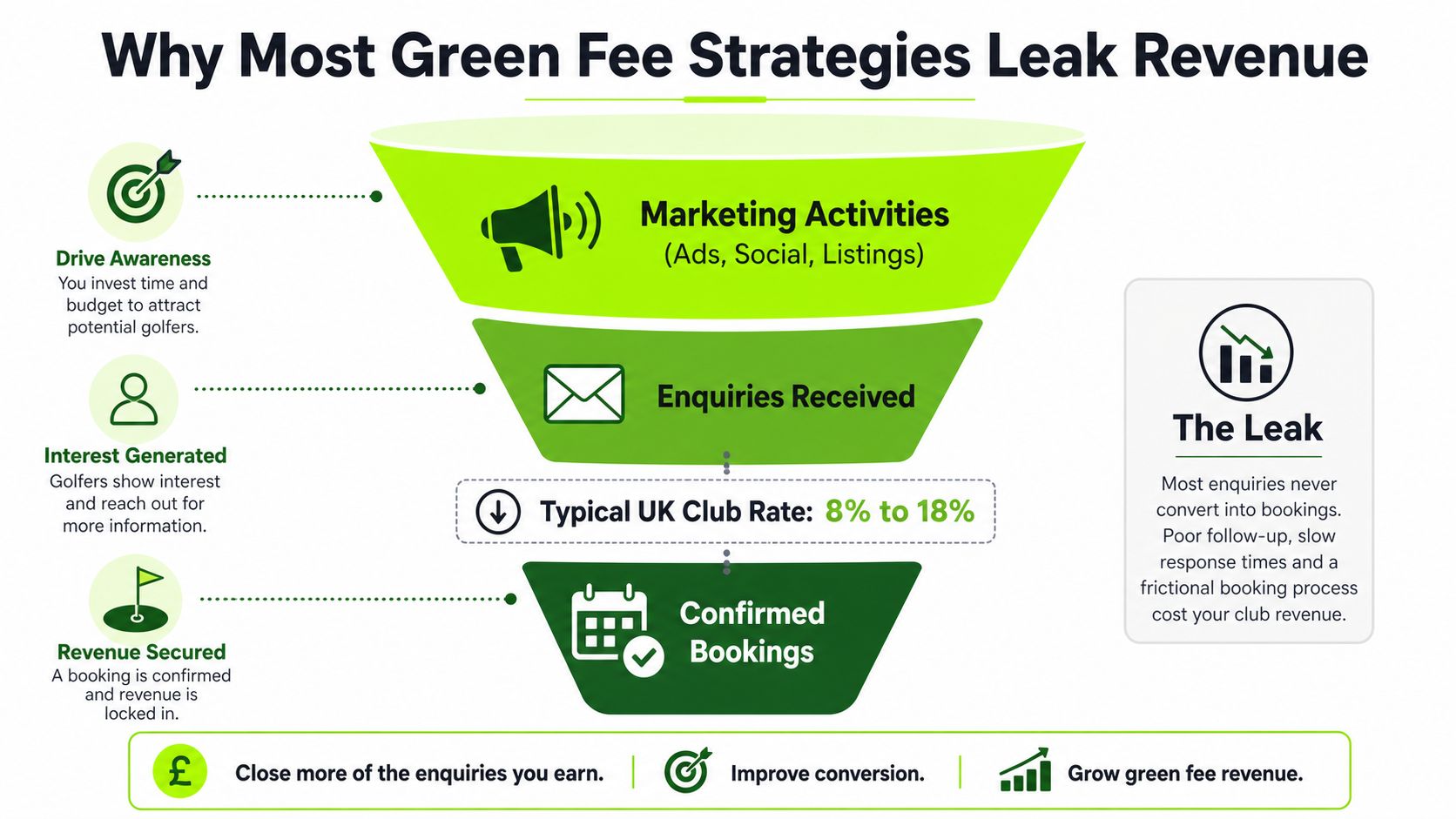
Start with the leak, not the campaign
Before increasing an advertising budget, trace one visitor journey from search result to payment. Record what appears in the search listing, how quickly the page loads, where the booking button sits, whether the fee is clear, and what happens when the selected date has no inventory.
Clubs often need fewer disconnected marketing activities and more ownership of the handover. A shared process should show who received the enquiry, who replied, what was offered, and whether the golfer booked, deferred, or disappeared. Practical guidance on B2B conversion optimisation tips is useful here because the underlying principle applies to golf clubs too, remove friction between interest and action.
Demand still matters, but it should feed a working system. If the booking path is unclear, adding more visitors only makes the leak larger.
Building the Demand Layer That Feeds Your Tee Sheet
A reliable demand layer connects positioning, paid search, local visibility, and tee-time marketplaces. These channels shouldn't operate as separate projects. They should all communicate the same offer and send golfers towards availability the club can fulfil.
Make the offer easy to recognise
Start with one plain-English statement that answers three questions: who the course suits, where it is, and what a visitor can expect. A parkland course near a town might position itself around accessible pay-and-play golf, convenient travel, and flexible visitor tee times. A more premium venue may lead with course character, hospitality, and advance booking.
Use the same core message on the homepage, Google Business Profile, course listings, and booking pages. Inconsistent descriptions create doubt, especially when the price on one platform doesn't match the visitor journey on another.
Match paid search to real availability
Google Ads should focus on intent such as “pay and play golf near me” or “book tee time [town]”. Keep the geographic area tight enough to reflect realistic travel behaviour, then connect campaigns to the tee sheet. There's no value in paying for demand around Saturday morning if those times are already closed or reserved.
A simple weekly review can pause ads for unavailable periods and move budget towards shoulder slots, midweek play, or upcoming events. The trade-off is that narrower targeting may produce fewer clicks, but those clicks are more likely to match the club's actual inventory.
Local SEO supports the same process. Keep the club's name, address, and phone details consistent, use strong course photography, and publish useful updates about society packages, open competitions, and visitor access. The content should help a golfer decide, not fill a news page for its own sake.
Use marketplaces as controlled distribution
GolfNow, TeeOff, and CountryWide can expose tee times to golfers who aren't familiar with the club. They're useful when the underlying website is clear about price, terms, and availability. They're less useful when the marketplace becomes the only place where a visitor can understand the offer.
Clubs should compare the booking value and customer ownership available through each channel. A marketplace can help fill a quiet slot, but the club still needs a compliant way to encourage future direct bookings and record the source of the round.
For a broader explanation of how a coherent demand layer works across local businesses, demand generation for Square salons offers a helpful comparison, although golf clubs need to adapt the approach around tee-sheet inventory and member access.
The practical operating model is simple: make the offer consistent, advertise only sellable times, improve local discovery, and use marketplaces to extend reach rather than hide a poor direct booking journey. GolfRep's guide to golf club tee-time marketing applies the same discipline to the specific realities of visitor golf.
Pricing, Yield, and Availability That Compounds
A flat green fee treats every tee time as if it has the same value. It doesn't. A Saturday morning slot with limited availability carries a different commercial opportunity from a quiet Tuesday afternoon, and the price should reflect that difference without damaging trust with members or local golfers.
The UK data shows why this matters. The Golfshake report found that the average visitor green fee rose 4% to £28.04 per person in 2024, while online revenue became the majority of green fee income. Price changes and digital access are working together, so clubs need to present both clearly.
Build rules around demand
A sensible yield model starts with demand tiers rather than constant manual changes. Peak Saturday mornings, summer twilight, and bank holiday periods can sit in a higher visitor tier. Shoulder periods, winter dates, and weather-sensitive slots can carry a lower rate or a stronger package.
The price should follow live tee-sheet pressure, not merely the name of the day. If a Tuesday afternoon remains open, the club can make that slot more attractive. If a Saturday morning is nearly full, discounting it gives away value that may have sold at the standard rate.
Protect the member relationship by keeping member and resident arrangements clear. Visitor prices can flex, but members shouldn't feel that their access or benefits are being used to subsidise opaque visitor offers.
Example yield pricing ladder for a UK parkland course
| Day Part | Demand Tier | Visitor 18-Hole Rate (£) | Member Rate (£) |
|---|---|---|---|
| Saturday morning | Peak | Set at the club's premium visitor rate | Protected member rate |
| Saturday afternoon | High | Slightly below peak | Protected member rate |
| Tuesday morning | Standard | Core visitor rate | Protected member rate |
| Tuesday afternoon | Shoulder | Value visitor rate | Protected member rate |
| Winter weekday | Weather-risk | Seasonal visitor rate | Protected member rate |
The table is a framework, not a claim about what any particular club should charge. Managers should review rates against availability, pace of play, weather, competitions, and member sentiment.
Yield pricing fails when it becomes unpredictable. Visitors need to see the price before they commit, understand what's included, and know the cancellation terms. A simple rules-based ladder reviewed regularly is more useful than constant ad hoc discounting.
Fixing the Booking Path Before You Spend More on Traffic
Audit the route from a Google result to a confirmed tee time as if you were a first-time visitor. Don't rely on staff familiarity with the website. Club teams know where the booking button is because they use the system every day. A golfer arriving from search doesn't have that knowledge.
The first check is the search result. The title and description should make the visitor offer, location, and booking action obvious. The landing page then needs to load cleanly on mobile, show a visible online booking button, and explain the price without forcing the golfer to hunt through menus.
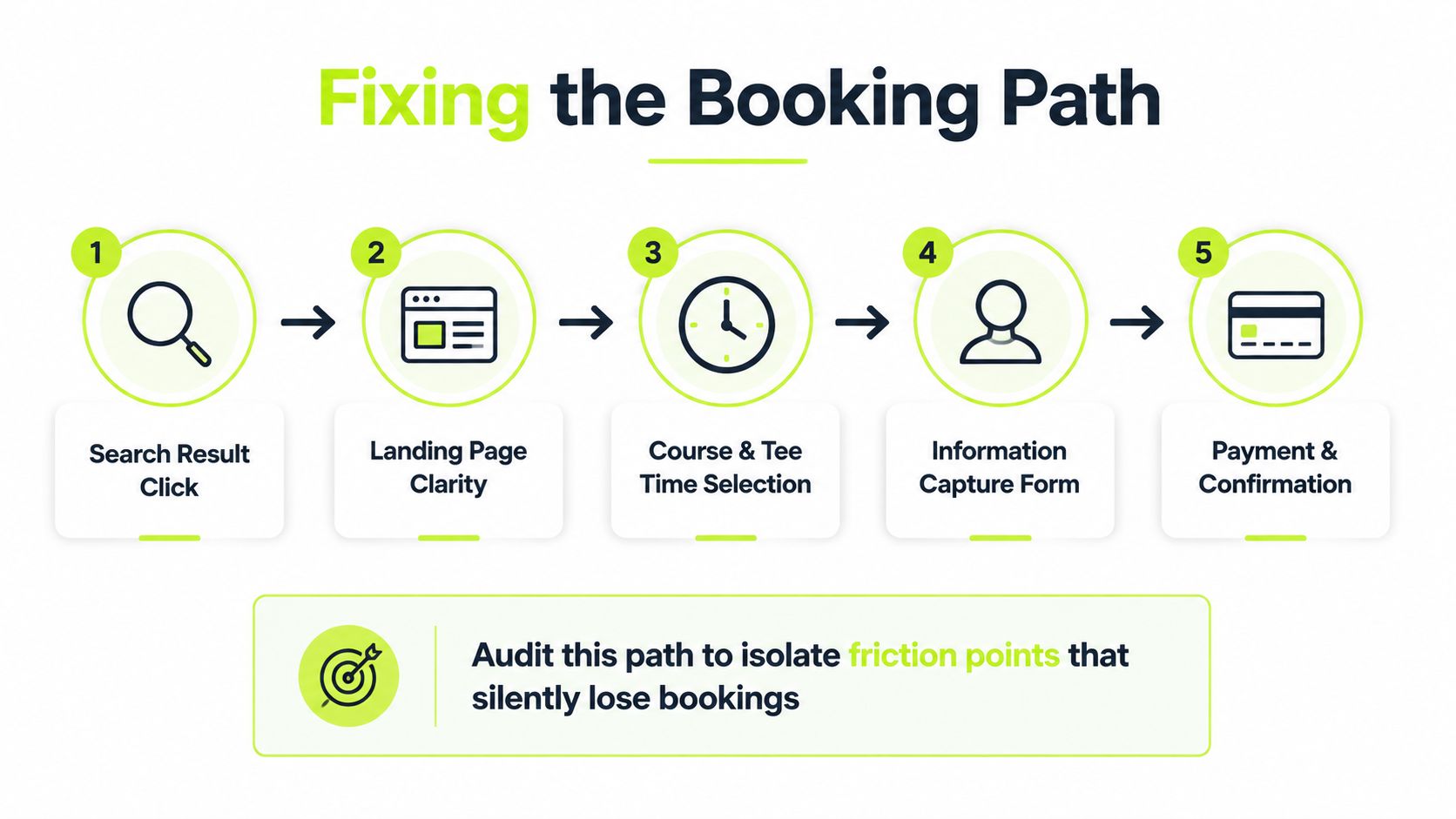
Walk the path in order
Search result click: Check whether the listing matches the page and sets an accurate expectation about visitor play.
Landing page clarity: Put the booking action near the top. Explain who can play, what the fee covers, and whether guests need an account.
Course and tee-time selection: Make the calendar legible. Date pickers shouldn't default to unavailable slots, and closed inventory should have a clear explanation.
Information capture form: Ask only for details needed to complete the booking or provide a useful follow-up. Long forms create hesitation.
Payment and confirmation: Confirm the date, time, players, price, arrival instructions, cancellation terms, and contact route in one message.
UK clubs often create avoidable friction by hiding BRS Golf widgets behind several menu items, requiring a clubhouse phone call for ordinary visitor bookings, or showing an empty calendar with no alternative. If inventory is full, offer another date, a nearby day part, a waiting-list option, or a clear enquiry route.
Set a minimum standard of under three taps to a bookable time and mobile page speed under 2.5 seconds only if the club can measure and maintain those standards. These are operating targets, not substitutes for watching real users complete a booking.
A booking system that works for staff but confuses visitors isn't working.
Phone support still has a place for complex groups and recovery conversations. The objective isn't to remove people from the process. It's to stop routine demand depending on a single person being free to answer. Advice on how to stop playing phone tag is relevant when the clubhouse team needs a dependable fallback. GolfRep's golf club booking system guidance also focuses on immediate access, enquiry capture, and moving visitors towards a confirmed round.
Response Time and CRM Follow-Up as the Real Conversion Lever
The highest-value improvement is often the one that doesn't look like marketing. A club can already have enough demand to fill more tee times, but lose it because the first response arrives after the golfer has moved on.
GolfRep's UK analysis records an average response time of 47 hours and 32 minutes for membership enquiries, as reported in its golf club marketing analysis. While membership enquiries aren't identical to green fee enquiries, the operational lesson applies directly: a duty manager on the course can't be expected to protect every opportunity through an unmanaged inbox.
The research cited in GolfRep's sales guidance says a lead answered within one hour is five times more likely to convert than one left for 24 hours. It also states that responding within five minutes can increase conversion rates by up to 98%, while waiting 30 minutes can reduce conversion odds by up to 100 times compared with a five-minute response. These figures come from GolfRep's CRM response-time guidance and follow-up process analysis.
A practical response model
| First Response Time | Estimated Conversion Rate | Action Required |
|---|---|---|
| Within five minutes | Strongest opportunity window | Automated acknowledgement plus staff alert |
| Within one hour | Better than delayed handling | Rota owner replies with available options |
| Same working day | Recoverable but weaker | Personal reply and alternative tee times |
| Next day or later | High risk of loss | Prioritise, record the reason, and follow up |
The table describes relative opportunity, not a universal green fee conversion rate. Clubs should replace the labels with their own measured results once the CRM records timestamps and outcomes.
Start with a single shared inbox and a rota that gives one person responsibility for first response. Create a pipeline tag for green fee enquiries, then record source, requested date, party size, quoted price, response time, and outcome.
Automated follow-up should support, not replace, human judgement. A message after 24 hours, another after 3 days, and a final check after 7 days can offer a different date, a shoulder-period tee time, or a society conversation. The sequence should stop immediately after booking or a clear decline.
The useful question: Can the club show where every visitor enquiry sits today?
Live booking software earns its keep when inventory is standard, prices are clear, and the visitor can complete the purchase independently. Human follow-up earns its keep when the group is large, the date is difficult, or the club needs to protect an experience promise. The two systems should work together, with the CRM showing the handover rather than forcing every lead into one route.
GolfRep's golf club follow-up system content describes this CRM-led approach. The same analysis records an average 47-day journey from first enquiry to signed membership, reinforcing a wider point for clubs: conversion is a managed process with multiple touchpoints, not a single sales moment. A green fee journey may be shorter, but the club still needs visibility from first contact to completed round.
Partnerships, Events, and Local Activity That Compound Over a Season
A mid-sized UK club rarely needs one spectacular visitor day. It needs a calendar of credible reasons to play, matched to the periods when the tee sheet is quiet or member demand is already high.
Start with the audience that can supply regular bookings. A club near hotels, business parks, and an active amateur golf community might agree a hotel package with clear prices, booking rules, and a defined referral process. Record every resulting booking source. The partnership earns its place through completed rounds and revenue after servicing time, not through agreeable meetings.
Build activity around the gaps
A local chamber networking evening can put the club in front of companies seeking society venues or client entertainment. Attendance is only the first measure. Staff should record qualified enquiries, provisional dates, and confirmed group bookings against the event, then follow up while the conversation is still fresh.
Member referrals can support society growth without cutting the visitor price. Members may know local firms, sports clubs, or community groups that would ignore a generic advert. Give them a clear landing page and a named contact, then route each referral into the same booking process as other enquiries.
Open competitions create a different form of demand. They give golfers a fixed reason to visit, a deadline for booking, and a legitimate opportunity to request permission for future communication. Junior and women-only events can broaden local participation and encourage return visits, but only if the club handles the experience and follow-up with the same care as the booking.
Useful activity may include:
- Midweek society packages: Sell food, scoring, arrival information, and playing arrangements, rather than unused tee times alone.
- Hotel partnerships: Give concierge teams current prices, availability rules, and a booking route that staff can manage reliably.
- Local digital activity: Promote open competitions and visitor windows to nearby golfers when specific tee-sheet periods need support.
- Member introductions: Use trusted relationships to reach businesses and groups that fit the club's format and capacity.
A single open day can create attention. A consistent monthly programme gives the team more chances to learn which audiences respond, which offers convert, and which periods need support. Follow-up capacity matters here. If event leads sit unanswered in a shared inbox, the activity creates work without filling the tee sheet.
Review partner performance quarterly. Retire arrangements that produce enquiries but few rounds, adjust packages that consume too much staff time, and protect member access before adding visitor inventory. The practical test is traceability: can the club connect each activity to confirmed bookings, repeat visits, and acceptable revenue after servicing costs?
The KPIs and 90-Day Plan a Club Secretary Can Run
A club secretary does not need a dashboard crowded with vanity metrics. Five measures expose most booking problems when the team records them consistently and assigns someone to act on the findings.
Keep the measurement practical
Enquiry-to-confirmed conversion rate links CRM enquiries to completed bookings. Review it weekly by source and requested date. A channel that generates enquiries but few confirmed rounds needs an examination of its offer, response handling, and booking path before the club spends more on traffic.
Average response time uses the enquiry timestamp and the first meaningful reply. Review it weekly, with a named owner for delays. The average can hide serious gaps, so record enquiries that received no response as well.
Repeat visitor share comes from the booking system or CRM identifying returning email addresses, phone numbers, or customer records. Review it monthly. A low repeat rate may reflect weak post-round communication, an inconsistent experience, or no clear reason to return.
Average green fee yield per available tee-time slot divides visitor revenue by sellable visitor inventory. Review it weekly by day part and season. If a slot sells repeatedly only after discounting, change its presentation, package, or availability rather than treating every demand period alike.
Cost per acquired booking by channel combines attributable advertising and marketplace costs with completed bookings. Review it monthly. Clicks and enquiries have little value if the club cannot connect them to payment and a profitable round.
The first 30 days should create visibility. Audit the booking path, remove hidden steps, check prices and terms, and create one shared enquiry view. Record every new green fee enquiry, including its source and response time. Hold back on expansion until the team can see where enquiries stall.
From days 31 to 60, introduce a response rota, automatic acknowledgement, and structured follow-up. Clean the tee-sheet listings and align the homepage, Google Business Profile, and marketplace descriptions. Test availability-led campaigns only where the club has sellable inventory and the team can handle the resulting enquiries.
Days 61 to 90 are for decisions. Review source yield, repeat visitor behaviour, response performance, and day-part revenue. Adjust pricing rules, retire weak listings or partnerships, and build a calendar of events and local activity around gaps in the tee sheet. Keep the plan small enough for the secretary and team to maintain after the initial review.
GolfRep helps clubs combine visitor lead generation with CRM capture, automated acknowledgement, structured follow-up, and conversion tracking. Visit GolfRep to discuss a booking growth system that gives the team visibility from first enquiry to confirmed round, without relying on extra traffic to cover manual processes.
Ready to tap into our proven growth system?