How to Build a Golf Club Sales Process That Converts
Most clubs are told to spend more on ads, more on social posts, and more on local visibility. That advice sounds sensible until you look at what happens after the enquiry lands. In private golf clubs, the breakdown is usually not demand, it's the gap between interest and a structured response, and that gap is where membership opportunities disappear.
A golf club sales process should be treated as an operations discipline, not a marketing afterthought. GolfRep's UK analysis puts the average response time to membership enquiries at 47 hours and 32 minutes, and the average time from first enquiry to signed membership at 47 days. That's not a lead generation issue, it's a follow-up system issue, and it's exactly why speed-to-lead, stage visibility, and disciplined handover matter more than ever. UGC Copilot for hotels is a useful example of how structured content and conversion thinking can support service businesses, but golf clubs need the same mentality applied to membership enquiries, not just their website.
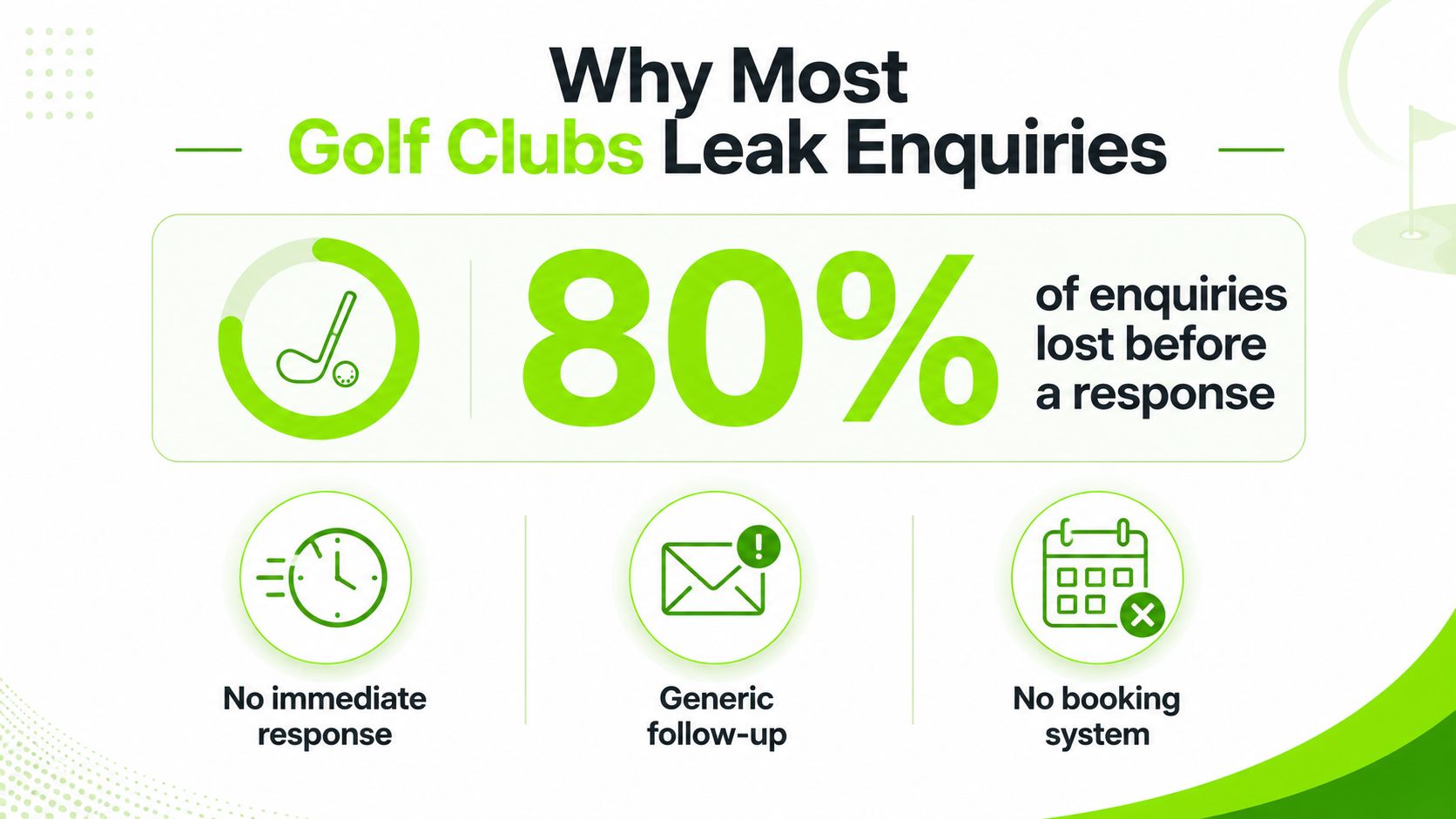
Why Most Golf Clubs Leak Enquiries Before a Sales Process Even Starts
The usual failure point is operational. A club receives an enquiry, it gets forwarded around, and everyone assumes someone else has picked it up. In practice, it sits in an inbox with no clear owner, no next action, and no visibility on whether the prospect has been contacted, qualified, or invited in.
GolfRep's UK analysis shows an average response time of 47 hours and 32 minutes for membership enquiries, and an average of 47 days from first enquiry to signed membership. That is long enough for interest to cool, so the first reply has to do more than acknowledge receipt. It needs to move the prospect forward. Manual handling struggles here because staff are busy, cover changes, and the enquiry gets treated like ordinary correspondence instead of a sales opportunity. GolfRep's UK sales-process analysis makes the point clearly, speed and follow-up are conversion work, not admin.
Practical rule: if the club cannot say who owns the enquiry and what happens next, it does not have a sales process yet.
An enquiry only becomes a prospect once it is contacted and logged in a tracked system. Until then, it is just incoming interest. Clubs that rely on a shared inbox, a secretary's memory, or a committee member “picking it up” leak business before a conversation has even started.
The warning sign is usually delay, inconsistent tone, and no structured booking into the next step. Clubs that still treat follow-up as a one-off email will struggle against clubs that use clear response rules, named ownership, and a CRM that shows every live enquiry. A similar lesson appears in UGC Copilot for hotels, where structured enquiry handling beats improvisation every time.
The Five Stages of a Golf Club Sales Process
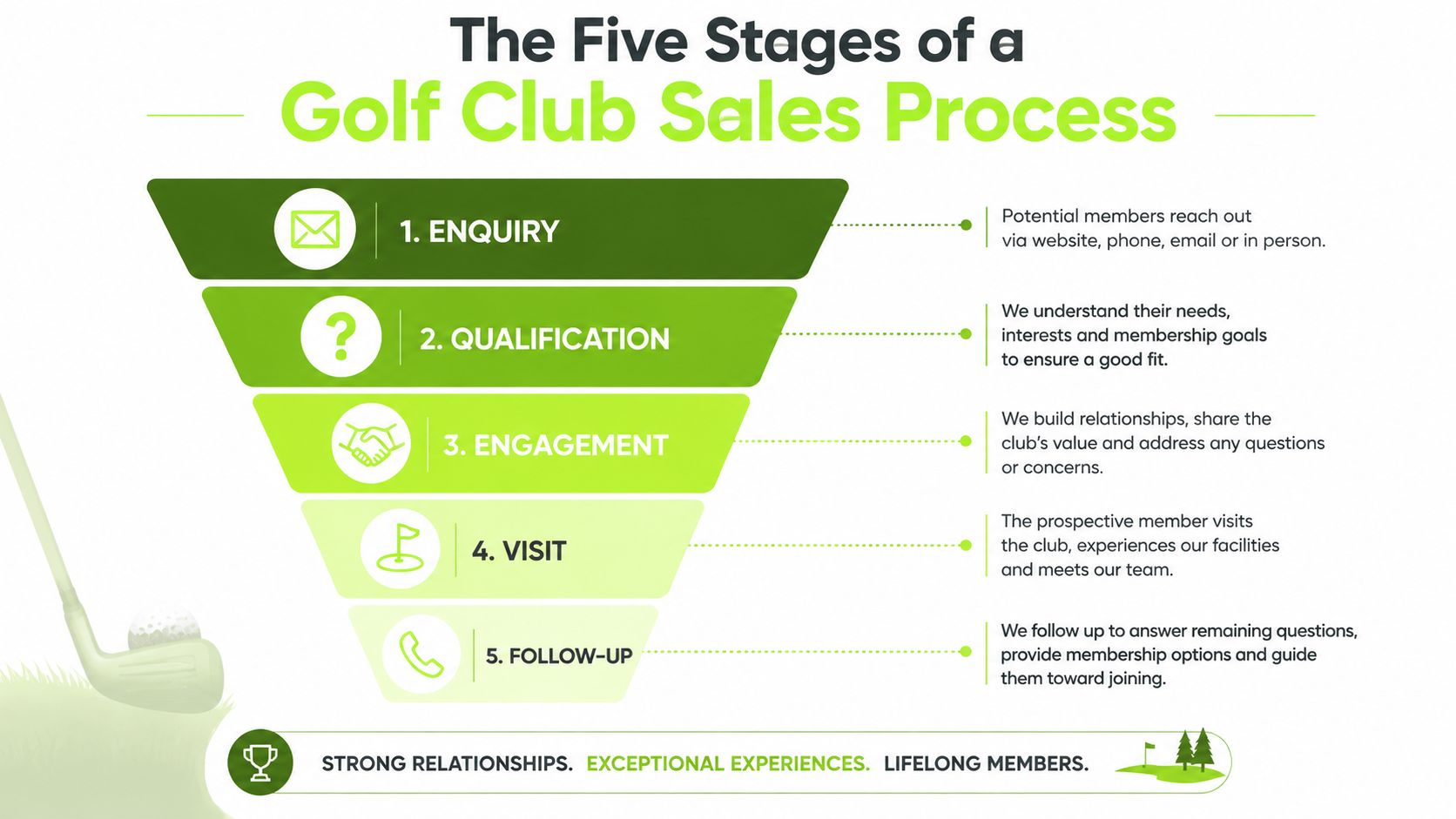
A golf club sales process only works if it is simple enough for a busy team to run and strict enough for the committee to trust. The goal is to keep every enquiry moving in a controlled way, without letting it sit in a shared inbox or disappear between staff. GolfRep's recommended pipeline is built around five stages, Enquiry → Qualification → Engagement → Visit → Follow-up, and each stage needs a clear owner and a clear outcome.
What good looks like at each stage
The first stage is Enquiry, the point at which a prospect raises their hand. The main measure here is how quickly the club gets that enquiry into contact and logged in a tracked system. GolfRep's sales-pipeline guidance sets New to Contacted at 90%+ for a well-run pipeline, and The club sales pipeline framework says a healthy process will often convert 15–30% of enquiries into memberships.
Qualification comes next. At this point the club works out whether the lead is serious, local enough, financially suitable, and actually looking for the type of membership on offer. Once that is clear, the process moves into Engagement, where the club starts building a reason to visit. That might be a course tour, a coffee with the membership lead, or a trial round, but it should not turn into open-ended back-and-forth.
The benchmark between Contacted to Toured sits around 30–50% in GolfRep's pipeline guidance, which makes this stage a useful early warning sign when conversion starts to slip. The move from Toured to Offered should sit around 60–80%, and from Offered to Joined around 40–60%. Those figures make it much easier to see whether the issue is weak contact, weak visits, or weak closing, especially when a club keeps asking why decent enquiries are not turning into members.
A CRM is what turns that process into something the club can manage. It shows the secretary, general manager, and committee where each prospect sits, what action is due, and which stage is stalling. Without that visibility, every conversation starts from scratch, and every missed follow-up can be mistaken for bad luck instead of a process failure.
If a prospect has toured but nobody knows whether an offer was made, the process has already gone soft.
Segmenting Enquiries So the Process Fits Each Prospect
Treating every enquiry as a generic membership lead is lazy, and it's one of the fastest ways to flatten conversion. A visitor booking, a guest round, a society organiser, and a corporate host are not the same prospect. They need different follow-up, different timing, and different measures of success.
A club that only counts lead volume misses the core question, which is where each enquiry type is most likely to create value. Some enquiries are better measured by membership conversion, others by repeat visits, event spend, or longer-term corporate relationships. That's why source-level reporting matters more than raw enquiry counts. The club needs to know what came in, what happened next, and whether that source produced one booking or ongoing revenue.
| Enquiry type | Pipeline entry point | Primary KPI | Typical time to revenue |
|---|---|---|---|
| Visitor | Engagement | Repeat visit or membership interest | Short to medium |
| Guest | Engagement | Return booking or referral | Short |
| Society organiser | Qualification | Booking value and re-booking potential | Short to medium |
| Corporate host | Qualification | Ongoing business relationship | Medium to long |
The practical mistake is pushing all of these through the same script. A visitor who wants to see the course may need a tour and a follow-up invite, while a society organiser needs pricing, availability, and a clear handover to a bookings owner. A corporate enquiry may need a commercial conversation before it ever becomes a membership discussion. Clubs that segment properly stop wasting time on generic replies that sound polite but go nowhere.
This is also where source-level tracking starts to pay off. Once you can see which enquiry types produce repeat activity, the club can stop guessing where to focus. For a simple primer on breaking audiences into usable groups, this market segmentation guide is worth keeping nearby.
The question isn't whether segmentation is useful. It's whether the club wants one sales path for everything, or a process that fits the actual buying intent in front of it.
Speed to Lead, First Touch, and the Visit Booking Playbook
Speed is an operations issue, not a branding one. If a club leaves an enquiry sitting until the next working day, or until someone has time to reply, the prospect has usually gone cold before the first proper conversation starts. GolfRep's internal data shows that clubs using AI-driven follow-ups see a shorter conversion lag and a higher membership sign-up rate, which is why the response process needs structure rather than good intentions alone. GolfRep's speed-to-lead guidance sets out the practical mechanics.
A simple first-day response rhythm
The first touch should acknowledge the enquiry, confirm receipt, and make the next step obvious. A same-day follow-up then needs to shift the conversation from acknowledgement to booking, so the prospect is not left wondering who owns the next move. By the end of the day, the club should have sent a final nudge with a clear invitation to visit, tour, or speak.
That sequence works because it removes friction. It also stops enquiries sitting in a grey area between interest and action.
The message should not ask the prospect to chase the club. It should invite them to book a visit, a trial round, or a short introduction with the right person. A generic phone call asks for too much effort. A visit booking gives the prospect a clear reason to continue.
Useful standard: every first-touch message should make one action easy, not three things possible.
A practical tool helps here. If enquiries are still coming in through scattered forms, email replies, or staff memory, a platform for forms can centralise capture so the first response does not depend on who happens to be at the desk. Once every enquiry lands in one place, automation can handle the repetitive work and staff can focus on the conversation itself.
What to automate and what not to automate
Automate the receipt acknowledgement, the reminder, and the booking prompt. Do not automate the human part of the exchange, such as answering membership fit, discussing the course, or handling a specific concern. That balance matters because the club gains speed without sounding robotic.
Clubs using a CRM-led approach can also route different enquiry types into different follow-up paths, which is where the sales process starts behaving like an operational system rather than a stack of emails. If you want a closer look at the setup, GolfRep's speed-to-lead guidance covers the practical detail. GolfRep's pipeline model combines enquiry capture, automated qualification, and personalised follow-up, so clubs do not have to rely on manual chasing to keep momentum.
Objection Handling, Lost Reasons, and the Onboarding Handoff
Most clubs think the sale is won or lost at the offer stage. In reality, the weak point is often the conversation after the tour, when the prospect raises price, time commitment, family fit, or club culture. If those objections are handled casually, the club gets a polite “I'll think about it” and never learns why the lead drifted away.
Why lost reasons are worth logging
Lost-reason data is one of the highest-value habits a club can build because it stops the team from guessing. If price keeps coming up, that's a messaging problem, not just a sales objection. If the tour experience is weak, that's an operational problem. If follow-up is inconsistent, that's a process problem. Logging that properly gives the club something concrete to improve.
The same discipline should carry into onboarding. Once someone joins, the handoff should include a welcome sequence, a member buddy if the club uses one, and clear touchpoints at 30, 60, and 90 days. New members don't just need access, they need a sense that they've made the right decision and know how to settle in. Clubs that treat onboarding as an afterthought often create retention problems they could have avoided.
A good reference point for structured handover thinking is Solo AI Website Creator's onboarding automation tips for service providers. The context is different, but the principle is the same, handoff needs a system, not a memory test.
A simple objection library
Use a small script library for the common objections and make sure staff log the outcome after each conversation. That should include what the prospect said, what was offered in response, and whether the next step was agreed. It doesn't need to be complicated.
- Cost concerns: frame value, access, and fit, not just price.
- Time commitment: address frequency, flexibility, and how often they plan to play.
- Facility quality: link the response to the condition of the course, practice areas, and clubhouse.
- Club culture: answer with examples of member life, not vague reassurance.
The onboarding handoff is where good sales work either sticks or disappears. A clean transfer from membership conversation to member experience protects retention, and it also makes the original sale feel professionally managed. That's the difference between getting a signature and building a member who stays.
KPIs and the Continuous Improvement Loop
A sales process without measurement is just a series of tasks. The dashboard doesn't need to be fancy, but it does need to be honest. A club should review stage-by-stage conversion, speed-to-lead, visit-to-join performance, source-level revenue, and retention at the 90-day mark, because those numbers tell the club where the process is working.
What to review each month
Start with the first response. If enquiries are sitting too long, everything downstream gets weaker. Then look at the move from contact to visit, because that's where interest becomes commitment. After that, check offers, closes, and new-member retention, so the club can tell whether it is attracting the right prospects and onboarding them well.
Multi-site operators should roll the same view up across venues so they can compare patterns instead of arguing about anecdotes. A CRM makes that possible, but only if the team uses it consistently. The point isn't to collect data for its own sake. It's to change scripts, improve ads, tighten follow-up, and fix weak handoffs before they become normal.
For clubs that want a more formal measurement mindset, this marketing analytics guide is a useful companion because it frames reporting as decision-making, not vanity tracking.
Month one focus: response speed, visibility, and booked visits.
Month twelve focus: source quality, conversion consistency, and retention.
The warning signs are usually obvious once the dashboard is in place. Leads are coming in, but the contacted rate is soft. Visits are happening, but offers aren't converting. New members are joining, but early retention is shaky. Those patterns don't fix themselves, and they rarely improve through more spend alone.
The clubs that grow predictably are the ones that treat the golf club sales process as a living operating system. They track every stage, tighten the weak points, and give staff a structure they can follow week after week.
GolfRep helps clubs build that kind of pipeline with enquiry capture, automated follow-up, and CRM-led visibility, so the process stops relying on memory and goodwill. If you want a calmer, more predictable way to turn membership enquiries into booked visits and signed members, visit GolfRep and see how the system is put together.
Ready to tap into our proven growth system?