AI for Golf Clubs: A Practical Guide for 2026

In 2026, AI is already a practical operating layer for UK golf clubs, helping automate administration, bookings, member communication and data analysis. AI content systems are also being used across a client base of 250 golf clubs, showing that adoption has moved beyond experimentation.
The more important question for a committee isn't whether AI sounds impressive. It's whether it can reduce routine work, improve the member journey and help the club make better commercial decisions without creating another complicated system for staff or volunteers to manage.
For a small club, that distinction matters. A volunteer secretary needs fewer manual tasks, not a futuristic dashboard. A general manager needs clearer visibility of membership movement, tee-sheet demand and enquiries, not another disconnected software subscription. AI for golf clubs should therefore be judged as an operating investment, with a clear job, an owner and a measurable commercial outcome.
What AI Actually Means for Your Club
AI doesn't need to look like a robot, a virtual caddie or a science-fiction experiment. For a golf club, it can be a practical layer that sits across the systems you already use, helping people manage information, routine communication and recurring decisions.
The Golf Club Managers' Association's technology coverage describes AI-powered tools being used to streamline administration, automate bookings and member communication, and analyse club data for usage trends and revenue opportunities. It also highlights increasingly self-service tasks such as tee-time booking, competition entry, account top-ups and membership renewals.
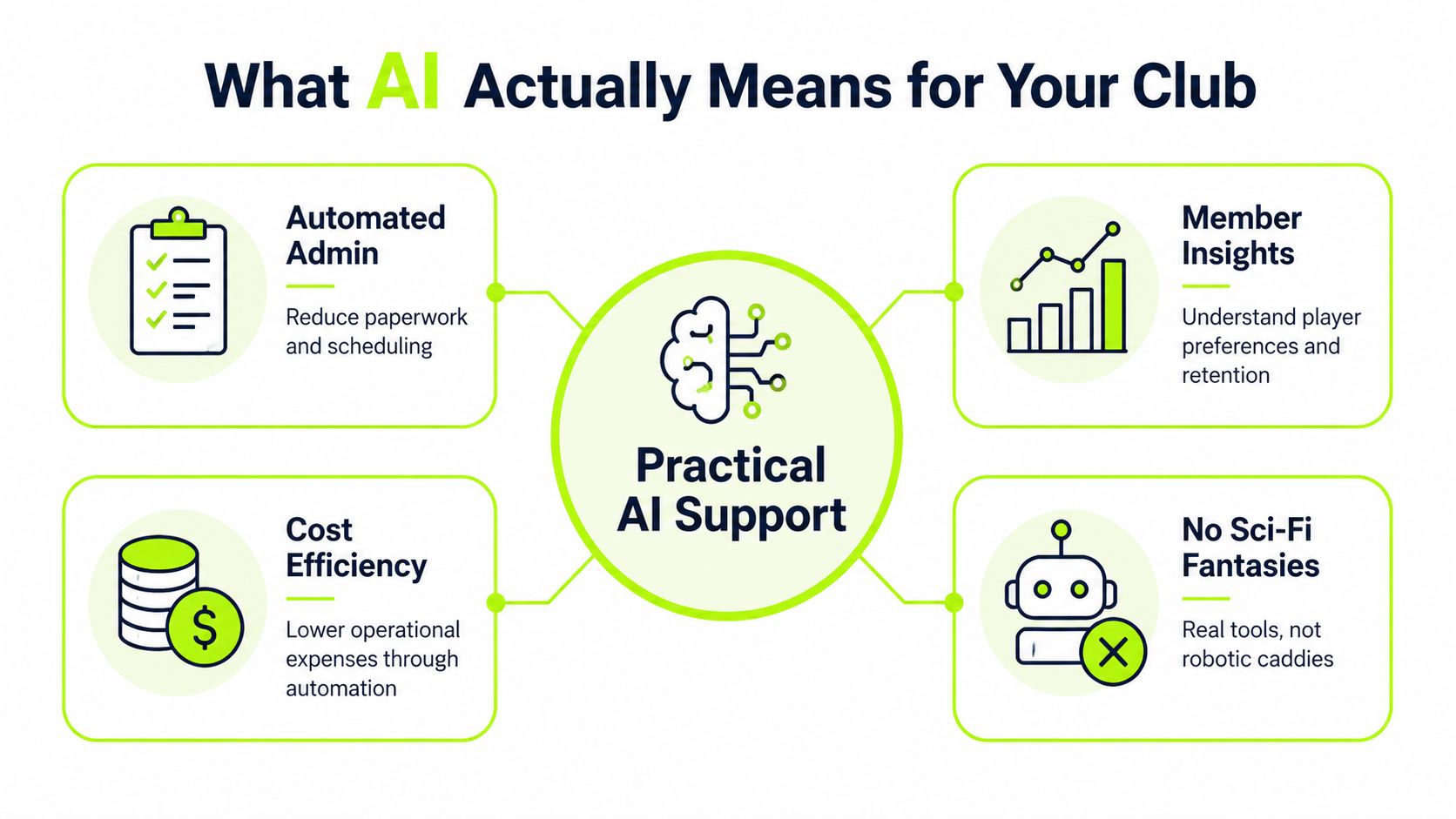
That changes the conversation. AI isn't replacing the welcome from a club secretary, the advice from a PGA professional or the relationships that make a members' club feel like a community. It handles repeatable work so those people can spend more time on decisions and interactions that need judgement.
The operating layer
Think of a typical club day. A member wants to renew, a visitor wants to book a tee time, a committee member wants to understand quiet periods, and the pro shop receives routine calls about availability. If each activity sits in a different system, staff spend time moving information between inboxes, spreadsheets, booking tools and payment records.
An AI-enabled operating layer can connect those signals. It can help route an enquiry, identify the relevant customer record, trigger a suitable message and surface a pattern in the data. The club still sets the rules and people still approve sensitive decisions, but the system reduces repetitive handling.
That is the practical difference between AI as a content generator and AI as part of a commercial operation. Writing a social post may save a few minutes. Connecting booking, CRM and member data can help the club understand demand and act on it.
Practical rule: Don't buy AI because it can produce more content. Buy it when it can remove a defined manual task or improve a decision your club already needs to make.
A useful next step is to understand how golf clubs are using AI to convert more enquiries, but conversion is only one part of the picture. The strongest use cases connect attraction, service, operational data and retention.
Five Commercial Use-Cases That Drive Growth
AI creates commercial value when it changes what the club can do consistently. The following five use cases are practical starting points, although the right priority depends on the club's current constraint.
1. Membership acquisition
AI can help a club organise and personalise its acquisition activity. It can group prospects by interest, identify whether someone is asking about full membership, flexible membership or social access, and help staff send information that matches that intent.
The opportunity is particularly relevant in a UK market with a broad and active membership base. Hillier Hopkins' 2023/24 Members' and Proprietary Golf Clubs' Survey found that membership numbers increased again for the majority of clubs, while 24% reported more leavers than joiners. The same survey recorded lady membership rising from 15% to 18%.
Those figures point to a segmented commercial task. A club isn't marketing to one uniform audience. It needs different messages and journeys for prospective playing members, social members, women, families, younger golfers and people considering a return to the game.
2. Lead qualification
A system can ask basic questions before a member of staff becomes involved. It might establish whether a prospect lives locally, what type of access they want, whether they've visited the club and what information they need next.
That doesn't mean handing the relationship to a machine. It means giving the membership team a clearer starting point. A volunteer-run club can use structured qualification to avoid repeatedly asking the same questions, while a larger operation can route different opportunities to membership, the pro shop, events or reception.
For a focused explanation of this application, see AI lead qualification for golf clubs. The commercial test is simple: does qualification help staff prioritise and respond appropriately, or does it add friction?
3. Automated nurture
A prospect who isn't ready to join today shouldn't disappear from the club's records. AI-assisted CRM workflows can schedule useful follow-up, recognise when someone has engaged with a message and prompt a human conversation when the opportunity becomes more active.
The sequence should reflect the club's proposition. A new golfer may need information about access and playing opportunities. A lapsed member may need a different conversation about what has changed. A society organiser may need package details, dates and food and beverage options.
Content generation can support this work, and resources such as grow with AI marketing assistant can help smaller organisations think about how AI supports marketing activity. The club still needs its own offers, pricing, tone and approval process.
4. Revenue optimisation
The most useful revenue insight may already be sitting in the tee sheet. UK golf-club technology guidance describes AI being used to analyse tee-sheet utilisation across a full year, identify quiet periods and generate actions to fill demand gaps. That can support targeted visitor offers, local golfer campaigns or better use of underperforming times.
This is more disciplined than discounting every available slot. The club can ask which periods need demand, which customer groups are most relevant and whether an offer should promote golf, food and beverage or a future membership conversation.
5. Operational efficiency
AI can reduce the administrative load around bookings, competition entries, account top-ups, renewals and routine member questions. The GCMA also notes that smaller clubs can gain time from basic administration automation, while larger clubs may benefit more from deeper analysis that supports cost reduction and revenue growth. That distinction should shape the buying decision.
A small club may need dependable self-service and reminders. A larger club may need joined-up reporting across tee bookings, competitions, payments and CRM. The system should match the operating model, not the size of the vendor's sales presentation.
Your Roadmap to AI Adoption
AI adoption should begin with a commercial audit, not a product demonstration. The club needs to identify where staff lose time, where members experience friction and where useful data currently remains disconnected.
The UK club support guidance on retaining golf-club members recommends reviewing the previous year's joins, resignations, first-year drop-off and enquiry sources that convert. It also advises mapping the journey from first contact to renewal and putting enquiry handling, onboarding and renewal tracking into one visible system with clear ownership.
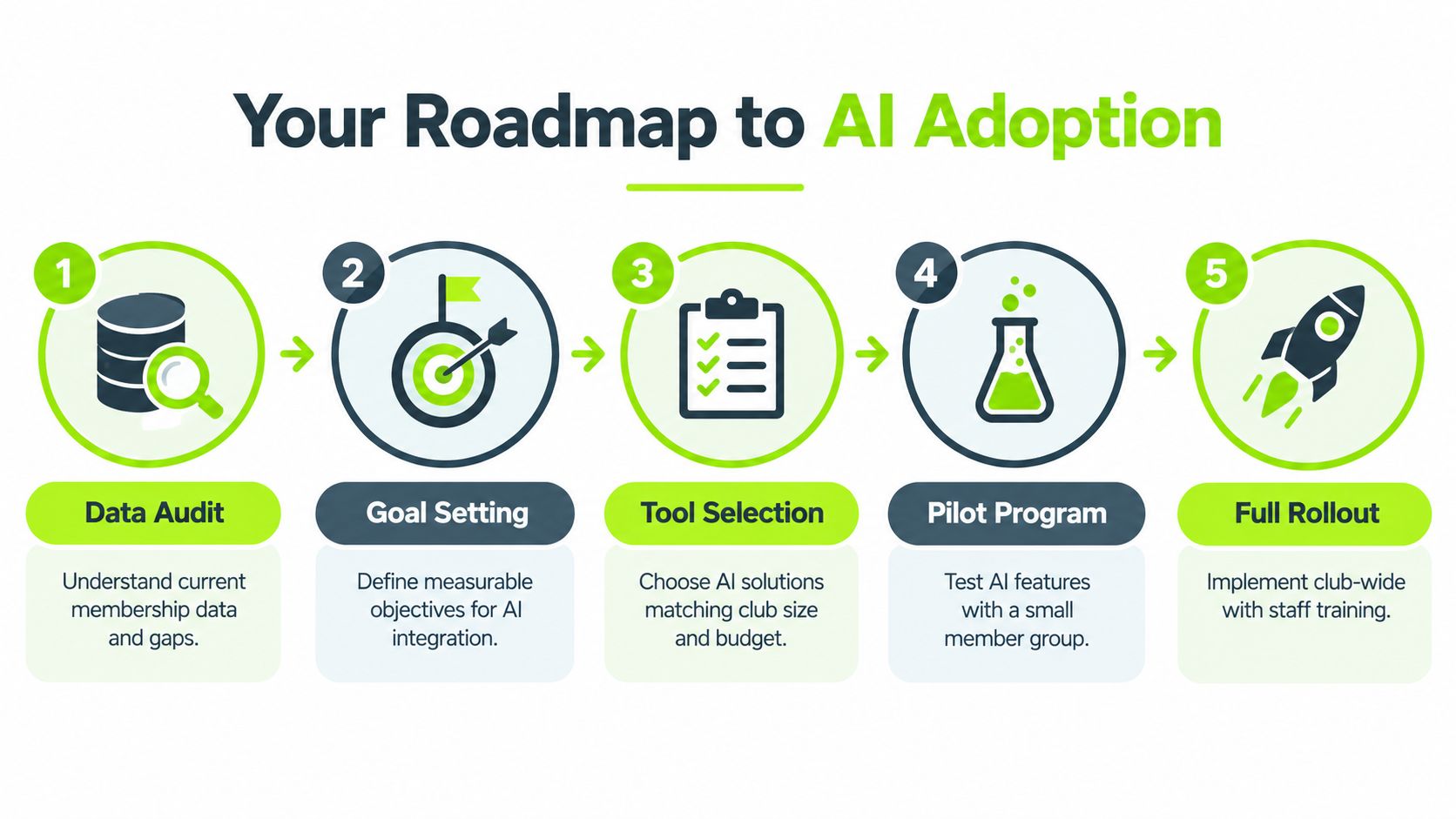
Step 1, audit the data
List the systems that hold relevant information. Include the membership database, tee sheet, competition platform, payments, website forms, email records and any spreadsheets maintained by the secretary or professional.
Then answer practical questions:
- Membership movement: Can you see joins, resignations, renewals and first-year drop-off in one place?
- Enquiry sources: Can you distinguish website, referral, social, visitor and open-day enquiries?
- Ownership: Does every active enquiry have a named person responsible for the next action?
- Usage: Can you identify quiet periods, underused facilities and changes in member behaviour?
If the answer is no, the first investment may be data cleaning and integration rather than AI.
Step 2, set one measurable objective
Choose an outcome the committee can understand. Examples include reducing manual renewal administration, improving the visibility of member onboarding, filling quiet tee-time periods or making enquiry ownership clear.
Don't begin with “implement AI”. Begin with “make this process reliable”. That keeps the project commercial and gives staff a sensible way to judge whether the change is helping.
Step 3, choose tools that fit the club
A volunteer-led club should favour simple workflows, clear permissions and dependable support. A multi-site operator may need central reporting, more detailed routing and integration between locations.
Ask vendors to demonstrate your actual workflow, including a new membership enquiry, a renewal reminder and a tee-sheet demand report. Don't accept a generic feature tour as proof that the system will work in your club.
Step 4, run a controlled pilot
Start with one process and a small group of users. Test the messages, escalation rules, data quality and staff workload before expanding. Staff should know when automation stops and a human takes over.
Step 5, roll out with ownership
The GolfRep guidance on golf-club AI automation reflects the need to connect automation to real commercial processes. At rollout, assign an owner, document the workflow and review performance regularly. AI should become part of the club's operating rhythm, not a project that fades after launch.
Selecting Vendors and Managing Change
The right vendor for a golf club isn't necessarily the one with the longest feature list. It's the one that understands how a club works, including member expectations, tee-sheet pressures, seasonal demand, committee governance and the limits of volunteer capacity.
A generic AI platform may be flexible, but flexibility often shifts the implementation burden onto the club. A golf-specific system may offer fewer unrelated features but provide better workflows for membership, bookings, competitions, payments and communication.
Compare the operating fit
| Decision area | Volunteer-led or smaller club | Larger club or multi-site operator |
|---|---|---|
| Primary need | Reduce routine administration and make ownership clear | Connect data across teams, facilities and locations |
| Useful first workflow | Renewals, member questions or booking support | CRM routing, demand analysis and joined-up reporting |
| Implementation risk | Complex setup that nobody owns | Inconsistent processes between departments |
| Vendor requirement | Training, support and simple controls | Integration, permissions and scalable reporting |
The vendor should explain what the system does when data is incomplete, a customer asks an unusual question or a staff member needs to override an automated action. It should also be clear who owns the data, how access is controlled and how the club can export its records.
Get committee approval through outcomes
Committee members don't need a technical presentation. They need a clear case for change. Set out the current process, the manual burden, the proposed workflow and the measure that will show improvement.
For example, a renewal pilot could track whether reminders are sent consistently, whether staff can see the status of each member and whether fewer manual checks are required. A tee-sheet pilot could track whether quiet periods are identified in time for the club to act.
The committee should approve a business process, not an AI label.
Staff buy-in follows the same principle. Explain which tasks the system will handle, which decisions remain human and what staff should do when the system escalates an issue. Receptionists, professionals and membership teams are more likely to adopt a tool when it removes duplication rather than threatens their relationships with members.
Change also needs a review point. After the pilot, ask what saved time, what created confusion and what members noticed. Keep the useful workflow, amend the weak one and stop anything that creates more administration than it removes.
Evidence from the Golf Industry
The UK evidence supports a practical, segmented view of AI rather than a universal promise. Clubs are adopting tools for administration, self-service, communication and data analysis, but the value differs according to the club's size, staffing model and commercial priorities.
The GCMA's technology coverage describes systems that connect tee bookings, competitions, reporting, payments and CRM. It also highlights self-service for tee-time bookings, competition entry, account top-ups and membership renewals. That combination matters because AI is more useful when it can work with operational data rather than generating isolated marketing material.
Hillier Hopkins' survey adds context about the customer base. It reports that 26% of members' clubs had social memberships above 100, the highest level reported since 2018, and that members' clubs delivered between 400 and 85,000 rounds of golf to members each year. These figures describe clubs with very different usage patterns and member cohorts, so a single communication approach will rarely be enough.
Adoption is ahead of proof
UK clubs are already using AI to analyse tee-sheet utilisation, identify quiet periods and generate actions to fill demand gaps, as described in GCMA-related industry guidance on AI for golf clubs. The commercial logic is clear, particularly when the system turns analysis into a specific action for staff.
The evidence is less complete on membership conversion. UK golf-industry coverage notes that AI marketing tools are being used across a client base of 250 golf clubs, and that clubs are applying AI to email and social content at scale. However, published club-level conversion benchmarks, payback periods and independently measured uplift are not available in the evidence provided.
That gap should make committees more disciplined, not dismissive. Ask a vendor to define the baseline, the pilot, the reporting method and the decision rule for expansion. Don't accept activity, such as messages sent or content produced, as proof of commercial success.
Broader marketing examples, including documented social media success, can offer useful ideas about content and channel management. They shouldn't be treated as evidence that a particular golf-club workflow will produce the same result.
The strongest conclusion is modest but important. AI is established enough to test in UK golf operations, while the club remains responsible for measuring whether a specific use case improves workload, service or revenue.
Common Myths and Misconceptions
Myth one, AI is only for large clubs
Small clubs may have the strongest reason to automate basic administration. A limited team can't monitor every routine question, renewal task and booking issue manually, especially when the same information is requested repeatedly.
The right starting point is smaller, not bigger. Choose one workflow, keep the rules clear and avoid buying a platform that requires a dedicated technical department.
Myth two, AI removes the personal touch
Poorly designed automation can feel impersonal. Sensible automation does the opposite by giving staff more time for conversations that require empathy, judgement or local knowledge.
The club should decide which interactions are suitable for self-service and which must move quickly to a person. A renewal reminder can be automated. A conversation with a concerned long-standing member shouldn't be reduced to a generic sequence.

Myth three, AI is a content machine
Content is one possible use, but it isn't the strongest commercial test. More posts won't fix disconnected membership records, unclear ownership or poor visibility of demand.
Use AI to support the operating process behind the content. The club should know which audience receives a message, what action follows engagement and how the result appears in the CRM.
Myth four, AI must be complex
Complexity usually comes from trying to automate too much too soon. A club can begin with a narrow workflow and expand only after staff understand it and the committee can see its value.
The practical test is whether the process is easier to run after implementation. If staff need a manual workaround for every automated action, the system isn't ready for wider adoption.
Building a Predictable Growth System
AI works best as part of the full Attract, Nurture, Convert, Retain cycle. It can help attract relevant demand, organise follow-up, support self-service and reveal member behaviour, but it can't compensate for an unclear offer or a poor club experience.
Start with the current constraint. Audit the data, choose one process, assign ownership and measure the operational or commercial result. Then improve the next constraint instead of attempting a club-wide technology project all at once.
GolfRep helps golf businesses improve acquisition, sales processes, CRM, follow-up, conversion, retention and revenue growth through practical, data-led systems. Visit GolfRep to discuss where AI could support your club's membership, visitor, society or event operations.
Ready to tap into our proven growth system?