Golf Club Sales Process: Convert Enquiries to Members
The biggest weakness in the average golf club sales process isn't lead generation. It's delay.
For UK golf clubs, the average response time to membership enquiries is 47 hours and 32 minutes, and that delay often leads to a 0% conversion rate for entire pipelines because the prospect has already joined another club according to GolfRep's analysis of golf marketing analytics. That should change how most clubs think about growth.
Many committees and managers still assume the answer is more enquiries, more campaigns, more spend, more visibility. In practice, clubs often already have enough interest to grow. What they don't have is a structured way to capture, respond to, qualify, nurture, and close that interest. The result is leakage at every stage. A good enquiry arrives on Friday afternoon, sits in a shared inbox, gets passed around on Monday, receives a generic reply on Tuesday, and goes nowhere.
That's not a marketing problem. It's an operational one.
Why Your Current Sales Process Is Leaking Revenue
Most clubs don't have a sales process. They have a collection of habits.
An enquiry lands through the website. Someone forwards it to the secretary. A manager means to call. A membership form gets attached to an email. Then the club waits. From the club's side, it feels like "we followed up". From the prospect's side, it feels slow, generic, and forgettable.
Slow response creates silent losses
The actual damage happens before your team ever realises it. A prospective member compares several clubs at once. The first club that responds clearly and gives them a next step usually gets the momentum.
If your club replies late, or replies without direction, the lead doesn't always complain. It disappears.
Practical rule: Every unanswered enquiry should be treated as a live sales risk, not an admin task waiting for office hours.
This is why the old advice to "just get more leads" misses the point. More enquiries flowing into a weak process only create more waste. The smarter move is to tighten the system that handles the demand you already generate. The same principle shows up in wider work on improving B2B sales performance. Better conversion usually starts with process discipline, not volume.
What revenue leakage looks like in a golf club
A leaking golf club sales process usually has a few obvious symptoms:
- Inbox dependence: Leads sit in one email account with no tracking, ownership, or urgency.
- Manual follow-up: Staff rely on memory, diary notes, or handwritten lists to chase prospects.
- No lead visibility: Nobody can say which enquiries are new, qualified, booked, stalled, or lost.
- Weak next steps: Replies answer questions but don't move the prospect toward a visit or decision.
Many clubs recognise parts of this immediately. If that sounds familiar, the issue isn't effort. It's system design. Manual effort can keep a club running, but it won't build predictable membership growth.
A more detailed breakdown of this pattern appears in GolfRep's article on how clubs lose enquiries without realising it. The key point is simple. If your club can't see every lead and move it forward quickly, revenue leaks out of the process long before anyone discusses marketing budget.
Process beats optimism
The clubs that convert well don't rely on one organised staff member or a particularly diligent committee member. They build a repeatable route from first contact to signed membership.
That means clear ownership, immediate acknowledgement, qualification questions, booked visits, tracked follow-up, and a visible pipeline. Without that structure, even strong demand produces inconsistent results.
A broken process is expensive because it hides in plain sight. The club still gets enquiries, still gives tours, still signs some members. It feels functional. But under the surface, too many good prospects drop out for reasons that were preventable.
Mapping the Modern Member Journey
A strong golf club sales process needs a visible path. Not a vague intention to follow up. A path.
The clearest model is a five-stage journey: Enquiry, Qualification, Engagement, Visit, and Follow-up. When clubs map leads through these stages, they stop guessing and start managing.
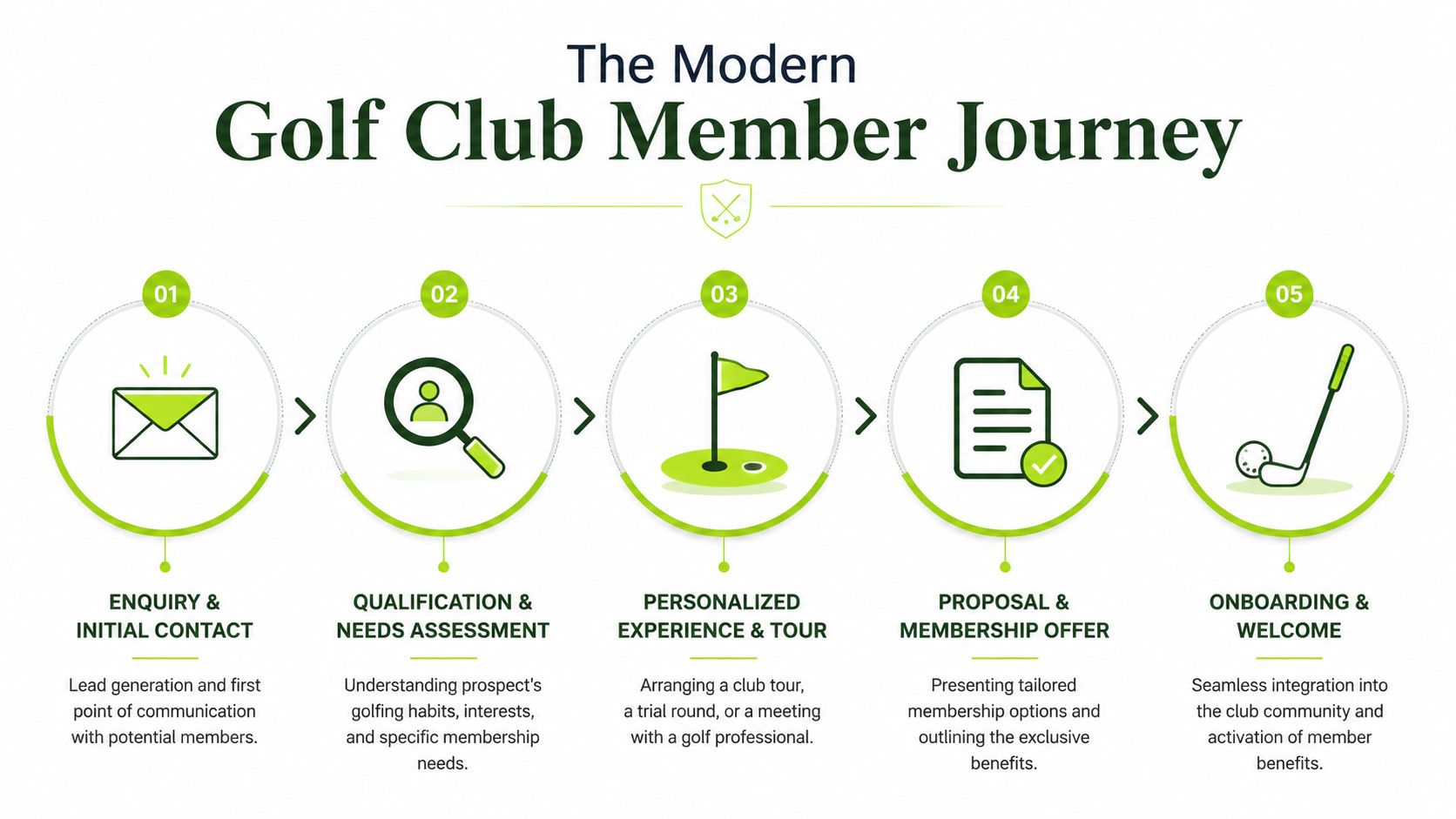
The reason this matters is timing. The period between first enquiry and signed membership averages 47 days in UK private clubs, while clubs using AI-driven follow-ups see a 54% reduction in conversion lag and a 2.1x higher membership sign-up rate according to UK POS guidance on improving golf club revenue. If your process doesn't actively manage that middle period, leads drift.
The five stages that matter
| Stage | What it means | What must happen |
|---|---|---|
| Enquiry | The lead makes first contact through a form, call, email, or walk-in | The club captures the enquiry immediately and assigns ownership |
| Qualification | The club establishes fit and intent | Staff or automation ask the right questions and record answers |
| Engagement | The prospect starts picturing themselves at the club | The club shares relevant details, answers objections, and creates momentum |
| Visit | The lead experiences the club in person or through a guided interaction | The visit is planned, hosted properly, and followed by next steps |
| Follow-up | The club turns interest into decision | Every lead receives timely, relevant contact until a clear outcome is reached |
Why the old method fails
Many clubs still run membership sales on what can only be described as the "email the secretary and hope" model. That approach creates three problems.
First, no one knows where a lead is in the process.
Second, there is no shared standard for what happens next.
Third, follow-up depends on individual memory instead of a system.
A pipeline only becomes manageable when every prospect has a stage, an owner, and a next action.
This is the difference between activity and process. Activity looks busy. Process creates movement.
Lead visibility changes behaviour
Once a club can see every prospect by stage, weak points become obvious. You can spot whether the bottleneck is early qualification, too few visits, poor visit quality, or weak follow-up after the visit. Without that visibility, clubs tend to blame marketing because it's the most visible part of the journey.
A workable setup doesn't need to be complicated. It needs to answer a few practical questions every day:
- Who enquired today
- Who still needs a call
- Who has a visit booked
- Who visited but hasn't been followed up
- Who has gone quiet and needs re-engagement
That alone is a major step up from scattered inboxes and spreadsheets.
A modern member journey is not more corporate
Some managers worry that a structured pipeline feels too commercial for a members' club. In practice, the opposite is true. A good system creates a more personal experience because staff aren't scrambling. They have context. They know what the prospect asked, what type of membership fits, whether a tour has been booked, and what should happen next.
That makes the club feel organised, attentive, and professional. Those are exactly the qualities a potential member is trying to judge.
The First Hour Is Everything Instant Response and Qualification
The first hour shapes the rest of the conversation.
A membership lead that receives a response within one hour is five times more likely to convert than one that waits 24 hours, according to CRM.Golf's breakdown of response time and conversions. That doesn't mean a manager has to personally call every enquiry within minutes. It means the club needs a system that responds instantly, even when staff are on the course, in a meeting, or off site.

What instant response should actually do
An automated first response shouldn't be a bland confirmation email. It should perform three jobs at once.
- Acknowledge quickly: Confirm the club has received the enquiry and is already acting on it.
- Set expectation: Tell the prospect what happens next and when.
- Start qualification: Ask one or two simple questions that help route the lead properly.
That gives the prospect confidence and gives the club better information before a human call happens.
A practical first-touch script
The most effective first response is short and specific. Something like this works well:
Thanks for your enquiry about membership. We've received your details and a member of the team will be in touch shortly. In the meantime, reply with the membership type you're most interested in and whether you'd like to arrange a visit, a call, or more information by email.
That message does more than acknowledge. It creates a micro-commitment. The prospect replies, chooses a preferred next step, and becomes easier to prioritise.
For clubs ready to make this more systematic, GolfRep has also written about AI lead qualification for golf clubs, which shows how automated qualification can support staff rather than replace them.
The qualification questions that matter
You don't need a long form. You need useful detail.
A good early qualification flow might ask:
- Membership interest: Full, flexible, academy, social, junior, or unsure.
- Playing pattern: Weekdays, weekends, mixed, or occasional.
- Decision stage: Comparing clubs, ready to visit, or actively looking to join soon.
- Best next step: Phone call, tour, trial round, or email information.
Those questions do two things. They help staff tailor the conversation, and they expose which leads are warm enough to move straight to a visit.
Automation creates capacity
Club teams sometimes resist automation because they think it will sound robotic. The opposite is usually true when it is built properly. Automation handles speed and consistency. Staff handle judgement and relationship-building.
That division matters. If your office team spends its time manually acknowledging every enquiry, chasing basic information, and forwarding emails internally, it has less time for meaningful conversations. A better golf club sales process removes that friction.
On the ground: Automation should deal with urgency first, then hand over context to the right person.
The clubs that win the first hour don't necessarily have larger teams. They don't leave the first touch to chance.
Nurturing Leads from Enquiry to Tee Time
Most memberships aren't won on the first reply. They're won in the follow-up.
Once a prospect has shown interest and shared some detail, the club needs to stay present without becoming repetitive. At this point, many sales processes go quiet. A lead receives a brochure, maybe a phone call, and then nothing structured happens. Interest fades, priorities shift, and the enquiry stalls.
Successful clubs report conversion rates of 28–32% from initial enquiry to signed membership when using automated nurture flows. The same source notes that 40% of clubs fail to use post-visit data for targeted offers, reducing repeat visit likelihood by up to 30%, based on industry statistics compiled by WiFiTalents.
A workable nurture sequence
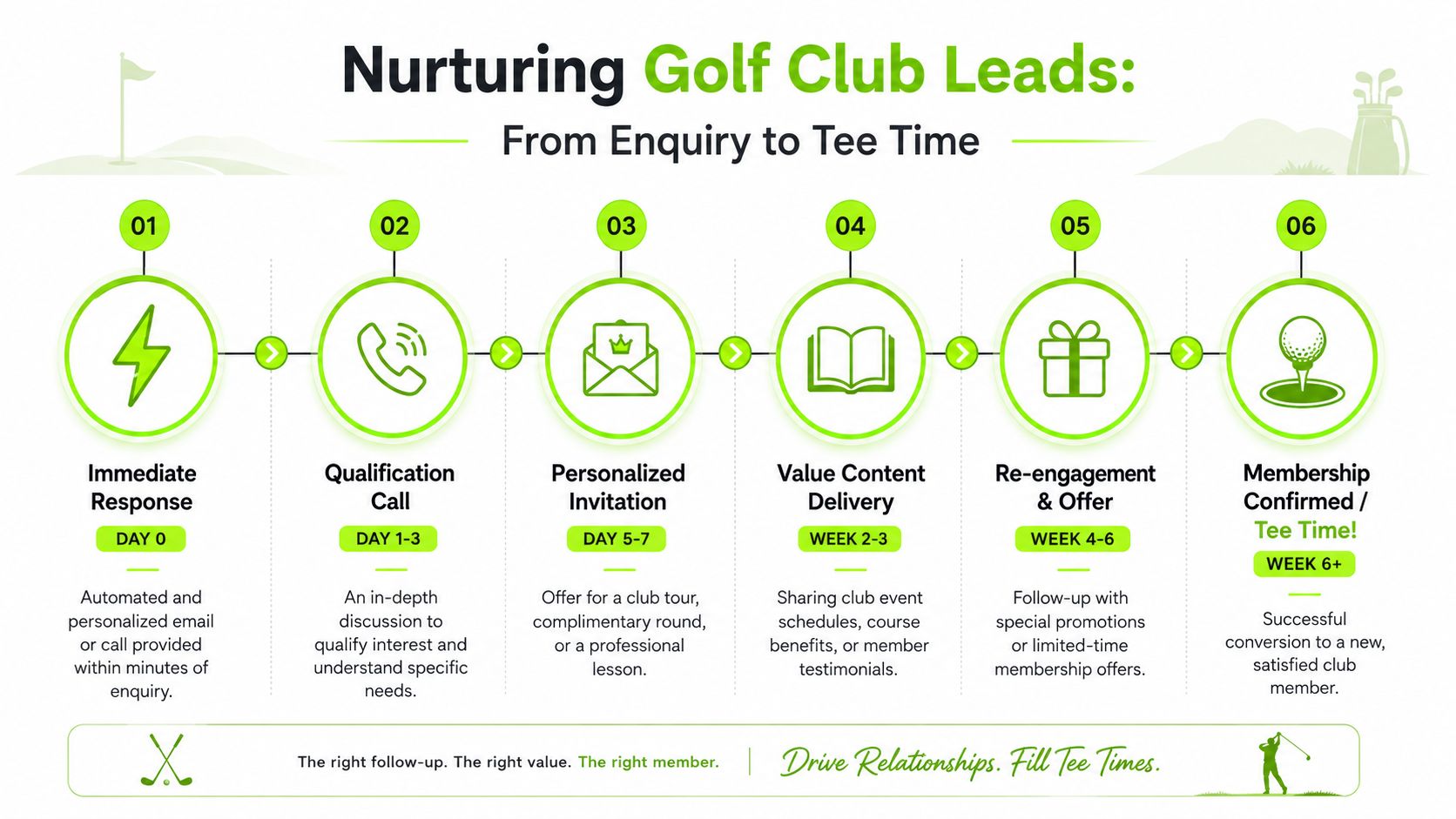
A strong nurture sequence doesn't need fancy copy. It needs relevance and timing. A practical version often looks like this:
- Touchpoint one: A personal email from the manager or membership lead with a direct invitation to visit.
- Touchpoint two: A short follow-up call that references the prospect's needs, such as weekday flexibility or beginner support.
- Touchpoint three: Useful proof, such as member testimonials, a simple course walkthrough, or an explanation of the club calendar.
- Touchpoint four: A visit reminder or post-visit message with a clear recommendation on the right membership route.
- Touchpoint five: Re-engagement if the lead goes quiet, with context based on their previous interest.
This sequence is where a CRM earns its keep. It stores context, schedules the next action, and keeps the prospect moving even if staff availability changes. GolfRep's article on golf club automated follow-up gives a useful view of how clubs can make this consistent.
What good nurturing sounds like
The tone matters. Most clubs already know how to be welcoming in person. They need to extend that same standard into email, phone, and SMS.
A poor nurture flow sounds generic: "Just checking in to see if you had any thoughts."
A strong one sounds useful: "You mentioned you mainly play at weekends and wanted a club with regular competitions. We have availability for a tour on Saturday, and I can also show you how our competition diary works."
That difference seems small. In practice, it's the difference between chasing and guiding.
Build the sequence around decision confidence
There is a lesson here from other sectors too. Even outside golf, strong account acquisition relies on well-timed, relevant contact rather than repeated generic nudges. This tactical playbook for SaaS account acquisition is useful because it shows how structured follow-up builds confidence across a longer decision cycle.
Golf club membership works in much the same way. People rarely need more information in general. They need the right information at the right moment.
Send the next message because it helps the prospect decide, not because the calendar says it's time to "check in".
Post-visit is where many clubs lose control
The visit often gets treated as the finish line. It isn't. It's the point where the prospect has the most emotional context. They've seen the clubhouse, met staff, walked the course, maybe had a coffee, and started to imagine themselves there.
If the club doesn't capture what mattered during that visit and use it in follow-up, the momentum fades quickly. A note in the CRM such as "interested in mixed comps, asked about joining with spouse, liked practice area" is far more useful than "good tour".
That detail makes the next message feel remembered. And remembered leads convert better than managed leads.
Key Metrics for a Predictable Pipeline
A golf club sales process becomes predictable when it is measurable.
Most clubs track outcomes loosely. They know how many members joined, or whether a campaign felt busy. That isn't enough. To improve conversion, you need visibility into the points where momentum is gained or lost.
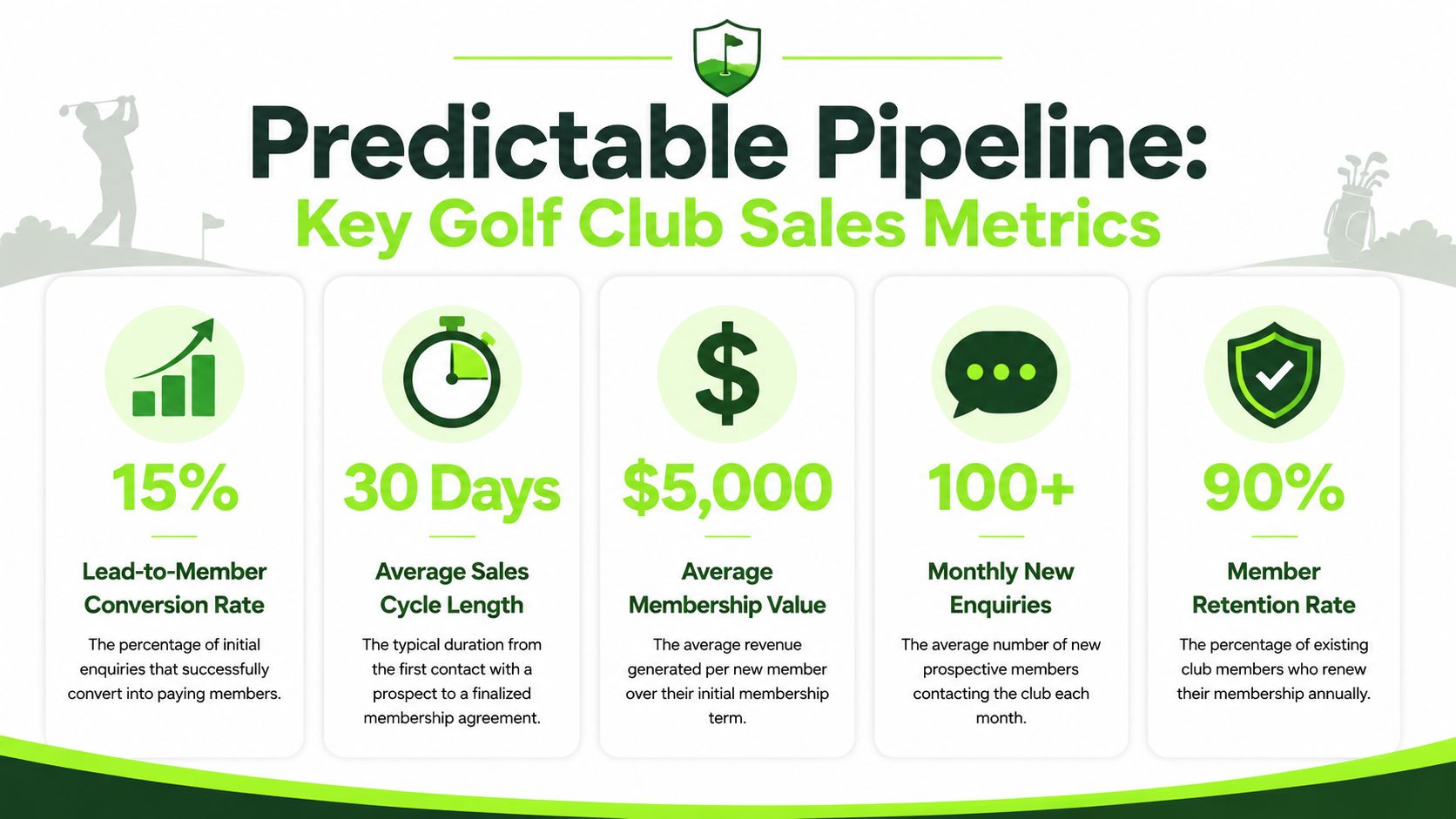
The dashboard doesn't need to be complicated. It needs to answer a small number of practical questions consistently.
The core metrics to track
| Metric | What it tells you | Why it matters |
|---|---|---|
| Lead response time | How quickly the club reacts to new enquiries | It shows whether speed is under control or left to chance |
| Enquiry-to-visit rate | How many leads progress to a real appointment | It reveals whether initial messaging and qualification are strong enough |
| Visit-to-member conversion rate | How many visits turn into sign-ups | It highlights the quality of the visit and the strength of post-visit follow-up |
| Sales cycle length | How long the journey takes from enquiry to membership | It shows whether leads are moving or drifting |
| Lead source and stage visibility | Where prospects came from and where they currently sit | It helps the club allocate time and budget more intelligently |
These metrics give managers a working view of reality. Not assumptions. Not anecdotes. Reality.
Reviews belong in the pipeline conversation
One useful metric many clubs ignore is review activity.
Fewer than 30% of clubs actively solicit reviews, even though 52% of UK golfers consult online ratings before purchasing. Actively showcasing reviews can increase purchase intent by 20–25%, and that mirrors how expert fitting services can increase equipment conversion rates by up to 35%, according to Credence Research on the UK golf club market.
That matters because social proof affects the sales process before a member ever speaks to you. If a prospect looks you up after an enquiry and finds thin, outdated, or inconsistent reviews, confidence drops. If they see recent proof of service quality and member experience, your follow-up lands on stronger ground.
What managers should review every week
A weekly review rhythm is often enough if it is disciplined. Look at:
- New enquiries: Were they all contacted properly and assigned.
- Stalled leads: Which prospects have had no movement and why.
- Booked visits: Are they increasing, flat, or slipping.
- Post-visit follow-up: Did every visitor receive a next step.
- Review capture: Are recent members and visitors being asked for feedback.
Even if your club is still refining lead generation, it helps to understand broader effective lead generation methods so the front end of the pipeline supports the process behind it. The key is not to confuse more top-of-funnel activity with a healthy system.
Metrics shouldn't exist to impress a committee report. They should tell staff what to fix this week.
Tracking creates accountability
Once these numbers sit in a CRM, weak habits become visible. That is a good thing. If response times slip, you see it. If lots of enquiries come in but few visits are booked, you know where to investigate. If visits happen but sign-ups stall, the issue is likely in the offer, visit quality, or follow-up.
Without metrics, clubs debate opinions. With metrics, they can improve the process stage by stage.
Common Pitfalls and Building a Resilient System
The most common failure in a golf club sales process is building it around one person.
That person might be excellent. They know the members, handle the inbox, remember who visited, and keep things moving by sheer effort. But the moment they're on leave, busy with an event, or pulled into daily operations, the process slows down. A resilient system can't depend on heroics.
The mistakes that keep repeating
The same patterns appear again and again:
- One-person bottlenecks: One individual owns too much of the process, so delays ripple through the pipeline.
- Inconsistent follow-up: Some leads get excellent attention while others receive none because there is no standard sequence.
- No shared visibility: The club cannot see who is new, who has visited, who is undecided, and who has been lost.
- Weak qualification: Time gets spent on poorly matched prospects while stronger leads wait too long.
These are process faults, not people faults. Good staff still struggle inside weak systems.
What resilience looks like in practice
A resilient setup is simple enough that any relevant team member can step in and continue the process without guessing. Enquiries are logged automatically. Qualification notes are stored centrally. Tasks are assigned. Visit outcomes are recorded. Follow-up reminders happen without relying on memory.
That structure protects the club in busy periods and gives committees more confidence because the pipeline is visible.
The right system reduces stress for staff and removes uncertainty for prospects.
Predictable growth comes from repeatability
Membership growth often gets discussed as if it were mostly seasonal or luck-driven. Seasonality matters, and local demand matters, but clubs still control the process that turns interest into revenue.
That is where predictability comes from. Not from chasing endless new enquiries, but from building a process that responds fast, qualifies properly, follows up consistently, and shows exactly where each lead stands.
If your club wants a healthier pipeline, start there. Tighten the system first. Then increase demand into something that can convert.
If your club needs help building a golf club sales process that doesn't rely on inboxes, memory, or manual chasing, GolfRep helps UK clubs put the right systems in place. That means lead generation connected to structured follow-up, CRM visibility, and a predictable route from enquiry to membership.
Ready to tap into our proven growth system?