Golf Club AI Playbook: Automate Growth in 2026

Around 42 hours is the average UK golf club enquiry response time, while AI-assisted workflows can reduce that to under 10 seconds. In a 2025 Midlands pilot, that change accompanied a 35% rise in qualified leads and a 28% increase in conversions within three months.
That gap matters because a prospective member, visitor or society organiser rarely separates your marketing from your sales process. They experience one journey, beginning with an advert, website form, phone call or booking request. If the club takes two days to acknowledge the enquiry, the quality of the original campaign becomes almost irrelevant.
The practical question for a club manager isn't whether AI sounds impressive. It's whether a workflow can capture an opportunity, record it properly, assign responsibility and help a member of staff make the right human intervention at the right time. That is the distinction between golf club AI as a novelty and AI as part of a commercial operating system.
The Golf Club AI Reality Check
The conversation around AI often starts in the wrong place. Managers hear claims about chatbots replacing reception teams, automated content replacing marketing staff, or algorithms making decisions about members. Those concerns are understandable, but they don't describe the most useful applications currently available to UK golf clubs.
The Golf Club Managers' Association reports that clubs and service providers are already using AI for marketing communications, customer service and operations. Its coverage also describes a client where around 75% of green-fee revenue is driven through advertising revenue, and explains how AI can process large volumes of free-text member feedback, including responses from 700 members, to identify themes more quickly than manual review. The GCMA's coverage of AI in golf clubs presents AI as a practical management tool linked to service, profitability and time savings.
Speed is a revenue issue
The response-time problem is more immediate than most technology discussions suggest. Industry coverage puts the average UK golf club enquiry response time at about 42 hours, while a 2025 Midlands pilot reduced response time from more than four hours to under 10 seconds using instant acknowledgement and CRM routing. The same pilot reported a 35% increase in qualified leads and a 28% increase in conversions within three months. The UK golf operations benchmark and Midlands pilot provide a useful commercial reference point, although every club should establish its own baseline before forecasting an outcome.
The point isn't that a bot magically creates demand. It creates a reliable first response, captures useful information and gives staff a visible next action. That protects the value of campaigns already being funded.
Practical rule: Automate the delay, the data entry and the reminder. Keep the relationship, judgement and difficult conversations with people.
AI also has a role beyond lead handling. A committee-led club may have good member feedback, booking information and enquiry history, but lack the time to turn those inputs into decisions. AI can help staff find patterns, provided the underlying information is organised and someone remains accountable for acting on it.
Defining Goals and Identifying High-Impact Use Cases
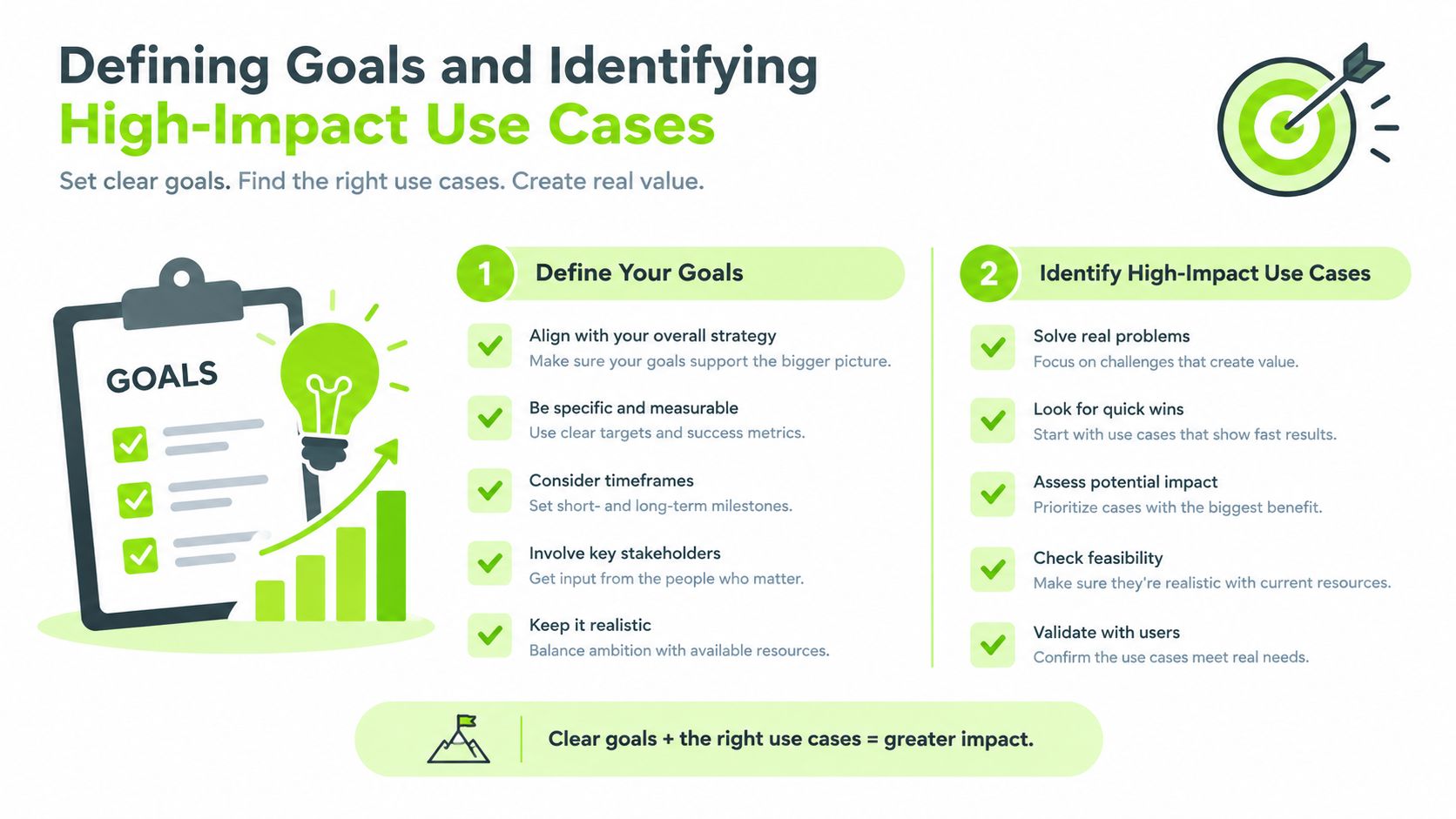
Buying software before defining the commercial problem is how clubs end up with another subscription, another login and no measurable return. Start with the workflow, not the technology. Write down where staff lose time, where customers wait, and where management can't see what happened next.
Research commissioned by UK golf bodies surveyed 134 golf club managers and found that software adoption is driven mainly by member experience and operational efficiency, rather than novelty. The same research recommends assessing whether each workflow reduces manual handling, response time and duplicated administration. The UK golf club software landscape research is a useful starting point for a club technology audit.
Begin with a bottleneck audit
Review the last few weeks of activity and ask four questions:
- Where does information arrive? List website forms, booking enquiries, phone calls, social messages and emails.
- Who owns the next action? If the answer changes depending on the day or staff member, the process needs clarification.
- What gets repeated manually? Look for data entry, acknowledgement emails, reminders, visit preparation and rebooking messages.
- Which outcome matters commercially? Choose a booked tee time, trial round, membership appointment, society proposal or retained member, not a vague productivity goal.
For a club trying to improve membership sales, an AI qualifier can ask about playing preferences, location, budget or desired membership type, then pass the relevant details to the right person. For a busy visitor operation, the priority may be recognising booking intent and directing the customer towards available tee times.
Match the use case to the leak
Lead qualification works when staff spend time filtering basic enquiries before a meaningful conversation can begin. Automation should collect context and identify buying signals, not pretend to conduct the entire sales process.
CRM automation matters when conversations sit across inboxes, spreadsheets and personal phones. A system should create a profile, record the interaction and assign a next action.
Personalised nurture is valuable after a visit or enquiry. UK golf marketing guidance recommends triggered communications such as post-round follow-ups and win-back campaigns for golfers inactive for 30, 60 or 90 days. This practical guide to golf course marketing workflows shows how timing and behaviour can shape useful contact.
Ad optimisation belongs later in the process. AI can help shift attention towards campaigns producing bookings or qualified enquiries, but it can't compensate for a weak sales journey. Use the market opportunity identification framework to connect audience demand with an operational capability the club can deliver.
Selecting the Right Technology and Integrations
A golf club doesn't need a collection of clever tools that each know only one part of the customer journey. It needs a dependable flow of information between the booking system, CRM, payment process, website and staff.
The operating environment is already digital. Independent industry coverage reports that 72% of golf clubs prioritise cloud-based management solutions, while 68% say mobile booking is the main way members interact with their facility. Coverage of the UK golf software market explains why AI follow-up should be treated as an extension of existing systems, rather than a separate experiment.
What the core system must do
A suitable CRM should create one customer record that staff can understand quickly. Calls, issues, agreements and emails need to sit against that profile, with internal tasks for sales follow-up and issue resolution. GolfManager's CRM functionality illustrates the basic operating principle, every interaction should be visible to the people responsible for progressing it.
Test a prospective platform against practical scenarios:
- A visitor completes a form asking about weekday tee times.
- The system acknowledges the enquiry and records the details.
- A task is assigned to a named staff member.
- The staff member sees previous contact before calling.
- The outcome, including no response or a booked visit, is recorded.
- A suitable follow-up is triggered without creating duplicate records.
If the software can't support that sequence, adding AI may only make a broken process operate faster.
Avoid isolated automation
A chatbot that can't see booking availability will frustrate customers. An email tool that can't identify a completed visit will send irrelevant messages. An advertising platform that reports clicks but not revenue can lead managers to fund activity that looks busy without producing a commercial result.
Ask suppliers how data enters the system, where it is stored, who can edit it and how staff receive exceptions. Human handoff must be built into the design. The best automation removes repetitive administration while giving the team enough context to deliver a personal response.
For clubs comparing platforms, this guide to the best golf club CRM requirements can help turn a broad software conversation into a list of operational tests.
Running Pilot Campaigns for Fast, Measurable Wins
A full AI rollout is rarely the sensible first move. Clubs have seasonal peaks, limited staff capacity and existing systems that may contain inconsistent data. Automating every customer journey at once makes it difficult to identify what worked, and it can expose customers to poorly timed or impersonal communication.
A pilot should focus on one revenue stream, one audience and one measurable outcome. The choice depends on the club's current constraint.
| If the club is experiencing | Start with | Measure |
|---|---|---|
| Slow acknowledgement of enquiries | Instant response and qualification | Response time and qualified opportunities |
| Healthy visitor demand but weak repeat play | Post-round and rebooking workflow | Repeat bookings |
| Strong membership interest but few visits | Trial-round nurture | Enquiry-to-visit conversion |
| Inconsistent society administration | Structured qualification and task routing | Proposal completion and confirmed bookings |
The rapid visitor route
Visitor acquisition can produce an early operational test because the journey from advert to booking is relatively direct. AI-supported campaign analysis can help identify which audiences and messages produce useful enquiries, while an automated qualifier gathers dates, group size and playing requirements.
That doesn't mean the system should promise availability it can't verify. It should provide a clear next step, route exceptions to staff and preserve the context of the conversation. The commercial test is whether more of the right enquiries become booked rounds, not whether the chatbot handles a large number of conversations.
The GCMA has linked AI use in clubs with marketing, service and operational efficiency, including the analysis of member feedback and the connection between revenue and communications. Its wider account of smarter club systems supports a measured approach, where technology improves evidence-based decisions rather than replacing managerial judgement.
The slower membership route
Membership conversion needs more patience because a prospect may need a conversation, a visit, a trial round and time to compare options. A single automated email won't solve that journey. The useful model is a sequence of small, relevant actions:
- Initial response: Confirm the enquiry and collect missing information.
- Staff follow-up: Create a task for a named person to make contact.
- Pre-visit communication: Explain what will happen and who the prospect should meet.
- Visit follow-up: Ask for feedback and answer outstanding questions.
- Next-step prompt: Offer a clear route towards joining or another conversation.
A UK golf club CRM case study describes automated workflows across membership enquiry responses, sales tasks, pre-visit communications, upsell opportunities, post-round feedback and rebooking prompts. The case study on HubSpot CRM for golf clubs demonstrates why stage-based automation is more useful than sending the same message to every prospect.
The pilot should prove a process, not a piece of software.
Give each pilot a start point, owner, audience definition, handoff rule and review date. If the club's biggest leak is response time, begin with acknowledgement and routing. If visitors arrive but rarely return, begin after the round. If prospects visit but don't progress, improve the human sales conversation before adding more automation.
Measuring KPIs That Matter to Club Revenue
AI projects often look successful because they generate activity. A dashboard may show conversations started, emails sent or website sessions increased, while the club still has no clearer view of booked visits, membership decisions or revenue.
Start with the time between enquiry and first meaningful acknowledgement. The Midlands pilot described earlier provides a useful benchmark because it connects faster handling with stronger qualification and conversion, but the first target for your club should be an accurate baseline. Measure response time by channel and by time of day, since an average can hide long delays outside office hours.
Build a short commercial scorecard
Track the movement between stages rather than counting activity in isolation:
- Response time: How long does a prospect wait for an acknowledgement and a human next step?
- Qualification rate: How many enquiries contain enough information to be commercially useful?
- Lead-to-visit conversion: How many qualified prospects book a trial round, appointment or site visit?
- Visit-to-membership conversion: How many visitors or prospects progress to membership?
- Rebooking rate: How many visitors return after the first round?
- Revenue by source: Which campaign or channel produces confirmed commercial outcomes?
- Handoff quality: How often does automation send a relevant opportunity to the right person?
Don't set a target that the system can't measure consistently. A club should be able to trace an enquiry from its source through contact, visit and outcome. If staff still need to reconcile three spreadsheets at month-end, the apparent intelligence is resting on unreliable information.
For teams monitoring automated conversations, Chatgrow agent monitoring offers useful context on checking whether AI agents behave as intended, identify failures and maintain appropriate oversight.
Report the constraint, not just the result
A monthly report should show where prospects stop moving. If acknowledgement is fast but few people book a visit, the issue may be the offer, price presentation, availability or staff conversation. If visits are strong but membership decisions are weak, improving the nurture sequence alone may not fix the proposition.
Use this guide to measuring marketing effectiveness to connect campaign reporting with the commercial stages that follow it. The right KPI is the one that helps the manager decide what to change next.
Iterating and Scaling Your Golf Club AI Strategy
An AI workflow isn't finished when it goes live. It becomes useful when staff review the outcomes, correct the exceptions and improve the rules. Golf clubs also change throughout the year. A membership campaign, a summer visitor push and a winter indoor facility may need different audiences, messages and handoff points.
Review performance monthly, but don't wait for the meeting to capture obvious failures. Ask staff which enquiries were misclassified, which messages felt unsuitable and which tasks arrived without enough context. Their feedback is operational data, not an inconvenience.
Improve one variable at a time
A simple review cycle keeps changes manageable:
- Measure: Record stage-by-stage performance and examples of failed handoffs.
- Diagnose: Identify whether the constraint is data quality, timing, message, offer or staff capacity.
- Change: Adjust one workflow rule, message, audience or escalation trigger.
- Check: Compare the next period with the previous baseline.
- Document: Record what changed and why, so the committee and staff can follow the decision.
If a sequence receives little engagement, test its timing, subject line or relevance. If a chatbot diverts qualified prospects away from staff, add a human handoff when a customer asks about pricing, availability, joining arrangements or a complex booking. Automation should become more selective as the club learns, not more intrusive.
Scale by similarity
Once one visitor workflow works reliably, the same operating logic may suit society and corporate enquiries, with different questions and staff ownership. A membership nurture sequence may also inform lapsed-member reactivation, but it shouldn't be copied without considering the reason for inactivity and the member's previous experience.
Discovery is another part of the strategy. A 2026 study covered by The Golf Business tested four UK multi-site operators across Perplexity and ChatGPT and found major differences in which clubs appeared for local prompts. St Mellion Estate was absent from Perplexity for a Cornwall query and ranked fourth of four on ChatGPT, while Orpington Golf Centre was absent on ChatGPT and appeared only as an afterthought on Perplexity. The report on AI-driven golf club discovery shows why clubs should make their location, facilities, reputation and visitor proposition clear across their digital presence.
For teams working on how businesses are represented in AI-generated answers, this prompt optimisation guide from MyMentions provides useful background. The commercial principle remains the same: make the information accurate, structured and easy for both customers and systems to interpret.
Committee-led clubs don't need to approve an abstract AI strategy. They can approve one workflow, one owner, one success measure and one review date. That approach keeps investment tied to a real constraint and gives the club evidence before it expands.
GolfRep helps UK golf clubs connect demand generation with qualification, CRM ownership, follow-up and measurable revenue outcomes, rather than treating AI as a standalone tool. If you want to identify the workflow limiting growth at your club and build a practical pilot around it, visit GolfRep.
Ready to tap into our proven growth system?