Golf Club Booking System: Drive Growth in 2026
The warning signs usually look ordinary at first.
The phone rings while a member is trying to amend a booking. A visitor enquiry sits in an inbox because the office is busy. A cancellation gets written down, but the tee sheet isn't updated everywhere it needs to be. Someone asks how many visitor rounds came from the website last month, and the answer is vague because the data lives in different places.
That isn't just an admin issue. It's a revenue issue, a service issue, and often a staff capacity issue.
For many clubs, the main problem isn't a lack of demand. Interest is there. Visitors want to book. Prospects want information. Existing members expect a smooth experience. What breaks down is the handling of that demand. Slow responses, manual workarounds, and disconnected systems make a club look harder to deal with than it needs to be.
A modern golf club booking system matters because it sits in the middle of that pressure. It controls access to tee-time inventory, but it also shapes how well the club responds to enquiries, tracks interest, captures payment, reduces friction, and turns activity into something measurable. When the system is right, staff spend less time chasing information and more time serving golfers. When it's wrong, the club keeps reacting instead of operating with control.
Introduction The Hidden Cost of an Outdated Booking Process
At many clubs, the booking process still depends on good people covering for weak systems.
A member calls to move a tee time. A visitor sends a web enquiry about green fees. A society organiser asks for availability. The office team checks one screen, then another, then a spreadsheet, then maybe a paper note left at reception. Nothing seems disastrous in isolation. The trouble is the accumulation.
Over time, an outdated process creates three forms of drag. It slows staff down, it frustrates golfers, and it weakens the club's ability to convert interest into revenue.
Where clubs feel the pressure first
The first pressure point is usually response time. If a booking request or membership enquiry isn't handled quickly, the club loses momentum. People rarely announce that they've gone elsewhere. They just stop replying.
The second pressure point is visibility. If bookings, cancellations, visitor data, and follow-up notes live in separate tools, no one has a clear view of what's happening. That makes forecasting harder and follow-up inconsistent.
The third is staff fatigue. Manual processes force capable teams to spend their day on low-value coordination work instead of member service, visitor experience, and sales conversations.
An outdated process doesn't fail in one dramatic moment. It leaks value in small, repeated misses.
The cost isn't only financial
Most committees look at software through the lens of cost. That's understandable. But the hidden cost sits elsewhere.
It appears in the unfilled slot that could have been rebooked faster. It appears in the visitor who had a decent experience on the course but a clumsy one online. It appears in the membership lead who asked for details and never received a structured follow-up. It appears in the office team who know the club is busy, yet still can't answer basic performance questions without digging.
A club can be well known locally and still underperform commercially because its systems don't support the demand it already has.
The practical shift that matters
The clubs that move forward stop treating booking as a diary problem. They start treating it as an operating system.
That changes the conversation. Instead of asking, “Can members book online?”, they ask better questions. Can staff see live availability without checking multiple places? Can the club track where visitor demand is coming from? Can booking behaviour feed into a stronger membership pipeline? Can managers spot gaps early enough to act?
A golf club booking system should answer those questions clearly. If it doesn't, the club is still relying on effort where it should be relying on process.
What Is a Modern Golf Club Booking System
A modern golf club booking system is not just a digital tee sheet.
It's the tool that manages how the club sells, protects, and allocates one of its most limited assets: playing time. That's why the shift in recent years matters so much. The rapid move from manual tee-sheet management to digital platforms in the 2010s and 2020s turned booking from a clerical task into a commercial tool. PGA.info explains how digital booking systems help clubs identify quieter times, promote visitor play, and implement dynamic pricing to manage tee-time inventory more effectively.
More than a calendar
A weak system stores bookings. A strong one helps the club make decisions.
That means it should do more than show who is playing at 10:12 on Saturday. It should help the club understand demand patterns, manage member access sensibly, and create controlled opportunities for visitor revenue without causing internal friction.
Many buying decisions go wrong because clubs compare software by screens and menus when they should be comparing operational outcomes.
A practical definition looks more like this:
- Inventory control: The club can see what is available, what is booked, and what has opened up.
- Commercial control: Managers can shape how tee times are offered and sold.
- Operational control: Staff don't need to patch together information from multiple tools.
- Data control: Booking behaviour becomes visible and usable.
Why this matters to UK clubs
Most UK clubs are balancing competing priorities. Members want access and fairness. Visitors create valuable revenue. Staff need manageable processes. Committees want accountability.
A modern booking system sits in the middle of those tensions. Done properly, it helps the club make deliberate choices instead of ad hoc compromises.
That's also why the booking system should be considered alongside the club's wider data setup. A booking platform on its own won't tell the full commercial story if enquiries, memberships, and follow-up sit elsewhere. The clubs that get most value from booking data usually think about it in the same breath as golf club CRM software.
The tee sheet is not just a schedule. It is a live record of demand.
The mindset change clubs need
The old mindset says booking software is there to reduce calls to the pro shop.
The better mindset says it is there to improve utilisation, protect member experience, support pricing decisions, and capture usable data. That's a different standard entirely.
A committee evaluating a golf club booking system should ask one central question: does this platform help the club run its inventory better, or does it digitise the same old bottlenecks?
That distinction matters. Plenty of systems look modern on the surface while leaving the club with the same blind spots underneath.
Core Features Versus Advanced Growth Capabilities
Clubs often buy too low or too high.
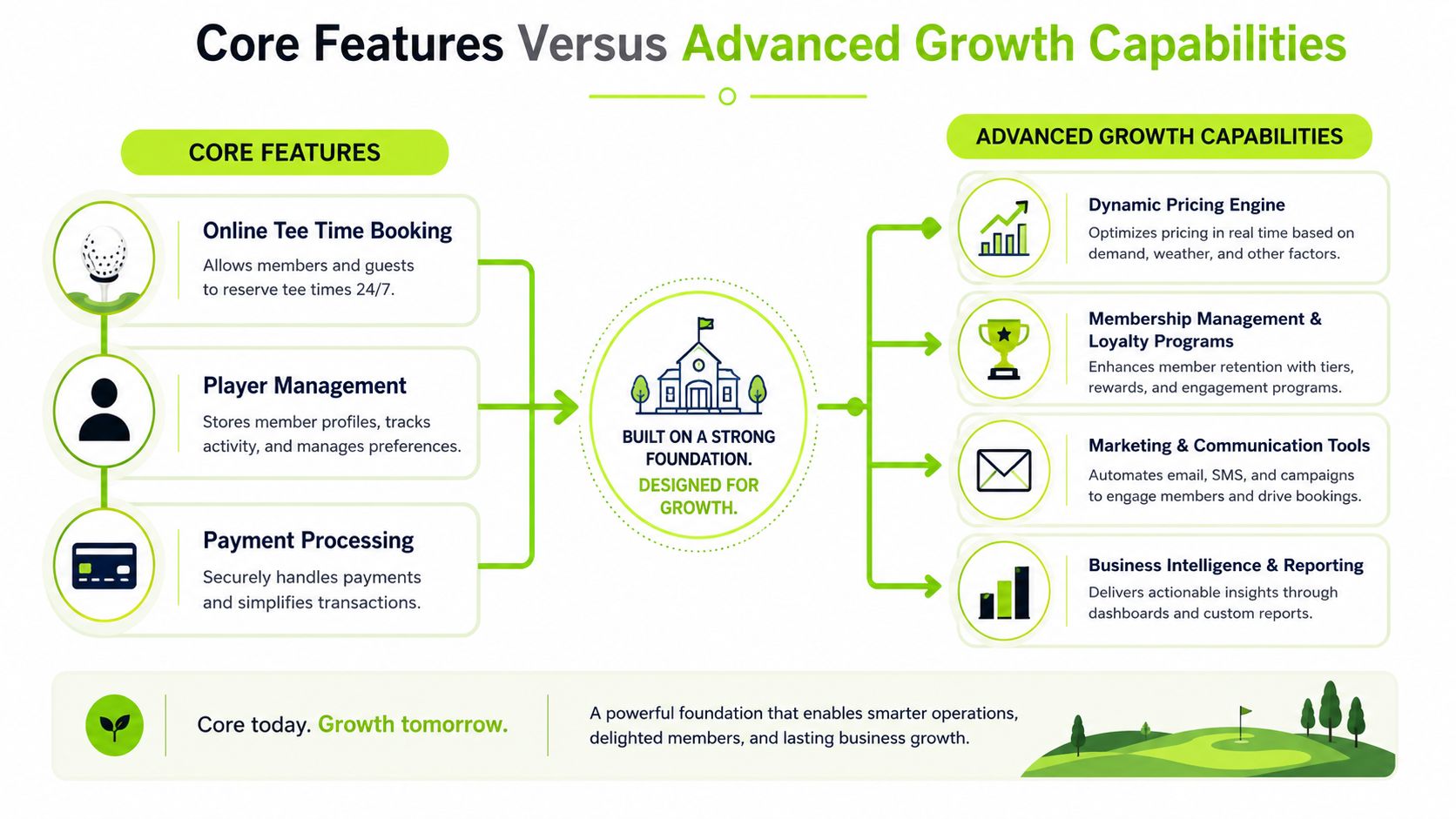
Buy too low and you get a tidy booking tool that still leaves the club manually fixing gaps elsewhere. Buy too high and you end up paying for a wide feature set that no one uses properly. The better approach is to separate core features from advanced growth capabilities.
The core features every club should expect
These are the foundations. If a system struggles here, nothing built on top of it will feel reliable.
| Area | What good looks like |
|---|---|
| Tee sheet | Clear, easy to update, and simple for staff to manage under pressure |
| Online booking | Straightforward booking flow for members and visitors |
| Payments | Secure payment handling without awkward manual chasing |
| Member rules | Booking permissions, access windows, and policy controls |
| Basic reporting | Enough visibility to review usage, cancellations, and booking activity |
Core features aren't glamorous. They are what stop daily friction from becoming normal.
A club should also expect practical basics like mobile usability, cancellation handling, and staff permissions. These don't sell software in a demo, but they shape daily confidence.
Where growth capability starts
Growth features matter when the club wants the booking system to contribute directly to revenue and lead generation, not just diary management.
Those capabilities often include:
- Dynamic pricing logic: Useful when the club wants to manage demand more actively rather than using one static approach.
- Marketing connectivity: Booking behaviour can trigger relevant communication instead of relying on broad email sends.
- Stronger analytics: Managers can see not just what happened, but where gaps and opportunities sit.
- Membership and loyalty links: Visitor behaviour can become part of a longer-term conversion path.
- Multi-site visibility: Important for operators running more than one venue or brand.
What works and what usually doesn't
What works is buying for the next operational stage, not just the current pain.
If the club still struggles with basic visibility, start with reliability, booking flow, and payment control. If those are already stable, then advanced commercial features start making sense. The order matters.
What doesn't work is chasing feature density. Long feature lists can hide weak adoption. If staff can't use the system confidently in a busy environment, the extra capability doesn't deliver value.
Practical rule: Buy the system your team can operate well, then layer in growth capability with discipline.
Another mistake is treating advanced functions as optional extras that no one owns. If no one reviews the reports, monitors schedule gaps, or acts on booking data, the club has purchased potential rather than performance.
Beyond Bookings Driving Growth and Operational Efficiency
The strongest systems earn their place because they improve decisions, not because they look modern.
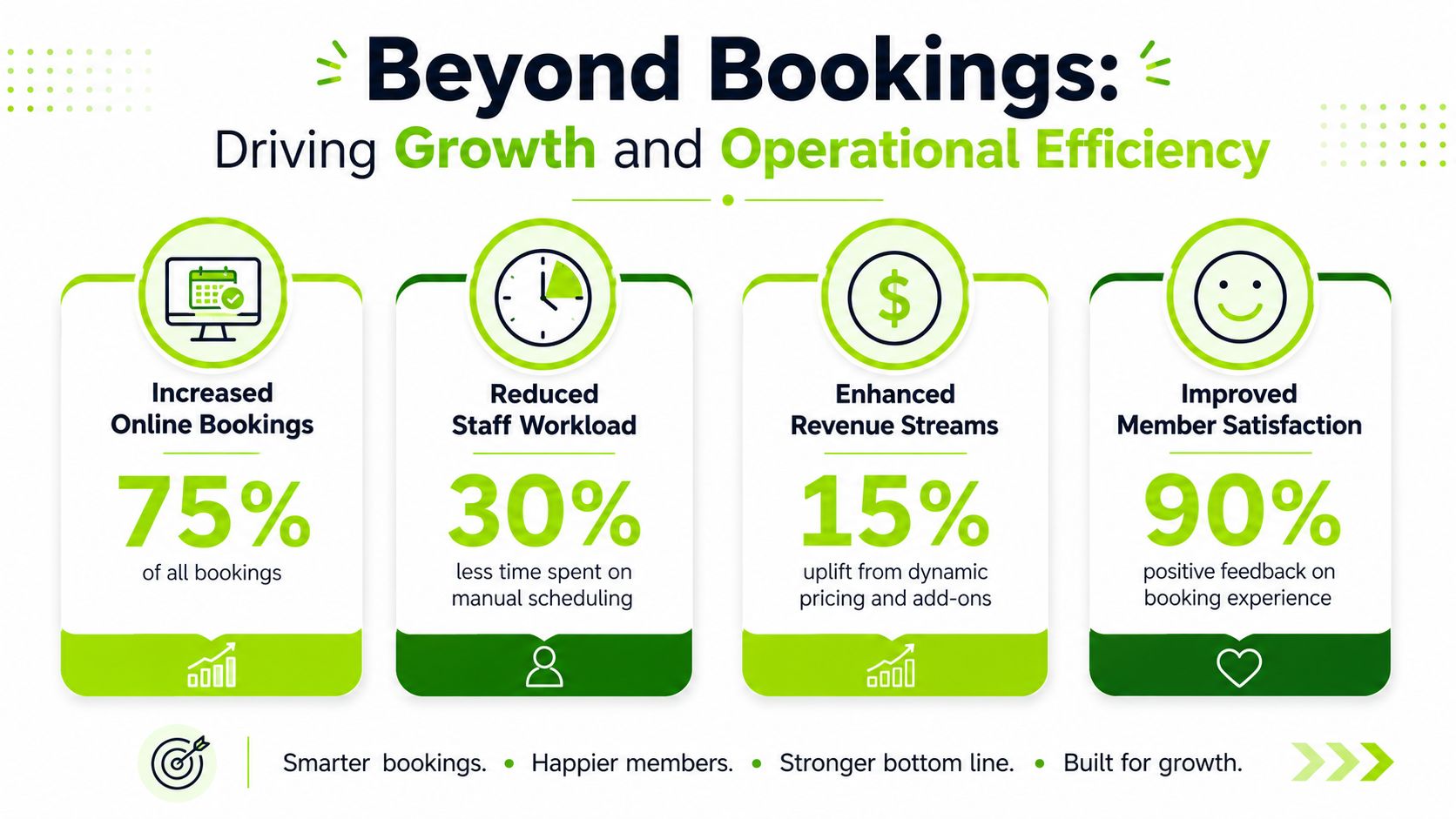
That starts with visibility. One cloud-based provider reports 99.96% reliability and highlights real-time dashboards that show revenue by tee times, green fees, add-ons, peak hours, new golfer sign-ups, and schedule gaps, which gives clubs a clearer operational picture than manual tracking can provide in its golf software overview. In practice, that means managers can see underused inventory, monitor demand patterns, and act earlier.
Revenue improves when visibility improves
Many clubs still review performance by feel. Staff know Friday afternoons are busy. They know some periods are harder to fill. But knowing in general isn't the same as seeing it clearly enough to act.
When a manager can view revenue by tee time and spot schedule gaps quickly, the club stops guessing. It can make better decisions around pricing, access, and promotional effort. That's one reason a good booking setup becomes part of revenue management infrastructure, not just office administration.
This is also where external booking performance should connect to wider commercial planning. Clubs trying to improve visitor yield often benefit from studying how strong tee time booking systems are structured across the market, especially when they're comparing ease of booking with revenue control.
Efficiency is not just about saving staff time
Efficiency matters, but not only because it reduces admin.
A better process also improves consistency. Bookings are confirmed properly. Payments are tracked. Reminders go out. Staff don't need to chase scattered information. Financial records are easier to audit because the booking trail is cleaner.
That creates a calmer operation. It also creates a more professional experience for golfers. Members notice when booking feels smooth. Visitors notice when they can reserve, pay, and receive confirmation without needing to call the club.
What clubs often underestimate
The hidden benefit is decision quality.
When the office team and management can see booking data clearly, they can answer better questions:
- Where are the recurring gaps?
- Which booking windows cause friction?
- Are visitor opportunities being handled properly?
- Which services are attaching to bookings?
- Are no-shows being reduced through process, not just effort?
Those questions affect revenue, staffing, and member experience at the same time.
A golf club booking system becomes commercially useful when it helps the club move from reactive scheduling to controlled utilisation. That's when it stops being a cost line and starts acting like an operating asset.
How to Choose the Right System A Vendor Checklist
Software demos are designed to be smooth. Club operations are not.
That's why a buying process needs more than a polished walkthrough. The club needs to test whether the system will still hold up on a wet Saturday, during a competition week, or when the office is short-staffed.
Questions that expose the real fit
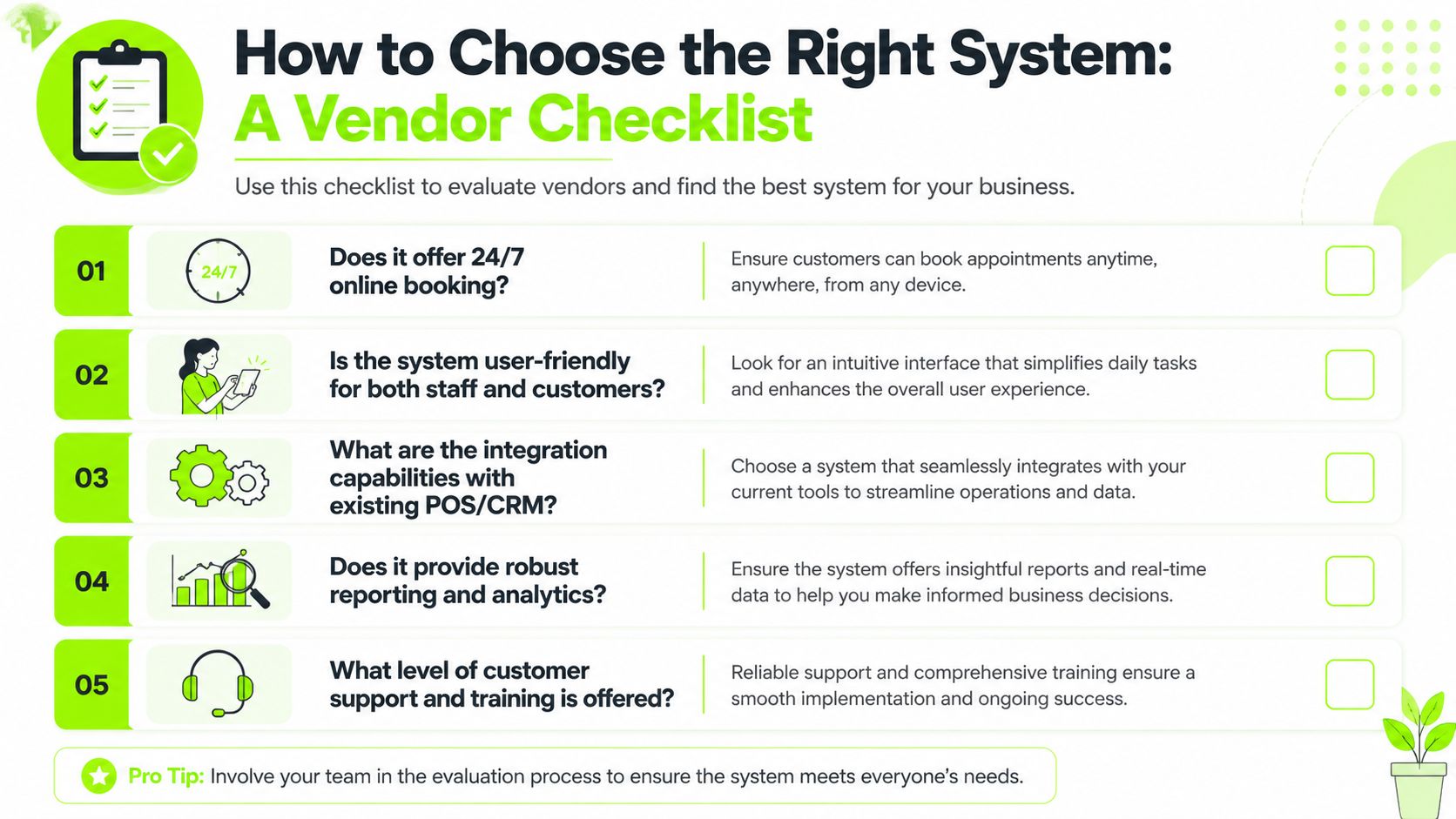
Use a checklist that gets past surface features.
- Booking access: Can members and visitors book easily at any time, without awkward workarounds?
- Usability under pressure: Can reception, pro shop, and management staff all use it confidently?
- Permissions and controls: Does it support the club's booking rules without creating constant manual exceptions?
- Reporting clarity: Can someone non-technical review performance without exporting everything into spreadsheets?
- Support model: What happens when the club needs help after launch, not just before signature?
Those are operational questions. They matter more than fancy interface language.
Integration should be non-negotiable
A standalone booking tool creates future problems. A connected one creates options.
Ask every vendor how the system connects to POS, CRM, website forms, and membership workflows. If the answer is vague, that usually means staff will end up bridging the gaps manually. That's exactly the situation clubs are trying to move away from.
If the club is also reviewing its digital member journey, it can help to look outside golf software for structural ideas. This guide to membership website creation is useful because it highlights how user flow, sign-up structure, and member access should be considered together rather than as separate website tasks.
What to ask before signing
This part is often rushed. It shouldn't be.
| Vendor question | Why it matters |
|---|---|
| How is data migrated? | Poor migration creates errors that last for months |
| What training is included? | Adoption depends on confidence, not just access |
| What does support look like post-launch? | Problems usually appear after go-live |
| How are updates handled? | Clubs need stability and clear communication |
| Can the system support membership workflows? | Booking and member management often overlap in practice |
One more point matters for growth-minded clubs. Ask how the system handles lead visibility. If a visitor books, enquires, cancels, or returns, can the club see that behaviour clearly enough to act on it? That question becomes even more relevant when a club is comparing booking platforms with broader membership management software in the UK.
If a vendor can't explain how the system supports follow-up, the club is probably buying software for transactions, not growth.
Implementation and Integrating with Your Growth Strategy
A golf club booking system can be selected well and still fail in practice.
That usually happens because implementation gets treated as a technical handover instead of an operational change. Staff are given logins, some data is imported, and everyone hopes the new process will settle itself. It rarely does.
Start with clean processes, not just clean data
Before launch, the club needs clarity on how bookings should flow.
Who owns cancellations? How are visitor enquiries handled? What happens when someone books a round, then asks about membership? Which staff members are responsible for following up? Software won't solve uncertainty in process. It will expose it.
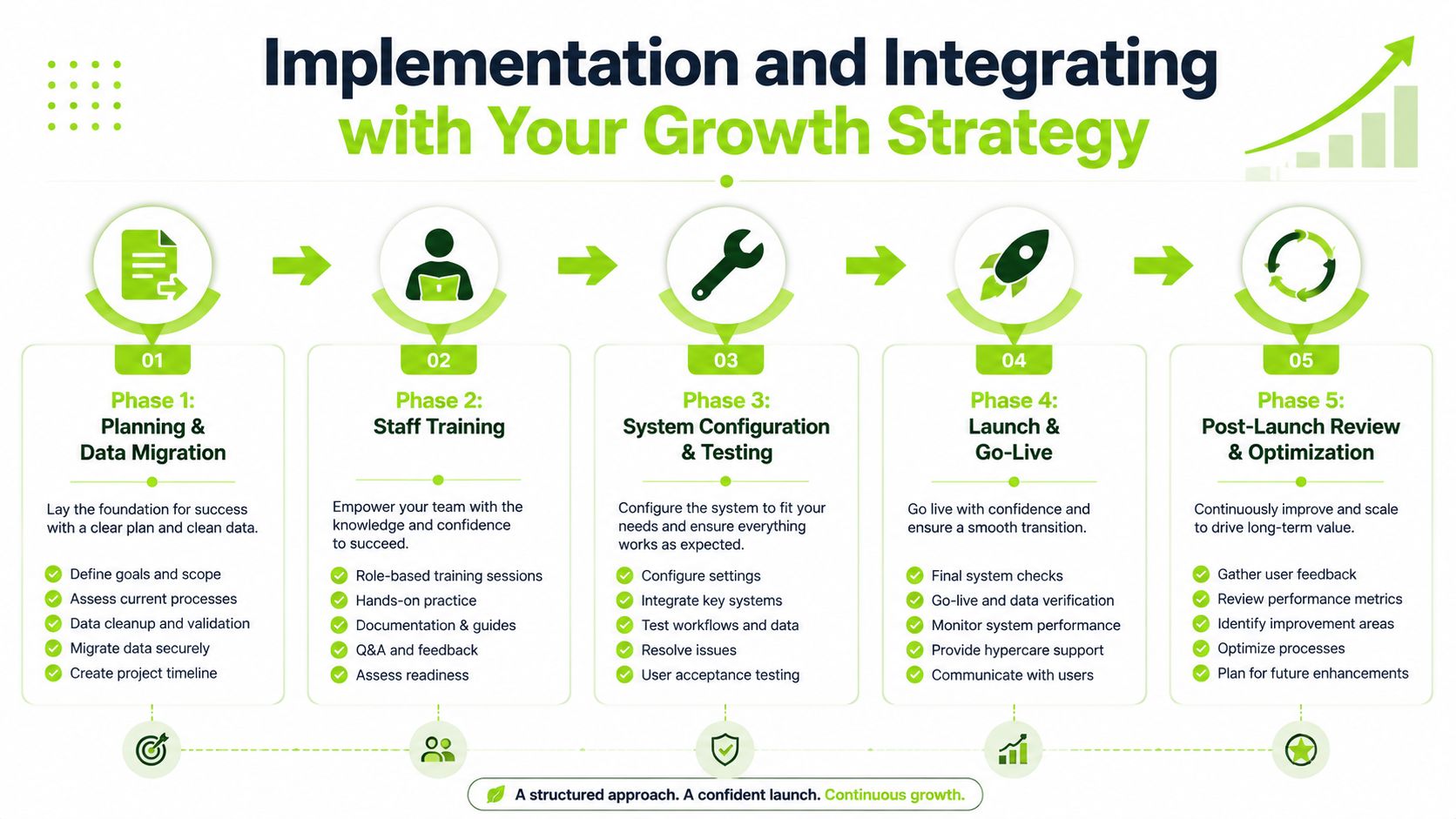
A disciplined rollout usually includes:
- Data review so duplicate or outdated records don't pollute the new system.
- Staff training built around real scenarios, not generic demos.
- Testing across booking, payment, cancellation, and communication workflows.
- Go-live ownership with named people accountable for each area.
- Post-launch review so small issues are corrected early.
For clubs that want a broader view of rollout discipline, this guide to effective appointment software onboarding is useful because the principles around adoption, user confidence, and post-launch support apply well beyond one sector.
Integration is where the value compounds
A booking engine becomes far more useful when it is connected properly.
When a booking engine is tied to a tee sheet and POS via an API, clubs gain real-time inventory control, which reduces double-booking and admin while creating the technical basis for linking booking data with wider course-management and sales systems, as described in Club Caddie's guide to tee sheet software and booking engines.
That matters because isolated data limits action. Connected data supports growth.
A visitor who books online shouldn't disappear into a closed record. If that person visits repeatedly, opens pricing emails, or submits a membership enquiry later, the club should be able to see that journey. That's where the booking system stops being a transaction tool and starts feeding a pipeline.
The strategic layer most clubs miss
The system needs measures attached to it.
Not vanity measures. Operating measures. Examples include online booking share, yield by booking window, lead response speed, and enquiry-to-visit conversion. Clubs don't need dozens of dashboards. They need a handful of metrics that reveal whether the process is working.
Good implementation means staff know what to do, managers know what to watch, and leadership knows what the system is contributing.
The clubs that get real value from a golf club booking system don't stop at launch. They review usage, refine automation, and connect booking behaviour to membership and visitor growth goals. That's where the long-term return usually sits.
Conclusion Your System Is a Tool Your Strategy Is the Engine
A modern golf club booking system should make the club easier to run, easier to buy from, and easier to understand.
But the software alone won't create growth. It won't fix slow follow-up, unclear ownership, weak enquiry handling, or disconnected reporting. Those are process problems first. The right platform gives the club a better way to solve them.
That's why the most useful way to view booking software is as infrastructure. It supports tee-time control, staff efficiency, visitor revenue, and member experience. Above all, it gives the club a clearer line of sight between interest and income.
The clubs that perform well in this area usually share one habit. They don't treat bookings, enquiries, and membership conversations as separate activities. They connect them. They track them. They build systems around them.
That is the shift.
When the booking process is structured properly, the club gains more than convenience. It gains visibility, consistency, and a stronger commercial rhythm. The technology matters. The thinking behind it matters more.
If your club wants help building that kind of joined-up system, GolfRep works with golf clubs to improve lead handling, follow-up, CRM structure, and pipeline visibility so enquiries don't just arrive, they convert.
Ready to tap into our proven growth system?