A Golf Club Follow Up System That Actually Converts Leads
Let's get straight to the point. A golf club follow-up system is not just a fancy tech term; it is a structured way to ensure every single person who shows interest in your club gets a prompt, professional, and personal response. It is about moving away from scribbled notes and forgotten emails, and instead using a reliable process, often powered by a simple CRM, to turn curiosity into revenue.
Without one, you are not just missing opportunities; you are actively losing revenue.
Why Your Club Is Leaking Revenue (And How to Fix It)
When membership numbers need a boost, the go-to solution for many clubs is to throw more money at marketing. It seems logical, right? More ads should mean more leads, which should mean more members. But in our experience as a growth partner for UK golf clubs, the problem is rarely a shortage of interest.
At GolfRep, we see it time and again: the real bottleneck is not lead generation. It is how clubs handle, respond to, and convert the enquiries they already have.

The truth is, your follow-up process is probably broken. An enquiry left unanswered for a day, a prospect's details lost on a post-it note, a verbal promise to "get back to them" are all symptoms of a manual process that is leaking money.
The Real Cost of Being Slow
Picture this all-too-common scenario. A keen golfer, let's call her Jane, fills out the membership enquiry form on your website. It's 8 PM on a Tuesday. She is actively looking and has just sent similar messages to two other local clubs.
At a typical club without a system, Jane’s email lands in a general inbox. The next morning, a busy club manager spots it but immediately gets dragged into an urgent operational issue. Jane finally gets a generic email with a PDF brochure attached late the next afternoon, nearly 24 hours after she first reached out.
By then, it is too late. A competing club, one with an automated system, has already sent her a personalised welcome message, a video tour of their course, and an invitation to book a call with the membership team. Jane has already moved on.
Your biggest growth opportunity is not spending more on marketing. It is building a better system to convert the interest you are already generating. Every unmanaged enquiry is pure lost revenue.
This one missed chance might seem small, but multiply it by the dozens of enquiries you get each month, and the financial hole becomes massive. Slow response times and a lack of lead visibility are the silent killers of membership growth.
A Tale of Two Follow-Ups: Manual vs Systemised
To truly grasp the difference, let’s compare how that one enquiry from Jane is handled in two different worlds. The first is the chaotic, manual process common in many clubs. The second is the structured, efficient approach we implement for our clients.
| Stage | Manual Process (Typical Club) | Systemised Process (GolfRep Method) |
|---|---|---|
| Initial Enquiry | Email arrives in a shared inbox (e.g., info@). It might be seen hours or even days later. | Enquiry form instantly creates a new lead in the CRM, tagged as a "New Membership Prospect." |
| First Response | A staff member (when they have a free moment) sends a standard email with a price list, often 12-48 hours later. | An automated, personalised email is sent within 2 minutes, thanking Jane and setting expectations. |
| Lead Nurturing | The club waits for Jane to respond. If she does not, she is likely forgotten. There is no further proactive follow-up. | A pre-built sequence begins, sending Jane a video tour on Day 2 and member testimonials on Day 4. |
| Staff Action | The manager might remember to call Jane a week later, but by then the lead is cold. | The system alerts a team member to make a personal phone call on Day 3, now that Jane is warm and engaged. |
| Outcome | Low probability of conversion. Jane has already engaged with a faster, more professional competitor. | High probability of conversion. The club has built trust and demonstrated value from the very first minute. |
This table shows it clearly: one approach relies on luck and spare time, while the other manufactures consistent, professional engagement that wins new members.
A systemised approach does not replace the human touch; it amplifies it. By automating the initial, time-sensitive steps, you free up your team to have meaningful conversations with genuinely interested people, rather than wasting time chasing cold leads.
Industry data backs this up. The Hillier Hopkins Golf Clubs Survey revealed that members' clubs saw a net gain of just 12 members on average, with 75 joiners being cancelled out by 63 leavers. With such razor-thin margins, you simply cannot afford to let new prospects slip through the cracks.
The core issue we see is that most clubs do not realise why their expensive leads don't convert. It is almost never about the price or the course condition; it is about the speed, quality, and persistence of the follow-up. Relying on individual effort and memory is not a strategy for growth; it is a recipe for stagnation.
Building Your Foundation with a CRM and Lead Capture
A truly effective golf club follow-up system is built on a solid foundation. It is not just about counting how many enquiries land in your inbox each week. To build a predictable pipeline of new members, you have to move beyond simply tracking volume and start measuring what actually drives growth.
This all starts with defining meaningful goals and Key Performance Indicators (KPIs). Instead of just tallying the total number of leads per month, your focus needs to shift to the metrics that directly impact conversion tracking and, ultimately, your club’s revenue.
Shifting to Revenue-Focused KPIs
For a modern golf club, the most telling KPIs are not vanity metrics; they are operational ones. These numbers give you a clear, real-time picture of how well your follow-up is actually working.
Here are the key metrics we see successful clubs tracking:
- Enquiry Response Speed: How many minutes or hours does it take for a new prospect to hear from you? Our own data shows that responding within five minutes can increase your contact rates exponentially. It is a game-changer.
- Lead Contact Rate: What percentage of new enquiries does your team actually speak with on the phone? A low rate here often points to a problem with your response speed or the persistence of your follow-up efforts.
- Cost Per Conversion: This is the one that really matters. It moves beyond the simple cost-per-lead to tell you exactly how much you’re spending to secure one new paying member. This gives you true insight into your return on investment.
Tracking these KPIs forces a shift in mindset across the club. The conversation changes from, "How many leads did we get?" to the far more important question, "How effectively are we turning interest into income?"
A system without clear KPIs is like a golf swing without a target. You might feel busy, but you have no idea if your efforts are actually getting you closer to the hole. The goal is predictable growth, and that starts with measuring what matters.
Selecting the Right CRM for Your Golf Club
The central hub for your entire follow-up system is a Customer Relationship Management (CRM) platform. A CRM is so much more than a digital address book; it is the engine that gives you complete visibility over every lead and automates the crucial, time-sensitive tasks that staff often miss.
We have seen many clubs make the mistake of choosing overly complex or generic software that just is not suited to their needs. For a golf club, the right CRM should be simple to use but powerful enough to manage the entire prospect journey. If you want to dive deeper into this, we have put together a comprehensive guide on choosing a golf club CRM system.
When you are evaluating your options, prioritise these essential features:
- Lead and Pipeline Management: You need the ability to see every single prospect, where they came from, and exactly where they are in your follow-up process at a glance. No more spreadsheets.
- Automation Capabilities: This is about giving your team superpowers. The right system can automatically send initial emails, schedule follow-up tasks, and trigger nurture sequences without anyone lifting a finger.
- Communication Tracking: A unified view of every email, phone call, and SMS message sent to a prospect is non-negotiable. It creates a complete history for your team to reference, so nothing gets missed.
A well-chosen CRM eliminates the guesswork and manual effort that cause leads to go cold. It ensures every enquiry is captured, tracked, and nurtured systematically.
Designing Effective Lead Capture Flows
Your follow-up process begins the very moment a potential member decides to show interest. The forms on your website, social media pages, and landing pages are the front door to your entire system. Poorly designed forms can create friction and deter the very people you want to attract.
The goal is to make it as easy as possible for someone to raise their hand, while still gathering the essential information you need to qualify and segment them properly. Think about it: a form asking for a dozen different fields of information will see a much lower completion rate than one asking for just a name, email, and phone number.
Start with the absolute basics required for an immediate follow-up. You can always gather more detailed information, like their current handicap or specific membership interests, during your first conversation. This approach respects the prospect's time and significantly increases the number of enquiries you capture, feeding your new golf club follow up system with a steady stream of opportunities.
Building Automated Nurture Sequences That Work 24/7
With your CRM ready to catch enquiries, it is time to build the engine that drives your golf club follow up system. This is where we design the automated communication flows, or 'nurture sequences', that engage potential members around the clock. A well-crafted sequence ensures no lead ever goes cold, working tirelessly in the background to build relationships and move prospects closer to a decision, even when your office is closed.
This is not about sending a single, generic "thanks for your enquiry" email and hoping for the best. It is about creating a series of timed, relevant, and genuinely valuable touchpoints that guide a person from initial curiosity to real interest. The goal is to educate, build trust, and prompt action without ever feeling like an impersonal hard sell.
The diagram below shows how to lay the groundwork for this system. It starts with clear goals, moves through choosing the right CRM, and ends with effective lead capture, the foundation for the sophisticated nurture sequences we are about to build.
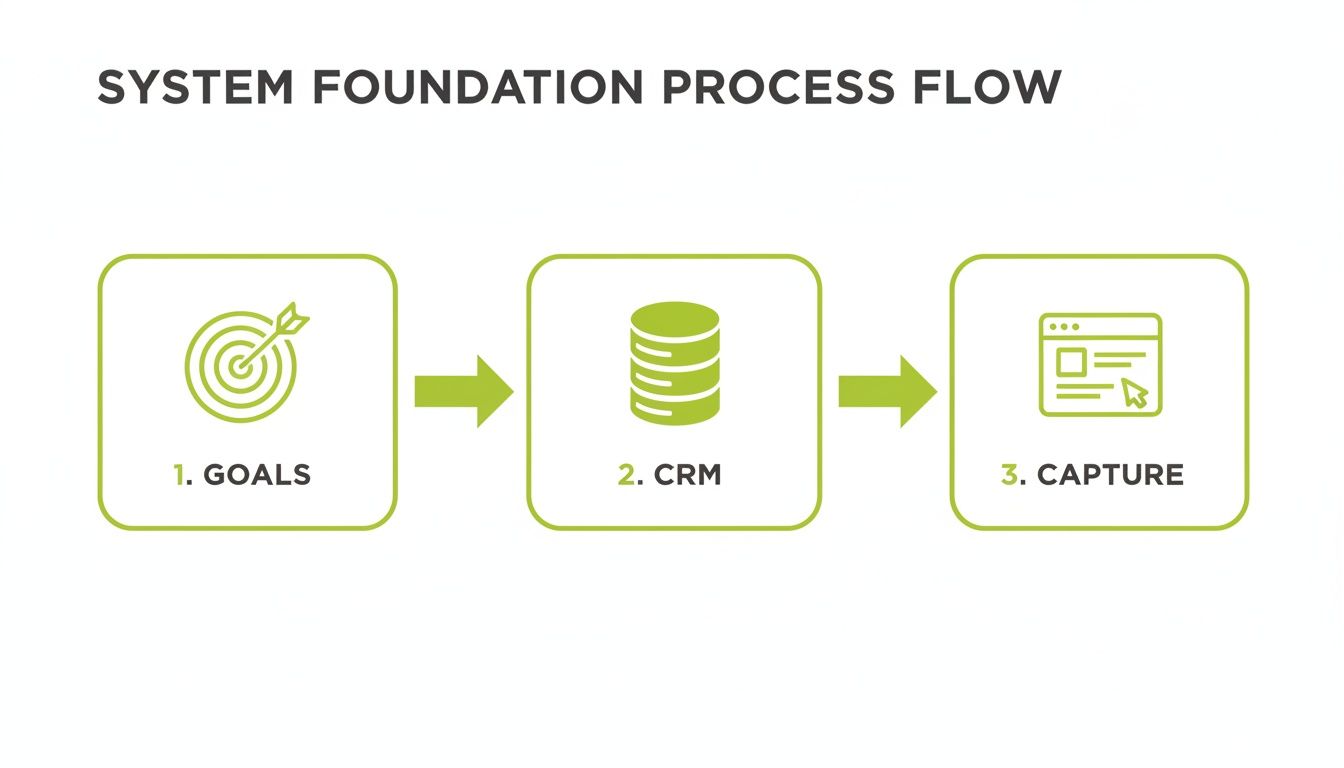
With this structure in place, every automated action becomes purposeful and perfectly integrated.
Segment Your Audience for Maximum Relevance
The first rule of effective nurturing is simple: not all enquiries are created equal. A prospective 7-day member needs a completely different conversation than a corporate client planning a society day. Treating them all the same is a surefire way to kill engagement.
Your system absolutely must segment leads based on what they first enquired about. This allows you to tailor your messaging to their specific needs and interests, making your follow-up feel personal and, most importantly, relevant.
Think about the common types of leads your club gets:
- Direct Membership Enquiries: These are your warmest leads. They have explicitly asked for information on categories, pricing, and how to join.
- Visitor Tee Time Bookers: These golfers have already experienced your course. The goal here is to convert that one-off visit into a lasting relationship by showcasing the real benefits of membership.
- Corporate & Society Day Organisers: This is a business-to-business sale. The conversation should focus on event packages, your excellent facilities, and the professional experience you guarantee for their guests.
- Function & Wedding Enquiries: Much like corporate clients, these leads are looking for specifics on your venue's capacity, catering options, and availability for their big day.
By creating a separate, automated sequence for each of these segments, you make sure every message speaks directly to what that person actually cares about. This simple act of segmentation can have a massive impact on your conversion rates.
Building Your Automated Communication Flow
Once your segments are defined, you can start building the communication journeys. The trick is to map out a sequence that delivers value over time, using a mix of channels to keep things interesting. In our experience, a good sequence should run for anywhere from 7 to 21 days.
Here is what a well-balanced flow might look like for a Direct Membership Enquiry:
- Instant Response (Email & SMS): Within 2 minutes of the enquiry, send an automated email and a text message. The email thanks them, links to a digital brochure, and invites them to book a tour of the club. The SMS is a short, personal-feeling note confirming you have got their enquiry and that an email is on its way.
- Day 2 (Email): Send a video tour of the course and clubhouse. This brings the club to life in a way a static PDF never could.
- Day 4 (Email): Follow up with an email featuring testimonials from current members. Social proof is incredibly powerful for building trust and quietly addressing any unstated concerns a prospect might have about the club's culture.
- Day 6 (System Task): If the prospect has opened your emails but not yet booked a tour, the system should automatically create a task for a team member to make a personal follow-up call. The automation has warmed up the lead; now a human touch can close it.
- Day 10 (Email): Send an email that highlights a unique club benefit, perhaps the active social calendar, a state-of-the-art swing studio, or a fantastic junior section.
Automation should handle the process, so your people can handle the relationships. The system's job is to deliver timely information and identify engaged prospects, freeing up your team to have high-quality conversations that convert.
The market is more competitive than ever. A recent Golfshake survey highlighted that with 30% of clubs operating waiting lists and 39% charging joining fees, every single enquiry is incredibly valuable. A sophisticated follow-up system is essential to manage this high demand and convert interested golfers into loyal members before they look elsewhere. You can learn more from the Golfshake survey about the state of club membership.
Crafting these sequences takes some thought upfront, but once they are built, they become a permanent asset for your club. They guarantee a professional and persistent follow-up for every single lead, turning what was once a manual, inconsistent chore into a predictable pipeline for growth. For a more detailed look, you can check out our guide on lead nurturing best practices.
Scripting Personal Touchpoints for Maximum Impact

Automation is fantastic for building momentum, but from what we have seen time and again, it is that personal, human touch that actually gets a deal over the line. While your automated sequences are working away in the background, educating prospects and keeping your club top of mind, the real magic happens when your team steps in at just the right moment.
The best golf club follow up system is not just about sending emails; it is about knowing when to stop emailing and pick up the phone.
Think about it. Your system can easily flag prospects who are showing real buying signals. Someone opens several emails, clicks through to the membership page for the third time, or watches your entire video tour. That is not just mild curiosity. At that point, your CRM should automatically create a task for a team member to make a personal call.
Suddenly, your call is not an interruption at all. It is a welcome and genuinely helpful next step for someone who is clearly interested. The context from the CRM means your team can skip the generic sales pitch and have a far more meaningful conversation.
Structuring the Perfect Follow-Up Call
A successful follow-up call is not an interrogation about someone’s budget. It is a conversation designed to find out what they are really looking for and show them how your club is the perfect fit. The golden rule? Listen far more than you talk.
When your system flags a warm lead, your team should have a clear framework for that call. This is not about reading from a script word-for-word, but about ensuring consistency and professionalism.
Here’s a simple structure we have seen work wonders:
- Open with Context: Start warm. "Hi [Prospect Name], it's [Your Name] from [Your Golf Club]. I noticed you'd shown some interest in our membership options online, so I wanted to reach out personally and see if I could answer any questions for you."
- Ask Open-Ended Questions: This is your discovery phase. Avoid anything that can be answered with a simple 'yes' or 'no'. Try asking, "What's prompting you to look for a new club at the moment?" or "When you picture your ideal club, what are the most important things for you?"
- Listen and Qualify: Their answers will tell you everything. Are they a competitive player who wants regular competitions, or a social golfer who values the clubhouse atmosphere and events? This is how you qualify them and figure out which membership is the right fit.
- Present the Solution: Now you can connect the dots. If they mentioned wanting to play more with their family, you can talk about your junior programme or family-friendly social events. You are not selling features; you are solving their specific needs.
- Secure the Next Step: Every call needs a goal. The best next step is almost always a personal tour. "Honestly, the best way to get a real feel for the place is to see it for yourself. Would you be free to pop in for a coffee and a quick look around sometime next week?"
This consultative approach, triggered by automated engagement tracking, is incredibly powerful. We saw this first-hand with Downes Crediton Golf Club. By combining our proven nurture flows with this exact kind of well-timed personal outreach, they drove rapid and highly profitable membership growth.
The purpose of a follow-up call is not to 'sell' a membership. It is to diagnose a prospect's needs and prescribe the club as the solution, with a club tour being the logical next step.
Capitalising on Visitor Data
Your follow-up system should not stop at direct membership enquiries. Every golfer who books a visitor tee time is a potential member hiding in plain sight.
Recent industry analysis shows a 15% rise in visitor income for partner clubs, driven largely by a huge surge in online bookings. This growing stream of casual players represents a massive, and often completely missed, opportunity.
A smart golf club follow up system automatically segments these visitors. It can place them into a specific nurture campaign designed to convert that one-off green fee into long-term subscription revenue. To see the numbers for yourself, you can read the full report on rising visitor income here.
By scripting these key personal moments and weaving them into your automated system, you create a seamless process. It ensures every warm lead gets the personal attention they need, precisely when they are most receptive, and dramatically increases your chances of turning that initial interest into a new, loyal member.
Analysing and Optimising Your Follow-Up Performance
Right, you have built your follow-up system. The automations are running and the leads are flowing in. It is tempting to dust off your hands and consider the job done, but this is where many clubs miss the biggest opportunity.
Your new system is not a slow cooker you can just set and forget. It is a performance engine, and it needs regular tuning to get the most out of it. To turn your membership pipeline into a predictable source of growth, you need to know what is working, what is not, and how to fix it, and that all comes down to the data.
Get Your Dashboard in Order
Forget drowning in spreadsheets. The first thing you need is a simple, clean performance dashboard, built right inside your CRM. This will become your command centre for the entire follow-up operation, giving you a clear, at-a-glance view of the metrics that actually matter to your bottom line.
Your dashboard should be focused on a few core Key Performance Indicators (KPIs) that tell you the health of your sales pipeline:
- Lead-to-Tour Conversion Rate: What percentage of people who enquire actually book a visit to the club? This is your first major checkpoint; a low number here suggests your initial emails or first phone call are not hitting the mark.
- Tour-to-Member Conversion Rate: Of all the people who walk through your doors for a tour, how many join? This metric tells you a lot about your in-person experience and the final sales conversation.
- Pipeline Velocity: On average, how many days does it take for a brand-new lead to sign on the dotted line? A shorter timeframe means your system is becoming more efficient.
These figures are not just numbers; they tell a story. For instance, a fantastic lead-to-tour rate paired with a poor tour-to-member rate is a huge red flag. It probably means your marketing is brilliant, but something about the on-site experience is letting you down. That is a specific, solvable problem.
A system that is not measured cannot be improved. Your CRM dashboard is the control panel for your club's growth, turning abstract data into concrete actions that drive revenue.
The Power of Testing One Thing at a Time
With your key metrics established, you can start the real fun: A/B testing. It is a simple concept. You change just one thing in your follow-up sequence, one headline, one button, one email, and measure how it affects your results. By isolating the change, you can say for certain what works best with your specific audience.
You could test almost anything, but it is smart to start with the things that could have the biggest impact.
Why not try testing:
- Email Subject Lines: Pit a direct question like, "Found the right golf club yet?" against a benefit-focused one such as, "Your weekend tee time is waiting."
- Calls to Action (CTAs): Does a "Book Your Tour" button work better than one that says "See the Club for Yourself"?
- Timing and Content: What happens if you send that member testimonial email on Day 4 instead of Day 7?
Even tiny wins here compound over time. A 1% improvement in your conversion rate each month adds up to a serious number of new members over a year, all without spending a single extra pound on marketing. This is the heart of optimisation: getting more from what you already have.
Keeping It All on Track for the Long Haul
As your system proves its worth, the focus shifts to maintaining consistency and clean data. This is absolutely critical for multi-site operators, where a single, unified approach can unlock huge efficiencies across the board. In our work with groups like Macdonald Hotels & Resorts, we have seen first-hand how a centralised CRM and follow-up process create a scalable engine for growth.
Good governance simply means having clear, non-negotiable rules for how the team uses the system. This covers everything from how to update a lead's status after a call to logging notes from a conversation. Your reporting and automation are only as good as the data you feed them; "garbage in, garbage out" has never been more true.
Finally, make reviewing the performance dashboard a regular team habit. These sessions keep everyone on the same page, allow you to celebrate wins, and quickly spot where a bit of extra training might be needed. A golf club follow up system really takes off when it is owned by the whole team, when it stops being ‘software’ and becomes simply ‘how we do things here’.
Common Questions About Golf Club Follow-Up Systems
Even with the best plan in hand, we find that club managers and committees always have a few practical questions. It is completely normal to wonder about the real-world impact on your team’s time and your club’s unique culture.
Let’s tackle some of the most common questions we hear when clubs are thinking about building a modern follow-up system. These are based on our experience helping clubs all over the UK move from sporadic effort to predictable revenue.
How Much Time Does Setup Really Take?
This is always one of the first questions, and for good reason. Realistically, you should set aside a few weeks of focused work to get the core system in place. This involves integrating your chosen CRM and building out those initial automated sequences.
The key here is that it is a one-time investment of effort, not a new, ongoing chore. Once you are up and running, the system immediately starts to pay you back, saving your team dozens of hours every month. The secret is to do it right the first time with a structured plan, rather than trying to patch something together on the fly.
Will Automation Make Our Club Feel Impersonal?
There is a genuine concern that automation can feel robotic and cold, the opposite of the welcoming atmosphere you have worked so hard to create. But that only happens when a system is poorly thought out. The goal is to automate the process, not the personality.
A great follow-up system uses data to make every communication more timely and relevant. Its real purpose is to free up your team to have higher-quality personal conversations at the right moment, making the entire experience more personal, not less.
Think of it this way: good automation ensures no one ever feels ignored. It delivers helpful information right when it is needed, building trust from that very first enquiry. This means your staff can step in to connect with genuinely warm and engaged prospects, focusing on what they do best: building relationships.
What Is the Difference Between a CRM and an Email Tool?
Understanding this difference is vital. A basic email marketing tool, like Mailchimp, is really just a megaphone for sending one-way, bulk messages to a list.
A Customer Relationship Management (CRM) platform, on the other hand, is the brain and central nervous system for your entire growth operation. It is a single hub that:
- Tracks every single interaction from website visits and form fills to emails and phone calls.
- Gives you a complete view of your sales pipeline, so you know exactly where every prospect is in their journey to joining.
- Automates essential tasks to ensure follow-up is always consistent and persistent, without anyone having to remember to do it.
In short, an email tool just sends messages. A CRM gives you a full, 360-degree view of your relationships, providing your team with the context they need to turn enquiries into happy, long-term members. It is the true engine of any successful golf club follow-up system.
A robust follow-up system turns inconsistent effort into a predictable growth engine. At GolfRep, we do not just generate leads; we build the complete system to capture, nurture, and convert them, giving your club a clear, sustainable path to growth. Discover how our Growth System can work for your club.
Ready to tap into our proven growth system?