Golf Club Tee Time Marketing: A Profitable Playbook

Most advice on golf club tee time marketing starts in the same place. Improve the website. Post more on social media. Run some ads. Tidy up local SEO.
That advice isn't wrong. It's incomplete.
At GolfRep, we see the same pattern repeatedly across UK clubs. Interest isn't always the issue. The leak usually happens after the click, after the form, or after the missed call. A golfer wants to play, asks a question, checks availability, or starts a booking journey, then hears nothing useful quickly enough. The club loses the round, the data, and often the chance of a repeat visit.
Profitable tee time marketing isn't a string of promotions. It's an operating system for demand, pricing, response, and follow-up.
The Real Problem in Tee Time Marketing
Most clubs still frame marketing as a visibility problem. If the tee sheet has gaps, the instinct is to push harder on awareness. More posts. More offers. More traffic.
But much of the current golf marketing advice tells clubs to improve websites and local SEO while rarely dealing with the operational bottleneck that decides whether an enquiry becomes a booking: response speed and follow-up automation, as noted in Club Prophet's guidance on golf course marketing tips. For clubs that want predictable pipeline growth rather than occasional spikes, that's a serious blind spot.
More clicks won't fix a weak process
A golfer who lands on your site at 9:30 pm expects to book, ask a question, or get clarity immediately. If the booking journey is clunky, if the enquiry sits in an inbox until morning, or if nobody follows up properly, the marketing hasn't really worked.
Many clubs misread the problem. They see low bookings and assume low demand. In reality, they may have demand that isn't being captured, qualified, or converted consistently.
A common pattern looks like this:
- Website traffic arrives: Paid ads, email, search, and social all send golfers to the site.
- Intent is present: The golfer checks green fees, opens the booking engine, or fills a form.
- The handoff fails: The club replies slowly, manually, or not at all.
- Revenue disappears: The player books elsewhere, forgets about the enquiry, or waits for a better option.
Practical rule: If your team can't see every enquiry, respond quickly, and track what happened next, you're not running a marketing system. You're running isolated activities.
The leaky bucket sits inside operations
This matters even more in committee-led and volunteer-run environments. The issue usually isn't effort. It's that the process depends on individuals remembering to call back, check messages, update spreadsheets, and chase undecided prospects by hand.
That works occasionally. It doesn't scale.
The clubs that build steadier tee time revenue tend to treat conversion as an operational function, not a receptionist side task. They know which enquiries came in, who responded, what was offered, whether a booking happened, and which leads still need follow-up. If that visibility is missing, spend on promotion becomes difficult to judge.
We unpacked this in more detail in The hidden reason your tee sheet isn't full. The short version is simple. Most clubs don't need more random demand. They need a tighter process for turning existing interest into booked play.
Foundations for Profitable Marketing
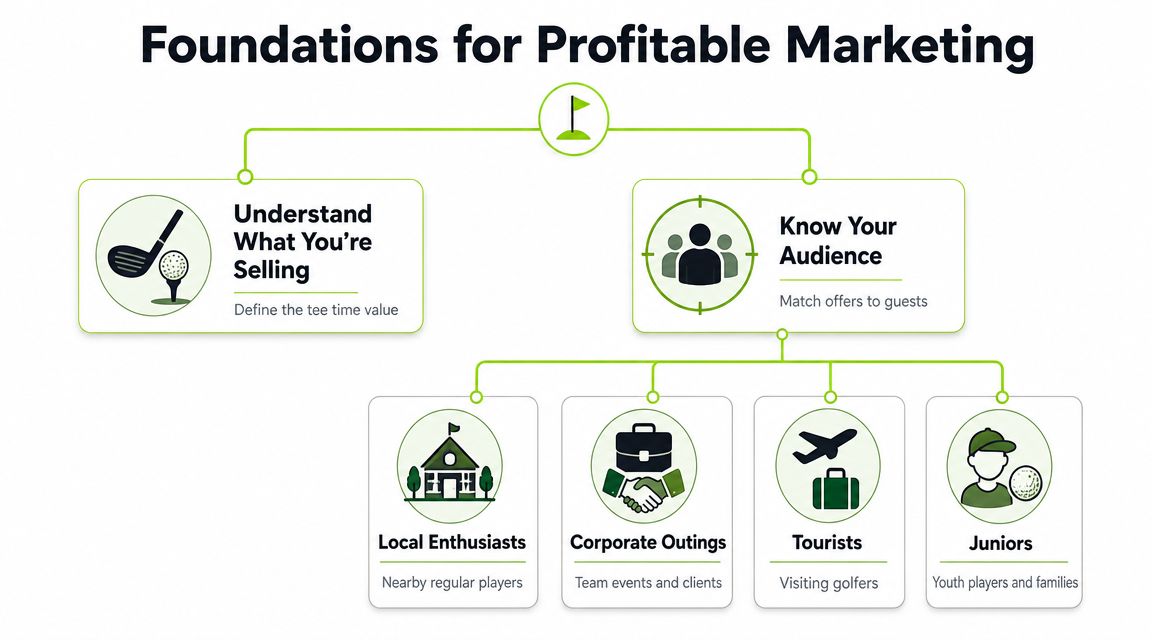
Tee time marketing gets sharper when a club understands two things clearly. First, what exactly is being sold. Second, who is most likely to buy it at different times and for different reasons.
That sounds obvious, but many clubs still market all available golf in the same way. The same creative, the same message, and often the same offer gets shown to everyone. That usually produces weak response and pricing confusion.
Know your inventory
A tee time isn't a generic product. A Saturday morning fourball has a different value, audience, and booking behaviour from a quiet Tuesday afternoon slot. If you market both in the same way, you flatten the value of your own inventory.
Revenue management is essential. A Cornell study on tee-time interval management found that shortening a course's tee-time interval from 10 minutes to 8 minutes increased capacity by 25%. The same study noted that management judged an 11-minute interval to be the best balance of revenue and customer satisfaction. This highlights why tee time marketing isn't just about filling empty space. It's about shaping demand around the operational realities of the tee sheet.
Here's the practical takeaway:
| Tee sheet question | Why it matters commercially |
|---|---|
| Which slots always sell first | These usually need protection, not discounting |
| Which periods lag repeatedly | These are the windows where targeted promotion can help |
| Which times attract visitors vs members | Messaging and access rules need to reflect that difference |
| Which slots create pace-of-play pressure | Extra volume can harm experience if sold carelessly |
Know your audience properly
Most clubs segment too broadly. "Members" and "visitors" isn't enough.
A better starting point is behaviour and intent. Some golfers want a convenient local round. Some are trialling the club before considering membership. Some want society or corporate golf. Some book infrequently but spend well when the offer fits. If you want help structuring those segments, this guide on strategies to identify target audience is a useful framework.
A practical segmentation model often includes:
- Local regular visitors: They care about convenience, booking ease, and consistent value.
- Potential members: They need a different journey, with signals about club culture, availability, and next-step conversations.
- Corporate or group bookers: They want clarity, speed, and confidence that the day will run smoothly.
- Occasional destination players: They respond to experience, course condition, and simple booking logistics.
The best tee time campaigns don't start with an advert. They start with a decision about which audience should see which part of the tee sheet.
What doesn't work
Three habits usually hold clubs back:
- Generic promotion: The same message goes to everyone, so it feels relevant to no one.
- Flat pricing logic: Quiet times and premium times get marketed with little distinction.
- No operational feedback loop: Marketing keeps running, but nobody checks which audience booked.
Profitable golf club tee time marketing starts with clarity. What inventory are you trying to move, who is right for it, and what message fits that buyer without weakening your better slots?
Implementing Smart Dynamic Pricing
Blanket discounting is one of the fastest ways to damage yield.
It feels productive because bookings may come in quickly. But if the club trains golfers to wait for offers, or if members see premium inventory treated like clearance stock, the short-term win creates a longer-term pricing problem.
Price the lagging blocks, not the whole sheet
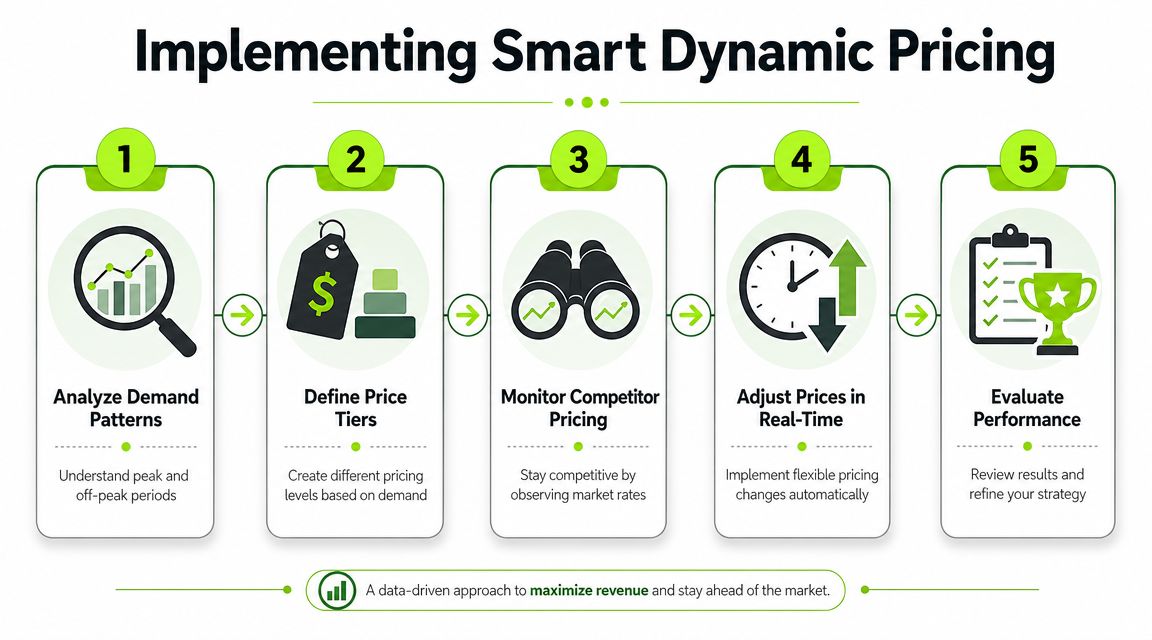
A more disciplined approach is to manage the tee sheet with REVPATT, which is greens and cart fee revenue divided by available tee times, and then apply dynamic pricing only to specific time blocks that are behind pace. Sagacity's guidance explains that this lets discounts shrink or disappear as inventory sells, avoiding the common mistake of discounting the entire tee sheet at once in its tee-time marketing plan guidance.
That difference is important.
If a club discounts everything, it tells the market that price is unstable and peak times may not be worth full value. If the club adjusts only selected underperforming periods, pricing becomes a tool for yield management rather than a panic response.
A sensible decision framework
Most clubs don't need a complicated model. They need clear rules and discipline.
A workable structure looks like this:
Protect the obvious winners
Start with the slots that already perform strongly. If demand is healthy, don't interfere.Spot the windows that are consistently behind
Midweek afternoons, shoulder seasons, or late-day periods often need help. Isolate them.Set limits before launching
Decide in advance how far pricing can move, which times qualify, and when adjustments stop.Review pace, not just totals
The question isn't only whether rounds sold. It's whether the right windows improved without dragging down stronger periods.
What good dynamic pricing sounds like
The messaging matters as much as the price.
A poor version says, "Big discounts this week across all tee times." That widens the discount expectation and gives your best customers a reason to wait.
A better version is narrower and more operationally honest:
- Focused on a time block: Quiet Wednesday afternoon availability
- Matched to an audience: Local golfers with weekday flexibility
- Clear in scope: Limited windows rather than broad course-wide discounting
Good dynamic pricing is selective, temporary, and rule-based. Bad dynamic pricing is emotional and course-wide.
Where clubs go wrong
The failure points are usually internal:
| Common mistake | Commercial effect |
|---|---|
| Discounting peak times with off-peak slots | Lowers perceived value of premium inventory |
| Running offers with no cutoff logic | Trains golfers to expect permanent deals |
| Ignoring member optics | Creates friction around fairness and access |
| Measuring only rounds sold | Misses whether revenue quality improved |
A practical note from the field. Committee discussions often focus on whether discounts "feel right". That's understandable, but the better question is whether the pricing rule protects peak value while helping underused inventory move.
For clubs that want a more structured view of underperforming periods, ways to increase midweek tee time revenue usually start with this kind of segmentation and pricing discipline, not with louder advertising.
Use tools that reduce manual decision-making
Dynamic pricing tends to fail when it relies on staff making ad hoc calls every day. Clear rules, agreed thresholds, and connected systems make it easier to act consistently.
That doesn't require complexity for its own sake. It requires enough structure that pricing decisions aren't driven by whoever noticed a quiet tee sheet at lunchtime.
Building Your Acquisition Engine
Once pricing and inventory rules are clear, acquisition becomes easier to manage because you know what you're trying to fill and who should see it.
Too many clubs treat channels as separate jobs. Someone posts on Facebook. Someone else updates the Google Business Profile. Paid ads run in isolation. Email goes out when there's a gap. That produces activity, but not a dependable flow of qualified demand.
One engine, multiple entry points
A better model is to treat every channel as part of one acquisition engine feeding the same booking and follow-up system.
That means:
- Google Business Profile captures local intent from golfers already searching nearby.
- Organic search supports discovery for branded and local non-branded queries.
- Paid search picks up high-intent demand when golfers are actively looking for somewhere to play.
- Facebook and Instagram ads can create local awareness around specific time windows, visitor offers, or seasonal opportunities.
- Email reactivates golfers who already know the club and need a timely reason to return.
Each channel has a different role. None of them should operate without a clear destination and a clear next action.
What a healthy acquisition setup looks like
The strongest setups usually share a few characteristics:
- The booking route is obvious: Golfers don't have to hunt for the next step.
- Landing pages match the campaign: If the advert mentions a weekday visitor rate, the page should continue that message.
- Calls and forms are tracked: Otherwise, the club can't see which channel is creating real enquiries.
- Local trust signals are visible: Recent imagery, reviews, course condition updates, and accurate contact details all reduce hesitation.
A lot of clubs underuse their own branded traffic. Golfers search the club name, land on the site, and still face friction. That's not an acquisition issue. That's a conversion issue exposed by acquisition.
Don't buy traffic your team can't handle
Paid campaigns can work well for golf club tee time marketing, but only when they feed a process that can capture and follow up properly. If the club isn't ready to respond quickly, more spend often magnifies inefficiency.
This is especially important for multi-site operators and busy clubs where enquiries can be split between reception, golf ops, and sales. If ownership of the lead isn't clear, the chance of drop-off rises fast.
The point of acquisition isn't to win more clicks. It's to create a predictable stream of bookable demand that your team can actually convert.
For clubs reviewing their channel mix, using digital marketing to fill tee times at your golf club is most effective when search, paid traffic, email, and on-site conversion all feed the same system rather than being managed as disconnected tactics.
The 24/7 Conversion System
Here, most revenue is won or lost.
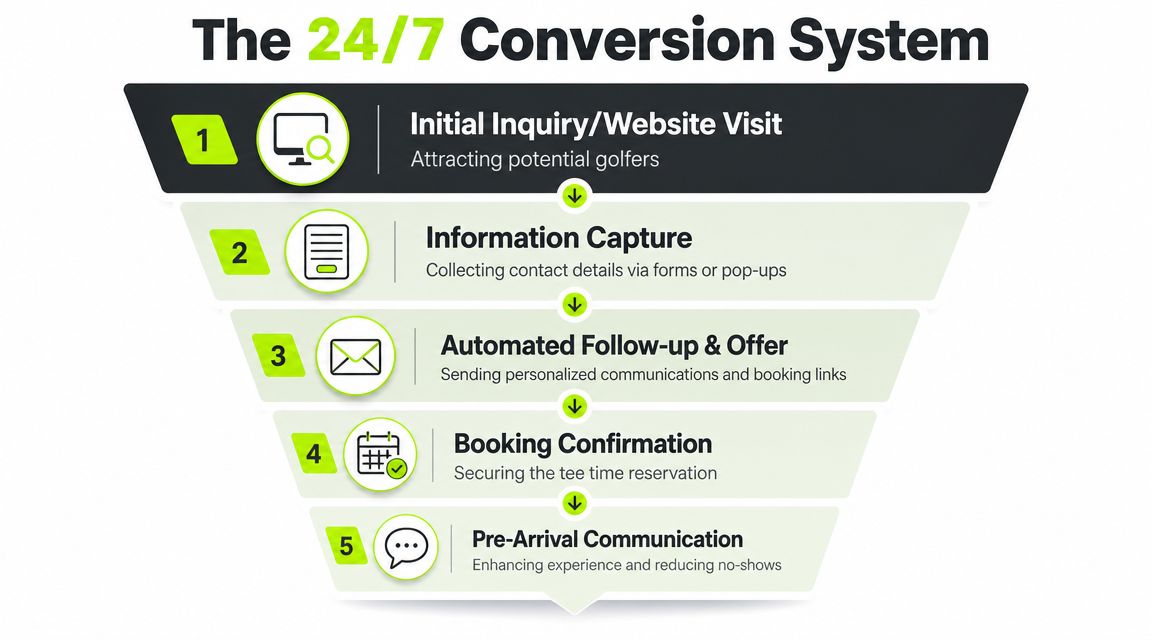
A golfer can arrive from Google, an email, a paid advert, or a referral. It doesn't matter if the club can't respond properly once that interest appears. The conversion system is the part that captures intent, qualifies it, and moves it towards a booking without relying on someone being free at the right moment.
The core components
A functioning 24/7 conversion system usually has four connected parts:
| Component | What it needs to do |
|---|---|
| Website | Capture interest clearly on mobile and desktop |
| Booking engine | Let golfers act immediately without unnecessary friction |
| CRM | Record the enquiry, source, and status in one place |
| Automation layer | Trigger fast follow-up and relevant nurture based on behaviour |
The value isn't in owning these tools separately. It's in having them connected.
Digital booking matters because it gives golfers a way to purchase outside office hours and gives the club better customer data. The PGA notes that digital booking systems help clubs identify quieter periods, use dynamic pricing, build a customer base for future marketing, and reduce phone calls and administrative work in its article on how digital booking systems can increase tee-time revenue.
Speed matters, but relevance matters too
Instant acknowledgement is the first step. If someone submits a form or starts an enquiry, they should get confirmation straight away. Not a vague autoresponder. Something useful.
That first message should do three things:
- Confirm receipt: So the golfer knows the enquiry hasn't disappeared.
- Set the next expectation: When they'll hear back or how to book immediately.
- Guide the fastest route: Direct booking link, visitor page, or the right contact path.
After that, segmentation takes over. Lightspeed's golf marketing guidance says tightly segmented email and CRM automation aimed at golfers by play frequency and recency outperforms generic blasts, and that this works best when the website, booking engine, and CRM are integrated so enquiries trigger follow-up within minutes. It also reported that courses live on its platform for 90 to 180 days saw a 4.3% increase in total sales and a 2.7% increase in rounds in its digital marketing guidance for golf courses.
That supports what operators already feel in practice. Fast follow-up alone isn't enough if every golfer receives the same message.
What segmentation should look like
A useful nurture flow should reflect intent, not just contact details.
For example:
- Recent visitor who didn't book: Follow-up with relevant availability and a clear booking path.
- Lapsed golfer in the database: Re-engage around timing, convenience, or a suitable off-peak window.
- Prospective member who played once: Route into a different sequence entirely, with club information rather than repeated visitor offers.
A CRM stops being an admin database and starts becoming a revenue tool.
One option clubs use for this kind of workflow is GolfRep, which combines lead generation with CRM-based automation and follow-up systems built around golf club enquiry handling. The important point isn't the provider. It's that the club can see every lead, trigger the right next action, and stop relying on manual memory.
A missed enquiry isn't usually a marketing failure. It's a systems failure.
Pre-arrival follow-up is part of conversion
Many clubs stop at the booking confirmation. That's too early.
Pre-arrival communication reduces confusion, reinforces the decision, and gives the golfer useful information such as arrival time, check-in expectations, buggy or food options, and any course notices. It also creates another touchpoint for upsell and repeat play later.
The full 24/7 conversion system doesn't just chase new demand. It protects the booking once it's made and builds the data needed for the next campaign.
Measure What Matters for Growth
A lot of golf marketing reporting is still built around surface-level activity. Clicks. Impressions. Reach. Social engagement.
Those numbers can be useful, but they don't tell a club whether tee time marketing is profitable. Managers need measures that connect demand, response, conversion, and revenue quality.
The KPI set worth watching
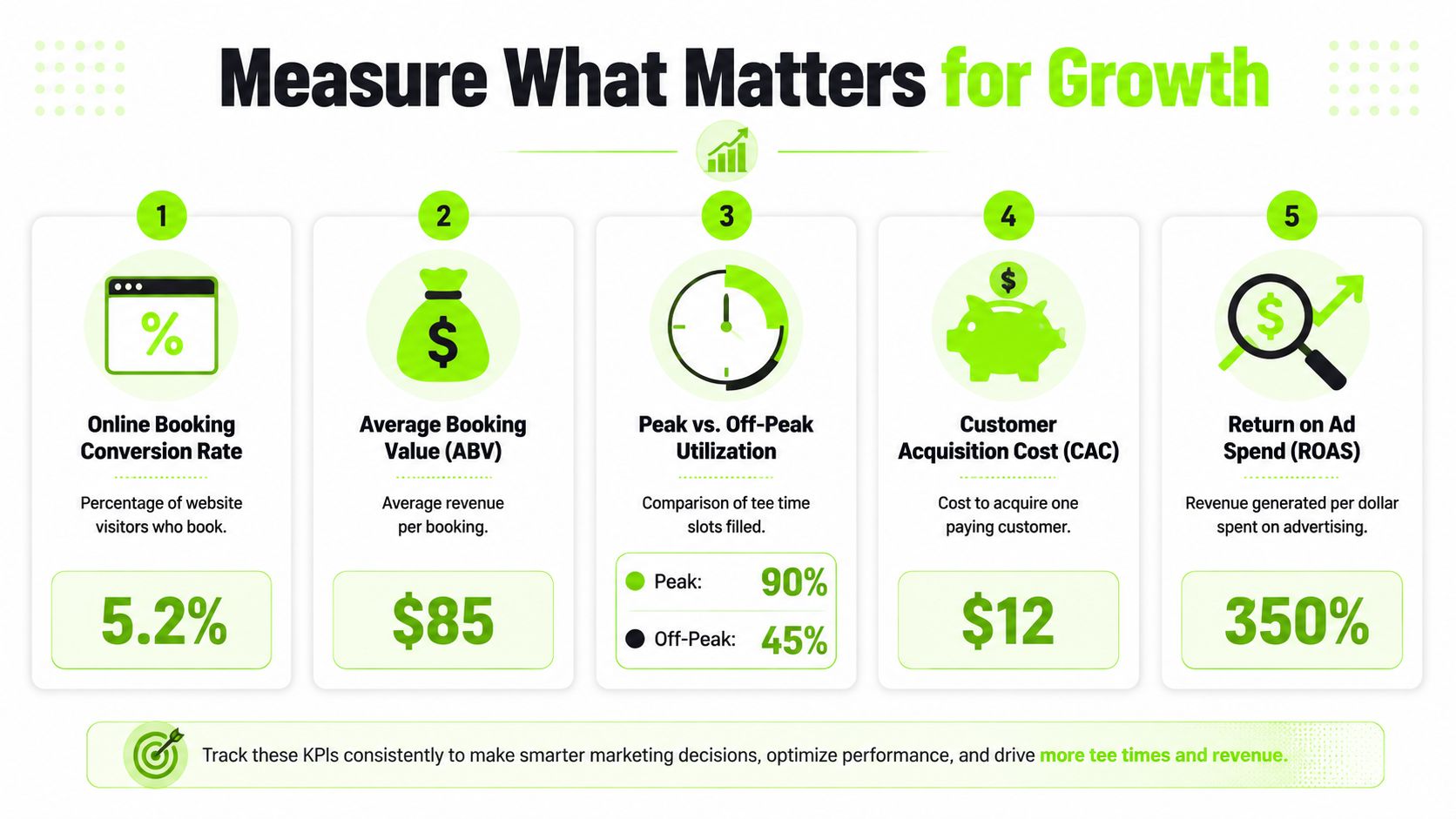
A practical dashboard for golf club tee time marketing should include:
- Lead response time: How quickly the club replies to forms, messages, and missed-call follow-up.
- Enquiry-to-booking conversion rate: Whether incoming interest is turning into confirmed rounds.
- Source-to-booking visibility: Which channels create booked golf rather than just traffic.
- Average booking value: Whether the club is improving revenue quality, not only volume.
- Peak versus off-peak fill performance: Whether demand is being shifted into quieter windows effectively.
- REVPATT: Whether available inventory is producing the right level of revenue.
These metrics work together. A campaign can produce plenty of enquiries and still fail if response is slow. A pricing change can increase bookings while lowering overall value. A busy period can look healthy while off-peak inventory remains weak.
What each metric reveals
This short table keeps the conversation grounded:
| KPI | What it tells you |
|---|---|
| Lead response time | Whether operational speed is helping or hurting conversion |
| Enquiry-to-booking rate | Whether follow-up and booking journeys are working |
| Source visibility | Where budget and effort should actually go |
| Average booking value | Whether demand is profitable, not just busy |
| REVPATT | How well the tee sheet is monetised overall |
Avoid vanity reporting
Committees and management teams often get overloaded with channel updates. That can distract from the core issues.
If a club wants better decisions, report on:
- Commercial outcomes first: bookings, value, fill quality
- Process health second: response speed, follow-up completion, lead ownership
- Channel performance third: which inputs create the outcomes above
If you can't trace a booking back to its source and the follow-up that converted it, you can't optimise the system with confidence.
The clubs that improve steadily don't just market more. They measure more effectively. They can see where leads come from, where they stall, and what changes improve booking performance without relying on guesswork.
GolfRep helps golf clubs build that kind of system: targeted demand generation, clear lead visibility, structured follow-up, and CRM-led conversion that doesn't rely on manual chasing. If your club is getting interest but not enough booked revenue from it, a review of the journey from first click to confirmed tee time usually reveals the bottleneck quickly.
Ready to tap into our proven growth system?