Golf Club Marketing Automation: A Practical UK Guide

A secretary is trying to answer a membership enquiry while checking the tee sheet, a PGA professional is returning calls between lessons, and the general manager is searching through an inbox for a society request that arrived earlier in the week. Nothing is necessarily broken, but the club has no dependable way to ensure that every prospect receives the right response, from the right person, at the right time.
That's the practical reason to consider golf club marketing automation. It isn't about replacing personal contact with generic emails. It's about creating a reliable operating layer around the work your team already does, from capturing an enquiry and assigning ownership to recording the outcome and prompting the next action.
Why Automation Now for UK Golf Clubs
The UK golf market has a substantial member base to serve. England Golf reported 1,735 golf clubs in England and more than 730,000 club members, while the average club member age fell to 54.99 years and the average Handicap Index stood at 18.62. Membership reached 750,071 in 2025, which was 2.66% higher than in 2024 and more than 100,000 above 2021 levels. England Golf membership and club data shows why clubs need systems that can handle recurring communication without making every task dependent on one person remembering it.
The operational pressure is visible in club occupancy and membership composition. Hillier Hopkins found that 59% of members' clubs and 55% of proprietary clubs had more than 600 playing members, while 75% of members' clubs and 78% of proprietary clubs reported growth in its 2024/25 survey. The earlier report found that 43% of club members were aged over 61, with 16% under 30, so clubs need to retain established members while building a stronger pipeline among younger golfers. These figures are reported in the Hillier Hopkins Golf Clubs Report 2024/25.
The response gap is a process problem
Golf club enquiries are answered in 47 hours and 32 minutes on average, according to a UK golf-club analysis. The same source states that leads contacted within one hour are five times more likely to convert than leads left for 24 hours. That makes the first automation job straightforward, capture the enquiry immediately, acknowledge it, assign an owner and escalate it if nobody has acted. GolfRep's analysis of golf club CRM response times provides the relevant benchmarks.
| Response Time | Contact Rate | Qualification Rate |
|---|---|---|
| Immediate acknowledgement | Recorded automatically | Qualification begins from submitted fields |
| Within one hour | Five times more likely to convert than a lead left for 24 hours | Owner can qualify while interest is active |
| Average current response | 47 hours and 32 minutes | Risk of stalled or unrecorded progress |
The table isn't a promise of a particular result. It's a design principle. Your system should make a prompt response the default, not an act of individual heroics.
Clubs should also resist treating automation as a substitute for demand generation. The commercial model still needs to attract, nurture, convert and retain. Good automation makes the handoffs visible and repeatable. For a useful wider perspective on reducing manual workload, see this guide to save time marketing your business, then consider how the same principle applies to membership, societies and visitor golf.
The right build sequence is practical:
- Diagnose the current constraint.
- Choose the simplest suitable stack.
- Build capture, routing and ownership.
- Add nurture flows for distinct commercial journeys.
- Review performance and remove what isn't helping.
Clubs considering the wider commercial context may also benefit from this discussion of why golf marketing is outdated. The issue is rarely a lack of possible channels. It's usually the absence of a dependable process connecting those channels to revenue.
Mapping the Constraint Before Choosing the Stack
A club shouldn't start by asking which CRM has the longest feature list. Start by identifying where the commercial process is constricted.
At the top of the funnel, there may not be enough relevant demand. In the middle, enquiries may arrive but wait too long for a response. At the bottom, prospects may visit the club but fail to receive a clear joining route. Each constraint calls for a different intervention, and automation won't fix the wrong one.
Use the first week to establish the baseline
Pull the last 90 days of enquiries into one working file or CRM view, and tag each record by source, enquiry type, owner, outcome and current stage. Measure the time from submission or missed call to first human contact. For membership visits, record whether the prospect attended, rescheduled or failed to turn up.
Three questions usually expose the problem:
- Are enough relevant people entering the process? Separate referrals, organic search, paid campaigns, walk-ins and existing-member introductions.
- Does every enquiry have an owner and next action? A shared inbox isn't ownership.
- Do booked visits progress to a commercial conversation? A taster visit without a scheduled follow-up is activity, not a pipeline.
The UK market also rewards this discipline because growth isn't uniform. A 2025/26 Hillier Hopkins survey reports that 71% of members' clubs rely on member referrals as their main marketing activity, while 34% use flexible membership and 60% use social media. Its Golf Clubs Survey Report 2025/26 points towards a practical question for club managers: can referral-led demand be captured, routed and measured as reliably as paid demand?
Let the constraint determine the stack
For a single club, a HubSpot Starter or ActiveCampaign setup connected to the existing club-management and tee-booking systems may be sufficient. ClubV1, Intelligent Golf and BRS can remain the operational source for bookings, while the CRM manages prospect stages, tasks and communication history. We'd say this is what works in a UK club context, provided the data ownership is explicit.
A multi-site operator needs more deliberate governance. Salesforce or Zoho may be appropriate where several venues share a central commercial team, but the decision should follow the reporting and permission requirements rather than vendor preference. A customer data platform may become relevant where member, visitor, society and event data sit in separate systems.
The key integration points are the website form, the booking system, advertising source data, email, and the phone system. The booking system should return member or booking status to the CRM. Forms should retain source parameters. Missed calls should create tasks or trigger a text acknowledgement. Before comparing top marketing automation solutions, decide who owns the workflow day to day, whether that's the membership secretary, commercial manager or an external partner.
Clubs looking specifically at CRM selection can use this practical guide to the best CRM for golf clubs, but the principle remains simple: buy for the process you can operate, not the system you can demonstrate.
Building Capture, Qualification and Routing
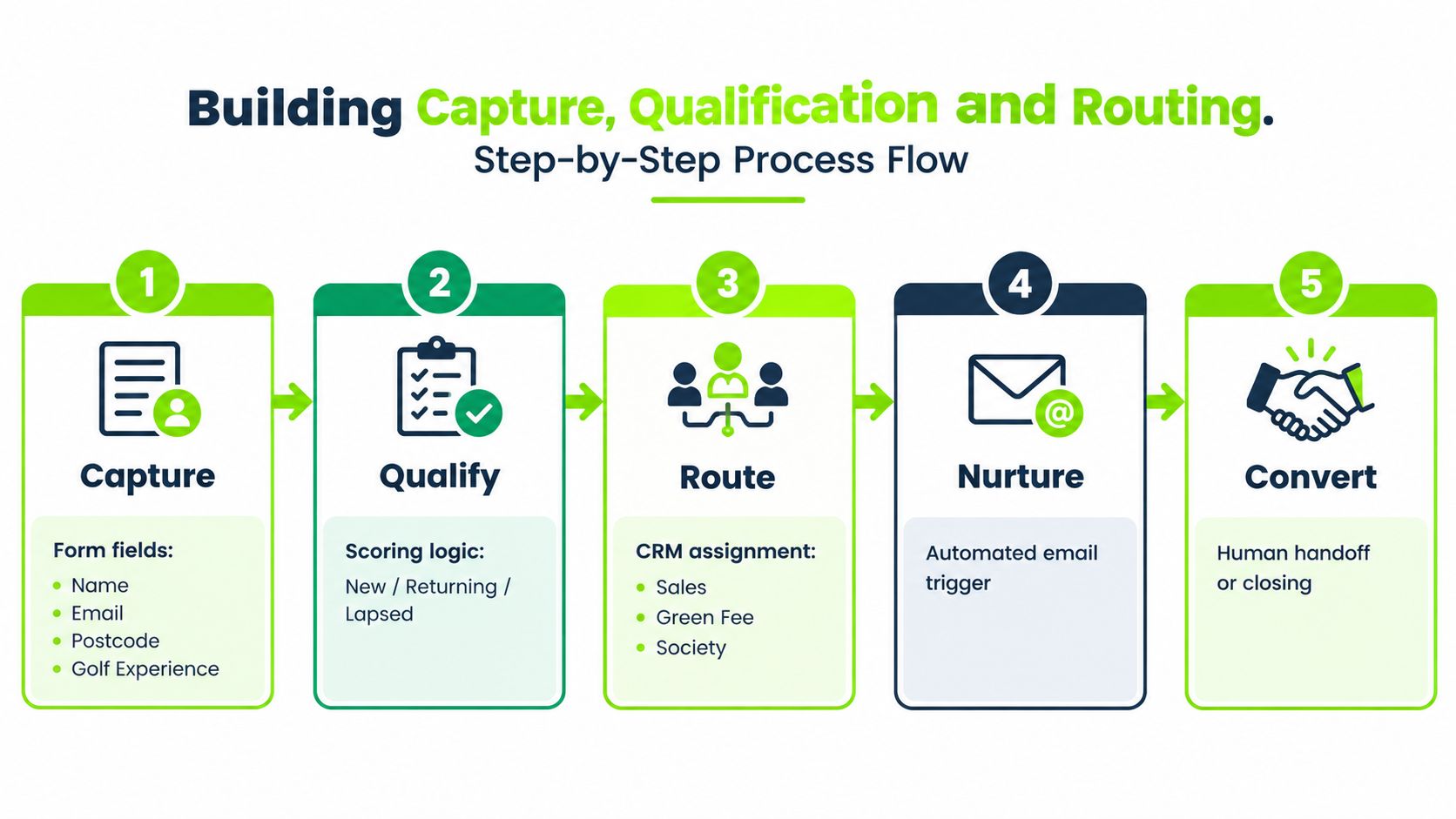
The working build begins with the form, not the email template. A membership form should ask for enough information to support a useful first conversation without becoming an application form.
Recommended fields include:
- Contact details: Name, email address and mobile number.
- Location: Postcode or broad local area.
- Golf background: Beginner, intermediate or advanced.
- Interest: Full membership, flexible membership, county membership, visitor golf, society or corporate golf.
- Timing: This month, this season or a later date.
- Visit preference: Preferred date or a request for a call.
Hidden source fields should retain campaign and landing-page information. The consent experience should be clear, specific and recorded, with the club's privacy process determining which communications can follow. Don't ask for information that nobody will use.
Name the workflows before you build them
Clear names prevent staff from editing the wrong automation later. A practical naming convention might include:
- Enquiry v3 - Trigger, which creates the contact and records the source.
- Membership Route v3, which assigns membership-related enquiries.
- Society Triage v2, which routes group and corporate requests.
- Callback Missed v3, which handles unanswered calls.
The routing logic should reflect commercial responsibility. A high-intent membership prospect can alert the membership manager by SMS and email, while a society request should go to the events coordinator. A mid-intent prospect can enter a short nurture sequence, with a task created if the person engages with key content.
Set a service-level agreement for each route. If the assigned person hasn't claimed a high-priority task after 15 minutes, escalate it to the deputy manager. That rule matters more than a complicated lead score because it makes accountability visible.
Treat missed calls as enquiries
A missed call is often a buying signal, particularly when the caller has chosen a direct route rather than filling in a form. The phone system should create a contact where possible, log the time and number, send an appropriate acknowledgement and create a callback task. The automation should stop once a staff member records a successful conversation.
The technical plumbing is uncomplicated but needs testing:
- The form sends a webhook to the CRM.
- The CRM checks for an existing record using the email address.
- Trigger conditions identify enquiry type and intended timing.
- The system assigns an owner and creates the correct task.
- The club-management system remains the source of truth for member status.
- Booking activity updates the CRM and suppresses irrelevant sales messages.
A practical explanation of the underlying tools is available in this lead capture software explained guide. For golf clubs, the important point is not the form technology. It's whether the submitted data reaches a named person with a clear next action.
Here, lead qualification automation becomes useful. Qualification should reduce uncertainty for the team, not create an impressive score that nobody trusts.
Designing Nurture Flows That Actually Convert
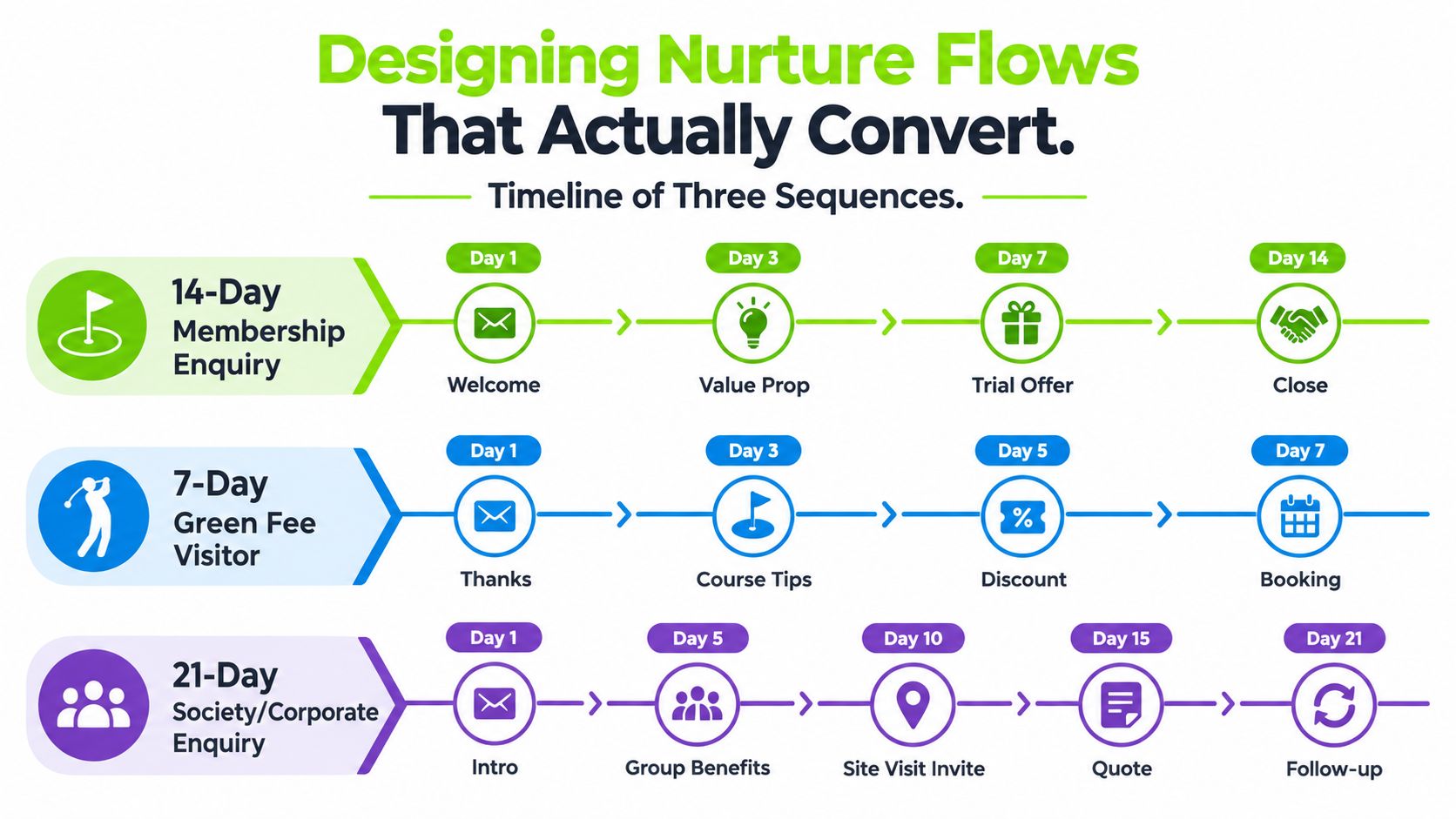
A nurture sequence should reflect the decision the golfer is trying to make. A membership prospect needs confidence about fit and joining. A visitor needs a reason to book again. A society organiser needs certainty about availability, pricing and the next step.
The membership enquiry sequence
Trigger this sequence when a person submits a membership enquiry and hasn't booked a visit. Use messages on day 0, day 2, day 5, day 9 and day 14.
- Day 0: Confirm receipt, explain when a member of staff will respond and offer one clear way to arrange a conversation.
- Day 2: Show the club experience through a course video or concise explanation of playing access.
- Day 5: Share a genuine member perspective or explain how a new member is welcomed.
- Day 9: Present the relevant visit or trial route without defaulting to a discount.
- Day 14: Ask whether the prospect would like a call, a visit or no further contact.
If a prospect watches the course video but doesn't reply, create a phone task after the next engagement event. If there are no opens after day 7, reduce the frequency and move the contact into a lighter long-tail sequence.
For high-value membership leads, SMS can be used on day 0 and day 9, but only where the contact has an appropriate communication basis and the message adds practical value. Every email should stay under 120 words, use one link and one button, and sound like the club rather than a software company.
Visitor and group journeys need different logic
The visitor sequence should start after a completed tee time. Send a thank-you message, useful course information and a relevant reason to book again. Once the booking system confirms a tee time back into the CRM, suppress further sales messages connected to that booking.
The society and corporate sequence should begin with an acknowledgement and a clear request for missing details. Follow with the group benefits, an invitation to discuss dates, a quote or package summary, and a final follow-up task for the organiser. Don't send membership content to a society organiser just because both records entered through the same website.
Measure engagement through actions
Open rates can help diagnose delivery and subject-line problems, but the commercial events are replies, calls, booked visits, attended visits and joined memberships. Use one CTA per message so the next action is unambiguous.
Practical rule: If an email needs two competing buttons, the underlying segment probably needs to be split.
The system should also pause nurture when a human conversation is logged. Automation that continues to sell after a prospect has spoken to the club damages trust and makes the team less likely to use the system.
Lessons from Clubs Running These Systems
The most useful lessons from automation projects are usually mechanical rather than glamorous.
One Midlands club found that its enquiry-to-visit process was being delayed by handoffs between the website, the secretary and the membership team. The change was to create a phone task automatically and assign it during office hours, with an escalation route when the task remained unclaimed. The lesson was ownership. A form submission became a managed sales stage rather than another message in a shared inbox.
A coastal club reviewing an old reactivation list had to deal with data quality before sending anything. Contacts were checked for consent, duplicates and current status before the club built a re-engagement journey. The mechanic was list hygiene. Without that preparation, higher send volume would have created confusion and weakened confidence in the database.
A multi-site operator faced a different problem. Each venue had developed its own email process, labels and reporting habits, which made group-level performance difficult to compare. Standardising the CRM stages and email tool created a shared operating language, while venues retained control over local content. The lesson was governance, not centralisation for its own sake.
In each case, the automation backbone supported a human decision. It didn't decide which prospect was suitable for membership, whether a society package was commercially viable or how a club should handle a sensitive member conversation. It made the work visible, timely and repeatable.
That distinction matters for clubs with volunteer committees or small commercial teams. A system should preserve local knowledge while reducing dependence on whoever happens to be available when the enquiry arrives.
Measuring Performance and Scaling What Works
The general manager doesn't need a dashboard full of activity metrics. The weekly view should show whether the commercial process is moving.
| KPI | Definition | Reporting Cadence |
|---|---|---|
| Cost per enquiry by source | Marketing spend divided by attributable enquiries | Weekly |
| Enquiry-to-visit rate | Enquiries that become booked or attended visits | Weekly |
| Visit-to-sign-up rate | Visits that progress to membership | Monthly |
| Average days to conversion | Time from first recorded enquiry to joining | Monthly |
| Member acquisition cost | Attributable acquisition cost per new member | Monthly |
| 90-day retention of automated sign-ups | Whether automated sign-ups remain active after onboarding | Quarterly |
The weekly dashboard should be owned by the person responsible for the workflow. Review unassigned leads, overdue tasks, failed triggers, source quality and stage movement. The general manager should hold a monthly review that asks which source produces suitable prospects, where prospects stall and whether staff are following the agreed service levels.
Make attribution useful, not perfect
UTM parameters can distinguish campaign traffic from other website visits. Dedicated phone numbers can help separate tracked campaigns from general calls, while unique landing pages can clarify which proposition generated a form submission. Referral-led enquiries should still be recorded rather than treated as unmeasurable. A referral is a source, not an exemption from pipeline discipline.
Retention needs its own view. Golfshake's 2025 Club Membership Survey found that 86% of respondents were golf club members, 77% planned to renew the following year and 4% said they wouldn't renew, making retention a measurable commercial issue. The figures are summarised in GolfRep's guide to the best golf club CRM. Don't judge an acquisition flow only by the joining event. Check whether the new member attends, engages and reaches the expected early experience milestones.
Re-diagnose the constraint quarterly using the same framework applied at the start. Add events, food and beverage or lessons only when the membership flow is stable, reporting has a named owner and the team can explain where the next constraint sits. Otherwise, the club adds complexity before proving that the first process works.
Common Pitfalls and How to Avoid Them
Automation projects usually fail through weak governance rather than a lack of software capability.
Over-automation removes the personal contact that helps a prospect decide whether the club is right for them. Before launch, create a contact matrix showing which events must trigger a human call, such as a high-intent membership enquiry, a complicated society request or a complaint.
Poor routing sends every alert to the general manager. Assign by enquiry type, commercial value and service-level agreement. Membership, green fee, society and event enquiries should have different owners where the club has the people to support that structure.
Arbitrary timing ignores the tee sheet and the club calendar. Build messages around booking windows, open days, competition periods and seasonal demand. A nurture flow should pause when a booking is made or a staff member has begun a conversation.
Incomplete data breaks qualification and reporting. Make the important fields mandatory at capture, then validate them against booking and visit activity. Don't create a dozen optional fields that staff will fill inconsistently.
Silent system drift appears after launch when staff change roles, forms are edited or integrations stop passing data. Review the workflow monthly, audit the larger process quarterly and give one named owner authority to correct errors.
Automation isn't set-and-forget software. It's a managed commercial process with an owner, a review cadence and an escalation path.
The practical test is whether the club can answer four questions at any point: who owns this prospect, what happened last, what should happen next and whether the outcome is recorded. If the system can't answer them, simplify the workflow before adding another sequence.
GolfRep helps golf clubs build connected acquisition and revenue systems across membership, visitor golf, societies and events, including capture, qualification, CRM follow-up and reporting. If you want to identify the current commercial constraint and design an automation process your team can operate, visit GolfRep to discuss the next step.
Ready to tap into our proven growth system?