How to Grow a Golf Club the Predictable Way

Most advice on how to grow a golf club starts in the wrong place. It tells you to run more adverts, publish more social posts and generate more enquiries. That sounds sensible until you look at what happens after a golfer makes contact. Calls go unanswered after office hours, web forms sit in inboxes, trial visitors leave without a scheduled next step, and nobody can say which staff member owns the opportunity. A club can increase demand and still fail to grow.
The practical bottleneck is usually conversion discipline. UK golf clubs reportedly take an average of 47 hours and 32 minutes to respond to membership enquiries, according to GolfRep's enquiry response analysis. A separate finding reported by GolfRep says a lead answered within one hour is five times more likely to convert than one left for 24 hours, as explained in its lead enquiry management guidance. More traffic won't repair a slow, invisible and ownerless pipeline.
The UK market is large enough to support serious growth, but clubs can't assume participation alone will carry them. England Golf's affiliation data records 1,735 affiliated golf clubs and more than 730,000 club members, with an average county containing about 21,408 golfers. The same dataset reports that average member age fell from 56.18 to 54.99, while the average male member age fell from 54.98 to 53.78 and the average female member age from 64.65 to 62.98. That gives clubs a substantial market, alongside a useful opportunity to renew the membership base with younger and mid-life golfers. (England Golf market data)
Why Most Golf Clubs Don't Have a Lead Problem
A golf club's enquiry log often reveals the problem within minutes. One golfer calls after work and reaches voicemail. Another submits a membership form and receives a response two days later. A visitor attends a taster session, enjoys the course, and hears nothing afterwards. The club may describe these as weak leads, but the failure is usually slow handling, poor visibility and missing ownership.
The wider membership picture reinforces the point. England Golf reported club membership in England rising from 730,602 in 2024 to 750,071 in 2025, a 2.66% year-on-year increase. That national movement creates an opportunity, but it doesn't convert itself into a club-level result. Managers still need to reduce response time, record the source of each enquiry and separate enquiry-to-contact performance from visit and sign-up performance. (England Golf membership growth report)
Practical rule: Treat every enquiry as a live commercial opportunity until a named person records a clear reason for disqualification.
Audit the leaks before buying more traffic
Start with the last several months of enquiries. Don't rely on a single total. Reconstruct the stages from first contact to signed membership and identify where each prospect stopped.
| Pipeline Stage | Typical Conversion Rate | Common Leak |
|---|---|---|
| Enquiry to first contact | Qualitative | Missed calls, delayed replies and no response owner |
| First contact to booked visit | Qualitative | No available appointment, vague invitation or weak qualification |
| Visit to trial | Qualitative | Unstructured tour, no host or unclear next step |
| Trial to membership | Qualitative | Ad hoc discounting, no closing conversation or delayed follow-up |
The correct response isn't automatically another paid campaign. Create a response service level, assign every enquiry to a person and use a follow-up sequence that continues after the first reply. The analysis of why most golf club marketing fails is useful background, but the operational lesson is simple: a lead you can't see can't be managed.
Model net growth, not just enquiry volume
Hillier Hopkins' 2023/24 survey found that 24% of members' clubs reported more leavers than joiners. Average joiners rose modestly from 70 in 2022 to 73 in 2023, while average leavers rose from 48 to 56. The figures show why a healthy headline membership count can conceal a weakening pipeline. (Hillier Hopkins golf clubs report)
The later Hillier Hopkins 2024/25 survey found 59% of members' clubs reported more than 600 playing members, up from 56% in 2023. It also reported that clubs welcomed an average of 94 new members in 2023, while only 46% had waiting lists, down from 52%, and the average waiting list fell to 51 people from 61. Clubs can no longer assume a queue will create urgency for them. (Hillier Hopkins 2024/25 survey)
That changes the growth brief. Clubs need to win the right prospects, respond before interest cools, make visits purposeful and detect disengagement before resignation. Growth now comes from disciplined conversion and retention, not from hoping the participation curve continues to rise.
Positioning Your Club Before You Spend a Penny on Ads
A club's positioning determines whether its marketing budget amplifies a clear offer or pays to broadcast confusion. “A friendly club for everyone” sounds welcoming, but it gives a golfer no reason to choose you over the next course.
Write one sentence containing three elements:
- Audience: Identify the golfer you want most, such as time-poor professionals, families, returning players or businesses entertaining clients.
- Category: State what kind of club you are, such as a flexible family club, premium private club, lifestyle-led venue or pay-and-play course moving towards membership.
- Promise: Explain the practical outcome, such as convenient weekday golf, an easy route back into the game or a strong social calendar without committee politics.
A positioning statement might read: “We're the flexible club for time-poor 35 to 55-year-olds who want reliable weekday golf, welcoming competition and a straightforward membership experience.” It's specific enough to guide advertising, website copy, tours and staff conversations.
Stress-test the message locally
Review the three clubs within your main catchment area. Record their membership categories, joining process, visitor experience, website claims and obvious strengths. Your position doesn't need to deny those strengths. It needs to make your club easier to understand.
market segmentation for golf clubs is essential. Segment by need and buying behaviour, not by vague labels such as “all golfers”. A golfer seeking flexible access has a different objection from a parent looking for junior pathways or a business seeking hospitality.
Use local search principles too. The same discipline applied in local SEO for wedding photographers applies here: define the local audience, match pages to specific intent and make the service obvious.
Before spending on Google Ads or SEO, check that your team can answer these questions:
- Who is the priority member?
- What problem does your club solve?
- Why should that golfer choose you locally?
- Which membership category fits them?
- What action should the website visitor take?
- Who responds when they do?
If the committee can't repeat the answer consistently, more traffic will only create more confused enquiries.
Building an Enquiry Pipeline That Fills Consistently
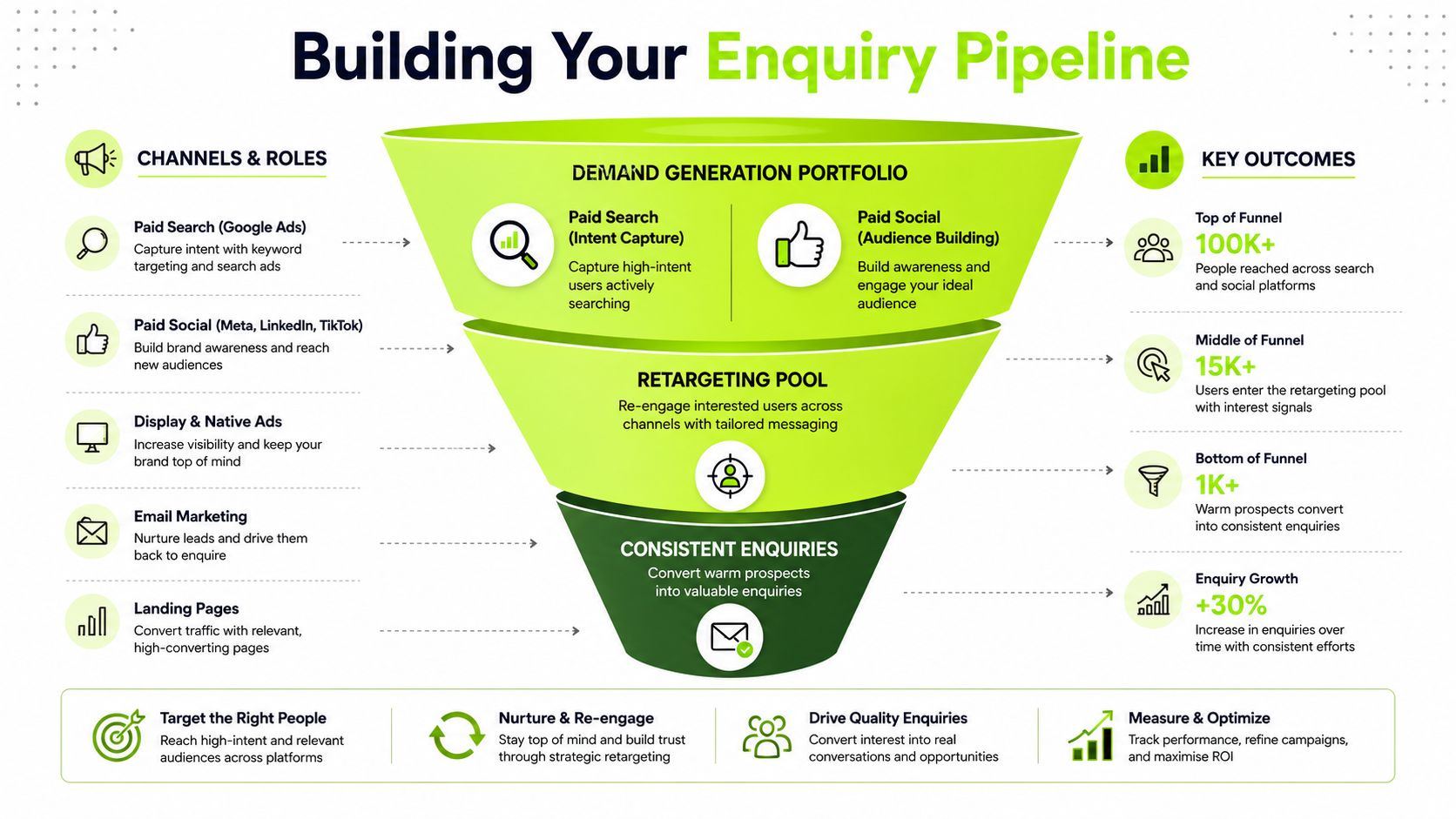
Demand generation should operate as a portfolio, not as a bet on one channel. Paid search captures immediate intent around terms such as “golf club near me”. Paid social introduces the club to relevant local audiences and keeps the venue visible to people who visited the website but didn't enquire. SEO builds useful discovery around membership FAQs, course guides, category pages and local golfing questions.
Local relationships add reach that advertising can't always create. Develop partnerships with hotels, employers, schools, PGA professionals and county unions. Each partner needs a clear referral route and a source tag, otherwise the club won't know whether the relationship produces serious membership prospects or casual interest.
Give every channel a commercial job
For each source, record:
- Source and campaign: Use consistent tags for paid search, paid social, organic search, referral and partnership activity.
- Cost per enquiry: Measure what the club spends to create initial interest.
- Cost per qualified lead: Separate a genuine membership prospect from a general visitor question.
- Cost per member: Follow the source through to a signed membership, not just a form submission.
Review sources weekly, then reallocate spend monthly. A club should be able to pause a channel that repeatedly misses its agreed commercial target rather than allowing an annual budget to run on habit. That decision requires clean source data and a CRM that connects the first enquiry to the final membership.
For broader lead-generation principles, CallZent's lead generation tips offer a useful reference point, particularly around defining sources and building a process that sales staff can follow.
A predictable pipeline doesn't mean every channel produces the same volume. It means the club understands each channel's role, sees the handoff into the enquiry process and knows where to improve.
Handling Enquiries So They Actually Convert
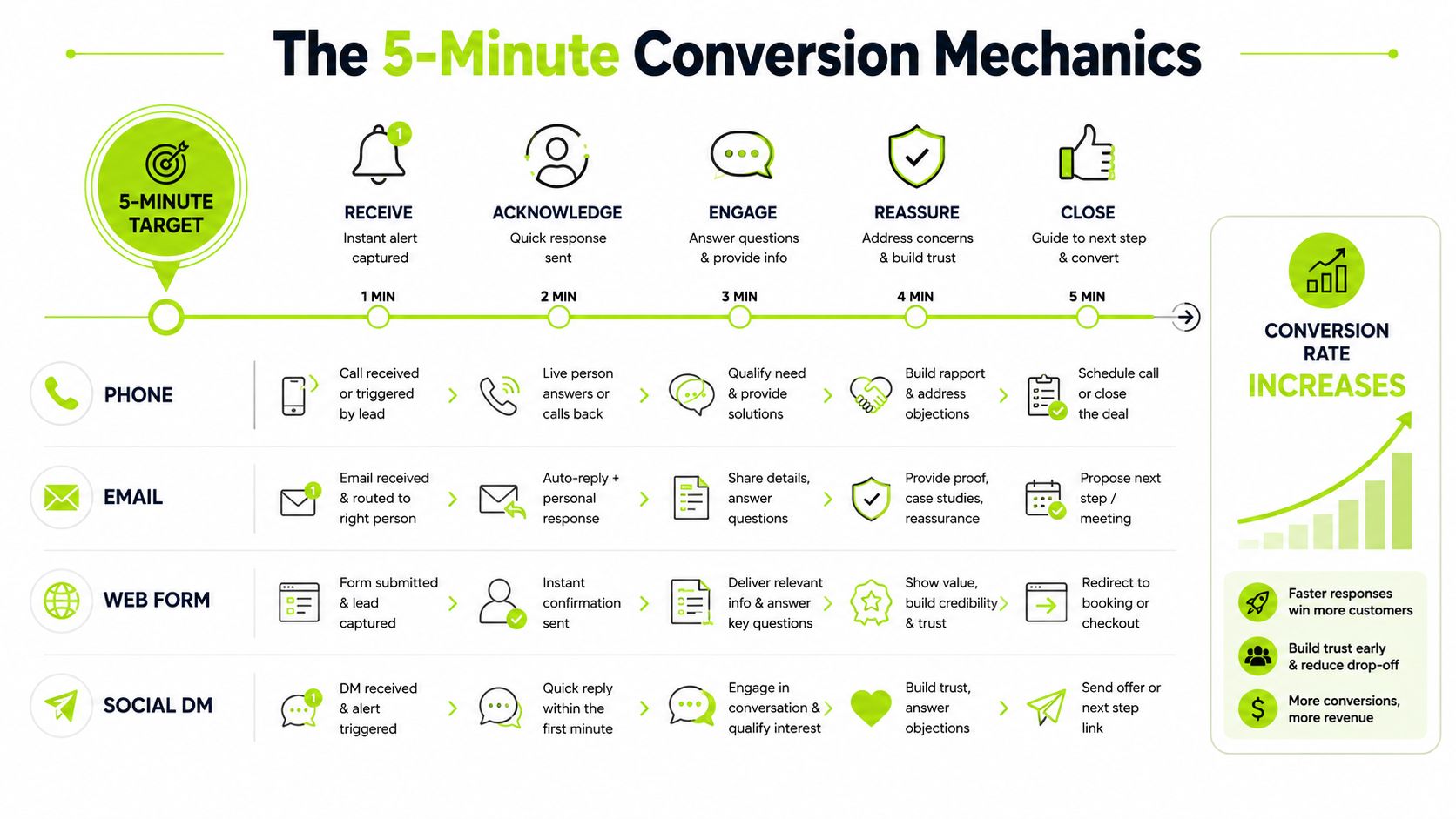
Speed and ownership matter more than another clever advert. One source reports that responding within five minutes can increase conversion chances by up to 100 times compared with waiting 30 minutes, while another describes the first five minutes as the “golden window”. (GolfRep marketing automation guidance)
Set a five-minute target for every channel, including phone, email, web forms and social messages. If a manager can't answer personally, the system should acknowledge the enquiry immediately, notify the right person and create a task with a deadline. An automated acknowledgement isn't a substitute for a human reply, but silence is worse.
Build the operating system
Use a shared inbox or CRM round-robin assignment. Every record should show the golfer's name, source, membership category discussed, questions asked, assigned owner and next action. “Someone will call them” isn't a process. It's how good enquiries disappear.
A practical nurture sequence can look like this:
- Day 1: Send a personal reply from a named contact and offer specific visit times.
- Day 3: Share a short course video, club tour or useful explanation of the relevant category.
- Day 7: Invite the prospect to a taster session or suitable visitor experience.
- Day 14: Make a follow-up call and offer a specific time to speak.
The reported average journey from first enquiry to signed membership is 47 days, which makes one-off replies inadequate. (GolfRep golf club sales process guidance) Track every touchpoint and keep the next action visible.
Ownership beats optimism. If an enquiry has no named owner and no dated next step, it isn't in a pipeline. It's in storage.
Review conversion weekly by source, membership category and owner. The golf club follow-up system guide provides a useful framework for turning manual chasing into a repeatable process.
Converting Visits and Trials into Signed Members
A visit shouldn't be an informal walk around followed by “let us know”. Design it as a decision experience. Fixed taster-session days make staffing easier, while a defined route, a prepared host and a scheduled closing conversation give the prospect a clear way to decide.
Ask every visitor three questions:
- Motivation: What brought you to the club now?
- Decision criteria: What would make you join?
- History: What has held you back from joining in the past?
Record the answers in the CRM. Objections about price, playing access, competition, social life or joining procedures should influence future messaging, onboarding and category design. If staff keep hearing the same objection, the club has a proposition problem, not a lead problem.
Replace permanent discounts with structure
A clear membership architecture gives people a route in without training them to wait for a cheaper price. Use sensible categories, a defined trial with a clear conversion date and a limited window for a founding-member or category-change offer. The point is to create clarity, not artificial pressure.
Discounts attract people who are primarily comparing prices. A well-designed trial helps prospects experience the course, meet members and understand the value of belonging. The host's job isn't to deliver a hard sell. It's to uncover fit and make the next decision easy.
| Practice | Do | Don't |
|---|---|---|
| Taster visit | Use a fixed format, prepared host and planned close | Let every staff member improvise |
| Trial | Set expectations and a clear conversion date | Leave the trial open-ended |
| Pricing | Present structured categories and explain fit | Offer a permanent discount by default |
| Objections | Log themes and review them regularly | Treat each concern as an isolated complaint |
| Follow-up | Agree the next contact before the visitor leaves | Wait for the prospect to chase the club |
Structure creates commitment. The club should make joining understandable, attainable and appropriate, without reducing the membership to a price negotiation.
Retention as a Measurable System Not a Motto
“Look after members” is a value, not a retention system. A manager needs to know which members are becoming less engaged, what signal appeared first and who is responsible for intervening.
Create cohorts based on membership age, such as 0 to 3 months, 4 to 12 months, 13 to 24 months and 25 months or more. Report retention, usage and spend by cohort each month. This shows whether the club has an onboarding problem, a mid-membership engagement problem or a long-term value problem.
Track the signals before resignation
Useful warning signals include:
- Usage decline: A member's visits or bookings fall noticeably from their normal pattern.
- Booking gap: No booking appears for a defined period, such as 28 days.
- Missed involvement: The member stops attending events or competitions they previously joined.
- Unanswered feedback: A complaint, survey response or service issue receives no visible resolution.
- Referral failure: A member expresses enthusiasm but never receives a simple way to introduce a friend.
CRM triggers can then create a manager call, a complimentary lesson, a suitable tee-time suggestion or a personal invitation. The action must match the signal. A member who can't find a playing partner needs a different intervention from someone frustrated by a service issue.
Quarterly pulse checks are more useful than a single annual survey when the club links feedback to specific touchpoints. Ask about joining, booking, playing, social participation and staff contact. Assign one accountable owner for retention. Reception, the secretary and the professional can contribute, but shared responsibility without a named lead usually means nobody acts.
Report gross retention, net retention, engagement score, referral rate and time to second visit. These measures turn member experience into an operating discipline rather than a committee aspiration.
Measuring What Matters and Optimising Month on Month
A committee dashboard should show cause and effect. Lead volume belongs beside response time, booked visits, signed memberships and financial outcomes. If the dashboard only reports enquiries, it rewards activity without proving growth.
Start with a KPI tree:
| Stage | KPI | Formula | Healthy Benchmark |
|---|---|---|---|
| Demand | Qualified enquiries per source | Qualified enquiries divided by source | Set from your own baseline |
| Response | Average days to first response | Total response time divided by enquiries | Improve towards the club's five-minute target |
| Visit | Enquiry-to-visit rate | Booked visits divided by qualified enquiries | Compare by source and owner |
| Conversion | Visit-to-member rate | Signed members divided by completed visits | Establish a baseline by category |
| Activation | Activation within 30 days | New members active within 30 days divided by new members | Set a club-specific target |
| Membership | Monthly active members | Members meeting your active-use definition | Track by cohort |
| Finance | Cost per acquired member | Attributable acquisition cost divided by signed members | Compare channels |
| Finance | Net revenue retention | Existing-member revenue retained and expanded divided by starting revenue | Review alongside churn |
| Value | Member lifetime value | Revenue and margin contribution across the member relationship | Use consistent assumptions |
Don't invent “healthy” benchmarks from another club. Establish a baseline, choose a direction of travel and agree what decision follows if the number misses target. A five-minute response target is a useful operating standard because the source data identifies the first minutes as a critical conversion window, but each club should still measure its actual performance.
Make attribution and testing unavoidable
Every advert, landing page, referral and partnership needs a source and campaign value in the CRM. Review the path from first click to recurring membership revenue. That prevents the club from confusing cheap enquiries with profitable acquisition.
Run one pricing test, one message test and one channel test per quarter. Define the hypothesis, the audience, the evidence required and the decision rule before the test begins. Hold a 60-minute monthly review, assign one owner per action and revisit the same dashboard. GolfRep can support this operating model through lead capture, qualification, automated follow-up, CRM visibility and revenue tracking, while the club retains control of its proposition and member experience.
The dashboard should change behaviour. If a metric doesn't lead to a decision, remove it or connect it to one.
Predictable growth is a loop: attract relevant demand, respond quickly, book a useful visit, convert without unnecessary discounting, activate the new member and intervene when engagement falls. Repeat the loop until the club can explain where growth came from and what will improve next month.
Visit GolfRep to assess your club's enquiry handling, CRM visibility and membership conversion process. GolfRep helps UK golf clubs combine targeted lead generation with structured follow-up and revenue tracking, so you can build a pipeline that turns more existing interest into long-term members.
Ready to tap into our proven growth system?