Why Most Golf Club Marketing Fails and The System to Fix It

The real reason why most golf club marketing fails has almost nothing to do with the quality of your course or the creativity of your adverts. It comes down to a fundamental breakdown in process: a systemic failure to capture, manage, and convert the interest your marketing works so hard to generate.
Your Marketing Isn’t the Problem, Your System Is

For years, the go-to advice for a quiet membership book has been to spend more on marketing. More social media, bigger ads, glossier brochures. But this approach almost always ends in frustration and wasted money. Why? Because it is aimed at the wrong end of the problem.
The biggest challenge for most clubs today is not a shortage of enquiries. In fact, you are probably sitting on a goldmine of potential members right now. The real issue is that these valuable leads are slipping through the cracks of a broken, manual, and inconsistent follow-up process.
The Leaky Bucket Analogy
Imagine your marketing efforts are like pouring water into a bucket. Every new enquiry, whether from your website, a phone call, or a Facebook message, is another litre of precious water. But if that bucket is riddled with holes, the water just drains away before you can do anything with it.
These holes are the systemic failures in your process.
- Slow Response Times: A potential member gets in touch on a Tuesday but does not hear back until Friday afternoon. By then, their initial spark of interest has gone, or worse, a competitor has already welcomed them.
- Inconsistent Follow-up: An enquiry is handed to a busy staff member who forgets to make the call, or the entire follow-up system relies on one person's memory and a chaotic spreadsheet.
- No Lead Visibility: You have no clear picture of how many enquiries are coming in, where they are from, or what stage they are at. You are flying blind.
The difficult truth is that pouring more money into marketing without first fixing these operational leaks is like trying to fill a sieve. Your investment, your time, and your potential revenue simply drain away.
This guide will dissect these common failure points one by one. More importantly, it will give you a clear, system-based solution for building a predictable membership pipeline. It is time to shift the focus from just getting more leads to properly managing the ones you already have. You can explore our foundational strategies in our guide to effective golf club marketing for more detail.
Failure Point 1: The Enquiry Black Hole

This is the exact spot where your marketing return on investment goes to die. Every single enquiry that arrives, whether from a web form, a phone call, or a social media message, represents a moment of peak interest. It is a potential member’s first meaningful interaction with your club, and the clock starts ticking the second they hit 'send'.
That crucial journey, from initial curiosity to a booked tour, collapses the moment an enquiry is mishandled. And the most common culprit is painfully simple: a slow response. When a prospect has to wait days for a reply, their excitement evaporates. Worse, they have often already moved on to a competitor who was quicker.
The problem is almost always systemic. Most clubs still rely on busy staff to manually monitor an inbox, update a spreadsheet, and somehow remember to make follow-up calls. This manual approach is destined to fail, creating an 'enquiry black hole' where promising leads disappear without a trace.
The True Cost of a Slow Response
Let's walk through a scenario we see all the time. A keen golfer, excited about your course, fills out your online form on a Tuesday morning. That enquiry lands in a general inbox, sitting there until a staff member finds a spare moment between other duties. They finally reply on Friday afternoon, but by then, it is far too late. The prospect has already booked a tour at the rival club down the road.
This is not a rare mishap; for many clubs, it is the default outcome of a broken process. The speed and quality of your response are far more important than the creativity of your marketing campaigns. A fast, professional, and personal reply makes a prospect feel valued from the outset. A slow one tells them they are not a priority.
This is the frustrating point where many clubs realise why their marketing "is not working". They are doing a great job generating interest but fail to convert it because the internal handling process is simply not fit for purpose.
The most expensive enquiry is the one you paid to generate but failed to answer. A slow or non-existent response not only loses a potential member but also wastes the entire marketing budget spent to attract them in the first place.
From Manual Chaos to a Centralised System
To fix the enquiry black hole, you must replace manual chaos with a structured system. Relying on spreadsheets and memory is not sustainable. The solution is a centralised platform, like a Customer Relationship Management (CRM) system, designed specifically to manage this process.
A well-implemented system ensures every single lead is:
- Captured Instantly: Enquiries from all your sources, such as your website, social media, and phone, are automatically logged in one central place. Nothing gets missed or forgotten.
- Actioned Immediately: Automated alerts can notify the right person to follow up, while automated emails can send an instant, professional acknowledgement to the prospect.
- Tracked Transparently: You gain complete lead visibility. At any moment, you can see exactly where every prospect is in their journey, from initial contact to becoming a fully-fledged member.
This shift from manual handling to a system-driven approach is fundamental. It transforms your enquiry management from a critical weakness into a powerful strength, creating a reliable and efficient conversion engine. To take a closer look at optimising this journey, you can learn more about building an effective golf club sales process in our complete guide. By plugging these leaks, you ensure that every pound spent on marketing has the best possible chance of delivering a fantastic return.
Failure Point 2: Relying on Interest Instead of Communicating Value
A dangerous assumption sits at the heart of many struggling clubs: the belief that a general interest in golf is enough to sell memberships. This is a passive, “build it and they will come” mindset, and it is a huge reason why most club marketing falls flat. It is what leads clubs to simply post a price list online, perhaps send a terse email about a fee increase, and then wait for the phone to ring.
That approach is a relic of a bygone era. In today’s competitive market, it is a recipe for failure.
Modern golfers, whether they are new to the game or seasoned players, have a dizzying array of choices. They are not just buying access to a course; they are investing in an experience, a community, and a lifestyle. When a club fails to spell out what makes it special, it becomes just another option on a list, a commodity forced to compete on price alone.
This mistake becomes painfully obvious when clubs raise their fees. While rising operational costs often make increases necessary, the change is frequently rolled out with next to no communication explaining the value behind it. Existing members feel taken for granted, and prospective members see nothing but a higher price tag with no compelling reason to pay it.
From Price List to Value Proposition
To turn things around, you need to shift from a passive to a proactive strategy. That means ditching the simple price list in favour of a powerful value proposition. A price list only answers, "How much does it cost?" A value proposition answers the far more critical question: "What do I get for my money, and why is it worth every penny?"
Your value proposition is the story you tell. It is the narrative that brings to life everything a member gains by joining your club, the stuff that goes far beyond just 18 holes of golf.
What are you really selling?
- The Community and Atmosphere: What is the social scene like? Do you run lively events, roll-ups, or competitions that build a real sense of belonging?
- Course Quality and Improvements: Are you investing in new drainage, bunker renovations, or top-of-the-line greenskeeping? Frame these not as costs, but as direct investments in a better member experience.
- Practice Facilities and Amenities: Is your driving range a place people want to spend time? Do you have a great short-game area or a clubhouse with a fantastic atmosphere? These are huge parts of the overall value.
- Exclusivity and Prestige: What makes your club distinct? Is it the history, the notoriously challenging layout, or the quality of the membership itself?
When you lead with these points, you transform your club from a commodity into a destination. You are no longer just a place to play golf; you are the place to be a golfer.
Before we dive into some real-world examples, let's crystallise the difference between these two mindsets.
Marketing Approach: Passive vs Proactive
The takeaway is simple: the passive approach waits to be chosen, while the proactive approach gives people a compelling reason to choose you.
The Real-World Impact of Poor Communication
The consequences of failing to communicate value are not just theoretical. A recent analysis threw this into sharp relief, revealing that an alarming 87% of UK golf clubs had increased their membership fees. While justified by demand and costs, the rollout often exposed a deep-seated marketing failure.
Many clubs simply neglected to explain the why behind the price hikes, leading to widespread member frustration. In one galling example, a member reported a 36% fee increase after their category was changed without any consultation. This is a textbook case of prioritising short-term revenue over long-term member relationships. You can dive deeper into these findings on the rising costs of golf club membership.
A membership fee is a price. A well-communicated membership package is an investment. The difference between the two is a story well told. Clubs that only post prices are leaving money on the table; clubs that articulate value build loyalty and attract members who are truly invested.
Ultimately, relying on assumed interest is a gamble you cannot afford to take. The recent surge in casual golf is a massive opportunity, but these new players will not automatically convert into loyal, full-paying members without a compelling reason. You have to show them why your club offers more than just a convenient tee time. By actively communicating your unique value, you justify your pricing, build a stronger brand, and create a sustainable pipeline of members who are proud to belong.
Failure Point 3: Using a One-Size-Fits-All Message

One of the most stubborn habits in club marketing is broadcasting a single, generic message to a mythical ‘average golfer’. The problem is, this person does not exist. When you try to speak to everyone, you end up connecting with no one.
The modern golfing world is not a monolith. It is a vibrant mix of distinct groups, each with completely different motivations, needs, and ideas about what a club should offer. Your marketing has to reflect that reality.
A single advert focused on your championship course and traditional heritage might grab the attention of a low-handicap golfer. But it is going to completely miss the mark with a young professional looking for flexible playing times, a woman searching for a welcoming social scene, or parents wanting a safe, structured junior programme.
The New Faces of Golf
The data is clear: the make-up of golf is changing. Participation among juniors, women, and younger professionals is on a serious upward trend. Any club that fails to tailor its marketing to these growing groups is not just missing an opportunity, it is actively choosing to become irrelevant.
To get this right, you must move beyond blanket messaging and get serious about segmentation. This just means shaping your communication to solve the specific problems and speak to the aspirations of each audience.
- For Juniors and Their Parents: Forget course prestige. Focus on development pathways, coaching excellence, safety, and fun. Showcase your junior academy and paint a clear picture of how a child can progress from their first lesson to competitive golf.
- For Women Golfers: Your campaigns need to radiate inclusivity and community. Promote ladies' roll-ups, taster sessions, and social events that feel accessible and welcoming, not intimidating.
- For Busy Professionals Under 40: This group is all about flexibility and value. Your messaging must centre on flexible membership tiers, networking potential, and a modern club atmosphere that fits their demanding lifestyle.
When you try to be everything to everyone, you become nothing to anyone. Effective marketing is about precision. It is about delivering the right message, to the right person, at the right time, making them feel like you truly understand them.
From Simple Database to Segmentation Engine
This is where a Customer Relationship Management (CRM) system stops being a digital address book and becomes your most powerful marketing tool. A well-configured CRM acts as a segmentation engine, letting you group your contacts and leads based on their interests, demographics, and how they have interacted with your club.
Instead of a generic email blast to your entire database, you can launch laser-focused campaigns. Imagine sending an invitation for a junior open day only to families, while a corporate golf day offer goes out to your local business contacts. That level of precision is simply impossible with a spreadsheet.
These segments are not niche markets; they represent the future. Recent industry analysis shows junior membership participation grew by 10.52 percentage points, the biggest gain of any group. Meanwhile, 41.59% of clubs report growth in female members. The failure is obvious: clubs often have this data but lack the systems to act on it, especially when it comes to creating automated pathways to graduate juniors into intermediate and full adult categories. You can explore more of this data in this report on the health of UK golf club membership.
Building Pathways, Not Just Campaigns
Ultimately, the goal of segmented marketing is to build clear, structured pathways for every type of potential member. A CRM helps you guide individuals along that journey, from their very first enquiry to becoming a loyal, long-term member.
A junior golfer joining today is a potential full member of tomorrow. Your system should be smart enough to track their journey and automatically send communications at key moments, like an email explaining the benefits of the intermediate category when they reach the right age. This proactive approach is how you maximise the lifetime value of every single person who shows an interest in your club.
By ditching the one-size-fits-all approach for a segmented, system-driven strategy, you stop shouting into the void and start having meaningful conversations. This is how you build a robust, diverse, and sustainable membership for the future.
Failure Point 4: Mistaking Website Traffic for Real Progress
It is one of the most common traps we see clubs fall into: confusing online traffic with genuine progress. Getting people to your digital front door, your website or booking engine, has become the easy part. The real reason why most golf club marketing fails is what happens, or rather what does not happen, next.
Many committees and managers get a warm feeling looking at reports filled with website visits, social media likes, or tee sheet views. But honestly, these are often just 'vanity metrics'. They look impressive on paper but mean very little if they do not lead to qualified enquiries and, ultimately, new membership revenue. A high-traffic website without a system to convert that interest is like a bustling pro shop where nobody ever actually buys anything.
The Problem Isn't a Lack of Interest
Let’s be clear: the problem is almost never a lack of demand. The interest in what you offer is already out there, often in huge numbers. The real breakdown is the lack of a proper system to capture, qualify, and nurture the attention you have worked so hard to get. Your club might have thousands of potential members browsing your membership page each month, but if you have no way to identify and follow up with these high-intent individuals, you are leaving a staggering amount of money on the table.
This gets to the heart of what we do at GolfRep: sustainable growth is not about shouting louder or chasing more clicks. It is about building an efficient, reliable engine that converts existing demand into predictable income by combining lead generation with structured systems. You can read more about getting your digital house in order in our guide to taking your golf course online.
A busy website is not a successful business. Progress is not measured by how many people look; it is measured by how many people commit. Without a system to turn visitors into members, website traffic is just digital window shopping.
The Shocking Scale of Missed Opportunity
When you look at the numbers, the scale of this missed opportunity is genuinely startling. The Hillier Hopkins Golf Clubs Report found that the average golf club received 17,697 online tee sheet visits in a single year. That's a huge pool of active, engaged golfers interacting directly with the club. But without the right systems, that flood of interest rarely translates into any meaningful membership growth.
This points to a fundamental failure of process. It is a massive disconnect between generating interest and actually converting it. Clubs are sitting on a goldmine of high-intent traffic but simply do not have the tools to systematically turn those prospects into members.
Moving from Vanity Metrics to Valuable Actions
To fix this, the club's entire mindset needs to shift from tracking superficial numbers to focusing on metrics that drive the business forward. Stop asking, "How many people visited our website?" and start asking the questions that really matter:
- How many visitors became known leads? Of all that anonymous traffic, what percentage did we convert into a real person with a name and email in our system?
- What is our enquiry-to-tour conversion rate? For every person who expresses interest in membership, how many do we successfully get to book a visit to the club?
- What is our tour-to-member conversion rate? How good are we at turning those club visits into signed-up, paying members?
Answering these questions is not about guesswork; it requires a proper system. It demands a CRM that gives you complete lead visibility and conversion tracking, showing you exactly where potential members are falling through the cracks. This data-first approach transforms your membership recruitment from a game of chance into a predictable process for growth, ensuring every pound you spend on marketing has the best possible chance of delivering a real return.
The Solution: A Predictable System for Sustainable Growth
Having diagnosed why most golf club marketing fails, the solution becomes clear. The only way forward is to stop relying on chaotic, manual efforts and instead build a permanent, system-driven engine for growth. This is not about asking your team to work harder; it is about installing the right machinery to make growth a predictable outcome.
This system is not complicated, but it does rely on a few key parts working in harmony. It all starts with a central CRM to give you complete lead visibility, making sure no enquiry ever slips through the cracks again. From there, you layer on automated follow-up sequences to deliver instant, persistent communication that catches prospects right when their interest is highest.
The Shift from Reactive to Proactive
The goal is to shift your club's entire growth strategy from being reactive and bogged down in admin to being proactive and informed by data. Instead of depending on a staff member's memory or a messy spreadsheet, the system handles the repetitive, time-consuming tasks with perfect consistency, every single time.
This frees up your team to focus on what humans do best: building genuine relationships and delivering a fantastic experience when prospective members visit the club. It takes the guesswork out of growth and replaces it with a reliable process.
This diagram shows how it all flows together, moving from anonymous website traffic through a conversion system to a signed-up new member.
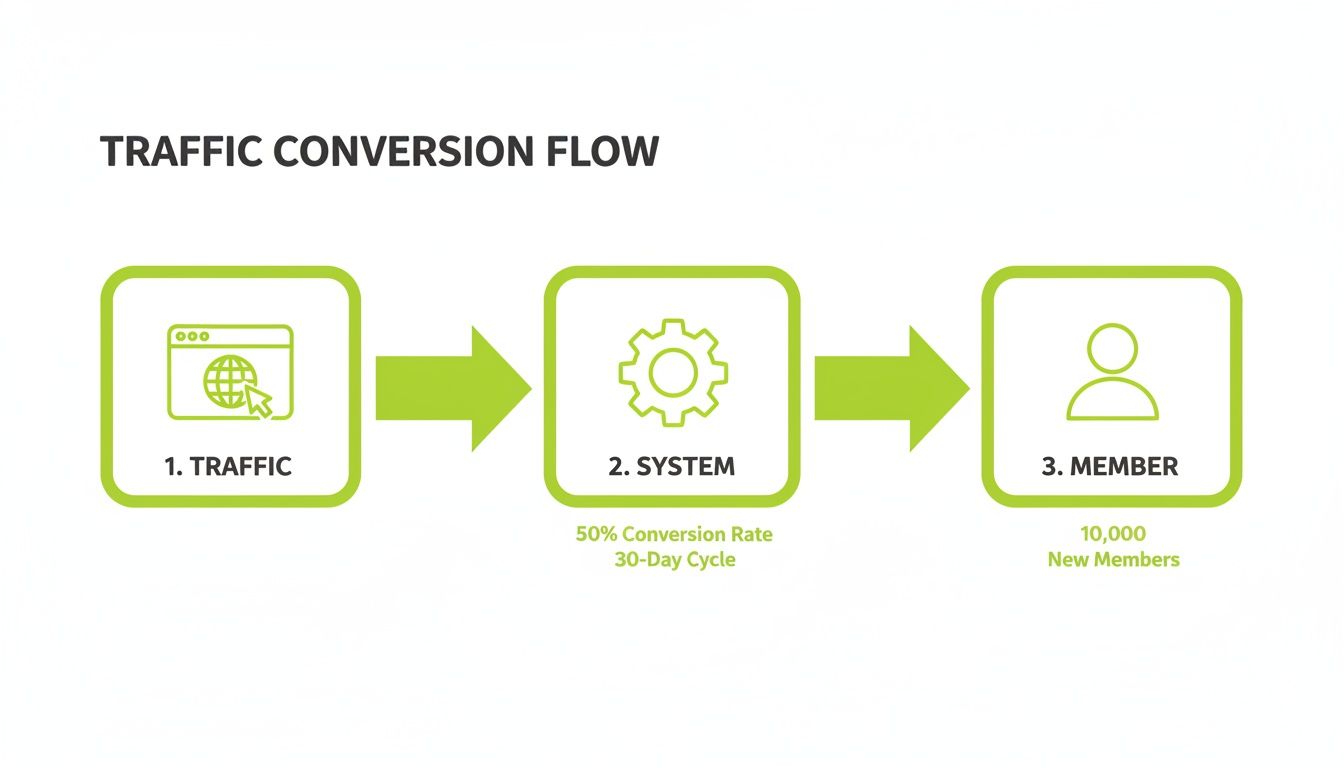
The big takeaway here is the central role of the system. It is the critical link that turns vague interest into measurable, profitable action.
Measuring What Truly Matters
A proper system also gives you crystal-clear data, shifting the focus away from vanity metrics like website visits and onto the numbers that dictate your club's financial health.
Predictable membership growth is not a myth or a matter of luck. It is the natural and inevitable result of having the right systems in place, consistently converting interest into revenue.
You finally start measuring what matters:
- Enquiry-to-Tour Conversion Rate: How effective are we at turning an initial flicker of interest into a physical visit?
- Cost Per Acquisition: What does it actually cost us, in real money, to get a new member through the door?
- Member Lifetime Value: What is the long-term financial worth of each new membership we sell?
This is precisely where a growth partner like GolfRep comes in. We do not just find leads; we build and manage this entire growth infrastructure for you, combining lead generation with the CRM and follow-up systems that create a predictable pipeline. By becoming system-reliant, you create a far more sustainable and predictable future for your club.
Common Questions About Fixing Club Marketing
Switching from traditional marketing to a structured, system-driven approach can feel like a big leap. Here are answers to a few common questions we hear from club managers and committee members.
"Is this just another marketing agency promising leads?"
Not at all. The typical agency model is built around one goal: sending more enquiries your way. But as we have explored, generating enquiries is rarely the main problem. If you do not have the internal setup to handle, respond to, and convert those enquiries effectively, they often go to waste.
Think of us as a growth partner. We build the entire predictable revenue pipeline for you, from generating initial interest right through to the CRM and automated follow-up systems that turn that interest into paying members. It is a permanent asset for the club, not a temporary campaign.
"Our team is already stretched. We don’t have time for a complex new system."
This is a valid concern. The good news is that a well-designed system actually reduces your team's workload; it does not add to it. By automating repetitive tasks like sending welcome emails, logging enquiries, and chasing up prospects, the system frees your people up.
Imagine your staff focusing their energy on giving fantastic club tours and building genuine relationships with potential members, instead of being buried in administrative tasks. That is what this approach delivers.
"How will we know if any of this is actually working?"
This is the best part. Unlike traditional marketing, where results can feel fuzzy, a proper system gives you complete clarity through conversion tracking. You stop obsessing over vanity metrics like website clicks and start measuring what really moves the needle for the club's bottom line.
A great system makes your performance undeniable. You can track every step of the journey, from the moment an enquiry lands to the day a new member pays their invoice. It gives you a crystal-clear, real-time view of your return on investment.
We set you up with straightforward reports that show you exactly what is happening, including metrics like:
- The number of qualified leads generated each month.
- Your enquiry-to-tour booking rate.
- The final tour-to-member conversion rate.
- Your precise cost to acquire each new member.
This data means we can continuously refine the process, ensuring every penny of your budget is working as hard as it possibly can to grow the club.
At GolfRep, we build and manage the entire growth system for you, turning sporadic enquiries into a predictable, measurable source of new members. If you are ready to fix your follow-up process and build a sustainable future for your club, book a discovery call with our team.
Ready to tap into our proven growth system?