Golf Club Marketing Automation: Systems That Convert

Most golf clubs keep asking for more enquiries when the problem is that they're already dropping the ones they have. A slow inbox, no owner for the lead, and no clear follow-up process do more damage than a quiet month of advertising ever will.
That's why golf club marketing automation matters. Not because clubs need more messages, but because they need a system that handles enquiry speed, lead visibility, and follow-up without relying on someone remembering to chase an email after a busy day in the office.
The Real Bottleneck at Most UK Golf Clubs
The popular advice is still backwards. Clubs are told to focus on traffic, campaigns, and content, then act surprised when the pipeline doesn't move. In the UK golf-club context, the problem is usually not demand generation, it's what happens after the enquiry lands.
GolfRep's marketing analysis says clubs take an average of 47 hours and 32 minutes to respond to membership enquiries, and it cites research that replying within 5 minutes can increase conversion chances by up to 100 times versus waiting 30 minutes. It also says UK clubs lose roughly 30% of membership enquiries before a proper discussion even begins because handling is slow, inconsistent, or invisible after arrival. That's not a marketing problem in the usual sense, it's a lead-handling failure. Why most golf club marketing fails
Stop treating every enquiry like it's safely parked
An enquiry sitting in a shared inbox is not a lead. It's a risk. If nobody can see it, own it, and move it forward, the club is effectively paying for demand and then leaving the door half shut.
Practical rule: if a prospect can enquire and then hear nothing meaningful the same day, the club is leaking money.
That's why automation is not a nice-to-have layer on top of “proper marketing”. It's a response-time control system. It makes the first acknowledgement instant, routes the enquiry to the right person, and keeps the enquiry visible until there's a visit, a call, or a clear decision.
A club can spend more on ads and still lose. A club can spend less and still win, if every serious enquiry gets handled properly. That's the shift committee members need to understand.
What Marketing Automation Means for a Golf Club
For a golf club, marketing automation is a connected system that captures an enquiry, assigns it, triggers the next action, and keeps the prospect moving until they book a visit or join.
A club without automation is a greenkeeper with a full tee-sheet and no radio. A club with automation is the same greenkeeper, but now there's a radio, a clear plan for every bay, and everyone knows who is handling what.
The four pieces that matter
A workable stack needs four layers that talk to each other. The CRM is the source of truth, because that is where the lead lives. The booking or tee-sheet system should feed member and visitor data into that record. The ads and enquiry-capture layer brings prospects in. The email and SMS layer carries the triggered follow-up.
If one of those is missing, the system gets brittle. If two of them do not integrate cleanly, staff fall back to manual copying, duplicated records, and half-finished follow-up. That is where automation projects die at clubs, not because the idea is wrong, but because the tools never joined up.
A sensible club uses automation for the repetitive parts and keeps human attention for the moments that matter. Booking confirmations, welcome messages, reminders, and post-event follow-up should run from the system. The actual conversation, especially when a member is considering joining or asking a sensitive question, should still feel like it came from someone who knows the club.
The cleanest way to think about golf club marketing automation is simple. It keeps every enquiry inside a controlled workflow so it does not disappear into a busy office inbox.
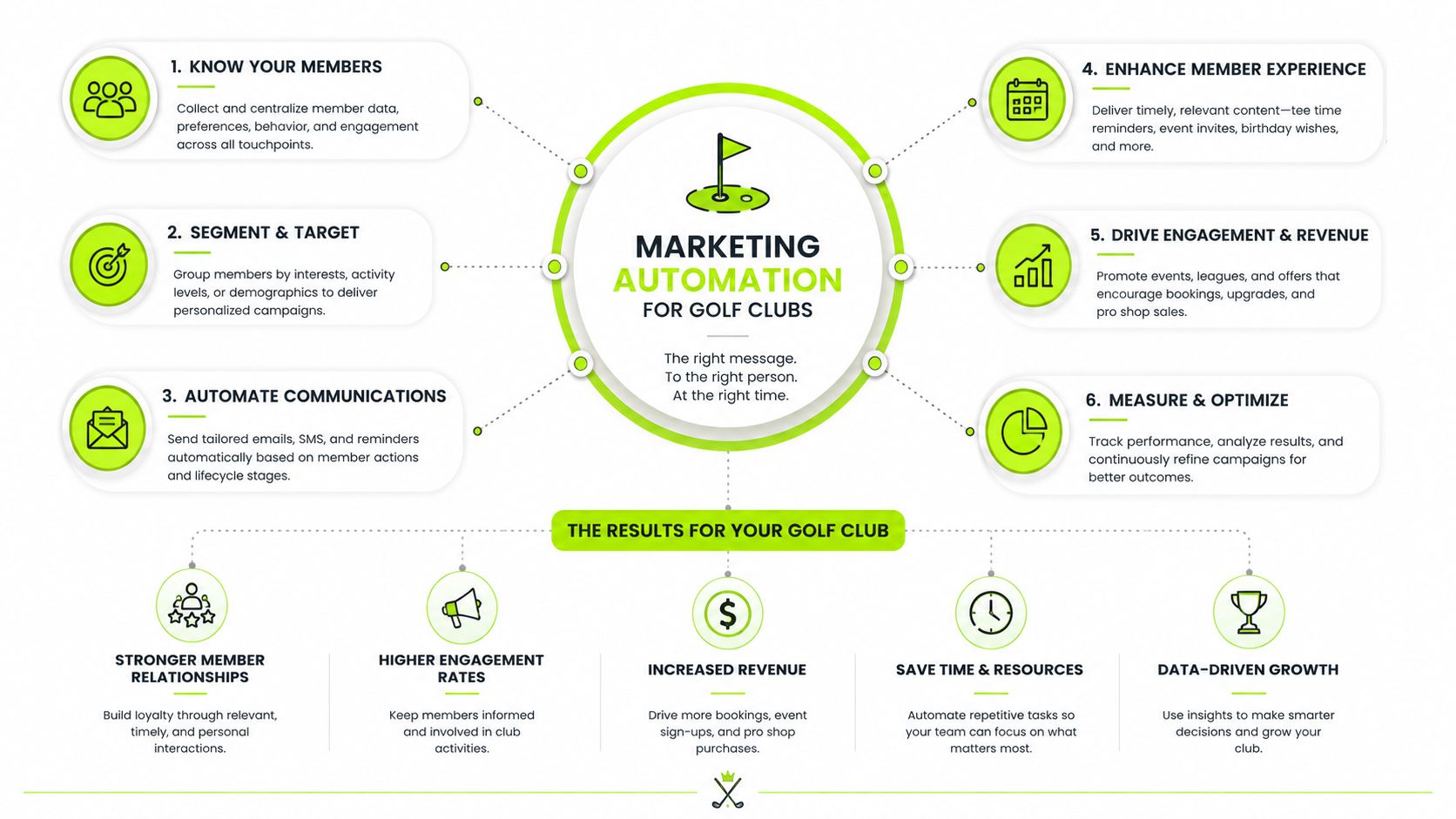
The test is whether the system gives the club control. If a prospect asks about membership, the enquiry should land in the CRM, trigger an acknowledgement, route to the right person, and create a visible follow-up task. If that chain breaks, the club is back to hoping someone notices the inbox before the lead goes cold.
A proper setup also protects existing demand. Clarity matters more than volume here. For a direct look at how fast follow-up changes enquiry handling, see GolfRep's speed-to-lead analysis. The same principle shows up in service operations too, which is why some clubs use Mercateer contractor call answering to keep calls captured when staff are busy.
One disconnected tool is not a strategy
Many clubs buy a form builder, then a newsletter platform, then a booking app, and wonder why nothing is visible end to end. The software list grows, but the pipeline stays murky. A system only works when each part feeds the next one without staff having to rescue the process.
Why Response Speed and Lead Visibility Drive the ROI
The financial case is blunt. Every hour a club delays responding to an enquiry increases the chance that the prospect has gone cold, booked elsewhere, or stopped caring. If the club already paid to create that enquiry through ads, SEO, social media, or referrals, then slow follow-up wastes the acquisition spend before the sales conversation has even started.
That's why speed-to-lead matters more than most committees realise. GolfRep's analysis says an enquiry answered within 5 minutes can convert at up to 100 times the rate of a 30-minute wait, which is exactly why a membership inbox should never be treated like admin. It's a revenue queue. Golf club speed to lead
Traffic without control just creates more leakage
The wider benchmark picture makes the same point. A 2026 golf-industry benchmarks article says mobile drives 62.5% of traffic but converts at only 1.8%, while desktop converts at 3.9% and overall conversion sits at 2.8%. It also reports a 68% booking abandonment rate. That combination says one thing clearly, clubs are paying to create interest, but many prospects fall away before anyone has a proper conversation. 2026 golf course benchmarks
That's where lead visibility becomes commercial, not cosmetic. A manager needs to know which enquiry came in, who owns it, whether it was acknowledged, and where it stalled. Without that view, the club is running on memory, not process.
For clubs that want a sense of how other sectors handle first response, a useful comparison is Mercateer contractor call answering, because the logic is the same, first contact must be immediate and consistent or the lead leaks.
Operational truth: if the committee can't see the stage of every membership enquiry, the club doesn't have a pipeline. It has noise.
That's why automation is an ROI project. It protects enquiries already won, shortens response times, and gives management enough visibility to stop guessing where the losses are happening.
The Enquiry to Member Pipeline and Where Automation Fits
The journey starts before the first phone call. A prospect clicks a Google advert, visits the club site, fills in a form, or submits a membership question through a social channel. From there, the club either has a controlled process, or it has a mess.
Where the system should run itself
The intake form should create the record automatically. The instant auto-reply should confirm the enquiry has been received. Staff should get a live notification so they can act, not discover the lead later. Booking reminders, post-visit follow-up, and reactivation of stalled enquiries should also run through the system.
That leaves the right people free to do the parts automation can't do well. The first phone call should be human. The visit should be human. Committee-led membership conversations should be human. Premium objections, especially at private clubs, should be handled by someone who understands the club's standards and tone.
Where clubs usually lose control
The weak points are usually the same. Someone sees an enquiry but forgets to log it. A prospect books a visit but never gets a proper follow-up. A lapsed enquiry goes back into the inbox and is never seen again. Multi-site operators feel this even harder, because each venue ends up handling follow-up differently unless the CRM and automations are centralised.
A central system doesn't just save time. It gives consistency. Every enquiry follows the same logic, every visit gets the same standard of care, and nobody has to wonder whether a lead was “probably replied to”.
Keep the human moments human, but make everything else machine-assisted. That's the balance clubs need.
A structured workflow matters more than a long list of campaigns. If the lead can be tracked from first click to signed-up member, management can see exactly where the club is converting well and where it isn't.
Choosing and Connecting the Right Tech Stack
UK clubs lose more time in the handoff than in the campaign itself. The key question is not which platform has the longest feature sheet. It is which stack moves enquiry data into the CRM, keeps booking information in sync, and gives staff a single place to act before leads go cold.
A simple vendor checklist
| Layer | Must Have | Watch Out For | Why It Matters |
|---|---|---|---|
| CRM | One central record for each enquiry and member | Duplicate records, fragmented notes, no ownership | This is the source of truth for follow-up and reporting |
| Booking or tee-sheet system | Feeds visit, booking, or member data into the CRM | Manual exports, disconnected systems | It keeps lifecycle data current |
| Ads and enquiry capture | Form tracking, source tracking, clean handoff into CRM | Leads trapped in landing pages or webforms | It shows where demand came from |
| Email and SMS | Triggered sequences based on behaviour or lifecycle stage | Broadcast-only sending, no automation logic | It delivers timely follow-up |
| Integration layer | Webhooks or middleware that syncs systems | Point tools that never talk to each other | It stops the workflow breaking |
Use that table before anyone approves a supplier. If they cannot explain the data path from enquiry to CRM to follow-up, the stack is too loose. If they can, you are closer to a system that staff will use.
Consent still matters. UK clubs operate in a strict data-protection environment, so service emails and marketing emails need separate treatment. The CRM should make that difference obvious, and the club should keep operational messages away from promotional consent. Golf club database marketing is covered in more detail in our guide to the best golf club CRM platforms, and the same logic applies here. The stack has to support compliance as well as conversion, or the whole setup becomes harder to trust.
Ask every vendor the same question. What happens when a member replies, books, or lapses? If that answer is vague, the workflow will be vague too.
GolfRep's CRM-linked follow-up setup is one practical model clubs can review. It routes enquiries and triggers nurture from the CRM rather than relying on isolated email blasts. Other tools can do the same job, provided the integrations are real and the data does not get stranded between systems.
Content support can sit inside that structure too. An affordable AI video generator can help with quick explainers or event promotion, but it only adds value if the enquiry handling underneath is disciplined. Content on its own will not repair a weak follow-up process.
Keeping Automation Premium Without Losing the Human Touch
A lot of private clubs worry automation will make them sound like a call centre. In practice, poor manual handling is what feels impersonal. An enquiry that disappears into an inbox, gets answered late, or receives a generic reply feels far more detached than a well-timed automated acknowledgement followed by a proper conversation.
Automation should be invisible to the member
The member does not need to know which messages are automated. They just need the communication to be fast, relevant, and consistent. Booking confirmations should arrive without delay. Reminders should land when they're useful. A thank-you after a visit should feel considered, not forgotten.
The journeys that should stay human are the same ones where judgement matters. Visits need a real conversation. Premium objections need a real response. Committee discussions need a person who can explain value without sounding scripted. Sensitive member issues should never be pushed through a sequence that ignores context.
Premium clubs need tighter segmentation, not louder messaging
The strongest UK guidance still points towards database-led, segmented communication rather than broad promotion. That matters because premium positioning depends on relevance. A private club doesn't win by sounding busy. It wins by sounding controlled, attentive, and selective.
That's why the argument isn't “automate everything”. It's “automate the repeatable parts so the people can focus on the moments that matter”. If the first touchpoint is clean and the follow-up is timely, the club feels more professional, not less.
For clubs looking at how content systems fit into that picture, content automation tools for 2026 are worth reviewing only as support, not as the core solution. The core remains the same, a good enquiry process, a reliable CRM, and human handling where the member experience depends on nuance.
KPIs, Reporting and a Realistic 90 Day Rollout
If a club can't measure it, the committee will eventually lose confidence in it. Automation needs a tight reporting set, not a dashboard full of vanity numbers. The metrics that matter are enquiry volume by source, speed to first response, booked-visit rate, visit-to-member conversion, tied revenue per new member, and member retention at six and twelve months.
The reporting rhythm that makes sense
Weekly reporting should show where enquiries are coming from and where they're getting stuck. Monthly reporting should connect spend to revenue, not just clicks to traffic. That's the difference between marketing activity and club growth.
Committee rule: if the report doesn't show a broken handoff, a response-time issue, or a conversion step that needs fixing, it's not useful enough.
A 90-day rollout is realistic if the club stays focused. Days one to thirty should cover the plumbing, CRM structure, enquiry forms, and instant response. Days thirty-one to sixty should add nurture sequences and staff notifications. Days sixty-one to ninety should be about testing, reporting, and reactivating stalled enquiries.
The biggest mistakes are predictable. Clubs buy tools that don't integrate. They ignore consent and data quality. They treat automation as a marketing project instead of a club-wide operating change. That last one is the killer, because the system only works when the office, membership team, and committee trust it.
GolfRep's analysis of club marketing also recommends tracking campaign spend, enquiry volume, booked-visit conversion rate, visit-to-member conversion rate, and tied membership revenue so clubs can see exactly where the funnel breaks. That's the right reporting mindset. Golf club marketing and tracking
The goal is not to automate for the sake of automation. It's to build a pipeline the club can run every week without chaos.
Practical Next Steps and Common Questions
Start with three moves. Audit where enquiries die. Define the response-time target the club will commit to. Then automate one CRM-led pipeline end to end before adding anything else. Most clubs don't need more tools, they need one process that works.
How long does it take? A simple setup can be moved through in weeks, not months, if the club already knows its enquiry path. Does it suit committee-run clubs? Yes, because the reporting makes handovers cleaner and stops leads living in people's inboxes. Is it compliant? It can be, but only if consent, service messages, and marketing messages are handled properly from the start.
GolfRep helps clubs build structured pipelines that connect lead generation with enquiry handling, CRM follow-up, and measurable reporting. If your club wants a clearer process for turning membership interest into booked visits and sign-ups, visit GolfRep and speak to a team that works only with golf clubs.
Ready to tap into our proven growth system?