What Is Customer Lifetime Value for Golf Clubs

Customer lifetime value is the total net revenue a golf club can expect from a member across the full relationship. For UK membership clubs, the metric is dominated by retention and ancillary spend rather than the headline joining fee.
A busy enquiry sheet can create false confidence. The general manager sees fresh names arriving, the committee hears that advertising is working, and the pipeline looks healthy. Meanwhile, members who joined recently may be playing less, spending nothing beyond their subscriptions, and considering cancellation. If the club can't connect enquiry handling, onboarding, renewals, visits, and additional spend, it can't tell whether growth is creating durable value or just replacing lost members.
Why CLV Matters More Than Enquiry Volume
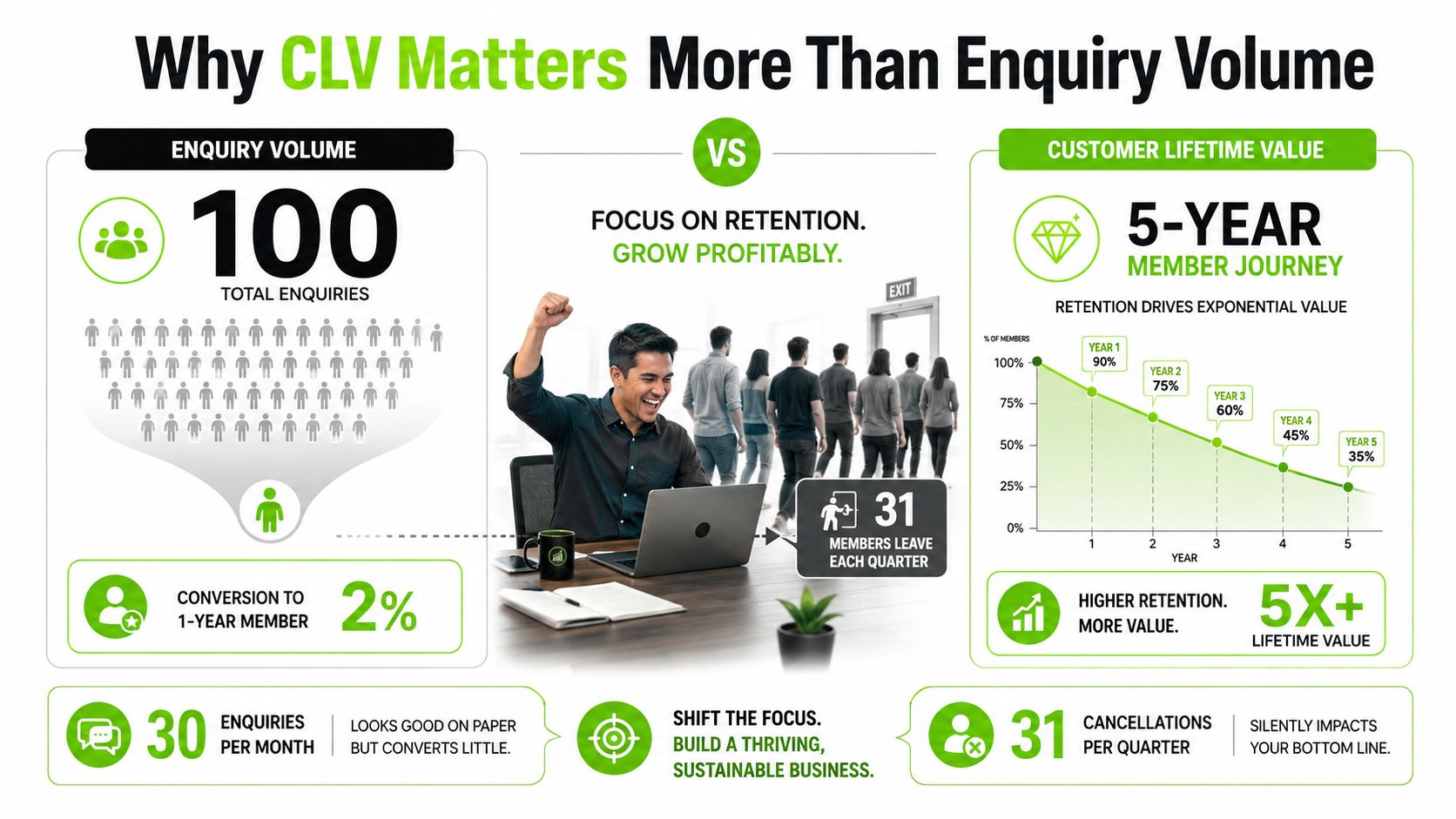
A club can report a strong enquiry quarter and still be losing commercial ground. The membership team sees fresh names, marketing activity looks healthy, and the committee feels reassured. Then renewal figures show that 31 members cancelled during the same quarter. The club has been measuring the front door while overlooking the exit.
Customer lifetime value, or CLV, puts both sides of that movement into one commercial view. It is the total net revenue a club expects to earn from one member over the whole relationship, after considering the cost of acquiring, serving, and retaining that member. The joining fee is only the first transaction. A member might renew, book lessons, use a buggy, buy food and drink, attend events, spend in the professional shop, or upgrade their category. Retention and participation determine whether that relationship becomes valuable.
Customer lifetime value is commonly defined as the total value a customer brings over the full relationship, and this UK guide to calculating LTV explains the practical link between customer value and average lifespan. For a golf club, the better question is not how many people enquired. It is what a 700-day member cohort is likely to contribute, which members are approaching early churn, and whether the club's enquiry handling and follow-up are fast enough to protect that value.
Turn member behaviour into a revenue forecast
Tracking CLV changes how a club allocates acquisition budget, sets pricing, and funds service. Lead sources can be judged by the members they eventually produce, not only by the number of names delivered. That gives the club a clearer basis for comparing advertising with faster response times, better onboarding, and visible CRM ownership.
It also strengthens the pricing conversation. A club can defend a subscription by examining the value of the full member experience, rather than reacting whenever another club advertises a cheaper joining offer. Early-churn prevention may produce more value than additional acquisition spend, particularly when slow enquiry responses, weak onboarding, or missed follow-up leave avoidable gaps in the first months of membership.
UK marketer research shows why the measurement gap matters. 81% of UK marketers reported sales increases after measuring CLV, 79% said it enabled more timely marketing, and 68% of those planning to implement it expected higher retention.The same research found that 76% of UK organisations couldn't measure CLV effectively, while only 24% monitored it effectively in the period reported. For clubs, a metric earns its place only when it changes who receives a call, how quickly an enquiry is handled, or where retention effort is directed.
Practical rule: If the club cannot connect enquiries to memberships, memberships to renewals, and cohorts to spend, enquiry volume is a dashboard decoration, not a growth plan.
CLV gives the committee a way to judge whether marketing is creating durable membership or temporary activity. It also supports investment in onboarding, CRM visibility, and timely follow-up, areas where GolfRep sees the speed-to-lead gap across UK club pipelines.
The CLV Formula for Golf Clubs in Practice
A member who pays well in year one can still be unprofitable if they leave before the club recovers its acquisition and onboarding costs. The calculation must therefore show both revenue and the length, quality, and cost of the relationship.
The simplest working formula is:
CLV = average revenue per member × average member tenure
It is quick enough for a committee meeting. A more useful operating version applies gross margin and, where appropriate, acquisition cost. A standard CLV model can include average purchase value, purchase frequency, customer lifespan, and costs to serve.
For a private club generating £6,800 in annual revenue per member, with a 0.40 gross margin and 7 years of average tenure, the margin-adjusted baseline is:
£6,800 × 0.40 × 7 = £19,040
Rounded, that is about £19,000 before acquisition cost. The margin-adjusted figure gives a clearer view than £6,800 because staff time, course operations, payment administration, and other delivery costs determine what the relationship contributes.
A churn-based version is:
CLV = annual revenue × gross margin × 1 ÷ annual churn rate
Using the same revenue and margin, a 15% annual churn rate produces approximately £18,133. At an 8% annual churn rate, the result is approximately £34,000. Reducing early churn can therefore create more value than increasing joining-fee activity, particularly when enquiry handling, onboarding, or follow-up leaves preventable gaps.
| Formula | Inputs | Worked Result | Best Used For |
|---|---|---|---|
| Simple CLV | £6,800 annual revenue, 0.40 margin, 7 years | £19,040 | Fast planning and committee discussions |
| Advanced CLV | £6,800 annual revenue, 0.40 margin, 15% churn | Approximately £18,133 | Testing the commercial effect of current churn |
| Advanced CLV | £6,800 annual revenue, 0.40 margin, 8% churn | £34,000 | Scenario planning around retention improvement |
Count the whole relationship
Annual revenue should include membership dues, buggy hire, food and beverage, retail, lessons, events, simulator use, and relevant upgrades. If these lines sit in separate systems, the club may understate member value and set acquisition budgets against incomplete information. CRM visibility matters because the same record should connect the original enquiry with membership activity, additional spend, and renewal.
The membership-sector guidance on CLV and the LTV:CAC benchmark also stresses comparing future member value with acquisition cost. A ratio of at least 3:1 is commonly used as a healthy benchmark. The simple formula supports quick decisions, while the advanced version prompts the operational questions: which members leave early, what does service cost, and where does the speed-to-lead gap in the club's pipeline affect future value?
Worked CLV Examples for a Private Club and a Resort
Worked examples reveal why headline spend can mislead a committee. The calculation should start with annual subscription revenue and ancillary spend, apply the gross margin, then multiply by average tenure.
Private club example
Take a 400-member private club. Each active member contributes £5,400 in annual subscriptions and £1,200 in ancillary spend, giving total annual revenue of £6,600 per member. At a 60% gross margin and 9-year average tenure, the calculation is:
£6,600 × 0.60 × 9 = £35,640
That produces a CLV of £35,640 before acquisition cost. The club's planning question isn't merely whether it can attract another member. It should ask whether the member will activate quickly, use the club regularly, discover relevant services, and renew long enough for the margin to justify the acquisition and onboarding effort.
Resort example
Now consider a multi-site resort with 1,800 members. Annual spend is £8,200, including £1,800 of ancillary revenue driven by stay-and-play packages. The resort has a shorter 4-year average tenure and a 45% gross margin:
£8,200 × 0.45 × 4 = £14,760
That result is materially below £36,000, despite the higher annual spend. If the intended resort scenario uses £8,200 as subscription revenue and adds the £1,800 ancillary line, total annual revenue becomes £10,000, producing:
£10,000 × 0.45 × 4 = £18,000
The arithmetic matters because definitions matter. A committee must agree whether an annual spend figure already includes ancillary revenue before using it in a budget.
| Input | Private Club (400 members) | Resort (1,800 members) |
|---|---|---|
| Annual subscriptions | £5,400 | Included in £8,200 annual spend |
| Ancillary spend | £1,200 | £1,800 |
| Gross margin | 60% | 45% |
| Average tenure | 9 years | 4 years |
| CLV before acquisition cost | £35,640 | £14,760 if £8,200 includes ancillary spend, or £18,000 if it excludes it |
The lesson is straightforward. Margin and tenure can outweigh annual spend, and early churn can undermine both examples before a member has established a playing habit or used additional services. The first 200 days deserve close attention because onboarding, tee-time access, playing partners, and early service experiences influence whether the relationship develops.
A private club should use the number to plan capacity, hospitality, and renewal investment. A resort should separate member value from package economics and track which sites, sources, and usage patterns produce durable relationships.
Why Retention Beats Acquisition for UK Clubs
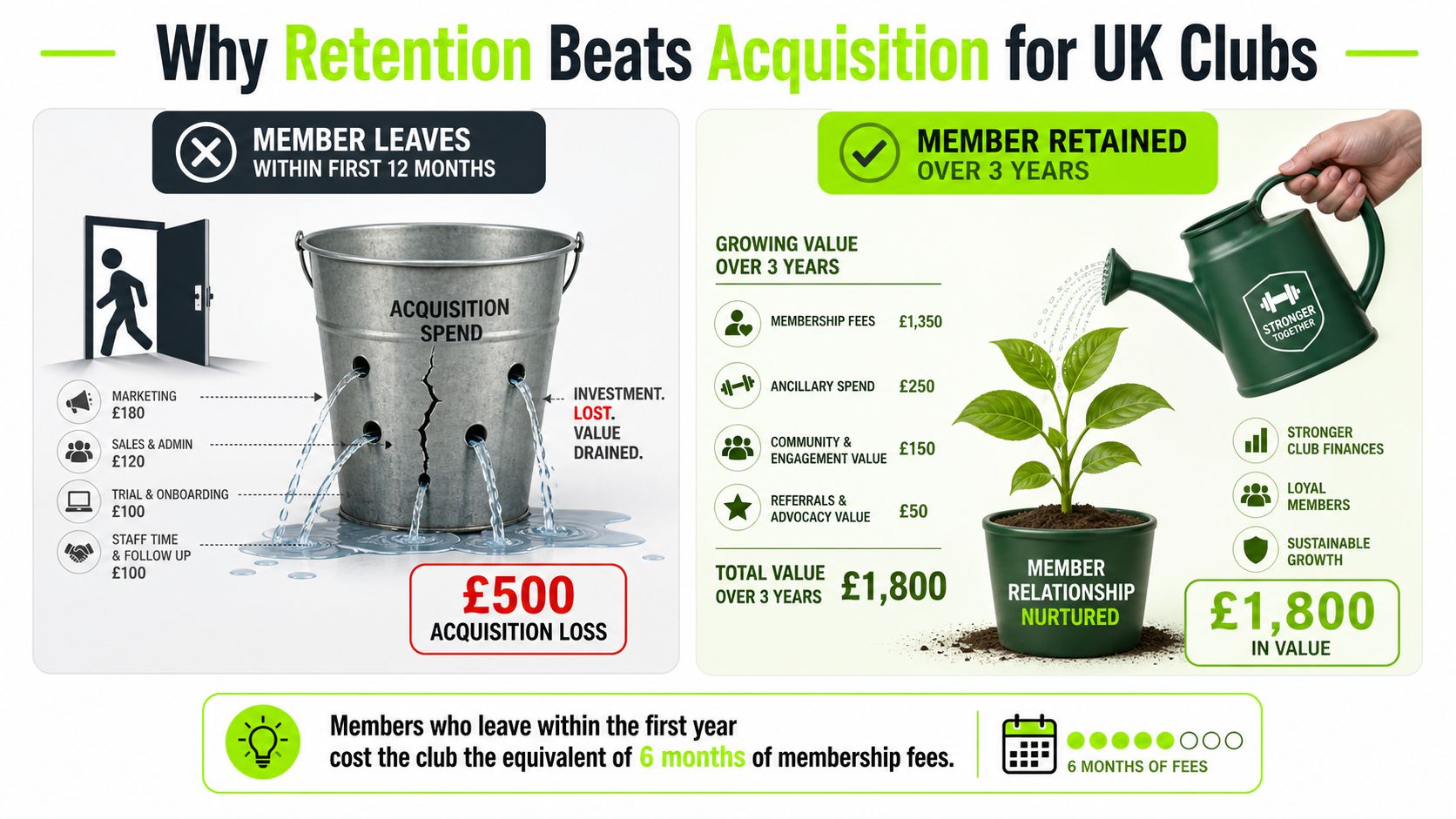
A club can increase enquiries, cut the joining fee, and still lose ground. If a new member leaves during the first year, the club may not recover its acquisition, administration, and onboarding effort. It also loses the ancillary spending that often develops once the member has built regular playing habits.
The UK figures show why enquiry volume is an incomplete growth measure. In 2023/24, 24% of members' clubs reported more leavers than joiners. Average joiners rose from 70 to 73, while average leavers increased from 48 to 56, according to the Hillier Hopkins Golf Clubs Report. More joining activity therefore did not guarantee a stronger member base.
Protect the first year before buying more demand
A 700-day cohort view makes the trade-off clearer. The club should identify whether new members reach their second renewal, not just whether they join. Enquiry handling, CRM visibility, and the speed-to-lead gap matter because a delayed response can leave the pipeline unmanaged before the first member experience has even begun.
Established clubs may already have demand from referrals, reputation, and limited supply. In the 2024/25 Hillier Hopkins survey, 53% of clubs had waiting lists, and an average of 21 members per club progressed from the waiting list to membership at the last renewal.[That evidence appears in the latest Hillier Hopkins golf-club survey.] A waiting list only creates value when records are accurate, follow-up is timely, expectations are realistic, and the move into membership is well managed.
Price-led acquisition can produce price-led churn. A discount may fill a vacancy, but it can reduce margin and encourage prospects to wait for the next offer. Retention work is less visible in the marketing report, yet course quality, playing access, communication, and hospitality influence renewal. Recent UK club research found that 90% of members said year-round course quality affects renewal, with conditioning rated the top factor at 55%, ahead of value for money and tee-time availability at 39% each, and price at 22%.[These findings are reported in the 2023/24 Hillier Hopkins report.]
Use proven retention tactics as prompts, then adapt them to golf operations. Review the GolfRep analysis of golf club churn rate to examine pipeline friction and early churn signals. The working measure is a member who renews and spends, not an enquiry that merely enters the CRM.
Practical Strategies That Lift Member Lifetime Value
The strongest CLV levers sit across the member journey, not inside one marketing channel. A club should improve the quality of the enquiry, activate the new member quickly, create relevant reasons to spend, and give staff a visible record of what happened.
Start with acquisition quality
Respond quickly. UK response-time research reports that leads contacted within 5 minutes are 2.6 times more likely to convert, while the average business reply time is 47 hours.[The figures come from UK CRM lead-response research.] A separate UK study found that nearly 10% of firms responded within 5 minutes and more than 46% responded within an hour, with the first-hour response identified as the practical standard.[See the UK lead-response study for that finding.]
The operational fix is simple, but it needs ownership. Every enquiry form should create a CRM record, assign a responsible person, send an immediate acknowledgement, and trigger a call task. Manual inbox checks won't provide dependable lead visibility.
Score the source. Track whether a lead came from a referral, waiting list, paid campaign, organic search, society event, or local partnership. The useful signal isn't just conversion to a tour. It's conversion to a member who renews and spends.
Make onboarding a retention system
A welcome email isn't an onboarding journey. New members need clear instructions, an introduction to playing partners, help with booking, and an early reason to return. A structured sequence should include personal contact, an invitation to an appropriate event, and checks for friction around access, tee times, payment, or playing confidence.
A buddy system can be particularly valuable for members who don't already have a network at the club. The CRM should record welcome completion, first visit, first competition, first lesson, and any unresolved service issue. Those signals help staff intervene before a quiet member becomes a leaver.
Increase value without defaulting to discounts
Relevant upgrades can raise average spend without damaging the price position. Consider family conversions, lesson packages, buggy hire, food-and-beverage bundles, simulator access, event packages, and society bookings. The offer should follow observed need, not arrive as an indiscriminate sales message.
For broader ideas on how to improve repeat purchase rates, translate repeat buying into repeat participation. A member who books a lesson, returns for a meal, and attends an event is displaying stronger engagement than one who only pays a subscription.
| CLV Lever | Tactical Action | Impact on Lifetime Value | CRM Signal to Track |
|---|---|---|---|
| Acquisition quality | Route every enquiry into one pipeline and respond promptly | Improves conversion quality before acquisition cost is wasted | Response time, source, contact attempts |
| Early activation | Use welcome calls, playing introductions, and scheduled check-ins | Builds visit frequency and lowers early churn risk | First visit, first booking, onboarding milestones |
| Ancillary spend | Offer relevant lessons, buggy hire, packages, and events | Increases revenue per active member | Offer viewed, booking, spend category |
| Retention nurture | Flag lapsed play and renewal risk | Protects tenure and future margin | Visit gap, renewal status, service issue |
| Segmentation | Separate age, source, category, and waiting-list cohorts | Prevents one-size-fits-all communication | Cohort CLV, engagement, conversion |
The GolfRep upsell strategy guidance can support this kind of planning. GolfRep combines lead generation with structured follow-up and CRM-enabled nurture, which means the club can see whether a tactic changed a pipeline stage, a visit pattern, a renewal, or a revenue line. Without that visibility, strategy becomes guesswork.
Measuring CLV and Tracking the Right KPIs
A usable CLV system starts with consistent definitions, not a complex predictive model. Begin with annual revenue per member, gross margin, retention by membership year, ancillary spend by category, and acquisition cost. These measures connect commercial performance with the operational causes behind it.
Build the first dataset by joining member details, payment records, and tee bookings. Add lessons, food and beverage, retail, events, and buggy activity where those systems provide data. An imperfect first version can still show which member groups renew, which spend beyond subscriptions, and where missing records limit decision-making.
Use cohorts instead of one blended average
Group members by joining year and follow each cohort through activation, renewal, and spend. A cohort view should show performance across 36, 60, and 120 months, rather than compressing every member into one tenure average. It exposes early churn and stops long-standing members from hiding weak performance among recent joiners.
Use the same view to follow the path from first enquiry to join, then from join to activation and renewal. A strong enquiry-to-join rate can still produce weak CLV if the source brings in members who leave quickly. A smaller source may create more value when its members stay longer and use more of the club.
The LTV:CAC benchmark of at least 3:1 is a useful starting point for assessing acquisition economics. A private club, resort, and pay-and-play operator face different margins, capacity limits, costs, and retention patterns. Each should therefore set its own cohort baseline instead of copying another operator's target.
| KPI | Definition | What It Tells You | Source Data |
|---|---|---|---|
| Retention by tenure | Renewal rate at each membership stage | Where churn concentrates | Membership and renewal records |
| Revenue per member | Total member revenue divided by active members | The value of the average relationship | Payments, tills, bookings |
| Ancillary spend per head | Additional spend divided by active members | Whether members use the wider offer | F&B, retail, lessons, buggy and event systems |
| Referral rate | New members linked to existing-member referrals | The quality of member advocacy | Enquiry source and referral fields |
| Enquiry-to-join conversion | Members divided by qualified enquiries | How well the pipeline converts demand | Enquiry and membership records |
Add one operational measure that CLV reports often miss: speed to lead. Record the time from enquiry to first response, alongside contact attempts, appointment outcomes, and the eventual membership result. GolfRep sees this gap regularly across UK club pipelines. A marketing source can appear weak when the underlying issue is delayed follow-up or poor CRM visibility.
A club without a CRM can produce a workable baseline in week one by reconciling these records in one spreadsheet. The priority is repeatability. Assign ownership for updating the figures, then review movement by cohort rather than rebuilding a report from scattered systems each month.
For a wider view of KPIs that drive real estate deals, the relevant lesson is that activity matters only when it connects to an outcome. Golf clubs should also review GolfRep's analysis of golf club marketing ROI and assess campaigns by member revenue, retention, response speed, and pipeline quality, not impressions alone.
A Short Action Checklist for Your Growth System
Use this as a working agenda for the next committee or management meeting. Each action should have an owner, a date, and one measurable outcome.
Capture every enquiry in one place. Fix the enquiry form, remove gaps in source tracking, and route every new record into the CRM within 5 minutes. This serves enquiry capture and speed-to-lead, while moving response time and enquiry-to-join conversion.
Build a 90-day onboarding journey. Set defined touchpoints at days 7, 30, 60, and 90. Include a welcome call, playing support, a relevant club invitation, and a check for unresolved friction. This serves onboarding and should improve activation, visits, and early retention.
Calculate a CLV baseline. Use the last 24 months of member data, combining subscriptions, ancillary spend, gross margin, tenure, and acquisition cost. This gives the CRM visibility pillar a starting point and exposes missing data.
Set a 12-month retention target. Identify the top two churn drivers, such as weak onboarding, poor booking access, course conditioning, or limited social connection. This serves retention and gives the committee a specific service agenda.
Introduce one ancillary revenue mechanic. Test buggy hire, a simulator bay, an F&B minimum, or society packages. Track average spend per active member and protect margin rather than relying on blanket discounts.
Review LTV:CAC monthly. Compare member value with marketing spend and separate results by lead source. This helps acquisition decisions reflect downstream economics.
Hold a quarterly cohort review. Compare joining-year cohorts across renewal, visits, ancillary spend, and service issues. Use the results to update onboarding, follow-up, and budget allocation.
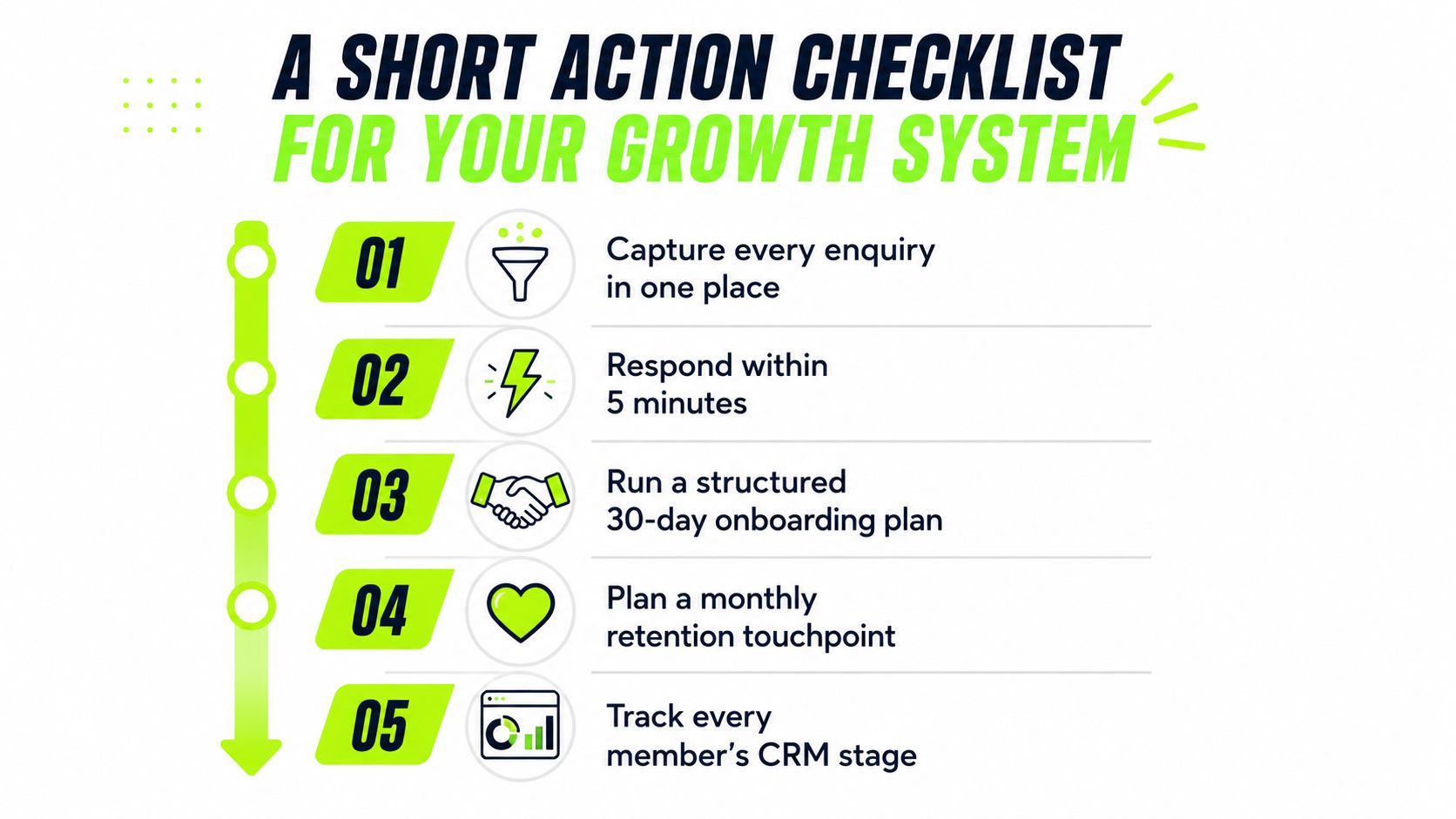
Good looks like a pipeline where every enquiry is visible, every response is prompt, every new member is activated, and every renewal decision is connected to real cohort value.
GolfRep helps UK golf clubs connect lead generation with speed-to-lead follow-up, structured onboarding, and CRM visibility, so customer lifetime value becomes an operating measure rather than a year-end estimate. Visit GolfRep to discuss how your club can build a more predictable pipeline from first enquiry through recurring member revenue.
Ready to tap into our proven growth system?