What Is Market Segmentation for UK Golf Clubs?

Most advice on what is market segmentation starts in the wrong place. It starts with audience theory, customer avatars, or broad marketing models. For a golf club, that's backwards.
The issue usually isn't a lack of interest. It's that enquiries arrive from different types of golfers, through different channels, and then get handled in the same clumsy way. A generic reply goes out late, or no one knows who should call, or the prospect gets one brochure and then silence. Segmentation matters because it helps a club decide who this person is, what they care about, and what should happen next.
For GolfRep, segmentation isn't a branding exercise. It's a practical way to build a predictable membership pipeline by making follow-up more relevant, faster, and easier to manage.
The Real Reason Your Membership Enquiries Fizzle Out
A lot of clubs say they need more leads when what they really need is a better way to handle the leads already coming in.
The pattern is familiar. One enquiry comes in through the website. Another arrives by email. A third comes from a Facebook campaign. Someone at reception takes a note. Someone else promises to follow up tomorrow. Then the week gets busy, a committee meeting takes over, and several warm prospects go cold without any real conversation.
That isn't a traffic problem. It's an operations problem.
According to Product Marketing Alliance's analysis of market segmentation and lead response mechanics, 60 per cent of potential members who make an initial enquiry to a private club will not proceed if they receive no response within 24 hours. For many clubs, that single fact should change the whole conversation.
More enquiries won't fix weak follow-up
If a club generates interest but can't see, sort, and respond to that interest properly, increasing marketing spend often just creates a larger mess.
Practical rule: If your team can't tell you who enquired yesterday, what type of prospect they are, and what happens next, your problem isn't lead generation.
This is why form quality matters as much as traffic quality. If you want a useful primer on how to build better lead capture forms, that's worth reviewing because a form should do more than collect a name and email. It should help your club identify intent from the start.
A prospect asking about flexible membership is not the same as a retiree looking for weekday golf and social events. Treating them the same creates friction immediately.
Segmentation starts before the first call
Good segmentation begins at the point of enquiry. The form, the CRM, the tags, and the follow-up process should work together so the club knows what kind of lead has arrived and how to respond.
That's also why so many clubs leak demand without realising it. This breakdown is covered in GolfRep's view on how most golf clubs lose 30% of enquiries without realising. The leak is rarely dramatic. It's usually small delays, weak visibility, and generic follow-up repeated over and over.
What Market Segmentation Really Means for Your Club
At club level, market segmentation means dividing potential members into smaller groups based on shared traits, then adjusting your message, offer, and follow-up to suit each group.
That sounds obvious because it is. Yet many clubs still market as if every golfer wants the same thing for the same reason.
A useful comparison is the club professional on the practice ground. You wouldn't give the same swing advice to a complete beginner, a steady mid-handicap member, and a scratch player. The instruction has to fit the golfer in front of you. Marketing works the same way.
Relevance beats generic messaging
A generic membership pitch usually sounds tidy but lands weakly. It tries to speak to everyone, so it doesn't feel specific to anyone.
Segmentation fixes that. It helps a club answer practical questions like:
- Who is this for: A local family, a commuter, a lapsed golfer, or a retiree with time for midweek play?
- What do they value: Convenience, status, competition, coaching, social connection, or flexibility?
- What should they hear first: Course quality, community, tee-time access, practice facilities, business networking, or beginner support?
The point of segmentation isn't to complicate marketing. It's to stop your club sending the same message to people with different reasons for joining.
This isn't a new idea
Segmentation isn't a trend imported from software companies. It has a long track record in UK business. The formalisation of market segmentation began in the UK in 1956. By 1978, a study found that 65% of UK private member clubs had adopted demographic segmentation to optimise membership pricing, leading to a documented 22% increase in membership uptake across the sector between 1978 and 1985.
That history matters because it shows segmentation has never been about jargon. It has always been about making commercial decisions with more precision.
For golf clubs, the basic principle still holds. Stop treating the whole local market as one audience. Start treating it as several distinct groups with different motivations, objections, and timelines.
Four Ways to Understand Your Potential Members
The four classic ways to segment a market are still useful for golf clubs because they map directly to how people choose where to play and whether to join.
Used properly, they help a club move from “we want more members” to “we know which members we want, why they're likely to join, and how to speak to them”.
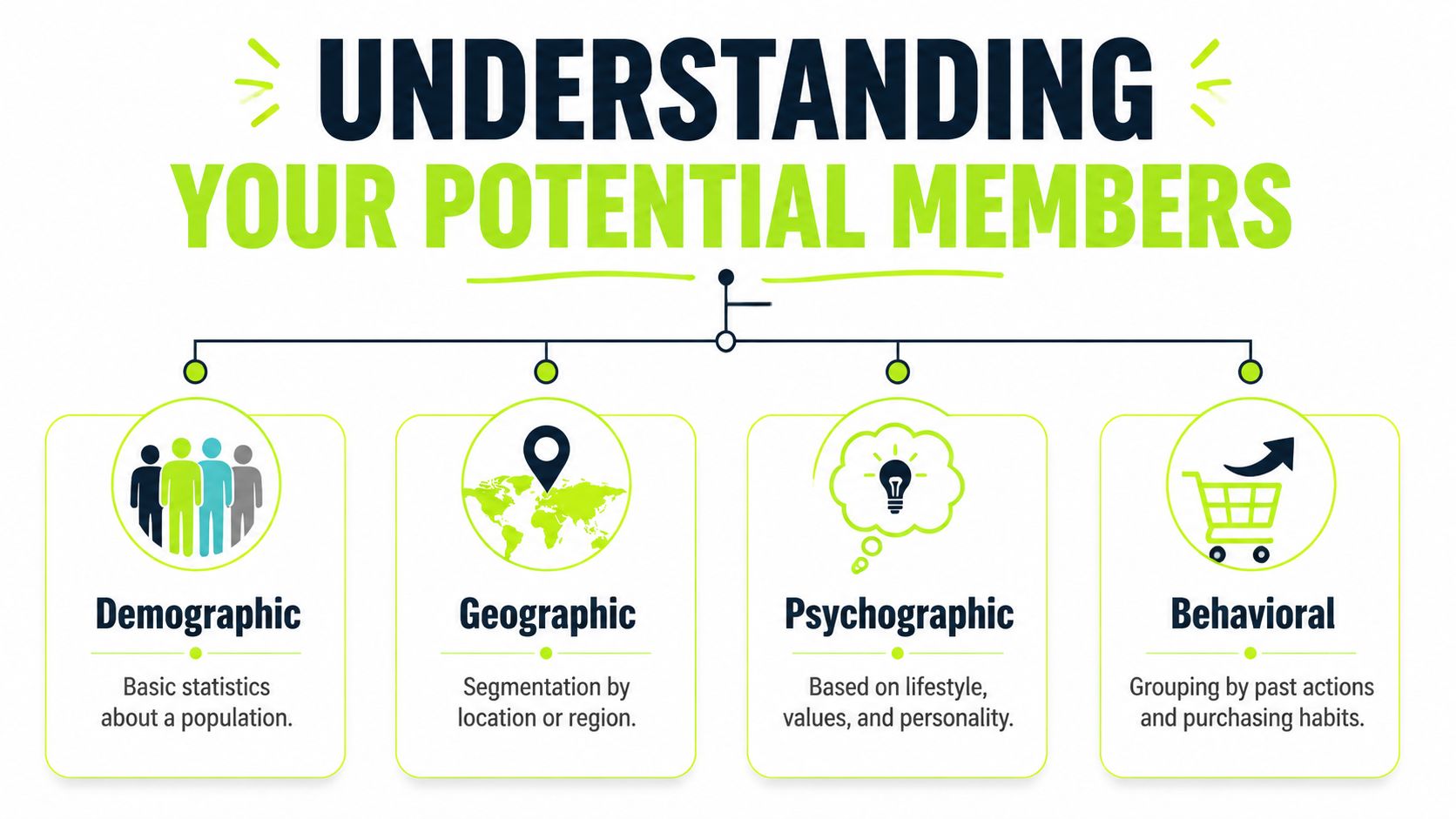
Demographic and geographic signals
Demographic segmentation looks at who the person is in broad terms. For a club, that might include age, life stage, household profile, or likely spending power. Junior players, younger professionals, family households, and older members often want different membership structures and respond to different language.
Geographic segmentation looks at where they live or work. That matters more than many clubs think. A prospect who lives five minutes away has different needs from someone who commutes from a nearby town and wants weekday twilight access. A resort operator may also need to separate local membership prospects from destination or corporate audiences.
These two categories are useful, but they only tell part of the story.
Psychographic and behavioural clues
Psychographic segmentation is about mindset. Why does this golfer want to join? Some prospects want competitive golf and handicap progression. Some want a social circle. Some want a family leisure habit. Others want a club that fits their sense of status, routine, or community.
Behavioural segmentation looks at what they do. Have they clicked the membership page several times, downloaded a brochure, booked a visitor round, abandoned an enquiry form, or stopped engaging after the first reply? Behaviour is often the clearest signal of intent.
A club that uses only age or postcode will miss the difference between two people who look similar on paper but want completely different experiences.
Why the combined view matters
The strongest segmentation combines all four. A younger professional in an affluent area might still behave like a casual player and only engage with flexible access options. A retired golfer might care less about price than about belonging, regular competitions, and social integration.
That's why multi-variable segmentation works better in practice. According to a 2023 report, UK-based golf clubs and resort operators that adopt multi-variable segmentation achieve a 35% average increase in lead-to-member conversion rates compared to non-segmented competitors.
A simple way to think about it is this:
| Segmentation type | What it tells you | Golf club example |
|---|---|---|
| Demographic | Who they are | Intermediate-age prospect, family household, retiree |
| Geographic | Where they are | Lives locally, works nearby, travels in from a commuter route |
| Psychographic | Why they care | Wants prestige, friendship, competition, flexibility |
| Behavioural | What they do | Opened emails, booked a round, clicked pricing, stopped responding |
The mistake isn't using one type of segmentation. The mistake is stopping there.
A Five-Step Process for Segmenting Your Market
Most clubs don't need a huge database to start segmenting properly. They need a disciplined process and a willingness to use the information they already have.
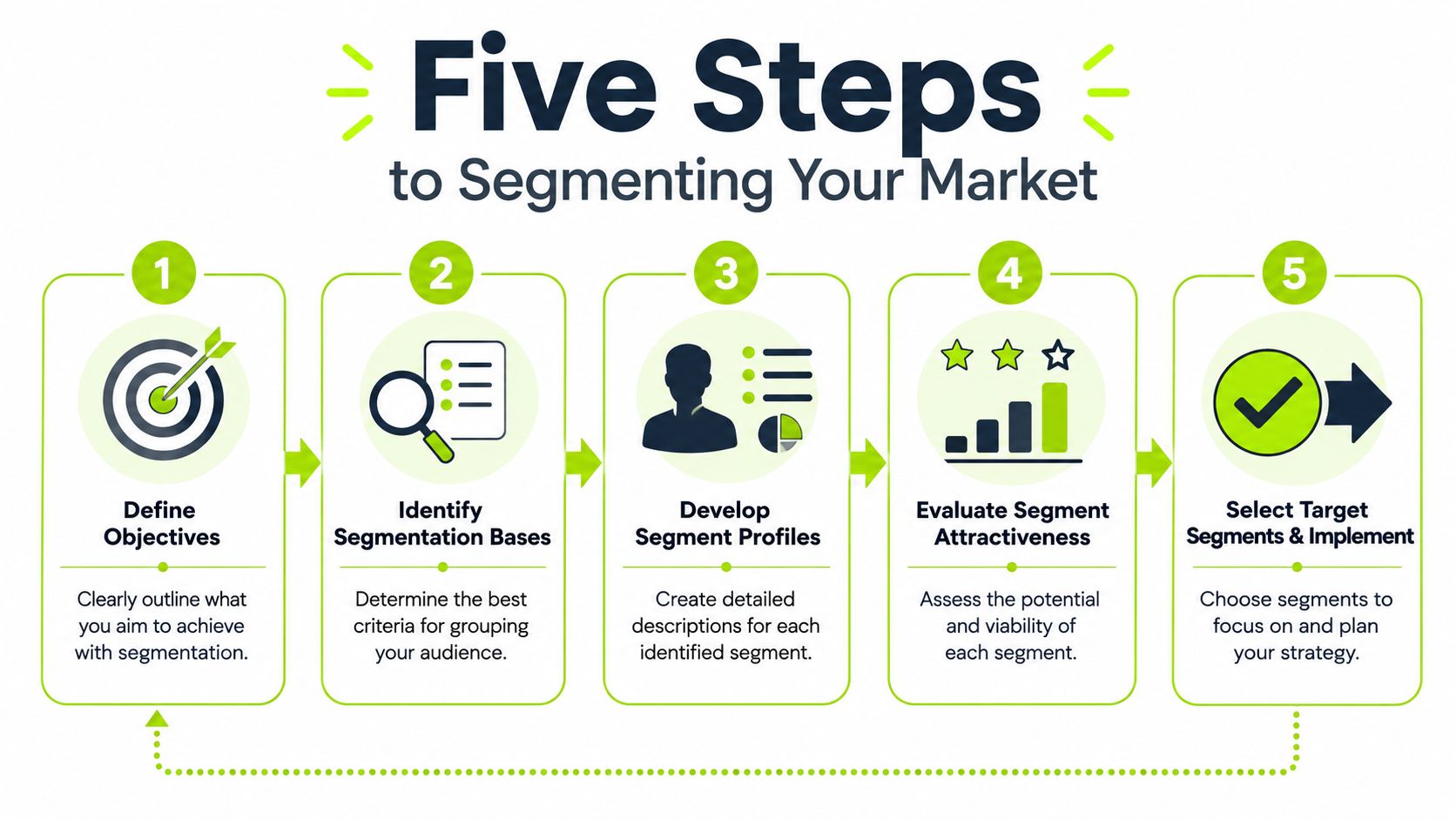
Start with the business goal
Segmentation only works if it connects to a decision.
A club might want to fill weekday tee sheets, increase female membership, improve conversion from visitor to member, or attract more local families. Each goal points to different segments and different follow-up priorities.
If the objective isn't clear, the segmentation won't be useful.
Use the data you already have
Most clubs already hold more insight than they think. Look at:
- Enquiry forms: What are people asking about?
- Visitor bookings: Who is playing before joining?
- Membership categories: Which groups stay, upgrade, or lapse?
- Staff observations: What objections come up repeatedly on calls and tours?
- Simple surveys: Why did members join, and what nearly stopped them?
You do not need a perfect data set to begin. Even basic patterns can reveal strong segments.
Group similar people together
Once you have the information, look for clusters.
Some clubs find a clear segment of busy professionals who respond well to convenience and fast digital follow-up. Others see a group of return-to-golf prospects who need reassurance, coaching, and a less intimidating joining path. Another club may find that many serious prospects are really buying into the social side, not just the course.
Working rule: If two prospects need different messages, different timing, or different next steps, they should probably sit in different segments.
Turn segments into usable personas
A segment becomes practical when staff can recognise it quickly. Give each one a name and a short description. That helps reception, managers, and marketing teams stay aligned.
For example:
The flexible commuter
Works full-time, wants convenient access, values speed and clear options.The social retiree
Has time to play, wants community, events, and regular midweek rhythm.The family starter
Interested in a wider lifestyle decision, not just golf alone.The competitive improver
Cares about handicap progress, competitions, coaching, and practice facilities.
Match each segment to action
Many clubs often stop too early. They define the segments, then do nothing operationally with them.
Each segment should have its own:
- First response: What does the first email or call say?
- Tour approach: What parts of the club should be emphasised?
- Membership route: Which package or pathway fits best?
- Nurture flow: What happens if they don't decide immediately?
- Retention plan: What signs suggest they may drift later?
The point isn't to create complexity. It's to make each prospect feel the club understands why they're there.
Market Segmentation Examples in a Golf Club Setting
Segmentation gets useful when you can see it in real people, not just categories on a spreadsheet.
A practical club approach is to build a small set of personas that reflect common membership journeys. These don't need to be elaborate. They need to be recognisable enough that your team can tailor communication without guessing.
Two members, two very different buying decisions
Chloe, the weekday professional is in her early career to mid-career stage. She likes the idea of membership, but she's balancing work, family, and limited time. She wants quality, convenience, and a club that feels well run. She may care about networking, but she won't tolerate slow admin or vague pricing.
David, the active retiree has time to play and wants a regular rhythm. He's interested in competitions, social events, familiar faces, and a club environment where he feels part of something. He may value tradition, but he still expects straightforward communication.
Here's how those personas differ in practice.
| Attribute | Persona 1: The Weekday Professional | Persona 2: The Active Retiree |
|---|---|---|
| Main motivation | Flexible golf that fits around work | Regular play and strong club community |
| Likely concern | Time commitment and membership fit | Whether the club feels welcoming and social |
| Best first message | Clear options, access flexibility, smooth joining process | Community, competitions, midweek play, social life |
| Best follow-up style | Fast email and call sequence with simple next step | Personal call, invitation to visit, warm introduction |
| Tour focus | Time-saving access, course quality, facilities | Member atmosphere, clubhouse life, regular playing opportunities |
Retention needs segmentation too
Most clubs use segmentation for acquisition and ignore retention. That's a mistake.
A 2024 study found that clubs targeting segments with hybrid behavioural-psychographic data such as high-frequency players who feel no community bond, and using specific nurture flows, saw a 45% increase in renewal rates within one year.
That insight matters because not every at-risk member looks inactive. Some play often but still don't feel connected. If a club only tracks rounds played, it may miss the member who is using the course but internally deciding not to renew.
A retention segment can be more valuable than an acquisition segment because the club already has the relationship. What's missing is usually relevance, not awareness.
If your team is reviewing ways of optimizing audience segmentation, it helps to think beyond ads and look at onboarding, member communication, event invitations, and renewal triggers. That's where many clubs leave value on the table.
Putting Your Segments into Action with a CRM
Segmentation on paper is useful. Segmentation inside a CRM is where it starts affecting revenue.
A lot of clubs still manage enquiries in inboxes, notebooks, or spreadsheets. The problem isn't just organisation. It's that manual systems don't give the team a reliable way to tag leads, trigger the right follow-up, or see where the pipeline breaks.
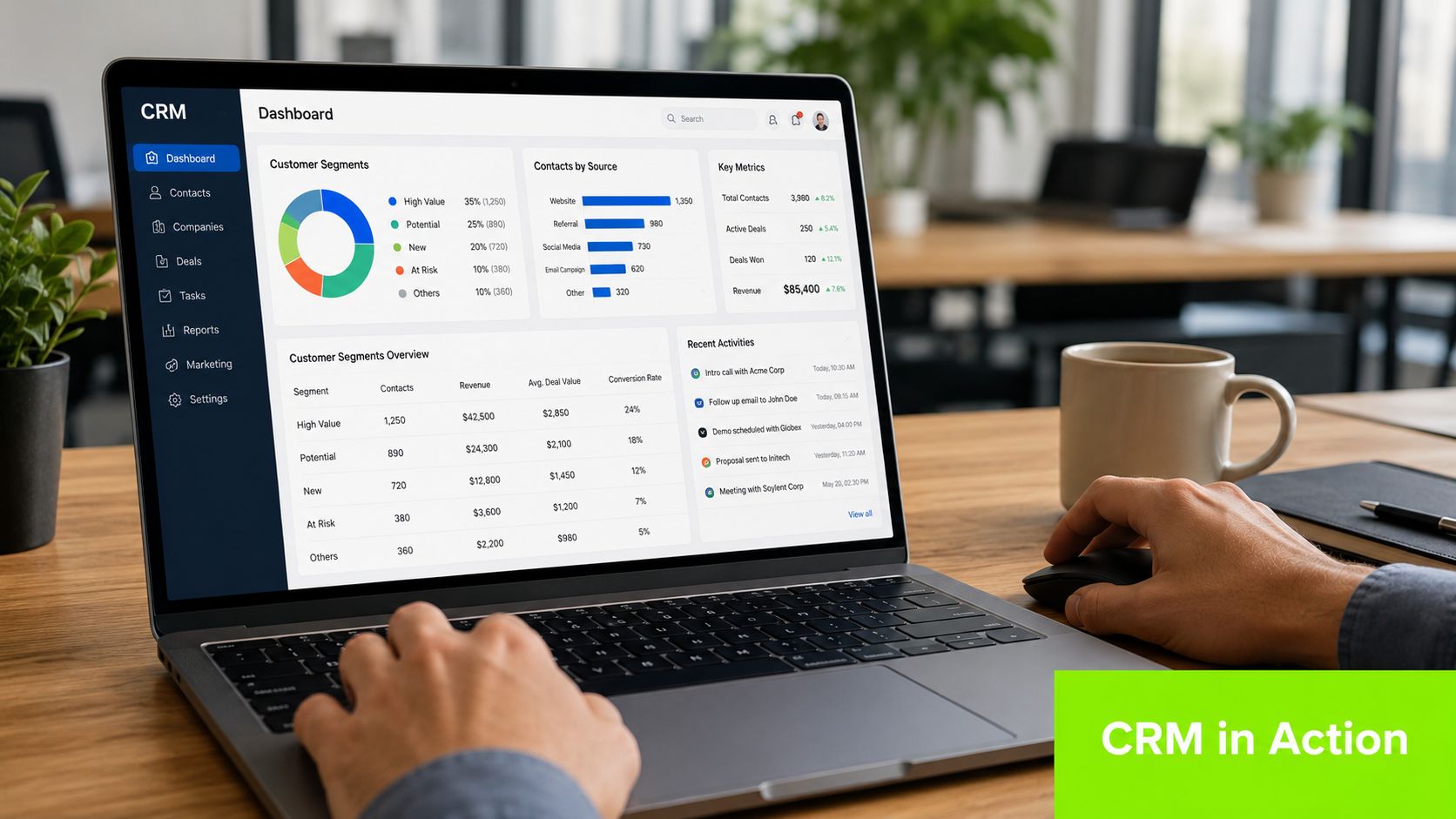
According to Fitchburg State University's guide to understanding market segmentation, many UK golf clubs still rely on manual spreadsheets for tracking enquiries, leading to a 30 to 40 per cent loss in potential conversion due to missed follow-ups and lack of pipeline visibility, which a digital CRM system solves.
What a CRM changes in practice
A proper CRM lets the club do four things that spreadsheets usually don't handle well:
- Tag the lead correctly: Family prospect, flexible membership interest, lapsed golfer, corporate enquiry, retiree, visitor upgrade.
- Automate the next step: Immediate acknowledgement, task assignment, reminder sequence, tour invitation, or reactivation message.
- Track movement through the pipeline: Enquiry received, contact made, visit booked, proposal sent, membership started.
- Measure segment performance: Which groups convert, stall, renew, or disappear.
Segmentation without execution becomes theory. A club may know that one prospect values community while another values flexibility, but if both receive the same delayed email, that insight has no operational value.
Systems beat memory
Clubs often rely on a few capable people who “know the members” and “keep an eye on enquiries”. That works until holidays, staff changes, or busy periods expose the fragility of the process.
Operational insight: If follow-up depends on memory, it will be inconsistent. If it lives in a system, it can be improved.
Tools differ, but the principle is the same. The CRM should become the single place where lead source, segment, response time, next action, and outcome all sit together. GolfRep builds this kind of structure into its growth system, and clubs can also apply the same principle with other CRM setups if they are configured properly. A useful starting point is getting the database itself in order, which is why many clubs first need a clearer golf club database before they try to automate anything.
How to Measure Success and Avoid Common Pitfalls
Once segmentation is live, the key question is simple. Is it helping the club convert and retain the right members more reliably?
Lead volume on its own won't answer that. Better measures are tied to movement and outcomes.
What to track
Look at performance by segment, not just in total.
- Lead-to-visit rate: Which segments book a tour or trial step?
- Visit-to-member rate: Which segments convert after seeing the club?
- Response speed: Are some segments waiting too long for a proper reply?
- Renewal pattern: Which member groups stay, drift, or need intervention?
- Revenue quality: Which segments support stronger long-term value without discount pressure?
If your team uses connected systems for communication and sales follow-up, guides such as Sight AI's HubSpot Teams guide can be useful for improving internal responsiveness and handover discipline.
Mistakes that weaken segmentation
The most common problems aren't technical. They're practical.
- Segments that are too broad: “Adults 30 to 60” is not a meaningful audience.
- Segments that are too narrow: Tiny categories create work without enough return.
- No difference in follow-up: If every segment gets the same message, the exercise is wasted.
- No owner for the process: Someone has to review the pipeline and act on what the data shows.
- No commercial lens: Segmentation should support profitable, sustainable growth, not just more activity.
GolfRep's perspective is that segmentation only proves its worth when the club can connect it to booked visits, joined members, retained members, and clearer operational decisions. That's also the lens worth applying when reviewing the real ROI of golf club marketing.
GolfRep helps UK golf clubs turn segmentation into a working growth system, combining lead generation, CRM structure, follow-up automation, and conversion tracking so enquiries don't sit idle and good prospects don't disappear. If your club wants a more predictable membership pipeline, you can learn more at GolfRep.
Ready to tap into our proven growth system?