Golf Club Growth Agency: What Clubs Need to Know

Most clubs don't need another campaign. They need a cleaner way to handle the enquiries they already have. In the UK, that distinction matters more than ever, because England Golf reported 750,071 club members in 2025, up from 730,602 in 2024, yet many clubs still lose prospects in the gap between first contact and first meaningful follow-up, not at the point of awareness England Golf membership data.
A serious Golf club growth agency doesn't just buy clicks or post content. It builds the machinery that turns interest into booked visits, joined members, and visible pipeline. If your club is still judging growth by enquiries alone, you're looking in the wrong place.
Why Most Golf Clubs Struggle to Convert Enquiries
The common assumption is that clubs need more leads. In practice, many already have enough interest coming in. The problem is slower, uneven handling once an enquiry lands. UK clubs take an average of 47 hours and 32 minutes to respond to membership enquiries, which gives a serious prospect time to compare other options, lose momentum, or stop replying Golf club CRM response timing.
Where enquiries actually disappear
Leakage usually does not happen on the advert. It happens after the form submission, after the missed call, and after the voicemail that never gets a return. Chasing more Facebook traffic can make activity look healthy while the actual pipeline stays flat.
Practical rule: if the first human reply arrives late, your campaign is competing with the prospect's next option, not with silence.
The funnel works like this:
| Funnel Stage | Average UK Club | Top Quartile |
|---|---|---|
| Initial enquiry captured | Captured, but often sits in inboxes or shared mailboxes | Captured and routed immediately |
| First meaningful response | Often delayed, sometimes by days | Fast enough to keep intent warm |
| Follow-up after missed contact | Inconsistent or manual | Automated and persistent |
| Tour or visit booked | Dependent on staff memory | Triggered by a defined process |
For a wider view of how clubs improve response discipline and message timing, the Heyline industry insights section is useful for comparing operational patterns.
The bigger point is simple. Growth breaks when the club treats enquiry handling as admin instead of revenue work.
Clubs that win in this market do not just generate more leads. They shorten the time between a golfer raising their hand and a member of staff doing something useful with that signal. That is an operations problem first, and a marketing problem second.
What a Golf Club Growth Agency Actually Does
A proper Golf club growth agency is a specialist partner that builds and runs the membership acquisition system from enquiry capture through to conversion tracking. The work reaches beyond ads and social posts. It includes enquiry handling, CRM structure, automated follow-up, and reporting, so the club can see where interest turns into visits and where it stalls.
The division of responsibility
The club brings the product, member experience, and local context. The agency brings pipeline design, follow-up machinery, and clear visibility at each stage. That split matters because growth fails when the handover is vague and everyone assumes someone else is dealing with the enquiry.
A club should expect recurring work, not one-off activity. That usually means monthly enquiry reporting, clear pipeline forecasts, and quarterly strategy reviews tied back to membership targets and category mix. PR, branding, and content can support that work, but they are not the core.
A good agency also separates traffic from conversion. A campaign can create attention without creating joiners. A growth partner examines what happens after the click, after the call, and after the visit booking.
What the club should buy
The deliverable is a working system with ownership attached to each stage. If a web form lands in a shared inbox and nobody knows who replies first, the club has not bought a growth system. It has bought a problem with a fresh coat of paint.
Good growth work makes the next action visible, named, and timed.
That visibility is what committees need. It shows whether the issue is lead quality, response speed, tour attendance, or follow-up. Without that, every meeting turns into opinion rather than evidence.
GolfRep sits in that category. It combines lead generation with CRM-led follow-up and conversion tracking for golf clubs, so the club can see how enquiries move rather than guess where they have gone. That is very different from outsourcing social media management and hoping the inbox takes care of itself.
Inside the Growth System
The strongest clubs don't treat acquisition as one activity. They treat it as a chain of connected stages, and each stage has to work before the next one can do its job. That's the logic behind a structured Growth System.
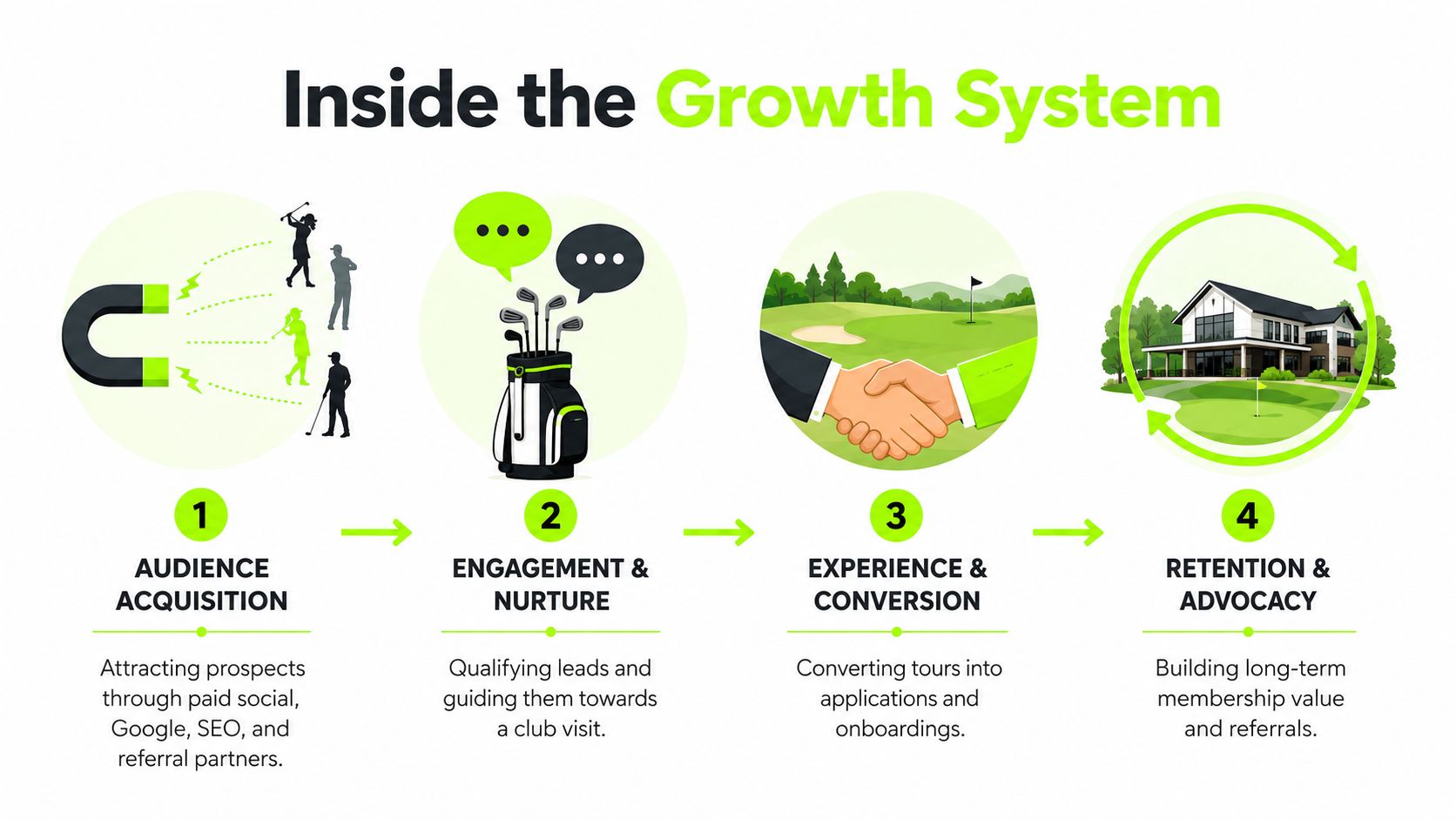
Stage 1 audience acquisition
Paid social, Google, SEO, and referral partners come in. The mistake clubs make is treating all traffic as equal. A person searching for a club membership in the catchment is a different prospect from someone casually seeing a post in their feed.
The channel mix should reflect membership categories, local demand, and the club's pricing position. A club doesn't need abstract reach. It needs golfers who are plausibly interested in joining or visiting.
Stage 2 qualification and first response
The system begins to separate browsers from genuine prospects. Good forms, behavioural signals, and instant acknowledgements reduce the amount of manual sorting staff have to do. If someone enquires and hears nothing for hours, the intent window starts closing immediately.
The first reply should feel like an invitation to continue, not a receipt that disappears into a queue.
For clubs comparing automation approaches, optimizing lead capture with SupportGPT is a useful external reference point for how fast acknowledgement and structured routing can be designed. The key point is not the tool name. It's the discipline of never leaving an enquiry in limbo.
Stage 3 CRM nurture and booking
Once a lead is qualified, the job changes from capture to progression. That usually means a defined sequence of touchpoints that leads towards a taster round, visit, or consultation. The club's team still handles conversations, but the CRM keeps the sequence moving.
Stage 4 tracking and optimisation
This stage is where the whole system becomes accountable. Cost per enquiry, cost per taster, and cost per new member tell you far more than channel vanity metrics. They also reveal where the process is weak, whether that's source quality, response timing, or follow-up discipline.
For clubs wanting the operating layer behind this approach, the workflow described in the GolfRep CRM system overview shows how the stages connect in practice. The important thing is that each stage feeds the next, and someone owns the handoff every time.
CRM Pipeline Mechanics That Replace Spreadsheets
Spreadsheets are fine for note-taking. They're poor at running a live acquisition process. Once the lead volume grows, or even when a committee wants visibility, a proper CRM pipeline becomes the operating layer underneath the whole system.
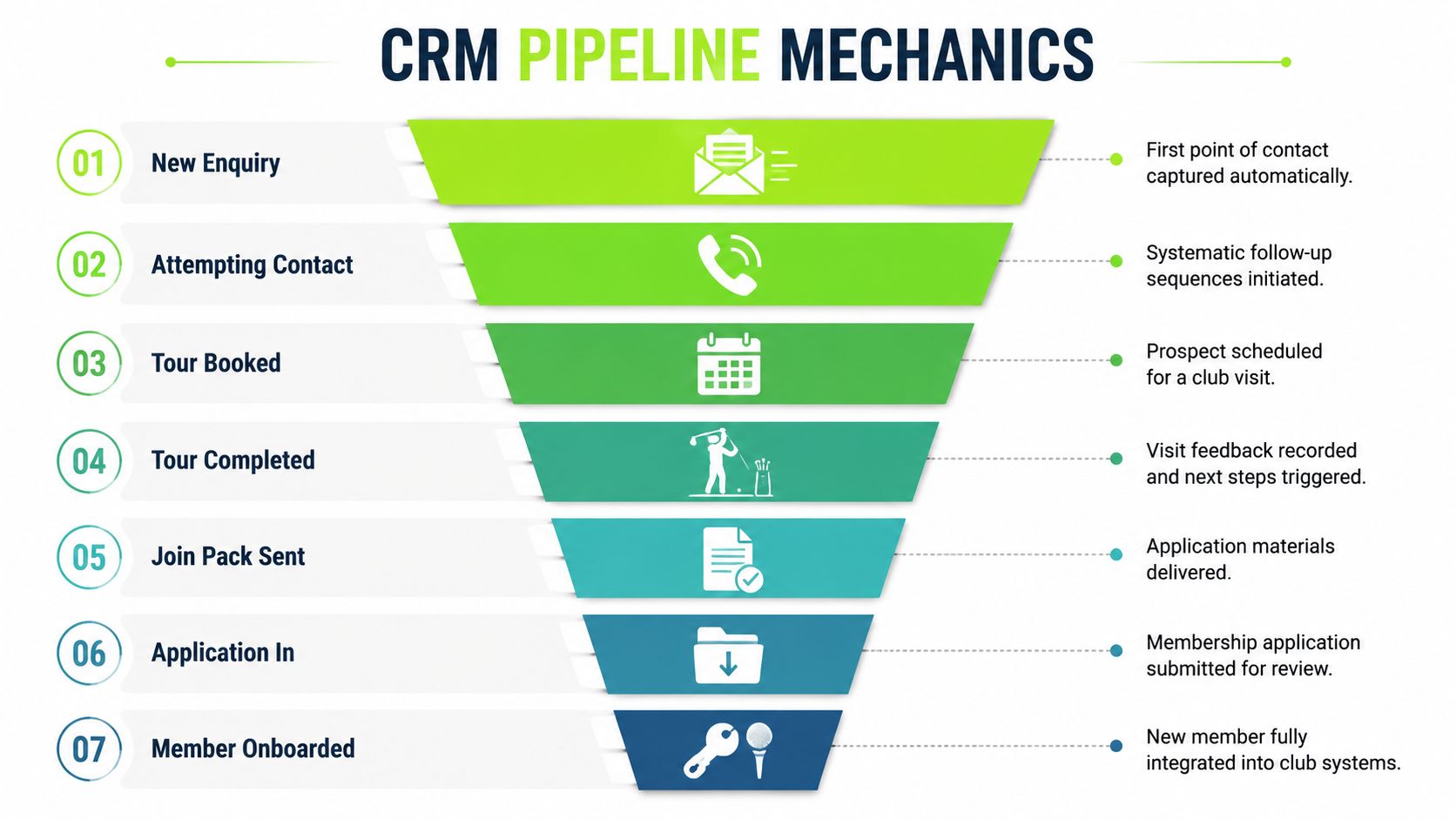
The visible stages that matter
A working pipeline usually includes New Enquiry, Attempting Contact, Tour Booked, Tour Completed, Join Pack Sent, Application In, and Member Onboarded. Those names matter because they give the committee a shared language for where every prospect sits.
The point is not to create more admin. It's to make lead ownership obvious. If the enquiry is at Attempting Contact, everyone knows who owns the next move. If it's Tour Booked, the next task is different. If it's stalled, the CRM should show that too.
The automation that protects response time
Good systems trigger an instant SMS or email acknowledgement within minutes, not whenever someone has time. If the call is missed, an auto-textback can follow. If the prospect goes quiet, a 24-hour sequence keeps the thread alive without forcing staff to remember every chase.
That kind of process is especially useful for clubs that can't rely on one person watching an inbox all day. It also reduces the awkwardness of manual chasing, because the system does the repetitive work and the staff step in for the meaningful parts.
A practical CRM should also support reactivation. Stalled enquiries aren't dead until they've been properly nurtured or marked lost. That distinction changes the committee conversation from “did marketing work?” to “where did the pipeline slow down?”.
Why committees need live visibility
Once source attribution and owner assignment are in place, the committee can see a forecast instead of a weekly guess. That makes planning much better. It also stops debates about whether leads “looked good” and replaces them with evidence about where the funnel is leaking.
For clubs looking at systems and tooling together, the same principle applies across the stack, whether the setup is built in-house or with a partner. The CRM is not a side tool the marketing team checks occasionally. It is the record of whether the club is converting demand into members.
Measurable Outcomes and UK Case Study Highlights
Clubs should ask for outcomes they can verify in club terms. New members signed, revenue recovered, response time improved, and conversion lifted are the measures that matter. Systems beat slogans here.
What measurable looks like in practice
One Surrey club moved from 14 to 47 new members in nine months. A Yorkshire club recovered £78,000 in lost revenue through structured reactivation. A Hampshire club cut enquiry-to-tour response time from 51 hours to under 90 minutes. A Midlands club lifted trial-to-conversion from 18% to 34%. GolfRep's January and February sales uplift is another example of how clubs should inspect the system behind the headline.
These outcomes point to the same commercial lesson. The club did not need louder marketing. It needed a better enquiry process, quicker follow-up, and clearer conversion control.
A useful way to read case studies
The club name matters less than the mechanism behind the result. Faster response drives a different result from better qualification or reactivation, and committees need that distinction spelled out. If a partner cannot explain what changed in the process, the case study is only decoration.
| Club | System Change | Measurable Result |
|---|---|---|
| Surrey club | Stronger acquisition and follow-up alignment | 14 to 47 new members in nine months |
| Yorkshire club | Structured reactivation | £78,000 in lost revenue recovered |
| Hampshire club | Faster enquiry handling | Response time cut from 51 hours to under 90 minutes |
| Midlands club | Improved qualification and nurture | Trial-to-conversion lifted from 18% to 34% |
A result in one part of the revenue mix does not automatically transfer to another. A visitor campaign and a membership campaign can use similar mechanics, but the offer, timing, and follow-up have to match the commercial goal. Clubs that treat every enquiry the same usually miss the uplift hiding in the pipeline.
How to Evaluate a Golf Club Growth Partner
A credible partner should be tested like a commercial operator, not admired like a creative vendor. The best way to evaluate a Golf club growth agency is to ask whether it can prove it understands club economics, enquiry handling, and follow-up discipline.
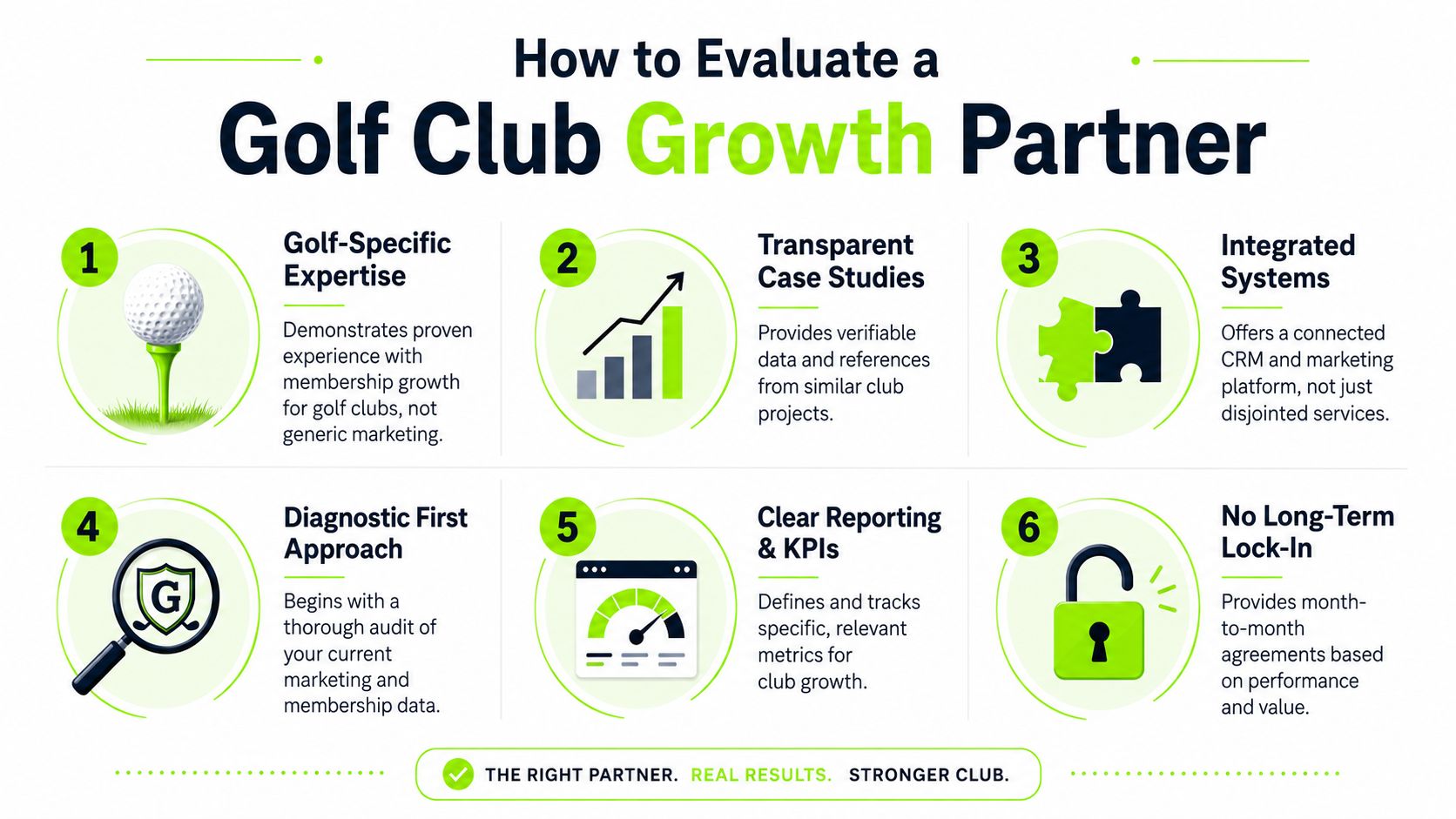
The criteria that matter
Look for golf-specific expertise, not generic lead generation. Ask for transparent case studies with named venues and real results. Check whether the partner builds the CRM and workflow itself, rather than licensing a separate tool and handing you the login.
A serious partner should also start with a diagnostic review of your current handling process. If they want to pitch media spend before they understand how your enquiries are managed, that's a warning sign.
Ten questions committees should ask
- How fast do enquiries get an acknowledged reply?
- Who owns the first follow-up task?
- What does your reporting show beyond clicks and impressions?
- Can you show named golf-club case studies with outcomes?
- Do you build the CRM pipeline or just plug into ours?
- Who owns the data if we leave?
- What happens to stalled enquiries after the first week?
- How often do you review pipeline performance with us?
- Is your fee tied to growth outcomes or mainly media spend?
- What do you want to audit before you propose a plan?
If a partner can't answer those questions cleanly, it probably isn't ready to own your growth process.
Red flags that should slow the conversation
Be careful with vague guarantees, shared dashboards that mix your data with unrelated accounts, and proposals that lead with ad budget before fixing conversion. Also watch for agencies that talk confidently about “awareness” but avoid the practical details of response time, pipeline stages, and data ownership.
The Revenue Growth Agency framework is a helpful internal reference if your committee wants to compare a systems-led approach against a channel-led one. The difference usually shows up in who gets held accountable when the enquiry doesn't turn into a visit.
Pricing Models, Timelines, and What to Expect
Commercial proposals can look different on the surface while hiding the same weakness underneath. The useful comparison is not just what the agency charges, but what the club gets, how quickly the system is configured, and whether the work is designed around membership growth or media management.
Comparing common commercial models
| Model | Typical Monthly Cost | What's Included | Best Fit |
|---|---|---|---|
| Retainer | Varies by scope | Strategy, CRM build, content, reporting, ongoing optimisation | Clubs that want a long-term operating partner |
| Performance-hybrid | Varies by base fee plus outcome element | Core setup plus growth-linked incentives | Clubs that want aligned accountability |
| Project-based | Varies by project scope | Defined build, audit, or campaign sprint | Clubs with a specific fix or one-off need |
The cost changes with membership category count, campaign intensity, and how much of the operating layer the partner is expected to handle. A club with multiple membership types and a busy seasonal calendar usually needs more configuration than a simple single-offer campaign.
Timelines that are realistic
Weeks one to three are usually about onboarding and CRM configuration. By month two, campaign launch should be underway. The first measurable pipeline shifts are often visible by month three, while membership conversions typically land between months four and seven.
Those timings are a guide, not a promise. If a proposal claims instant transformation, it's probably skipping the hardest part, which is building a system the club can run.
The commercial red flags
Opaque media mark-ups make it hard to know what you're buying. Long lock-in contracts before baseline data exists are another concern, because they lock the club into a process before anyone has proven it works. Vague reporting deliverables are just as risky, because they keep committees guessing.
A good proposal should make the numbers understandable and the stages visible. If it doesn't, the cheapest quote can easily become the most expensive mistake.
Next Steps for Clubs Considering a Partner
The right first move is not to book a full campaign. It's to understand where enquiries are being lost today. Ask for a baseline audit that looks at response times, conversion visibility, and current pipeline handling before you agree to anything else.
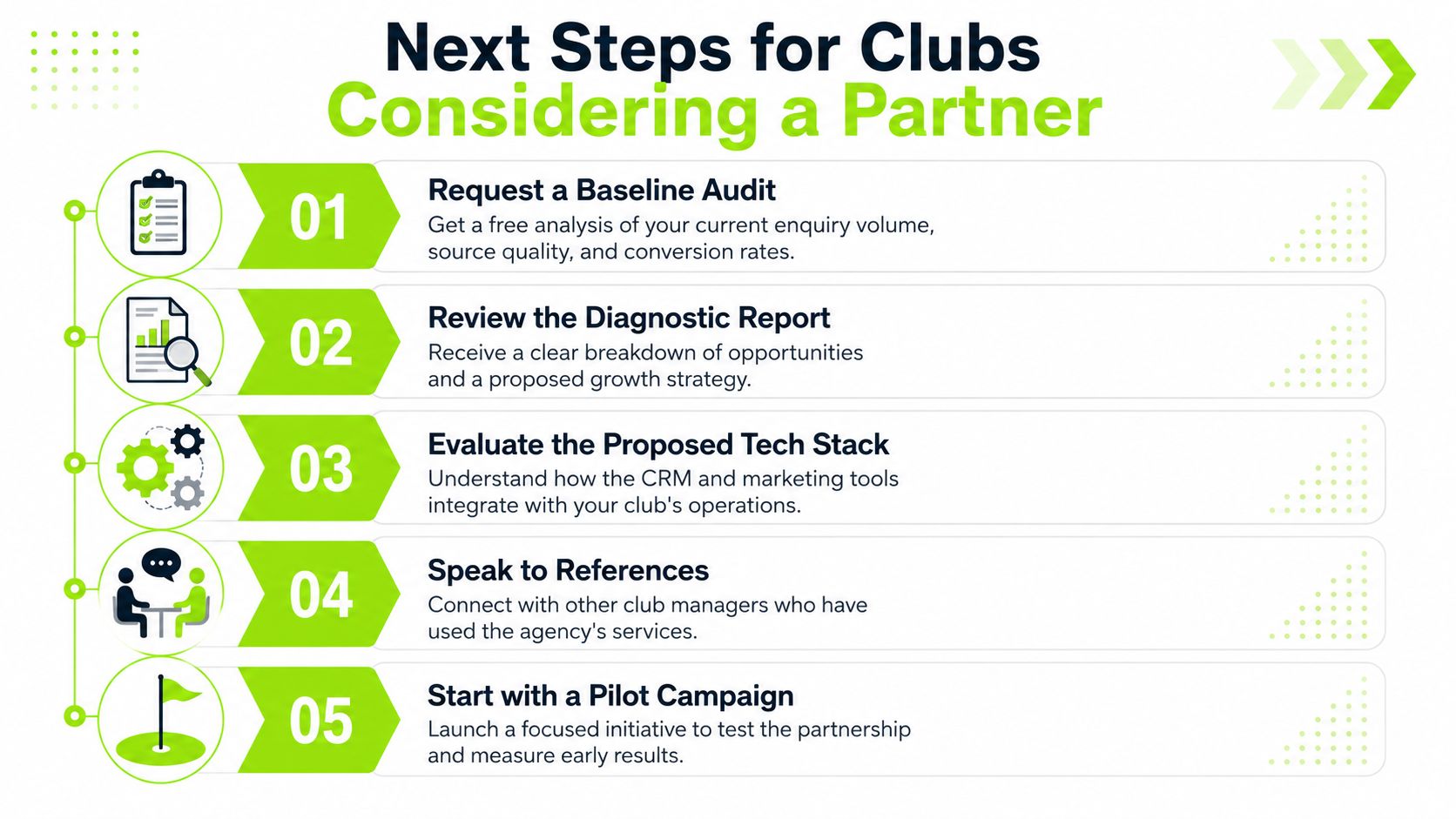
Prepare the club before you speak to anyone
Committee alignment matters. Agree the membership categories that matter most, the budget band you can support, and the growth priorities that deserve attention. You also need a clear picture of current marketing activity, because no partner can improve what nobody can describe.
A good discovery call should be built around your data, not a pre-packaged pitch. Keep it structured and short. Thirty minutes is enough if the brief is prepared properly.
What a credible shortlist looks like
Shortlist two or three agencies with verifiable golf-sector results, transparent reporting, and a willingness to diagnose your current process before proposing media. If they can't explain how your enquiries move from first contact to joined member, keep looking.
Ask for the audit before the proposal, not after the contract.
The first 90 days should produce a working system and early pipeline signals. It probably won't produce a full membership transformation yet, and that's fine. The point is to build something the club can trust, measure, and improve.
If your club wants a clearer view of enquiry handling, conversion tracking, and CRM-led follow-up, speak to GolfRep. Visit GolfRep to arrange a diagnostic conversation and see where your current pipeline is leaking.
Ready to tap into our proven growth system?