Golf Club Lead Nurture: The 2026 Playbook

Most clubs still treat enquiries as the win. In practice, that's where the leak starts. A golfer fills in a form, the club sends one polite reply, and then the prospect goes cold because nobody builds the next step.
That's the wrong model for golf club lead nurture. The job isn't generating more interest, it's handling the interest you already have, fast enough and well enough to turn it into a visit, then a membership conversation. Broad marketing benchmarks back that up, companies with strong lead nurturing generate 50% more sales-qualified leads at 33% lower cost, while 79% of marketing leads never convert into sales if they aren't nurtured, and 50% of leads are qualified but not yet ready to buy (GolfRep guidance on lead generation systems).
For golf clubs, that matters because membership decisions are rarely instant. People compare clubs, check costs, talk to partners, wait for the right moment, and then disappear if no one keeps the conversation alive. Nurture is what keeps the opportunity visible until the prospect is ready to act.
Why Most Golf Clubs Waste Their Enquiries
The most common growth mistake is assuming the club needs more leads. In reality, many clubs already have enough enquiries, they just don't have a reliable way to convert them. A slow reply, a generic email, and a missing follow-up task are enough to lose a serious prospect.
That failure usually looks harmless from the inside. Someone answers the inbox, maybe sends a brochure, and assumes the prospect will come back if they're interested. But if the golfer isn't ready to join that day, the enquiry drifts into silence, and the club never knows whether the issue was timing, price, course fit, or being forgotten.
The gap is after the enquiry, not before it
This is why clubs should stop measuring success by enquiry volume alone. A healthy pipeline needs lead visibility, clear ownership, and a process that moves each contact forward. Without that, even well-qualified prospects get treated like low-priority admin instead of future members.
Practical rule: if a club cannot say who owns an enquiry, when it was last contacted, and what stage it's in, the club doesn't have a nurture system. It has an inbox.
Manual follow-up also creates inconsistency. One staff member remembers to call, another doesn't, and the committee assumes “marketing” is underperforming when the core issue is operational. The fix is not louder promotion, it's a better handoff between enquiry, response, and next touch.
The clubs that grow more predictably are the ones that respect the delay in decision-making. They keep the conversation open, they qualify properly, and they make it easy for the prospect to take the next step when the timing feels right.
Setting Up Your CRM and First-Response Workflow
A good nurture system starts with visibility. Every enquiry should create a contact record with a source, timestamp, and enquiry type, so the club can see where it came from and what the person asked for. If that information lives only in inboxes, phone notes, and spreadsheets, the club loses the thread before follow-up even starts.
The simplest setup is also the most reliable. Keep all membership enquiries in one CRM, use a clear stage model, and make sure each lead is assigned to a named owner as soon as it arrives. GolfRep's membership lead-generation guidance recommends an instant email acknowledgement first, SMS only where appropriate, an immediate alert to the membership contact, source and campaign tagging from the start, and a basic CRM stage setup so no enquiry sits unassigned (GolfRep membership lead generation guidance).
The week one workflow
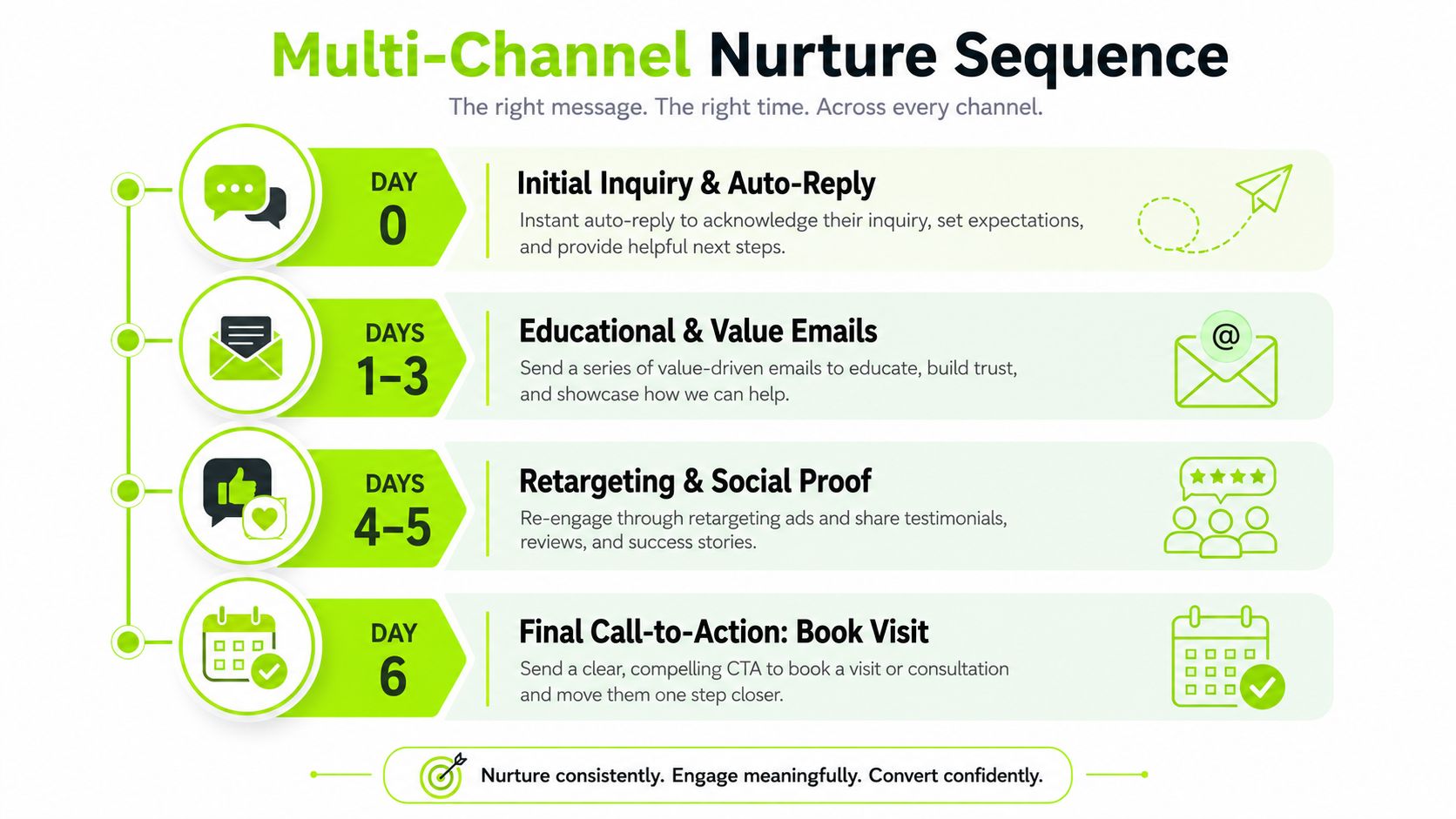
The first-response sequence should be short and disciplined.
- Create the record immediately: capture name, email, phone, source, enquiry type, and timestamp the moment the form lands.
- Send the acknowledgement instantly: the first message should confirm receipt and set expectations for the next human contact.
- Alert the right person straight away: the membership lead, secretary, or admissions contact needs to see it without digging through an inbox.
- Ask one or two qualification questions: keep it light, but useful enough to separate high-intent prospects from early-stage browsers.
- Move the lead into a stage: for example, new enquiry, qualified, visit booked, follow-up pending, or closed.
A useful CRM setup doesn't try to automate everything. It uses automation to prevent neglect, then hands off to staff at the right moment. GolfRep's CRM software guidance covers the same operational logic, with structured capture, staged follow-up, and clear ownership built into one system (GolfRep CRM software guidance).
The point is simple. If a lead comes in at 9.10 on a Tuesday, the club should know by 9.11 who owns it and what happens next.
Building Multi-Channel Nurture Sequences That Convert
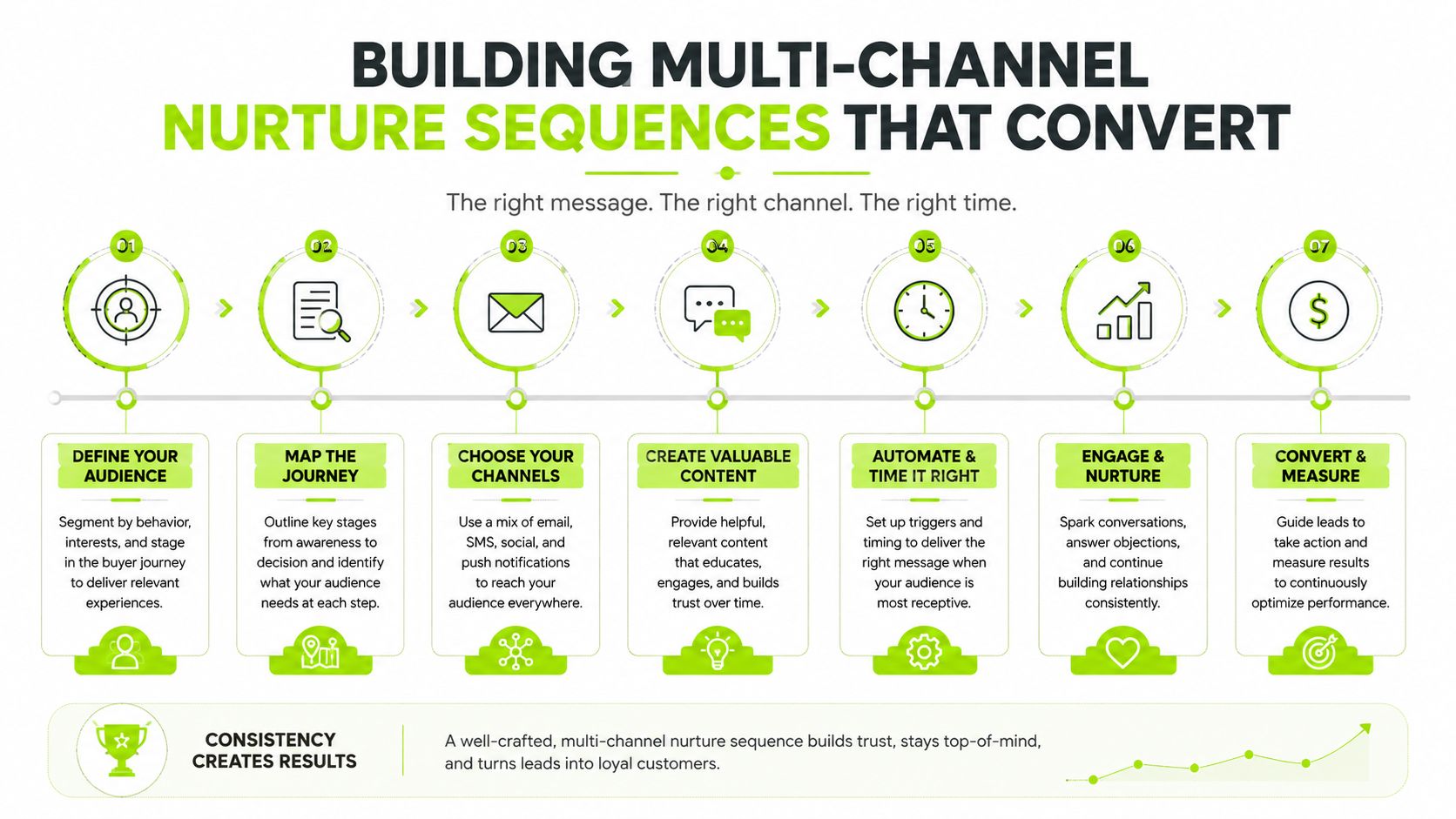
Email still does most of the heavy lifting in nurture. A current lead-nurturing roundup says 69% of marketers use email marketing as their main channel for lead nurturing, and another dataset reports an average email open rate of 43.46% and an average click rate of 2.09% (lead-nurturing statistics roundup). For golf clubs, that makes sense, because the first job is staying present in a prospect's inbox without becoming irritating.
The mistake is to treat email as a dump for club news. That rarely helps a prospect who's trying to decide whether the club fits their playing habits, budget, commute, or social preferences. The same source also notes that 71% of consumers abandon irrelevant experiences, which is exactly why generic messaging underperforms.
What to send, and when
The sequence should answer different questions in different touches. Early emails can confirm the enquiry and explain what happens next. Later messages can cover the things people compare, such as practice facilities, visitor pathways, coaching access, clubhouse atmosphere, and how easy it is to arrange a visit.
SMS and phone calls have a place, but they should support the sequence, not replace it. SMS works best for high-intent nudges, visit reminders, and short confirmations. Phone calls matter when a lead has shown enough interest to justify human time, not as a blunt substitute for a thoughtful sequence.
Practical rule: if a message could be sent to any club in the country without changing a single line, it's too generic.
Segmentation makes the difference between helpful and forgettable. A local golfer who wants membership, a parent asking about coaching, and a visitor who might convert later should not see the same follow-up path. Golf clubs that need a wider demand engine can also pair nurture with grow qualified demand with Scéaled, then use the club's CRM to turn those enquiries into actual visits.
For clubs that want a sharper content structure, the email sequence should be tied to the same logic used in GolfRep's email marketing guidance, with relevance, timing, and next-step clarity doing the work.
Lead Scoring and Segmentation for Prioritised Follow-Up
A golf club loses enquiries when every lead is treated as if it needs the same reply. Someone asking to join next month should not wait behind a browser who only wants a brochure. Lead scoring gives the membership team a practical way to separate urgent prospects from early-stage interest, so the right people get human attention while the rest stay in a structured nurture flow.
The scoring criteria should match how clubs sell membership. Playing frequency, budget signals, timing, engagement with email or content, and the strength of the enquiry all matter. A person who asks about availability, fees, and a visit is usually closer to joining than someone who only wants general information.
A simple scoring model clubs can use
| Scoring Factor | Points | Trigger Example |
|---|---|---|
| Visit requested | 10 | Prospect asks to book a tour or meet the membership team |
| Membership timeline | 8 | Says they're considering joining soon |
| Fees or joining cost asked | 6 | Asks direct questions about annual costs |
| Local catchment | 5 | Lives close enough for regular play |
| Repeat email engagement | 4 | Opens or clicks more than once |
| Casual interest | 1 | Requests brochure only |
That table is intentionally simple. A club does not need a complex model on day one, it needs a reliable way to stop hot leads sitting in the same queue as early-stage browsers.
Once the score exists, segmentation turns it into action. GolfRep's segmentation guidance explains that intent and lifecycle-based CRM segmentation can lift open and conversion rates by 15–40% and reduce unsubscribes, but it only works when data stays clean and tags are reviewed regularly (GolfRep segmentation guidance). The trade-off is clear, better relevance requires better CRM discipline.
Segment the audience around decision stage, not just around contact source. Source tells you where they came from, lifecycle tells you what they need next.
For clubs that want a practical way to define audience groups, GolfRep's segmentation overview is a useful reference point. A membership seeker, a coaching enquiry, and a lapsed visitor all need different follow-up, even if they arrived through the same form.
Priority should drive the workflow. High-score leads should go to staff quickly, and the team should automate lead prioritization so hot enquiries are surfaced without manual sorting. Mid-score leads belong in a sequenced nurture with clear reminders. Low-score leads still matter, but they need patience and relevance, not pressure.
Post-Visit Nurture That Addresses Real Objections
Most clubs make a mistake after the visit. They send a polite thank-you, maybe one or two reminders, and then they stop. That's a wasted moment, because the visit is often where objections surface and the buying decision begins.
The post-visit sequence should not assume the prospect needs more persuasion in general. It should answer the specific issue that stopped them joining. In the UK market, that usually means questions about annual costs, joining fees, waiting lists, playing frequency, and whether the club feels socially or culturally like the right fit.
Match the follow-up to the hesitation
If the prospect asked about fees, the next message should clarify the value proposition in plain English. If they worried about fitting in as a less frequent golfer, the follow-up should explain how different member types use the club. If the concern was waiting lists, the club should respond directly instead of hoping the prospect won't notice.
The strongest post-visit nurture is triggered by what happened at the visit. Did the person speak with the pro, tour the clubhouse, ask about junior access, or compare categories? Those signals should shape the next email or call, not just the date of the visit.
A practical structure looks like this.
- Day 0: send a thank-you and recap the conversation.
- Day 1 to 2: answer the main objection raised during the visit.
- Day 4 to 5: add proof, such as member experience, club atmosphere, or next-step guidance.
- Day 7 onward: use light reminders only if the prospect is still open.
That approach works because it respects decision psychology. People rarely join a club because they received one more brochure. They join when the club answers the unanswered question that kept them on the fence.
The gap many clubs miss is that post-visit nurture should feel more like a helpful follow-up conversation than a broadcast sequence. GolfRep's membership marketing guidance highlights this exact problem, clubs often rely on generic drips instead of addressing the objection that stopped the join (GolfRep membership marketing guidance).
Measuring Nurture Performance and Identifying Bottlenecks
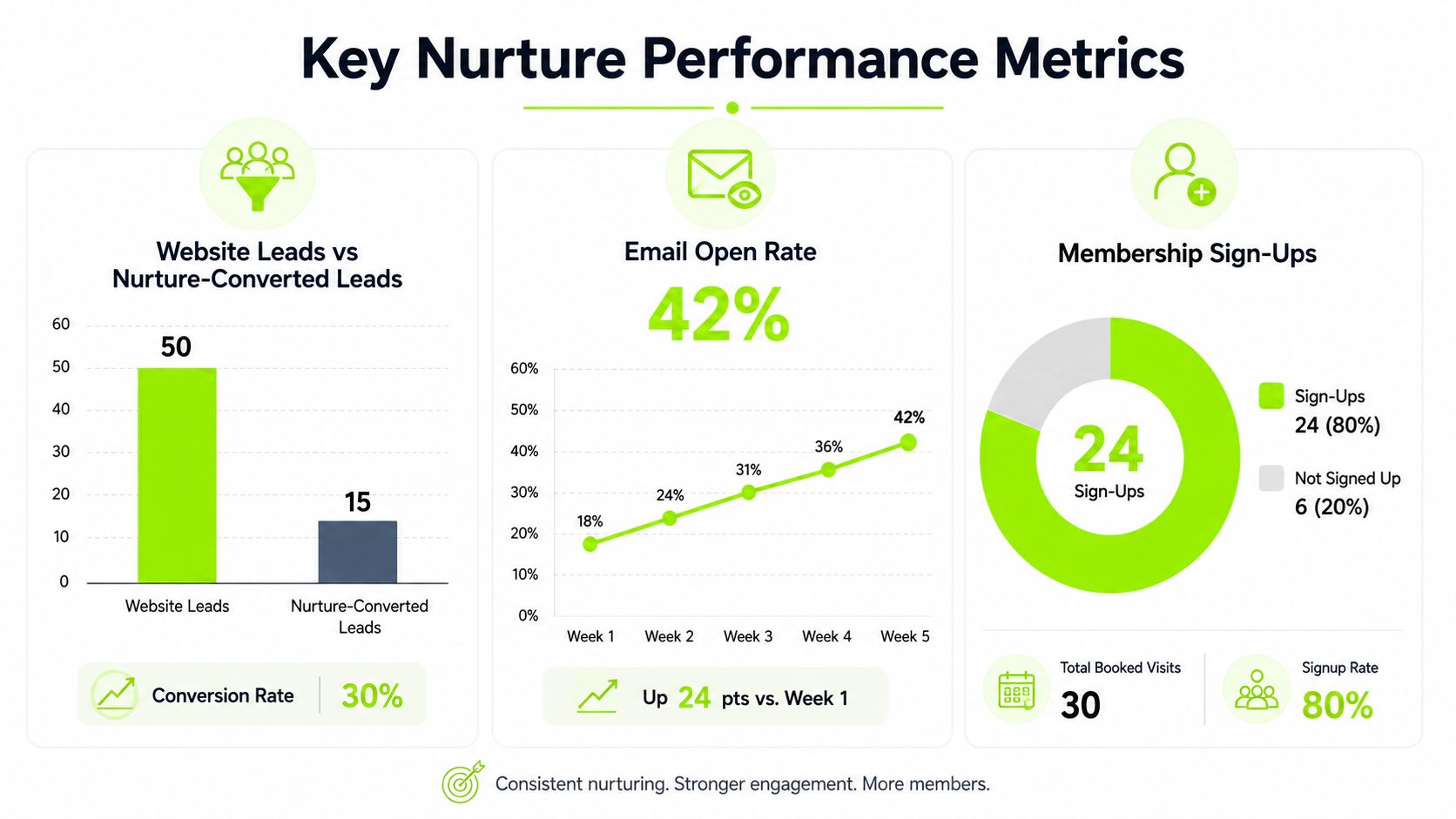
Good nurture is measurable, but the wrong metrics can mislead a committee quickly. Open rates alone won't tell you whether the club is booking more visits or signing more members. The reporting needs to connect the first response to the final outcome.
The core measures are straightforward. Track response time, qualified lead rate, lead-to-visit rate, and pipeline contribution so the club can see where prospects are dropping out. GolfRep's operational guidance on AI lead nurture points to those exact KPIs because they show whether automation is creating booked visits rather than just email activity (GolfRep AI lead nurture guidance).
Where to look when the funnel stalls
If response time slips, the bottleneck is operational. If leads are qualified but not booking, the problem is usually the message or the offer. If visits happen but sign-ups don't, the objection handling needs work.
Testing should stay practical. Change one thing at a time, such as subject lines, send times, or the order of the sequence. Then compare the result against booked visits, not just inbox engagement.
A simple dashboard helps the whole club stay aligned.
| Metric | What it tells the club |
|---|---|
| Response time | Whether enquiries are being handled quickly |
| Qualified lead rate | Whether the right people are entering the pipeline |
| Lead-to-visit rate | Whether nurture is creating appointments |
| Pipeline contribution | Whether the sequence is feeding membership growth |
The best clubs use the dashboard in monthly review meetings, not as a vanity report. That keeps the conversation on conversion, ownership, and the next operational fix.
Your First 30 Days Implementing Golf Club Lead Nurture
The first month should be about control, not complexity. Start with one enquiry type, usually membership enquiries, and build a working system before you widen it to coaching or visitor-to-member conversion. Clubs that try to automate everything at once usually create confusion, then abandon the project when the team can't keep up.
Week one is for foundations. Audit the current lead sources, choose the CRM, define ownership, and make sure every enquiry is visible in one place. If the club's website is slow or clunky, that will drag down the whole funnel, so it's sensible to diagnose and speed up websites with a technical resource such as PageSpeed Plus while the nurture setup is being built.
A practical 30-day sequence
- Week 1: clean up lead capture, tag sources, and set response targets.
- Week 2: import existing contacts and build the first automated workflow.
- Week 3: write and schedule the email sequence, then train the front-desk or membership team on the new process.
- Week 4: review the first campaign data and set a monthly optimisation meeting.
That cadence works because the club gets a live system fast, then improves it with real data. It also reduces resistance from staff, since the process starts with a single clear workflow rather than a complete operational overhaul.
GolfRep's implementation guidance stresses the same point, instant acknowledgement, agreed lead ownership, and a basic CRM stage setup should be in place early so enquiries don't sit unassigned (GolfRep lead generation guidance). That's the difference between a system that gets used and a system that gathers dust.
The three actions to take first are simple. Pick one CRM, define one enquiry path, and make sure every new lead gets a same-day human response. Once that is working, the rest of the nurture system becomes much easier to trust and scale.
If your club is still relying on manual follow-up, GolfRep can help you build a structured nurture system that keeps every enquiry visible, assigned, and moving. Visit GolfRep to see how we help clubs turn more of their existing enquiries into booked visits and memberships.
Ready to tap into our proven growth system?