Golf Club Email Marketing: A System for More Members
Most advice on golf club email marketing starts in the wrong place. It starts with newsletters, fixtures, event reminders, and the odd green fee offer. That's useful, but it's not what drives membership growth.
At most clubs, the problem isn't a total lack of interest. It's what happens after interest appears. A golfer submits an enquiry. Someone means to reply later. A membership prospect gets one follow-up, then silence. A visitor plays once, says they enjoyed the course, then never hears from the club again. The loss doesn't happen at the advertising stage. It happens in the handover between enquiry and action.
That's why email matters far more than most clubs think. Used properly, it isn't a digital noticeboard. It's the follow-up layer inside a conversion system. It helps your club respond faster, stay visible, and move people towards the next step while staff get on with running the course, the shop, and the clubhouse.
Why Your Email Marketing Is Not Delivering Members
Most clubs don't have an email problem. They have a systems problem.
If your current version of golf club email marketing is one monthly update and a few seasonal promotions, you're using email as a publishing tool. Membership growth needs something else. It needs a process that captures interest, routes it properly, and follows up without relying on memory.
Newsletters don't fix broken follow-up
A polished newsletter won't rescue a missed enquiry. Nor will a nice template make up for a slow response when someone asks about joining.
In practice, clubs lose prospective members in ordinary ways:
- The inbox gets crowded: Membership emails sit beside supplier messages, committee notes, and day-to-day admin.
- The handover is unclear: One member of staff assumes another has replied.
- The follow-up stops early: A prospect gets an initial response but no structured sequence after that.
- The message is too broad: A serious membership lead receives the same email as a casual visitor.
That's why generic advice about “sending more emails” usually falls flat. More volume doesn't create more members if the club is still handling enquiries manually.
Practical rule: If an enquiry depends on someone remembering to chase it, that enquiry is already at risk.
The better way to think about email
Email works best when it sits inside a wider operating system. The first job isn't to broadcast. It's to convert existing intent.
A useful test is simple. When somebody enquires about membership, can your club do all of this without staff improvising?
- Acknowledge the enquiry quickly
- Record the source and status
- Send relevant follow-up based on interest
- Prompt a visit, call, or trial step
- Show who needs another nudge and when
If the answer is no, the issue isn't content. It's process.
Deliverability matters as well. Even a good system struggles if messages don't reliably land in the inbox, which is why a practical resource like this 2026 email deliverability fix is worth reviewing when campaigns are underperforming for technical rather than strategic reasons.
What actually delivers members
The clubs that get more from email usually stop treating it as a side task. They build around:
- Speed: New enquiries get an immediate and professional response.
- Visibility: Every prospect sits somewhere clear in the pipeline.
- Segmentation: Visitors, members, lapsed enquiries, and live membership prospects don't receive the same message.
- Automation: The basic follow-up happens every time, not only when staff have space.
That shift changes everything. Email stops being an occasional club update and starts acting like a conversion engine.
Building Your Foundation on a CRM Not a Mailing List
A spreadsheet can hold email addresses. A booking system can export contacts. Neither gives you a reliable growth foundation.
If you want golf club email marketing to drive membership, visitor revenue, and retention, you need a CRM. Not because it sounds impressive, but because it gives your club one place to see who the contact is, what they asked for, what they've received, and what should happen next.
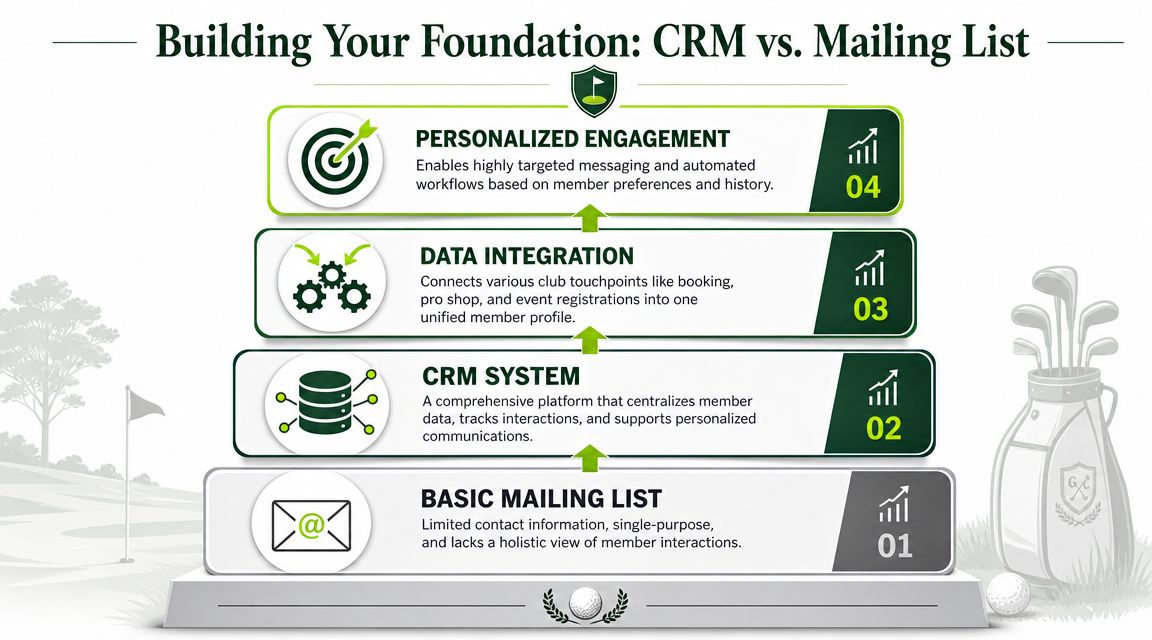
A mailing list stores addresses. A CRM manages relationships
This is the distinction many clubs miss.
A mailing list tells you who can receive an email. A CRM tells you:
- What type of contact they are
- Where they came from
- Whether they asked about membership, society golf, or casual play
- What messages they've already received
- Whether they clicked, replied, booked, or went quiet
That changes how you operate. Instead of asking, “Who should we send the newsletter to?”, you start asking, “Which prospects need a follow-up today, and what should it say?”
For clubs trying to build a more organised pipeline, a dedicated golf club CRM system gives you the structure that a basic mailing list can't.
Compliance isn't admin. It shapes the whole system
Under UK law, including PECR and UK GDPR, direct email marketing to individuals requires valid consent, which makes permission-based marketing, list hygiene, and segmentation central to an effective strategy rather than optional extras, as outlined in this guidance on golf club email marketing under UK rules.
That has practical consequences for your setup.
A strong CRM doesn't just collect contacts. It records whether consent exists, how it was captured, and what category that contact belongs to. That matters because clubs often mix member communications, operational updates, and marketing messages in ways that create confusion.
Good clubs don't treat consent as a box-ticking exercise. They treat it as the starting condition for a usable database.
How to structure the database properly
The simplest useful CRM structure is not complicated. It just needs to reflect reality.
Use clear categories such as:
- Live membership enquiries: People who have recently asked about joining
- Visitors with marketing consent: Golfers who've played and may come back
- Lapsed prospects: People who enquired before but didn't move forward
- Current members: Existing members who need renewal, event, and engagement communication
- Society or event contacts: Organisers and attendees with different intent from membership leads
Then add status fields that help staff act. For example, awaiting reply, nurture active, tour invited, tour booked, follow-up due, not interested.
Many clubs feel immediate relief. Once the contact record is organised, your email activity becomes easier to control. You can see gaps. You can assign tasks. You can stop sending broad messages to the wrong people.
What works and what doesn't
Here's the blunt version.
| Approach | What happens |
|---|---|
| Single master list | People receive irrelevant messages and staff lose confidence in the channel |
| No source tracking | You can't tell which enquiries came from forms, calls, events, or in-person conversations |
| Manual note-keeping | Follow-up becomes inconsistent and dependent on individuals |
| Segmented CRM records | Staff can send targeted messages and see where each prospect sits |
| Tracked engagement fields | Clubs can use open, click-through, and bounce signals to improve sends over time |
The value of a CRM isn't that it sends prettier emails. It gives your club a single operational view of the relationship.
Without that, email remains isolated. With it, email becomes part of a measurable pipeline.
Growing Your List with High-Quality Contacts
Most clubs don't need a bigger email list. They need a better one.
A database full of old addresses, vague consent, and low-intent contacts won't help your club convert more members. In fact, it usually does the opposite. It clutters your system, weakens targeting, and leads staff to doubt whether email works at all.

The best contacts are often captured offline
The strongest lists are rarely built by hiding a generic sign-up box in the website footer.
GolfNow's support guidance is useful here. It recommends staff-assisted marketing opt-in when golfers book or check in, and that same guidance supports routing new contacts into a timed welcome sequence rather than dropping them straight into the main newsletter list, as explained in this customer marketing opt-in workflow.
That fits what works in clubs. Staff interactions are often where intent is clearest.
Good moments to capture consent include:
- At tee-time booking: A caller or online booker has already shown direct interest in the club
- At reception check-in: Staff can ask clearly and confirm preferences properly
- In the pro shop: Especially after a positive round or lesson enquiry
- After a society day: Organisers and attendees may be open to follow-up if the day went well
The point isn't pressure. It's clarity. If staff ask properly and explain what the golfer is signing up for, the quality of the contact is much higher than a passive web form filled in without context.
Train staff to capture usable consent
Most clubs leave this too loose. Someone asks, “Do you want to hear from us?” and hopes for the best.
A better approach is to give front-of-house and golf operations staff a short, consistent script. It should explain:
- What the golfer is agreeing to
- What type of updates they'll receive
- That it's optional
- How their details will be used
That sounds small, but it changes list quality. Better consent leads to a more usable CRM and fewer dead-end records.
The list that matters isn't the biggest one. It's the one your club can confidently use.
Online capture still matters, but only with intent
Web forms are useful when they're attached to a real next step.
Examples include:
- Membership enquiry forms tied to a clear invitation to visit the club
- Open day registrations with a defined event follow-up
- Course guides or visitor packs where the person is actively requesting information
- Competition and event registrations that feed directly into your contact system
One-off giveaways can help if they're linked to the right audience and handled correctly. For clubs exploring that route, this example of a giveaway on Facebook for golf clubs shows how list growth needs to connect back to proper follow-up, not just attention.
What to do after capture
Most list-building breaks down when clubs collect a contact and then leave them untouched until the next newsletter.
Instead:
- Add the contact to the CRM immediately
- Apply the right segment and source
- Start the relevant welcome or nurture sequence
- Suppress duplicates and tidy weak records
- Keep unengaged contacts under review
The first email matters most when interest is fresh. If a golfer has just booked, visited, or asked a question, that's the moment to begin the relationship. Leave it too long and the club disappears from view.
High-quality contacts don't come from luck. They come from disciplined capture at the right touchpoints, with clear consent and a next step already built in.
Key Automated Campaigns That Drive Revenue
A club doesn't need dozens of automations. It needs a few that run properly.
The most effective golf club email marketing setups usually rely on three core flows. A new enquiry flow, a welcome sequence, and a reactivation campaign. Lightspeed's golf marketing guidance supports this broader direction, with emphasis on segmentation, automation, clear calls to action, and send windows that are typically most effective around 9 to 11am or 1 to 3pm in this golf course marketing ideas guide.
The new enquiry flow
This is the one most clubs should build first.
A golfer asks about membership. They don't need a newsletter. They need acknowledgement, useful information, and a reason to take the next step. If that doesn't happen quickly, the enquiry cools off.
A good new enquiry flow feels personal even when it's automated. It should do three things well:
- Reply immediately: Confirm receipt and set expectations
- Answer the obvious questions: Membership options, facilities, culture, next step
- Move towards action: Encourage a tour, call, guest round, or meeting
Here's a practical structure.
| Timing | Email Subject Line | Purpose |
|---|---|---|
| Immediate | Thanks for your membership enquiry | Confirms receipt and outlines what happens next |
| Next working window | A closer look at the club | Introduces the course, clubhouse, and playing experience |
| Later follow-up | Would you like to visit the club | Prompts a tour, conversation, or trial visit |
| Final check-in | Still considering your options | Reopens the conversation without pressure |
The exact spacing will depend on your sales process, staffing, and how quickly someone can follow up personally. The key is consistency. No enquiry should sit untouched because the office was busy.
The welcome sequence
This sequence is for new opted-in contacts who aren't yet in a live sales conversation. Think visitors, event sign-ups, recent check-ins, or golfers who've requested information.
The mistake clubs make here is going straight to promotion. The better route is orientation.
A welcome sequence should help the contact understand the club and what kind of communication to expect. It might include:
- a thank-you message
- a short introduction to the course and amenities
- useful links or practical information
- a softer call to action, such as booking again or exploring membership options
This is also where format matters. If you're adding event access, pass-throughs, or on-site redemption ideas, tools like Scanely's guide to QR codes in email can help clubs think more clearly about how digital communication connects to real-world action.
For teams building this out properly, golf club marketing automation becomes less about blasting messages and more about making sure every contact receives the right next step without manual chasing.
Operational note: Every automated email should ask for one action, not five. Confused readers don't convert.
The reactivation campaign
This one is badly underused in golf.
Clubs often have a large pool of dormant value. Past visitors who enjoyed the course. Old membership enquiries that went quiet. People who asked for details months ago but never booked a visit. They're not cold in the same way as a brand-new prospect. They already know the club exists.
A reactivation campaign should feel relevant, not desperate. It isn't about shouting louder. It's about giving a sensible reason to re-engage.
For example, a club might send:
- an update on current playing opportunities
- an invitation to a membership open event
- a reminder of flexible ways to experience the club
- a simple check-in asking whether the contact still wants information
What not to automate badly
Automation can create revenue. It can also create noise when built without judgement.
Avoid:
- Long, generic sequences: If every email says roughly the same thing, contacts tune out
- No human handoff: Automation should support staff, not replace real conversations
- One list for everyone: Membership leads and past visitors shouldn't sit in the same campaign
- Weak CTAs: “Find out more” is less useful than “Book a club visit”
The best automations don't feel robotic. They feel organised. That's the standard clubs should aim for.
Measuring What Matters From Opens to New Members
Open rates matter. Clicks matter. Bounce rates matter. But none of them, on their own, tell you whether your club is growing.
The problem is that many clubs stop measurement at the email platform. They review opens, note a few clicks, then move on. That's not enough if the aim is to turn golf club email marketing into a revenue system.
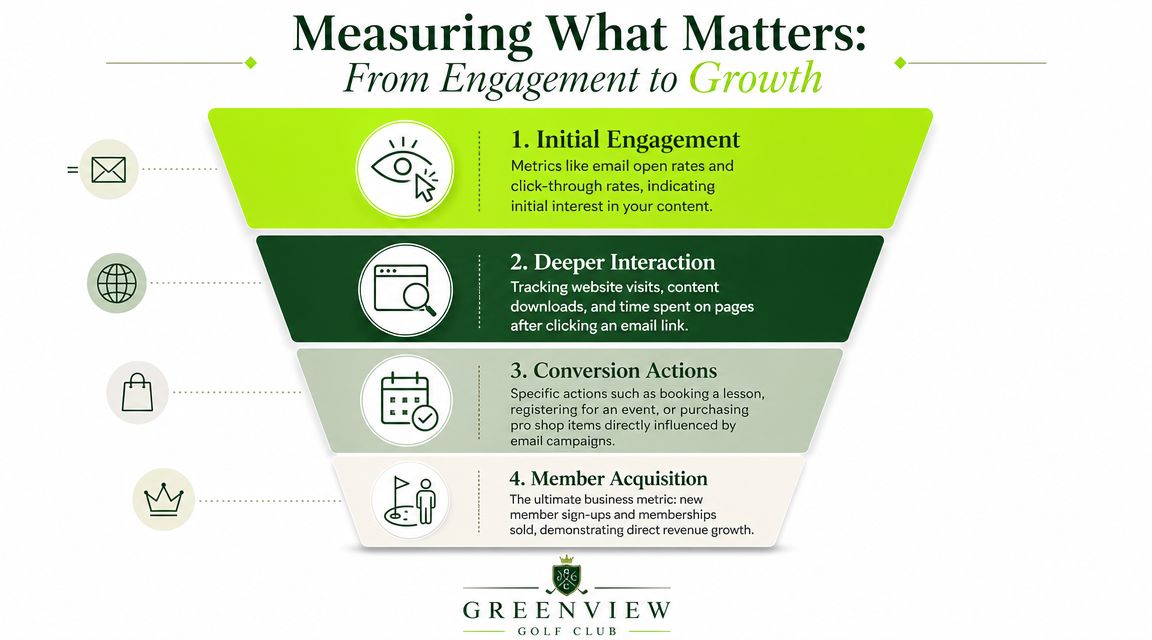
The difference between activity and outcome
Email metrics are useful because they show whether people noticed and interacted with the message. They are not the end result.
What clubs really need to understand is the chain from communication to conversion.
That means tracking questions like:
- How quickly did we respond to the enquiry?
- Did the contact book a visit or call?
- Did they attend?
- Did they progress to a membership conversation?
- Did they join?
Once those stages sit inside a CRM, email stops being isolated performance data and starts becoming part of a visible pipeline.
The KPIs worth caring about
A sensible reporting view includes email engagement, but it doesn't stop there.
| Metric type | What it tells you |
|---|---|
| Open rate | Whether subject line and sender recognition are working |
| Click-through rate | Whether the message and call to action are relevant |
| Bounce rate | Whether your list quality and hygiene need attention |
| Response time | How quickly the club acknowledges and handles interest |
| Booked visits or calls | Whether email is creating meaningful next steps |
| New members attributed | Whether the system is actually producing revenue |
Clubs frequently uncover the underlying issue. The email itself may be fine. The breakdown may be happening after the click, after the form, or after the first response.
If the club can measure opens but can't measure booked tours, it's still missing the commercial picture.
Use KPI logic that reaches beyond the inbox
Many managers know they need KPIs, but fewer build a clear method for connecting channel metrics to business outcomes. A broader resource on understanding how KPIs are measured is useful here because it reinforces the difference between easy-to-view numbers and decision-making metrics.
For golf clubs, the practical model is straightforward:
- Track the email interaction
- Track the next action in the CRM
- Track the staff follow-up
- Track the final commercial result
Once that's in place, optimisation becomes much easier.
How to improve based on real data
Clubs don't need elaborate dashboards to start making better decisions. They need disciplined review.
Look for patterns such as:
- High opens but low clicks: The subject line is working, but the content or CTA isn't
- Good clicks but few enquiries progressed: The handoff after the email may be weak
- Strong early engagement then drop-off: The sequence may be too long or poorly timed
- Frequent bounces or stale segments: The list needs cleaning and tighter suppression rules
A lot of manual marketing falls short. Staff remember that a campaign “felt busy” or that “a few people replied”. A system gives you proof.
And proof matters, especially in clubs where committees or boards want to know whether marketing is creating real value. When you can show the path from message to enquiry to visit to member, the conversation changes.
Building Your Predictable Membership Pipeline
Membership growth doesn't come from one clever campaign. It comes from a chain that holds together.
That chain starts with a proper contact record, not a loose mailing list. It improves when consent is captured cleanly, contacts are segmented properly, and new enquiries trigger follow-up without waiting for somebody to remember. It becomes commercially useful when the club can see which emails led to visits, conversations, and sign-ups.
Systems beat sporadic effort
Manual marketing feels productive because people are busy. Emails go out. Staff reply when they can. Notes sit in inboxes. Follow-up happens unevenly.
That approach usually creates hidden waste.
A structured system does something more valuable. It removes guesswork from the moments that matter most:
- When a prospect first enquires
- When a visitor gives consent to stay in touch
- When a warm lead goes quiet
- When the club needs to know what converted
Each part supports the next. The CRM provides visibility. Segmentation keeps messages relevant. Automation protects response time. Measurement shows what to improve.
Predictability comes from process
This is the shift many clubs need to make. Stop treating email as a side channel for updates and start treating it as part of the club's conversion infrastructure.
When that happens, several good things follow:
- staff don't have to rely on memory
- prospects don't get forgotten
- reporting gets clearer
- membership conversations happen more consistently
A predictable pipeline isn't built by sending more messages. It's built by making sure every enquiry gets the right message at the right stage.
Golf club email marketing works best when it is connected to the way the club sells. That means handling enquiries properly, not just generating them. It means seeing the difference between a casual contact and a serious membership lead. It means knowing what happened after the email was opened.
Clubs that build that system put themselves in a stronger position. Not because email is magical, but because organised follow-up beats ad hoc effort every time.
If your club wants a clearer system for handling enquiries, tracking follow-up, and turning interest into membership conversations, GolfRep helps golf clubs build the CRM and automation structure behind predictable growth.
Ready to tap into our proven growth system?