Golf Club Twilight Membership: Is It Worth Joining?

You're finishing work at five, you can realistically tee off after six in summer, and the club has just quoted you a full golf club twilight membership alternative at a fraction of the seven-day fee. It looks like a bargain. Don't judge it on the headline. Judge it on cost per usable round. If the window, the days and your actual diary don't line up, the cheaper product is the expensive one.
What a Twilight Membership Actually Buys
Say you're that commuter. Saturday mornings are family time, weekday mornings are work, and your golf lives in a narrow slot after 5.30pm from April to September, plus the odd Sunday afternoon. A full membership charges you for tee times you'll never use. A twilight membership keeps your status as a member, with a handicap, a locker room and a clubhouse, but links your playing rights to off-peak hours.
That trade suits both sides when it's honest. The club protects its morning and early afternoon inventory for full members who paid for it. You pay less because you're buying later capacity the club would otherwise struggle to fill.

The three moving parts
Most products combine the same three elements, and you need all three before you can price one properly.
- A modest annual fee: This buys membership status and the right to access the twilight window. It's not always the whole cost.
- Pay per round charges: Some clubs charge per round on top, and the rate can differ by course, so a main course and a short course won't cost the same.
- Seasonal cut offs: The start time moves with daylight. A summer threshold in late afternoon becomes a much earlier threshold in winter, when there's less light and less demand.
Rudding Park in Yorkshire is a clean worked example. The Rudding Park Golf Club 2022 to 2023 brochure sold short introductory packages from £99 for one month to £280 for three months, alongside a twilight product built on exactly that annual fee plus per round model. The exact fees and times sit in the comparison table below, where they belong.
That staged route matters. A one month or three month trial, then twilight, then full membership gives a golfer a way in without a large first commitment, and gives the club measurable steps. Each stage produces its own numbers, rounds played, yield per round and upgrade rate.
Don't ask what twilight costs. Ask what a round you can actually play costs.
Before you go any further, get clear answers to three questions. What does the fee cover, in full, including per round charges. When does the window apply, by season and by day of the week. And can you upgrade later, with credit for what you've already paid, or do you start again from zero.
Twilight Membership Prices and Access Windows Compared
£886 buys a year of twilight golf at Trentham Park. £350 buys it at Coulsdon Manor. The same label covers both deals, so the annual fee means nothing until you set it against the access window, the days covered and whatever is charged on top. Judge each option on the cost of one round you can realistically play, not on the headline figure.
| Club and year | Annual fee | Access window | Other charges |
|---|---|---|---|
| Coulsdon Manor Golf Club (2025) | £350 for 5-day access | After 3pm April to October, after 12pm November to March | No per round charge stated in published terms |
| Trentham Park Golf Club (2025 to 2026) | £886 | Typical range across this table: after 2pm to 4pm in summer, 11am to 2pm in winter | Typical extras in this table: a joining fee up to £250, or £5 to £10 per round |
| Peel Golf Club | £385 | Typical range across this table: after 2pm to 4pm in summer, 11am to 2pm in winter | Typical extras in this table: a joining fee up to £250, or £5 to £10 per round |
| Ringway Golf Club | £887 | After 3pm summer, after 2pm winter | £250 joining fee |
| Glyn Abbey Golf Club | Typical range across this table: £160 to £887 | After 2pm, 1 April to 20 September, after 12pm in winter | Typical extras in this table: a joining fee up to £250, or £5 to £10 per round |
| Rudding Park Golf Club (2022 to 2023) | £160 | Hawtree after 3pm weekdays and 4pm weekends, 1 March to 31 October, 11.00am and 11.30am in winter | £10 per round Hawtree, £5 per round Repton Short |
The spread is the point. The Golf Membership Finder listing for Trentham Park Golf Club puts its twilight membership at £886 per year for the 2025 to 2026 membership period, almost level with Ringway at £887 plus a £250 joining fee. Peel sits at £385 and Coulsdon Manor at £350, while Glyn Abbey's twilight membership page defines access as after 2.00pm from 1 April to 20 September and after 12.00pm during the winter period. Same product name, six very different deals.
Per round charges flip that ranking. Rudding Park's £160 fee looks cheapest in the table, but a golfer playing three rounds a month on the Hawtree course pays £10 a round on top, taking the first year cost to £520. Coulsdon Manor's £350 with no stated per round charge beats that for anyone playing weekly, at under £7 a round before extras. Read the fee and the extras as one number.
The wider pricing context
Twilight only looks cheap or dear against what full access costs locally. The 2023 to 2024 Members' and Proprietary Golf Clubs' Survey from Hillier Hopkins found only 29% of surveyed clubs charged more than £1,000 for standard playing membership. An £886 twilight fee at one club can sit close to full membership at another, which is why the label tells you nothing on its own.
That survey also priced twilight as a distinct period, at £16.88 for twilight use with a member and £18.15 without a member, against all day rates of £24.00 and £32.00 respectively. The with member distinction changes what your golf costs if you usually play alongside a full member, and it changes the saving your membership is buying. Match the rate to your actual habit before you count the benefit.
Put every club you are considering into one row each: fee, joining cost, per round charge, window, days covered. Then divide the total first year cost by the rounds you can realistically play inside the window, not the rounds the brochure implies. Our guide to golf club membership fees works through how those headline fees are built. Recheck each club's current published terms before you pay, because schedules like these change every season.
Terms to Confirm Before You Join
Get these in writing before money changes hands. If a club can't put them on one page, that tells you something about how the product is run.
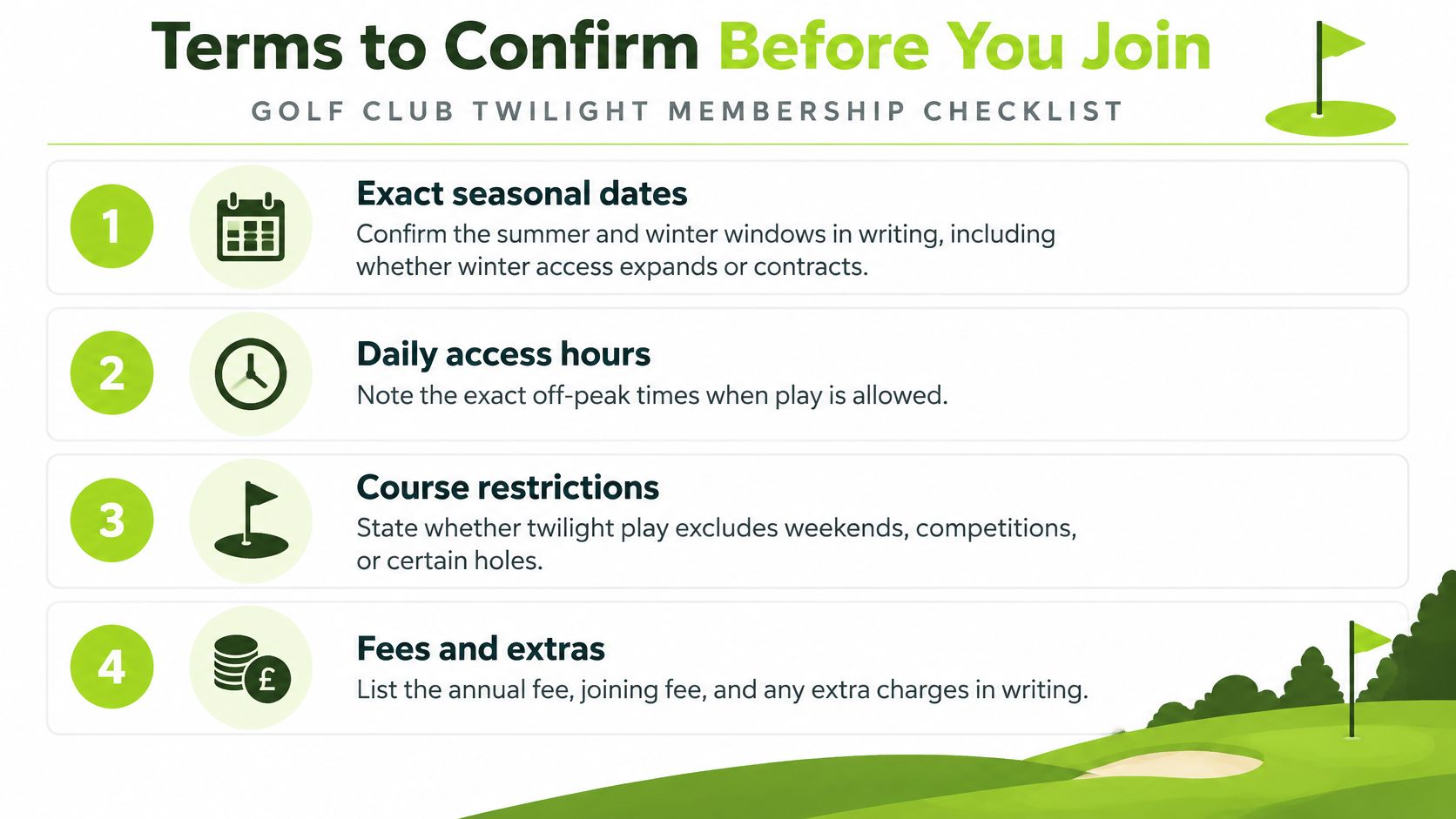
- Exact seasonal dates: Confirm the first and last day of the summer and winter windows, and whether winter access expands or contracts.
- Daily cut off: Get the precise start time, and ask whether weekday and weekend times differ.
- Days covered: Check whether the window applies every day or only on set days. A five day product removes two days a week, which matters if those are your days.
- Competition eligibility: Ask whether handicap qualifying competitions are open to you. Some clubs include them; others exclude twilight members from the competitions that make membership feel real.
- Clubhouse and practice rights: Confirm clubhouse access, practice facility use and guest rates, rather than assuming they follow playing rights.
- Playing with a member: Ask whether charges change when you're accompanied by a full member.
- Booking rights: Find out how far ahead you can book, whether late tee times can be booked online, and whether full members get earlier access to the same slots.
- Fees and renewal: Confirm the joining fee, whether the annual fee is fixed for the year, and what happens at renewal if the price rises.
- Upgrade credit: Ask whether money already paid is deducted if you move to full membership mid year, or whether you pay twice.
Why thirty minutes changes everything
Take a golfer who can reach the club for a 2.30pm tee time in July. At a club with a 2.00pm cut off, they're playing. At a club with a 3.00pm cut off, they're waiting, or paying a visitor rate, or not playing at all because a 3.30pm start doesn't finish before they need to be home.
That single half hour decides whether the product fits their life. It's also why vague terms cause trouble for clubs. If the schedule is unclear, staff can't qualify an enquiry properly, members dispute what they were sold, and the pro shop ends up negotiating exceptions at the counter. Publish it as one document, with dates, times, days and charges together.
We work on that basis with clubs. GolfRep provides a system, strategy and partnership to help golf clubs grow membership, increase enquiries or stabilise retention, and we offer the opportunity to schedule a call with our founder if a club wants to pressure test a proposition like this before launching it.
Once you've got these terms confirmed, you can run the numbers properly.
Working Out the Break-Even Against Pay and Play
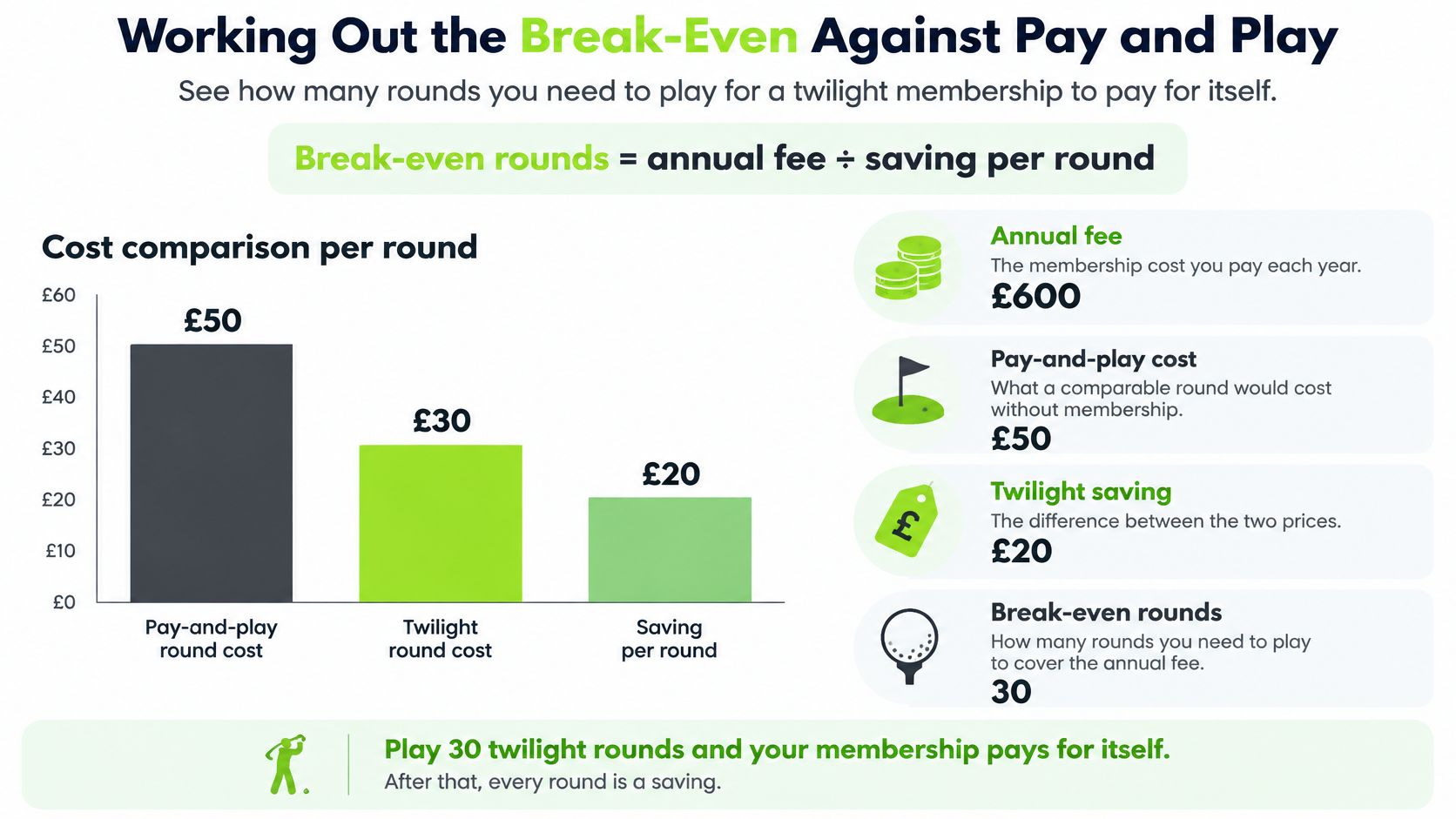
The formula is simple. Break even rounds = annual fee ÷ saving per round. The saving per round is what you'd otherwise pay for a comparable round, minus any per round charge built into the membership.
Two worked examples
First, a flat fee product. Coulsdon Manor Golf Club's published green fees page lists a 2025 twilight membership price of £350 per year for 5-day access, valid after 3pm from April to October and after 12pm from November to March. Set £350 against the £18.15 non member twilight benchmark from the 2023 to 2024 survey and you get 19.3 rounds, so call it 20 rounds to break even.
Second, a fee plus per round product. Rudding Park charged a £160 fee with £10 per round on the Hawtree Course. Against an assumed £18 pay and play round, and that £18 is an assumption for illustration, you save £8 a round, so the fee needs 20 rounds to wash out. Swap in your local pay and play rate before you decide. If your local twilight green fee is £25, the answer changes completely.
Decision rule: Join only if your realistic rounds clear break even with room to spare. Breaking even exactly means losing money in a wet year.
| Golfer | Rounds a year | Cost per round on a £350 fee |
|---|---|---|
| Commuter | 40 rounds | £8.75 |
| Parent with school run | 15 rounds | £23.33 |
| Shift worker | 25 rounds | £14.00 |
| Occasional golfer | 4 rounds | £87.50 |
Cost per round falls fast as rounds rise, and rises just as fast when they don't. Now be honest about the deductions. A five day limit removes two days a week. Winter closures, frost delays and waterlogged weeks remove rounds you were counting in October. Summer evenings get booked by other people.
Count last year's actual rounds if you have them, then knock something off for weather and missed slots. If that reduced figure still clears break even comfortably, buy it. Our breakdown of whether a golf membership is worth it applies the same logic to full categories.
Who Twilight Membership Suits and Who Should Look Elsewhere
Start with the profile, then run the break even test. Fitting a profile isn't enough on its own.
| Golfer | Typical playing pattern | Likely fit | Main risk |
|---|---|---|---|
| Commuter | Weekday evenings after work | Strong fit | Summer evening demand may limit late tee times |
| Parent with school run | Late afternoons, weekend mornings with family | Mixed | Weekend cut off may fall during family time |
| Shift worker | Irregular days and late finishes | Fits only if the rota allows | Fixed off peak access may not match the rota |
| Summer only golfer | Evenings from April to October | Good fit if the summer window suits | Winter restrictions matter less but check the dates |
| Occasional player | Under 10 rounds a year | Poor fit | Break even is rarely reached, pay and play may cost less |
| Retired golfer | Flexible weekdays | Compare with full membership | Full access may be worth more if play is frequent |
Commuters gain most, because their available time and the product's window are the same hours. Still check supply. If the club releases only a handful of late slots and every commuter in the membership wants 5.45pm on a Tuesday, you'll be refreshing the booking page and losing. Ask how many twilight tee times are released on a typical weekday evening.
Parents and shift workers need the window to match a life that doesn't move. A weekend cut off that lands in the middle of family time makes the product unusable, however low the fee, and a rota that finishes late two weeks in four halves the usable rounds you paid for.
Where the maths usually fails
Occasional golfers are the clearest no. Under ten rounds a year rarely reaches break even on any of the fees in the table earlier, so pay and play or a visitor twilight rate will cost less and carries no commitment.
Retired golfers should look the other way and price full membership. If you can play Tuesday at 10am and Thursday at 11am, restricting yourself to afternoons to save money is a false economy, because frequent daytime play spreads a full fee very thinly. Summer only golfers suit a summer window well, but confirm the exact April and October dates, since a window that starts late or ends early removes the shoulder weeks when evening golf is at its best.
If you don't know your pattern, don't guess. Log a month of rounds you would have played, with times, then test that record against the window.
Designing a Twilight Product Without a Second-Class Membership
For managers and committees, this is a design problem before it's a pricing problem. Work through it in order.
- Define eligibility and the cut off first: Decide who it's for, whether the window is daily, and which courses it covers, before you set a price.
- Price by cost per usable round: Take the fee, the access window and a realistic playing pattern for your target golfer, and work out what each usable round costs them. That figure should beat pay and play clearly while staying far enough below full membership that the full fee still looks like the better deal for anyone who can use it.
- Track the measures separately: Rounds played, weekday and season occupancy, repeat play and upgrades each tell you something different. One blended number tells you nothing.
- Review satisfaction at six months: Sign-up optimism hides the problems. Six months in, you'll hear about tee time access and competition exclusions.
- Protect full members at peak: Set the cut off so twilight demand fills empty late capacity rather than displacing the members who pay most.
The second class risk is real
The Golfshake 2025 membership survey found 77.9% of current members intended to renew, 18.3% were undecided and 3.8% did not plan to renew. That undecided group is where a twilight product earns its keep or does damage. Offered well, it lowers the price barrier and keeps a wavering member in the club. Offered badly, it tells them they're a lesser category of member and pushes them out.
You're not inventing a category here. The Hillier Hopkins Golf Clubs Survey Report 2025/26 found flexible membership offered by 43% of members' clubs and 44% of proprietary clubs. The category is established, and the design choices still separate clubs that retain these members from clubs that churn them.
The product breaks on exclusion.
Keep twilight members out of competitions, social events and club communications and they'll feel it within a month, whatever they saved. Include them, give them handicap support, and make the upgrade route visible from day one, with clear credit for moving to full membership. A twilight member who upgrades is worth far more than one who's permanently discounted. Our guide to golf club membership tiers covers how to structure that ladder.
A twilight category should be a doorway into the club: a lower-priced first rung that points clearly at the full fee.
Launch only if your occupancy data shows spare late capacity to sell. If your summer evenings are already full, you're discounting rounds that would have sold at full price and upsetting full members in the process.
If you're weighing up a twilight category, or repricing one that isn't converting, GolfRep provides the system, strategy and partnership that help clubs grow membership, increase enquiries and stabilise retention. Visit GolfRep to see how it works with UK golf clubs on membership propositions, and schedule a call with the founder to talk through the category before it goes on sale.
Ready to tap into our proven growth system?