Master Your Golf Club Lead Generation System
Most advice on golf club growth starts in the wrong place. It tells clubs to get more enquiries, spend more on ads, post more on social media, and widen the top of the funnel.
That sounds sensible, but it misses the actual constraint.
A golf club lead generation system doesn't fail because there isn't enough interest. It fails because enquiries arrive, sit in inboxes, get passed between staff, receive inconsistent replies, and go cold before anyone has properly qualified them. For many clubs, especially those with lean teams, part-time admin cover, or committee-led decision-making, the bottleneck is operational. It's follow-up.
The Real Problem With Golf Club Lead Generation
The UK golf market is not small. There is already a large pool of beginners, returning golfers, social players, and people comparing local clubs. Yet many clubs still behave as if scarcity of interest is the main issue.
It usually isn't.
The fundamental issue is that clubs confuse lead generation with lead handling. They run a campaign, collect a batch of form fills, then manage the next step manually. One person checks the website inbox. Another person returns calls when they have time. A membership enquiry gets the same response as a society booking. Nobody can see which source brought the lead in, what they asked for, or whether they ever booked a visit.
That's how good enquiries go stale.
Practical rule: If a club can't see every enquiry in one place, assign ownership instantly, and trigger follow-up without relying on memory, it doesn't have a system. It has admin.
Broad marketing advice often falls short. Even when the diagnosis is right, the operational fix is often missing. If you want a useful overview of the friction points that sit underneath poor results, Lead Genera discusses common issues that map closely to what golf clubs face in practice, especially around process gaps and inconsistent follow-up.
Why more leads can make the problem worse
More volume doesn't automatically create more members. In a weak process, it often creates more waste.
A club that already takes too long to respond won't solve that by increasing enquiry numbers. It will just delay more replies. A club that treats every lead the same won't improve conversion by adding more channels. It will just make attribution messier and staff more reactive.
The better approach is to assume that some of your current demand is already being lost between first contact and booked visit.
What a club manager should focus on instead
If you're time-poor, the priority isn't finding a new trick. It's building a structure that answers four practical questions:
- Where did this enquiry come from? You need source visibility across ads, website forms, referrals, and offline touchpoints.
- What does this person want? Membership, lessons, visitor golf, social play, corporate use, and society golf should not enter the same path.
- Who owns the next action? Every lead needs an immediate task, automation, or handoff.
- What happens if nobody is available? The system still needs to reply, qualify, and keep the conversation moving.
That's the shift. Stop asking how to generate more attention before you've fixed how the club handles the attention it already earns.
First Principles Define Your Ideal Member and Message
Before forms, automations, and CRM stages, there's a simpler question. Who is the club trying to attract?
If the answer is “anyone interested in golf”, the system will stay blunt. The UK market is broad, and the National Golf Foundation's industry reporting highlights a large addressable audience that includes 3.3 million beginners and 21.2 million latent-demand prospects in golf's wider reach, which is why clubs need to segment by intent rather than market to everyone the same way (National Golf Foundation industry research).
Start with member fit, not demographics alone
Age and postcode help. They're not enough.
A useful member profile combines practical details with buying motivation. The club manager should know:
- Why they're looking now. Returning to golf, taking up the game, moving area, changing club, or wanting more family or social use.
- How they expect to use the club. Competitive play, casual weekend golf, coaching, client entertainment, or mixed use with food and events.
- What they're comparing. Course condition, tee access, social atmosphere, membership structure, coaching, flexibility, and ease of joining.
- What creates hesitation. Cost clarity, dress-code assumptions, whether they'll fit in, travel time, or uncertainty about commitment.
A beginner does not read your club the same way as a low-handicap golfer leaving another members' club. A family looking for a social base doesn't respond to the same message as someone wanting competitive fixtures.
That's why message-market fit matters more than broad reach.
Build three intent groups first
Most clubs don't need ten personas. They need three clear audience groups with different entry points.
A simple working model looks like this:
| Audience | What they usually want | Best first offer |
|---|---|---|
| Beginners | Confidence, coaching, low-pressure entry | Intro session, beginner pathway, academy option |
| Social or lifestyle golfers | Friendly access, flexible play, club atmosphere | Club visit, trial round, social event invitation |
| Membership shoppers | Clear comparison, value, playing access | Membership pack, callback, hosted tour |
The point isn't to create a polished document. It's to stop sending one generic message to everyone.
Clubs often think they need better adverts. More often, they need a sharper answer to “why should this type of golfer choose us over the club ten minutes away?”
Turn club features into reasons to enquire
A lot of golf marketing stays too close to the club's internal view. It lists features. Prospects buy outcomes.
“Seven-day access” matters if the person struggles to get weekend tee times elsewhere. “Welcoming clubhouse” matters if they're worried they won't fit in. “Active mixed calendar” matters if they want golf to become part of their social life.
Translate what the club has into what the golfer gets.
For clubs doing this work from scratch, a structured database and segmentation approach helps because it forces cleaner audience thinking before campaigns go live. That's the practical value behind GolfRep's guidance on golf club data and audience structure.
Keep the message narrow enough to feel relevant
The strongest campaigns usually don't say more. They say less, more clearly.
If you're speaking to beginners, remove insider language. If you're speaking to lapsed golfers, reduce friction and make the return feel realistic. If you're speaking to serious membership prospects, lead with access, standards, and the joining process.
Clarity at this stage makes every later step easier. Better forms. Better follow-up. Better conversion. Poor targeting upstream creates admin downstream.
Building Your Lead Capture and Qualification Engine
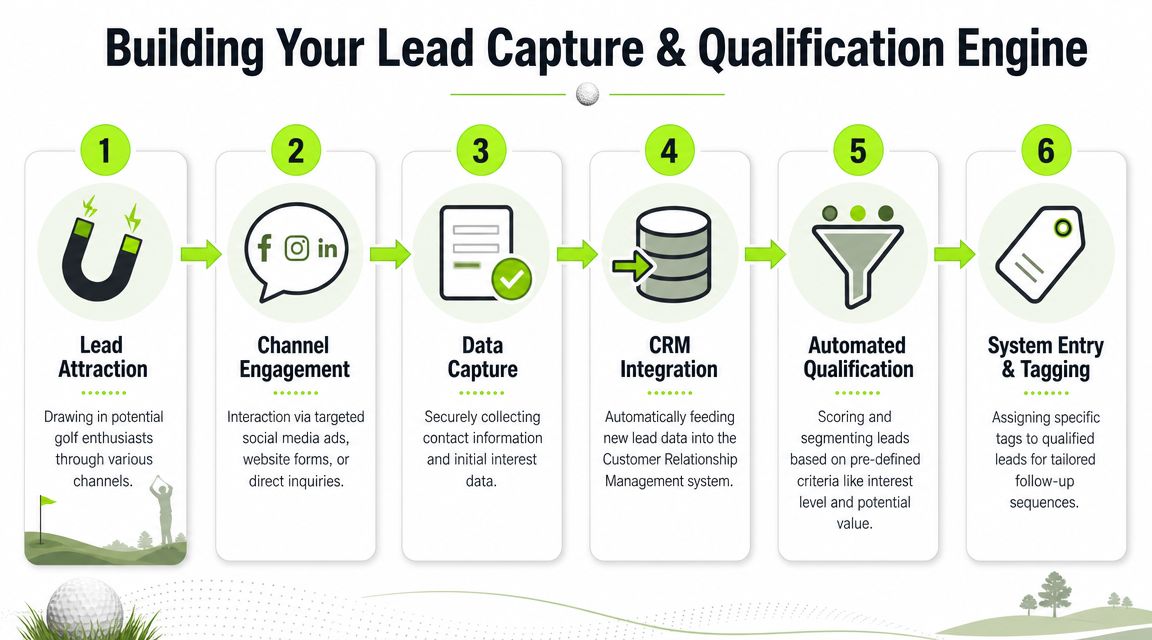
A lead system should work when the office is quiet, when the pro is on the lesson tee, and when nobody has time to chase website notifications. That means joining capture, qualification, and routing into one engine rather than treating them as separate jobs.
Research on lead generation structure points to a three-stage funnel of capture, instant qualification, and CRM-based nurture, and notes that companies with strong lead nurturing generate 50% more sales-qualified leads at 33% lower cost (lead generation statistics compiled by Sopro). For a golf club, the lesson is practical. The enquiry needs a response and next step immediately, not when someone notices it later.
Every channel should feed one place
The club may attract interest from paid social, Google search, website forms, phone calls, referrals, open days, and walk-ins. Operationally, those channels don't matter if each one creates a separate workflow.
That setup breaks fast. Staff can't prioritise properly, reporting becomes guesswork, and leads disappear into personal inboxes or paper notes.
A better model is simple:
- Capture the enquiry
- Push it into one CRM
- Tag it by source and intent
- Trigger the right reply and task
That is the core of a usable golf club lead generation system.
What the capture layer actually needs
Most clubs overcomplicate forms and underbuild process. You do not need a long questionnaire on first contact.
You need enough information to route the lead intelligently:
- Basic contact details so the club can reply quickly
- Enquiry type such as membership, beginner golf, society, coaching, or visitor
- Intent signal such as requested callback, downloadable pack, tour request, or trial interest
- Source data so the club knows whether the lead came from an advert, organic search, referral, or event
A short, clean form will usually outperform a bloated one operationally because staff can act on it faster and automations can segment it without guesswork.
Qualification should happen immediately
Most clubs still think qualification is a phone call someone makes later. In practice, part of it should happen at the point of capture.
That can include assigning tags based on form choice, setting a lead status, scoring urgency from behaviour, and triggering a path based on what they asked for. Someone requesting a club tour is different from someone downloading a membership guide. Both matter, but they should not receive the same handling.
Fast qualification isn't about rejecting leads. It's about deciding the next best action while interest is still live.
Automation proves its effectiveness. Even a straightforward setup can acknowledge the enquiry, send the right information, create a follow-up task, and move the lead into the correct nurture track without waiting on a manual handoff.
If you want a practical model for that stage, GolfRep's guide to AI lead qualification for golf clubs shows how clubs can separate urgency, intent, and fit without turning the process into a technical project.
The first response should do real work
An automated reply should never be a dead-end “thank you” message.
It should confirm receipt, match the enquiry type, and make the next step obvious. For example:
- Membership enquiry gets a short note, a clear timeline for personal contact, and a prompt to book a visit
- Beginner enquiry gets a simple explanation of the starting route, not a full membership brochure
- Society enquiry gets event-specific details and a booking conversation path
The mistake is sending one stock email to everyone and calling that follow-up.
Keep ownership visible
Clubs leak leads when nobody knows who is responsible. A proper engine assigns ownership by rule.
That might mean the membership manager receives tour requests, the pro handles beginner pathways, and society enquiries route to events or admin. The rule itself matters less than the visibility. Staff should be able to open the CRM and see status, next action, and lead age without searching across inboxes.
One mention is enough here: GolfRep builds this kind of CRM-connected capture and routing structure for clubs that need central visibility across forms, calls, and follow-up. The point is not the brand. The point is the architecture.
The Art of the Follow-Up Nurturing Leads to Conversion
Most golf clubs don't lose enquiries because the first reply is terrible. They lose them because nothing coherent happens after the first reply.
One email isn't a nurture strategy. One voicemail isn't a process. The clubs that convert consistently move prospects through a visible path from interest to visit, then from visit to decision.
Industry guidance around golf marketing increasingly points to measurable funnels where the website feeds data into a CRM, enabling automated emails and texts, with lead sources tracked and reviewed through a structured path from visit to enquiry to follow-up to booking to conversion (golf marketing and CRM guidance).
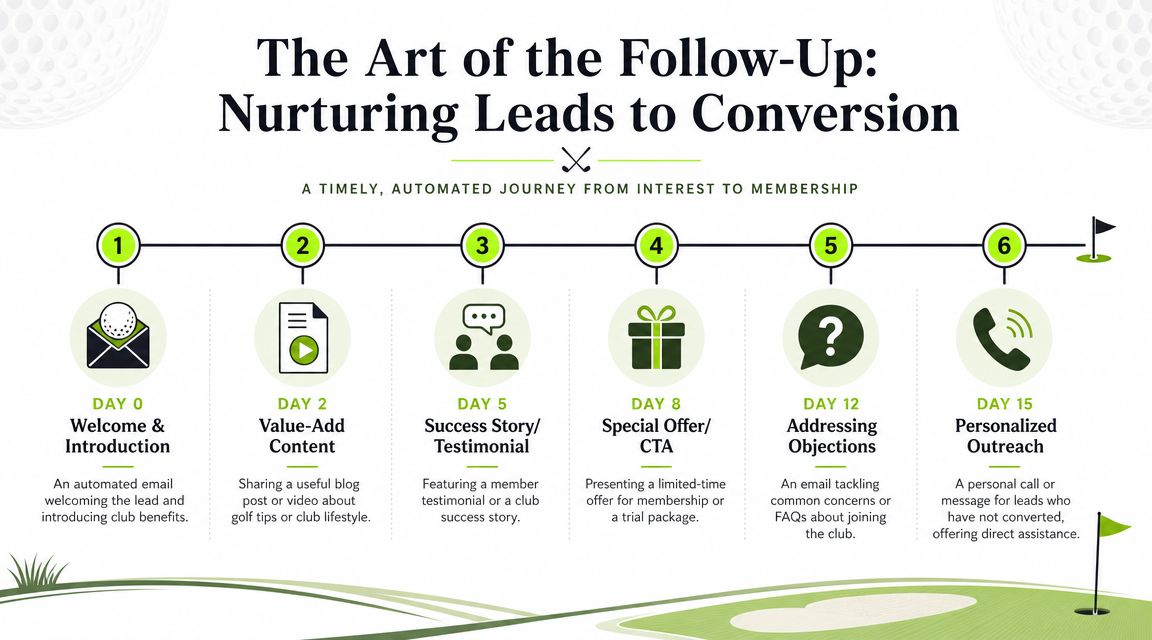
A typical membership enquiry journey
Take a common example. A local golfer submits a form asking about membership after clicking an ad.
On day one, the system sends a brief confirmation, explains what happens next, and offers a clear booking route for a club visit. If they don't book, the next messages shouldn't repeat the same generic pitch. They should reduce uncertainty.
A good sequence might do this over time:
- Early message answers practical questions such as playing access, who the club suits, and how to arrange a visit
- Middle message shows what club life feels like, including competitions, social atmosphere, coaching, or flexibility
- Later message deals with hesitation, often around fit, commitment, or timing, and invites a direct conversation
That's not aggressive selling. It's organised reassurance.
Different enquiries need different nurture
A common pitfall for many clubs is building one email sequence and sending it to everyone.
That creates friction fast.
A beginner lead often needs simplicity, encouragement, and an easy first step. A society organiser needs clarity on dates, format, and logistics. A serious membership shopper usually wants transparency and a reason to visit in person.
Here's the practical test. Read your follow-up and ask, “Would this still make sense if the person had asked about a completely different service?” If the answer is yes, it's probably too generic.
The job of follow-up is not to keep sending messages. It's to move the prospect to the next commitment.
Add automation, then add judgement
Automated nurture works best when it handles consistency and staff handle context.
That means the system should send the first replies, reminders, and value-building messages on schedule. Staff should step in when there is a meaningful signal, such as a booked visit, repeated opens or clicks, a reply with questions, or clear buying intent.
This is also why clubs need a visible status model. New enquiry. Attempted contact. Engaged. Visit booked. Visit completed. Decision pending. Joined. Lost. Without those stages, follow-up becomes guesswork.
For clubs refining this area, GolfRep's article on golf club follow-up systems is useful because it treats follow-up as an operational process rather than a one-off admin task.
What works better than “just checking in”
Most “just checking in” messages add nothing. They ask the prospect to do all the work.
Better follow-up gives the lead a reason to re-engage:
- a specific visit slot
- a clearer starting route
- answers to common joining questions
- a relevant event or open day
- a comparison point that helps them decide
Clubs that do this well don't sound pushy. They sound organised. That alone changes conversion.
Measuring Success From First Click to Recurring Revenue
If a club can't connect enquiry source to outcome, it can't manage budget properly. It can only react to whichever campaign feels busiest.
That's why measurement has to follow the funnel stage by stage. Not just how many leads came in, but which ones became qualified conversations, which ones booked visits, and which ones turned into paying members.
Research on lead-generation measurement highlights the practical benchmark. High-performing companies achieve around a 6% lead-to-customer conversion rate, versus a 3.2% average, and modern lead scoring and automation can produce 75% higher conversion rates than traditional methods. The same guidance stresses that attribution across channels is necessary to calculate true acquisition cost (lead generation KPI benchmarks and attribution guidance).
The KPIs that matter to clubs
A golf club doesn't need a sprawling dashboard. It needs a short set of metrics that answer commercial questions.
| KPI | What It Measures | Why It Matters |
|---|---|---|
| Lead volume by source | Enquiries from each channel | Shows where demand is entering the system |
| Lead conversion rate | Leads that become customers | Reveals whether the system turns interest into revenue |
| SQL rate | Leads judged sales-ready or high intent | Separates raw volume from useful demand |
| Cost per qualified lead | Spend required to create a strong opportunity | Helps compare channels more fairly than cost per click |
| Visit booking rate | Enquiries that become tours, trials, or meetings | Indicates whether follow-up is creating momentum |
| Nurture-to-booking conversion | Leads converted after automated follow-up | Shows whether the nurture system is rescuing delayed decisions |
| Cost per acquisition | Spend to win a member or customer | Tells you if campaigns are commercially viable |
| Recurring revenue visibility | Revenue tied back to source and campaign | Helps justify budget decisions over time |
What to ignore or downgrade
Clubs often overvalue clicks, impressions, and social engagement because those numbers arrive first.
They're not useless. They're just incomplete.
A campaign with lower click volume can still be the better channel if it produces more booked visits and more signed members. A busy open day can still be inefficient if nobody tracked who came, what they wanted, and what happened next.
A lead source isn't good because it creates activity. It's good because it creates outcomes you can trace.
Attribution needs clean setup
Attribution sounds technical, but the basic requirement is straightforward. The club must know where each enquiry came from and what happened after it entered the CRM.
That means using campaign tracking consistently, keeping forms connected to the CRM, and logging offline leads in the same system rather than keeping them outside reporting. Clubs that want stronger web attribution can also enhance analytics growth with GA4, which is useful when you need clearer visibility from site visit to form completion.
Review rhythm matters as much as the data
A dashboard nobody checks won't improve results.
The clubs that get value from reporting usually review weekly at an operational level and monthly at a budget level. Weekly answers: Are leads being contacted, booked, and progressed? Monthly answers: Which channels are producing qualified demand at an acceptable cost?
That discipline stops marketing from becoming opinion-led. It also makes committee conversations easier because the discussion moves away from taste and towards evidence.
Common Pitfalls and Your System Launch Plan
Clubs rarely have a lead problem in isolation. They usually have a handling problem.
Enquiries come in, then the day gets busy. The phone rings. A visitor arrives. Someone is covering the office. By the time the team returns to that form submission, the prospect has gone cold or booked elsewhere. That is the operational bottleneck for many understaffed clubs, and it is why a decent campaign can still produce disappointing membership results.
As noted earlier, participation interest exists. The harder part is turning that interest into visits, conversations, and signed members with a process staff can maintain.
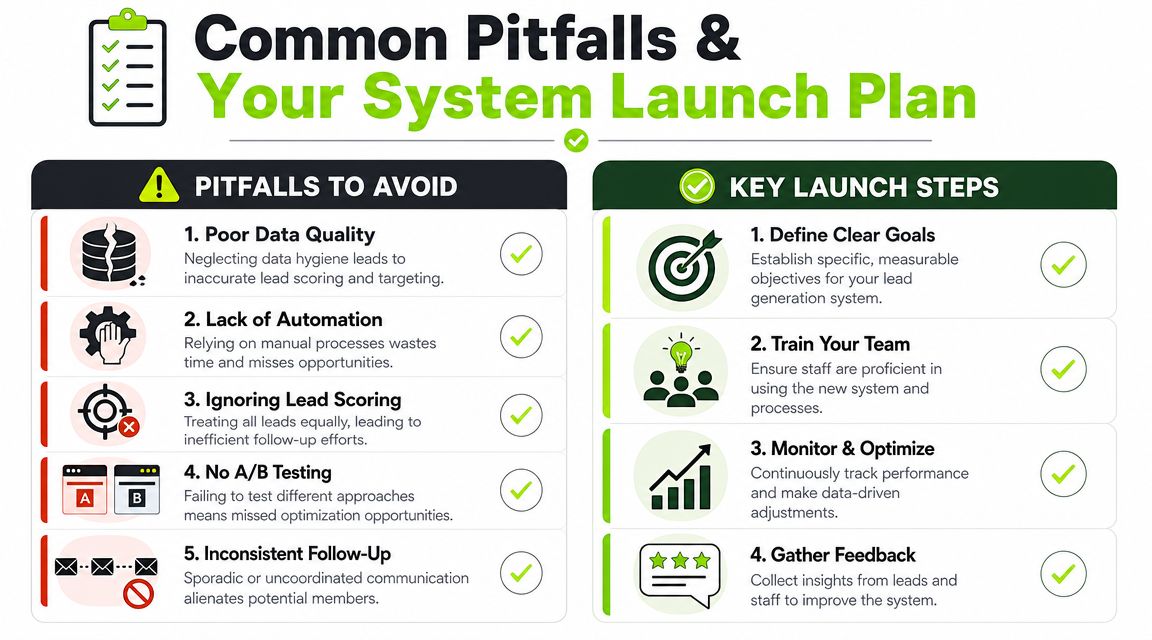
Five Mistakes That Kill Conversion
These are the failures I see repeatedly when a club says, "we are getting leads, but not enough of them turn into anything."
- Dirty CRM data: If source fields, statuses, and notes are inconsistent, staff stop trusting the system. They keep separate spreadsheets, inboxes, or scraps of paper, and visibility disappears.
- Manual follow-up as the default: A personal call matters. Relying on memory and spare time to trigger every response does not scale when the office is stretched.
- One path for every enquiry: A membership prospect, a beginner, and a society organiser do not need the same message, the same timing, or the same next step.
- Automation with no human judgement: Templates save time, but generic responses can make a warm enquiry feel processed rather than welcomed.
- No named owner: If nobody owns each stage, leads sit in limbo. Clubs then blame the campaign, even though the leak happened after capture.
Those are process issues. They sit inside operations, staffing, and ownership.
That distinction matters because changing ads will not fix a club that responds late, records poorly, or leaves follow-up to chance.
Your launch plan should be short and strict
A good launch is not large. It is controlled.
Start with one commercial objective and one manageable workflow. In practice, that means choosing a single priority such as membership enquiries or beginner journeys, then building the handling process around that before adding anything else. Clubs that try to launch every enquiry type at once usually create complexity faster than staff can absorb it.
A practical launch sequence looks like this:
Set one priority outcome
Pick the result that matters first. Membership leads, trial visits, academy sign-ups, or society bookings.Map the enquiry routes
Define what happens when each lead type arrives. Who gets notified, what the prospect receives, and what task is created.Keep CRM stages simple
Use stages the whole team can understand at a glance. New, contacted, booked, attended, won, lost is often enough to start.Build the first response
Every enquiry should get an immediate acknowledgement with a clear next step. That buys time for the team without leaving the prospect in silence.Assign ownership by stage
Put a name against each handoff. If a lead needs a call, booking, or follow-up, one person must be accountable.Test the full journey
Submit the forms. Check the tags, emails, tasks, notifications, and CRM updates. Do it from a prospect's point of view, not just an admin view.Review in week one
Look for stuck leads, missed notifications, weak messaging, and handoff delays. Small fixes early prevent a month of waste.
If staff need a long explanation to follow the process, the process is too complicated.
Keep committee complexity out of the live process
This is a common failure point in member-led clubs. Too many people want to approve wording, timing, pricing, and exceptions after the system is already running.
That slows response times and creates inconsistent handling. Prospects do not see the internal debate. They see a delayed reply, no reply, or three different replies from three different people.
The better approach is simple. Agree the rules once. Approve the initial sequence. Set boundaries for offers, tone, and escalation. Then let staff run the system and review results on a schedule. Committees should govern the framework, not interfere with daily lead handling.
The standard you should hold
A lead generation system is ready when it does three things every time:
- Captures every enquiry
- Responds fast
- Makes the next action obvious
If one of those fails, the club does not have a finished system. It has a campaign sitting on top of operational gaps.
If your club is already getting enquiries but too many stall before a visit or a membership conversation, GolfRep helps clubs put the handling side in order. That includes lead capture, follow-up structure, and CRM visibility that staff can manage day to day.
Ready to tap into our proven growth system?