Golf Club Influencer Marketing: A UK Guide for Clubs

England's golfers submitted 10,213,894 World Handicap System scores in 2024, the highest annual total since the system launched, according to Golf News. That's evidence of golfing activity, not evidence that paying a creator will fill your membership vacancies.
For a club manager, the useful question is whether a creator can persuade suitable golfers to visit, enjoy the experience and return. At GolfRep, we judge golf club influencer marketing by commercial outcomes, with clear advertising disclosure treated as a control that protects both the club's reputation and its budget.
Why Local Golfers Are Worth Reaching Through Creators
In 2024, England had approximately 1,735 affiliated golf clubs and 730,000 club members, alongside more than 55,000 iGolfers who submitted nearly half a million scores without belonging to a club, according to the Golf Club Managers' Association. Those independent golfers are a useful audience: they already play, but haven't necessarily found a membership proposition that suits them.
National participation doesn't define your market. A golfer who admires your course online but lives beyond a practical travelling distance is unlikely to become a regular member.

Start with the journeys golfers will actually make
Map your catchment using existing member postcodes, visitor bookings and realistic driving routes. Account for commuting patterns and access: a club that looks close on a map may be inconvenient for an evening round.
Then answer these questions:
- Who can reach you? Identify local independent golfers, beginners and existing players whose preferred playing times match your available capacity.
- What do they watch? Look for course tours, coaching clips, social golf and local recommendations rather than assuming everyone follows tournament content.
- What stops a first visit? Address equipment, dress expectations, playing ability, welcome arrangements and joining costs.
Members can provide particularly credible testimonials because they can describe ordinary club life, not just a hosted filming day. Ask them to explain why they joined and what surprised them, rather than repeat promotional slogans.
For practical help finding candidates, JoinBrands' guidance on how to vet nearby content creators offers a starting point for local discovery. Treat a creator's location as an initial filter, not proof that their followers live nearby.
This week, build a catchment shortlist. Estimate its golfing audience from your own records and available local information, label any estimates transparently, and match creator formats to the offer you can deliver.
Choosing the Right Type of Golf Creator
Creator types and where each fits a golf club
| Creator type | Audience location | Best use | Main risk |
|---|---|---|---|
| National golf personality | Spread across the UK | Brand awareness and course content | Weak local relevance to a single club |
| Regional golf creator | Concentrated in one region | Beginner sessions and course tours | Catchment may only partly overlap the club |
| Local micro-creator | Close to the club | Visits, taster rounds and local enquiries | Smaller reach per post |
| Club-linked creator, such as a member or PGA professional | Club catchment and members' networks | Testimonials and coaching content | Disclosure and conflict-of-interest rules apply |
Choose the creator for the buying decision you want to influence. A national personality might suit a destination course selling golf breaks, while a regional course reviewer could be a better fit for weekday visitor golf.
For membership, practical proximity matters. A smaller creator whose followers can regularly use your tee sheet may generate more useful conversations than a well-known account with little local relevance.
Compare like with like
Heepsy's UK golf TikTok ranking reports average engagement of 5.7% among its listed creators. That's a platform-specific reference, not a performance promise or a sensible pass mark for every account.
Compare creators on the same platform, using similar formats and consistent reporting periods. Check whether comments show genuine interest in playing, visiting or learning, rather than reacting to a trick shot.
Selection rule: Choose the audience you can serve, then the storyteller who can make the experience understandable.
Build a longlist, remove creators whose audiences sit mainly outside your catchment, then test three suitable creators using different formats. That's a proposed test design, not an industry benchmark.
Request platform-native screenshots or exports showing audience geography, reach, saves, shares and link clicks. Ask for recent examples, not just their best-performing post, and agree how they'll report results before signing.
Keep creator partnerships distinct from routine club publishing. Your own channels still need accurate opening information, current course conditions and useful member content; our guide to golf club social media marketing explains that broader role.
Keeping Creator Content Compliant With ASA Rules
Sponsored content must be obviously identifiable as advertising. The ASA's guidance on recognising social media ads covers payment, incentives and relevant personal or commercial connections, so complimentary rounds, coaching, hospitality or membership benefits shouldn't be treated as disclosure-free alternatives to cash.
Agree an upfront Ad label. Don't accept vague descriptions such as gifted, aff or I work with them as your default disclosure, and don't bury the relationship beneath the caption.
Disclosure requirements by creator arrangement
| Situation | Disclosure needed | How long it applies |
|---|---|---|
| Free product, complimentary round or hospitality | Upfront label such as Ad on the content | For the campaign and any content arising from it |
| Paid fee or commission | Upfront label on every relevant post | Throughout the commercial relationship |
| Recurring tee times, ambassador status or free practice | Label on every relevant post, including later reviews | Throughout the relationship and for 12 months after it ends |
| Discounted or free membership offered to a creator | Clear advertising label, not a buried disclosure | Throughout the relationship and for 12 months after it ends |
| Creator is a member, employee or volunteer linked to the club | Disclosure of the connection and any benefit received | While the relevant connection or benefit applies, with post-relationship rules checked |
The post-relationship periods above reflect the ASA's influencer guide, which expects disclosure for relevant content for 12 months after a commercial relationship ends. An ordinary member posting independently isn't automatically the same arrangement as a paid ambassador, so record the actual relationship rather than relying on a job title.
Put responsibility in writing
An ASA and CMA disclosure report found that approximately 57% of assessed UK Instagram and TikTok influencer content would likely be adequately disclosed. A biography or earlier advertising post doesn't cover subsequent content.
Your contract should specify:
- Fact approval: The club checks prices, availability, membership conditions and facility descriptions.
- Editorial boundaries: Creators retain their own voice and aren't required to make scripted claims about outcomes.
- Monitoring ownership: A named person checks every agreed platform and requests corrections.
- Benefits and dates: Record cash, access, hospitality, discounts and the relationship's start and end.
Social Cloud's influencer marketing compliance checklist can help organise the operational checks, alongside the ASA guidance.
Before publication, the committee or delegated manager should approve the arrangement, disclosure wording, factual claims and correction process. Authenticity means an honest account with transparent sponsorship, not concealed advertising.
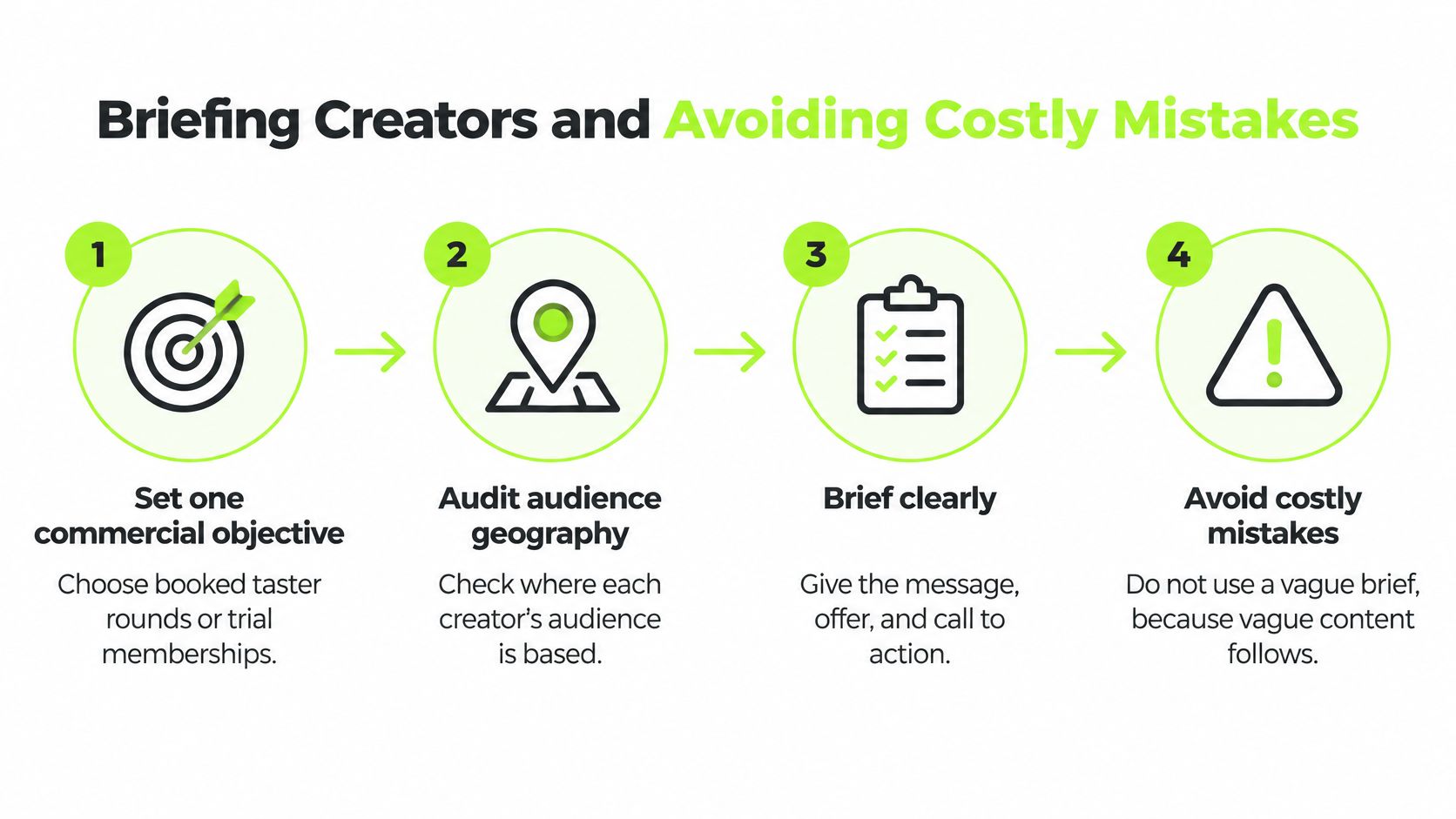
Briefing Creators and Avoiding Costly Mistakes
- Set one commercial objective. Choose booked taster rounds, trial memberships or another specific outcome. Don't ask a single campaign to sell membership, fill the restaurant and promote every society package.
- Audit the audience before agreeing a fee. Check geography, recent reach and follower authenticity. Platform insights establish audience location; authenticity checks may also require a specialist audit.
- Prepare creator-specific tracking. Give each partner a dedicated landing page or booking code, supported by UTM parameters that identify the creator and content.
- Brief the enquiry team. Explain the advertised promise, eligibility, availability and CRM source-tagging rules. Test the booking journey together.
- Schedule a review. A recommended first review after 30 days gives the club an early decision point, although membership outcomes may need longer to mature.
A vague brief produces vague content. The creator should know what a suitable prospect looks like, what that person should do next and what the club will provide when they arrive.
What the finished brief needs
- Objective and audience: The desired booking, catchment and relevant golfing experience.
- Deliverables: Formats, publication dates, follow-up content and reporting requirements.
- Offer and logistics: Price, capacity, equipment, weather arrangements and named club contact.
- Measurement: Tracking links, booking codes, CRM tags and review date.
- Commercial controls: Fee, expenses, usage rights, disclosure wording and approval boundaries.
Cost the whole arrangement, not just the invoice. Include staff hosting time, hospitality, editing requests and any tee time that could otherwise have been sold.
Separate the creator's publication fee from permission to reuse their footage. Agree whether the club can publish it organically, use it in paid advertising, edit it or retain it after the partnership ends. Don't assume paying for a post transfers ownership of the content.
Mistakes and their fixes
- Flat fee with no tracking: A fixed fee can be sensible, but agree evidence of delivery and a measurable booking route before payment.
- An over-scripted performance: Provide factual message points and required disclosures, then let the creator explain the experience naturally.
- A single post with no continuation: Commission a coherent sequence, such as preparation, the visit and answers to audience questions.
- A discount aimed at everyone: Describe the value and suitable customer clearly instead of attracting golfers who only want the cheapest available round.
- Unrestricted filming: Agree where cameras can go, obtain appropriate permissions and protect members who don't want to appear.
A creator should be free to describe the experience honestly. The club should remain responsible for the accuracy of the offer.
Keep weather and course availability in the agreement too. If temporary greens or closures undermine the promised experience, rescheduling may be commercially wiser than publishing content that sets the wrong expectation.
Tracking Enquiries, Visits and Members
Funnel stages to record for each creator
| Funnel stage | What to record | Where it comes from |
|---|---|---|
| Attributed reach | Views, reach, saves and link clicks by creator | Platform insights and UTM links |
| Landing-page conversion | Visits to the creator's page and form completions | Web analytics |
| Qualified enquiry | Enquiries that meet the club's criteria, tagged by creator | CRM source field |
| Booked visit | Taster rounds or visits booked with the creator's code | Booking system |
| Membership sale | Joining applications and payments by creator source | CRM and membership system |
| 90-day retention | Members still active three months after joining | Membership system |
Use 90-day retention as a recommended reporting checkpoint, not an industry performance standard. Keep membership status and actual playing activity separate: someone can remain subscribed without establishing a habit of visiting.
A Modash UK golf creator benchmark reports median engagement of approximately 0.62%, median video views of 178,700 across profiled accounts, and examples of fake-follower rates as high as 18.82%. These describe the profiled accounts, not results your club should expect.
Calculate the cost of a useful action
Define a qualified enquiry before launch. For membership, it might mean a contactable golfer within the agreed catchment who wants a suitable membership category and understands the indicative price.
Illustrative calculation, not a quoted creator rate: a fee of £600, producing 12 qualified enquiries, gives a fee-only cost of £50 per qualified enquiry. Add hosting, production and other campaign costs before comparing the fully loaded figure with another acquisition channel.
Cost per impression can help assess distribution efficiency. It can't tell the committee whether the club reached people who could realistically buy.
Record attendance as well as bookings. A creator who generates reservations that nobody honours creates a different commercial result from one whose audience arrives and pays.
For managers setting up consistent reporting, Trackingplan's guide to marketing measurement provides useful broader context. Within the club, keep definitions fixed so different campaign reports remain comparable.
Separate attribution from additional business
A tracked booking tells you which route someone used. It doesn't prove that the campaign caused a booking that wouldn't otherwise have happened.
Compare creator-exposed postcodes or campaign periods with similar areas or periods without activity. Account for weather, seasonality, open competitions and other advertising before attributing a change to the creator.
Use consistent attribution rules when someone watches a creator, later searches for the club and finally books by telephone. Preserve the recorded journey rather than letting whichever channel appeared last claim everything.
Budget decision: Pause partnerships that repeatedly produce attention without bookings. Reinvest when suitable golfers progress to attended visits and commercially worthwhile purchases.
Review retained membership revenue and contribution, not just applications. A high joining rate achieved through an unsuitable offer can still leave the club with poor returns once servicing costs and cancellations are included.
Designing the Offer Creators Send People To
A creator introduces the experience; the club must give viewers a clear, credible reason to book. Match the offer to their readiness rather than sending everyone straight to a full membership application.
| Offer | Who it suits | What the club must prepare |
|---|---|---|
| Introductory round or taster | Golfers assessing the course | Suitable tee times, welcome arrangements and clear price |
| Open day | People comparing membership options | Hosts, tours, joining information and sufficient capacity |
| Trial membership | Regular golfers testing club fit | Defined access, booking rights, end date and joining terms |
| PGA-led beginner session | New or returning golfers | Coach, equipment, practice space and a progression route |
Make the booking page match the promise
Use a headline that reflects the creator's invitation. Follow it with what happens on the day, who it suits, the full price and what's included.
Ask only for information needed to organise the visit. Capture the creator's tracking code automatically where possible, and explain any separate marketing opt-in clearly.
Say a beginner-focused creator promotes a Saturday morning adult taster session. The page should identify the PGA professional, confirm equipment is provided, explain where to arrive and make clear that previous club membership isn't required.
The club then needs reserved practice capacity and a host who recognises the advertised experience. Sending beginners into a busy competition morning without guidance would undermine an otherwise well-matched campaign.
Sell a reassuring first experience, not merely a cheaper version of your usual product.
Use our guidance on golf club membership offers when defining trial access and the next joining step. Protect the value of membership by explaining its benefits rather than relying on a headline reduction.
If visits increase but the joining rate falls, review the welcome, playing experience and membership fit before increasing creator spend.
Deciding Whether to Run a Creator Pilot
Start with a recommended 90-day pilot, using three creators across suitable catchment areas or formats, a fixed budget and an agreed cost-per-qualified-enquiry threshold. These are proposed operating parameters, not promised results.
Set the threshold from what the club can afford to acquire a member, allowing for the proportion of enquiries that become paying members. Don't copy another club's target without understanding its pricing and margins.
Give the committee clear decision points
- At 30 days: Review attributed reach, landing-page conversion and qualified enquiries. Investigate weak audience fit or a confusing booking page.
- At 60 days: Examine booked visits, attendance and membership sales. Continue testing where visits are credible but joining needs improvement.
- At 90 days: Assess sales and early retention signals. Full retention checkpoints will only be available once each joining cohort has matured.
Scale when qualified enquiries cost less than the agreed threshold and attended visits follow. Pause creators producing views without bookings, and move available budget towards stronger performers.
GolfRep uses data-led campaigns to target prospects matching a club's ideal member profile. We help clubs implement a structured pipeline strategy for year-round member acquisition, combining targeted advertising and nurture automation with visibility from first contact to membership.
The first action is simple: write the pilot objective, budget and acceptable acquisition cost before approaching a creator. Fix the weakest stage before expanding the commitment.
GolfRep helps clubs connect targeted demand generation with sales processes, CRM, conversion and retention. If you're considering creator partnerships, visit GolfRep to discuss how to build a measurable pilot around your catchment, membership proposition and commercial targets.
Ready to tap into our proven growth system?