Golf Club CRM Software: A Guide for Growth in 2026
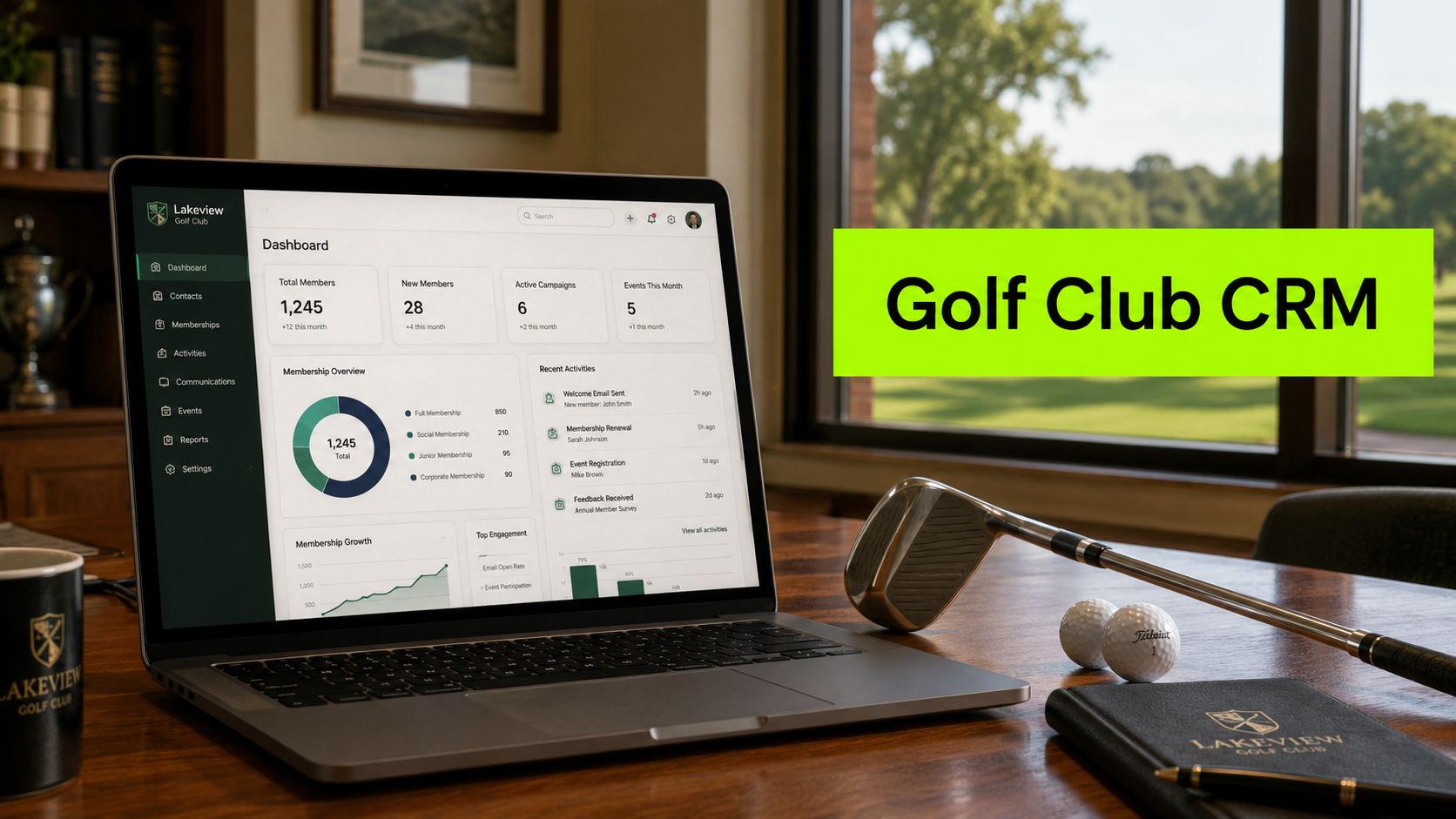
Most advice about golf club CRM software starts in the wrong place. It starts with features, dashboards, automations, and promises of better marketing. That misses the actual problem inside most clubs.
A club rarely stalls because nobody is interested. It stalls because enquiries sit in a shared inbox, follow-up depends on whoever happens to be in the office, and nobody can see what happened after the first message. The software question matters, but the operational question matters more. Who owns the lead, who responds, who chases, and who checks whether any of it happened?
That is why a sensible conversation about golf club CRM software has to begin with club reality. Not product demos. Not generic sales claims. Just the truth about how enquiries, tours, renewals, and member communication are handled when the office is busy and committee time is limited.
Your Club's Problem Is Not a Lack of Enquiries
Most clubs say they need more leads. In practice, many need better control of the leads they already have.
A membership enquiry comes in through the website on a Tuesday afternoon. The office is dealing with visitor bookings, a supplier call, and a member complaint. The email gets flagged for later. Later becomes tomorrow. Then someone forwards it to the secretary, the professional, or a committee member. By that point, the prospect has already made another enquiry elsewhere.
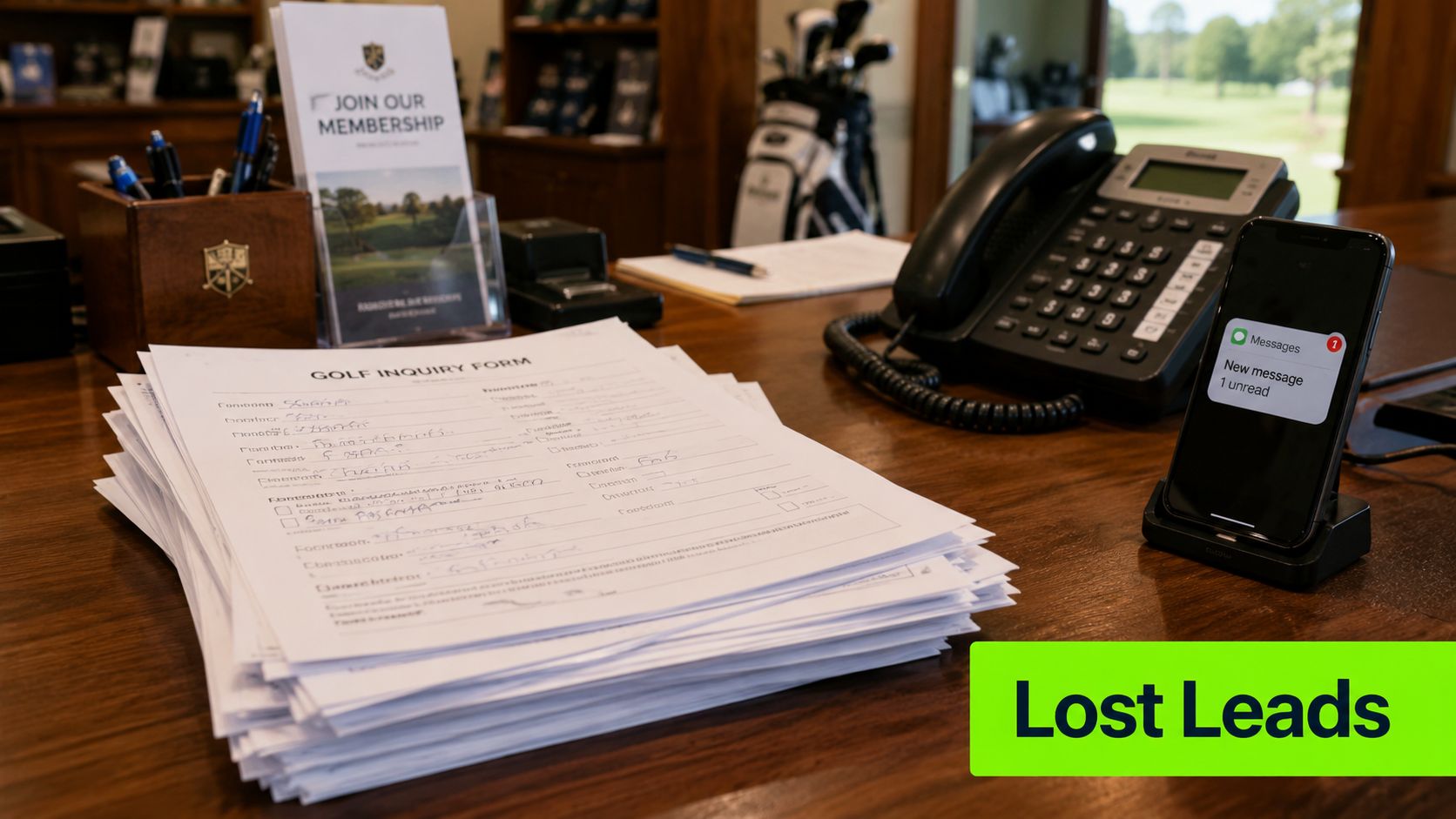
That is the primary leak. Not awareness. Not reach. Not ad spend. Handling.
Where clubs usually lose momentum
The failure points are usually predictable:
- Inbox dependency: One person sees the enquiry, but nobody owns the next step.
- No response standard: Some prospects get a quick reply, others wait far too long.
- No visibility: The committee asks how many membership enquiries came in, and nobody can answer confidently.
- No follow-up structure: A prospect who does not book a visit straight away disappears.
A spreadsheet does not solve this. A shared mailbox does not solve it either. Both can store information, but neither creates accountability.
Practical rule: If your club cannot see every live enquiry and its current status in one place, you do not have a pipeline. You have a list.
This is why clubs often underestimate how much they lose through poor response handling. The issue is not just lead volume. It is lead visibility, response time, and whether anyone follows through consistently. If you want a useful breakdown of how this happens in day-to-day club operations, GolfRep's piece on how most golf clubs lose enquiries without realising is worth reading.
The committee mistake
Committees often treat growth as a marketing problem because marketing feels visible. You can approve a campaign, redesign a page, or discuss pricing. Process work feels less exciting, so it gets ignored.
But the club that answers properly, tracks every enquiry, and follows up in a disciplined way usually outperforms the club that generates more interest and handles it badly.
What Is Golf Club CRM Software?
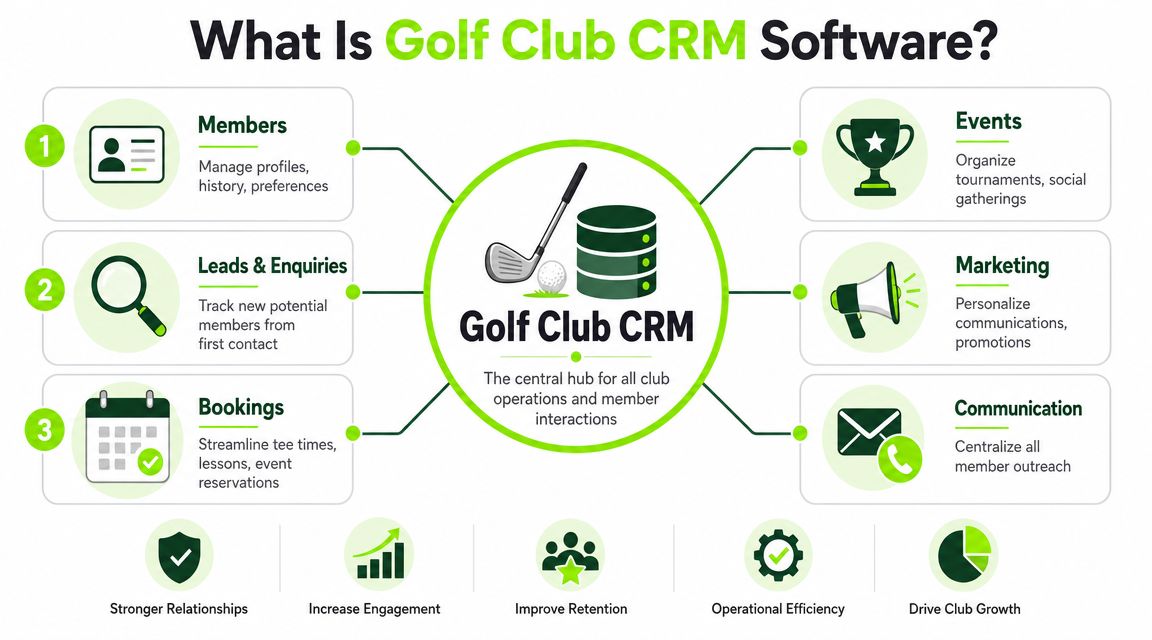
Golf club CRM software is the system that holds your club's commercial and membership relationships in one working process. It records who the person is, what they have asked for, what they have booked, what they have been sent, and what needs to happen next.
That definition matters because many clubs buy CRM software expecting better results, then use it as a storage tool. If nobody updates stages, records calls, or owns follow-up, the club has bought another database. The software only becomes useful when it fits the way the club operates, especially where staff time is limited and committee members are helping part-time.
One record the whole club can trust
A workable CRM gives the club one customer profile instead of scattered records across inboxes, tee sheets, EPOS, and spreadsheets. That means the membership secretary, general manager, and front-of-house staff can all see the same person, the same history, and the same outstanding actions.
For smaller clubs, that single record is where the value starts. It reduces duplicated admin, cuts down on missed context, and makes handovers far less risky when volunteers change roles or a staff member is off. If you want a useful comparison of lightweight systems that smaller organisations can maintain, Prometheus Agency's free CRM review is a reasonable starting point.
A good CRM also makes segmentation practical. The club can separate prospective members from current members, lapsed members, visitors, society contacts, and coaching leads based on actual behaviour and status, not guesswork.
What a CRM does inside a club
At club level, a proper CRM usually handles work such as:
| Function | What it means in practice |
|---|---|
| Enquiry capture | Website forms, calls, and email enquiries are logged in one place |
| Pipeline tracking | Staff can see who is new, who was contacted, and who needs action |
| Member records | Contact details, notes, renewal timing, and interaction history sit in one profile |
| Communication logs | The club can see what was sent, by whom, and what happened next |
| Segmentation | Messages go to the right group based on status, interest, or behaviour |
The point is not the feature list. The point is control.
When a club uses a CRM properly, routine questions stop causing disruption. Who spoke to this prospect last? Which trial member is due a follow-up call? Which lapsed members have not been contacted? A manager should be able to answer those questions in minutes, not by chasing three people and opening two spreadsheets.
What a CRM is not
A CRM does not fix weak ownership. It does not create discipline on its own. It does not help if the club picks a system that looks impressive in a demo but is too awkward for the people who must run it every day.
That is the part software articles often skip. For a volunteer-led or resource-constrained club, the best CRM is usually the one the team will keep updated, not the one with the longest feature list.
Why Spreadsheets Are Costing Your Club Members
Many clubs keep using spreadsheets because they feel cheap, familiar, and flexible. On the surface, that seems sensible. In reality, spreadsheets hide cost rather than remove it.
The UK golf market is large enough that manual systems are no longer viable. England Golf reported 762,742 affiliated members in 2023, with 98% belonging to one of more than 1,800 clubs, which underlines why membership, renewals, and communication need proper digital infrastructure rather than ad hoc tracking in files and inboxes, as noted in this golf CRM market overview.
Where spreadsheets break down
A spreadsheet can hold names and notes. It cannot manage a living pipeline properly.
Here is what usually happens:
- Updates depend on discipline: If staff are busy, entries are missed or delayed.
- Follow-up becomes invisible: A lead may be marked as contacted, but nobody can see the quality or timing of that contact.
- Reporting is weak: Managers and committees get snapshots, not real-time visibility.
- Member communication stays broad: Clubs cannot easily separate new enquiries, active members, lapsed members, and visitors with different interests.
That last point matters more than many clubs realise. If the system cannot support targeted communication, the club ends up either sending generic messages to everyone or sending nothing at all.
Manual systems create false confidence
The biggest risk with spreadsheets is that they create the illusion of control. The data exists somewhere, so the club assumes the process is working.
It often is not.
A prospect may be on row 84 of a sheet with a note saying "call next week". Nobody checks whether that happened. Another contact might sit in a separate inbox thread. A renewal reminder may depend on someone remembering to run through a list manually. None of that is reliable.
Clubs rarely lose members because a spreadsheet is ugly. They lose them because manual systems make consistency impossible.
If your club is still comparing low-cost tools before committing to a platform, broad business resources can help narrow the field. For example, Prometheus Agency's free CRM review is a useful starting point for understanding the trade-offs between lightweight CRM options and more structured systems.
The cost is operational, not just technical
A poor system costs your club in four ways:
- Slow response handling
- Missed follow-up
- Weak reporting
- Generic member communication
None of those problems show up neatly on a software budget line. They show up as tours not booked, enquiries not converted, renewals handled late, and staff spending hours checking what should already be clear.
Key CRM Features That Drive Membership Growth
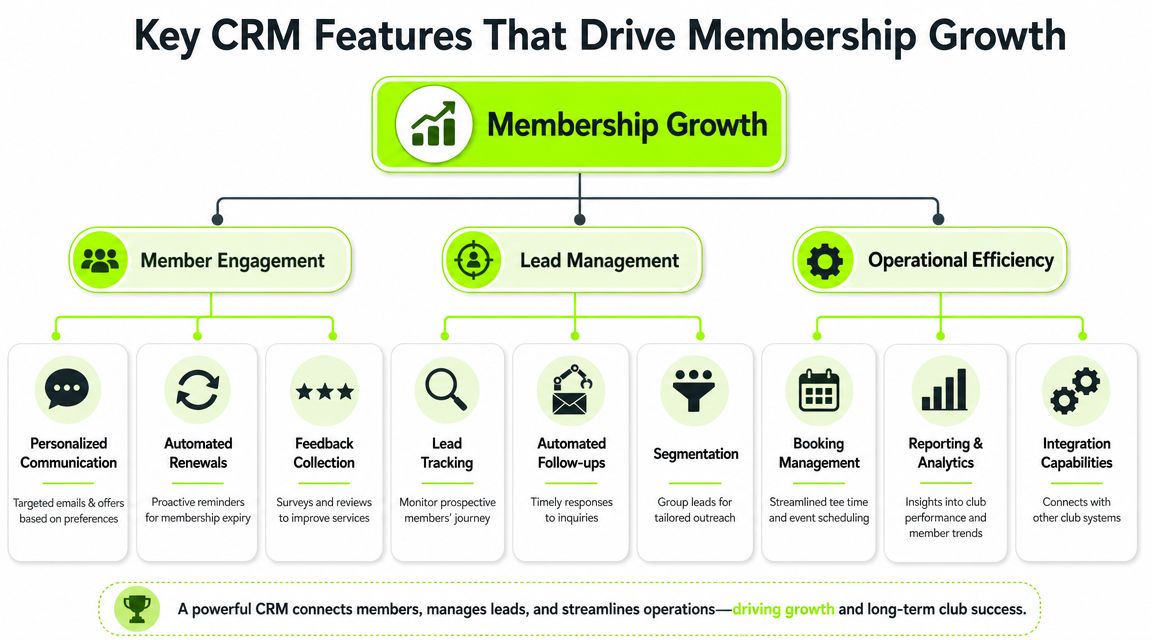
Most golf club CRM feature lists are written for software buyers, not for clubs trying to convert more enquiries with a small team and limited time. The useful features are the ones that stop prospects going quiet, help staff pick up where someone else left off, and give management a clear view of what is happening.
Start with one usable record
A CRM only helps if everyone works from the same member or prospect record.
That record should hold enquiry source, contact details, tour status, notes from calls, visit history, renewal dates, and past communication in one place. If those details sit across inboxes, spreadsheets, and booking tools, staff waste time checking what happened last, and prospects get inconsistent follow-up. Clubs feel this most when office cover changes or a volunteer hands work over without context.
One clean profile does not sound exciting. It is still the base requirement. Without it, segmentation is poor, reporting is patchy, and automation runs on incomplete information.
Features that improve conversion and retention
The strongest CRM setups in golf clubs usually rely on a short list of functions used properly every day.
Lead and enquiry tracking
Every new enquiry needs a status that can be reviewed at a glance. Enquired, contacted, invited to visit, toured, proposal sent, joined, or lost. If a manager cannot see where prospects are sitting, the club cannot manage conversion properly.Task assignment and reminders
Good systems create a next action, not just a record. If someone needs to call a visitor lead on Tuesday or chase a tour that has not been booked, the CRM should put that task in front of the right person.Communication history
Staff should be able to open a record and see the last email, the last call note, and any promises made. That matters in golf clubs because membership sales often involve several conversations over weeks, sometimes with different people involved.Segmentation
Clubs need to separate prospective members, current members, lapsed members, society organisers, and casual visitors. Sending the same message to all of them usually lowers response and makes the club look disorganised.Useful reporting
Management needs simple answers quickly. Which enquiry sources produce tours? How long does first response take? Where are prospects stalling? Reports should help a club make decisions, not just fill a dashboard.
What to prioritise and what to ignore
Clubs often overbuy.
A feature is only valuable if someone will keep it updated and use it during the working week. That is why straightforward pipeline stages, reminders, and communication logs usually do more for membership growth than heavily customised fields or dozens of reports nobody checks.
| Feature type | Usually valuable | Often overrated |
|---|---|---|
| Growth focused | Enquiry capture, pipeline stages, follow-up automation, segmentation, reporting | |
| Operationally useful | Renewal workflows, member notes, calendar tasks, communication logs | |
| Often overbought | Complex custom fields, excessive dashboards, features nobody will maintain |
A practical test helps here. If a feature does not help the club respond faster, follow up on time, or send more relevant communication, it should not sit near the top of the buying list.
Automation should reduce missed actions
Automation matters, but only in places where the club already knows what should happen next.
If a prospect submits a membership enquiry, the system should send a confirmation, assign an owner, and create a follow-up task. If that prospect has not booked a visit after the first contact, the CRM should prompt the next call or email. If a member is approaching renewal, the system should trigger the right reminder at the right point.
Used well, automation reduces the number of prospects who disappear because nobody picked up the next action. The process behind golf club automated follow-up is a good example of how clubs turn scattered enquiries into a managed pipeline.
The key point is simple. The best CRM features are the ones your club can keep running consistently, even when the office is busy and the same two or three people are covering everything.
The Real Challenge Is Implementation Not Features
Buying software is the easy part. Running it properly inside a golf club is where most of the difficulty sits.
This is especially true for clubs with lean office teams, part-time staff, or volunteer-led committees. Product pages usually focus on capability. They rarely answer the practical questions that determine whether the system survives the first few months.
The questions most clubs should ask first
Before choosing any platform, ask:
- Who owns new enquiries each day
- Who updates records after calls or visits
- Who checks that follow-up tasks were completed
- Who handles renewals inside the system
- Who keeps data clean when staff change or volunteers rotate
If nobody can answer those questions clearly, the issue is not software selection. It is process ownership.
The key gap in a lot of UK golf advice is operational capacity. Guidance often talks about what CRM can do, but does not deal properly with the workload and governance needed to keep it useful. The more useful conclusion is that the best system is often the one with the lowest ongoing operational burden and the clearest rules for staff and volunteers, as highlighted in the PGA's guidance on CRM and revenue processes.
Why feature-rich often fails
Clubs are often tempted by bigger systems because they seem safer. More features feel like more value.
But if the platform needs constant manual updating, lengthy training, or complicated administration, adoption drops quickly. Then the club ends up back in email threads and side spreadsheets, except now it is paying for software too.
A simpler system with clear stages, obvious task ownership, and limited room for process drift usually performs better than a powerful system nobody maintains.
The right CRM is the one your club can still run properly in the middle of a busy week, not the one that looks best in a demo.
Adoption is a management issue
Implementation succeeds when management treats the CRM as part of club operations, not a side project. That means agreed response standards, clear handoffs, and regular checks on pipeline movement.
If a CRM is introduced without those basics, it will become a digital filing cabinet. Clubs do not need another filing cabinet. They need a working system.
Putting Your System to Work Practical Automation
A good CRM should remove repetitive admin and make the next action obvious. That is where automation earns its keep.
By centralising member data and interaction history, golf club CRM software can automate workflows for renewals, billing, and reporting, which reduces spreadsheet administration and minimises human error in key membership processes, as explained in this member management software guidance for golf and country clubs.
What manual follow-up looks like
A prospect fills in a membership form.
Someone receives the email. It sits for a while because the office is busy. A reply eventually goes out, often written from scratch. If the prospect does not reply, there may or may not be a follow-up. If they book a visit, the details go into a diary or inbox. After the tour, another staff member may not know what was discussed.
Nothing is technically impossible in that process. It is just fragile.
What practical automation looks like
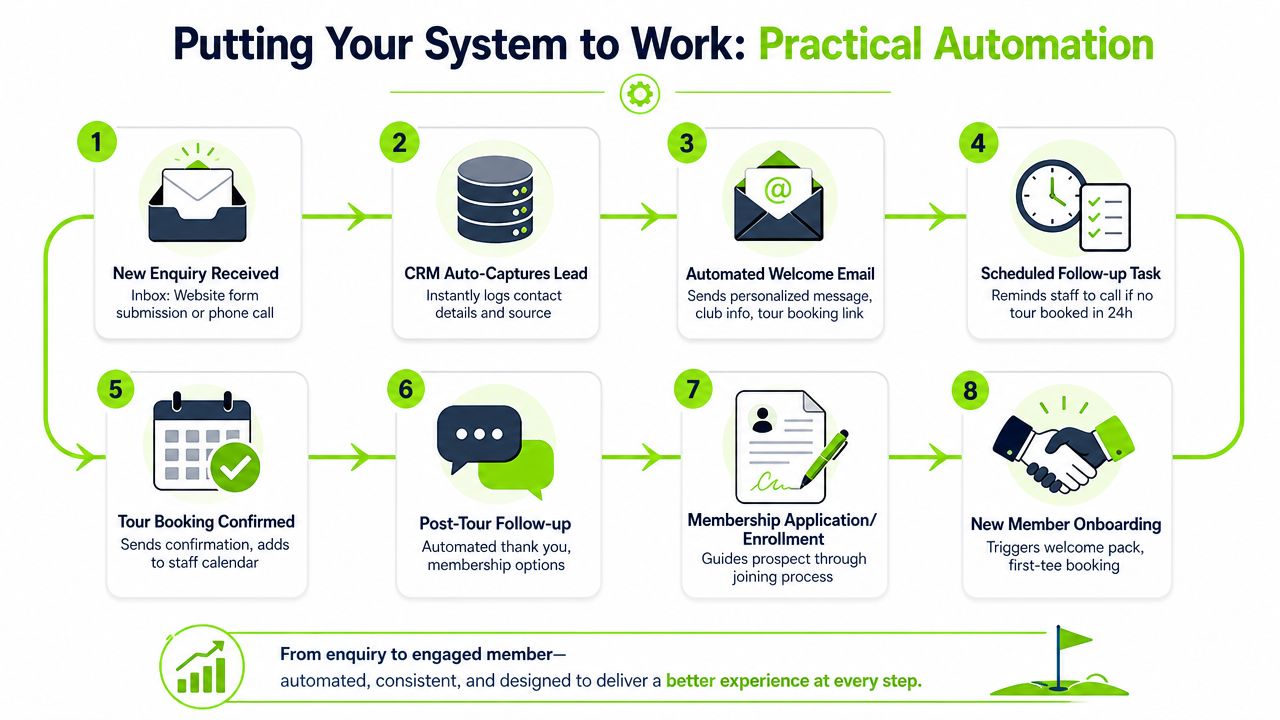
Now take the same enquiry in a structured CRM:
The enquiry is captured immediately
Contact details and source are logged automatically.A welcome response is sent straight away
The prospect gets a professional acknowledgement and the next step, such as a tour booking link or club information.The right person is assigned ownership
The membership lead, secretary, or manager sees a task rather than hoping to notice an email.The system triggers follow-up if there is no action
If no visit is booked, the CRM prompts a call or sends the next message.Notes from the visit stay attached to the record
Anyone picking up the lead later can see the context.The new member journey continues automatically after joining
Welcome messages, orientation steps, and early engagement prompts can all be scheduled.
This is not about replacing personal contact. It is about protecting it. Automation handles the repetitive parts so staff can focus on the conversation that needs a person.
Renewal automation matters just as much
Many clubs only think about CRM for new membership enquiries. That is too narrow.
The same system can support retention by prompting timely renewal communication, flagging incomplete payments, and keeping reporting cleaner. If a member has a history of interaction, preferences, and contact notes stored centrally, renewal communication becomes more organised and less reactive.
For clubs exploring the wider category of automation tools, Zebracat automation tools guide offers a broad view of how automation can be structured across communication workflows. The golf-specific lesson is simpler. Start with the repetitive actions that already happen in your club and systemise those first.
Automate the predictable work. Keep the human attention for the moments where reassurance, judgement, or persuasion matter.
Choosing a Growth Partner Not Just a Platform
Most clubs do not need to become software experts. They need a system that works and a process that people follow.
That is why the decision should not be framed only as which platform to buy. It should be framed as how the club will build a reliable pipeline from first enquiry through to membership and renewal. Software is part of that answer, but not the whole answer.
What to look for beyond the platform
A useful partner should help with more than setup. They should be able to support:
- Process design so the club knows exactly how enquiries move through the pipeline
- Implementation discipline so fields, stages, and automations reflect how the club operates
- Training and ownership so staff and volunteers know what they are responsible for
- Reporting clarity so management can see what is happening without chasing updates
Some clubs are also reviewing AI and workflow tools as part of their broader systems thinking. For that side of the conversation, Mindlink Systems AI solutions is one example of how operators are thinking about process support beyond traditional software categories.
The right help is operational
The strongest support does not start by selling complexity. It starts by simplifying the club's workflow.
That means fewer dropped enquiries, clearer handoffs, better conversion tracking, and better member communication. If a provider talks only about lead generation and not about what happens after the lead arrives, the offer is incomplete.
For clubs weighing whether they need a supplier or a more strategic relationship, this GolfRep article on choosing a golf club marketing agency makes the distinction clearly. The key point is that growth comes from systems and execution, not just traffic.
A good golf club CRM software setup should make your club calmer, clearer, and more consistent. If it adds confusion, admin burden, or uncertainty, it is the wrong setup regardless of how advanced the platform looks.
If your club needs a clearer way to handle enquiries, follow up properly, and build a predictable membership pipeline, GolfRep helps golf clubs put the right CRM and automation system around the leads they already generate.
Ready to tap into our proven growth system?