Golf Club AI Lead Nurture: A Manager's Guide for 2026

The most common advice on AI for golf clubs is also the least useful. It tells you to “use AI to get more leads” when most clubs don't have a lead shortage at all. They have a handling problem.
Enquiries arrive through forms, email, Facebook, Instagram, WhatsApp, phone calls, open days, and visitor bookings. Then they sit in different inboxes, get passed between staff, or rely on someone remembering to follow up after a busy Saturday. That's where pipeline value leaks out.
Good golf club AI lead nurture isn't about replacing your team. It's about building a system that acknowledges every enquiry, routes it properly, follows up on time, and gives staff enough context to have better conversations when the moment is right.
The Real Problem Facing Your Golf Club
In the UK, golf participation reached 5.1 million adults in 2023, which means the market is bigger than ever, but clubs are still competing hard for the same local audience. In that environment, improving conversion of existing enquiries is often more effective than attempting to generate more, as outlined in this AI lead nurturing overview from Salesforce.

Most clubs still describe the issue as marketing. In practice, it's usually operations. A membership enquiry comes in, someone replies once, then nothing happens for days. A society lead asks for dates and pricing, but the response doesn't answer the actual question. A trial round gets booked, but nobody follows up afterwards.
That isn't a traffic problem. It's a process problem.
Where clubs actually lose leads
The weak points are usually predictable:
- Slow acknowledgement: The prospect doesn't know if their enquiry was received.
- No visibility: One staff member has the email, another takes the call, nobody sees the full picture.
- Generic follow-up: A visitor receives the same message as a prospective member.
- No next step: The club answers a question but doesn't move the conversation forward.
- Manual dependency: If a key person is off, the process stalls.
Clubs rarely lose leads because people weren't interested. They lose them because interest wasn't handled while it was still warm.
AI can help, but only if the basics are clear first. You need to know what success looks like for each enquiry type. “More sales” is too vague to build a system around.
Start with business goals, not software
Before any automation goes live, define the journeys you want to improve.
A sensible setup usually starts with three separate pathways:
| Enquiry type | Immediate objective | Human handover point |
|---|---|---|
| Membership | Book a visit, call, or trial experience | When buying intent becomes clear |
| Society or event | Confirm requirements and preferred dates | When pricing and availability need discussion |
| Visitor green fee or lesson | Deliver useful information and make booking easy | When a repeat pattern suggests wider opportunity |
Relevance beats volume. A prospective full member should receive a completely different sequence from someone asking about a casual round or a coaching package.
Segmentation before automation
The clubs that get value from golf club AI lead nurture usually keep the early segmentation simple. They don't try to score every tiny interaction from day one. They separate enquiries by intent, route them into the right sequence, and make sure every message leads somewhere useful.
That first decision changes everything. Once you stop treating all leads the same, follow-up becomes clearer, reporting becomes cleaner, and staff stop wasting time on the wrong conversations.
Capturing and Qualifying Leads Instantly
A membership enquiry at 9 PM on a Friday shouldn't wait until Monday morning for a response. The club might still close the lead later, but the first impression has already been set. If the prospect hears nothing, they assume one of two things: the club is disorganised, or they're not that interested.
That's why the front end of your system matters so much. Capture every enquiry in one place, qualify it quickly, and send an immediate acknowledgement that feels relevant.

What the first layer should do
The first layer of automation doesn't need to be clever. It needs to be dependable.
If an enquiry comes through your website, Meta lead form, or social inbox, the system should:
- Create a contact record with source, timestamp, and enquiry type.
- Tag the lead as membership, society, lesson, visitor, or other.
- Send an acknowledgement that confirms receipt and sets expectation.
- Ask one or two useful qualification questions if more context is needed.
- Assign or queue the lead for staff follow-up when a threshold is met.
That's enough to stop most avoidable lead loss.
For clubs thinking more broadly about the role of automation at the top of the funnel, this guide on how AI improves sales prospecting is useful because it frames AI as a way to improve speed and prioritisation, not just scale activity.
A practical Friday night example
Here's the difference between a manual and automated process.
Manual version:
A prospect fills in a membership form late Friday evening. The email lands in a shared inbox. Nobody sees it until Monday. By then, the prospect has visited two other club websites, spoken to one of them, and emotionally moved on.
Automated version:
The form submission creates a contact instantly. The prospect receives a personalised acknowledgement within moments. The message confirms that the club has their enquiry, shares the next step, and offers a link to choose a visit time or request a call. If they click key pages or complete a second action, the system flags them for priority follow-up on Monday morning.
That's a better experience without requiring anyone to work out of hours.
Keep qualification short
Most clubs overcomplicate this stage. They ask for too much, too soon.
Use short forms and a few simple fields:
- For membership: Preferred membership type, current playing status, ideal start time.
- For societies: Preferred month, expected group size, whether catering is needed.
- For lessons: Current handicap band or beginner status.
- For visitors: Booking interest and whether they've played before.
Practical rule: If a field won't change your next action, don't ask for it on the first form.
If you want a golf-specific view of this setup, GolfRep has written in more detail about AI lead qualification for golf clubs, especially around structuring initial questions so staff receive useful context rather than form clutter.
Building Your 24/7 AI Nurture Automations
Once capture is working, the next job is follow-up that doesn't depend on memory. Regarding this, many clubs either do too little or go too far. Too little means a single confirmation email and silence. Too far means robotic sequences that feel like software wrote them, because it did.
The middle ground works best. Use automation to keep momentum, then bring a person in when intent is strong.
According to the research cited in this golf lead nurturing article from SMBGolf, companies with strong nurture programmes generate 50% more sales-ready leads at 33% lower cost, and nurtured leads make purchases that are 47% larger than non-nurtured ones. For golf clubs, that matters because a structured process can improve the quality of member acquisition without leaning on discounts.
Two automations worth building first
The most useful early sequences are usually these:
Membership enquiry flow
This should feel like a guided path, not a marketing campaign.
A practical version looks like this:
- Message one: Acknowledge the enquiry and offer the next step.
- Message two: Share relevant membership information based on interest.
- Message three: Handle common objections such as flexibility, playing access, or club culture.
- Message four: Invite a visit, trial round, or conversation.
- Message five: Trigger a staff task if the prospect has engaged but not booked.
The AI part can personalise the wording based on source, pages viewed, or form answers. Someone interested in flexible membership shouldn't receive the same message as a player asking about full seven-day access.
Open day or event follow-up
This sequence should build attendance first, then conversion after the event.
A strong flow usually includes:
| Timing | Purpose | Example content |
|---|---|---|
| Registration confirmation | Reduce uncertainty | Event details, who they'll meet, what to expect |
| Reminder before event | Increase show-up quality | Parking, dress code, arrival time |
| Post-event follow-up | Keep intent warm | Thanks, recap, invitation to next step |
| Later follow-up | Re-engage slower prospects | Answer FAQs, offer another visit |
Clubs can borrow useful thinking from adjacent email nurture formats too. This guide on how to boost webinar ROI with email sequences isn't golf-specific, but it's a good example of how timed follow-up builds attendance and then drives action afterwards.
What doesn't work
Three mistakes show up again and again.
- Writing like a brochure: Prospects want clarity, not polished waffle.
- Sending the same message to everyone: This kills relevance quickly.
- Never changing the route: If someone clicks pricing twice or revisits membership pages, the sequence should adapt.
If a prospect behaves like they're ready to talk, don't keep drip-feeding them generic content.
For clubs using platforms such as HubSpot, ActiveCampaign, or a golf-specific setup, the principle is the same. Build short journeys around clear actions. If you want a golf-centred view of that architecture, golf club marketing automation should be treated as a workflow problem first and a content problem second.
Integrating Your CRM for Full Visibility
Automation without a CRM usually creates a new kind of mess. Messages go out on time, but nobody can see the full story. The membership manager knows a lead asked for pricing. The operations team knows they attended an open day. Someone else knows they clicked three follow-up emails. None of that helps if it lives in separate places.
A CRM fixes that by acting as the central record for every prospect and every action.
Why a CRM isn't optional
If your lead nurture runs outside a proper CRM, you'll struggle with four basics:
- History: Staff can't see what the lead has already received.
- Ownership: Nobody knows who should follow up next.
- Priority: High-intent prospects get buried with casual enquiries.
- Reporting: You can't tell which channels and sequences are producing real pipeline.
This is why clubs need a single source of truth. Every form fill, email reply, booked tour, website revisit, and call note should sit against one contact record.
A good phone call closes more deals when the caller knows exactly what happened before they picked up the phone.
What staff should see before making contact
When a membership manager opens a record, they shouldn't have to piece the story together from memory. They should see a usable timeline.
A strong record usually includes:
| CRM field or activity | Why it matters |
|---|---|
| Original enquiry source | Shows how the lead found the club |
| Enquiry type | Stops irrelevant follow-up |
| Pages viewed or key actions | Signals intent level |
| Emails sent and clicked | Shows what content has landed |
| Tasks and notes | Keeps team handovers clean |
| Deal stage | Clarifies the next action |
That context changes the conversation. Instead of asking broad questions, staff can be more precise. They can say, in effect, “I can see you looked at our membership options and registered interest in visiting. Would you like to arrange that this week?” That feels organised, because it is.
The handover between AI and people
The best setups don't try to automate the close. They automate the preparation.
A CRM lets you decide when a lead moves from nurture to human outreach. For example, a prospect who has only downloaded information can stay in automated follow-up. A prospect who has revisited core pages, replied to an email, or requested dates should land in a queue for direct contact.
That's the difference between automation that supports sales and automation that gets in the way.
For clubs still running on spreadsheets, inboxes, and informal notes, a proper golf CRM system is what turns scattered activity into a visible pipeline.
Measuring and Optimising Your Nurture System
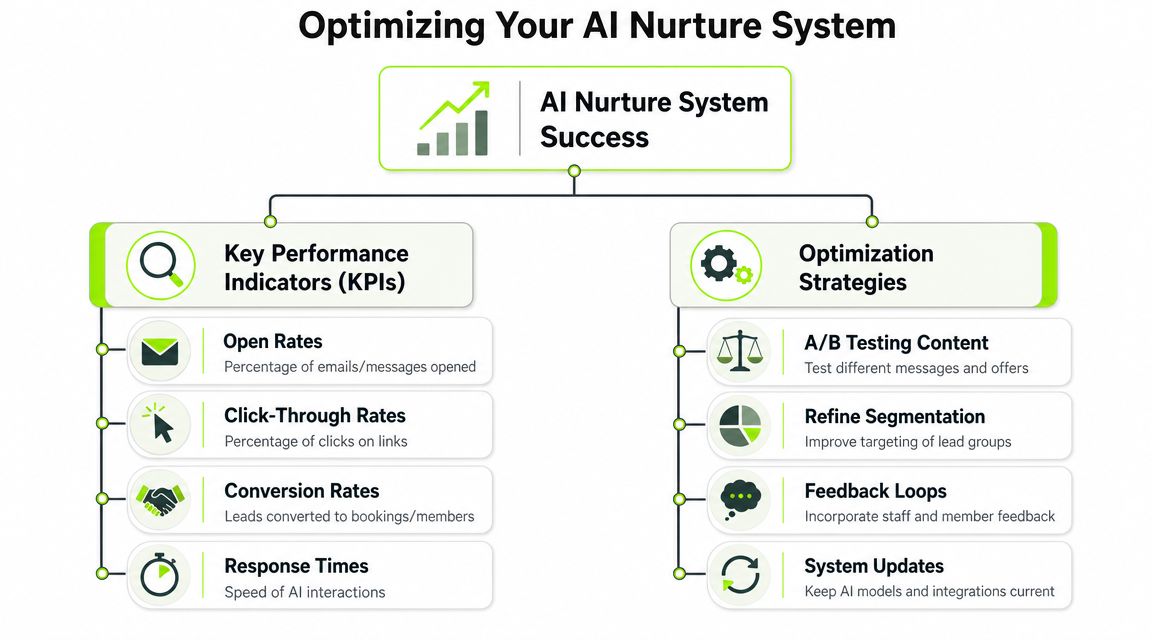
Most clubs look at the wrong numbers first. They check opens, maybe clicks, then decide whether an email “worked”. That's too shallow to improve a sales process.
The stronger view is pipeline-based. Which enquiries become qualified conversations? Which qualified conversations become visits? Which visits become members, societies, or repeat bookings? That's where your nurture system either earns its keep or doesn't.
The KPIs that matter more than open rates
Demand Gen Report's research highlights that high-performing nurture teams focus on MQL-to-SQL conversion, pipeline contribution, and cost per qualified lead, and that lead scoring should trigger outreach when a prospect passes a defined threshold, as discussed in this B2B lead nurture analysis from Demand Gen Report.
Translated for a golf club, the most useful metrics tend to be:
- Response time: How quickly the system acknowledges and routes a lead.
- Qualified lead rate: How many enquiries become genuine opportunities.
- Lead-to-visit rate: How many nurtured prospects book a tour, trial, or meeting.
- Pipeline contribution: Which channels and sequences are creating sales opportunities.
- Cost per qualified lead: What you're spending to generate leads worth staff time.
Open rate still has a role, but only as a diagnostic. It can tell you if subject lines or timing are weak. It can't tell you whether the system is growing membership.
Use lead scoring carefully
Lead scoring is useful when it stays simple.
You don't need a complex model on day one. Start by assigning more weight to actions that suggest buying intent, then use a threshold to trigger direct contact. Mid-intent leads stay in nurture until behaviour changes. Low-intent contacts receive lighter follow-up.
A simple scoring approach helps clubs avoid two expensive mistakes: chasing people who were never likely to buy, and ignoring people who were nearly ready.
Operational note: Review your scoring rules whenever seasonality changes or your membership offer changes. Old assumptions go stale faster than most clubs realise.
Optimisation should be scheduled
A nurture system needs regular review. Not constant tinkering. Regular review.
A monthly check is usually enough to answer questions like:
- Which message gets the strongest downstream action
- Where leads stall in the journey
- Which follow-up step needs rewriting
- Whether staff are acting on high-intent leads quickly enough
If your team needs a broader framework for thinking about measurement discipline, this SEO measurement strategies guide is useful because it separates vanity metrics from business metrics. The same mindset applies here. Activity matters less than contribution.
Timelines Resources and Practical Next Steps
A full AI rollout is rarely the right first move for a golf club. The clubs that get results start smaller. They fix lead handling in one journey, prove it works, then expand with far less risk to staff time and member experience.
That matters in UK clubs where the same people are often covering enquiries, admin, events, and front-of-house. A system that needs constant attention will be ignored within weeks.
Research referenced by Clay shows broad AI adoption across UK businesses, but the useful takeaway for clubs is simpler than that headline suggests. Start with the few automations that remove delay and inconsistency from enquiry handling, then keep a clear handover point for sales conversations and exceptions, as outlined in this AI lead nurturing systems article from Clay.
A realistic first 30 days
A practical rollout usually fits into four weeks.
Week 1: Map the enquiry journey
List every lead source, who receives each enquiry now, how long a reply usually takes, and where follow-up breaks down. Keep it simple. One whiteboard session is often enough to spot the gaps.
Week 2: Set up immediate acknowledgement
Build one automated reply for your highest-value enquiry type, usually membership. Include a helpful next step, expected response time, and internal notification to the right staff member.
Week 3: Add routing and tags
Separate membership, society, visitor, and lesson leads at form level or inside the CRM. This prevents one inbox from becoming the holding pen for every type of enquiry.
Week 4: Launch one short nurture sequence
Build a three-step follow-up for the same enquiry type you chose in Week 2. Test every trigger, check every email on mobile, and make sure staff know when the sequence stops and personal follow-up starts.
That is enough to create a working system. It is also enough to expose the next bottleneck, which is usually slow staff handover or weak CRM hygiene.
Where clubs should keep human judgement
Early automation works best when the boundaries are clear.
| Automate in phase one | Keep with staff |
|---|---|
| Form capture and lead tagging | Final membership conversations |
| Confirmation emails | Pricing exceptions or bespoke packages |
| Reminder messages | Objection handling for high-value prospects |
| Internal task creation | Committee-sensitive messaging |
The risk is not the software on its own. Problems start when nobody owns the workflow, messages go out without review, or high-intent leads sit in a sequence when they should have had a phone call.
Resource planning before you buy anything
Clubs often assume the tool is the hard part. In practice, maintenance is what decides whether the system lasts.
Plan for one person to own these checks:
- Lead routing: wrong tags send people into the wrong sequence
- Message review: AI-written copy can drift away from your club's tone or make claims staff would never make
- Consent and privacy: GDPR applies to forms, email permissions, and CRM storage
- Workflow updates: offers, joining fees, staffing cover, and seasonality change throughout the year
This does not need a new hire. It does need ownership.
If outside support is needed, GolfRep is one option that combines lead generation, CRM setup, and AI-led follow-up in a golf-specific growth system. The main requirement is a repeatable process the club can monitor, rather than a collection of disconnected tools and ad hoc replies.
The clubs that get value from golf club AI lead nurture build around speed, visibility, and clear next actions. Start with one journey. Make it reliable. Then expand once the team trusts it.
If your club wants a clearer view of where enquiries are being lost and what to automate first, GolfRep helps golf clubs build structured lead handling, CRM visibility, and follow-up systems that turn interest into booked visits and memberships.
Ready to tap into our proven growth system?