Why Is Member Retention Important for Golf Clubs

A UK members' club can recruit successfully and still lose ground. The latest 2024/25 Members' and Proprietary Golf Clubs' Survey recorded an average of 75 joiners and 82 leavers per members' club in 2024, leaving clubs seven members down before any wider growth is considered (Hillier Hopkins Golf Clubs Report 2024/25).
That changes the answer to why is member retention important. Retention isn't just about keeping members satisfied until renewal. It's a revenue-quality and forecasting discipline. A club needs to know whether its membership base is stable, whether valuable members are slipping away without notice, and whether new joiners are replacing lost subscription income or creating genuine growth.
For GolfRep, the commercial question is straightforward: which members are at risk, what value do they represent, and what action can the club take before resignation becomes visible in the accounts?
What UK Club Churn Data Shows
The movement from 77 leavers in 2023 to 82 in 2024, compared with joiners rising from 73 to 75, exposes a weakness in headline membership reporting (Hillier Hopkins Golf Clubs Report 2024/25). A club can report healthy recruitment, maintain a full joining pipeline and still lose commercially valuable relationships. The relevant question is not whether membership grew, but whether the incoming cohort replaces the income, usage and predictability of the members who left.
A continuing member supports forecastable subscription income and may also enter competitions, spend at the clubhouse, attend events, buy from the professional shop or refer new members. A new joiner may develop the same value, but the club must first build playing habits, introduce the member to the community and establish regular engagement. Retention therefore protects the quality of revenue already visible in the club's forward plan.
Retention is a baseline risk
The same survey reported that 59% of members' clubs had more than 600 playing members, while an average of 21 members moved from waiting lists into membership at the last renewal. That combination indicates available demand alongside avoidable churn. A waiting list does not prove that the membership proposition is commercially healthy if established members leave because they feel disconnected, underused or overlooked.
Management reporting should therefore track member movement and value together:
- Joiners: Count new members by category and joining date.
- Leavers: Record resignation date, category, tenure and stated reason.
- Net movement: Compare joiners with leavers rather than reporting recruitment alone.
- Commercial value: Review subscription type, competition use, clubhouse spend and referrals.
GolfRep's guide to the golf club churn rate provides a useful framework for interpreting this pattern. Clubs with suitable data can also assess an AI-powered customer retention strategy, using behavioural signals to identify risk before cancellation.
Manager's action: Put joiners, leavers and net movement on the same monthly report. Add category, tenure, usage and stated reason, then calculate how many members the club must replace merely to stand still.
The True Cost of Replacing a Lost Member
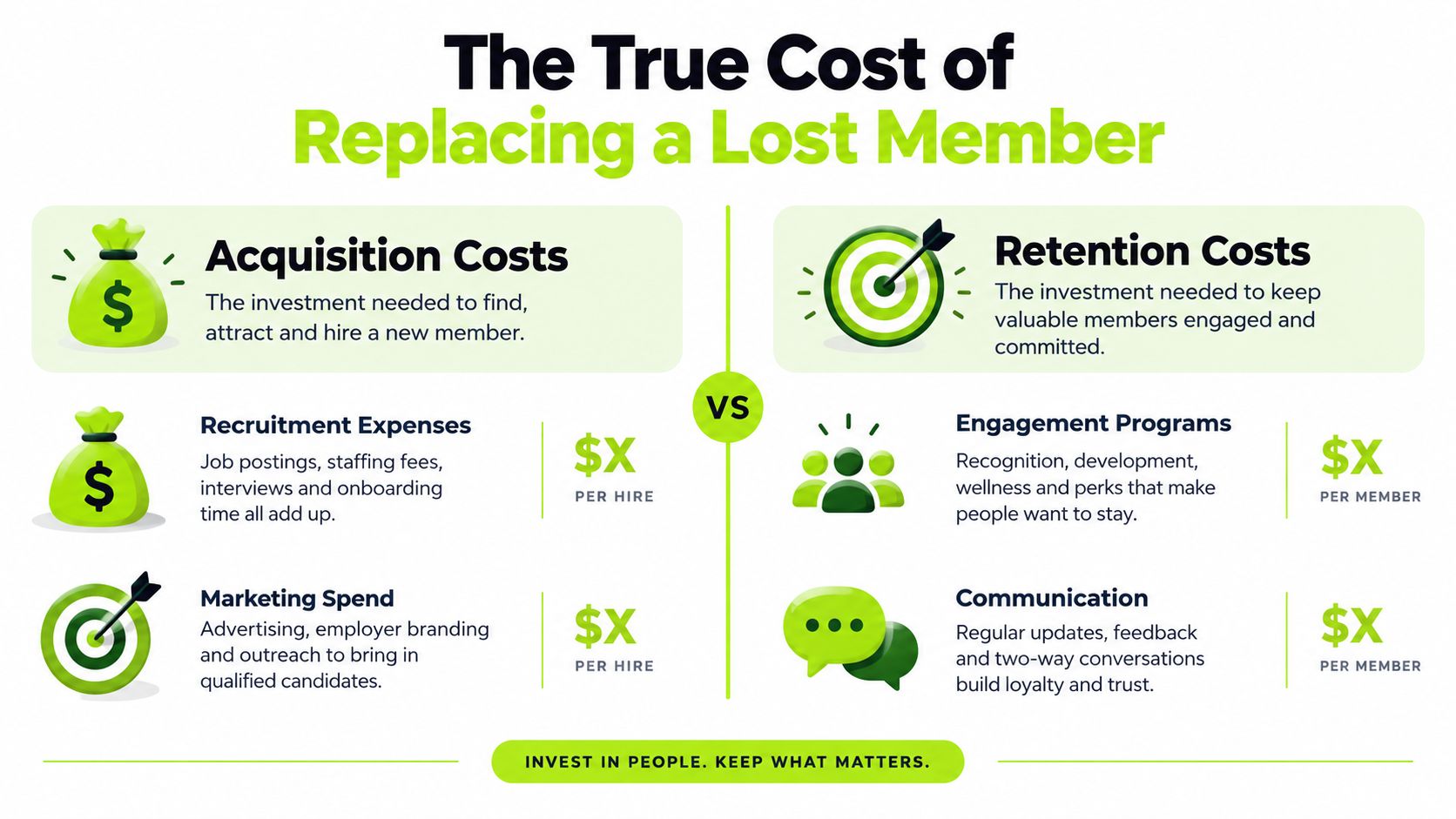
A lost member creates a revenue gap before the club has even started recruitment. Replacing that member may require local promotion, open days, trial access, staff tours, follow-up calls, joining administration, induction and early support. The club pays in cash and staff capacity before the replacement develops a playing habit or contributes beyond the joining transaction.
Retention uses a different cost base. Staff can monitor usage, invite members to suitable competitions, introduce playing partners, resolve service issues and clarify value before renewal. These actions still consume time, but the club already knows the member's category, contact details, usage history and preferences. That information makes the intervention easier to target and its commercial result easier to track.
Build a club-specific comparison
A general manager can make the case from the club's own ledger rather than relying on an industry-wide benchmark:
| Cost area | Replacement calculation | Retention calculation |
|---|---|---|
| Demand generation | Campaign spend divided by joining members | Communication and engagement cost |
| Staff time | Tours, calls, emails and administration for applicants | Check-ins, introductions and renewal conversations |
| Induction | Time helping a new member understand the club | Time correcting disengagement |
| Revenue risk | Months before the member becomes active | Revenue protected when the member renews |
| Commercial quality | Category and expected usage of the replacement | Known spend and participation from the existing member |
Add one worked row using actual internal figures. For example, compare campaign cost per joiner with the staff cost of a targeted retention contact. The figures should come from recorded spend and paid or estimated staff time, not an assumed multiplier.
The club can then compare the cost of replacing one member with the cost of supporting an at-risk member. Results will differ by category, staffing model and recruitment channel. The useful comparison is the amount spent to restore one membership against the amount spent to protect one already contributing relationship.
England Golf-affiliated reporting placed UK club membership at approximately 730,000 members across about 1,735 clubs in 2024, with around 420 members per club on average (GCMA analysis of England Golf data). That base shows why churn is a forecasting issue as well as a service issue. Repeatedly replacing members can preserve the headline count while weakening revenue quality if new joiners use less, stay for less time or require heavier support.
GolfRep's explanation of customer lifetime value provides a wider way to assess the relationship, including value beyond the annual subscription.
Practical rule: Record campaign spend, staff hours, joining outcomes and retention contacts by member category. Compare the cost of restoring membership with the cost of protecting it, then target the segment with the clearest avoidable revenue risk.
Why Small Retention Changes Move Big Revenue
A small change in retention can alter the club's revenue profile far beyond the renewal line. A continuing member already has relationships with the course, competitions, professional shop, clubhouse and other members. Those connections create established opportunities for participation and secondary spend. A replacement begins with less certain behaviour and no proven usage history.
Across the 730,000-member England Golf base cited earlier, a 5% reduction would represent approximately 36,500 memberships. The figure is illustrative rather than predictive. Its value is showing the finance committee why a modest percentage movement deserves clear visibility in the budget.
The same effect appears at club level. A 600-member club losing a small share of its base may forgo competition entries, food and beverage purchases, social event attendance, retail activity and member referrals as well as subscription income. Retained members therefore offer a more evidenced revenue contribution than the annual fee alone indicates.
Retention improves the quality of the forecast
A stable membership base supports more reliable planning. Managers can make better assumptions about subscription income, competition demand, bar activity, staffing and member events when established members continue to participate. Repeated replacement creates a less predictable mix of existing members, new joiners and changing usage patterns.
This matters during budget setting because net membership growth can look positive while recurring revenue quality weakens. High-value full members may leave while lower-fee, lower-usage or less-integrated categories take their places. The membership total holds steady, but the income profile and future forecast become less dependable.
Measure revenue quality beside member count:
- Subscription value: Compare retained and replacement members by category.
- Participation: Track competition entries and organised golf involvement.
- Secondary spend: Review bar, catering, retail and event usage where records are available.
- Referral contribution: Record which members introduce prospects or guests.
- Forecast stability: Compare expected renewal income with actual renewal outcomes.
The commercial choice is selective retention. A club should protect relationships that show sustained participation and value, while identifying why other categories leave and whether replacing them produces comparable income.
Manager's action: Add revenue per active member and usage by category to the membership report. A stable count alongside falling activity signals weaker revenue quality and should trigger an at-risk member review.
The Hidden Churn Behind Headline Growth
A waiting list can make a club appear commercially secure. The 2025/26 Hillier Hopkins survey reported an average of 122 people on members' club waiting lists, up from 53 in 2024, while the proportion of clubs with more than 600 playing members rose from 59% to 63% (Hillier Hopkins Golf Clubs Survey Report 2025/26).
That demand is useful, but it doesn't answer the more important question: who is leaving? Industry reporting cited BRS Golf data showing that roughly 1,500 clubs collectively lost around 6,000 members in one quarter, despite recording approximately 5.6 million member rounds (GolfRep analysis of golf club membership churn). High participation across the market can coexist with serious member movement beneath the surface.
A club may fill vacancies quickly and still lose experienced full members, regular competition players or members who spend consistently in the clubhouse. If the replacements use the club differently, the membership ledger may recover while revenue quality falls.
The signals that membership totals miss
Silent churn begins before resignation. A member might play less often, stop entering competitions, avoid social events, reduce clubhouse visits or leave feedback unresolved. Accounts will show a paid membership, but the relationship is weakening.
Use a quarterly signal table to make this visible:
| Indicator | What it shows | Trigger for action |
|---|---|---|
| Playing frequency | Whether the member still uses the core product | Contact when activity falls below the club's agreed norm |
| Competition participation | Social and sporting integration | Invite the member to a suitable format or playing group |
| Clubhouse usage | Wider commercial engagement | Ask whether the member understands relevant events and benefits |
| Feedback status | Whether a concern remains unresolved | Assign an owner and record the response |
| Category movement | Whether members are moving to lower-value options | Review the reason and offer a suitable alternative |
The club should also compare leavers with joiners by category, tenure and usage. That reveals whether growth is replacing like for like or concealing a change in the quality of recurring income.
What the headline number hides: A full waiting list can fill vacancies. It can't explain why established members decided to leave.
Designing a 180-Day Onboarding Lifecycle
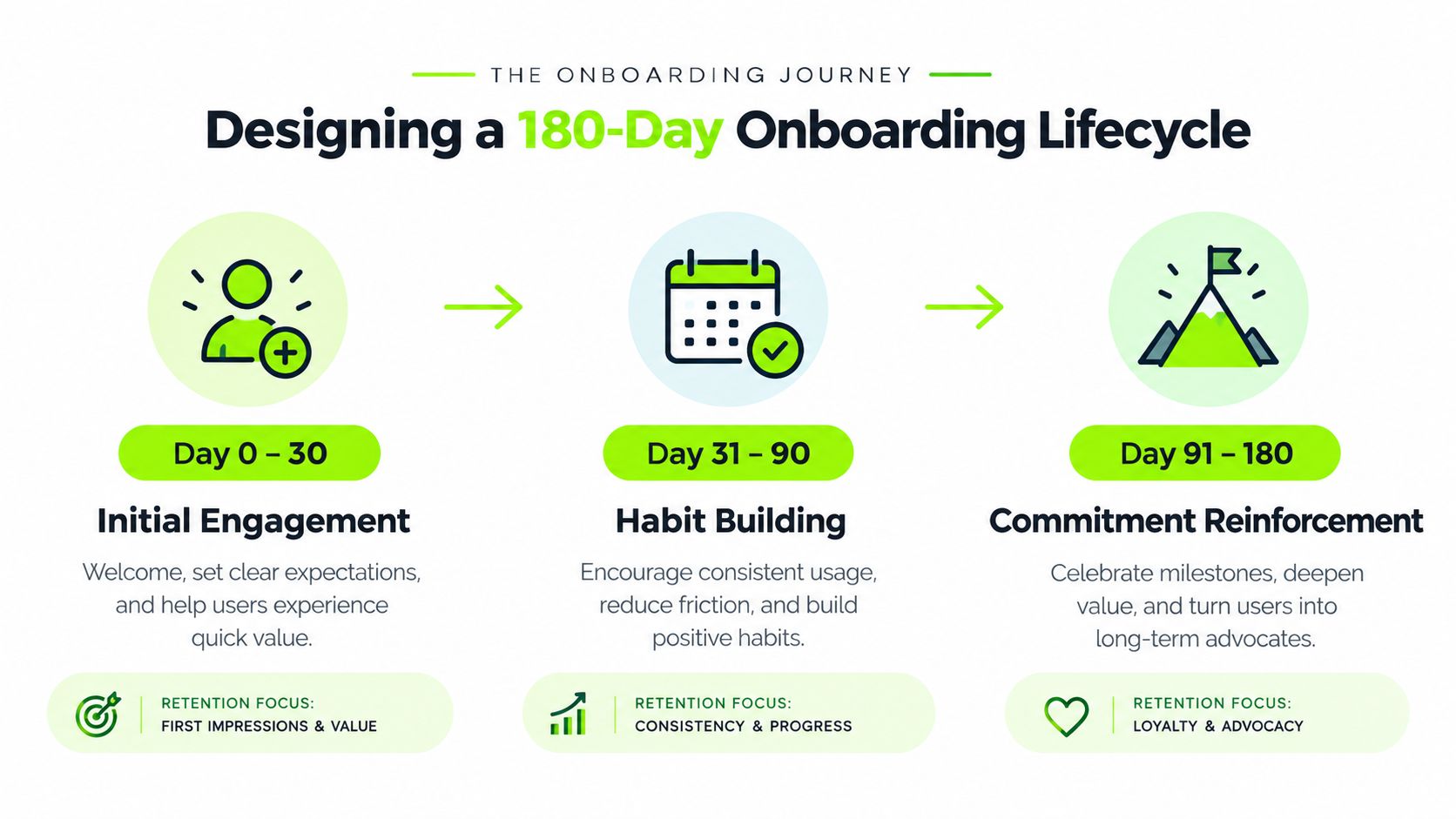
The first months after joining are a commercial opportunity to establish a habit, create social connections and make the club easier to use. An England Golf literature review defines retention as sustaining continued paid membership and identifies member experience, social connection, participation and club integration as central components, recommending that the first 180 days be managed as an onboarding lifecycle (England Golf literature review).
The process doesn't require advanced software. A shared spreadsheet can record attendance, introductions, invitations and follow-up actions. A CRM can make the work easier to assign and automate, but the operating discipline comes first.
Days 0 to 30 build orientation
Give the new member a clear first experience. Confirm access, explain booking and competition processes, introduce relevant staff and identify the type of golf or social activity they want from membership.
The membership team should also make a personal introduction to at least one suitable playing partner, roll-up, competition or social group. A new member who knows how to participate is more likely to use the membership than one who only receives a welcome pack.
Days 31 to 90 build a repeatable habit
Review attendance and playing frequency during this period. If usage is low, contact the member with a useful invitation, not a generic reminder. The invitation might relate to a competition format, a social fixture, a lesson, a group of similar players or a quieter time on the course.
Ask a short check-in question about access, confidence, introductions and expectations. Record the response and give a named person responsibility for any follow-up.
Days 91 to 180 reinforce commitment
At this stage, the club should know whether the member has started to integrate. Review participation, unresolved feedback and contact history. Members who remain inactive should receive a personal conversation that tests whether the club is meeting the reason they joined.
The output should be a simple lifecycle record:
- Joined: Category, goals, preferred playing pattern and key interests.
- Introduced: Playing partners, competitions and relevant staff contacts.
- Observed: Attendance, participation and feedback.
- Supported: Targeted outreach when usage or integration weakens.
- Reviewed: A 180-day conversation before the first renewal cycle.
For more detail on the operating process, GolfRep's guide to golf club customer retention provides a useful reference point. The important principle is that onboarding isn't an administrative handover. It's the first measurable retention period.
Renewal Communication That Actually Changes Outcomes
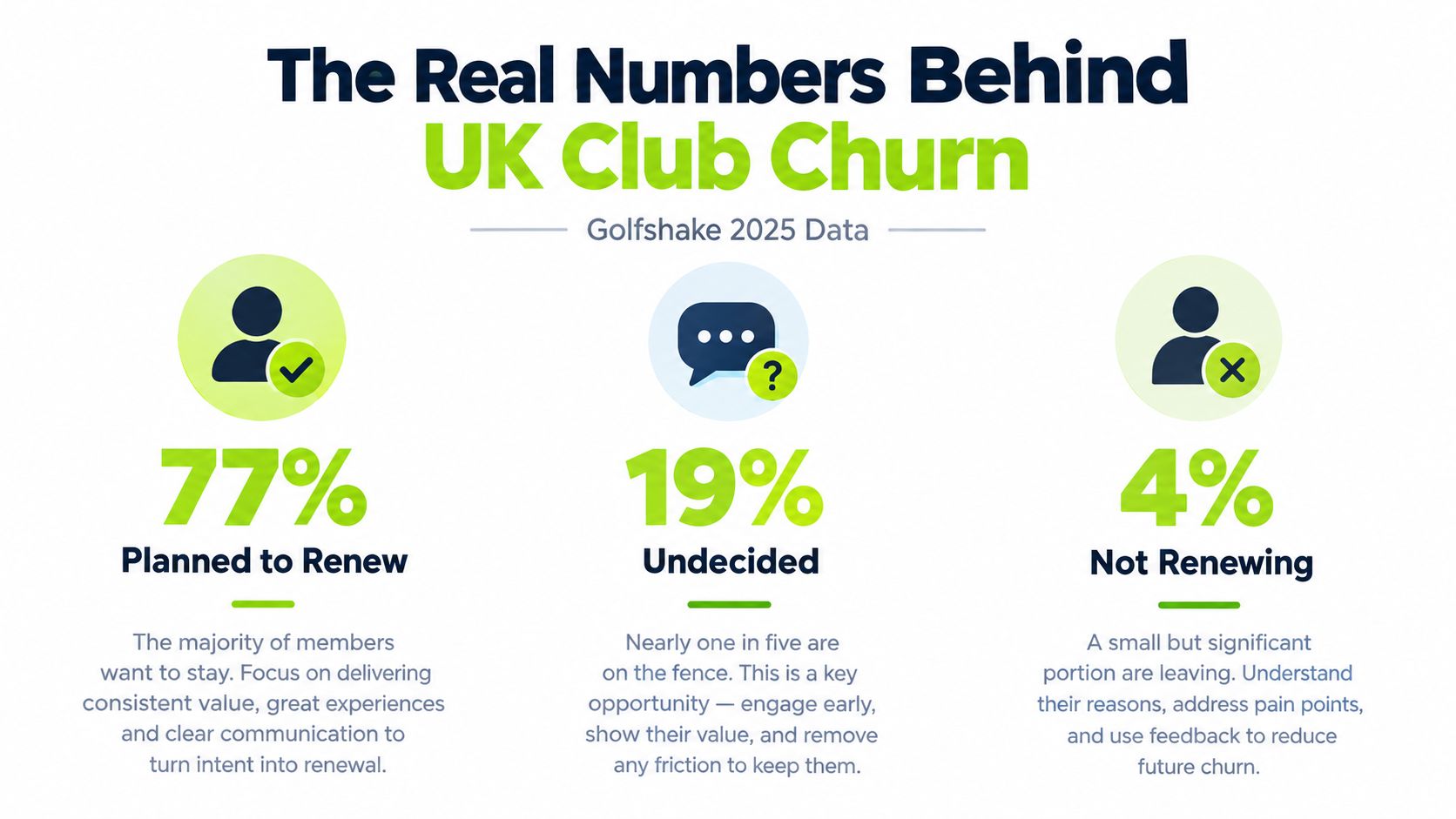
Renewal communication should distinguish between members who are ready to continue and members who need a reason to decide. Golfshake's 2025 survey reported that 77% of golfers planned to renew, 19% were undecided and 4% said they would not renew, making the undecided group a commercially actionable segment.

A single renewal letter treats every member as if they have the same concerns. That approach may be efficient, but it wastes the opportunity to focus staff time where the decision is still open.
Compare blanket discounts with targeted conversations
| Approach | Likely management effect | Better alternative |
|---|---|---|
| Blanket discount | Reduces income from members who intended to renew anyway | Reserve concessions for defined, evidence-based cases |
| Fee increase with little explanation | Leaves undecided members to interpret the change alone | Explain what the fee supports and how the club is managing value |
| One generic email | Provides information but not reassurance | Match the message to usage and member category |
| Last-minute reminder | Finds risk after disengagement has already developed | Begin renewal conversations before the decision point |
Targeted communication doesn't mean pressuring members. It means making the renewal decision easier for the right reasons. A member who rarely plays might need help finding suitable tee times. A regular competition player may value the fixture list and playing opportunities. A socially motivated member may respond to relevant events or introductions.
Use behaviour to prioritise the undecided group
The membership secretary or general manager can create a short conversation sequence:
- Start with usage: Refer to the member's playing or participation pattern.
- Ask directly: Find out whether access, value, social connection or cost is influencing the decision.
- Explain clearly: Set out fee changes and the services or facilities they support.
- Offer relevance: Suggest competitions, tee-time support or events linked to the member's interests.
- Record the outcome: Mark the member as renewing, undecided, at risk or leaving.
The 4% who said they wouldn't renew may still provide valuable feedback, but the undecided group deserves the most immediate commercial attention because its decision remains open. Blanket discounts spend money on certainty. Personalised conversations spend staff time on uncertainty.
Renewal principle: Don't ask every member for the same response. Ask each member the question that reflects how they actually use the club.
Measuring Retention Like a Commercial KPI
An annual renewal percentage is useful, but it hides the timing and quality of churn. A club can report a reasonable renewal result while losing first-year members, full members with strong secondary spend or regular competitors who previously supported events.
Earlier UK survey data illustrates why the trend matters. In 2023/24, 24% of UK members' clubs had more leavers than joiners. Average leavers rose from 48 in 2022 to 56 in 2023, while average joiners moved from 70 to 73 (GolfRep analysis of clubs losing members).
Build the dashboard around cohorts
A practical monthly dashboard should separate:
- First-year retention: How many new members reach their first renewal?
- Established-member retention: Whether longer-tenured members remain active and renewing.
- Usage frequency: How often each cohort plays or participates.
- Average spend: Revenue per active member by category.
- Competition participation: Whether members are integrated into organised golf.
- Age profile of leavers: Whether departures concentrate in a particular group.
- Leaving reasons: The recorded cause, separated from assumptions.
- At-risk members: Low usage, unresolved feedback or approaching renewal.
Use cohorts rather than one blended average. A club may have strong retention among established members and weak retention among new joiners. The management response differs in each case.
A simple report can fit on one page. Show current members, recent joiners, low-usage members, approaching renewals and recent leavers. Add an owner and next action for every flagged member. Managers who want a wider explanation of retention reporting can also consult this SaaS customer retention guide, adapting the principles to paid club membership rather than software subscriptions.
The thresholds should be set by the club's normal pattern. If a member's activity falls materially below their previous behaviour, or if a new member hasn't participated after joining, trigger a personal check-in. Don't wait for the resignation list to reveal the result.
Management test: If the committee sees only total members and annual renewals, it isn't yet seeing retention as a commercial KPI.
The Retention Principle a Club Should Adopt
Retention should be managed as continuous revenue-quality control. The club earns more confidence in its forecast when members remain active, integrated and able to explain why their membership matters. A renewal percentage records the outcome, but cohort behaviour explains the outcome.
The first priorities are clear:
- Measure: Report joiners, leavers, category value, usage and leaving reasons together.
- Protect: Manage the first 180 days as a planned onboarding lifecycle.
- Intervene: Contact low-usage and undecided members before renewal becomes a resignation.
A club doesn't need to retain every member through discounts. It needs to understand which relationships create sustainable value and fix avoidable causes of disengagement. For clubs reviewing their wider member experience, resources such as join Pebb Clubs may also help support community participation alongside the club's own retention process.
GolfRep works with golf clubs to connect acquisition, sales processes, CRM follow-up and retention into a measurable revenue system. If you want to identify which member cohorts are leaking value and build a practical intervention plan, visit GolfRep to discuss your club's commercial pipeline.
Ready to tap into our proven growth system?