Golf Club Customer Retention: A Practical System That Works

Most clubs talk about golf club customer retention as if it starts with the renewal notice. That's the wrong end of the problem. By the time a member is reading a resignation form, the club has usually already lost them in the first few weeks after enquiry, when response time was slow, ownership was unclear, and nobody watched the follow-up closely enough.
The better clubs treat retention as an operating system, not a year-end campaign. They know the first impression is built before the first round, and the habits that keep a member active are formed in the first 180 days. GolfRep's view is simple, if a club wants predictable retention, it needs a structured enquiry-to-onboarding process, a visible CRM, and named people responsible for every next step.
Why Most Clubs Lose Members Before Renewal
The biggest mistake is assuming churn happens at renewal. It doesn't. By the time a member gets to the renewal stage, they've already decided whether the club feels easy to use, worth the money, and socially welcoming.
A familiar committee-room pattern goes like this. The club has plenty of enquiries, the pro shop is busy, the secretary is chasing paperwork, and the membership chair assumes the new intake is healthy. Then three months later, the same people are asking why several new members have barely played, never entered a competition, and disappeared from the tee sheet.
That's not a marketing problem. It's a follow-up problem.
GolfRep's retention guidance points to a strong UK benchmark, golf and country clubs typically retain 92% to 94% of members annually, which implies churn of roughly 6% to 8% GolfRep's club retention benchmark. That's the point most clubs miss. Even well-run clubs lose a meaningful minority every year, so retention can't be treated as a one-off rescue job.
The real leak is early
The first few months matter because habits form fast. If a new member has to chase a reply, wonders who owns their enquiry, or arrives for the first visit without a clear next step, they start mentally distancing themselves. A slow CRM does the damage, because nobody sees the problem until the resignation lands.
Practical rule: If a new member has not been contacted, welcomed, and nudged into a second visit quickly, the club is already behind.
A more useful way to think about golf club customer retention is this. Enquiries are not the finish line. They're the start of a conversion journey that only works if the club can see every lead, respond quickly, and keep the momentum alive after sign-up.
A club that keeps generating enquiries but leaves them to drift is paying to create future churn.
The clubs that do this well don't rely on memory or goodwill. They build a process that tells staff what happened, what should happen next, and who owns it.
Diagnosing Where Your Club Is Losing Members
Start with the behaviour already sitting in your system. Resignation forms only explain why people left after the fact. They do nothing to show where the club lost control of the relationship.
The useful question is earlier, and sharper. Where did engagement start to fall, who stopped showing up, and which enquiries never turned into members who felt attached to the club?
GolfRep recommends using cohort tracking instead of only end-of-year totals, because drops in rounds played, competition entry, and event attendance usually appear before resignation GolfRep cohort guidance. That is the level of visibility club managers need if they want to act before silence turns into churn. If your team only looks at annual attrition, you are reviewing a finished loss, not a live one.
The numbers worth pulling
Pull the data you already hold. Monthly counts for new members, resignations, rounds per member, event participation, and visit frequency are enough to start. Then split new joins by month instead of reading them as one annual block, because a weak intake can look healthy until it stops coming through the door.
The test is simple. Who is still active, who is fading, and who has already started behaving like a member who will not renew?
A member rarely disappears overnight. The warning signs show up in usage first.
The Golf Queensland attrition report says clubs should measure attrition annually and survey members at least every two years Golf Queensland attrition report. That advice is sound, but it is not enough on its own. If you only wait for complaints or survey responses, you are already behind the point where intervention would have helped.
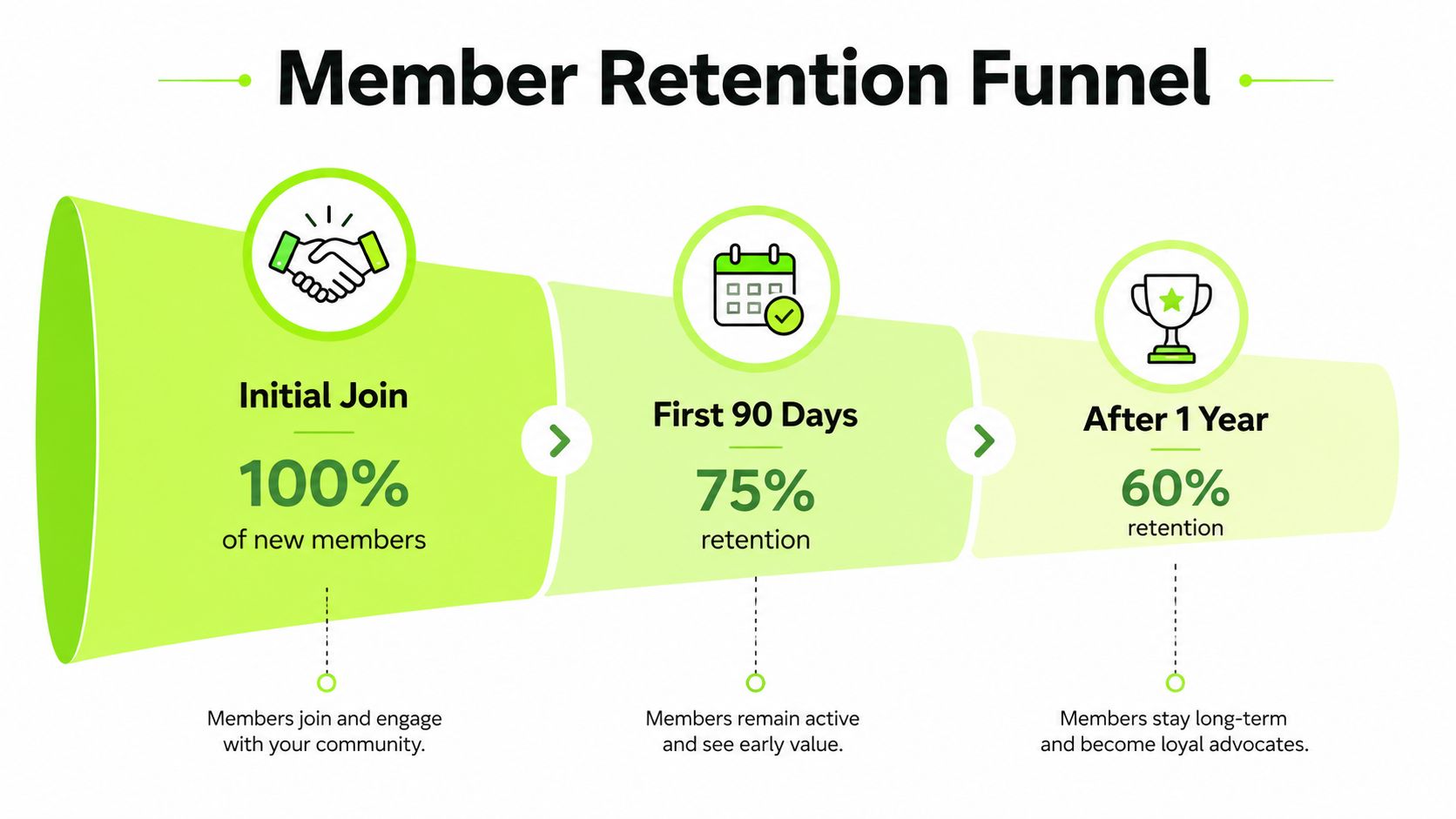
Build an at-risk list every week
A weekly at-risk list changes behaviour because it forces action. Include members whose usage is falling, members who have stopped entering competitions, and anyone who went quiet after an enthusiastic start. That list should trigger a call, an invite, or a category review before disengagement hardens into resignation.
This rhythm matters more than a long annual report. The annual report explains what already happened. The at-risk list shows who still needs a human touch.
Resigned-member feedback still has value, but it belongs beside live usage data, not in place of it. A club that wants to catch disengagement before the resignation letter arrives needs a dashboard that shows movement, not just outcomes. The same discipline applies outside golf too, which is why operators who understand automatic lead capture for home services are already used to tracking handoff, follow-up, and response timing instead of trusting memory.
The First 180 Days Onboarding System
The first 180 days should run like a managed pathway, not a loose welcome process. Golf administration guidance has been saying this for years, measure attrition annually, survey members regularly, and pay attention to the early tenure window because habits form there NSW Golf Association attrition and retention report. The clubs that benefit are the ones that turn that advice into a living process.
Put one owner on every member
Every live prospect and every new member needs a named owner. Not a department, a committee, or “the office”. One person should know the next action, whether that is a call, a tour, a competition invite, or a category review.
That same owner should review a short at-risk list each week. If usage drops, they act. If the member hasn't visited, they nudge. If the category no longer fits, they raise it before frustration builds.
The practical sequence should be straightforward.
- Day 1 to 7, welcome and orientation. Confirm who the member should contact, what happens at their first visit, and how they book.
- Day 14 to 30, first usage check. Look for a first round, a first social touchpoint, or a first event invite.
- Day 60 to 90, engagement check. Review whether the member has played, attended, or interacted often enough to suggest they are settling in.
- Day 150 to 180, renewal preparation. Use actual engagement data, not guesswork, to decide whether the member is on track.
Golf clubs do not need enterprise software to do this. They need discipline, a clean CRM workflow, and clear task ownership. For clubs that want a practical model for this kind of follow-up, automatic lead capture for home services is a useful example of how fast response and structured routing can stop opportunities from going cold.
Make intervention normal, not awkward
A quiet new member should not feel abandoned, and the staff member should not feel they are bothering them. A phone call, a competition invite, or a category conversation is not overreach. It is how you prevent a tiny disengagement from turning into a resignation.

The club's job is to make the first six months predictable. If those months are left to chance, retention becomes luck.
CRM Segmentation and Automation Templates That Save Time
Retention falls apart when follow-up depends on whoever remembers to send the email. A decent CRM stops that. It makes the follow-up visible, repeatable, and easy to assign.
Segment members by behaviour, not just category
Start with five simple groups.
- New members who need onboarding and first-visit support.
- Low-usage members who have gone quiet and need a check-in.
- Competition-only members who engage for golf but not social activity.
- Social members who attend events but don't play much.
- Renewal-near members whose habits should be reviewed before the bill goes out.
That segmentation is basic, but it works because it reflects what members do. A golfer who only plays on competition days needs different nudges from a member who comes for the clubhouse atmosphere and rarely books a tee time.
A strong CRM doesn't need dozens of fields. It needs the right ones. Capture join date, membership category, last visit, last competition entry, event attendance, and whether a follow-up task is open or complete. If you can't see those six things, the system will always drift back to manual chasing.
Automate the obvious touchpoints
The aim is not to automate relationships. It is to automate the reminders that stop people being forgotten.
- 14-day no-visit nudge. A short check-in for new members who haven't used the club.
- 30-day activity review. A task for staff to confirm the member has found their way around.
- Competition invitation flow. Useful for social members who may need a more structured way in.
- Category-change prompt. For members whose usage patterns no longer fit the subscription they bought.
- Renewal-prep reminder. Sent only when engagement data supports it, not just because the calendar changed.
Golf clubs looking to map this properly should also think about system visibility. A useful internal reference point is GolfRep's club CRM system guide, because the win comes from making every lead and member step visible, not from adding software for its own sake.
If a secretary has to ask around to find out what happened to a new member, the CRM is not doing its job.
Keep the automation simple enough that a small team can run it in a few hours a week. That's how clubs get consistency without turning membership management into a full-time admin trap.
Events, Loyalty, and the Access Trade-Off Members Actually Notice
Most clubs treat events and perks like extras. They aren't extras. They are signals that the member still feels the club has a place for them.
Belonging shows up in participation
A member who joins events, enters competitions, and uses the clubhouse is much less likely to feel anonymous. That doesn't mean every event has to be large or expensive. It means the club should create recurring reasons to show up, especially for members who are still forming habits.
Structured open competitions, member-only windows, and invitation-led social formats work because they give people a reason to return. A well-timed category-change conversation can help too, especially if the member's playing pattern no longer matches the subscription they bought.
For clubs wanting to think more carefully about the social side of the experience, GolfRep's clubhouse event marketing strategy is relevant because retention is often reinforced in the clubhouse, not just on the tee sheet.
Access decisions matter more than clubs admit
Some resignations are driven by access friction. Tee-time congestion, pace of play, and the sense that visitor revenue is being favoured can wear members down. If a member feels they are competing with visitors for access, the club is creating churn it doesn't need.
That's why some clubs should protect more member inventory, even if it costs short-term visitor revenue. It's a hard call, but lifetime value beats a quick boost when the members at risk are the people who pay year after year and refer others into the club.
Direct rule: If access feels scarce, loyalty becomes fragile.
The answer isn't to shut visitors out. It's to decide clearly which tee times, formats, and peak slots are reserved for members, then communicate that decision properly. Members can tolerate limits. They don't tolerate confusion or the feeling that they come second.
A loyalty offer only works if it supports that wider experience. Discounts without access, or events without a pathway into playing, don't fix retention. They just decorate the problem.
A UK Case Pattern Worth Studying
There's a pattern you can see across clubs such as Bidston, Addington Palace, and Downes Crediton. The turnaround wasn't built on louder marketing. It was built on sharper ownership of the enquiry and onboarding process.
The first change was simple, every prospect had a named owner. The second was structural, follow-up moved out of people's heads and into a visible CRM flow. The third was practical, new members were given a clearer route into the club so they didn't drift after sign-up.
That matters because the hard part in committee-led clubs is rarely the idea. It's getting the team to use the same process every time. Staff are busy, volunteers rotate, and if no one owns the follow-up, the best-intentioned enquiry still cools off.
A club in this position does not need a miracle. It needs a tighter response time, a cleaner handoff, and a weekly review of who has gone quiet. Early signals of improvement usually appear in better enquiry handling and more consistent first visits before they show up in headline retention numbers.
The lesson is blunt. Clubs don't lose members because they lack interest. They lose them because the club didn't keep the process alive long enough for interest to turn into habit.
The Monthly Retention Dashboard and Early Warning Signs
A retention system is only real if someone reviews it. Committees should not wait for quarter-end surprises. They should look at a short monthly dashboard and make decisions while the warning signs are still reversible.
| KPI | What It Shows | Healthy Signal | Action When It Drops |
|---|---|---|---|
| Retention rate | Whether members are staying | Stable month to month | Review cohorts and recent joiners |
| New-member activation rate | Whether new joiners are using the club | Most new members are active early | Trigger welcome calls and first-visit checks |
| At-risk member count | How many members are fading | Small and visible | Assign owners and close gaps quickly |
| Event participation rate | Whether members still feel involved | Regular attendance by active members | Refresh invitations and formats |
| Time-to-first-visit from enquiry | How quickly interest turns into use | Short and consistent | Tighten response and booking follow-up |
GolfRep's churn guidance is worth reading alongside this because the club's real job is to spot patterns before they become exits GolfRep's churn rate guide. The key warning signs are rarely dramatic. They are quiet, repeatable, and easy to ignore if nobody is looking.
Questions to put on the next agenda
- Which new members have not visited within the expected settling-in window?
- Which cohorts are entering fewer competitions than last year's intake?
- Which members have dropped event attendance but not yet resigned?
- Who owns each at-risk member right now?
- What was the last communication to the low-usage group?
If the committee can't answer those questions quickly, the club is running blind.
Retention is built at enquiry, reinforced in the first 180 days, and protected by a dashboard that forces action. Renewal is only the final test.
If your club wants a proper retention system, GolfRep can help you build one that links enquiry response, CRM visibility, and structured follow-up into a process your team can run. Visit GolfRep to see how we help clubs turn more enquiries into active members and stop good leads from going cold.
Ready to tap into our proven growth system?