Golf Club Member Acquisition Strategies: 8 CRM Tactics
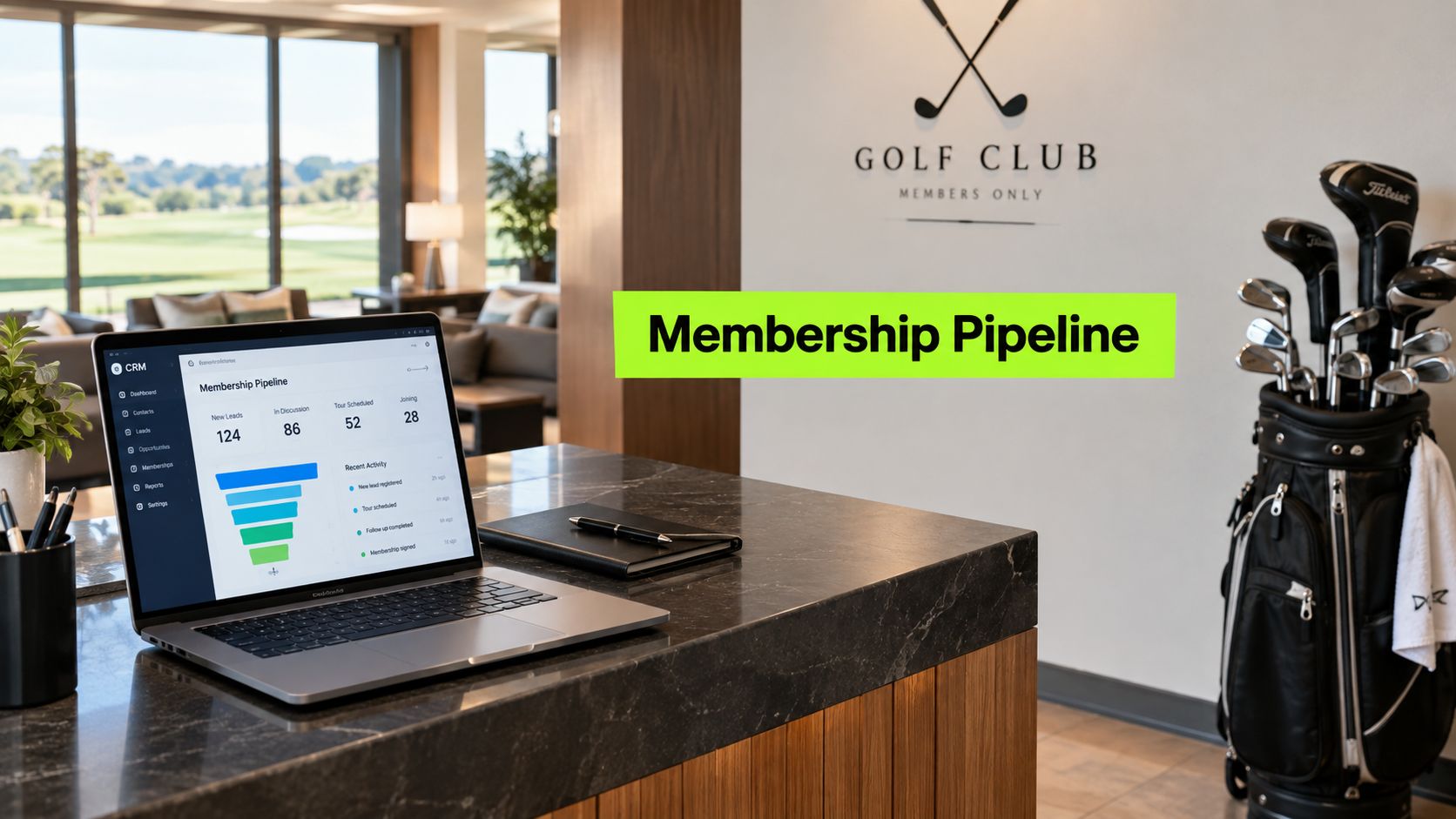
What happens between a golfer first showing interest and becoming a member? A click, form submission or open-day conversation isn't a membership pipeline on its own. The commercial opportunity lies in connecting that interest to the right audience segment, recording intent, triggering useful next steps, assigning ownership and measuring the relationship beyond the joining date.
The strongest Golf Club Member Acquisition Strategies don't rely on one isolated campaign. They combine targeted demand generation with a practical CRM operating system that helps the club attract, nurture, convert and retain the right members. That system should work for a single-site club with a small team, as well as a multi-site operator that needs central visibility without losing local relevance.
This article sets out eight tactics built around that operating system. They include trial programmes, win-back campaigns, referrals, digital advertising, events, partnerships, content and an implementation framework. Don't launch everything at once. First identify whether your constraint is audience reach, attendance, follow-up, conversion, capacity or retention, then use the data to choose the next improvement.
1. Trial and introductory membership programmes
A trial membership can turn an uncertain prospect into someone the club knows well. Instead of asking a golfer to make a full financial and social commitment immediately, give them a structured opportunity to experience the course, coaching, clubhouse and member culture.
The offer needs more structure than a temporary discount. Define the start and end date, included access, joining route, upgrade price and the person responsible for the relationship. A trial member should never be left to work out what happens next.
GolfRep's guide to golf club membership offers provides a useful starting point for shaping the offer around the club's commercial priorities rather than reducing the headline price.
Build the upgrade path before the trial starts
For a 12-week trial, schedule an upgrade conversation around week 8. That gives the golfer time to decide while leaving room to answer questions, arrange another visit or explain payment options before the trial expires. Sending the full membership pathway only at the end creates an avoidable decision deadline.
Assign a PGA professional, membership manager or another named contact. The CRM record should show:
- Engagement: Course visits, coaching attendance, competitions, social events and practice-facility use.
- Intent: Questions asked, membership type viewed, preferred playing times and barriers raised.
- Next action: The owner, due date and channel for the next conversation.
- Upgrade status: Not ready, considering, application started or joined.
A non-user needs a different message from an engaged trial member. The first may need a welcoming phone call or beginner clinic. The second may be ready for a specific comparison between trial access and full membership.
Practical rule: Treat the trial as a member experience with a planned commercial outcome, not as a discounted green fee.
The welcome should include something distinctive, such as a buddy introduction, beginner clinic or social invitation. Track which experiences lead to applications and which trial sources produce members who remain engaged. That turns a promotional idea into a repeatable acquisition and retention process.
2. Local golfer reactivation and win-back campaigns
Former members already know the club's location, course and basic offer. Reactivation should therefore begin with the reason they left, not a generic return discount. Separate recent lapses from older records, then add tenure, playing frequency, preferred tee times, competition participation and departure reason where available.
A simple campaign map keeps the operation practical:
- Cost concerns: Present flexible membership, payment options or a lower-access package if the club can support it without weakening pricing discipline.
- Time pressure: Explain off-peak access, shorter playing commitments or arrangements that fit changed working patterns.
- Injury recovery: Offer a coaching restart, gradual return or conversation with the PGA professional.
- Relocation or life change: Ask whether circumstances have changed before presenting an offer.
The contact plan should reflect both recency and relationship value. A recent former member might receive an email, text and call from a known club contact. Someone who left longer ago may respond better to a letter, course update or invitation to visit. A high-value former member warrants direct ownership rather than an automated offer alone.
GolfRep can connect each branch to a CRM record, with one named owner, the reason for leaving, the offer shown, every response and the next action. A person who expresses interest but does not book should receive a scheduled follow-up, not disappear into a completed campaign report. For a group operating across several sites, record the relevant venue and capacity constraints so an offer remains commercially workable. Single-site clubs gain the same control with fewer routing rules.
Use a time-limited offer only when staff can explain it clearly and the club can protect its pricing policy. Record returnee arrangements separately from new-member acquisition, allowing the board to compare immediate conversions with profitable, lasting relationships.
The GolfRep membership retention guide explains why reactivation sits between acquisition and retention. For broader principles, this win back campaign guide for e-commerce offers a useful framework, although golf clubs must adapt the message to playing habits, relationships and available capacity. Review response, booking and later participation by segment, rather than judging success from enquiries alone.
3. Referral and member advocacy programmes
A referral programme should make a credible introduction easy, then give staff enough information to handle it properly. Capture the referrer, prospective member, preferred site, interests and consent in the CRM at the point of referral. Without those fields, teams may give inconsistent information, miss follow-up or leave the member who made the introduction wondering what happened.
Keep the offer simple and commercially controlled. A club might provide credit, a green-fee benefit, merchandise or a joining-fee concession to the existing member, with a separate benefit for the new member. The right choice depends on pricing policy and capacity. A complicated tier system can create administration without improving the quality of introductions.
Make advocacy fit the club's membership mix
The strongest referral reflects a genuine match. A competition-focused golfer may introduce someone who wants regular tee access, while a social member may know a prospect interested in clubhouse events. Record that context so staff can shape the first conversation around likely needs rather than treating every referral as an identical lead.
Give advocates practical material they can use:
- Simple wording: A short email or message explaining who the club suits and how to enquire.
- Clear access: A referral page, welcome-pack insert, clubhouse notice or member-email reminder.
- Source tracking: A CRM tag linking the referrer, prospect, offer, site and eventual membership.
- Recognition: Appropriate thanks for active advocates, without turning the club into a sales leaderboard.
GolfRep can automate the acknowledgement, assign a named owner and schedule the next action when a prospect does not book. Staff should still protect the referring member's reputation. If the prospect is promised facilities, tee access or a social experience the club cannot provide, disappointment affects both people.
Measure the path from referral to attended visit, application, joining outcome and later participation. Compare results by referrer type and member fit, not activity alone. This shows whether advocacy is attracting younger golfers, women, families, competition players or social members who remain engaged.
A referral programme works best when it helps members make a credible introduction, not when it pressures them to sell the club.
For multi-site operators, store both referring and joining sites. Central visibility preserves the relationship while the relevant local team owns conversion. A single-site club can use the same fields with fewer routing rules. Review referral source, offer, response and member value together so acquisition decisions reflect lasting participation, not just quick joins.

4. Targeted digital advertising
Digital advertising works when the club defines both the audience and the next action. A campaign for women considering their first club membership should lead to a different page and follow-up route from one aimed at experienced golfers seeking regular competition.
Search advertising captures active demand. Social advertising reaches selected local audiences, while retargeting keeps the club visible to visitors who have not enquired. The channel matters less than the operating link between advert, landing page, CRM record and assigned staff member.
Build campaigns around CRM segments
England Golf's reported dataset recorded 730,602 club members across 1,735 affiliated clubs and more than 10.2 million scores submitted through the World Handicap System. It also recorded 4.4 million general-play scores, up from 3.9 million in 2023, alongside 494,000 iGolfer scores. iGolfers represented 7% of golfers with a Handicap Index in England. England Golf's reported dataset indicates the size of the active local audience beyond existing member networks.
Use separate campaign audiences and CRM fields for:
- Beginners and newer golfers: Coaching, confidence and a welcoming introduction to club life.
- Established players: Competitions, handicap development, tee access and regular playing opportunities.
- Women and families: Flexible access, social connection and suitable routes for different abilities.
- Local iGolfers and general-play golfers: Convenience, formal competition, community and progression.
Set an owner for every enquiry, with response tasks triggered by the advert source and audience segment. GolfRep can connect the campaign record to booked visits, attendance, trials, applications, joining decisions and early usage. A single-site club may need only a few routing rules. Multi-site operators should retain central reporting while sending each lead to the team responsible for the relevant venue.
Judge campaigns by member value, not enquiry volume alone. A low cost per enquiry can conceal weak intent, while a costlier audience may produce better attendance and longer participation.
Discounts should not be the default message. Explain the access included, the golfers the club suits and what the first visit involves. That gives staff a more useful conversation than a generic price-led enquiry.
5. Event-driven acquisition
An event earns its acquisition role through the operating system around it. The club needs a clear route from registration to attendance, a useful conversation on the day and an agreed next action afterwards.
Start with the audience and the outcome. A ladies' taster morning, junior clinic, beginner session and member-guest day should each have their own registration fields, message, attendance tag and follow-up route. This preserves the reason for attending, whether that is confidence, coaching, family participation or finding playing partners.
Build the next visit into the event
Assign responsibilities before registrations open:
- Before arrival: Capture contact details, playing experience, preferred times and motivation.
- At the club: Match each prospect with the PGA professional, membership contact, suitable facilities and welcoming members.
- Before departure: Book a trial, coaching assessment or return visit where appropriate.
- After the event: Send a same-day thank-you message, then give the assigned owner a task and deadline.
- In reporting: Connect attendance with booked visits, applications, joins and later retention.
The experience needs active hosting. Newcomers should not be left while regular members talk among themselves. A named host, small groups, course tours, short coaching sessions and introductions to suitable members can make the club feel accessible without turning the event into a facilities presentation.
The GolfRep guide to golf club open-day marketing covers promotion and follow-up as one campaign, rather than treating attendance as the result. GolfRep can link event source, audience, ownership and subsequent membership activity for both single-site clubs and multi-site operators. Smaller clubs may use a straightforward workflow. Groups with several venues need central reporting alongside local responsibility for each lead.
Capacity must sit inside the plan. If a beginner programme fills faster than the academy can support, create a qualified waiting list and offer the next available route. A crowded first experience can reduce conversion and later retention.
For junior sessions, directing families to practical resources such as golf gear for young players can support the participant's next step when the recommendation fits the programme.
6. Strategic partnership and co-marketing programmes
A partnership should give the club access to a defined audience and give that audience a clear reason to respond. A local gym may reach health-conscious adults, an employer may have teams interested in group activities, and a school or coaching academy may connect the club with families and junior golfers.
Test the relationship before building a large programme. Agree one offer, such as a taster session, coaching assessment or introductory visit, then define the referral route, approved copy and club contact. The partner needs a simple way to introduce prospects, while the club needs enough information to follow up properly.
The CRM record should show the partner, campaign, consent status, contact history, visit, application and joining outcome. Assign ownership when the referral arrives, with a next action and deadline. GolfRep can connect those steps across a single club or several venues, so staff can see whether a partnership produces visits, joins and members who remain active.
Partnership performance needs a shared review, not just a lead count. Discuss:
- Audience fit: Check whether the partner reaches beginners, experienced golfers, families, corporate decision-makers or another useful segment.
- Test result: Compare the agreed offer with response, attendance, applications and staff time before extending it.
- Mutual value: Confirm whether the partner receives an event benefit, member offer, referral payment or shared exposure.
- Ownership: Keep one named club contact accountable for questions, follow-up and partner updates.
- Member value: Review conversion, retention and fit by source, not only the initial volume.
Multi-site groups need routing rules. A referral should remain in one central record, while task ownership can sit with the venue best placed to serve the prospect. That prevents duplicate contacts and lets the group compare partner performance across locations without removing local accountability.
Brand control protects conversion. Partner materials should use approved wording and avoid promises about tee access, facilities or pricing that the club cannot honour. Give partners a clear escalation route for questions outside the agreed offer.
For paid collaboration concepts beyond golf, this guide to partnership ads provides useful context. Apply the principle selectively, and keep every proposition aligned with the actual member experience.
7. Content marketing and thought leadership
Useful content gives prospective members a reason to engage before they are ready to discuss membership. A beginner's guide, short-game video, hole-by-hole walkthrough, member profile or explanation of handicap progression can answer practical questions while showing how the club operates.
The strongest subjects come from people and experiences already inside the club. A PGA professional might explain preparing for a first nine holes. A member can describe entering a competition for the first time, while a greenkeeper can show how course work affects play. These perspectives make the club more credible than polished advertising alone.
Build content around the audience and the next operational action. Beginner material may generate wider interest; intermediate-player content may attract fewer prospects with a clearer membership motive. Record the topic, audience, consent and source in the CRM so the membership team can choose an appropriate follow-up.
A single idea can support several touchpoints. A course-management article might become a video script, short social clips, a PGA email, a clubhouse display and a retargeting asset. Each version should point to a defined response, such as joining an email series, booking a taster session or arranging a course visit.
GolfRep can connect those responses to a practical nurture path. The system can retain the original content source, group prospects by interest, trigger relevant follow-up and create a task for the appropriate membership or venue team. In a multi-site group, central records prevent duplicate contacts while local staff handle visits and conversion.
Ownership needs to be clear. Coaching content may sit with the PGA professional, while membership staff manage applications and the club manager reviews capacity. That division keeps content useful without leaving interested prospects waiting for a response.
Judge performance by commercial progression rather than reach alone. Review captured contacts, engaged prospects, booked visits, applications and the fit and retention of members acquired through each topic. A smaller audience with stronger enquiries may justify more investment than a widely viewed piece with no next action.
Phone questions should shape the editorial plan, and engagement history should inform the next sales conversation. That feedback loop turns content from a publishing task into a repeatable acquisition and nurture channel.
8. Implementation frameworks summary
A ladies' taster morning shows how the operating system should work from first contact to membership review.
Before promotion, GolfRep records the source as “Ladies' taster morning”, the venue, date, capacity, consent status and the member or staff contact who recommended it. The booking form also captures playing experience, preferred days, interest in coaching and whether the prospect wants membership information. These fields give the club useful context without forcing staff to reconstruct the conversation later.
The workflow then runs in sequence. A central marketing owner confirms available places and sends the invitation. The membership coordinator receives task alerts for incomplete bookings and personal follow-up. The PGA professional sees attendees interested in coaching, while the local club manager owns any application requiring a decision. In a multi-site group, central teams can compare performance across venues, but each club retains responsibility for its own visits and conversion.
After the event, GolfRep separates attendees, cancellations, no-shows and new enquiries. Attendees can receive a relevant membership route, while no-shows receive a controlled rebooking message rather than the same campaign again. Staff can record visit notes, objections, preferred start timing and the next agreed action. A prospect who is not ready now remains available for a later win-back or event invitation.
Management should review the path from registration to attendance, application, joining, early usage and retention. That exposes operational pressure as well as marketing performance. A full event may create demand the club cannot serve immediately, so capacity, start dates and follow-up workload belong in the review.
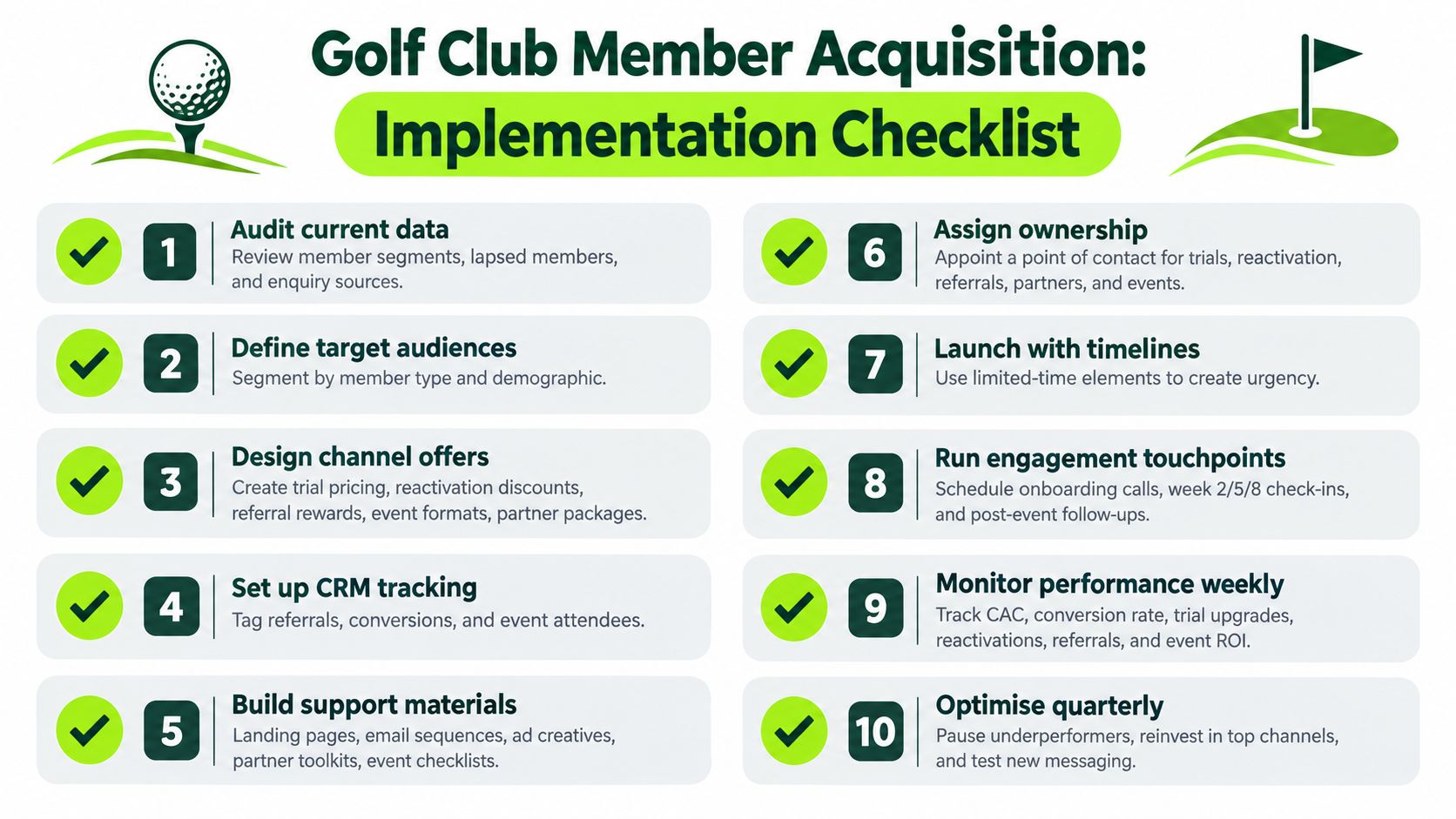
The same pattern can support all eight tactics, while the fields, messages and owners change by source. That gives single-site clubs a workable routine and multi-site operators a consistent view of member value.
8-Point Golf Club Member Acquisition Comparison
| Strategy | Implementation complexity | Resource requirements | Expected outcomes | Ideal use cases | Key advantages |
|---|---|---|---|---|---|
| Trial and Introductory Membership Programmes | Medium, needs onboarding flows and clear upgrade pricing | Moderate staff time for onboarding, CRM tagging, promotional budget | Higher trial→full conversion; predictable upgrade timing | Clubs wanting to reduce entry barrier and attract tentative prospects | Lowers financial risk for prospects; builds habit and early engagement |
| Local Golfer Reactivation and Win-Back Campaigns | Medium, data audit, segmentation and personalised outreach required | CRM cleanup, staff for phone/email outreach, targeted offers | Rapid revenue with lower CAC; higher conversion vs cold leads | Clubs with lapsed-member data seeking quick impact | Cost-effective; leverages prior relationships and known behaviour |
| Referral and Member Advocacy Programmes | Low–Medium, design incentives and tracking; simpler to deploy | Incentive budget, CRM referral tracking, comms/toolkit | Lower CAC; referred members show stronger retention | Clubs with satisfied, engaged membership base | Scalable, passive acquisition; strong social proof and higher retention |
| Targeted Digital Advertising (Local & Demographic) | Medium–High, campaign setup, landing pages, conversion tracking | Ongoing ad spend, digital skills/agency, landing pages, analytics | Fast lead generation; measurable CAC and ROAS; scalable | Clubs needing precise reach and rapid testing of offers | Precise audience targeting; real-time optimisation and measurable ROI |
| Event-Driven Acquisition (Open Days, Tasters) | High, logistical planning, facilitation and follow-up required | Staff/PGA pro time, event budget, hospitality, promotional spend | Concentrated qualified leads; strong experiential conversions | Clubs with volunteer base and good facilities wanting in-person trials | Experience-led persuasion; social proof and group conversion efficiency |
| Strategic Partnership & Co‑Marketing Programmes | Medium, partner sourcing, negotiation and ongoing management | Partner account management, co-branded materials, possible referral fees | Steady, pre-qualified referral pipeline; diversified reach | Clubs near businesses, gyms, hotels or corporate audiences | Access to trusted audiences; scalable referrals with shared marketing cost |
| Content Marketing & Thought Leadership | Medium, content strategy, production and SEO discipline | Time or budget for writing/video, SEO, email list tools | Long-term organic traffic, email subscribers and lower future CAC | Clubs aiming for sustainable brand growth and education-led leads | Builds authority and owned channels; content is reusable across channels |
| Implementation Frameworks Summary | Low–Medium, coordination of templates and ownership roles | Planning time, CRM tagging, reporting setup | Better execution, tracking and prioritisation across tactics | Clubs launching or scaling multiple acquisition tactics | Consolidates playbooks; speeds implementation and measurement |
Choose the constraint you can measure
A club rarely needs eight new campaigns at the same time. It needs a clear view of where prospective members stop progressing.
Begin with the audience. England's membership market gives clubs a substantial addressable base, but broad reach isn't enough. England Golf's demographic data reported an average club-member age of 54.99 years in 2024, down from 56.18 in 2023. The average male member age fell from 54.98 to 53.78, while the average female member age fell from 64.65 to 62.98. The average Handicap Index was 18.62 overall, with men at 17.38 and women at 28.09, according to reported England Golf membership figures. The practical conclusion is that one generic membership message is unlikely to suit every prospect.
Then audit capacity. The Golfshake 2025 membership survey found that 30% of golfers reported their club had a waiting list, up from 27% in 2024, while 39% said their club charged a joining fee, up from 37%. That makes unrestricted lead generation a poor objective for some clubs. A qualified waiting list, transparent start dates and better-fit member mix may be more commercially responsible than filling the pipeline with people the club can't serve well.
Use a simple prioritisation exercise:
- If reach is weak: Test targeted advertising, local partnerships or useful content.
- If attendance is weak: Review event design, booking friction and pre-visit communication.
- If applications are weak: Improve the experience, offer explanation and assigned sales ownership.
- If upgrades are weak: Rework trial milestones, member introductions and decision timing.
- If retention is weak: Examine onboarding, usage and expectation-setting before increasing acquisition.
- If capacity is tight: Build a segmented waiting list and prioritise fit, value and start-date clarity.
Benchmark the outcome against the club's own history and relevant sector context. A 2024/25 survey of UK members' and proprietary golf clubs recorded an average of 75 new joiners during 2024, compared with 73 in 2023, alongside an average of 8 female joiners and 17 junior joiners per members' club. Those figures from the Hillier Hopkins Golf Clubs Report can help managers separate total recruitment from the composition of new members.
GolfRep's role is to help clubs map this pipeline across advertising, CRM, follow-up, conversion and retention, whether the operation has one site or several. The important decision is not which tactic sounds most impressive. It's which measurable constraint is currently limiting sustainable membership growth.
GolfRep helps golf clubs connect targeted acquisition with CRM capture, automated nurture, assigned follow-up and reporting through to membership value. If you want to identify the constraint in your current member pipeline, visit GolfRep to discuss a practical growth system for your club or golf group.
Ready to tap into our proven growth system?