Golf Course Marketing That Turns Enquiries Into Members
Most golf clubs are told to solve growth by generating more enquiries. That advice is incomplete, and often expensive. A club can attract strong local interest yet gain little membership if enquiries sit in an inbox, staff reply late, or nobody can see which prospects have booked a visit and which have disappeared.
The commercial problem is usually conversion discipline, not awareness. UK golf clubs reportedly take an average of 47 hours and 32 minutes to respond to membership enquiries, according to GolfRep's analysis of golf club response handling. A separate UK lead-response study cited by GolfRep found that nearly 10% of firms replied within five minutes, while more than 46% replied within an hour. These figures don't prove that every fast reply becomes a member, but they do expose the operational gap clubs need to address.
GolfRep approaches golf course marketing as a connected growth system. Local advertising and useful content create demand, qualification identifies intent, follow-up moves prospects towards a visit, and CRM reporting shows where membership opportunities are being lost. More traffic can help, but only after the club can handle the interest it already receives.
Introduction Why Most Golf Clubs Do Not Need More Enquiries
The popular advice is simple: increase awareness, run more adverts, post more often, and collect more leads. The assumption is that membership growth follows enquiry volume automatically. It doesn't.
A membership enquiry is only the beginning of a commercial process. It may come from a regular golfer comparing clubs, an occasional player testing the idea of joining, a parent asking about junior golf, or someone who isn't ready to make a decision. Treating all enquiries alike gives managers a misleading view of demand and leaves staff trying to remember conversations across email, telephone calls, spreadsheets, and personal inboxes.
Practical rule: Don't ask only how many enquiries your marketing produced. Ask how many received a timely response, how many were qualified, how many booked a visit, and how many joined.
The market is large, but it isn't anonymous. England Golf data records about 1,735 affiliated golf clubs in England and more than 730,000 club members, with average county membership around 21,408 golfers. That scale makes local targeting more important, not less. Clubs compete within realistic drive-time catchments, where location, access, playing culture, facilities, pricing, and the quality of the joining experience influence the decision. England Golf data reported by The Golf Business also shows that the average member age fell from 56.18 to 54.99, with declines for men from 54.98 to 53.78 and women from 64.65 to 62.98. That is a useful signal for clubs reviewing who their messaging is designed to attract.
The real leak sits between interest and action
A prospect who fills in a form expects the club to respond. If the message is missed, answered without context, or followed up once and forgotten, the club has paid to create an opportunity it hasn't managed.
Manual handling fails for predictable reasons:
- Enquiries arrive in different places: Website forms, social media messages, telephone notes, and email create fragmented records.
- Ownership stays unclear: Staff don't know who should reply or when the next contact is due.
- Intent gets lost: A prospect asking about a taster round needs a different response from someone comparing membership categories.
- Reporting stops too early: Counting leads says little about booked visits, applications, or retained members.
GolfRep's position is direct. Clubs should build a pipeline that combines lead generation with structured qualification, follow-up, and CRM visibility. The objective isn't to make marketing look busy. It's to create a dependable route from local interest to a conversation, a visit, a membership decision, and recurring value.
How Predictable Membership Growth Really Works
Predictable membership growth comes from treating marketing as a series of connected handovers. Traffic is useful only when it reaches a relevant landing page. A landing page matters only when it captures enough information to begin a proper conversation. An enquiry has commercial value only when someone responds, qualifies the prospect, and guides them towards a visit.
The pipeline has four operating stages:
- Attract: Reach golfers within practical local catchments through search, social advertising, partnerships, events, and useful course content.
- Qualify: Ask enough to understand the prospect's playing habits, preferred membership route, timing, and main concern.
- Nurture: Provide relevant information and follow-up until the prospect is ready to book a visit, trial round, lesson, or meeting.
- Measure: Connect the original source to each later action, so managers can see which campaigns produce meaningful membership conversations.
A CRM is the course's pipeline board. Each enquiry should have a visible status, a named owner, a next action, and a record of previous contact. Automation handles routine tasks such as an immediate acknowledgement, reminders, information delivery, and prompts for staff intervention. It shouldn't replace personal conversations. It should make sure personal conversations happen consistently.
Build feedback into every campaign
A campaign shouldn't end when an advert stops running. Managers need to compare the quality of enquiries, response handling, visit bookings, applications, and membership outcomes. If an advert creates attention but few visits, the issue may be the offer, the landing page, qualification, or follow-up rather than the advert itself.
The same principle applies to different clubs. A committee-led club may need a simple shared dashboard and clearly assigned responsibilities. A multi-site operator may need a central CRM with local routing, standardised stages, and site-specific messaging. The technology should fit the operation, but the logic remains the same.
Growth becomes predictable when the club can explain what happened to every serious enquiry, not merely how the enquiry arrived.
This is why GolfRep combines acquisition with structured nurture and tracking. A club doesn't need a collection of disconnected tactics. It needs a pipeline where each stage informs the next decision and where managers can improve the weak point before increasing spend.
Who You Are Really Marketing To and Why Segmentation Matters
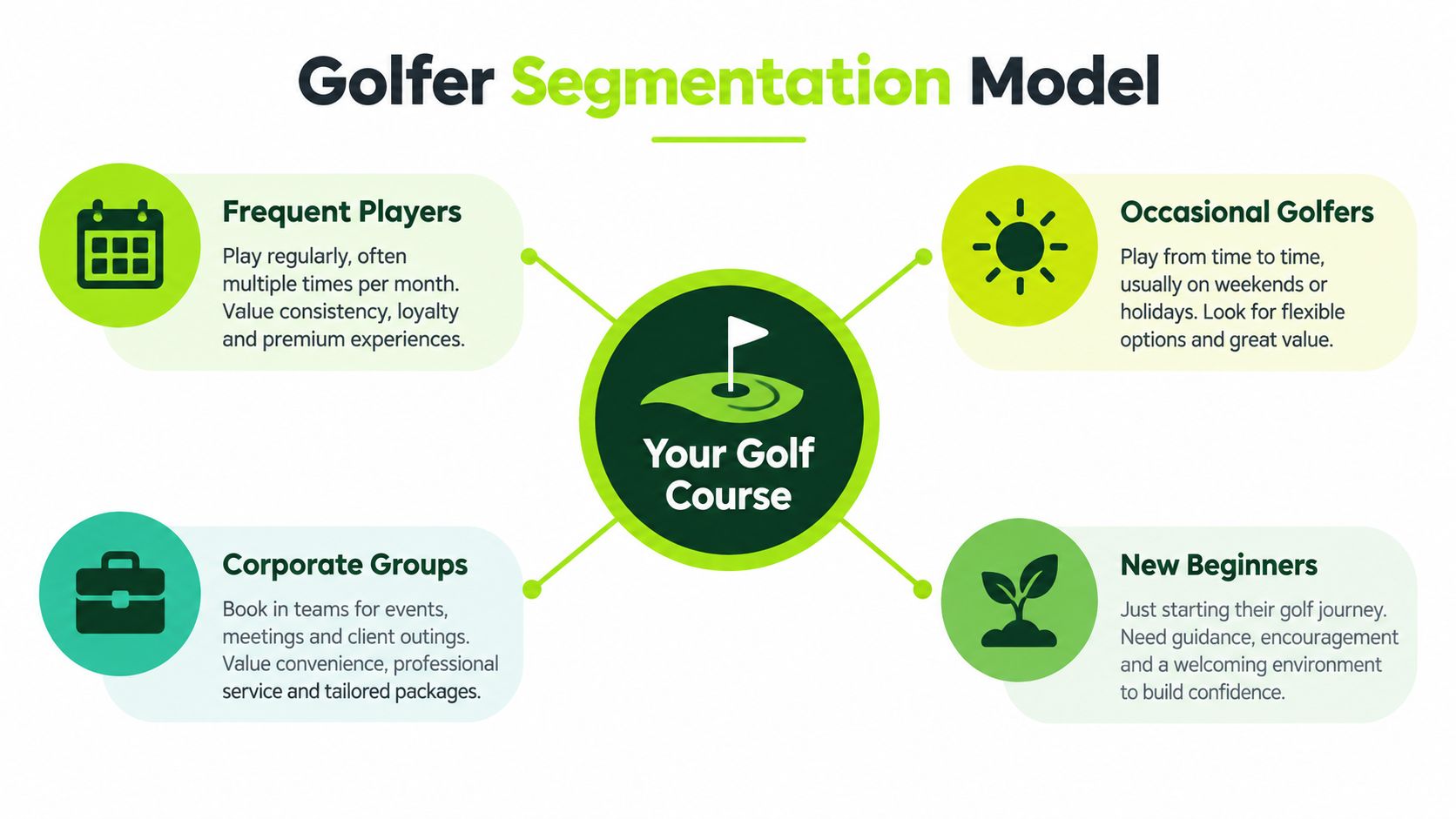
A single “join now” message is too blunt for the modern golf market. The R&A's UK satellite account estimates 5.356 million adults play golf at least once a year, while 2.357 million play at least once every four weeks, as reported in UK golf participation data. Those groups shouldn't receive the same offer or the same follow-up window.
England also records 4.2% four-weekly participation, compared with 6.0% in Scotland, according to the same source. A club should therefore assess its own catchment rather than copy a national media plan. Frequent golfers may be ready for a visit quickly. Occasional golfers often need reassurance about access, playing rights, social fit, lessons, and the practical experience of joining.
The market extends beyond traditional on-course players. England Golf reports that 12.6 million adults in England played some form of golf in the last 12 months, including 7.3 million who played at least one on-course round and 5.3 million who used off-course formats such as ranges, simulators, adventure golf, or Topgolf-style venues. England Golf's 2025 participation coverage supports a clear opportunity: clubs should create routes for range users, simulator golfers, casual nine-hole players, beginners, women, and juniors, rather than presenting one traditional membership proposition to everyone.
Match the journey to intent
| Segment | Intent Level | Best Offer and Journey |
|---|---|---|
| Frequent players | High | A direct membership conversation, course visit, category comparison, and prompt follow-up |
| Occasional golfers | Developing | A taster round, clear joining explanation, social proof, and education across several touchpoints |
| Off-course participants | Curious | A beginner-friendly lesson, trial experience, or event linked to a simple nurture sequence |
| Women and juniors | Varied | Relevant welcome messaging, visible community benefits, and offers that address confidence, access, and progression |
The Hillier Hopkins 2023/24 survey found that UK clubs welcomed an average of 94 new members in 2023, while only 24% of member clubs reported more leavers than joiners. It also reported female membership at 18%, up from 15% the previous year, junior membership at 9%, and waiting lists at 46% of clubs, with an average waiting-list length of 51 people. The Hillier Hopkins survey points to a wider commercial task: growth requires acquisition, retention, and targeted communication.
Clubs should segment by playing frequency, format, location, age category, enquiry reason, and stage in the joining process. For a broader explanation of how structured audience groups support commercial planning, these segmentation tactics for business growth provide useful context. The important point is practical: create different landing pages, offers, follow-up messages, and retargeting windows for people with different levels of intent.
The Channel Mix and Campaign Types That Fill Your Pipeline
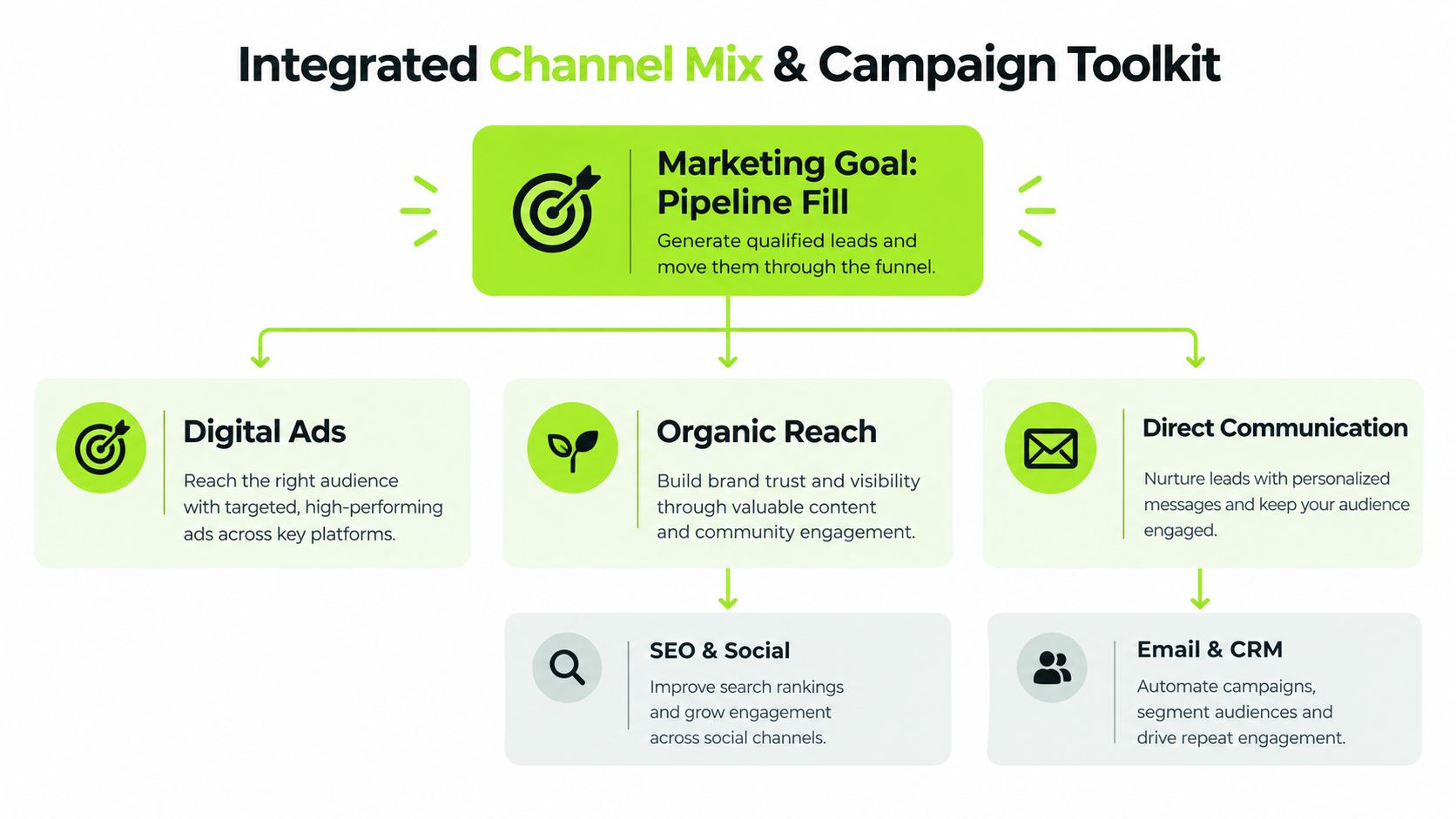
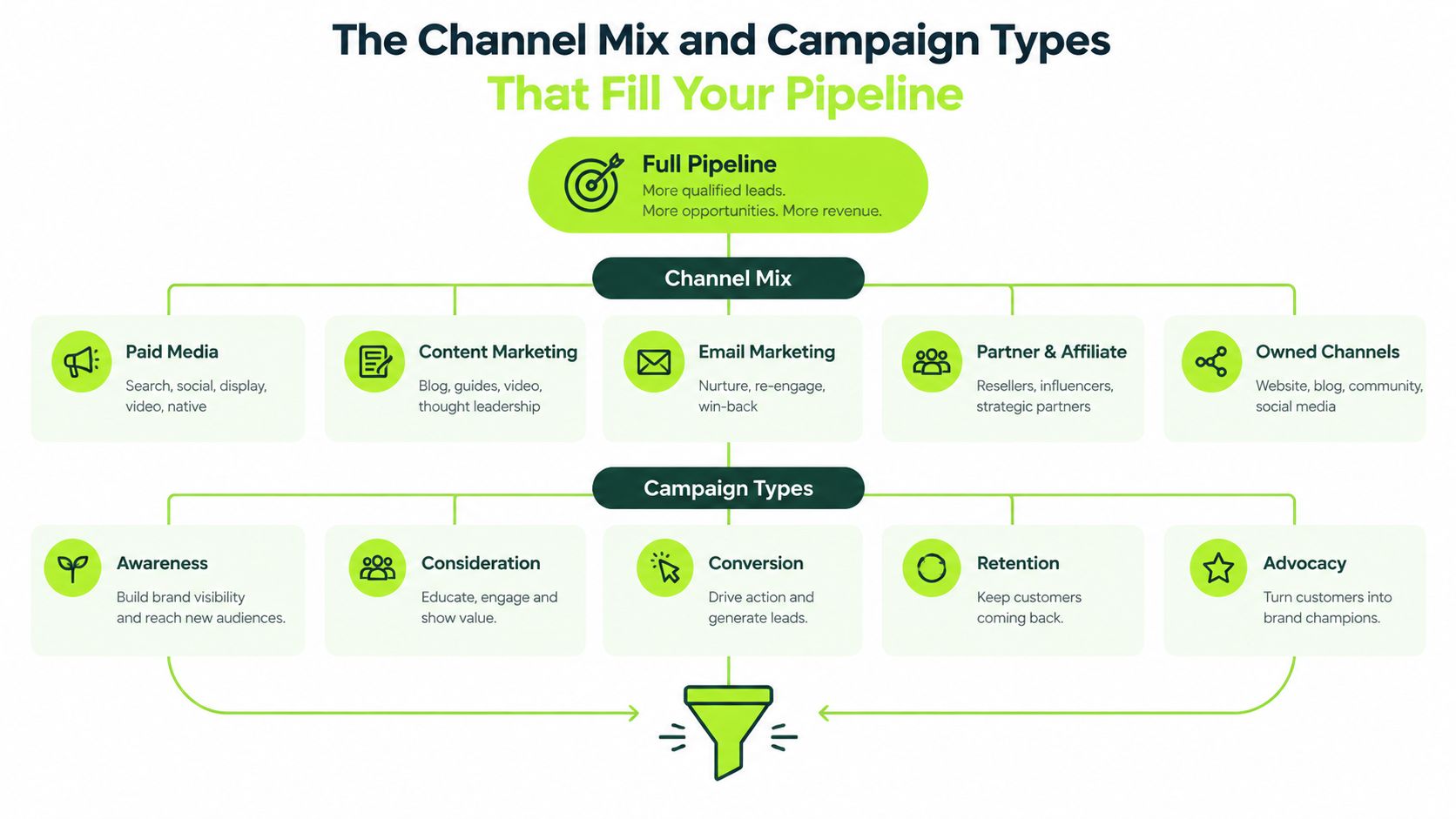
A channel mix only works when every activity has a defined commercial job. Paid advertising creates targeted local reach. Search content answers questions from people already researching. Social media shows the club's atmosphere. Email and CRM follow up with people who have expressed interest. Treating these channels as separate publishing tasks creates attention without a reliable route to enquiries, visits, or membership.
Start with the conversion destination, not the advert. A membership campaign should lead to a focused page covering membership categories, joining steps, practical questions, and one clear next action. A taster-day campaign needs a registration page. A corporate-events campaign should set out capacity, catering, formats, and the enquiry process. The page must match the promise made in the campaign.
Use campaigns with a defined commercial purpose
- Membership campaigns: Reach local golfers with a direct invitation to discuss membership or arrange a visit. Follow-up messages should address common objections instead of repeating the advert.
- Taster days and beginner events: Lower the perceived risk for people who have not yet built a relationship with the club. Capture their details and place them in a post-event membership journey.
- Corporate and society campaigns: Speak to organisers about a practical event proposition, not a general course message. A clear event pack and prompt handling matter more than a large audience.
- Stay and play packages: For resorts and hotel groups, connect accommodation interest with golf availability, itinerary planning, and a route for future visits.
- Off-course partnerships: Work with ranges, coaches, simulator venues, and local businesses whose audiences may want to progress to course play.
Adjacent experiences can bring people into golf before they are ready for membership. Resources such as Modern Yard Landscapes custom greens show how putting and practice environments can support engagement away from a full course. A club can apply the same principle through coaching programmes, open practice sessions, family events, or a beginner pathway. Each activity needs a clear next step, such as registration, a conversation, or a visit.
Sequence activity around the visit
The visit connects digital interest with membership progression. Build campaigns that make booking straightforward, then organise the messages and staff actions around that appointment. Reminders can reduce missed conversations, while a post-visit message can answer questions while the experience remains fresh. If the prospect has not decided, assign a follow-up task rather than leaving the lead invisible in an inbox.
Search, social, email, and paid media should support one measurable sequence. Clubs reviewing paid acquisition can use GolfRep's guide to golf club paid advertising as a practical reference. Judge each channel by enquiries, booked visits, and membership progress, then adjust spend and follow-up based on those outcomes rather than impressions alone.
From Enquiry to Booked Visit Why Speed and Systems Win
More enquiries will not fix a club that loses prospects between the form submission and the first useful conversation. Growth depends on how reliably the club acknowledges interest, assigns ownership, answers questions, and turns intent into a booked visit.
Set a response standard that staff can meet and managers can inspect. A separate UK lead-response study cited by GolfRep found that nearly 10% of firms replied within five minutes, while over 46% replied within an hour, as detailed in GolfRep's CRM response analysis. The practical lesson is to define the next action, record whether it happened, and make missed follow-up visible. Do not rely on an inbox that nobody owns.
Give every enquiry a controlled next step
A workable response system should:
- Acknowledge immediately: Confirm receipt and explain what happens next, while making clear that an automated message is not a personal reply.
- Capture context: Record the preferred contact method, playing history, interest category, timing, and key questions.
- Assign ownership: Send the lead to a named person or team, with a deadline for the next action.
- Offer a visit: Move the conversation towards a course tour, taster round, lesson, or membership meeting.
- Trigger nurture: Send relevant information when the prospect is not ready to book.
- Track the outcome: Record response time, contact attempts, visit status, application, joining decision, and later retention.
A shared spreadsheet can improve visibility temporarily, but it relies on disciplined manual updates. A CRM gives the club one record, one stage, and one source of truth. Automation can acknowledge enquiries, create tasks, route leads, and continue low-pressure nurture while staff handle the personal conversation.
Operational standard: If a manager cannot answer “What happened to this enquiry?” without searching several systems, the club does not have lead visibility.
Conversion tracking gives managers a practical diagnosis. They can see whether prospects stall because replies are late, qualification is weak, visit availability is limited, the proposition is unclear, or follow-up stops after the first contact. Committees can then review evidence rather than anecdotes. For a practical framework, use GolfRep's golf club follow-up system.
The aim is relevant contact at the right stage. A clear handover from automation to a real person protects staff time and gives serious prospects a straightforward route from enquiry to visit.
What Good Looks Like Lessons From Real Club Growth
The most useful club growth examples aren't stories about one clever advert. They show managers changing the operating system behind the marketing.
Consider a traditional private club with steady local interest but inconsistent follow-up. The club replaces shared inbox handling with a central pipeline, routes each enquiry to a named person, and introduces separate journeys for membership questions, taster visits, women's golf, and junior golf. Staff still make the important calls, but automated acknowledgements and task reminders prevent prospects from disappearing between shifts or committee meetings.
The lesson is transferable: the club didn't need to make the brand cheaper or louder. It needed to make the joining process easier to understand and more reliable to manage.
Local demand needs local control
A multi-site operator faces a different problem. A central team may run campaigns across several venues, while each site has different facilities, availability, membership categories, and response capacity. A shared CRM can provide central visibility, but the workflow must still route enquiries to the right site and preserve local context.
That structure supports useful comparisons:
- Which sites respond promptly?
- Which campaigns create booked visits?
- Where do prospects stall after a visit?
- Which membership questions recur across venues?
- Which local messages need to be adapted rather than copied?
Centralisation should create control, not blandness. Site teams need clear ownership and permission to tailor the conversation.
Growth without discounting
A club can improve conversion without reducing its fees. Better campaigns explain the experience, access, playing opportunities, social environment, coaching, and route into membership. Better follow-up answers practical questions before the prospect has to ask again.
The Hillier Hopkins survey data reinforces the importance of retention as well as acquisition. If the club welcomes new members but fails to onboard them properly, the initial marketing effort produces fragile growth. A structured welcome journey should introduce people to playing groups, competitions, coaching, clubhouse facilities, and the people who make the club feel usable.
England Golf reported 750,071 club members in 2025, up from 730,602 in 2024, while junior membership rose 34% and iGolf expanded 34% to 72,921 users, according to coverage of England Golf's membership data. The same report cited GCMA commentary using BRS Golf data, which showed some 1,500 clubs had lost around 6,000 members in a quarter even while member rounds remained strong. That contrast matters. Participation can be healthy while individual clubs lose members through poor qualification, weak onboarding, or inadequate retention processes.
Building Your Measurable and Optimisable Marketing System
A club's reporting should follow the member journey, not stop at the advert. Track the original source, enquiry quality, response time, qualification status, booked visit, attendance, application, joining decision, and retention signals. Keep the stages simple enough for staff to use every day.
Start with an audit
Ask five questions:
- Visibility: Can the team see every current enquiry?
- Ownership: Does each lead have a named person and next action?
- Speed: Can managers measure the time between enquiry and first response?
- Conversion: Can the club connect campaigns to visits and membership decisions?
- Retention: Does onboarding continue after the person joins?
Use GolfRep's conversion tracking setup guide to structure the measurement layer, then review the pipeline regularly with the people responsible for enquiries. Fix the biggest leakage point before increasing advertising spend. A small improvement in handling can be more valuable than another campaign sent into an unmanaged inbox.
GolfRep helps clubs combine local lead generation, automated follow-up, qualification, CRM visibility, and revenue tracking into one practical pipeline. Visit GolfRep to assess how your club can turn more of its existing interest into booked visits, new members, and a more predictable growth process.
Ready to tap into our proven growth system?