Golf Club Revenue Management Strategy
Raising annual subscriptions is the most popular answer to a golf club's revenue problem. It's also an incomplete one. A higher fee may improve income per member, but it can weaken conversion, increase resistance at renewal and leave the club exposed if tee-time capacity, visitor revenue and hospitality spend remain poorly managed.
Effective golf club revenue management treats the whole operation as a connected commercial system. Membership provides recurring income, while the tee sheet, societies, food and beverage, functions, coaching and visitor golf create additional opportunities to generate value from capacity that would otherwise go unused. The board's question shouldn't be “How much can we increase subscriptions?” It should be “Which customer, product or time period is currently producing the weakest return, and what can we change without damaging member value?”
Redefining Golf Club Revenue Management
A golf club has several revenue pools, and each behaves differently. Subscriptions are relatively predictable, visitor green fees vary with demand and weather, societies require forward planning, while bar and function income depend on usage, occasion and spend per head. Treating all of these as one turnover figure makes it difficult to see where commercial performance is improving or deteriorating.
The Hillier Hopkins Golf Clubs Survey 2024/25 illustrates why headline membership totals aren't enough. Seventy-seven per cent of members' clubs reported annual turnover above £1 million, compared with 68% in 2023, while 59% had more than 600 playing members, compared with 56% in 2023. Average rounds also rose from 27,000 to 32,000, showing that utilisation can change materially even when membership scale moves only modestly.
That creates a practical distinction between revenue growth and revenue quality. A club may add members but fail to monetise unused afternoon tee times. It may increase green-fee income while frustrating members with congested peak periods. It may fill the diary with societies that generate strong bar sales, but occupy times that would have produced better value from visitor golf or member events.
The full commercial mix
The Golf Club Managers' Association reports that subscriptions typically account for only 50–60% of annual club revenue, with the balance coming from visitor green fees, societies, food and beverage, and functions. The GCMA guidance on club subscription pricing supports a broader view of the club as a leisure and hospitality business, not just a subscription organisation.
A useful board dashboard should therefore separate:
- Recurring income: subscriptions, joining fees and recurring indoor-golf products.
- Playing income: visitor green fees, societies, competitions, coaching and simulator sessions.
- Hospitality income: bar, catering, functions and corporate events.
- Capacity measures: available tee times, booked times, cancellations and member access.
- Customer economics: acquisition cost, retention, ancillary spend and lifetime value.
Board question: If subscriptions rose but revenue per available tee time fell, would the club describe the year as a success?
That question changes the conversation. It encourages directors and managers to examine how much value each member, visitor, society and available playing opportunity contributes. It also protects the membership proposition. Member value isn't measured only by the number of times a golfer plays. It includes access, service, course condition, community and the confidence that the club won't sell its best inventory at the expense of members.
Revenue management is an allocation decision
Every tee time, function room and coaching slot has a commercial opportunity cost. Allocating one of those assets to a particular customer means choosing not to allocate it to another. The right decision depends on price, probability of booking, ancillary spend, retention value and the effect on the wider member experience.
That's why blanket price increases and indiscriminate discounting both underperform. One may prioritise short-term yield at the expense of acquisition and retention. The other may fill capacity while training customers to wait for a lower price. A stronger approach measures total contribution by segment and makes deliberate decisions about where access, price and service should differ.
Strategic Frameworks for Tee-Time Yield
A busy tee sheet can conceal weak commercial performance. The board should judge yield through revenue per available tee time, calculated across every slot the club could sell, including booked times and capacity that remained empty.
The PGA guide to tee-sheet optimisation gives a practical example. A course with 160 available tee times that generates £4,800 produces revenue per available tee time of £30. If 120 booked times generated an average of £40, the £10 gap represents capacity that was available but not monetised.
The commercial risk is easy to miss. Average revenue per booked time can rise while total yield falls if price increases are applied only to the times that continue to sell. The club then reports a stronger average ticket while a growing number of empty slots weakens the value of its fixed capacity.
A useful tee-sheet review starts with purpose, not price. Classify each block by the role it plays in the club's wider revenue model:
- Member entitlement: Times members expect to access, particularly where visitor sales could damage trust or reduce the membership proposition.
- Visitor demand: Slots that can command a green fee because of the day, time, course condition or local demand.
- Society and corporate blocks: Group bookings with potential for food, drink, repeat events and future commercial relationships.
- Off-peak inventory: Periods suited to flexible products, nine-hole offers, coaching or progression into membership.
- Protected capacity: Times retained for maintenance, competitions, member events and operating resilience.
These categories connect the tee sheet to the membership funnel. A quiet introductory round may have limited first-booking value but create a future member. A prime visitor booking may produce more immediate revenue while contributing less to retention or long-term club value. Commercial directors should therefore assess the opportunity attached to each slot, not only the price paid by the golfer who books it.
Review booking pace, cancellation behaviour, average spend and repeat usage by category. Dynamic pricing does not require constant or opaque changes. A clear rate architecture can apply a premium to peak visitor times, attach a useful product to quieter periods and keep member access understandable.
The trade-offs should be explicit. A society that fills a weak weekday period and spends on food may create more total contribution than a visitor using a prime Saturday slot. A society that blocks attractive inventory without a deposit, dependable attendance or ancillary spend may consume capacity that could support stronger member value or visitor yield.
Measure revenue per available tee time by weekday, weekend, morning, afternoon and seasonal period. Pair those results with cancellation rates, no-shows, buggy hire, range usage and food and beverage spend. This shows whether an apparently weak period needs a different product, better demand stimulation or protection from low-value bookings.
The aim is not to make every slot expensive. It is to identify under-monetised capacity and understand the reason. A last-minute offer may suit a quiet weekday afternoon. Discounting a high-demand Saturday morning just gives a lower price to customers who were already willing to pay the standard rate.
Nine-hole and twilight products can monetise periods that do not suit a full-round customer. Judge them by repeat frequency, spend and capacity impact, not just the first booking price. They create value when they add usage and strengthen the membership pathway. If they replace full membership or displace a higher-yield booking, adjust the structure. The GolfRep guide to tee-time revenue offers a useful operating reference. Price the opportunity, not merely the customer who happened to book it.
Membership Segmentation and Pricing Architecture
The traditional seven-day membership remains appropriate for frequent golfers who value broad access. It shouldn't be the automatic first product for every prospect. England Golf's participation data shows a wider market, with 12.6 million adults in England playing some form of golf during the previous 12 months, including 7.3 million on a nine- or 18-hole course and 5.3 million through off-course formats such as driving ranges, simulators, adventure golf and Topgolf-style venues. The participation figures reported by Northern Golfer also indicate that 59% of recreational players wanted to play more regularly.
The commercial opportunity is to build a progression route, not to push every golfer into the same contract.
Start with observed behaviour
Use actual usage and enquiry data to identify customer groups. A practical segmentation might include:
- Frequent full-course golfers: Offer broad access where expected usage justifies the price and capacity impact.
- Occasional visitors: Test credits, off-peak access or nine-hole products before presenting a full membership.
- Independent golfers: Create a clear route from pay-and-play to trial access and then to recurring membership.
- Juniors and families: Link coaching, access and progression so the product reflects how the household participates.
- Women and new golfers: Remove unnecessary barriers with suitable playing times, coaching support and an obvious next step.
- Indoor or off-course users: Use simulator, range or academy activity as a starting point for a wider relationship.
England Golf membership increased from 730,602 in 2024 to 750,071 in 2025, while junior membership rose from 46,028 to 61,483 and iGolf subscribers reached 72,921, according to England Golf membership coverage from Golf Business News. Those figures describe a growing pipeline, not guaranteed full-member revenue. Each segment needs its own conversion and retention assumptions.
Build upgrade triggers into the product
A flexible membership should have a commercial purpose. Define the usage point at which an upgrade becomes more attractive for the golfer and more profitable for the club. That trigger might be based on visits, booking frequency, coaching participation, ancillary spend or repeated use of peak inventory.
Track four stages:
- Participation: What activity brought the golfer into contact with the facility?
- First purchase: Did they buy a green fee, lesson, credit bundle, academy place or trial product?
- Repeat behaviour: Did they return, and how quickly?
- Recurring conversion: Did they upgrade, renew and remain commercially valuable?
England Golf recorded 11.83 million World Handicap System scores in 2025, with nine-hole scores up 28%, 18-hole scores up 14% and general-play scores accounting for 52% of submissions, as reported by Golf News. The format mix supports products that reflect shorter, flexible and informal play. It doesn't support assuming that every golfer wants the same access pattern.
A family membership can be commercially strong when it introduces several participants to the club, but the club should monitor capacity use and renewal by household. For clubs developing junior participation, a practical youth sports sponsorship guide can help structure community partnerships and funding conversations. The commercial test remains the same: measure the route from participation to paid, retained usage.
Balancing Visitor Revenue with Member Value
Visitor income fills capacity that would otherwise go unused and introduces golfers who may later become members. The UK golf satellite account identifies approximately 5.356 million adults playing golf at least once annually, 2.357 million playing at least every four weeks and 889,000 club members. It also estimates consumer spending of £1.438 billion on members' fees and £526 million on green fees, according to the UK golf satellite account.
The difference between participation and membership is a substantial prospect pool. It is also a capacity risk. Selling every available visitor booking can consume the tee times members value most, increase congestion and weaken the practical value of the annual subscription.
A board should approve a tee-sheet policy that connects visitor yield with member retention. The general manager, professional shop and events team should work from the same rules, rather than releasing or protecting times through separate decisions. Define which periods are reserved for members, which may be sold to visitors and which can be released to societies when demand is soft.
Apply five tests to each time block:
- Member access: Would this booking reduce the practical benefit of membership?
- Visitor yield: What fee can the time command, and is that income genuinely incremental?
- Ancillary contribution: Will the golfer use the bar, restaurant, shop, range or buggy service?
- Retention exposure: Could recurring visitor congestion affect satisfaction or renewals?
- Repeat potential: Is the golfer likely to return, buy coaching or enter a membership pathway?
The decision should reflect the whole customer journey. A visitor who pays a green fee, buys a lesson, returns with friends and later joins may be worth more than a single high-priced booking. Conversely, a booking that occupies a peak member time, produces little ancillary spend and has no repeat potential may be poor capacity use, even if the green fee looks attractive.
Visitor packages should include relevant products beyond the round itself. Coaching, food and beverage, equipment hire and repeat-visit credits can increase contribution while keeping membership access credible. For golfers who want lessons as part of the experience, information on where to get golf lesson vouchers can support a more structured approach to coaching sales.
Compare relationships, not headline prices
A member's value includes subscription income, joining fees where applicable, coaching, food and beverage, competitions and other purchases. Deduct servicing costs, acquisition cost and the capacity consumed by that relationship. For a visitor, include expected repeat green fees, group bookings, ancillary spend and the probability of conversion into a recurring product.
Practical rule: Never call a booking high value because it produces a strong green fee alone. Include the time used, attached spend and future relationship it creates.
The 2024/25 Hillier Hopkins survey also shows that member clubs can generate substantial income from both green fees and bar sales. That combination makes cross-selling and capacity allocation board-level decisions, not isolated sales activity. Visitor revenue should broaden the commercial base and support the facility without weakening the reason members joined.
Essential KPIs and Commercial Dashboards
A turnover report tells the board what happened. It doesn't explain why. A revenue dashboard should connect demand, capacity, customer behaviour and contribution so management can identify the current constraint.
Start with a shared definition for each measure. If the professional shop counts a booking as revenue when it's made, finance counts it when payment clears and the events team counts it when the customer attends, the board will receive conflicting information.
The core measurement set
| KPI | Definition | Commercial purpose |
|---|---|---|
| Revenue per available tee time | Total tee-sheet revenue divided by all available tee times, booked and empty | Shows whether the course is monetising capacity rather than only booked inventory |
| Revenue per booked tee time | Tee-sheet revenue divided by booked times | Helps assess price and customer mix among confirmed bookings |
| Net membership growth | Joiners minus leavers, reported by membership segment | Separates acquisition performance from retention performance |
| Cohort conversion rate | Prospects progressing from first enquiry or visit to a paid recurring product | Shows which propositions and sources create sustainable revenue |
| Member lifetime value | Expected recurring and ancillary contribution over the active relationship | Supports pricing, acquisition and retention decisions |
| Ancillary spend per head | Bar, food, buggy, range, coaching or retail income divided by relevant customers | Identifies products and segments that create value beyond the booking |
| Capacity utilisation | Used capacity divided by available capacity, by time period and product | Shows where inventory is constrained and where demand needs stimulation |
| Cancellation and no-show rate | Cancelled or unused confirmed bookings divided by confirmed bookings | Quantifies avoidable capacity loss and supports deposits or reminders |
| Acquisition cost | Sales and demand-generation cost divided by acquired customer or member | Prevents the club from judging volume without considering cost |
| Upgrade and renewal rate | Flexible customers moving to higher-value products, and members renewing | Tests whether the product ladder produces durable revenue |
Report these measures by segment, daypart, weekday, weekend and season where the data supports it. A single club-wide average can hide a weak weekday afternoon, a profitable junior pathway or a membership category with high churn.
Give each team a decision metric
The general manager needs total contribution and risk. The PGA professional may need lesson conversion, repeat usage and coaching capacity. The membership team needs enquiry-to-visit and visit-to-joiner progression. The bar manager needs spend per head by booking type. The board needs a concise view of trend, forecast and variance.
The dashboard should therefore include a short commentary beside each material change. “Visitor revenue down” isn't enough. “Visitor revenue down because weekend inventory was protected for members, while weekday yield improved” gives directors a decision to review.
For broader measurement principles, the GolfRep guide to measuring marketing effectiveness is relevant because marketing activity should ultimately be connected to visits, purchases, memberships and retained revenue. A campaign that produces enquiries but no profitable customer progression isn't a commercial success, even if the top-line activity looks strong.
Use cohorts instead of anecdotes
Track customers by the month or season in which they first purchased. Compare their repeat visits, ancillary spend, upgrade behaviour and renewal over time. This helps distinguish a product that creates initial volume from one that creates durable value.
Board discussions often rely on statements such as “women's golf is growing” or “visitors don't spend in the clubhouse”. The dashboard should replace those assumptions with segment evidence. If a customer group uses the course less often but spends more on coaching and food, its value may be underestimated by a rounds-only report.
Integrating CRM and Automation into Revenue Operations
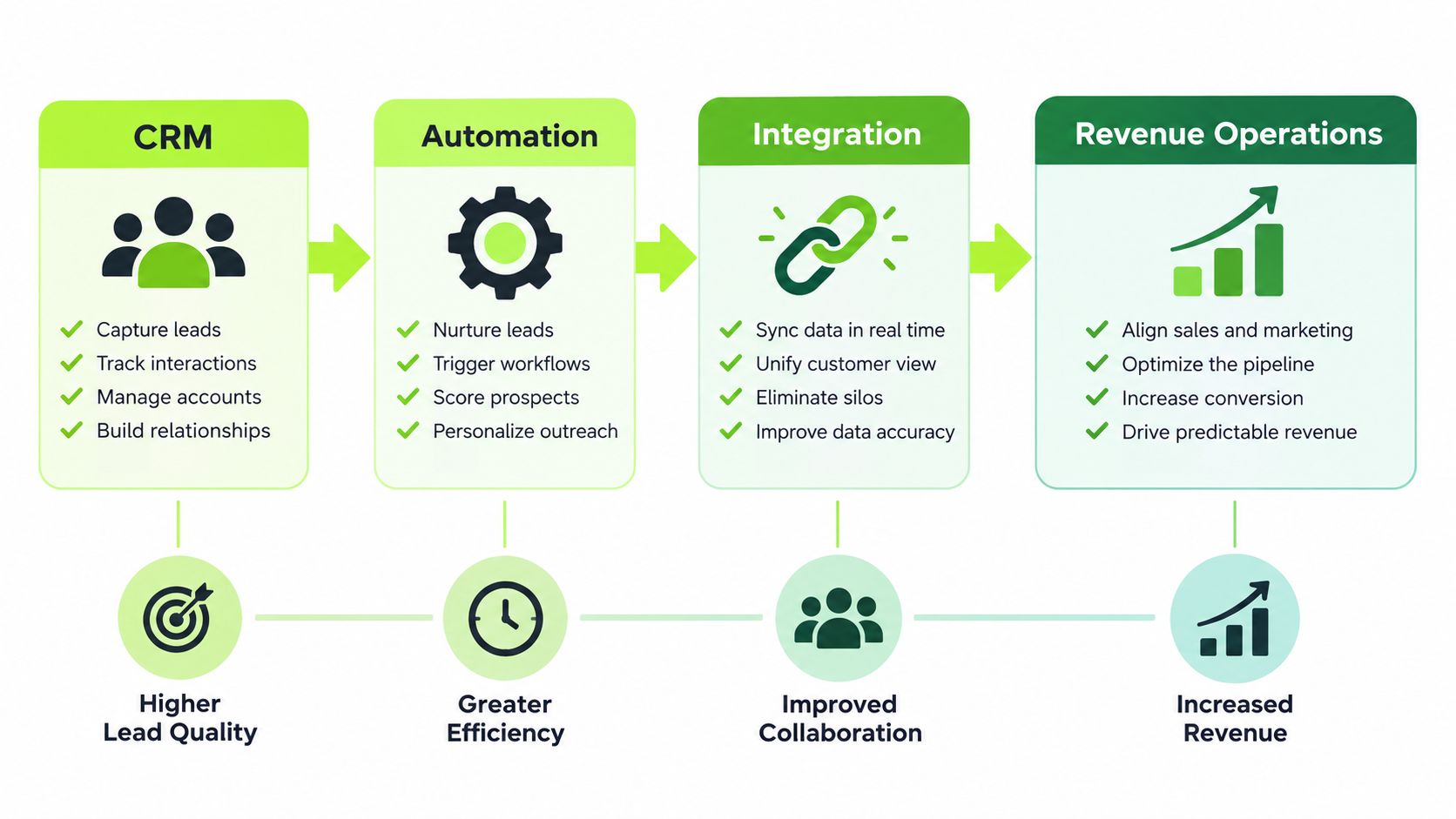
A tee sheet and a membership funnel are connected revenue pools. Pricing changes only work when the club can identify demand, follow up promptly and convert the right customers into repeat visits, higher-value products or membership. A flexible membership for independent golfers, a society package for a quiet weekday or a visitor offer designed to encourage repeat play all depend on consistent handling from first contact through purchase.
The commercial record is often split across systems. The website holds the enquiry, the tee sheet stores the booking, the till records spend and the membership system tracks renewal. Without a shared customer record, staff cannot see whether a visitor has played repeatedly, attended a lesson or reduced their course usage. Those gaps hide both lifetime value and retention risk.
A useful CRM record should answer five operational questions:
- Source: Did the contact arrive through the website, phone, professional shop, event, society, referral or paid campaign?
- Intent: Is the immediate need membership, visitor golf, a society booking, lesson, function, simulator session or corporate golf?
- Value signals: How often do they play, which times do they prefer, how large is their group, what might they spend and which products interest them?
- Stage: Are they a new enquiry, qualified prospect, booked visitor, attendee, proposal recipient, won customer, lost prospect or dormant contact?
- Next action: Who owns the follow-up, when will it happen, through which channel and for what reason?
These fields give the commercial team a usable view of capacity and customer value. They also show whether a membership prospect is competing for the same peak inventory as visitor demand, or whether an off-peak offer is filling capacity without creating a path to longer-term value.
Automation should handle repeatable administration while staff retain judgement. A visitor can receive booking confirmation and arrival information automatically. A society organiser can receive a deposit reminder and a prompt to rebook. A prospect who attends a trial can enter a structured sequence that answers common questions and presents a suitable next step.
Behaviour should trigger action. Repeated off-peak play may support an upgrade conversation. A lapsed member may warrant a personal call instead of another general newsletter. A society that books every year should receive a rebooking prompt before its preferred date is taken. If a flexible product is used heavily in protected peak periods, review its entitlements. If a weekday bundle attracts first visits but no returns, examine onboarding, product fit and booking friction before cutting the price.
GolfRepOS is one example of a golf-specific system connecting acquisition, enquiry handling, automated follow-up and revenue reporting across membership, visitor, society and event activity. Clubs can also build equivalent processes with a CRM, tee-sheet integration, booking platform and point-of-sale connection, provided ownership and data definitions are clear. The guide to CRM for golf clubs outlines the operational requirements managers should assess.
Commercial discipline: Every automated workflow needs an owner, a success measure and a route to human intervention. Automation without accountability moves confusion faster.
The objective is not a higher message volume. It is a visible, timely next commercial opportunity for each customer, while staff preserve capacity for conversations that require judgement.
Implementation Steps and Commercial Next Actions
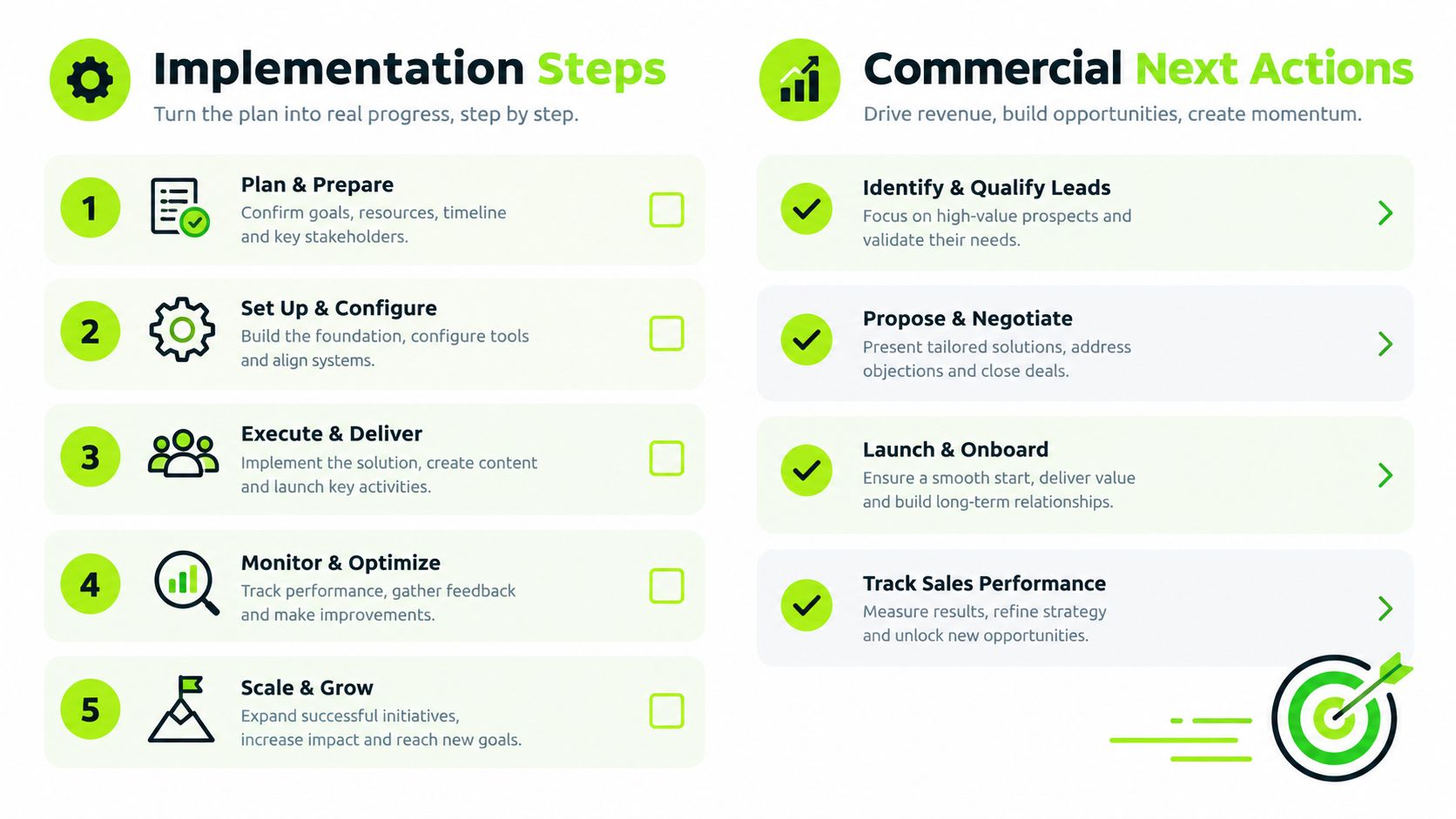
Revenue management works best as an operating discipline introduced in manageable stages. A club doesn't need to replace every system or redesign every membership category at once. It needs to identify the constraint that currently limits profitable growth, test a focused response and measure the result against an agreed baseline.
Begin with a commercial audit
Bring together the general manager, finance lead, PGA professional, membership owner, events contact and a representative from the board. Review the full income mix, tee-sheet availability, member access, visitor demand, society diary, hospitality contribution and customer data.
The audit should answer four questions:
- Which capacity is consistently underused?
- Which capacity is constrained and at risk of frustrating members?
- Which customer segments generate repeatable contribution?
- Where does the customer journey lose people between interest and purchase?
The answer will differ by operation. A private members' club may need better visitor allocation and retention insight. An indoor facility may need stronger repeat-visit and bay-utilisation reporting. A resort may need to connect rooms, golf, food and events into one customer-value view.
Pilot before rolling out
Choose one measurable commercial question. For example, can a weekday afternoon product improve revenue per available tee time without reducing member satisfaction? Can a flexible customer pathway increase repeat usage without displacing full memberships? Can society deposits reduce late cancellations?
Define the eligible inventory, target customer, price logic, staff responsibility, communication plan and review date. Keep the pilot narrow enough that the team can explain it to members and operate it consistently.
A board should approve decision rules in advance:
- Continue: The test improves contribution and protects the member experience.
- Adjust: The test produces demand but exposes capacity, margin or operational problems.
- Stop: The product mainly cannibalises higher-value demand or creates unacceptable friction.
- Scale: The result is repeatable across another suitable segment or time period.
Create a monthly revenue meeting
Use one dashboard and one set of definitions. Review actual performance, booking pace, membership funnel, churn signals, ancillary income and capacity by period. Assign an owner to each action, and record what management expects to learn from any price or product change.
Communication with members matters as much as the calculation. Explain protected access, the purpose of off-peak offers and how visitor or society income supports the club. Members are more likely to accept commercial experimentation when they can see that the club is protecting their core value rather than just selling access wherever possible.
The long-term objective is a repeatable cycle:
- Audit the revenue mix and capacity.
- Identify the binding commercial constraint.
- Design a controlled product, pricing or process change.
- Measure yield, conversion, retention and member impact.
- Keep, adapt or remove the change based on evidence.
That is the practical foundation of golf club revenue management. Subscriptions remain important, but they're only one part of a system that must coordinate tee times, customer segments, hospitality, sales processes and retention.
GolfRep helps golf clubs and facilities connect demand generation, CRM, follow-up, conversion and revenue reporting across memberships, visitors, societies and events. If you want to identify your club's biggest commercial constraint and build a measured plan around capacity and customer lifetime value, visit GolfRep.
Ready to tap into our proven growth system?