Building a Golf Club Sales Pipeline That Converts

A golf club can receive enquiries from the same county, through the same website and on the same morning, yet those enquiries may have almost nothing in common commercially. One person may be ready to discuss a full membership category. Another may be looking for a junior pathway, a society booking, a casual round or a flexible way back into the game.
So why do so many clubs put them into one queue and send them the same brochure?
A golf club sales pipeline should do more than record activity. It should identify intent, assign the right next step and show whether each category is producing sustainable member growth. The commercial question is not how quickly the club replies. It's whether the club knows what conversation it should have.
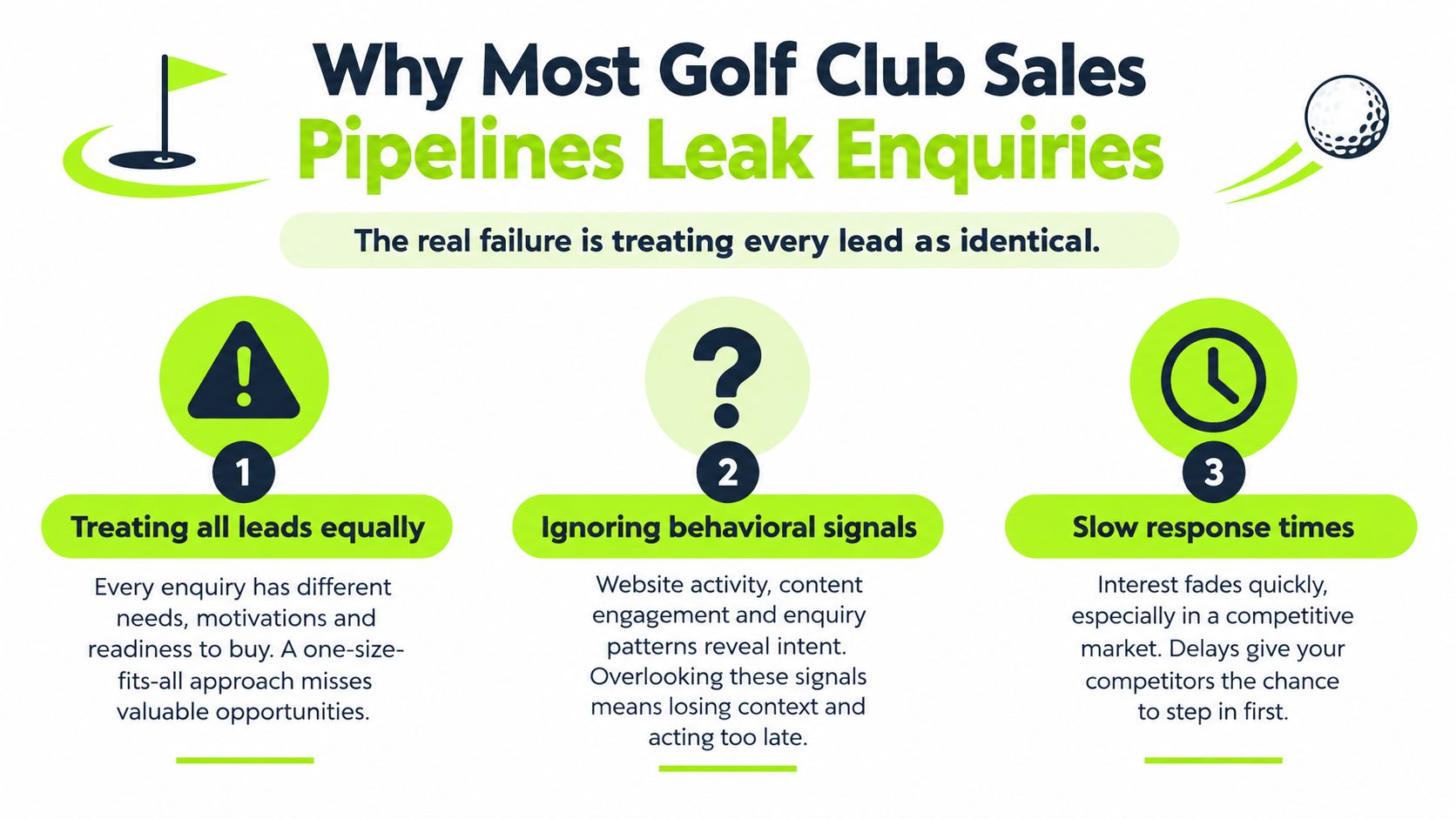
Why Most Golf Club Sales Pipelines Leak Enquiries
Slow response times can cost a club opportunities, but they aren't always the first problem to fix. A fast, generic reply sent to the wrong person still creates a poor buying experience. A county-level golfer considering a full membership shouldn't enter the same sequence as a parent asking about junior coaching or an organiser requesting society rates.
The first design question is therefore who is this enquiry for, not how quickly can someone call back.
England Golf's 2024 data gives clubs a sense of the market's scale, with 730,602 club members across 1,735 affiliated clubs. Averaged across the network, that equates to roughly 421 members per affiliated club, although local circumstances vary considerably. Yorkshire had 70,926 members, followed by Lancashire with 49,990 and Surrey with 47,779, which is why county-level targeting is more useful than a national average when a club estimates its opportunity. (England Golf membership data)
Three symptoms of a badly designed pipeline
A club usually has a segmentation problem when:
- Enquiry-to-visit conversion is weak: People ask for information but rarely book a tour, taster session or meeting.
- Visit-to-application conversion drops sharply: The club creates interest in person but doesn't present a relevant next step.
- The CRM contains stalled records: Nobody can say who owns the lead, what category was discussed or when the next action is due.
The third symptom is particularly revealing. A large database can make a club feel commercially organised while hiding a collection of unqualified names, duplicate records and prospects who received information that didn't match their situation.
Practical rule: A lead isn't progressing because somebody sent an email. It progresses when the prospect shows the behaviour required for the next stage.
A useful diagnostic is to separate enquiries into at least four branches before building automation: full-member intent, participation-led interest, group or visitor demand, and family or junior interest. The exact labels can differ by club, but the principle is consistent. Source tells you where the person came from. Behaviour tells you what the club should do next.
For a related review of operational leakage, see why golf clubs lose enquiries without realising. The important point here is different: even a well-managed response process will underperform if the club starts with the wrong category.
The Seven Stages of a Modern Golf Club Sales Pipeline
A practical pipeline needs stages that describe observable behaviour, not vague feelings such as “warm” or “interested”. If a prospect can remain in a stage because a staff member thinks they seem promising, the pipeline won't forecast anything reliably.
The following seven stages work well for membership acquisition because each transition has a clear gate.
Awareness
The golfer has encountered the club through search, social content, a referral, a visitor booking, a coaching programme or local reputation. Awareness is not a lead yet. The useful measure is the quality of the audiences being reached and the participation context behind the interest.
Enquiry
The person has made contact through a form, phone call, email, message or conversation with a member of staff. Capture the source immediately, but don't assume the source determines the commercial outcome.
Qualified
Qualification requires a useful exchange. The club has confirmed a likely membership category, a budget range or fee expectation, playing pattern and decision timing. A generic request for a brochure is still an enquiry, not a qualified opportunity.
Visit Booked
The prospect has agreed to a specific visit, taster session or hosted experience. A suggestion to “pop in sometime” doesn't count. The booking should have a date, owner and purpose.
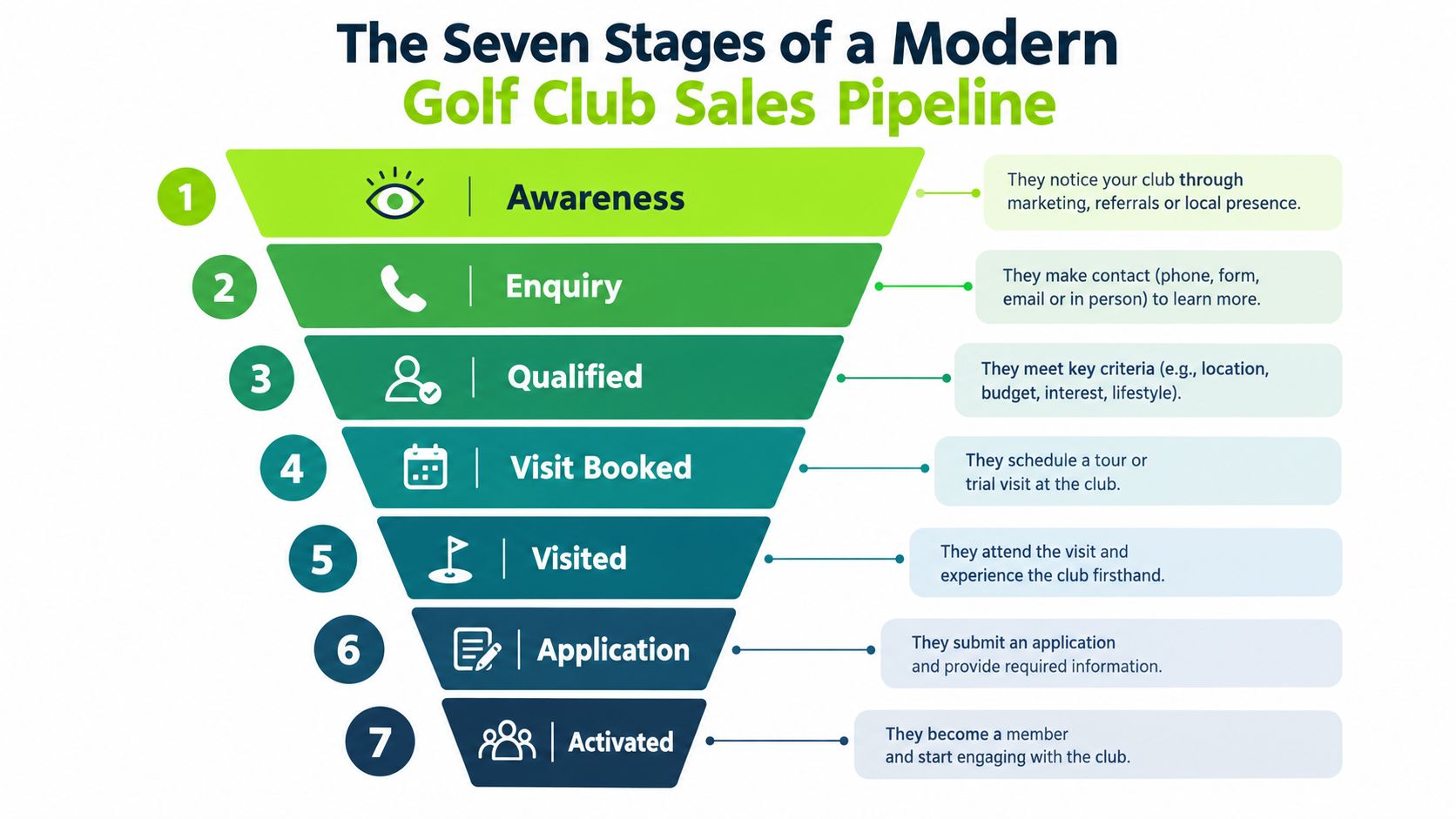
Visited
This stage means the experience took place. It shouldn't be triggered by a calendar invitation or an automated reminder. Record who hosted the visit, what the prospect valued, which objections appeared and what category was recommended.
Application
An application exists when the prospect has received a defined proposal and completed the club's formal application step. Where the club requires a deposit, signed proposal or payment confirmation, that evidence should be attached to the record.
Activated
The person has joined and has been introduced to the club properly. Activation is more useful than “joined” because it connects acquisition to the first member experience. Record the welcome contact, playing opportunities and any early engagement action.
A simple audit involves drawing these stages on a page and placing every open opportunity into one of them. Don't redesign the CRM first. Agree what each stage means, then identify where records currently stall.
For a broader explanation of how stage definitions support visibility and ownership, see what pipeline management means for a golf club. The commercial benefit comes from making the next action unambiguous, not from adding more fields or buying a larger platform.
Building the CRM Workflow and Automation Layer
A club can build a useful first version of its CRM without creating an enterprise project. Start with the stages above, one owner for each open opportunity and a record that contains enough information for another member of staff to continue the conversation.
Every lead record should contain:
- Name
- Contact details
- Original source
- Enquiry category
- Budget band or fee expectation
- Decision timeline
- Membership type or commercial product
- Named owner
The owner matters as much as the contact details. A shared inbox is a location, not accountability.
Keep the first automations narrow
Three automations usually earn their place early:
- Acknowledgement: Send a confirmation that reflects the enquiry category and states the next step.
- Routing: Alert the assigned owner when a new enquiry arrives. A club may choose a 15-minute internal routing standard for high-intent membership enquiries.
- Dormancy task: Create a follow-up task when a record has had no meaningful activity for 14 days.
Automation should route, remind and organise. It shouldn't conduct the entire sales conversation. A membership secretary still needs to understand why a golfer is considering the club, what they care about and whether the proposed category is a sensible fit.
Teams building workflows outside golf can also review these workflow examples for e-commerce for ideas about event triggers, routing and exit conditions. The mechanics transfer, but the conversation doesn't. A golf club is selling access, belonging and an experience, not just a transactional product.
Use behaviour-led scoring
A useful score rewards actions that indicate commercial intent. It shouldn't award points just because a person matches an assumed demographic.
| Behaviour Trigger | Points | Action |
|---|---|---|
| Direct question about a membership category or joining fee | High | Route to the membership owner for a personal response |
| Return visit to the membership or pricing page | Medium | Offer a relevant visit or call |
| Confirmed visit booking | High | Move to the visit workflow |
| Attendance at a taster or hosted experience | Very high | Create a post-visit task |
| Generic brochure download | Low | Keep in nurture unless another signal appears |
| Enquiry about society or visitor rates | Separate route | Move to the appropriate non-membership pipeline |
The scoring model should be reviewed against actual outcomes. If a behaviour produces no useful conversations, reduce its weight. If a junior parent regularly books coaching before asking about membership, treat that behaviour as a segment signal rather than forcing it into an adult full-member score.
A no-code setup can work if the fields, ownership rules and stage definitions are agreed first. Software won't resolve an internal disagreement about who qualifies an enquiry or what counts as an application. For an example of a more focused approach, see lead qualification automation for golf clubs.
Qualifying Enquiries by Behaviour Not Just Source
Two illustrative enquiries arrive on the same morning.
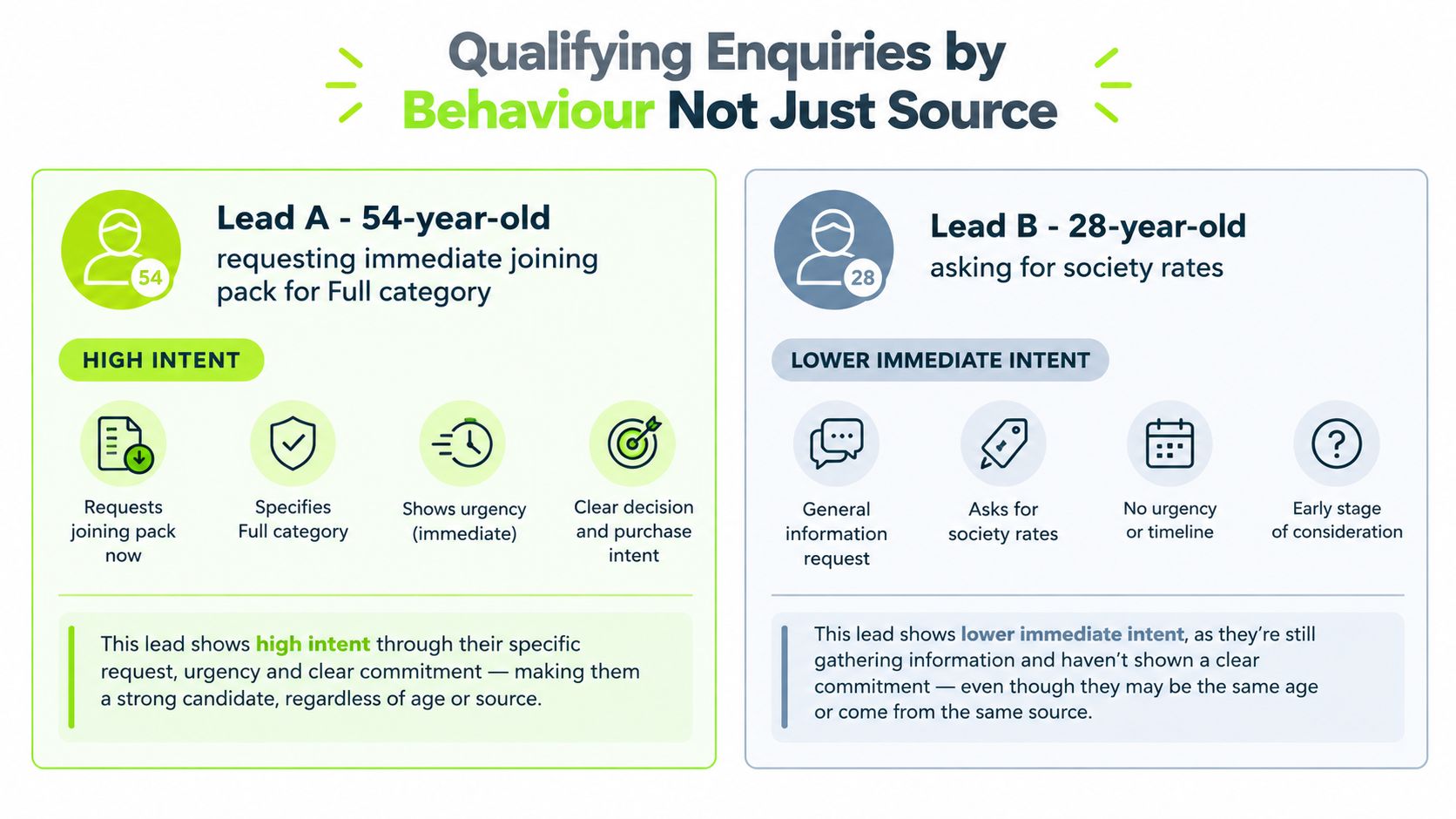
Lead A is a 54-year-old golfer asking for an immediate joining pack for the Full category. They want to understand the fee, available payment options and whether they can visit before deciding. The age is not what makes this a strong opportunity. The direct request, category clarity and willingness to discuss a visit do.
Lead B is a 28-year-old golfer asking for society day rates. They don't mention membership and want to know whether the clubhouse can support a group event. That may become a valuable society booking, but it isn't a full-membership opportunity just because the person plays golf or falls within a younger audience.
Lead A should enter a same-day membership call queue, with an internal 15-minute alert and a practical invitation to view the course. Lead B should route to the society workflow, receive the relevant package information and enter a 90-day re-engagement path that can introduce membership only if later behaviour supports it.
The signals worth trusting
Three behaviours often provide a better basis for action than source alone:
- Pricing-page attention: The person spends time reviewing fees, categories or joining arrangements.
- Repeat membership visits: The same contact returns to membership content rather than browsing only general club information.
- Direct category questions: They ask whether a particular membership suits their playing pattern, age group, family situation or availability.
Downloads and generic form completions are weaker indicators. They help the club identify interest, but they shouldn't automatically move someone into a personal sales queue.
A practical lead scoring guide can help teams think through positive and negative signals without confusing activity with intent. In a golf club, the model should also recognise that one person may have more than one commercial route. A visitor could become a member. A parent could become a family member. A society organiser could remain a society customer without ever being a membership prospect.
The source explains acquisition context. Behaviour determines the next conversation. That distinction protects staff time and prevents the club from sending a full-membership pitch to someone who has given no indication that membership is their objective.
Nurture Sequences That Book Visits and Sign Ups
A booked visit is not the end of the pipeline. It's a commitment that the club must prepare for and deliver well. The sequence should remove practical uncertainty before the visit, create a structured experience on the day and make the decision easy afterwards.
For a taster visit, the working sequence can look like this:
Before the visit
Within five minutes of booking, send confirmation with the date, meeting point, expected format and the name of the club contact. Forty-eight hours before, send directions, parking information, dress guidance and the host's name. On the day, send a text two hours before the appointment.
The messages should be useful rather than promotional. A prospect who knows where to park and who will meet them arrives with fewer reasons to feel awkward or uncertain.
During the visit
A structured 75-minute route gives the club enough time to demonstrate the experience without turning the meeting into a hard sell:
- Coffee and an informal introduction
- A walk around the course and key practice areas
- Nine holes with a member host where appropriate
- Lunch or refreshments in the clubhouse
- A conversation with the membership secretary covering category, joining fee and payment options
The route should flex around the prospect. A family, a returning golfer and an experienced county player may need different emphasis. The host should record what mattered to the prospect, not just whether the tour was completed.
After the visit
Send a thank-you email before midnight with a personalised video, a one-page summary of the points discussed and the agreed next step. Include a clear 14-day decision window, then send a soft “still considering” reminder at day seven.
Two actions remain manual. The sales lead should call between the visit and the decision deadline, then make a personal follow-up if the deadline passes without a reply. Automation can create both tasks, but it can't replace judgement about tone, timing or objections.
Split the sequence by situation
The main visit workflow should branch for:
- Cold prospects: Continue with proof of fit and a low-pressure invitation.
- Families: Address junior activity, parent convenience, coaching and how the household can use the club.
- Intermediates returning to golf: Explain re-entry options, playing confidence and a realistic route into club life.
- Ex-members: Start with the reason they left, then address what has changed before presenting an offer.
A nurture sequence works when every message answers the next question in the prospect's mind. It fails when the club only repeats prices and asks whether the person is ready to join.
Pipeline KPIs and Reporting Cadence That Drive Action
A report should help a manager decide what to change this week. It shouldn't be a monthly scrapbook of enquiries, calls and social reach.
The seven core measures are stage movement, speed, value and net outcome. Use the benchmarks below as club-set operating targets, not as universal industry statistics. A smaller private club and a larger resort won't have the same economics, capacity or membership mix.
| KPI | Benchmark | Action if Below Target |
|---|---|---|
| Enquiry-to-visit conversion | Set from the club's historic category data | Review qualification, offer and booking friction |
| Visit-to-application conversion | Set separately for full, flexible, junior and family categories | Audit the visit experience and recommendation |
| Application-to-join conversion | Set by membership type and payment route | Check objections, paperwork and decision ownership |
| Average days from enquiry to visit | Establish a baseline, then reduce avoidable delay | Inspect routing, ownership and available visit slots |
| Average days from visit to decision | Establish a category-specific baseline | Add a personal call and record the reason for delay |
| Pipeline value by stage | Use expected annual value and realistic conversion | Prioritise valuable opportunities, not raw lead count |
| Net member movement | Joiners minus resignations, reviewed by category | Connect acquisition activity to retention and capacity |
The club should also use a cohort view. Compare average joining fee by source, retention of members acquired in the last 12 months and lapsed-member reactivation by category. These measures expose quality that a top-line enquiry count hides.
UK club data reinforces the need to connect sales with operating performance. The 2024/25 members' and proprietary golf clubs survey reported 75% of members' clubs showing growth, while 77% reported annual turnover above £1 million. It also found that 59% had more than 600 playing members, and average annual rounds rose from 27,000 to 32,000. (UK golf-club operating survey)
Make the meeting operational
Hold a 45-minute pipeline review on the first Tuesday of the month. Share the dashboard 24 hours earlier, cap attendance at five people and give every KPI a named owner.
The agenda should cover:
- Stage-to-stage movement
- Aged opportunities
- Lost reasons
- Category and source quality
- One bottleneck to fix before the next review
A weekly snapshot of drop-off tells the team where to work. If visits are being booked but applications lag, improve the visit and proposal. If qualified enquiries never reach visits, inspect availability and booking friction. A KPI without an owner and a target is decoration.
Connecting Pipeline Output to Net Member Growth
A joiner tally can look healthy while the club's commercial position weakens. The basic equation is simple:
Net member movement = joiners minus leavers.
That calculation becomes useful only when the club breaks it down by category, source and joining cohort. A full member and a social golfer may each count as one joiner, but they can carry very different subscription values, playing patterns, joining-fee implications and retention risks.
The pipeline should therefore forecast two outcomes at once:
- Expected joiners: Qualified opportunities multiplied by a realistic category conversion rate.
- Expected value: Expected joiners multiplied by the relevant annual subscription, joining fee and downstream commercial assumptions.
Those assumptions must come from the club's own history. Don't use the same conversion rate for a booked full-membership visit, a junior coaching enquiry, a society organiser and a casual visitor.
UK joining-fee data illustrates why value needs to sit beside volume. A 2025 survey of 79 UK members' clubs found that 74% required a joining fee, with reported fees ranging from £140 to £9,300 and an average of £2,350. The average membership fee was £1,760, with the middle 50% of clubs charging between £1,270 and £2,260. (UK golf-club membership fee survey)
A planning model for category value
The following table is a structure for a monthly forecast. The figures should be populated from the club's own CRM and membership system, rather than copied from another business.
| Segment | Enquiries | Visit Rate | Join Rate | Avg Annual Sub | Joiners | Leavers | Net Movement | Weighted Value |
|---|---|---|---|---|---|---|---|---|
| Full membership | Record actual | Record actual | Record actual | Use current tariff | Forecast | Record actual | Joiners minus leavers | Joiners multiplied by subscription |
| Flexible or social membership | Record actual | Record actual | Record actual | Use current tariff | Forecast | Record actual | Joiners minus leavers | Joiners multiplied by subscription |
| Junior or family | Record actual | Record actual | Record actual | Use current tariff | Forecast | Record actual | Joiners minus leavers | Joiners multiplied by subscription |
| Visitor or trial pathway | Record actual | Record actual | Record actual | Use eventual category value | Forecast | Record actual | Joiners minus leavers | Expected conversion multiplied by value |
For an illustrative planning exercise, a manager might distribute a 120-enquiry month across visitor, trial, social and full categories, then apply each category's recorded visit rate, join rate and annual subscription. The resulting forecast is more useful than assuming every enquiry has equal value, but the scenario should remain clearly labelled as a planning model, not reported club performance.
Leavers belong in the same review. UK club survey data found that 24% of clubs had more leavers than joiners, while average joiners rose from 70 to 73 and average leavers from 48 to 56 in the periods reported. (UK club joiner and leaver analysis)
That is why GolfRep's monthly commercial checklist is straightforward:
- Review the pipeline against the member and revenue target.
- Reconcile joiners and leavers by category, source and joining month.
- Reallocate acquisition effort towards segments that increase net recurring revenue, not just enquiry volume.
A pipeline becomes a forecasting tool when it explains where future members will come from, what they are likely to be worth and whether the club is retaining enough of them to create net growth.
GolfRep helps UK golf clubs map membership, visitor, society and family opportunities into an organised pipeline, with qualification, ownership, follow-up and revenue reporting connected. If you want to identify the category where your pipeline is leaking value and build a practical improvement plan, visit GolfRep.
Ready to tap into our proven growth system?