Golf Club Churn Rate: A Manager's Guide to Retention

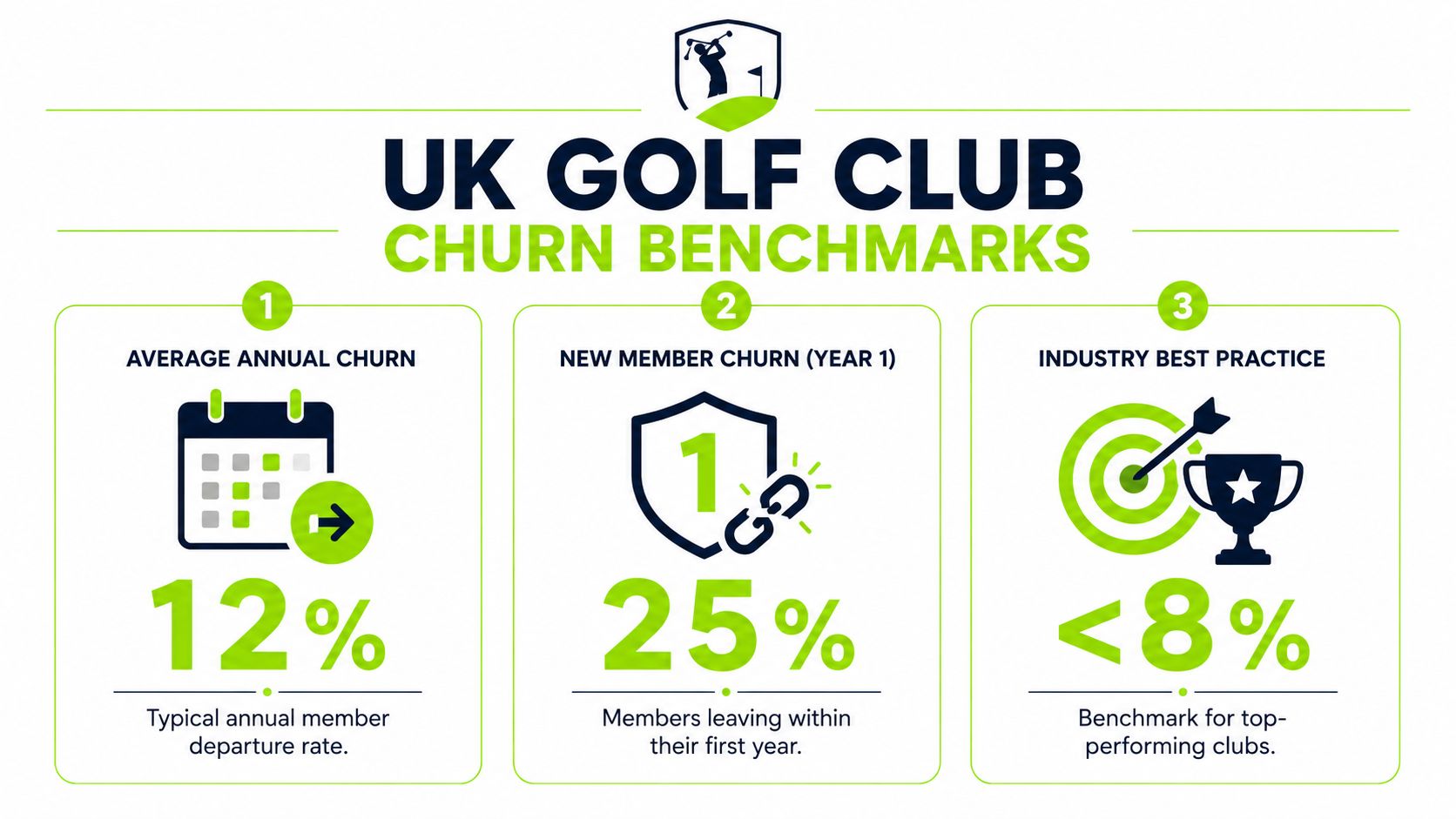
If up to 25% of new members can leave in the first year if they aren't properly integrated into club life (ClubMark), churn stops being a background metric and becomes a management issue.
That matters more than many committees realise. Most clubs don't struggle because nobody wants to join. They struggle because member experience, follow-up, onboarding, and engagement are still handled through fragmented admin, inconsistent staff habits, and too little visibility.
At GolfRep, we look at golf club churn rate as an operating system problem. If a club can't see who is drifting, can't respond when usage drops, and can't guide new members through the first phase of membership, it will keep losing people for reasons that feel vague but are usually measurable.
What Is Golf Club Churn Rate and How Do You Calculate It
A club can post healthy join numbers and still go backwards. Churn rate shows whether membership growth is holding or leaking away.
Golf club churn rate is the percentage of members who leave over a set period, usually a year. Committees should treat it as a control metric, not a finance footnote, because it affects subscription income, staffing pressure, and how hard the club has to work to replace lost revenue.
The basic formulas are simple:
- Annual churn rate = members lost during the year ÷ total members at the start of the year x 100
- Retention rate = members kept during the year ÷ total members at the start of the year x 100
If the club starts the year with 500 members and loses 30, annual churn is 6%.
That number matters. A 6% churn rate means the club must replace 30 members before it grows at all. It also gives management a cleaner way to assess pricing decisions, sales performance, and member experience. For clubs tying acquisition activity back to member value, the ROI of golf club marketing becomes clearer once churn is measured properly.
Why one annual figure is not enough
A single club-wide percentage is useful, but it is not enough to manage retention well.
In practice, churn sits inside specific operational gaps. One intake group may receive a proper welcome and settle in. Another may join during a busy period, get little follow-up, play a few rounds, and drift out before anyone notices. The annual average hides that difference.
Break churn down by cohort so the club can see where member loss starts:
- New members versus established members
- Membership type, such as five-day, seven-day, flexible, intermediate, or social
- Source of join, such as referral, open day, website enquiry, or corporate introduction
- Join month or season, to spot whether some intakes are onboarded and followed up more consistently than others
If the board only reviews one annual churn figure, intervention comes late.
The first-year view deserves separate reporting. As noted earlier, poor integration into club life increases the risk that new members leave early. That is why churn should be connected to onboarding steps, first-month activity, and whether anyone owns the follow-up process.
How to calculate churn in a way the club can act on
Calculation is the easy part. Building a reporting process that helps staff and committees act on it is where clubs usually fall short.
A useful monthly review should include:
Resignations logged consistently
Record each resignation with membership category, join date, stated reason, and any recent drop in usage.Early-life member tracking
Review new joiners at 30, 90, and 180 days. Low activity in those windows is often a stronger warning sign than the resignation itself.Engagement data beside churn data
Look at rounds played, competition entries, lessons, event attendance, and whether the member has formed visible ties to the club.Clear ownership
Someone needs to own retention reporting and follow-up. If responsibility sits vaguely between admin, marketing, the pro shop, and the committee, avoidable churn gets missed.
This is also the practical value of understanding member retention through churn analysis rather than treating cancellations as isolated events. Clubs that control churn well usually do three things consistently. They monitor member behaviour early, flag risk before renewal, and trigger follow-up through a defined process rather than staff memory.
That is the shift from measuring churn to managing it.
UK Golf Club Churn Benchmarks You Should Know
Most managers ask the same question after calculating churn. Is this healthy, or is something broken?
The answer depends on club type, local market, and capacity. But there are still useful benchmarks. UK-focused guidance and golf-industry benchmarks give a practical range that committees can use to sense-check performance.
What the benchmark ranges mean
One UK club benchmark says annual churn below 5% is the target for premier private clubs, and adds that 15% annual churn implies an average member stay of 6.6 years (country-club KPI guidance).
Separate golf-club benchmarking guidance places established private golf clubs at 6% to 10% annual churn, while above 12% is treated as a warning sign. That same benchmark notes that 10% churn implies average tenure of about 10 years, while 12% reduces it to roughly 8.3 years (LinksMeridian).
That gap matters. Small changes in churn alter how long members stay, how much acquisition pressure the club faces, and how much room management has to protect price integrity without relying on constant recruitment.
| Annual Churn Rate | Implied Member Tenure | Performance Status |
|---|---|---|
| Below 5% | Long-term retention profile | Strong for premier private clubs |
| 6% to 8% | Moderate retention pressure | Commonly discussed range in UK club golf |
| 6% to 10% | Established private club benchmark | Watch by segment, not just headline |
| Above 12% | Roughly 8.3 years at 12% | Warning sign |
| 15% | 6.6 years | Serious retention problem |
Don't compare a golf club to a software company too literally
It's sometimes useful to look at wider subscription thinking, especially if your committee wants context on how recurring-revenue businesses track churn. This overview of SaaS churn rate benchmarks can help frame the principle. But golf clubs shouldn't copy software-sector assumptions blindly.
A golf club has capacity constraints, peak-time demand, social dynamics, and ancillary spend that software businesses don't. A club can tolerate some natural movement if incoming demand is strong and the members leaving are not the ones driving value.
Healthy churn isn't just a low number. It's a number that fits your club's positioning, capacity, and member mix.
That is why the benchmark should trigger questions, not panic. If your rate sits in the common range but most losses come from recently joined members, your issue is onboarding. If losses come from long-standing, high-spend members, the issue is more serious.
For committees reviewing long-term resilience, future-proofing golf clubs starts with this discipline. Measure churn, compare it objectively, then break it down before acting.
The Real Reasons Your Members Are Leaving
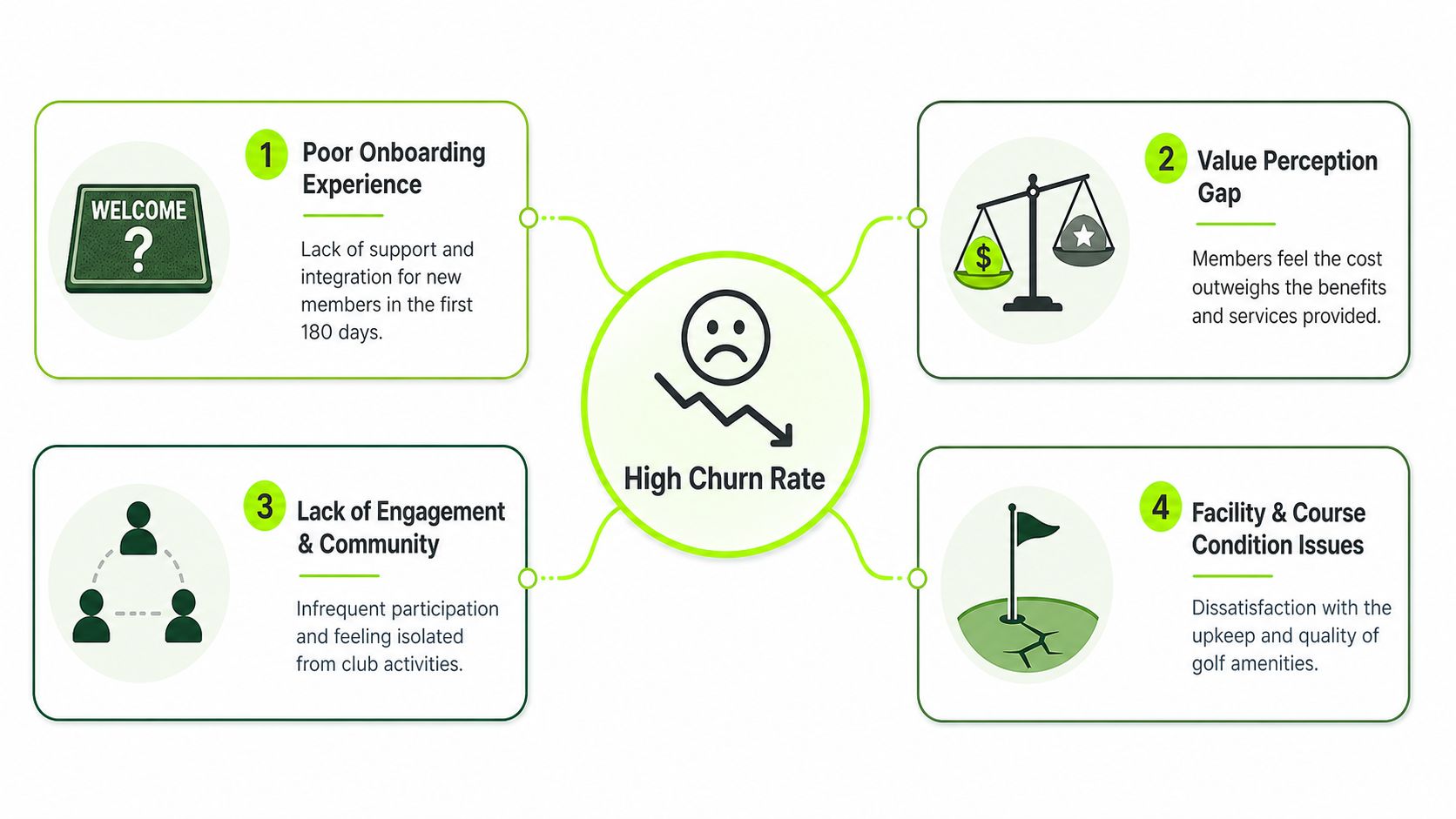
Member loss usually starts months before a resignation email. In most clubs, the pattern is operational, not dramatic. A weak join process, limited visibility into engagement, and inconsistent follow-up create a slow drop in perceived value.
Poor onboarding creates silent regret
The first risk period starts straight after payment.
Many clubs still handle joining like an admin task. A welcome email goes out, login details are sent, and the member is expected to work out tee sheets, competitions, playing groups, clubhouse routines, and who to speak to. Confident golfers can push through that. Plenty do not. They feel unsure, use the club less than planned, and begin to question the decision before the first renewal conversation even arrives.
This is an operating problem. New members need a defined first-90-to-180-day journey with named touchpoints, simple prompts to book, and a clear route into the social side of the club.
Low engagement often stays invisible
A committee can usually see who has paid. Far fewer clubs can see who is drifting.
The warning signs are familiar. Fewer bookings. No competition entries. No guest activity. Less food and beverage spend. Fewer appearances at club events. On their own, these signals look minor. Together, they show a member relationship losing momentum.
Without a basic tracking system, staff rely on memory and anecdote. That works for a small number of members the team sees often. It breaks down across the wider base, especially when membership, the pro shop, and food and beverage all hold different pieces of the picture.
The type of member leaving matters
A departure rate on its own does not tell you what to fix.
Losing a lightly engaged off-peak member is different from losing a long-standing competition player who brings guests, spends in the bar, and introduces friends. Losing a price-sensitive member in a crowded category is different from losing a new joiner who showed strong early intent but never got integrated. The same churn figure can point to very different commercial and cultural issues.
That is why retention work has to move past headline percentages and into member-level diagnosis. Clubs that are losing members need to review exits by tenure, category, usage pattern, spend, and social connection, not just total count.
Friction changes how value feels
Members judge value through day-to-day experience. Annual fees matter, but they are only part of the decision.
Small frustrations do more damage than many committees expect. Booking feels awkward. Event information arrives late. Benefits are poorly explained. Questions sit unanswered. New members do not know who to play with. None of these issues guarantees a resignation. Repeated over months, they make the club feel harder to use and easier to leave.
This is also why better member feedback matters. Clubs should not wait for an exit form to learn what is going wrong. Asking members directly, and storing those declared preferences properly, gives the team something useful to act on. If your staff are building a cleaner feedback and preference process, it helps to understand what is zero party data and how that kind of member-provided information can support better follow-up.
The common thread is simple. Members rarely leave because of one isolated incident. They leave because the club has no reliable system for onboarding them well, spotting disengagement early, and triggering the right response before the relationship goes cold.
Data-Led Retention Strategies That Actually Work
Retention usually breaks down in the handoff between information and action. Clubs collect bookings, attendance, emails, and payment history, then fail to turn any of it into a repeatable follow-up process.
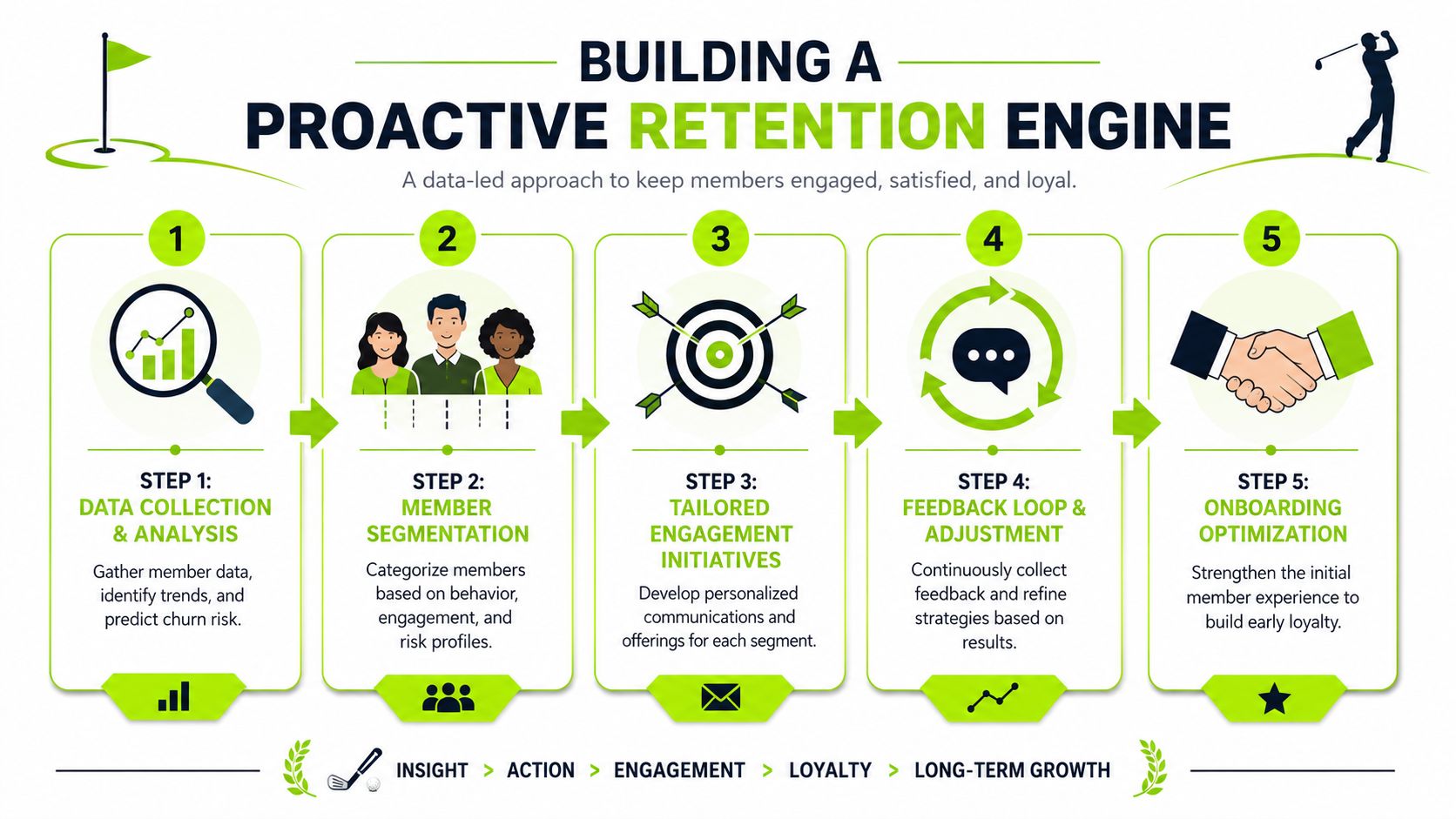
The clubs that hold churn down tend to run retention like an operating system. Staff can see who joined, who is settling in, who has gone quiet, and who owns the next conversation. That sounds simple. In practice, it is the difference between a club that notices risk early and one that only reacts to resignations.
Start with behaviour, not assumptions
A workable retention setup should let management answer four questions without chasing five people for updates:
| Question | What the club should be able to see |
|---|---|
| Who joined recently? | Join date, category, source, onboarding stage |
| Who is using the club? | Booking activity, event participation, visible engagement signals |
| Who is going quiet? | Drop-off in usage, missed touchpoints, weak integration |
| Who has been contacted? | Follow-up history, owner, next action |
This is less about software choice and more about operational discipline. A spreadsheet can work at small scale. Once membership, admin, the pro shop, food and beverage, and management are all involved, it usually stops being reliable. Important context ends up in inboxes or staff memory, and no one sees the full member relationship.
That gap creates avoidable churn.
Treat the first 180 days like a managed programme
Early tenure needs tighter control than the rest of the membership lifecycle. New members are still deciding how easy the club is to use, whether it fits their routine, and whether they know enough people to stay involved. If that period is left to chance, weak engagement becomes a pattern before anyone intervenes.
The practical response is segmentation by early behaviour, followed by clear follow-up rules.
A useful structure looks like this:
Early starters
Members who book quickly, join competitions, or attend events need reinforcement. Show them what to do next and pull them deeper into club life before momentum fades.Quiet joiners
Members with little or no early activity need contact early, not at renewal. Check whether the issue is booking friction, confidence, schedule fit, or simple uncertainty about how the club works.Socially hesitant members
Some members do not need more information. They need introductions. Give them named contacts, hosted roll-ups, or formats that lower the social barrier to participation.Time-poor members
These members often look disengaged on paper even when intent is high. Point them to realistic playing patterns, shorter formats, off-peak access, or coaching-led touchpoints that fit their week.
A welcome email is only one step. Onboarding works when the club has defined checkpoints, assigned owners, and a response when activity stays low.
Use declared preferences alongside observed behaviour
Behaviour shows what members have done. Preference data explains what they were trying to get from membership in the first place. Both matter.
A club should know whether a member joined for competition golf, flexible casual play, family use, networking, lessons, or social events. That kind of stated preference is often described as what is zero party data. For a golf club, the application is straightforward. Ask directly, store the answer properly, and use it when deciding what good engagement looks like for that person.
This prevents bad judgement. A weekday golfer who never enters Saturday competitions may be using the club exactly as intended. A socially motivated member who plays rarely may still renew if the club helps them build connections. Without that context, staff can mistake a mismatch in communication for lack of interest.
Automate the routine. Keep judgement for the moments that matter
Good retention systems do not replace personal service. They protect it by removing the need for staff to remember every task manually.
Useful automations include:
A structured welcome series
Timed messages that explain booking, contacts, relevant events, and the first actions a new member should take.Usage-triggered alerts
If a new member shows little early activity, the system creates a prompt for personal follow-up.Re-engagement prompts
If an active member goes quiet for a defined period, the club reaches out before that silence rolls into renewal risk.Segment-specific communication
Five-day members, competitive golfers, beginners, and socially focused members should not receive identical messaging.
The trade-off is straightforward. More automation gives consistency and speed, but it can also create generic communication if the underlying member data is poor. More manual follow-up feels personal, but it usually becomes inconsistent as staff get busy. The stronger model is hybrid. Automate timing, triggers, and task creation. Let staff handle the conversations that require judgement, context, and trust.
Putting It All Together A Practical Implementation Plan
The clubs that reduce churn usually don't start with a large transformation project. They start by fixing visibility, ownership, and the first member experience.

A practical implementation plan can be built in stages.
First, create one member view
Most clubs already have the raw information. The problem is that it's scattered across tee sheets, inboxes, membership records, staff memory, and separate systems.
Bring the essentials into one place:
- Join date and membership category
- Original enquiry source
- Onboarding status
- Recent engagement notes
- Renewal timing
- Named owner for follow-up
Without that view, the committee gets lagging reports and staff work reactively.
Next, define the moments that trigger action
Good retention is event-driven. Someone joins. Someone hasn't played. Someone stops engaging. Someone approaches renewal after a quiet spell. Those moments should trigger a defined response.
A simple playbook often works better than a complicated strategy document:
| Trigger | Club response |
|---|---|
| New member joins | Start onboarding sequence and assign welcome owner |
| Little early activity | Personal outreach to remove barriers |
| Drop in visible engagement | Re-engagement message or staff call |
| Renewal approaching with weak usage | Review category fit and offer appropriate conversation |
Clubs often discover a wider commercial problem. The same lack of visibility that causes churn usually also affects enquiry handling. A club that responds slowly to leads, loses track of follow-up, and relies on manual admin will usually show the same weaknesses after the member joins.
Then make onboarding a value delivery process
The best onboarding isn't about explaining rules. It's about helping the member experience value quickly.
That means:
- introducing relevant competitions or roll-ups
- making booking and admin feel easy
- showing the practical benefits of the category they purchased
- helping them form at least one social connection inside the club
- checking in before silence becomes a habit
Retention improves when the club proves value early, not when it tries to defend value at renewal time.
At GolfRep, we've seen that clubs grow more predictably when they treat the full journey as one pipeline, from first enquiry through to long-term member engagement. The committees that get this right usually stop asking, "How do we get more leads?" and start asking, "What happens to every lead and every new member after first contact?" That's the better question.
From Reactive to Predictable The Future of Club Growth
A small improvement in member retention has a disproportionate effect on revenue because the club keeps subscription income, protects secondary spend, and reduces the pressure to replace lost members with fresh acquisition.
That changes the management job. Committees need a retention operating rhythm, not a year-end review. In practice, that means one owner for member data quality, one agreed set of risk signals, and a monthly decision meeting that ends with named actions, deadlines, and follow-up. Without that discipline, churn stays visible only in arrears lists and resignation emails.
The clubs that become more predictable usually do three things well. They treat membership data as an operational asset, they measure early-warning behaviours rather than waiting for renewals, and they build simple workflows that staff can maintain during a busy season.
Technology matters, but governance matters more.
If the CRM is incomplete, if staff log activity inconsistently, or if nobody owns follow-up, the software becomes an expensive filing cabinet. If those basics are in place, the club can forecast pressure points earlier, intervene with better timing, and make cleaner decisions on category design, pricing, and member experience.
That is the shift from reactive to predictable growth. Churn stops being a number you explain after the fact and becomes a management system the club runs every week.
If your club wants a clearer view of where members are being lost, where enquiries are being missed, and how to put structured follow-up around both, GolfRep helps golf clubs build practical systems for acquisition, conversion, and retention without relying on manual guesswork.
Ready to tap into our proven growth system?