Golf Club Losing Members: A 2026 Rebuilding Playbook

If your golf club is losing members, the first reaction is usually to blame price, the economy, or changing habits. Those things matter, but they often hide a more practical problem. Many clubs aren't just losing members at renewal. They're losing people much earlier, through missed enquiries, weak onboarding, low visibility on member behaviour, and a membership model that no longer fits modern life.
That matters because churn is rarely caused by one dramatic issue. It usually comes from several smaller failures that sit between the first enquiry and the renewal notice.
The UK picture supports that view. A 2023/24 survey of UK members' golf clubs found that 24% reported more leavers than joiners. The same report shows average joiners rising from 70 in 2022 to 73 in 2023, but average leavers also rising from 48 to 56. So even in a reasonably healthy market, churn still puts pressure on growth.
A club can generate demand and still feel stuck. That's the core issue. If the systems behind enquiry handling, onboarding and retention are weak, new sign-ups merely replace recent losses instead of building the membership base.
First Find the Leaks in Your Membership Bucket
One of the most expensive assumptions in club management is that people leave for one reason. They don't. In practice, clubs usually lose people in three places at once: prospects who were interested but never properly followed up, new joiners whose first experience feels disconnected, and existing members whose usage slowly drops before resignation, as noted in GolfRep's analysis of why golf clubs lose members.
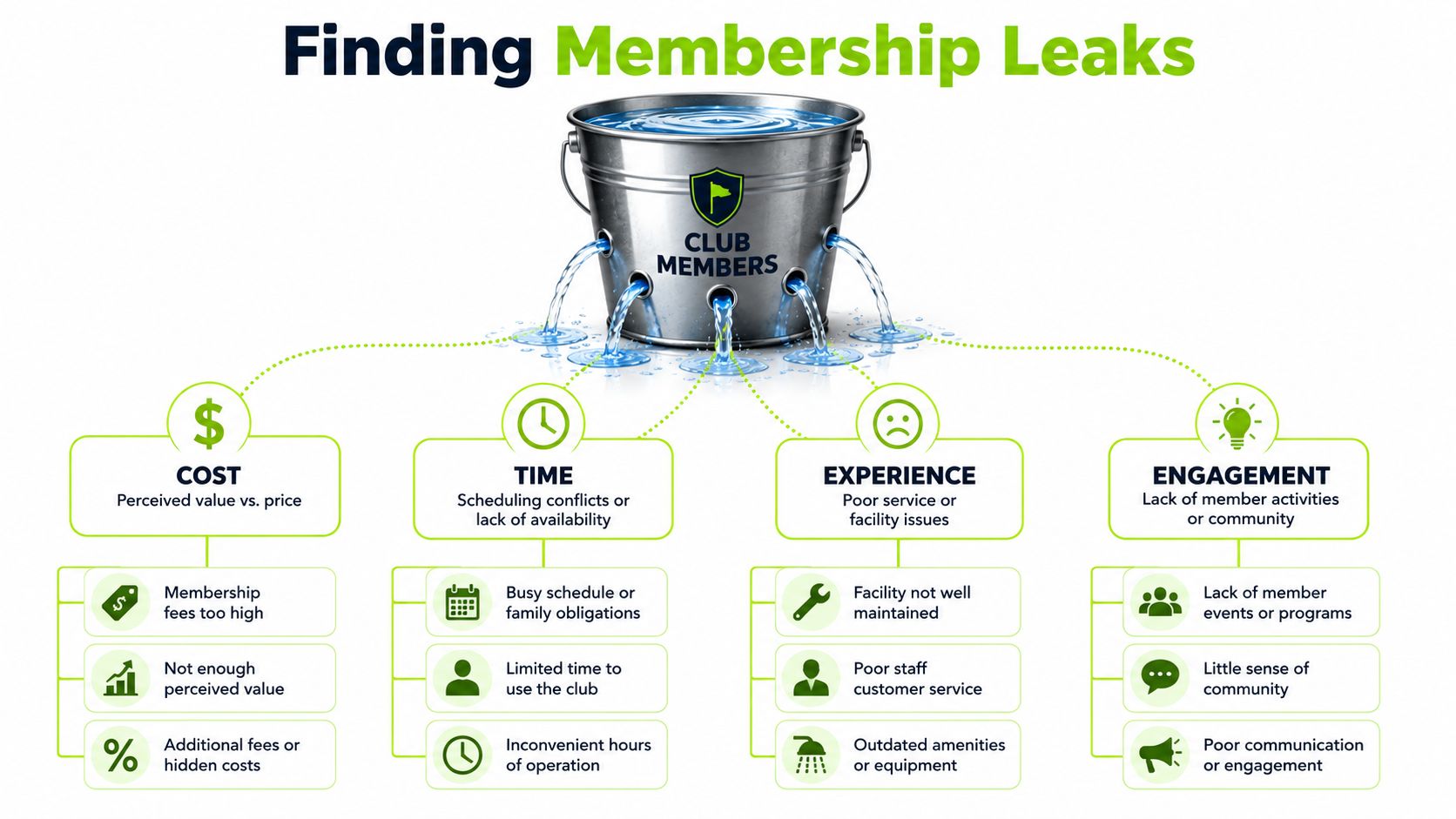
If you're trying to solve a golf club losing members problem, start by separating resignation reasons from system failures. "Too expensive" may mean they didn't use the club enough. "No time" may mean booking felt awkward or they never found their regular group. "Not for me" often means nobody helped them settle in.
Segment the loss before you try to fix it
A useful working split looks like this:
Unconverted enquiries
These people showed intent, asked for details, maybe even visited, then disappeared. That's often a follow-up failure, not a demand problem. GolfRep has written in detail about how many clubs lose enquiries through weak handling and poor visibility.Early-tenure drop-off
These are members who joined, played a little, then faded. They may still be on the books for months before resigning.Longer-term disengagement
These members used to participate, then reduced rounds, stopped attending events, or stopped booking into competitions.
Practical rule: Don't put every leaver into one spreadsheet category called "resigned". That tells you nothing useful.
Audit the touchpoints that shape retention
Run a simple review across the whole member journey:
| Stage | What to check | Common leak |
|---|---|---|
| Enquiry | Response speed, follow-up, visit booking | Prospect goes cold |
| Join date | Welcome process, first contact, staff handover | Member feels anonymous |
| First months | Rounds played, competition use, event invites | Low early habit formation |
| Pre-renewal | Usage trend, complaints, payment friction | Resignation arrives as a surprise |
Exit surveys help, but they shouldn't be the only lens. You also need booking data, attendance patterns and staff notes. If a member says "I wasn't using it enough", ask what happened before that. Did they stop booking? Did they never meet anyone? Did they enquire about a different membership option and get no answer?
Some clubs also need to review member experience beyond golf. Clear behaviour standards, staff confidence and a welcoming culture affect whether people stay. In team and youth settings, structured policies like these professional systems for bullying prevention are a useful reminder that retention isn't only administrative. People remain where they feel safe, recognised and included.
Secure Your Club with Immediate Retention Wins
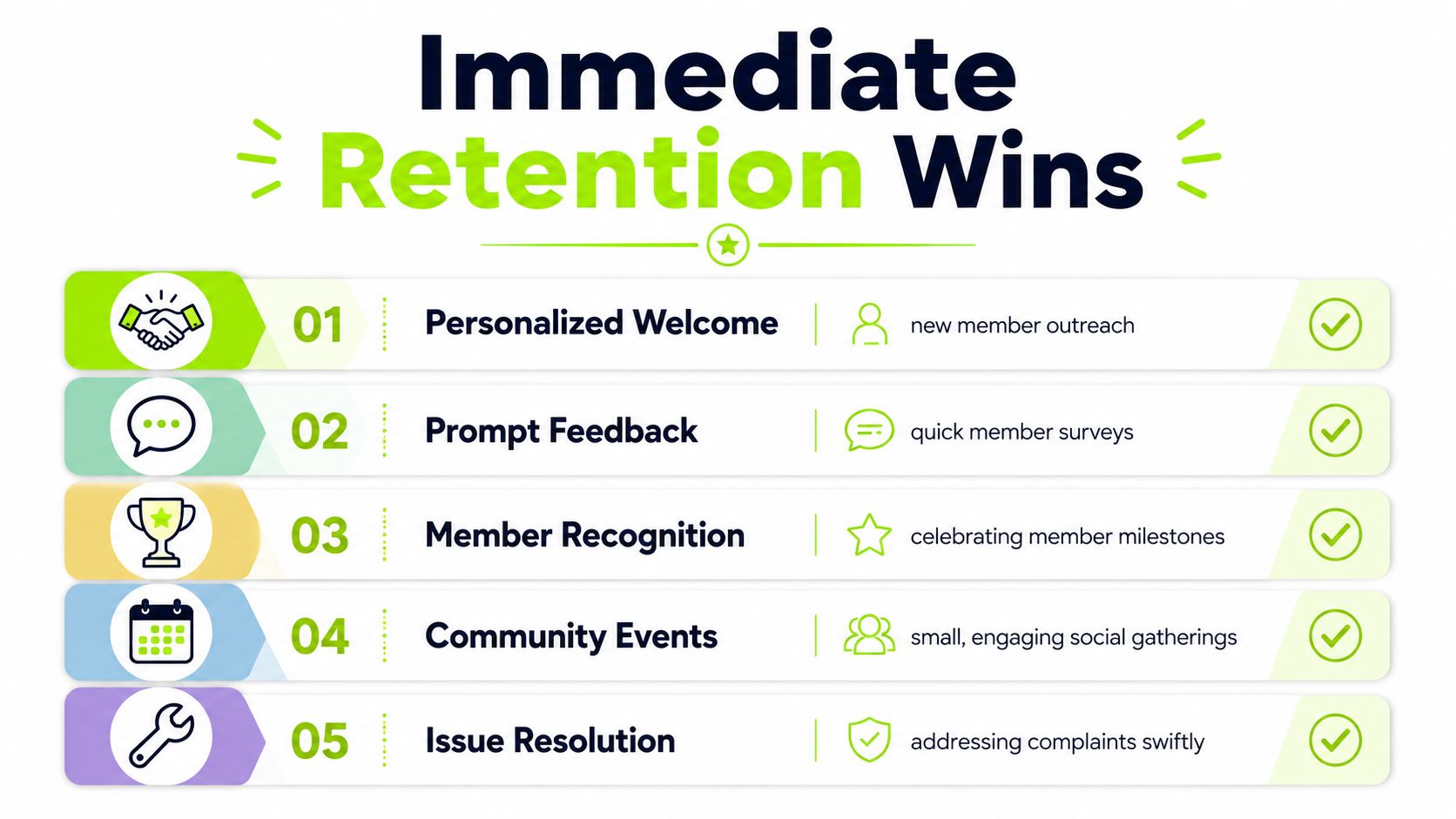
Long-term retention systems matter, but if members are slipping away now, you need a short list of actions that staff can start this week.
The most effective quick wins aren't flashy. They're operational. They improve how your club responds, welcomes and re-engages.
Tighten the first seven days
A poor first impression doesn't just hurt conversion. It damages retention later because members join with uncertainty instead of confidence.
Start here:
Answer every enquiry the same day
Not when the office has time. Not when a committee member is available. Every new enquiry needs a clear response, a named contact and a next step.Book the visit, don't just send details
Information alone rarely moves people forward. A visit does.Call every new member personally
A short welcome call from the membership lead, secretary or pro shop team works because it feels human and specific.
Run simple rescue actions for low-engagement members
Clubs often wait too long. By the time someone sends a resignation email, they've usually been drifting for a while.
Use a short reactivation list:
No booking activity
Contact them with a practical prompt, not a generic newsletter.Dropped off after joining
Ask if they'd like help joining a roll-up, competition or social event.Quiet before renewal
Start the conversation before the paperwork arrives.
A structured golf club reactivation campaign can help clubs bring back members and prospects who have gone quiet, especially when no one currently owns the follow-up process.
Members rarely resign out of nowhere. Staff usually had warning signs. They just weren't organised into a system.
Fix complaints faster than you explain them
When a member raises an issue, clubs often defend the reason before solving the problem. That response makes churn worse.
Use a simple rule:
- acknowledge quickly
- assign one owner
- confirm what happens next
- follow up after resolution
That doesn't require new software. It requires discipline. Clubs that do this well look more organised, more attentive and more worth the fee.
Build a New Member Onboarding Journey That Sticks
A signed membership form is not the finish line. It's the point where retention work starts.
Many clubs underperform. They treat joining as an admin event, not a behavioural transition. The result is predictable. Club industry guidance says as many as 25% of new members can leave in the first year if they are not properly integrated into the club's social and playing culture. England Golf also says that turning a new member into a retained member is, on average, a 3-year process in its guidance on member retention.
A new member doesn't need more brochures. They need momentum, familiarity and reasons to come back.
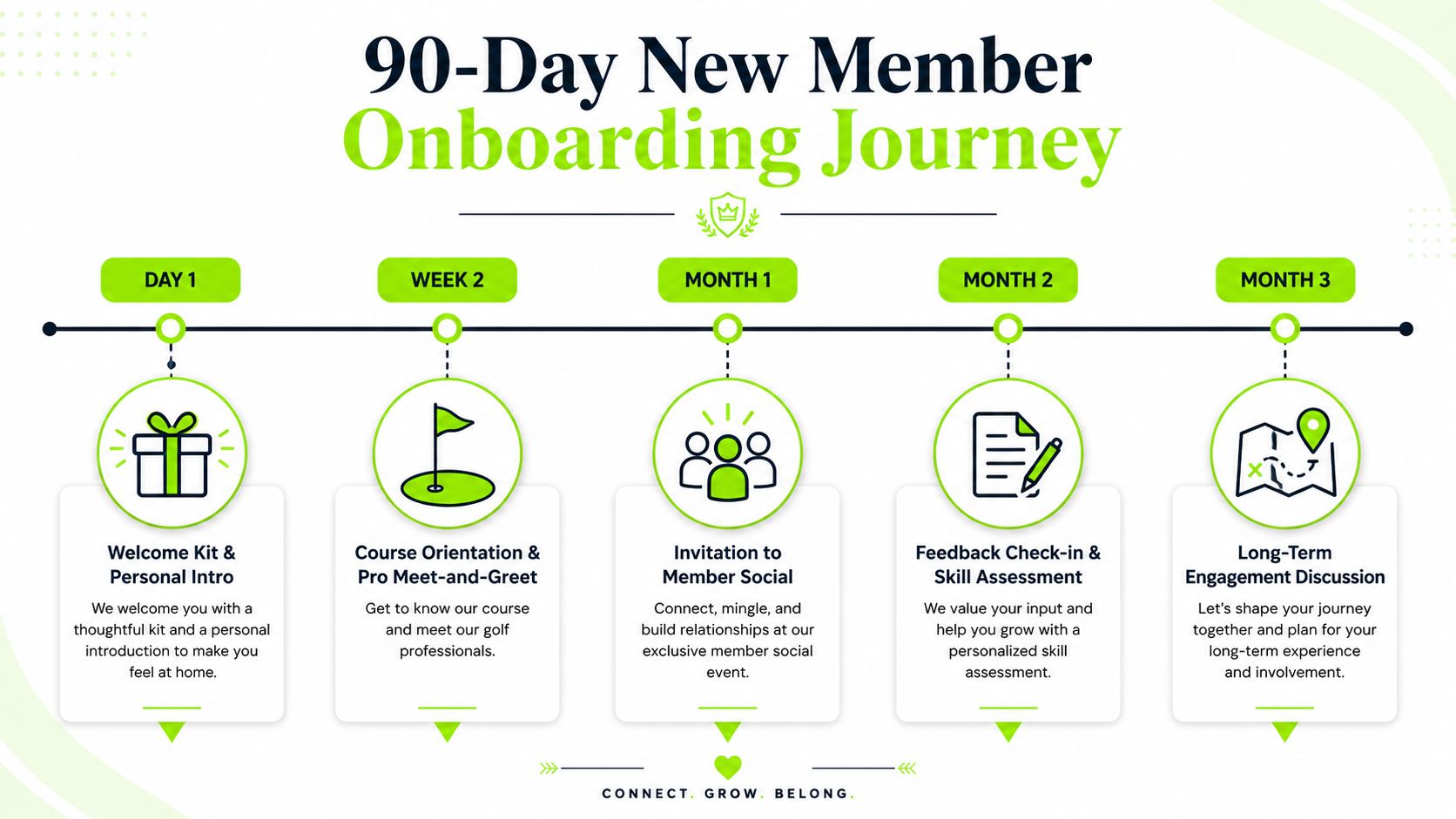
What a strong first 90 days looks like
Think in stages, not one welcome email.
Day 1 to Day 7
The new member should receive:
- A personal welcome from a named person, not a generic inbox
- A practical starter pack with booking instructions, key contacts and simple next steps
- A first activity prompt such as booking a round, induction, lesson, or roll-up
This first week should answer one question clearly. "How do I start using the club without feeling awkward?"
Week 2 to Week 4
At this point, clubs often go quiet. That's a mistake.
Use this period for:
- a course or facilities orientation
- an introduction to key staff
- a suggestion of suitable competitions or social formats
- a check that they can book easily and understand the club rhythm
If they haven't played or visited, that is your first retention warning.
Useful test: If a new member has joined but hasn't formed any routine at the club, they're not settled yet.
Month 2 to Month 3
Now the focus shifts from welcome to belonging.
That means helping them build at least one of these:
- a regular tee time
- a social connection
- a playing group
- confidence with competitions
- use of another part of the club beyond the course
Use communication templates, not memory
Most onboarding fails because it depends on busy staff remembering what to do. That isn't a strategy.
A simple CRM is enough to trigger the right messages at the right time. Tools built for golf club CRM software excel in this function. The value isn't just storing contact details. It's giving the team a repeatable follow-up sequence so each member receives the same standard of care.
A practical onboarding flow might include:
| Timing | Message purpose | Best format |
|---|---|---|
| Join day | Welcome and next steps | Personal email or call |
| Day 3 | Booking help | Email with direct reply option |
| Day 10 | First event or round invitation | Personal message |
| Day 21 | Check-in on usage | Call |
| Day 45 | Social or competition nudge | |
| Day 75 | Feedback and support | Call or in-person chat |
Assign ownership across departments
Retention doesn't sit with one person. The office, pro shop, bar, food and beverage team, membership lead and professionals all shape first impressions.
What works is a visible handover. For example:
- office confirms details and welcome
- pro shop supports first booking or lesson
- membership lead introduces relevant activities
- senior staff review low-usage joiners weekly
What doesn't work is assuming someone else will do it.
A club that wants to stop losing members has to act like onboarding is part sales, part operations and part hospitality. Because it is.
Use Systems to Predict and Prevent Member Churn
If your retention process lives in a spreadsheet and staff memory, you don't have a retention system. You have a record of what already happened.
The clubs that stay ahead of churn don't wait for resignation emails. They monitor behaviour early enough to step in while the relationship is still recoverable.

UK club-retention benchmarking from Golfmanager cites golf and country clubs at 92% to 94% annual retention, and its guidance recommends a data pipeline that tracks retention by cohort and flags declining leading indicators such as rounds played before a member resigns. That point matters more than the headline range. Retention is managed best when clubs track behaviour, not just renewal outcomes.
Track leading indicators, not just leavers
Most committees review retention too late. They look at annual resignations after the damage is done.
A better approach is to watch leading indicators like:
Rounds played
A drop in play frequency often appears before a resignation.Competition entry
For members who used to enter regularly, silence matters.Event participation
Social disengagement can be as important as playing disengagement.Use of club touchpoints
Restaurant visits, coaching sessions, guest rounds and attendance patterns help build context.
This kind of thinking isn't unique to golf. In other member-based and hospitality settings, structured lifecycle tracking is standard. For clubs exploring how customer data can support retention thinking, this article on a restaurant CRM system is a useful parallel because it shows how repeated interactions create a fuller picture than transactions alone.
Build a practical early-warning model
You don't need an advanced analytics team. You need clear rules.
For example, flag members when they show combinations such as:
| Signal | Why it matters | Suggested action |
|---|---|---|
| No recent booking | Habit may be slipping | Friendly check-in |
| Strong start, then drop-off | Early enthusiasm wasn't sustained | Invite into a routine |
| Renewal approaching with low engagement | Value may be under question | Review fit and options |
Those categories align with the behaviour-based segmentation GolfRep sees regularly in golf club growth work. The key is consistency. A flag only matters if someone follows it up.
A retention dashboard should tell staff who needs attention this week, not simply confirm who left last month.
Centralise the workflow
The operational gap at many clubs isn't a lack of care. It's fragmentation. Enquiries sit in one inbox, membership notes in another file, booking data in another platform, and complaints in someone's head.
A central system fixes that by giving the club:
- one visible record per member
- task ownership for follow-up
- visibility from enquiry to renewal
- cleaner handover between office and front-line teams
A platform or partner can help. GolfRep, for example, works with clubs to combine lead generation, CRM follow-up and conversion tracking so managers can see where pipeline and retention are slipping, rather than relying on scattered manual updates.
What doesn't work is adding more admin without adding visibility. If staff still can't see who enquired, who joined, who stopped using the club and who needs a call, the process is still broken.
Rethink Your Membership Model for Today's Golfer
Sometimes a member leaves even when they like the club.
That's the part committees often miss. Resignation doesn't always mean dissatisfaction. It can mean the membership product no longer fits the person's time, budget or playing pattern.
Recent UK-facing coverage points to waitlists and younger members using clubs more heavily, which suggests that demand can remain strong while some existing members still resign. The National Club Golfer analysis on membership trends makes the bigger point clearly. The challenge is often affordability and usage fit, not a collapse in demand.
Full membership or nothing is too rigid
Many clubs still offer a narrow choice:
- full membership
- social membership
- leave entirely
That creates unnecessary exits. A member whose work changes, whose family commitments increase, or who can't justify full use for a period may not want to resign forever. They may just need a better fit.
Build a membership ladder, not a cliff edge
A more resilient structure includes step-down routes that protect both revenue and relationships.
Options can include:
- Off-peak membership for members with daytime flexibility
- Transitional categories for people moving out of full use without wanting to disappear
- Pause mechanisms for temporary life changes
- Points or flexible-access formats where appropriate for the club's model
The point isn't discounting for the sake of it. The point is reducing forced resignations.
If a member still values the club but can't justify the current category, your job is to preserve the relationship before they leave the ecosystem completely.
Use data from operations to shape product decisions
Strategy and systems meet. If your retention data shows that certain members disengage because they aren't playing enough to feel value, the answer may not be another reminder email. It may be a better product path.
Committee discussions often become ideological here. Some want to protect the prestige of full membership at all costs. Others want to create broad flexibility. The sensible approach is to test alternatives carefully, monitor take-up and watch whether they reduce outright resignations or only shift members into lower-yield categories unnecessarily.
A golf club losing members doesn't always need more demand. Sometimes it needs a better bridge between committed full members and people whose circumstances have changed.
Conclusion From Member Churn to Sustainable Growth
Most clubs don't have a single membership problem. They have several smaller leaks that add up. An enquiry isn't followed up quickly enough. A new member joins but never properly settles. An established member starts using the club less and nobody notices until the resignation arrives.
That is why generic advice about "engagement" often falls flat. Clubs need a working retention system. One that starts before a person joins, carries through the first months of membership, and keeps tracking behaviour long before renewal season.
The practical route is clear:
- audit where losses are happening
- tighten the first response to every enquiry
- build a structured onboarding journey
- track signs of disengagement early
- create membership options that reflect real lives
This is how a club moves from reactive firefighting to steady control. It also changes how growth feels internally. Instead of constantly backfilling churn, the club starts compounding.
For managers, secretaries and committees, that's the shift that matters most. Not more activity for the sake of it, but a process that makes member growth more predictable and resignations less surprising.
If your club wants a clearer view of where membership is leaking and how to build a more reliable follow-up and retention process, GolfRep helps golf clubs put structure around enquiries, onboarding, CRM visibility and conversion tracking so growth doesn't depend on manual chasing alone.
Ready to tap into our proven growth system?