What Is a Strategic Marketing Plan for Golf Clubs?

Most advice on what is a strategic marketing plan starts in the wrong place. It starts with channels, campaigns, content calendars, or brand messaging. For golf clubs, that usually leads to more activity, more admin, and very little change in membership growth.
A club can run Facebook ads, post on Instagram, send emails, refresh the website, and still feel stuck. That doesn't mean the marketing is too quiet. It usually means the club has no reliable system for turning interest into conversations, visits, and signed memberships.
That's the difference between a plan that looks good in a committee pack and a plan that effectively helps a club grow.
Why Your Marketing Might Be Busy But Not Productive
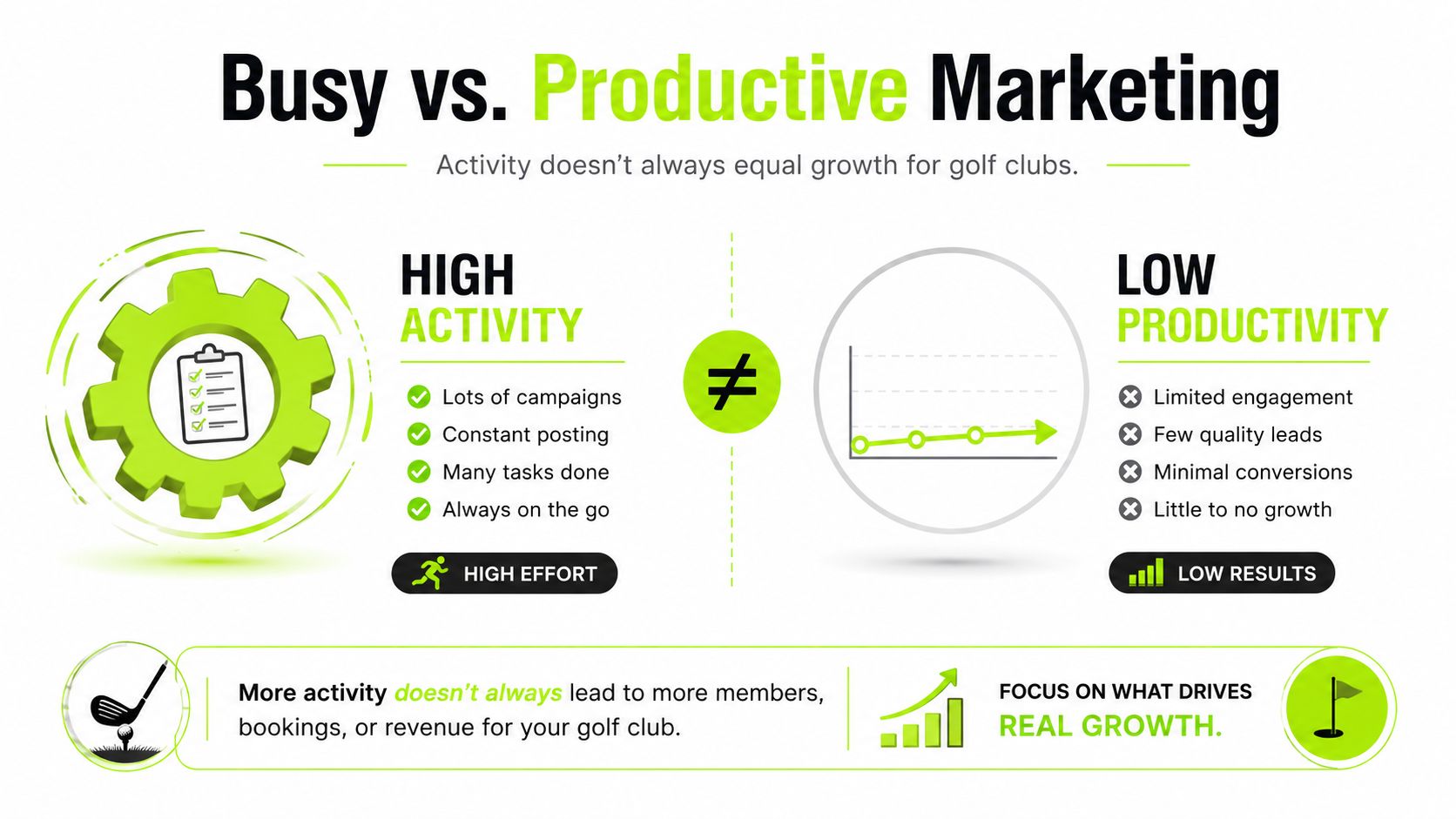
A lot of golf clubs assume the problem is volume. Not enough enquiries. Not enough website traffic. Not enough leads. So the answer seems obvious. Do more marketing.
That sounds sensible until you look at what happens after an enquiry arrives.
For UK golf clubs, the average response time for membership enquiries is 47 hours and 32 minutes, and that delay often leads to 0% conversion in many pipelines, according to GolfRep's analysis of golf club marketing analytics. If a prospect asks about joining on Monday and hears nothing meaningful back until Wednesday, the issue isn't demand. The issue is handling.
Activity can hide weak conversion
Busy marketing is easy to mistake for productive marketing because it creates visible motion.
You can point to:
- More posts: The club is active on social media.
- More campaigns: Ads are running and enquiries are coming in.
- More admin: Staff are replying when they can, between other jobs.
- More reporting: Someone is counting clicks, likes, and open rates.
None of that guarantees commercial progress.
A productive marketing system does something simpler. It creates a clear path from first enquiry to booked visit to membership decision. If that path is slow, inconsistent, or invisible, extra spend usually just pours more leads into the same leak.
Practical rule: If your team can't say who responded, when they responded, and what happened next for every membership enquiry, the bottleneck isn't lead generation.
That's why clubs often feel disappointed after trying “more marketing”. The ads may have worked. The website may have worked. The enquiry form may have worked. The follow-up didn't.
The real constraint is usually operational
In practice, most clubs don't have a creative problem first. They have an execution problem first. A manager is busy. The office team is stretched. A membership enquiry lands in a shared inbox. Someone means to call later. Later becomes tomorrow. Tomorrow becomes the end of the week.
That pattern is more common than many committees realise. It's one reason why most golf club marketing fails, even when clubs believe they are “doing marketing”.
A strategic marketing plan, in the golf club context, should fix that. It shouldn't just describe how to attract attention. It should define how the club will respond, track, nurture, and convert interest into revenue.
Defining a Strategic Marketing Plan for Growth
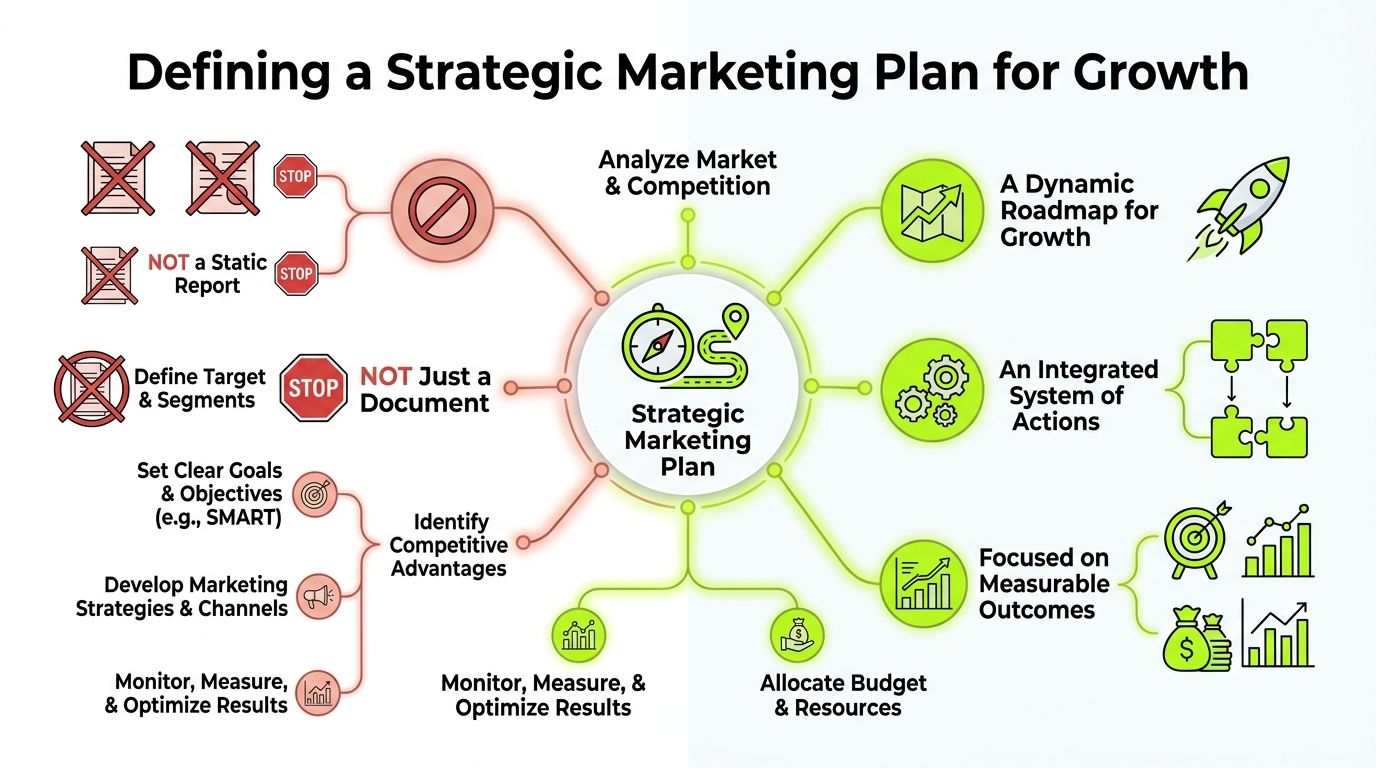
A strategic marketing plan isn't a list of tactics. It isn't “we'll post three times a week” or “we'll run some Google Ads before the open day”. It's the structured alignment of marketing activity to specific business outcomes.
The clearest definition comes from LSBF's guide to strategic marketing planning, which describes a strategic marketing plan as the structured alignment of marketing practices and strategy to achieve measurable business outcomes. Their example is useful because it connects a business target with a marketing target. If a business wants 15% overall sales growth, it might set a marketing goal of increasing lead generation by 50–60% to support that result.
For a golf club, the principle is the same, even if the targets differ. The plan should connect club goals to marketing outcomes in plain English.
What the plan actually does
A proper plan answers four practical questions:
What are we trying to grow?
Membership. Visitor revenue. Society bookings. Event income. Retention. Usually more than one, but one has to lead.Who are we trying to attract?
Not “everyone within ten miles”. A club needs a real view of ideal members, their motivations, and the objections that stop them joining.How will we reach them?
Through the channels that fit the audience, budget, and buying journey.How will we turn interest into revenue?
This is the part most golf club plans leave weak or vague.
That last question matters most. The plan has to describe both the what and the how. The strategy explains the direction. The operational system makes sure the work happens in a consistent way.
A golf club plan should be readable, not theoretical
Committees don't need jargon. They need clarity.
A useful plan includes SMART goals, target audience definition, channel choices, budget, implementation responsibilities, and measurement. If you want a broader non-golf reference point, this practical guide to small business marketing strategies gives a solid outside perspective on how strategy becomes day-to-day execution.
A strategic marketing plan only matters if a club can trace spend, action, and follow-up back to an outcome the committee actually cares about.
For golf clubs, that usually means the plan should be judged less by how polished it looks and more by whether it gives managers line of sight between marketing spend and membership revenue.
The Core Components of a Golf Club Marketing Plan
A golf club marketing plan should be built around commercial reality, not a generic template. Seasonality changes demand. Membership decisions take time. Visitor revenue can distract from member growth if a club isn't careful. A proper plan reflects those pressures.
A strategic marketing plan for UK golf clubs must be a 12-month document segmented into quarterly cycles, with each quarter tied to KPIs such as membership conversion rates and tee-sheet occupancy. Clubs that follow quarterly KPI reviews achieve 24% higher membership retention, according to this guide on creating an effective golf marketing plan.
The pieces that actually matter
A strong plan usually includes the following:
- A clear commercial priority: Decide what matters most. If the club wants membership growth, don't let the plan drift into a visitor-first document.
- Defined member personas: The plan should describe the type of member the club wants more of. Lifestyle, work pattern, household stage, expectations, and likely objections all matter.
- A proper USP: “Great course, friendly members” isn't a useful proposition because almost every club says it.
- Quarterly objectives: This helps clubs adjust to spring peaks, summer pressure, and winter softness.
- Tracking and ownership: Every campaign, form, and follow-up step needs a clear owner.
- Retention thinking: A membership plan shouldn't stop at the first payment.
If your club hasn't done this level of audience work, it helps to understand what market segmentation means in golf club growth. Too many clubs still market to a blended audience and then wonder why the message lands weakly.
Traditional Plan vs Growth System Plan
| Element | Traditional Plan (Activity-Focused) | Growth System Plan (Outcome-Focused) |
|---|---|---|
| Target audience | Broad local golfers | Clear member personas with defined fit |
| USP | Generic claims about course quality | Specific reason this club suits this buyer |
| Timeframe | Annual plan reviewed rarely | 12-month plan broken into quarterly cycles |
| KPIs | Followers, reach, website visits | Enquiries, booked visits, conversions, retention |
| Budget | Spread loosely across channels | Assigned to priorities with clear expected outcome |
| Follow-up | Manual and inconsistent | Structured process with visibility and accountability |
| Reporting | Channel updates | Commercial reviews tied to revenue outcomes |
A plan also needs to account for how the club earns trust before a joining decision. That includes website content, tour booking flow, email nurture, and proof points. For clubs improving their authority online, this essential link building guide is a useful companion read because visibility still matters. It just can't be the whole plan.
The best golf club plans are narrow enough to guide action and detailed enough to expose weak follow-up.
Beyond the Plan Building Your Growth System
Most clubs get caught out. They have a plan, or at least a version of one. What they don't have is the operating system behind it.
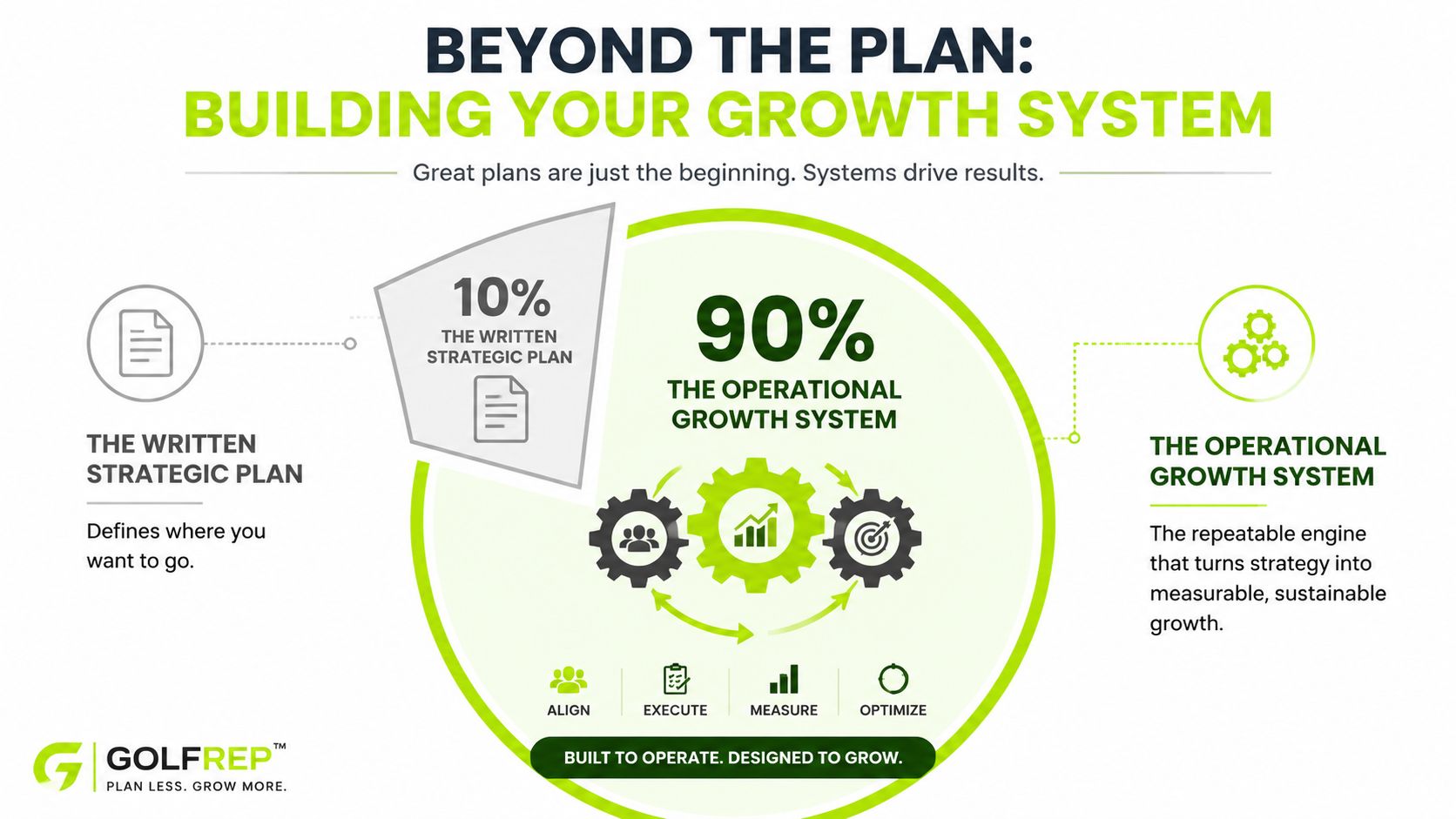
A written plan is important, but on its own it doesn't move a single enquiry through the pipeline. It doesn't tell staff who responds first. It doesn't show where leads came from. It doesn't reveal which campaigns produce visits and which ones produce noise.
That's why, in practice, the written plan is only a small part of growth. The bigger part is the system that carries out the plan every day.
The six layers clubs can't afford to skip
In UK golf, a strategic plan needs six integrated data layers, including commercial alignment metrics, full-stack tracking, CRM pipeline visibility, response time design, brand tone calibration, and review rhythm. According to GolfRep's breakdown of golf club marketing systems, clubs missing full-stack tracking or CRM visibility suffer 40% higher lead attrition rates, while clubs that integrate all six layers achieve 3.2x higher membership growth per £1,000 marketing spend.
Those layers matter because each one answers a different operational question:
- Commercial alignment: What counts as a qualified lead for this club?
- Tracking: Which form, ad, landing page, or campaign generated the enquiry?
- CRM visibility: Where is every lead in the pipeline right now?
- Response protocol: Who replies first, how quickly, and what happens if they don't?
- Brand tone: Does the club sound like a private members' club, a resort, or a pay-and-play venue?
- Review rhythm: Are managers reviewing outcomes or just channel activity?
Why clubs without systems fly blind
A club can spend money generating leads and still have no useful visibility after the click. That's common when enquiries go into inboxes, spreadsheets, or handwritten notes. Staff may be doing their best, but the process depends on memory and availability.
That's fragile.
A better way to think about it is this. The plan is the route. The system is the vehicle. Without the vehicle, the route is just a drawing.
For clubs trying to get more value from the content they already produce, this SparkPod guide to content repurposing is worth reading. Repurposing can increase output without overloading staff, but it only helps if the club also has a structure for capturing and progressing the resulting enquiries.
If you want predictable growth, you need more than campaigns. You need a system that tracks, qualifies, follows up, and reports clearly. That's the basis of predictable revenue for golf clubs.
Common Pitfalls That Derail Golf Club Growth
Some marketing failures look like channel problems, but they're really process problems. A club says Facebook leads are poor quality. Or email “doesn't work”. Or the website needs a redesign. Sometimes that's true. Often it's a convenient diagnosis because the harder issue sits inside the follow-up process.
The most damaging mistake is treating enquiry generation as the main challenge when conversion handling is the weak point. In UK golf, clubs lose approximately 30% of membership enquiries before a proper discussion even begins because post-arrival handling is slow, inconsistent, or invisible, according to CRM.Golf's analysis of response time and conversions.
The patterns that cause avoidable loss
Three failures come up repeatedly.
Vanity reporting
A committee sees more impressions, more clicks, or more followers and assumes performance is improving. Those numbers can be useful diagnostic signals, but they are not business outcomes.
If a campaign generates interest but nobody tracks booked visits or membership conversations, the club is reporting motion, not progress.
Invisible lead handling
This usually sounds like, “We get the forms by email” or “The office picks them up.” That is not visibility. Visibility means knowing where each lead came from, who owns it, its current stage, and the next action due.
Without that, no one can tell whether the problem sits in the campaign, the first response, the nurture sequence, or the close.
Most golf clubs don't need more marketing noise first. They need fewer blind spots after the enquiry lands.
Manual follow-up by busy staff
Golf clubs are operational businesses. Managers are dealing with members, staffing, food and beverage, competitions, and weather disruption. That's exactly why manual lead handling breaks down.
Manual processes create inconsistency:
- Different response quality: One prospect gets a strong call, another gets a short email.
- Different response speed: One lead is handled immediately, another waits.
- Different next steps: Some get invited for a visit, others are left hanging.
- No clean reporting: Results live in inboxes and memory, not in a usable pipeline.
Why these mistakes keep repeating
Most clubs haven't deliberately designed the journey after the enquiry. They've just inherited it. The website form sends an email. A member of staff responds when possible. The process survives until volume rises or staff get stretched.
That's why a strategic marketing plan has to include operations. If it doesn't, clubs keep blaming the front end while the leak stays open in the middle.
Your First Steps to Building a Predictable Pipeline
Don't start by launching another campaign. Start by auditing what already happens inside the club. That gives you a much clearer answer than any brainstorming session.
Run a simple response test
Submit a genuine-looking membership enquiry through your own website. Do it at a normal business time, not as a staged exercise that the team knows about. Then watch what happens.
Check:
- Speed: How long before a real human response arrives?
- Channel: Is the reply by email, phone, text, or not at all?
- Quality: Does the message help the prospect take the next step?
- Ownership: Is one person clearly responsible for progressing the enquiry?
This one test often tells a committee more than a month of marketing reports.
Map the pipeline you actually have
Most clubs think they know their process until they write it down. Then the gaps appear.
Use a whiteboard or spreadsheet and map the stages:
- Enquiry arrives
- First response is sent
- Lead is qualified
- Visit is invited or booked
- Follow-up continues after the visit
- Decision is recorded
- Outcome is reviewed
If your team can't map those stages clearly, the club doesn't yet have a pipeline. It has a collection of intentions.
Fix the handover points first
The biggest gains usually come from removing uncertainty at the moments where leads stall.
Focus on:
- First response responsibility: One named owner beats shared assumption.
- Next-step discipline: Every enquiry should have a defined next action.
- Lead visibility: Use a CRM or a structured pipeline tool, not inbox archaeology.
- Review rhythm: Hold regular commercial reviews around outcomes, not just marketing tasks.
One useful test: ask your team to list every open membership enquiry and its next step without checking multiple inboxes or asking three different people.
If that's difficult, the priority is operational clarity.
A good strategic marketing plan for a golf club doesn't begin with “what campaign should we run next?” It begins with “what happens when interest arrives, and can we trust that process every time?” Once that's clear, new marketing investment becomes much easier to justify and much more likely to work.
If your club wants a clearer view of where enquiries are leaking and how to build a more predictable membership pipeline, GolfRep helps UK golf clubs combine lead generation with structured follow-up, CRM visibility, and conversion systems that fit how clubs operate.
Ready to tap into our proven growth system?