Golf Club Advertising: Build a Predictable Pipeline

Most golf club advertising advice gets the first half right and the second half wrong. It tells clubs to buy more ads, chase more enquiries, and measure cheaper leads, then acts surprised when membership numbers barely move. The problem usually isn't demand. It's what happens after the enquiry lands.
At GolfRep, we see the same pattern again and again. Clubs spend money to attract interest, then lose momentum because no one owns the lead, no one follows up quickly, and no system shows where the pipeline is leaking. In UK sector analysis, the average response time to a membership enquiry is 47 hours and 32 minutes GolfRep sector analysis, which is long enough for a warm enquiry to go cold.
That's why golf club advertising has to be treated as a conversion system, not a media purchase. The goal isn't traffic. The goal is a predictable flow from enquiry to visit to membership, with every lead visible and every step accountable.
Why Most Golf Club Advertising Fails to Deliver Members
More advertising rarely repairs a weak membership process. A club can buy more clicks, collect more form fills, and still fail to grow if nobody handles those enquiries properly. The mistake is treating the campaign as if it starts and ends with the ad itself.
The bottleneck is response speed and lead ownership. GolfRep's UK sector analysis reports an average response time of 47 hours and 32 minutes to a membership enquiry, and that gap sits directly between interest and action GolfRep sector analysis. In practice, a slow reply means the enquiry lands in a stale inbox, a missed call log, or a vague spreadsheet before anyone has a useful conversation.
If an enquiry is not assigned to a named person immediately, it is already at risk.
That is why so much club advertising underperforms. The committee or management team may celebrate rising enquiry volume, but if no one is tracking who contacted the lead, when they contacted them, and what happened next, the spend is leaking into silence. The club thinks it has a marketing problem, but it has a process problem.
Learn why campaigns stall in why most golf club marketing fails to deliver members.
GolfRep's view is straightforward. Clubs do not need more noise, they need better conversion infrastructure. That means clear lead ownership, fast response discipline, and a follow-up process that matches the intent of the enquiry. Without that, paid media becomes a way to buy disappointment faster.
The clubs that improve results stop asking only, “How do we get more leads?” They start asking, “How do we convert the leads we already have?” The work shifts from ad copy to operations, and from vanity metrics to membership outcomes.
The Four-Stage Conversion Funnel Every Club Must Track
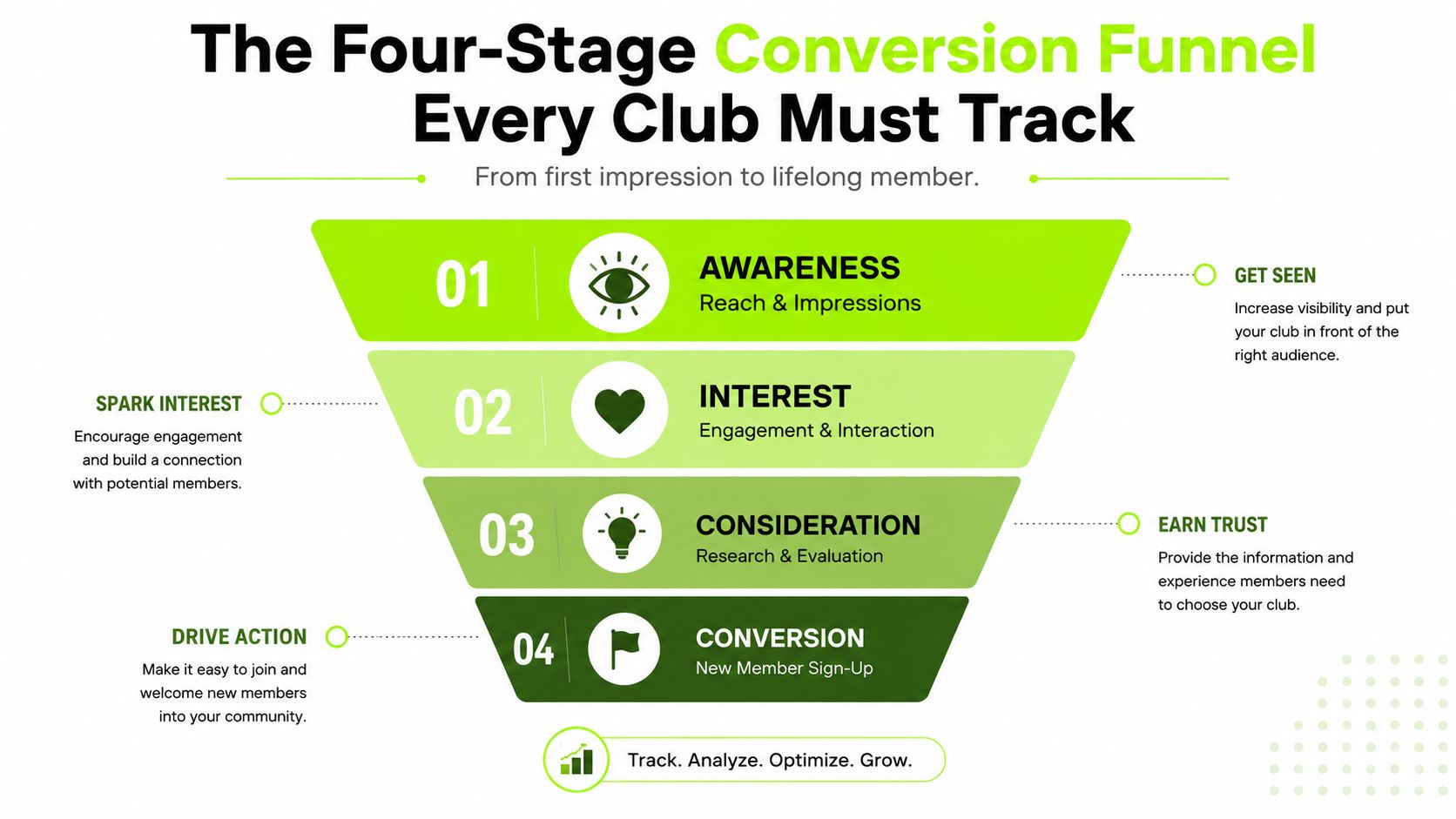
Membership growth breaks down when clubs track activity instead of progression. A click, a form fill, and a site visit are useful signals, but they do not tell you whether the enquiry is moving toward joining. A club needs to measure the full chain from first response to signed membership, because that is where wasted spend usually hides.
GolfRep's framework separates the funnel into qualified enquiry cost, enquiry-to-visit rate, visit-to-member rate, and lead ownership GolfRep sector analysis. Track performance with the four-stage golf club membership funnel. Those four measures show whether advertising is creating real pipeline or just creating noise.
Track each handoff, not just the ad
The most common failure point is lumping every enquiry into one bucket. A serious membership enquiry is different from a casual brochure request, and a booked tour is different from a follow-up that ends with, “we'll think about it.” Each stage needs separate tracking because each stage has a different owner and a different reason for stalling.
A practical structure looks like this:
- Qualified enquiry cost. What does a relevant lead cost, not just a click?
- Enquiry-to-visit rate. How many enquiries become face-to-face visits or tours?
- Visit-to-member rate. How many visits move into membership conversations and sign-ups?
- Lead ownership. Who is responsible for each lead from first contact to decision?
The numbers matter less than the handoffs. If the handoff fails, the campaign fails.
That is why CRM visibility matters so much. A spreadsheet can store names, but it will not reliably show who called, who replied, and who still needs follow-up. A proper system gives management a clear view of pipeline health, so weak spots appear early instead of at the end of the month.
Clubs that track only traffic or lead volume usually overstate the value of their advertising. Clubs that improve results inspect the full path, assign every lead, and judge campaigns by downstream conversions. That is the difference between a busy inbox and a growing membership list.
Choosing the Right Advertising Channels for Membership Growth
Channel choice should follow conversion performance, not habit. Too many clubs keep funding the channels they understand, then wonder why the membership desk stays quiet. The better approach is to compare where intent is strongest and where the club can respond quickly enough to turn interest into a visit.
Google search usually deserves the first look because it catches people who are already searching for membership, tee times, or society days. That intent is harder to buy elsewhere. In a golf-course benchmark report, CUFinder benchmark report shows Google Ads with a 4.90% CTR, $1.65 CPC, and a 3.8% conversion rate, while mobile traffic makes up a large share of visits but converts at a much lower rate. That gap matters. Mobile still brings volume, but the landing page has to be fast, short, and built for immediate action if it is going to produce enquiries.
Where each channel earns its place
| Channel | Conversion Rate | Best Use Case | Budget Allocation |
|---|---|---|---|
| Google Ads | 3.8% | High-intent membership and booking demand | Strong core channel for direct response |
| Facebook Ads | Lower than search in the benchmark set | Awareness and remarketing | Supportive, not the primary conversion engine |
| Mobile traffic | Lower than search in the benchmark set | Discovery and browse behaviour | Needs mobile-optimised pages and quick forms |
Search usually wins when the club wants people already looking for membership, tee times, or society days. Social still has a role, but it works better when it keeps the club visible between visits and gives warm audiences another reason to return. Organic search and content help with discovery over time, but they do not replace a direct-response channel when the club needs enquiries in the near term.
Budget discipline matters as well. Established clubs are commonly advised to allocate 5% to 7% of gross revenue to marketing, which gives a sensible ceiling before efficiency has to be reviewed. That does not mean every club should spend to the top of that range. It means spend should be planned against revenue, not hope.
GolfRep's view is that paid search should carry the most pressure for membership growth, while social supports awareness and remarketing. Clubs that expect Facebook to behave like search usually end up disappointed. Clubs that use each channel for the job it is suited to get cleaner pipelines and less wasted spend. For a direct comparison of the two channels, see this GolfRep guide on Google Ads versus Facebook Ads.
Building the CRM and Automation System That Converts Enquiries
The first 24 hours after an enquiry are where most clubs lose the opportunity. Not because the lead wasn't good, but because the response was slow, inconsistent, or left to memory. A good CRM and automation setup fixes that by making the first follow-up immediate and the later follow-up consistent.
Compliance has to sit underneath the process. In the UK, the Information Commissioner's Office says organisations using email, phone, SMS, or live chat for direct marketing must comply with PECR rules, which means clubs need structured consent and contact handling rather than ad hoc follow-up ICO and PECR guidance. That's not paperwork for the sake of it. It's the foundation that lets the club follow up confidently and lawfully.
Build the workflow before you scale the spend
A usable system usually starts with four steps:
- Capture the enquiry cleanly. Name, email, phone, membership interest, and source.
- Trigger an immediate response. A welcome email should land while the enquiry is still warm.
- Assign a human owner. Someone on the team needs to call or reply with context.
- Move the lead into nurture. If they don't convert quickly, keep the club in front of them.
The automation doesn't replace the person. It buys time and consistency. Clubs should use instant acknowledgement to confirm receipt, then a personal call or message to move the conversation forward. If the lead doesn't book, a short nurture sequence can share membership information, visitor benefits, or a reminder to book a tour.
This is also where a CRM-led process beats manual chasing. A good system shows who opened, who replied, who booked, and who stalled. If management can't see that pipeline in one place, the club is operating blind.
GolfRep's own work is built around this combination of advertising, automation, and lead tracking. Other tools can help too, but the principle doesn't change. Enquiries only become members when the club can respond quickly, stay organised, and keep the lead visible until a decision is made.
Budgeting and Timeline for Your Golf Club Advertising Campaign
A realistic campaign starts with budget, but it should not start with media spend. It should start with measurement, because a club cannot improve what it cannot see. If tracking is not in place, even a modest campaign can create noise instead of clarity.
For established clubs, a common planning range is 5% to 7% of gross revenue. Treat that as a ceiling for decision-making, not a guarantee that the money will produce members on its own. Once the ceiling is set, the next question is how much goes into channels, how much into content and landing pages, and how much into the tools that keep enquiries visible after the click.
A sensible rollout pace
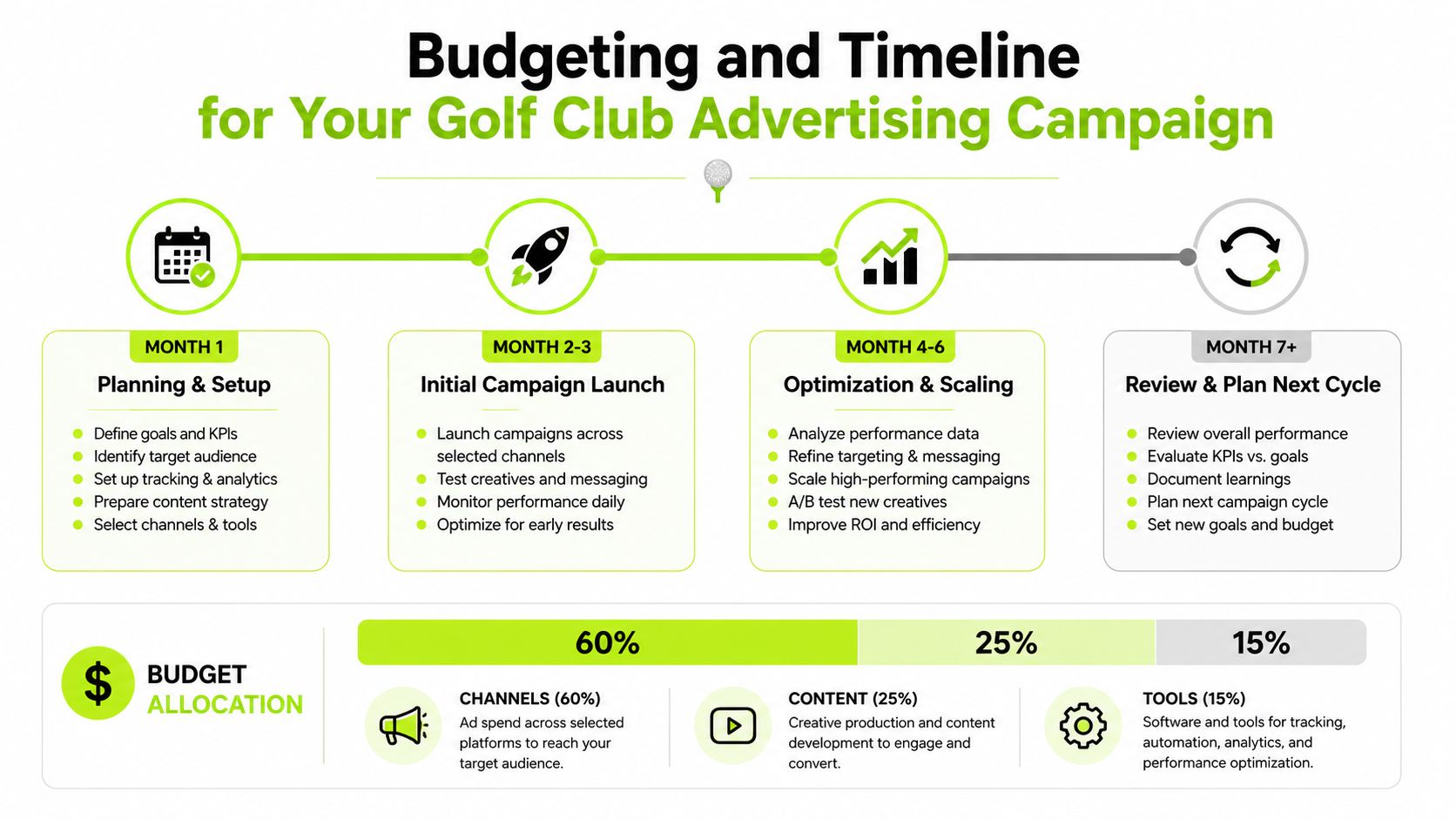
The first month should be reserved for setup. That means tracking, CRM fields, enquiry routing, landing pages, and consent handling. If the club goes live before those basics are ready, it cannot tell whether the campaign is producing poor leads or whether the follow-up system is failing.
Months two and three should be used for testing. Different audiences, headlines, and offers need to be judged on enquiry quality, not just the lowest cost per lead. A cheap enquiry that never gets answered, or arrives from the wrong member profile, is wasted budget. By the time a club reaches the scaling phase, the main question should be straightforward, which source is producing the most booked visits and the cleanest handoff to membership discussion?
After that, review needs to become routine. The club checks what converted, what stalled, and where the team lost momentum. Then it adjusts the budget and the follow-up process for the next cycle, based on the leads that moved forward.
A short planning checklist helps keep the rollout disciplined:
- Set tracking first. No spend before enquiry sources and ownership are visible.
- Launch in stages. Test one or two channels before expanding.
- Review pipeline quality. Do not optimise on lead count alone.
- Reallocate quickly. Move money from weak routes to stronger ones once the evidence is clear.
A campaign that launches without a timeline usually drifts. A campaign with phases gives the club room to learn, correct, and scale without wasting months on guesswork.
Real Club Transformations From Ad-Hoc to Predictable Pipeline
The clubs that change fastest usually stop treating advertising as a side task. One common starting point is a spreadsheet of enquiries, a shared inbox, and a committee member trying to chase leads between other duties. That setup may feel manageable at first, but it breaks down as soon as interest increases.
The turnaround usually begins with one operational shift, not a bigger ad budget. The club assigns ownership, installs a CRM, and makes response speed visible to management. Once the team can see which enquiries have been contacted and which ones are still waiting, the conversation changes from “we need more leads” to “we need fewer leaks”.
In practice, the most useful changes are often boring. A welcome email goes out immediately. A call task appears in the CRM. Unanswered enquiries trigger a reminder. The membership secretary and GM can see the same pipeline, so no one assumes someone else has already followed up.
A predictable pipeline feels less dramatic than a big campaign launch, but it's what gives a club control.
We've seen clubs go from scattered ad hoc marketing to a structured membership engine by tightening just three things, response time, lead ownership, and visibility. The advertising doesn't become magic. It just starts working the way it should, because the club is finally handling the enquiries properly.
The best part is that the improvement compounds. Once the system is in place, every future campaign has a better chance of turning interest into visits and visits into members. That's the shift from promotion to growth.
If you want Golf Club Advertising that produces a pipeline instead of a pile of enquiries, GolfRep can help you build the system behind it. Visit GolfRep to see how we combine advertising, CRM-led follow-up, and lead tracking into a predictable membership growth process.
Ready to tap into our proven growth system?