Golf Marketing Agency Explained for Clubs That Want Growth

The phone rings, a few enquiries land in the inbox, and somebody at the club gives the usual reply, “We'll get back to them.” By the time the response goes out, some prospects have gone quiet, others have booked elsewhere, and the committee is left wondering why the marketing looks active but membership barely moves.
That gap is where a golf marketing agency should earn its place. The job is not just to bring in names, clicks, or social attention. The job is to make sure enquiries are seen, handled, followed up, and converted in a way the club can measure. If that sounds familiar, this guide will make the difference between lead volume and real growth much clearer, in plain English, with no jargon for its own sake. For a useful companion piece on why enquiries often stall, see why golf club leads don't convert.
Introduction Why Enquiries Do Not Become Members
A club can have the right website, a steady stream of adverts, and a decent social presence, then still wonder why membership feels flat. The issue is often not that golfers aren't interested. The issue is that the club has no reliable system for answering quickly, qualifying properly, and guiding people to the next step.
That's why response time, lead visibility, and follow-up discipline matter more than marketing noise. If a secretary has to dig through email threads, or if a pro shop hands enquiries around informally, the club is already leaking value. Good marketing doesn't stop at the enquiry form, it starts there, because every contact needs a clear owner and a clear next action.
Practical rule: if a prospect can't tell what happens after they enquire, the club's process is too vague to convert consistently.
From a GolfRep point of view, the right conversation is not “How do we get more people to click?” It's “How do we make sure every genuine golfer is tracked, contacted, and nurtured properly?” That shift matters because clubs don't just need traffic, they need a pipeline that can hold up under real-world admin, committee sign-off, and seasonal demand.
What a Golf Marketing Agency Actually Does
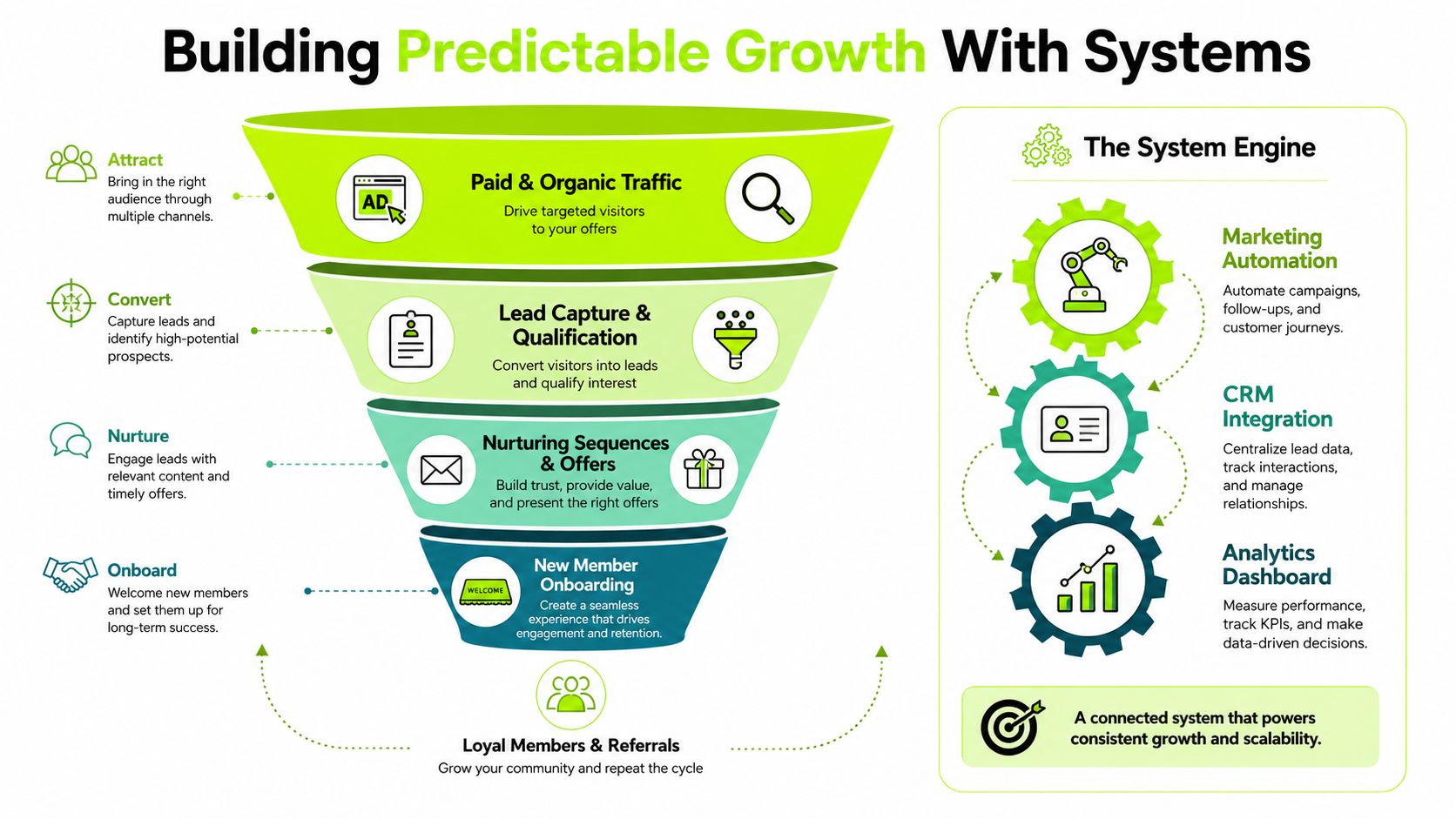
A specialist golf marketing agency works like a pipeline, not a poster campaign. First it attracts the right golfers. Then it filters out weak leads, captures contact details, and keeps the conversation alive until the person books a visit, asks for a call, or joins.
The simple flow from click to member
At the top of the funnel sit digital ads, local search visibility, and useful content that answers real questions. In the middle, the agency captures the enquiry and makes sure the club sees it straight away. At the bottom, automation and human follow-up turn interest into action, instead of letting it drift.
The UK market is large enough to support that kind of structured approach. The UK golf satellite account estimated that 9.9% of adults played golf at least once in the last year, equivalent to 5.356 million adults, and 4.3% played at least once every four weeks, or 2.357 million adults (UK golf satellite account). That matters because clubs are not selling into a tiny audience, they're working inside a broad annual market and a smaller, higher-intent core.
A good agency also helps the club choose the right software stack. If you're comparing tools and workflows, the guide to top digital marketing agency software is a practical way to see how platforms, dashboards, and automation fit together.
Why specialist knowledge changes the result
A general agency may know ads and content. A golf specialist understands member journeys, visitor offers, committee approvals, and the fact that many enquiries need reassurance, not pressure. That's why the conversation has to include CRM setup, contact handling, and conversion tracking, not just impressions and reach.
A club grows faster when every enquiry has a owner, a status, and a next step.
Core Services KPIs and How Success Is Measured
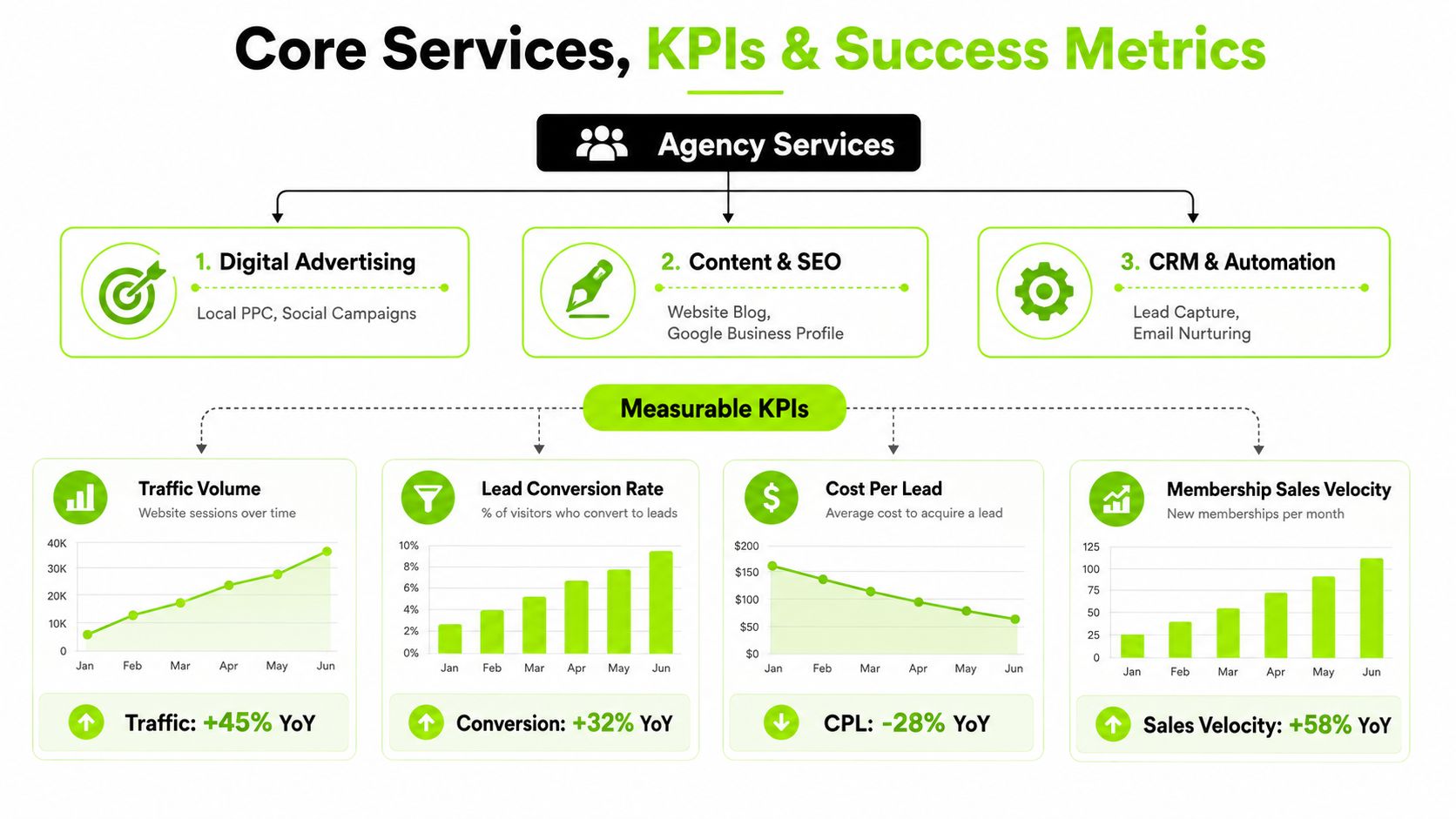
The most useful agencies prioritise measurable systems over activity metrics. That usually means paid acquisition, local SEO, landing pages, CRM setup, enquiry automation, segmentation, nurture emails, and reporting that links spend to outcomes.
What the core services should cover
Paid ads should bring in local demand, but they only work properly when the landing page is built to convert. Local SEO should make the club visible when nearby golfers search for membership, lessons, visitor golf, or events. CRM setup should make sure every enquiry is recorded, tagged, and handed off cleanly, instead of sitting in someone's inbox.
The mobile experience deserves special attention. Across golf-course marketing benchmarks, mobile generated 62.5% of traffic but converted at only 1.8%, while mobile bounce rate was 54.1% versus 39.5% on desktop. That points to a simple problem, the club may be visible on phones, but the path from interest to enquiry is too slow, unclear, or awkward to complete.
The KPIs that matter most
The numbers a club should ask for are simple and outcome-led.
- Qualified leads, because not every enquiry deserves the same follow-up.
- Booked visits, because interest only matters if it becomes the next step.
- Conversion rate, because traffic without conversion is just expensive browsing.
- Cost per acquisition, because spend needs to be judged against actual member gain.
- Retention and reactivation, because membership value does not stop at the first sign-up.
Lifecycle thinking matters at this stage. Golf-course marketing guidance recommends separating loyal members from one-time visitors, then tracking booking behaviour and using CRM data to segment by player type, handicap, and spending habits, because treating all contacts the same is a conversion killer (golf-course marketing guidance). The same guidance shows that if annual member revenue is £5,000 and attrition is 10%, the implied average member lifetime is 10 years and lifetime value is £50,000.
That is why the reporting conversation has to go beyond vanity metrics. Clubs should want a dashboard that shows who came in, who was contacted, who booked, and who joined. If the numbers do not connect to the CRM, they do not really tell the club anything useful.
How Predictable Membership Growth Is Built With Systems
A club doesn't get predictable growth by hoping someone remembers to call back. It gets it by making the follow-up process automatic, visible, and consistent, while still keeping the human touch where it matters.
Why systems beat manual chasing
The best system is simple. A golfer enquires, the lead lands in the CRM, an instant response goes out, the right person sees the enquiry, and a nurture sequence keeps the club in front of the prospect until they're ready to visit. That's better than a scattered inbox, a shared spreadsheet, or a pile of sticky notes on a desk.
GolfRep viewpoint: lead generation only matters when the club can process the lead properly.
That is also where segmentation pays off. A first-time visitor, a lapsed member, and a serious local golfer should not receive the same message. The right sequence depends on whether the person is curious, comparing options, or already close to making a decision.
For clubs that want this set up properly, GolfRep's automation approach shows how CRM-led workflows can support enquiries without relying on manual memory. The important part is not the software itself, it's the discipline around who sees what, when they see it, and how the next touch is triggered.
What predictable growth looks like in practice
A committee member should be able to ask three questions and get clear answers. How many enquiries came in? How many were contacted quickly? How many became booked visits or members? If the club cannot answer those questions cleanly, it doesn't have a growth system yet.
That's also why measurement should focus on revenue behaviour, not noise. As noted in the earlier section, the UK market is large enough to support sustained acquisition, but the clubs that win are the ones that keep their leads visible and their nurture consistent. Over time, that creates a calmer sales process and a more reliable pipeline.
How to Evaluate and Choose the Right Agency Partner
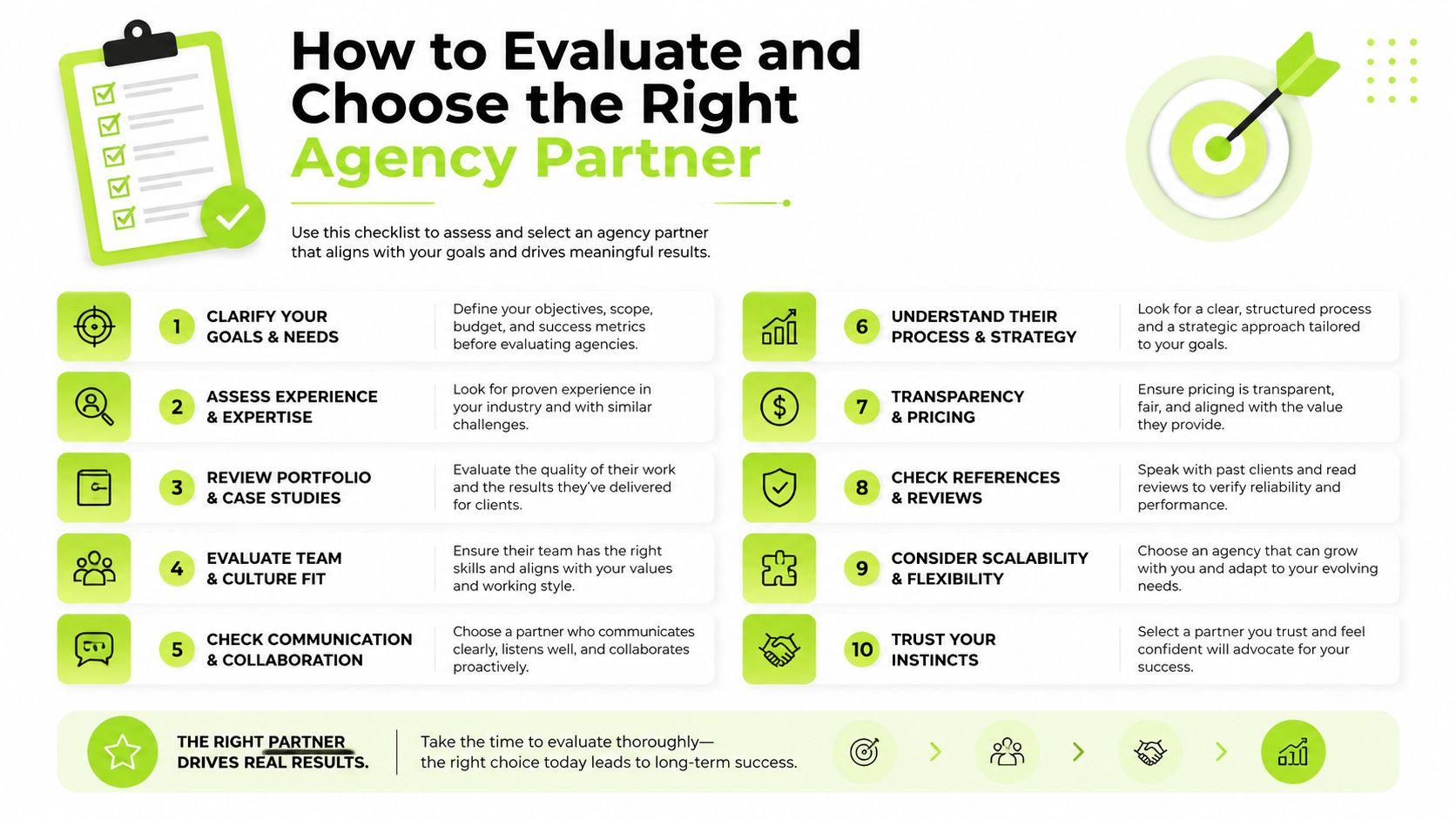
A club comparing agencies should look for proof, not polish. A slick presentation can hide weak follow-up, vague reporting, or a process that depends too heavily on one person remembering to respond.
Generalist agency versus golf growth partner
A generalist agency may talk confidently about branding, paid media, and content. A specialist golf partner should go further and explain how leads are captured, how enquiry ownership works, and how member journeys are tracked inside a CRM. That difference matters because golf clubs don't just need visibility, they need operational clarity.
The UK compliance side matters too. In the UK, golf clubs can use the Information Commissioner's Office guidance on direct marketing to structure follow-up systems legally: the Privacy and Electronic Communications Regulations (PECR) generally require consent for most electronic marketing to individuals, while the soft opt-in can apply only where a club obtained the person's contact details during a sale or negotiation for a sale, is marketing its own similar services, and offers an unsubscribe in every message (GCMA paper on direct marketing and PECR). If an agency ignores that, the club inherits the risk.
Questions to ask before you sign
The right questions are practical.
- Who owns the lead data? The club should know where enquiries live and who can access them.
- What happens within the first hour? Slow follow-up weakens momentum.
- How are enquiries segmented? One-size-fits-all messaging usually misses the mark.
- What will reporting show? Ask for booked visits, conversions, and source visibility, not just clicks.
- How is compliance handled? The agency should be able to explain opt-ins and unsubscribes plainly.
For a wider view of what other providers charge and how that fits into supplier comparisons, NotFair Google Ads agencies is a useful place to benchmark how agencies present themselves and what details they reveal.
The best partner should also sound calm and specific. If the answers stay vague, or if every conversation comes back to flashy creative and discounted ad spend, the club is probably being sold a surface-level service rather than a proper growth system.
Pricing Contract Models and ROI Expectations
Agency pricing makes more sense once you separate delivery from outcome. Some firms charge a monthly retainer, others add setup fees, and some include performance-linked elements. The structure matters less than what is included, and whether the reporting gives the club a fair view of value.
How to read the commercial model
A retainer usually covers ongoing strategy, campaign management, content, and optimisation. Setup fees often cover the initial build, such as CRM structure, tracking, and landing pages. Longer partnerships can make sense when the work depends on iteration, because golf marketing improves through refinement rather than one-off bursts.
If you're comparing numbers, the guide to pricing for SEO teams is a sensible reference point for understanding how agencies package service, time, and expertise. The main thing is to match the cost to the work, not to the sales patter.
This is also where clubs should keep the internal budget conversation grounded. If the earlier section on ROI showed anything, it's that the club should care about confirmed golfers reached, qualified leads, booked visits, and member conversions (state of golf marketing coverage). That framing is much more useful than counting likes or page views.
For a fuller breakdown of cost expectations at club level, how much golf club marketing costs is worth reading before any supplier comparison.
What to watch for in ROI promises
Be careful with guarantees that sound too neat. A sensible agency should talk about tracking, pipeline visibility, and incremental improvement, not magic outcomes. If follow-up is still manual, or if mobile conversion is poor, the club can spend heavily without seeing the return it expected.
The hidden cost is often in the admin, not just the ads. Missed enquiries, slow replies, and unclear ownership all eat into ROI long before a report is written. Good commercial terms should make room for that reality, because the value of the work is in the conversion system, not the headline spend.
Decision Checklist and Next Steps for Club Leaders
A committee meeting goes better when the club stops debating “more marketing” and starts asking “what happens after the enquiry?” That is usually the point where the right decision becomes obvious.
A practical checklist for the room
Start with the basics. Does the club know what a good enquiry looks like? Can it respond quickly enough? Is the current contact data clean enough for proper CRM use? If the answer to any of those is weak, the club needs process before more traffic.
Then compare agency fit. One provider may be brilliant at ads but weak on CRM. Another may talk well about strategy but avoid the question of who owns the follow-up. The better choice is usually the partner that can explain both generation and conversion without slipping into jargon.
The club should choose the team that makes the pipeline visible, not the one that makes the deck look impressive.
A sensible next step is a short trial with clear reporting. That should include enquiry handling, source tracking, and a review point where the club can see whether the process is improving. Golf clubs rarely need more noise, they need a steadier way to turn interest into action.
GolfRep works with clubs that want a predictable pipeline built from lead generation, structured follow-up, and CRM-led conversion. If that's the kind of growth you want to put in place, visit GolfRep and take a closer look at how the system is built for golf clubs.
Ready to tap into our proven growth system?