Predictable Revenue for Golf Clubs: The Growth System

The most popular advice in club growth is still the most misleading. If membership feels flat, people say you need more leads.
Usually, you don't.
Most clubs already have interest coming in. The primary issue occurs after that first enquiry. An email sits unread until the next morning. A phone message gets passed around. A trial visitor says they’ll think about it, and nobody follows up. By the end of the month, the club reports “not enough demand” when the underlying cause was a weak conversion process.
Predictable revenue for golf clubs doesn't come from stuffing the top of the funnel and hoping for the best. It comes from building a system that captures interest, responds quickly, tracks every conversation, and keeps following up until a prospect either joins or clearly opts out. That’s a different discipline from marketing alone. It sits between sales, operations, and member experience.
Golf clubs that get this right don't rely on memory, goodwill, or a busy team doing their best. They use structure. They know where each enquiry came from, who owns the next action, whether a visit was booked, and what happened after the visit. That visibility is what turns sporadic membership wins into a repeatable growth engine.
The Real Bottleneck to Golf Club Growth
A lot of clubs blame demand when revenue feels uneven. That diagnosis is often wrong.
The bigger problem is that revenue is too exposed to short-term trading. UK golf clubs deal with volatile income because of weather dependency, and average annual revenue per club sits at £1.2 million, with 55 to 65% heavily tied to green fee income. England Golf data also shows only 28% of clubs reaching more than 80% membership capacity, while rain-affected days can drive 20 to 30% revenue loss (YouTube reference).
That matters because daily-fee income moves around. Membership income steadies the business.
More enquiries won't fix a leaky process
A club can run decent advertising, generate local interest, and still see no reliable growth. Why? Because enquiries aren't the same as opportunities. An opportunity only exists when someone has been contacted, qualified, and moved into a clear next step.
If that handoff is weak, the club leaks value in small ways all week:
- Email-only handling: Someone sends an enquiry form, gets one reply, then hears nothing else.
- No ownership: The office assumes the pro will call. The pro assumes the manager has it covered.
- No status tracking: Nobody can say which prospects are waiting for a call, a visit, or a proposal.
- No follow-up discipline: Interested golfers disappear because life got busy and the club didn't stay in touch.
Most clubs don't have a lead generation problem first. They have a lead handling problem that makes marketing look worse than it is.
Revenue becomes unpredictable when follow-up is manual
Clubs often get stuck here. They operate with decent intent but inconsistent execution.
A member of staff replies when they can. Another chases a prospect if they remember. A committee member asks how the campaign is going, and the answer is based on gut feel rather than pipeline visibility. That isn't a sales process. It's a patchwork.
For private clubs, that creates a dangerous gap between interest and income. The club sees demand in bursts, but not enough of it converts into recurring revenue. The result is familiar: busy periods followed by anxiety, a few wins but no confidence in next month's numbers, and pressure to discount when things go quiet.
The clubs that grow steadily do one thing differently
They treat membership acquisition as an operational system, not a collection of ad hoc tasks.
That means every enquiry enters one place. Every prospect gets a response quickly. Every lead has a next action. Every visit is tracked. Every non-response triggers another touchpoint. Every result is visible to management.
Once that exists, advertising becomes far more effective because the club can convert the demand it creates.
Auditing Your Current Membership Pipeline
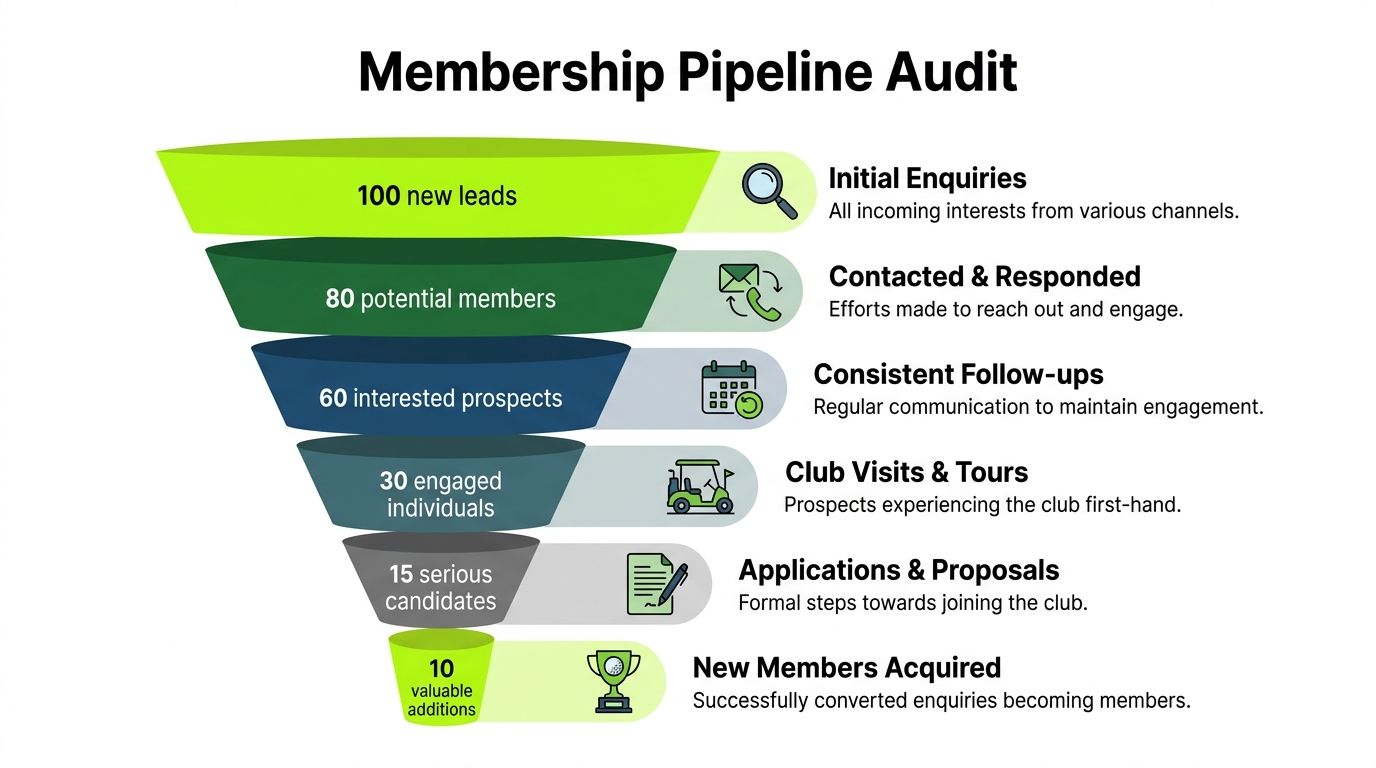
A pipeline audit shows whether the club has a conversion problem, a response problem, or an ownership problem. Without that clarity, clubs tend to blame lead volume and spend more on marketing before fixing the process that loses enquiries already coming in.
Many clubs can tell you how many enquiries arrived last month. Fewer can show, with confidence, which of those people received a timely response, which progressed to a visit, and which stalled without any clear reason. That gap matters more than the top-of-funnel number.
Member turnover puts extra pressure on that system. Stronger clubs keep churn under control. Others see turnover rise well above that, which means every missed enquiry hurts twice. Once in lost acquisition and again in the recurring revenue the club needed to replace.
Start with visibility, not opinion
Review the last full month of membership enquiries. Pull everything. Website forms, phone calls, email enquiries, walk-ins, referrals, open day sign-ups.
Then check each enquiry against five basic questions:
- Where did the enquiry come from
- How quickly did someone respond
- Was there more than one follow-up
- Was a visit, call, or trial arranged
- Did the club record an outcome
If those answers are incomplete, the club is not managing a pipeline. It is reacting to incoming interest.
GolfRep’s guide to golf club enquiry tracking is a useful reference for mapping that process properly, especially if enquiries currently sit across inboxes, spreadsheets, and handwritten notes.
The audit questions that expose leakage
The biggest losses usually happen after the first reply. A prospect asks for details, gets a brochure or a short email, then hears nothing unless they chase. Staff often assume silence means low intent. In practice, it often means the club failed to keep momentum.
Use this checklist:
- Response speed: Did every enquiry receive a reply the same day, or did some wait until a busy admin period cleared?
- Follow-up depth: How many prospects received a second and third touchpoint, not just one reply?
- Lead ownership: Is one named person responsible for each enquiry from first contact to decision?
- Visit conversion: How many enquiries progressed to a tour, trial round, or meeting?
- Decision tracking: Can the club separate no fit, no response, delayed decision, and active opportunity?
- Source quality: Which channels produce members, not just enquiries?
- Retention link: Does the handover into onboarding reduce early drop-off, or does the process stop at sign-up?
One missed follow-up is not the issue. A repeated pattern is.
Look for the handoff failures
Many audits get too shallow. They focus on ad performance and ignore what happens once a prospect replies, books a visit, or asks a more detailed question about categories and pricing.
Check the handoffs between teams. Reception may log the call. The membership contact may send rates. The golf office may host the visit. If nobody owns the full journey, prospects drift between people and stages. The club stays busy but conversion stays inconsistent.
A simple stage review usually makes the problem obvious:
| Pipeline stage | What to check | What failure looks like |
|---|---|---|
| Enquiry received | Is every lead logged? | Some leads exist only in email or a notebook |
| First response | Was contact made promptly? | Response time depends on who is on shift |
| Follow-up | Are reminders and retries happening? | One reply sent, then no next action |
| Visit booked | Is there a clear invitation to visit? | Interest stays vague and never advances |
| Application | Is the prospect guided through joining? | Strong prospects cool off after the tour |
Judge movement, not activity
Clubs often mistake busyness for process. Plenty of emails, calls, and conversations can still produce weak conversion if there is no structure behind them.
The test is simple. Can you see the current status of every live membership prospect within a minute?
If the answer is no, there is no reliable pipeline to manage. There is only staff effort, which works until enquiry volume rises, someone goes on leave, or several prospects need attention at the same time.
What a useful audit should produce
A good audit ends with three practical outputs:
- A stage map: the path from first enquiry to paid member
- A leakage list: the points where prospects slow down, disappear, or get ignored
- An ownership model: the person responsible for the next action at each stage
That gives management something useful to fix. In my experience, the answer is rarely more campaigns. It is usually tighter response standards, clearer ownership, and a system that makes follow-up happen without relying on memory.
The Foundation A Centralised CRM and Automation Engine
The clubs that grow predictably don't run membership sales from a shared inbox, a spreadsheet, and someone’s memory.
They use one central system. That's the difference between chasing enquiries and managing a pipeline.
When follow-up is fragmented, leakage is inevitable. Multi-site UK golf resort groups report pipeline leakage of up to 25% due to fragmented follow-up. Volunteer-run clubs make up 35% of the UK total and can convert two times slower without automation, missing an estimated £50k to £100k in annual recurring revenue (Brainz Magazine analysis).

Why spreadsheets stop working
Spreadsheets feel manageable because they're familiar. The problem isn't that they store information badly. The problem is that they don't drive action.
A spreadsheet won't:
- remind staff that a prospect hasn't been called
- trigger a same-day email after a form submission
- assign ownership when someone books a visit
- show management which leads are stalled
- record every touchpoint in one timeline
That means the system depends on people remembering what to do next. In a busy club office, that's where good opportunities get lost.
What a golf club CRM should actually do
A proper CRM for membership growth is not just a contact list. It should function as the club’s operating system for enquiries.
At minimum, it needs to give you:
| CRM function | Why it matters in practice |
|---|---|
| Central lead capture | Every enquiry enters one place, regardless of source |
| Pipeline stages | Staff can see whether a prospect is new, contacted, booked, visited, or pending |
| Task assignment | One person owns the next action |
| Activity history | Calls, emails, texts, and notes stay attached to the lead |
| Reporting | Management can see conversion trends rather than relying on anecdotes |
Without those basics, you can't manage conversion consistently.
Automation is there to enforce standards
Some managers hear “automation” and think impersonal messages or overcomplicated software. Used properly, it does the opposite.
Automation handles the routine parts that humans do inconsistently. It sends the instant acknowledgement. It creates the follow-up task. It chases the no-response lead. It confirms the visit. It prompts the next touch after the tour.
That doesn't replace staff. It protects staff time for the conversations that matter.
A strong automation setup doesn't remove the human element. It makes sure the human element happens at the right moment instead of being forgotten.
For clubs comparing systems, GolfRep’s overview of golf club automation is a useful reference for how automated follow-up fits into day-to-day club operations.
One view of the pipeline changes decision-making
The biggest gain from a centralised CRM isn't technical. It's managerial.
When the whole pipeline is visible, leadership can finally answer practical questions:
- Which channels bring serious membership prospects?
- Which staff actions lead to more visits?
- How long does it take an enquiry to become a joiner?
- Where are prospects getting stuck?
- Which sites or teams need support?
That matters even more for multi-site operators. If every venue handles leads differently, head office can't spot leakage early. A central system gives structure without removing local nuance.
What works and what doesn't
Some approaches look organised but still fail in practice.
What works
- one system for all membership enquiries
- clear pipeline stages
- assigned ownership on every active lead
- automatic reminders and follow-up triggers
- reporting that links source, action, and outcome
What doesn't
- shared inboxes with no stage tracking
- handwritten notes after visits
- staff updating spreadsheets when they remember
- ad reports with no connection to joined members
- assuming a warm lead will “come back when ready”
Choosing tools without overcomplicating the club
A club doesn't need a bloated tech stack. It needs a setup that staff will use.
That usually means one CRM, sensible automation, clear templates, and a reporting view that a general manager can understand in minutes. Some clubs build this with general CRM platforms configured properly. Others use specialist systems designed for club growth. GolfRep is one example of a UK-focused option that combines advertising, CRM tracking, and automated nurture for golf clubs.
The right choice isn't the one with the most features. It's the one that gives the club full visibility and dependable follow-up without creating more admin.
Designing Data-Led Advertising That Attracts Quality Enquiries
Once the pipeline is solid, advertising starts to work the way clubs expect it to.
The mistake is to advertise broadly before the club knows what type of prospect it wants, what offer fits them, and what happens after they enquire. That approach creates activity, but not reliable membership growth.
The better approach is narrower. Define the right audience. Match the message to that audience. Push prospects into a conversion system that can handle them properly.

Start with member fit, not ad reach
A quality enquiry is someone who fits the club’s model.
That might be:
- The local committed golfer who wants regular play and community
- The younger professional who needs flexibility and easy booking
- The family decision-maker looking at value, facilities, and atmosphere
- The corporate buyer interested in client golf and hospitality use
Each group responds to different messages. If the club advertises with generic copy to everyone, the campaign pulls in curiosity rather than intent.
Use revenue data to guide where and when you advertise
Advertising shouldn't be separated from pricing and tee sheet performance.
Using predictive analytics and dynamic pricing can deliver a 15 to 25% uplift in Revenue Per Available Round (RevPAR) by optimising tee time rates based on forecast demand, and that same demand view can help clubs decide when member acquisition is most profitable (GolfBack Solutions guide).
In practice, that means a club can make smarter calls about when to push membership, when to protect yield, and when to position flexible products rather than full access.
Build campaigns around actual objections
Most golf club advertising is too polished and too vague. It talks about beautiful fairways, heritage, and a warm welcome.
Prospects usually want answers to more practical questions:
| Prospect concern | Better advertising angle |
|---|---|
| “Will I actually use it enough?” | Show flexibility, booking ease, and realistic membership fit |
| “Will I feel comfortable there?” | Show the club culture, not just the course |
| “Is this worth the money?” | Explain value through access, events, and experience |
| “What happens if I enquire?” | Offer a clear next step such as a visit or conversation |
Avoid the usual advertising traps
The clubs that struggle with ads often make one of these errors:
- Too broad an audience: They target “golfers” instead of likely members within a sensible catchment.
- Too much discounting: They lead with price cuts rather than fit.
- No operational follow-through: Enquiries land in a system that can't convert them.
- No message variation: Every campaign says the same thing, regardless of audience segment.
Better advertising doesn't mean louder advertising. It means the right message reaches the right golfer at the moment your club can convert interest into revenue.
What good campaign design looks like
A practical setup often includes a small number of tightly aligned campaigns rather than one generic push.
For example:
- A membership campaign aimed at local regular golfers
- A flexible option for time-poor professionals
- A reactivation campaign for past enquirers who never joined
- A club visit campaign for people not yet ready to commit
That structure gives the sales process cleaner intent. Staff know why the person enquired, what likely matters to them, and what next step to offer.
That’s how advertising starts supporting predictable revenue for golf clubs rather than producing random bursts of attention.
Implementing Nurture Flows That Convert Enquiries into Members
Most clubs lose prospects in the quiet period after first contact.
Someone enquires on a Tuesday night. They get a reply on Wednesday morning. They mean to respond but get distracted. By Friday, the club has moved on to other tasks and the prospect has gone cold.
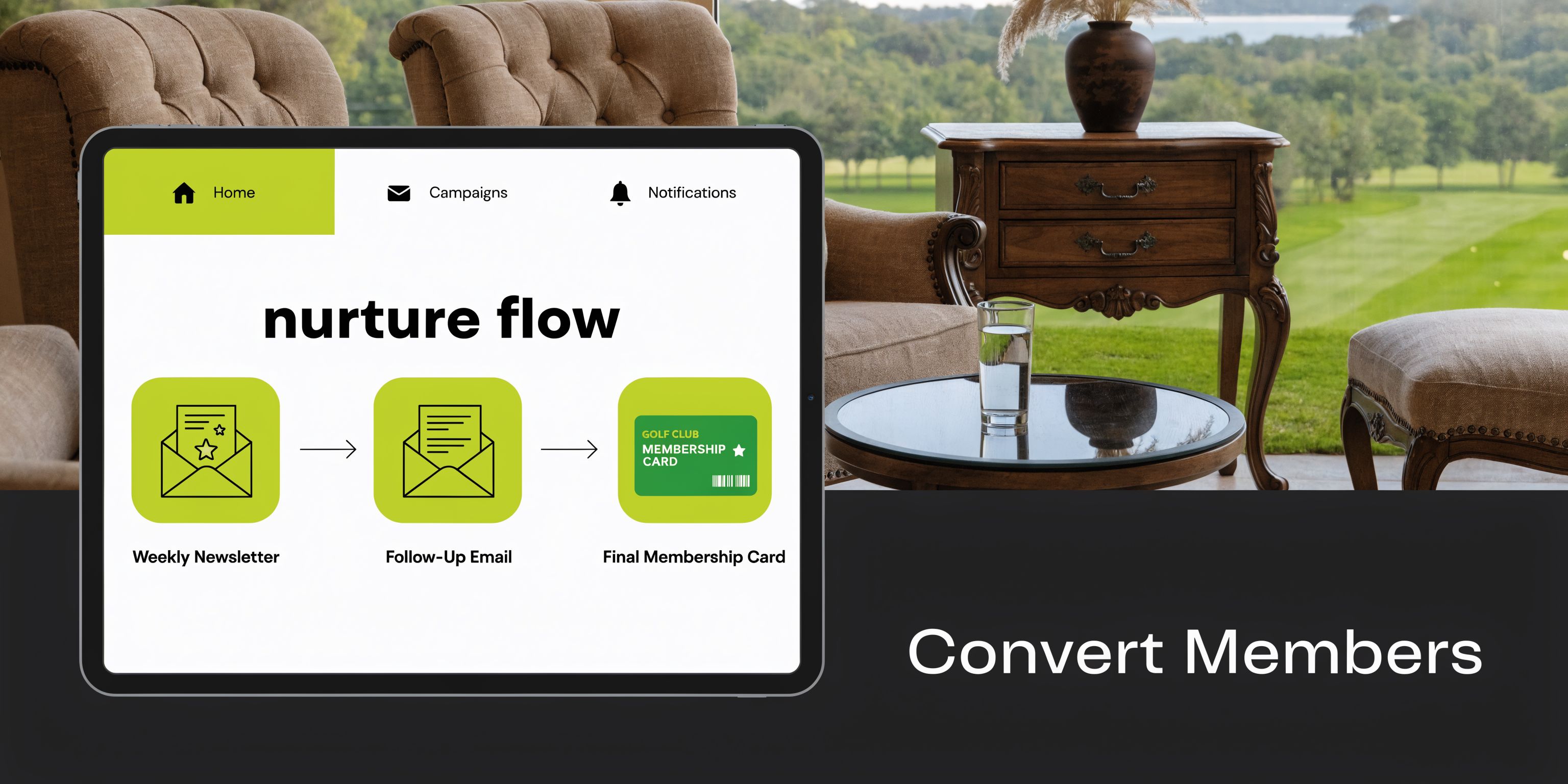
Nurture flows solve that by removing the dead space between touches.
A key step in stabilising revenue is nurture automation. Proven systems can achieve 98% payment success rates on recurring fees and improve retention, and clubs that automate follow-ups are better positioned to keep churn below the critical 10% threshold (Financial Models Lab reference).
What a strong nurture flow feels like to a prospect
It shouldn't feel like a campaign. It should feel like a well-run club.
That means the communication is prompt, useful, and steady without becoming pushy. Each message moves the prospect one step closer to a decision.
A practical framework for this is outlined in GolfRep’s article on a golf club follow-up system, but the core principle is simple. Never leave interest unattended.
A realistic example of the sequence
Take a local golfer who submits a membership enquiry form after browsing the website in the evening.
Day 0
The system sends an immediate confirmation email. It thanks them, sets expectations, and gives a simple next step such as booking a call or visit.
A task is created for a staff member to review the lead the next morning.
Day 1
If no reply has come back, the prospect gets a short follow-up message. Not a sales pitch. A prompt.
It might reference membership options, offer a conversation, and make the next step easy. At the same time, the assigned staff member gets a reminder to call.
Day 3
If there has still been no engagement, the system sends a value-led email. Many clubs err at this point. They talk only about price or availability.
A better email shows what joining means. Regular play. Member competitions. Practice access. Club atmosphere. Ease of integrating into the club.
The best follow-up doesn't chase. It reduces uncertainty.
Day 5 to Day 10
If the prospect opens emails but doesn't book, the flow can branch. Someone showing interest but hesitating may need a club visit invitation, a trial experience, or a clearer explanation of membership fit.
Someone who has already visited should move into a different path. That path should focus on unresolved questions, joining steps, and gentle urgency without pressure.
The sequence must change after each action
Manual follow-up often falls apart at this stage. Staff keep sending the same generic messages because they can't easily see what happened before.
A proper nurture flow changes based on behaviour:
| Prospect action | Next system response |
|---|---|
| Enquiry submitted | Immediate acknowledgement and staff task |
| Email opened, no reply | Follow-up with visit or call invitation |
| Visit booked | Confirmation and reminder sequence |
| Visit completed | Membership information and personal follow-up |
| No engagement for a period | Re-engagement path or pause |
That logic matters because timing and relevance matter. Prospects rarely join because of one perfect message. They join because the club stayed present, answered concerns, and made the decision easy.
Where clubs overdo it
Not every touchpoint improves conversion.
Common mistakes include:
- Too much information at once: Sending fee sheets, policy documents, and event calendars in one bundle
- No behavioural branching: Treating a warm prospect and a cold prospect the same way
- Overly corporate messaging: Writing like a software company instead of a golf club
- Stopping after the visit: Assuming interest is strongest immediately after a tour, then failing to follow through properly
Nurture should continue after sign-up
A lot of clubs treat conversion as the finish line. It isn't.
If the club wants reliable recurring income, the first weeks of membership matter. New member onboarding should continue the same principle as pre-sale nurture. Prompt welcome communication, clear next steps, and visible engagement opportunities all help reduce early regret and improve retention.
That’s how a nurture flow becomes more than a sales tool. It becomes part of the club’s revenue system.
A Practical Roadmap for Implementation
Most clubs don't need a dramatic overhaul. They need a phased build with clear ownership.
The easiest way to make this manageable is to split the work into three stages. Each stage should leave the club more organised than before, even before the full system is complete.
Phase one is about control
Start by getting the data and process under control.
That means collecting all current enquiry sources, mapping the actual pipeline stages, deciding who owns each stage, and moving active opportunities into one central system. Keep the stages simple enough that staff use them consistently.
At this point, measure operational discipline more than marketing performance.
Phase two is about activation
Once the core system is in place, switch on the basics that stop leakage.
That usually includes instant acknowledgements, follow-up reminders, task assignment, visit booking flows, and a small number of tightly targeted campaigns to feed the pipeline. Staff should know exactly what happens when a new enquiry arrives and what happens after a visit.
Phase three is about refinement
Only after the process is stable should the club start optimising.
Now the questions become sharper. Which campaign is attracting the best-fit prospects? Which stage has the biggest drop-off? Which follow-up messages lead to visits? Which membership conversations stall and why?
That review rhythm is what turns a working system into a predictable one.
Membership growth system implementation roadmap
| Phase (Timeline) | Key Actions | KPIs to Measure |
|---|---|---|
| Phase 1 (Weeks 1 to 4) | Audit enquiry handling, define pipeline stages, centralise lead capture, assign ownership, migrate active prospects | Enquiry response time, lead visibility, number of active leads with a clear next action |
| Phase 2 (Weeks 5 to 8) | Launch core automations, create follow-up templates, set visit booking process, begin targeted campaigns | Enquiry-to-visit rate, follow-up completion, visit booking volume, lead source quality |
| Phase 3 (Ongoing) | Review reports, refine messaging, improve stage conversion, adjust campaigns and nurture paths | Visit-to-member rate, cost per new member, member retention trend, recurring revenue consistency |
Keep the first version simple
A common mistake is trying to build every campaign, every workflow, and every report at once.
Don't.
Start with the operational basics that produce control:
- One pipeline: every membership enquiry goes into the same system
- One owner per lead: no shared accountability
- One follow-up standard: every lead gets a minimum sequence
- One review rhythm: leadership checks pipeline movement regularly
Clubs don't need more complexity. They need fewer gaps between enquiry, follow-up, visit, and sign-up.
When that foundation is in place, improvements become easier because the club can see what to change.
The Shift from Reactive Marketing to Predictable Growth
Reactive marketing feels busy. Predictable growth feels controlled.
That's the key shift. Not from offline to digital, or from traditional to modern, but from scattered activity to a managed revenue system. The clubs that grow steadily don't just advertise better. They respond faster, track more clearly, follow up more consistently, and remove guesswork from the pipeline.
That changes the conversation inside the club.
Instead of asking whether enough leads came in, management can ask where prospects are stalling. Instead of hoping staff remembered to chase a strong enquiry, the system makes sure it happened. Instead of relying on short-term green fee spikes, the club builds a stronger base of recurring member revenue.
Predictable revenue for golf clubs isn't built on one campaign or one good month. It's built on a process that can repeat under pressure, through staff changes, and across different seasons.
That's why the strongest clubs treat conversion as an operational discipline. Once that happens, marketing stops being reactive and starts becoming measurable growth.
If your club wants a clearer view of where enquiries are being lost and how to turn them into a more reliable membership pipeline, GolfRep helps golf clubs build structured follow-up, CRM visibility, and data-led growth systems without relying on discount-led marketing.
Ready to tap into our proven growth system?