What Is Marketing Analytics: Drive Golf Club Growth

Most advice about marketing analytics sends golf clubs in the wrong direction.
It says the answer is more traffic, more reach, more campaigns, more leads. That sounds sensible until you look at what usually happens after an enquiry arrives. In UK golf, clubs lose approximately 30% of membership enquiries before a proper discussion even begins because handling is slow, inconsistent, or invisible post-arrival, which means the issue is often conversion handling rather than demand itself, as noted in GolfRep's review of lost membership enquiries.
For most clubs, marketing analytics isn't about becoming a data science operation. It's about finding where the bucket leaks. If your website, Meta ads, Google Ads, visitor forms, diary, and email inbox all sit in separate places, you don't have a marketing problem first. You have a visibility problem.
That distinction matters. A club can be busy with enquiries and still feel flat on membership growth because no one can clearly see which leads arrived, who replied, how fast they replied, which prospects booked a tour, and which ones disappeared. That's why a clearer understanding of data analytics vs business intelligence differences is useful. One helps you examine patterns and decisions. The other often focuses on reporting the state of play. Clubs need both, but they usually need decision-making clarity first.
A practical starting point is to stop asking, "How do we get more leads?" and start asking, "What happens to every lead we already get?" That shift changes everything. It also aligns with the thinking behind data-driven golf marketing systems, where growth comes from connected follow-up, not isolated campaigns.
From Guesswork to Growth How Analytics Works
The leaky bucket is the real issue
When club committees talk about marketing, they often jump straight to promotion. New creative. New offers. A new agency. More budget. But marketing analytics starts earlier and closer to the cash result.
It asks whether the club can follow a prospect from first click to signed membership. If the answer is no, then any discussion about scaling spend is premature. You can't improve what you can't see.
Practical rule: If your team can't say where yesterday's enquiries came from and what happened to each one, you're still operating on guesswork.
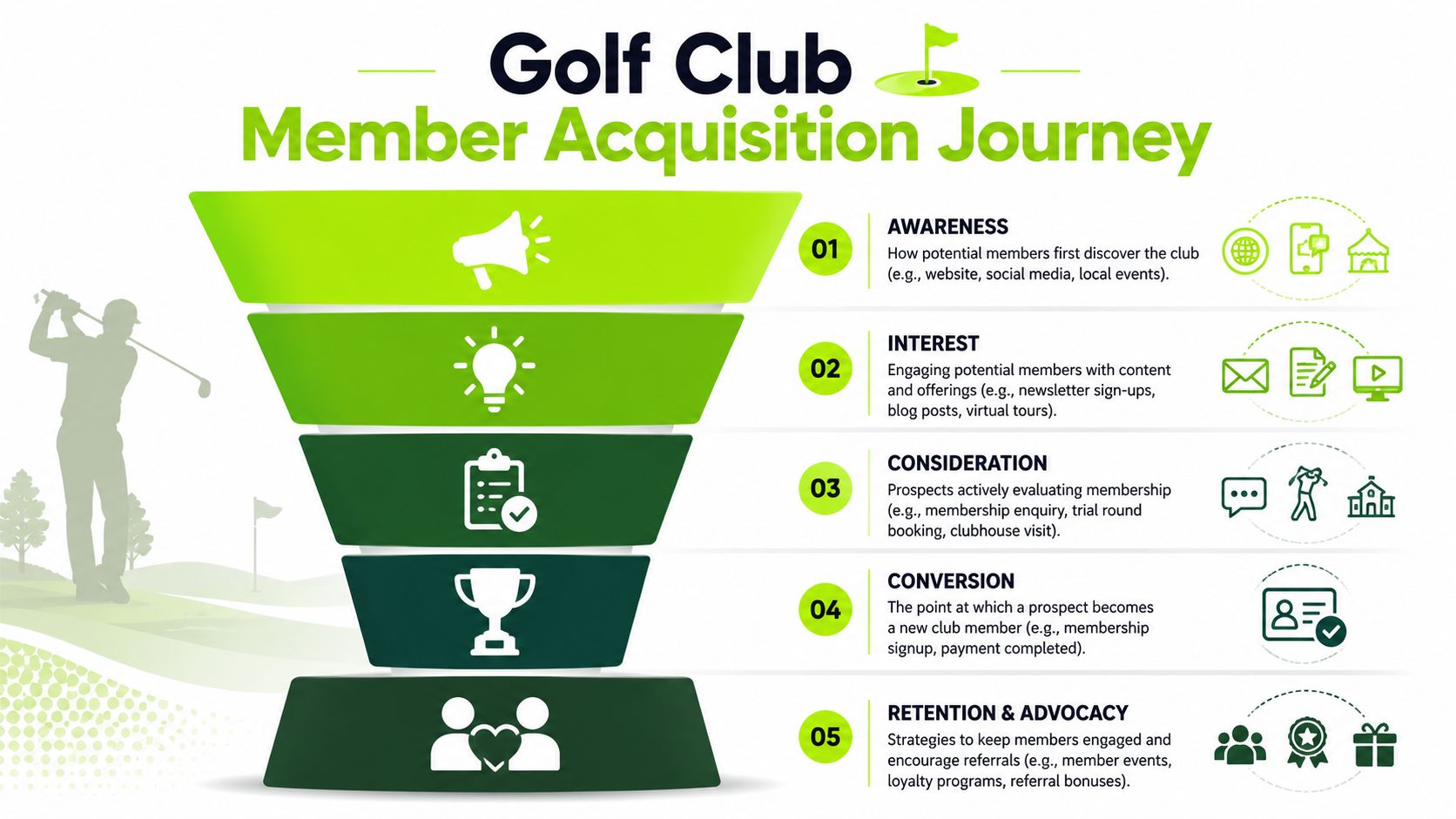
That doesn't mean every club needs a complex dashboard. It means every club needs a clear view of movement through the pipeline. Who enquired. When they enquired. Whether someone responded. Whether they visited. Whether they joined.
What analytics changes in practice
Good analytics replaces assumptions with operational facts. It shows whether a campaign produced low-quality traffic or whether good prospects were left waiting. It shows whether one membership page works better than another. It shows whether one staff member consistently converts tours better because they follow a tighter process.
A useful way to think about it is this:
| Question | What analytics tells you |
|---|---|
| What happened | Which channels, pages, and forms generated interest |
| Why it happened | Where prospects dropped off, stalled, or stopped replying |
| What to improve | Which part of the process needs fixing first |
Most clubs don't need more reports. They need fewer blind spots.
The clubs that make progress usually simplify first. They track a short chain from attention to enquiry, enquiry to contact, contact to visit, and visit to membership. That turns marketing from a hopeful activity into a managed commercial process.
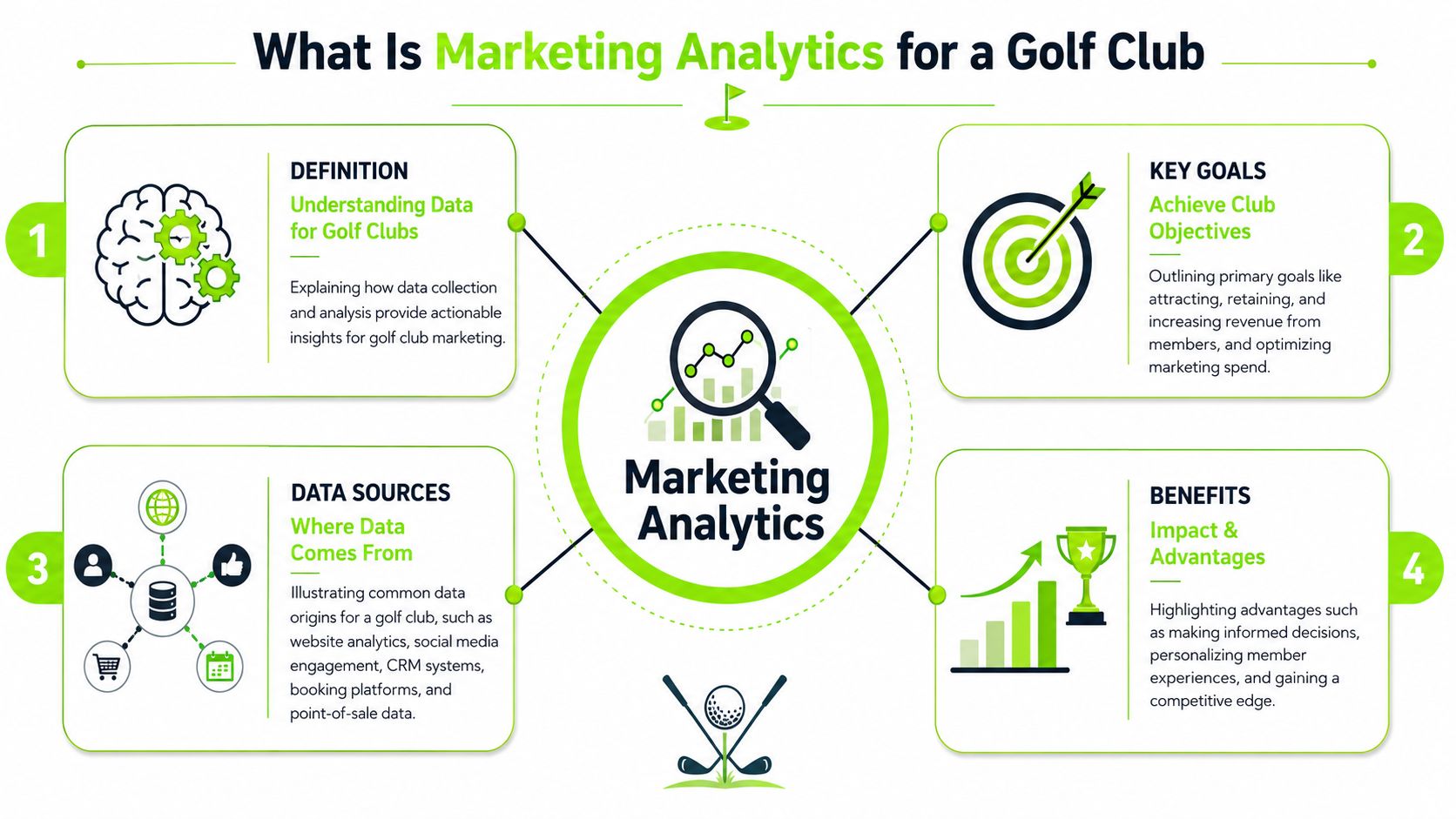
What Is Marketing Analytics for a Golf Club
At club level, what is marketing analytics really asking? It isn't asking for theory. It's asking how you connect activity to revenue.
Marketing analytics involves applying technology and analytical processes to understand consumer actions, refine campaigns, and optimise return on investment, turning big data into a practical asset for strategic decisions, as outlined by the University of Stirling's marketing analytics overview. In golf club terms, that means connecting the dots from advert, search, or referral through to enquiry, tour, membership, and ongoing value.
It works like an EPOS view for marketing
Most club managers already understand inventory logic in the pro shop or food and beverage reporting. If stock goes missing, margin drops, or one product line stops moving, you want to know where and why.
Marketing analytics does the same for membership growth.
It helps answer three plain-English questions:
What happened
Which campaigns, pages, calls, or forms generated response.Why did it happen
Whether the message was wrong, the landing page was weak, or the follow-up process broke down.What can we improve
Whether to change budget allocation, tighten the website journey, or automate first response.
Vanity metrics versus revenue metrics
At this stage, many clubs drift off course. They focus on numbers that feel encouraging but don't help anyone make a better decision.
A few examples make the distinction clear:
Vanity metrics
Social likes, broad impressions, and raw pageviews can suggest activity, but they don't tell you whether membership revenue is improving.Useful operating metrics
Enquiry source, response speed, booked tours, completed applications, and cost per acquired member show whether the system is producing members.Commercial metrics
Revenue per member, retention signals, and membership mix tell you whether acquisition is profitable and sustainable.
A club doesn't need more charts. It needs the right line of sight from first interest to recurring revenue.
The point isn't to dismiss top-of-funnel data. Website traffic and campaign reach still matter. But they only matter if they feed a process that captures, tracks, and converts demand. Otherwise, clubs can spend months discussing awareness while the actual loss happens in the inbox, diary, and follow-up gap.
Why Analytics Matters More Than Ever for UK Clubs
The UK golf market isn't short of competition. The IBISWorld overview of UK golf courses reports 2,510 businesses in 2025 and describes a slow-growth market, which points to a saturated environment where retention and efficient acquisition matter more than broad, unfocused promotion.
That changes the role of marketing analytics. In a crowded market, the club that wins isn't always the one with the loudest promotion. It's often the one with the clearest operating discipline.

Saturation raises the cost of sloppy systems
In a market with many competing clubs, a weak response process hurts twice.
First, you waste the money spent generating interest. Second, you hand the prospect to a competing club that replies faster, follows up better, or appears more organised.
That is why analytics matters at board and committee level, not just marketing level. It brings discipline to decisions such as:
Budget allocation
Which channel is worth backing because it produces qualified enquiries, not just clicks.Operational staffing
Whether the club has enough structure to respond consistently during evenings, weekends, and busy periods.Retention focus
Whether recurring revenue is protected through better tracking of member behaviour and renewal risk.
Predictability beats seasonal hope
Many clubs still run membership growth on seasonal momentum. A spring push. A summer lull. A late scramble. That's not a pipeline. That's a cycle of hope.
Analytics creates predictability because it makes performance visible. A manager can see whether enquiries are falling, whether response times are slipping, whether tours are being booked, and whether one site in a group is underperforming compared with another.
For multi-site operators, this visibility becomes even more valuable. A central view helps spot where one club has a website issue, another has a follow-up issue, and a third has a stronger conversion process worth replicating across the group.
Strong clubs don't just collect demand. They manage it with clarity.
Without analytics, most of those decisions are based on anecdote. With analytics, they are based on what the pipeline is doing.
The Key Metrics That Actually Drive Membership Growth
A club can drown in dashboards and still miss the numbers that matter. The aim isn't to monitor everything. The aim is to track the handful of metrics that tell you whether membership demand is being turned into revenue.
One of the clearest examples is response speed. A membership lead that receives a response within one hour is five times more likely to convert than one that waits 24 hours, according to CRM.Golf's analysis of golf club response time and conversions. That single measure says more about pipeline health than most social media reports ever will.
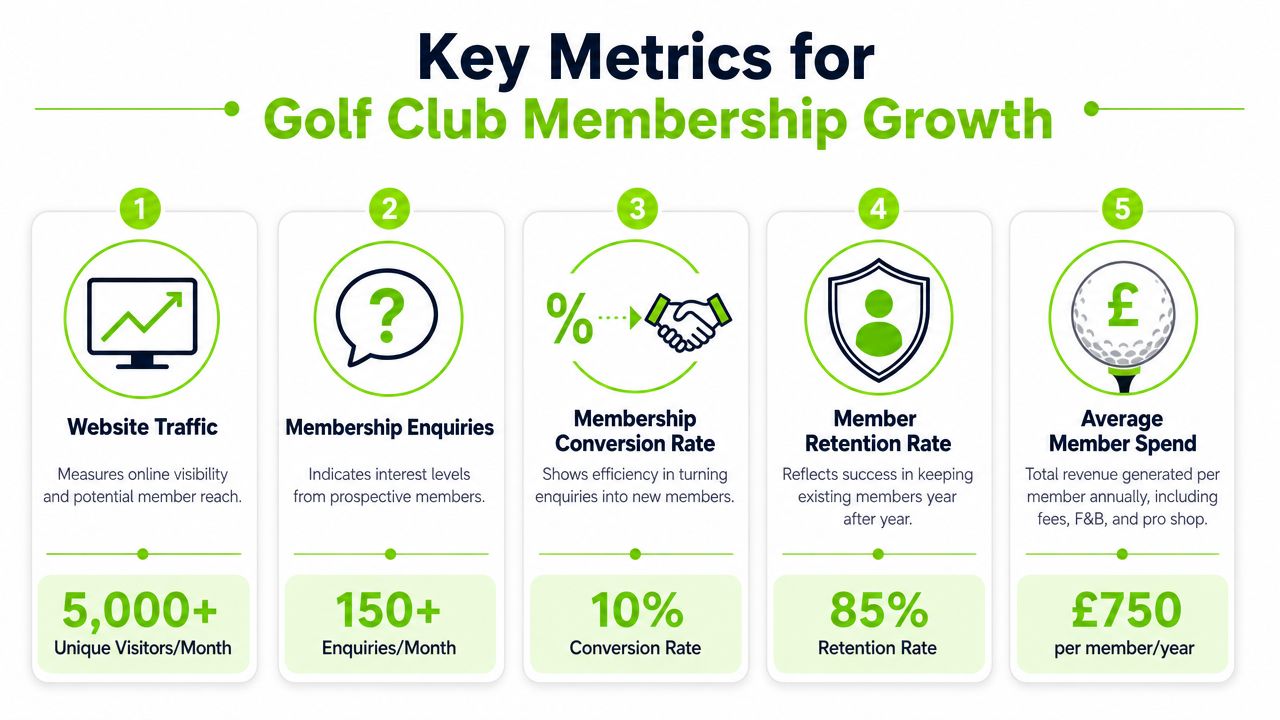
The metrics worth tracking
Start with metrics that support decisions, not vanity.
Enquiry source
This tells you whether prospects came from Google Ads, organic search, Meta, email, referrals, or offline activity. The point isn't just attribution. It's understanding which source produces people who move forward.Lead response time
This is the gap between enquiry arrival and first meaningful reply. It exposes whether the club is operationally set up to convert demand.Lead-to-tour conversion
If lots of people enquire but few visit, the problem usually sits in handling, messaging, or speed, not traffic volume.Tour-to-member conversion
This shows whether the club experience, sales conversation, and offer structure are doing their job.Cost per acquired member
Cost per acquired member marks the point when marketing becomes commercial rather than cosmetic, connecting spend to a real business outcome.
What not to overvalue
Engagement data has its place. It can be useful for judging content quality and early-stage interest. If you need a clearer benchmark for social interaction specifically, this explanation of what defines a good engagement rate is useful background. But engagement should support decision-making, not replace it.
A post with strong reactions and comments may still produce no serious membership demand. A simpler campaign with fewer visible signals may produce better prospects and lower acquisition cost.
That is why clubs need a hierarchy of metrics:
| Priority | Metrics |
|---|---|
| Highest commercial value | Cost per acquired member, tour-to-member conversion, response time |
| Useful operational value | Enquiry source, lead-to-tour conversion, follow-up completion |
| Lower decision value on their own | Likes, impressions, broad reach, unqualified traffic |
The best way to test whether a metric matters is simple. Ask what action it creates. If the number changes, do you know what the team should do next?
If the answer is no, it probably belongs lower down your dashboard. A more grounded way to think about this is to tie marketing review back to outcome, not activity, which is exactly why clubs should examine the real ROI of golf club marketing rather than stop at surface performance.
Practical Analytics Examples in a Golf Club
Analytics becomes useful when it changes a decision.
The examples below are typical of what clubs and operators deal with. They aren't about advanced modelling. They're about using clear data to stop waste, tighten process, and improve conversion.
A private members' club cuts waste in ad spend
A club runs paid campaigns across Google and Meta. On the surface, both channels appear active. Plenty of clicks. Good traffic. Healthy enquiry volume.
But once the club connects enquiry source to booked visits and membership outcomes, the picture changes. One channel is generating curiosity. The other is generating prospects who are far more willing to visit and discuss membership seriously.
So the decision isn't "which campaign gets more attention". It's "which campaign earns more committed conversations". That club reallocates budget accordingly, not because one advert looked better, but because the downstream data showed stronger commercial value.
A multi-site operator spots one club's bottleneck
Group operators face a different issue. They often have inconsistent handling across sites.
One club answers quickly and logs every enquiry in a CRM. Another relies on inboxes, handwritten notes, and memory. A central dashboard makes that gap visible. The operator can see one site moving prospects from enquiry to visit smoothly, while another loses visibility halfway through.
Operational truth: The same campaign can look successful at group level and still fail at site level if local follow-up breaks down.
That changes the intervention. The operator doesn't blame creative first. It standardises response process, booking flow, and lead ownership.
A website funnel improves without a redesign
A common club problem sits on the website. The membership page gets traffic, but too few visitors complete the form or request a tour.
When the funnel is reviewed, the issue is often friction rather than design quality. The form asks too much. The call to action is weak. The page doesn't make the next step feel simple or personal. Sometimes the enquiry goes into a generic inbox with no clear hand-off.
A club doesn't always need a new website. It often needs a cleaner path:
Sharper call to action
Make the next step obvious. Book a visit. Request membership information. Speak to the membership team.Shorter forms
Remove fields that don't help the first conversation.Clear ownership
Route the enquiry into a system where someone can see it, act on it, and track the outcome.
Analytics identifies where people stop. The fix usually comes from reducing friction, not adding complexity.
Common Pitfalls in Golf Club Marketing Analytics
The biggest analytics mistake in golf isn't having too little data. It's failing to act on the right data.
For UK golf clubs, the average response time for membership enquiries is 47 hours and 32 minutes, and that kind of delay often leads to 0% conversion rate for many pipelines, according to this golf industry response-time review. That isn't a reporting issue. It's a systems issue.
Tool obsession without process
Some clubs buy software before they decide how enquiries should move.
A CRM on its own won't save a weak process. Nor will a new dashboard. If nobody owns first contact, if follow-up reminders don't exist, and if tours aren't tracked properly, the club just ends up with a more expensive version of the same confusion.
A better order is:
- Define the pipeline stages.
- Decide who owns each stage.
- Put the system around that process.
Tracking too much and learning too little
Another common problem is metric overload. Clubs collect campaign data, website reports, email stats, and social reports, then struggle to identify what matters.
Measurement discipline helps. A broader guide for SaaS metrics governance isn't golf-specific, but the principle applies well. If a metric isn't clearly defined, consistently tracked, and linked to a decision, it becomes noise.
That usually shows up in a few ways:
Spreadsheet sprawl
Different people keep different records, and none of them fully match.No lead visibility
Enquiries enter through forms, calls, messages, and email, but nobody sees the whole picture.Delayed follow-up
Staff intend to reply, but busy days, leave, and handover gaps get in the way.
Good analytics isn't more information. It's a tighter connection between signal and action.
Confusing activity with performance
Clubs often report that marketing is "busy". Ads are running. Social is active. The website is updated. Emails went out.
But activity doesn't equal output. If leads aren't visible, if responses are late, and if there is no clear conversion tracking, the club can feel productive while losing valuable demand every week.
That's why the practical test is simple. When an enquiry arrives, can the club see it, respond to it, follow it through, and measure what happened next? If not, the analytics stack doesn't need expanding. It needs simplifying and connecting.
Your First Steps Toward Data Driven Growth
Most clubs don't need to start with a major platform rollout. They need to start with control.
The first shift is mindset. Stop treating marketing as a collection of campaigns and start treating it as a managed pipeline. That means fewer disconnected actions and more attention on how prospects move from interest to membership.
Start with an enquiry audit
Look at the club's current process from the prospect's point of view.
Where can someone enquire? Website form, email, telephone, social message, third-party directory, or referral. Then ask three questions. Where does that lead appear, who sees it first, and what happens if that person is unavailable?
This kind of review often reveals that clubs don't have a lead generation issue. They have a handover issue.
Track one metric that changes behaviour
Don't build a giant scorecard on day one. Choose one high-impact measure that forces better habits.
For many clubs, that's response time. For others, it may be lead-to-tour conversion. The key is to pick a number that creates a clear action when it moves.
A clean way to begin is to build basic golf club enquiry tracking so every prospect is visible from arrival to outcome.
Replace manual follow-up with a repeatable system
Manual follow-up works until the team gets busy. Then speed drops, notes get missed, and visibility disappears.
A stronger setup usually includes:
Immediate acknowledgement
So the prospect knows the enquiry has been received.Assigned ownership
So one person is clearly responsible for next action.Structured reminders
So nobody relies on memory to chase a lead.Simple reporting
So management can see what entered the pipeline and what converted.
Clubs grow more predictably when follow-up stops depending on good intentions and starts depending on process.
That is what marketing analytics should deliver in a golf club. Not theory. Not dashboards for their own sake. Just a clearer, more reliable way to turn demand into revenue.
GolfRep helps golf clubs build predictable membership pipelines by combining lead generation with structured follow-up, CRM visibility, and conversion tracking. If your club wants a clearer view of where enquiries are being lost and how to turn more of them into booked visits and members, explore GolfRep.
Ready to tap into our proven growth system?