Golf Club Waiting List Strategy That Converts

The most common advice on golf club waiting list strategy is wrong. A longer list doesn't automatically mean a healthier club, it often means the office is carrying demand without converting it, qualifying it, or keeping it warm enough to join when a place opens.
That distinction matters in the UK right now. A 2025 survey of 79 members' clubs across ten regions found average waiting list size reached 122 people, up from 53 in 2024, and 53% of clubs with a waiting list saw those lists grow versus the prior year (Golfshake). The same survey found 74% of clubs charged an entrance fee, which tells you the list is already part of the club's commercial engine, not just an admin task.
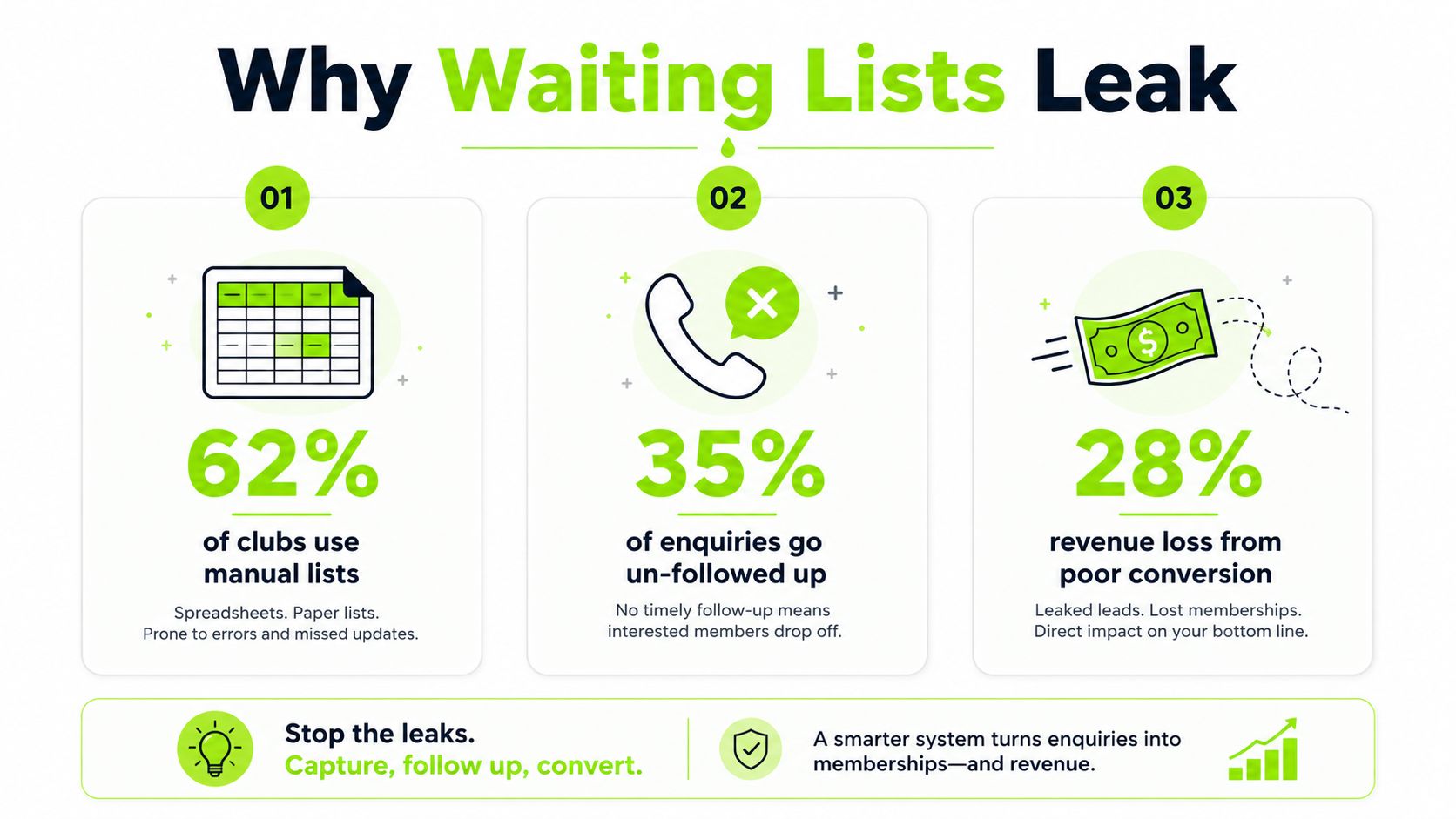
A healthy golf club waiting list strategy doesn't treat names as inventory. It treats them as a deposit-qualified pipeline, with clear rules, visible ownership, and follow-up that keeps intent alive.
Practical rule: if a waiting list can't tell you who is next, who is warm, and who has gone cold, it's not a strategy. It's a spreadsheet with optimism attached.
For clubs that also want to understand how waiting lists interact with member exits, this guide on golf club churn rate is the right companion piece.
Why Most Waiting Lists Leak Members and Revenue
A waiting list can hide a conversion problem. If the office replies slowly, the next step is unclear, or timing is left vague, the club keeps collecting interest while prospects drift elsewhere. That is the mistake I see most often at private members' clubs. The list is treated as proof of demand, while the primary job, turning that demand into signed members, gets left to memory and goodwill.
There is also a practical point that the long list can disguise a capacity issue. A club with a healthy brand and a weak intake process will often look busy on paper while still losing good applicants. In the UK, that matters because a long queue is not always a status symbol, it can be the sign that the club is underusing interest it has already paid to create.
The wider private-club market shows the same pattern. Membersplash notes that waitlists are common across clubs, and Golf Life Navigators reports that many prospects will not tolerate a very long delay, with a large share choosing another club rather than wait. Those figures do not argue against waiting lists. They show why the list has to be run like a live pipeline, with timing, qualification, and follow-up all managed together.
A club that waits for applicants to stay interested on their own is leaving money on the table. A club that logs names, warms them properly, and controls the handoff when a place opens is protecting both fairness and revenue. That trade-off matters in committee rooms, because a visible process is easier to defend than informal calls, side conversations, or last-minute exceptions.
A waitlist should be able to answer three questions at any time, who is genuinely interested, who is ready to move, and who is drifting away.
The right definition is simple. A healthy waiting list is deposit-qualified, segmented, and measurable. Anything less is just a queue with better branding.
For clubs that also want to understand how waiting lists interact with member exits, this guide on golf club churn rate is the right companion piece.
Designing the Written Policy That Governs the List
Before any software, template, or automation decision, the club needs a written policy that can survive committee scrutiny and staff turnover. If the secretary, a new membership manager, and an unhappy applicant cannot read the same rules and reach the same conclusion, the process will drift. That is where fairness complaints start, and where staff end up improvising under pressure.
A useful policy starts with scope. It should state who can join the list, what categories exist, whether applications stay open year-round, and what happens when the club is at capacity. It also needs to define the deposit or entrance fee clearly, because clubs across the UK are using waiting lists alongside joining fees again, and the policy has to say exactly how money, placeholding, and priority interact.
Clauses every committee should put in writing
The policy should cover these points plainly:
- Eligibility and category rules: who may apply, and which membership categories are handled first.
- Application fee or deposit terms: whether it is refundable, partly refundable, or forfeited on refusal or withdrawal.
- Priority logic: whether the club uses date order, referral weight, deposit tier, or a hybrid model.
- Offer rules: how offers are issued, how long a prospect has to respond, and what happens after non-response.
- Communication rhythm: when the club updates applicants, and which channel it uses.
- Review schedule: how often the committee revisits the policy and who signs it off.
A policy meeting works better when the document is prepared like a checklist. If the agenda is clear, the committee can approve the principle, the office can draft the wording, and the chair can sign off the final version without three separate rounds of debate. The London Audio Visual Hire guide is a useful reminder of how much smoother operations run when every decision is captured before delivery day.
| UK waiting-list policy clauses and why each matters | ||
|---|---|---|
| Policy clause | Why it matters | Practical detail to include |
| Eligibility | Prevents disputes about who can apply | State category and any sponsor requirements |
| Deposit terms | Filters low-intent enquiries | Specify refund, forfeiture, and timing |
| Priority order | Protects fairness and consistency | Define exactly how applicants are ranked |
| Offer window | Stops stalls after a place opens | Set a clear accept or decline deadline |
| Non-response rule | Prevents manual chasing | State when the next applicant is advanced |
| Review date | Keeps the policy current | Put review into committee calendar |
The point is not bureaucracy for its own sake. It is making sure the club can manage scarcity without creating confusion. A written policy also gives the committee a defensible position when members challenge decisions, which matters more in smaller UK clubs where personal relationships can make every exception feel larger than it is.
Choosing a Prioritisation Model That Balances Fairness and Revenue
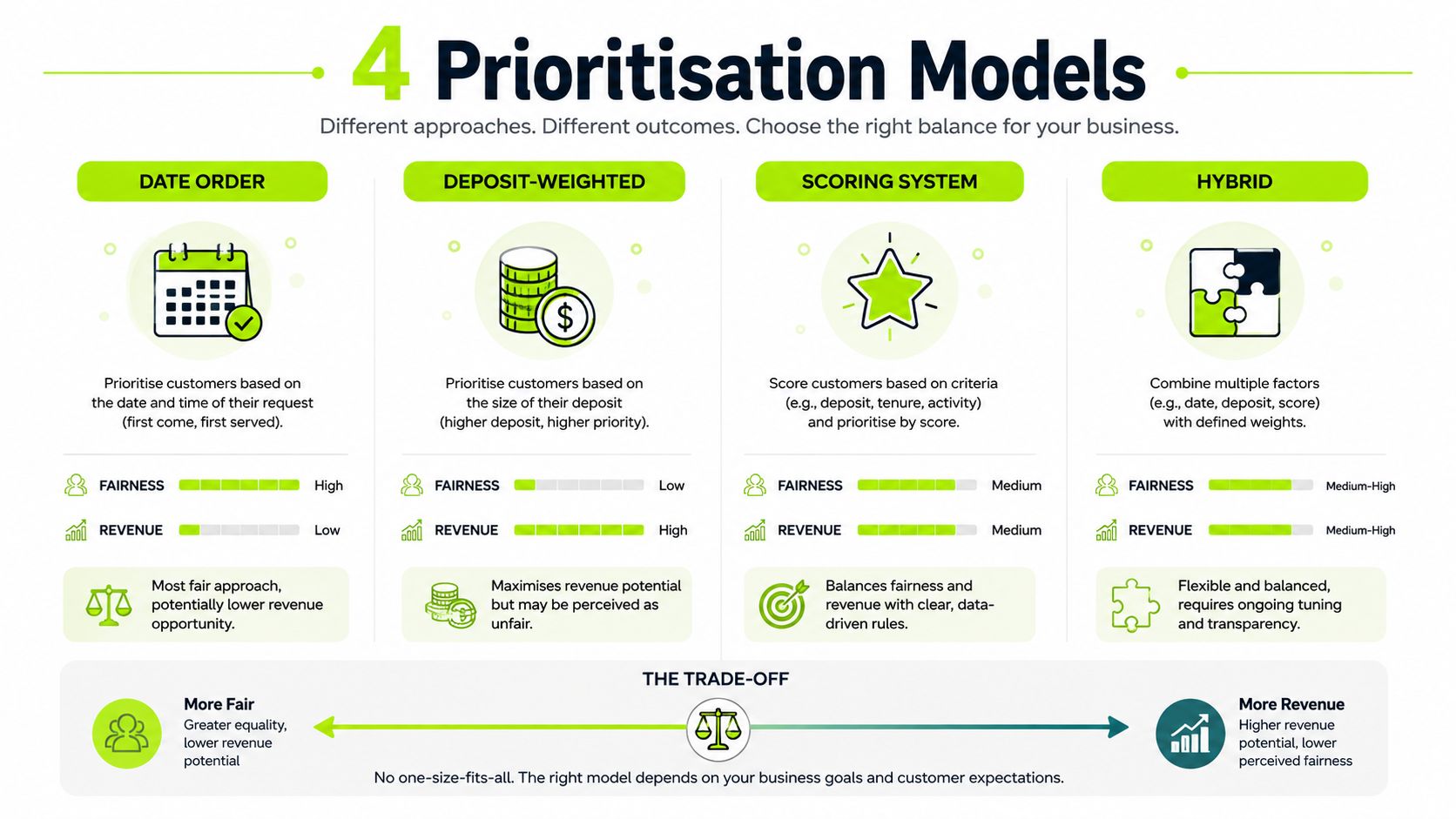
Prioritisation is where waiting-list politics usually gets difficult. A pure date-order list feels fair, but it can ignore strong prospects who are ready to commit. A deposit-weighted system can improve conversion, but members may see it as buying a place in line. Every model rewards some people and disadvantages others, so the committee has to own the trade-off instead of pretending there isn't one.
The four models clubs usually consider
Date order is the simplest. It's easy to explain, hard to dispute, and well suited to clubs where fairness matters more than commercial squeeze. The downside is that it can be slow and blunt, especially if some prospects are less ready than others when a place opens.
Deposit-weighted tiers work better when the club wants stronger intent signals. Prospects who've put down a meaningful deposit are treated as higher priority because they're more likely to move when called. That usually improves conversion, but it needs a clear policy so the system doesn't look like a silent auction.
Member-referral weighting gives some preference to applicants introduced by existing members. That can strengthen cultural fit and improve onboarding, though it can also create resentment if the club doesn't explain why referrals matter.
Category-based fit matches applicants to the club's long-term membership balance. Age mix, family profile, and playing frequency can all influence whether a category is the right fit. This is the model to use when the club cares about both pipeline quality and future utilisation, not just order of arrival.
The right model is the one the committee can defend in a room full of members without sounding evasive.
For most UK private clubs with genuine capacity pressure, I'd favour a hybrid model. Start with date order, then allow deposit level and category fit to move a prospect forward within a defined policy. That keeps the process defensible while still giving the club room to protect revenue and improve conversion quality.
The Waiting List Communication Journey from Enquiry to Offer
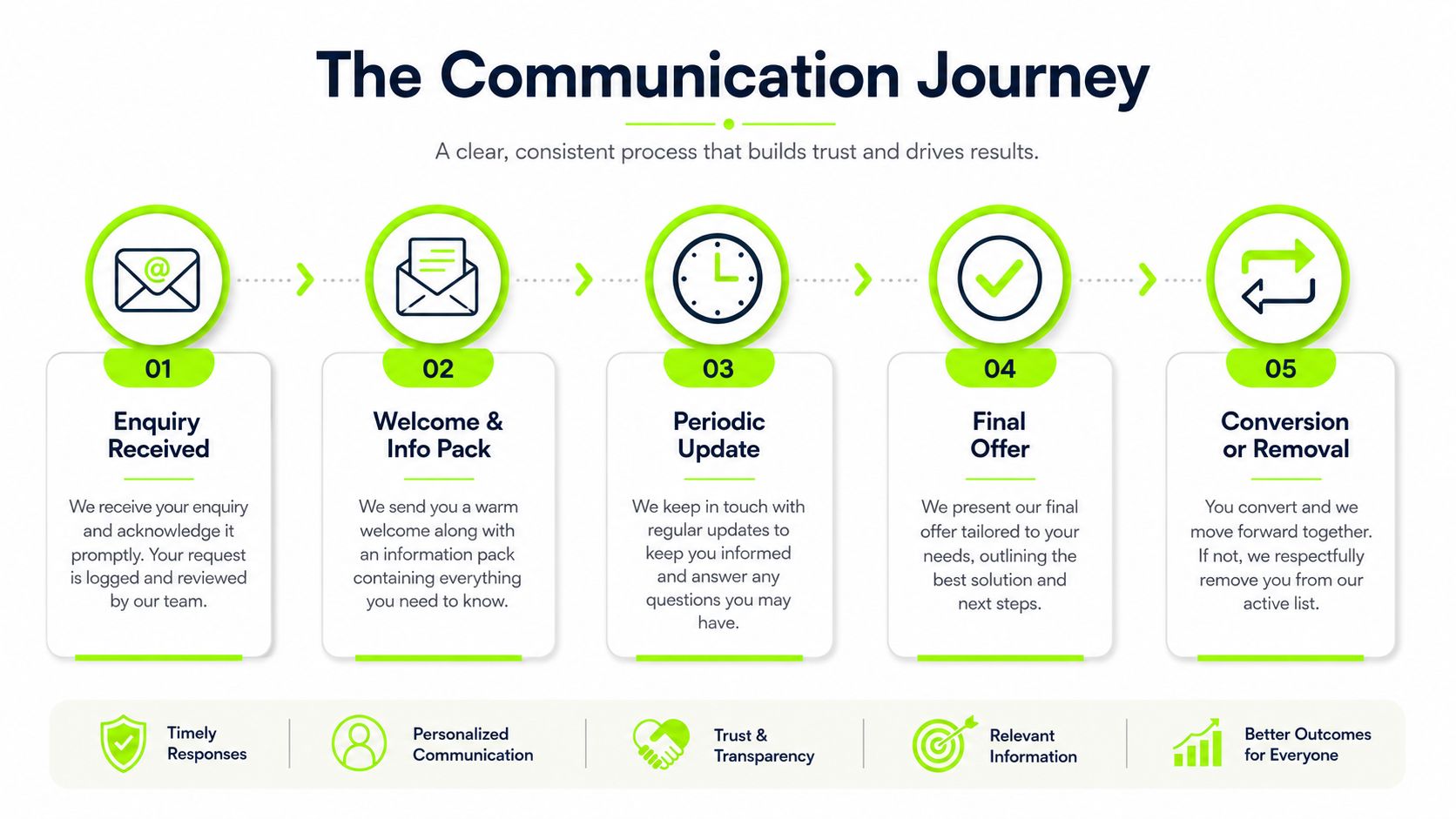
Clubs lose members between enquiry and offer because the conversation goes quiet. A waiting list only works when it behaves like a deposit-qualified, CRM-managed pipeline, with each prospect receiving the right message at the right time and each stage governed clearly enough for the committee to defend it.
Build the journey around specific moments
The first message should go out as soon as the enquiry arrives. It should confirm receipt, explain the next step, and set expectations about response time. That first touch matters because it makes the club feel organised rather than reactive.
The second message should land when the application or deposit is confirmed. At that point, the club sets the tone for the wait, including any limited access, the likely process, and the fact that the prospect is now in a structured pipeline. A concise, factual email works better than a long brochure.
Quarterly check-ins keep the list warm. The message doesn't need to be clever, it just needs to remind the prospect that the club is still active, still managing the list, and still thinking about their place in the process. At the one-year and two-year marks, the club should be more direct, asking whether the prospect still wants to remain on the list.
The offer window is where clubs often lose pace. The next qualified prospect should be notified instantly, given a clear accept or decline deadline, and advanced automatically if they don't respond. That prevents the list stalling behind one unread email, which is exactly how valuable openings leak away.
Practical rule: if a place opens and nobody knows who owns the next call, the club has already lost time.
A simple communication pattern looks like this:
- Enquiry received: acknowledge instantly, confirm next steps.
- Application or deposit confirmed: welcome them into the list and state the rules.
- Quarterly update: keep them engaged and answer likely objections.
- Pre-offer notice: remind them to expect contact.
- Final offer: send one clear message with the response deadline.
- Conversion or removal: close the loop, either with membership or a polite exit.
For clubs looking to tighten the front end of this process, GolfRep's enquiry conversion guidance is a useful reference point because the same discipline that improves enquiry handling also improves waiting-list conversion. The same principle shows up in service communication more broadly, and this client communication resource from Jimmy Clemmons Photographer is a good reminder that clarity and timing matter more than volume.
CRM Setup, Automation Triggers and Reporting That Keep the Pipeline Honest
A waiting list held in spreadsheets will decay. Staff change, names get missed, and nobody can tell which prospects are still active. A basic CRM setup fixes that by giving the club one source of truth, a visible queue, and automated reminders that run whether the office is busy or not.
Minimum setup for a club office
Start with one record per prospect. Capture name, category, contact details, application date, deposit status, referral source, and current stage. Tag each prospect by readiness, so the club can see who is warm, who is cooling, and who has gone silent.
Automations should trigger by milestone, not by memory. The system should send the welcome message, the deposit confirmation, the quarterly update, and the offer notice without someone having to remember a date. If a place opens, the next qualified prospect should be visible immediately, with a clear slot counter so the office knows who is next.
A practical CRM stack can be simple. It doesn't need to be technical to be useful. The important thing is that every enquiry is logged once, every update is scheduled, and every action is visible.
If a club wants to explore a CRM-led setup in more detail, GolfRep's CRM software guide is relevant because the same system discipline used for enquiry handling is what keeps a waiting list honest over time. GolfRep's own platform approach also reflects this, using structured follow-up in a CRM to capture and nurture incoming interest, rather than leaving staff to manage the process manually.
What the committee should see each month
The reporting pack doesn't need to be large. It should answer a few direct questions:
- Applications received: are prospects still coming in?
- Deposit conversion: are enquiries becoming qualified?
- List age distribution: how old is the pipeline?
- Average wait experience: are prospects being held too long?
- Offer-to-acceptance rate: are places converting?
- Lost-to-competitor reasons: where did the prospect go instead?
Those numbers matter because they expose whether the list is healthy or just busy. A big list with weak acceptance is not an asset, it's a warning.
A realistic 30-day rollout
Week one, build the fields. Week two, write the automations. Week three, test the offer sequence with a dummy record. Week four, review the first reporting dashboard with the committee and clean up any gaps. That's enough to move from guesswork to control without hiring a full-time marketing team.

When a Long Waiting List Is a Warning Sign Not a Trophy
A long list is only good news if the club can still offer meaningful access to the people already inside. If members struggle for tee times, avoid peak periods, or complain that the course feels congested, the waiting list may be masking a capacity problem rather than proving demand strength. That's the point too many clubs miss when they celebrate scarcity too quickly.
England Golf reported 9.92 million rounds played in England in 2024, the highest on record for a second year, and Sport England reported 18.2 million adults playing golf in the year to November 2024. That backdrop suggests demand is still there, but it doesn't tell a club how much of that demand it can safely absorb without damaging member experience. The club has to check its own operations.
The diagnostics that matter
A committee should look at member rounds per year, peak-time utilisation, member satisfaction, churn, rejoin rates, and the gap between advertised capacity and real access. If the waiting list is growing while access is getting tighter, the club should ask whether it needs a different membership mix rather than more names on the list.
That can mean tiered membership, midweek-only products, better pace-of-play management, or a different offer window for prospects. Those changes aren't admissions of failure. They're a way to protect the club's value while keeping the experience credible for existing members.
The key distinction is this. A waitlist is positive when it supports price integrity and member desirability. It becomes a problem when it starts to erode playability, service, or goodwill. Committees that recognise the difference early usually make cleaner decisions and avoid public frustration later.
If the course is full but the members are unhappy, the list isn't proof of success. It's evidence the club needs to rebalance access.
A 90 Day Plan to Rebuild Your Waiting List as a Pipeline
The fastest way to fix a waiting list is to stop treating it as a separate project. Policy, communication, and reporting all have to move together. Over 90 days, a club can shift from manual admin to a governed pipeline without changing its membership model.
Days 1 to 30, foundations
The secretary and committee approve the policy, deposit rules, and prioritisation method. The office creates the CRM fields and cleans up the current list. Success looks like one written process and one source of truth.
Days 31 to 60, communications
The club launches the enquiry acknowledgement, deposit confirmation, quarterly update, and offer templates. Automations are switched on, and the next-prospect logic is tested. Success looks like every prospect receiving the right message at the right time.
Days 61 to 90, optimisation
The committee reviews reporting, checks conversion leakage, and confirms whether the prioritisation model is working as intended. If not, it adjusts the policy rather than forcing staff to patch the gaps manually. Success looks like a list that converts cleanly and produces predictable membership movement.
A useful discipline here is referrals. The Vice Golf referral page is a good reminder that structured prompts can move people from interest to action when the process is clear and the timing is right.
The first three actions to take this week are simple. Write the policy in one sitting. Clean the current list into a single CRM. Decide who owns the next offer call before the next vacancy appears.
GolfRep helps clubs turn waiting-list interest into a tracked pipeline, with structured follow-up, CRM setup, and response systems that don't depend on one person remembering every next step. If you want a waiting list that feels fair to members and commercially useful to the club, visit GolfRep and start with a conversation about your current process.
Ready to tap into our proven growth system?