Top Golf Club Marketing Agency UK: Your 2026 Guide

Most club managers don't wake up thinking they need another marketing agency. They look at a list of membership enquiries that never received a proper follow-up, visitor enquiries sitting in a shared inbox, and a committee asking why digital spend hasn't turned into signed-up members.
That's usually the problem.
If you're searching for a golf club marketing agency UK clubs can trust, start with a harder question. Do you need more traffic, or do you need a system that turns existing interest into booked visits, conversations, and memberships? In our experience at GolfRep, many clubs already generate enough interest to grow. What they lack is visibility, speed, consistency, and accountability from first click to signed direct debit.
A club can have a polished website, active social feeds, and decent enquiry volume, then still underperform because nobody owns the process after the form is submitted. Manual follow-up breaks down. Leads go cold. Staff get busy. Committee-led decision making slows response. Good prospects disappear.
That's why the right partner doesn't just run ads or post content. They build the conversion system around your club's commercial goals, operational reality, and member experience.
First Define Your Clubs Growth Goals
Vague goals produce vague marketing.
If the brief is “we want more members”, you'll get activity instead of outcomes. One agency will push paid ads. Another will talk about SEO. A third will suggest a website rebuild. None of that is useful until the club decides what growth means.
The UK golf club market is still expanding. Grand View Research projects the UK golf club market will reach USD 280.7 million by 2027, growing at a 2.5% CAGR. That matters because growth is there to be captured, but only if your club knows which revenue streams deserve focus.
Start with revenue lines, not channels
Separate your targets by commercial category. Most clubs have more than one growth objective, and they shouldn't all be treated the same way.
- Full memberships: These usually need a longer sales cycle, stronger consultation, and better handling of objections around value, waiting lists, or club fit.
- Flexible or lifestyle memberships: These often appeal to golfers who want access without the perceived rigidity of traditional membership.
- Visitor green fees: These depend heavily on pricing, timing, availability, and clear online conversion paths.
- Society and corporate days: These require structured sales follow-up, not just a brochure page.
A good planning exercise is to ask one question for each category: what would success look like over the next year, and how would we recognise it in the pipeline before revenue lands?
If you need a framework for that planning, GolfRep's guide to golf club growth strategies is a useful place to start.
Practical rule: If a club can't define which type of member it wants more of, the agency will optimise for the easiest lead, not the most valuable one.
Define the member you want
Not every enquiry is equal.
A private members' club might want stable, long-term members who value competitions, clubhouse life, and retention. A resort or proprietary venue may need a stronger mix of visitor revenue, flexible memberships, and event-related spend. A town club may want to attract golfers who can play midweek and engage quickly.
That affects everything from messaging to follow-up.
Ask your team:
- Who is the ideal member for this club?
- What objections do they usually raise?
- What does the club need more of. Age profile, playing frequency, social engagement, off-peak use, or family participation?
- What type of lead should you avoid attracting?
That last question matters. Clubs often waste money filling the top of funnel with low-intent enquiries that were never likely to convert.
Set commercial targets the committee can understand
Marketing works better when the board, secretary, general manager, and membership lead use the same scorecard.
Keep it simple. Define targets around:
- Membership growth: by category, not as one blended number
- Visitor revenue: especially if tee sheet availability is part of the plan
- Society or event bookings: where those are strategically important
- Acceptable acquisition cost: what the club is willing to invest to win the right member
A target cost per acquisition forces discipline. It stops marketing from being judged on clicks and starts judging it on business value.
Clubs that grow predictably usually make one shift early. They stop asking, “How do we get more leads?” and start asking, “What is a good lead worth to this club, and how will we convert it properly?”
How to Set a Realistic Marketing Budget
The budget question usually comes too early.
Clubs often ask what they should spend before they've decided what they need the spend to do. That's backwards. Budget follows commercial intent, operational capacity, and the quality of the system behind the enquiry process.
A realistic budget for a golf club marketing agency in the UK shouldn't be framed as “what can we afford for some ads?” It should be framed as “what level of growth infrastructure do we need, and who inside the club will support it?”
Here's a visual way to think about budget components:
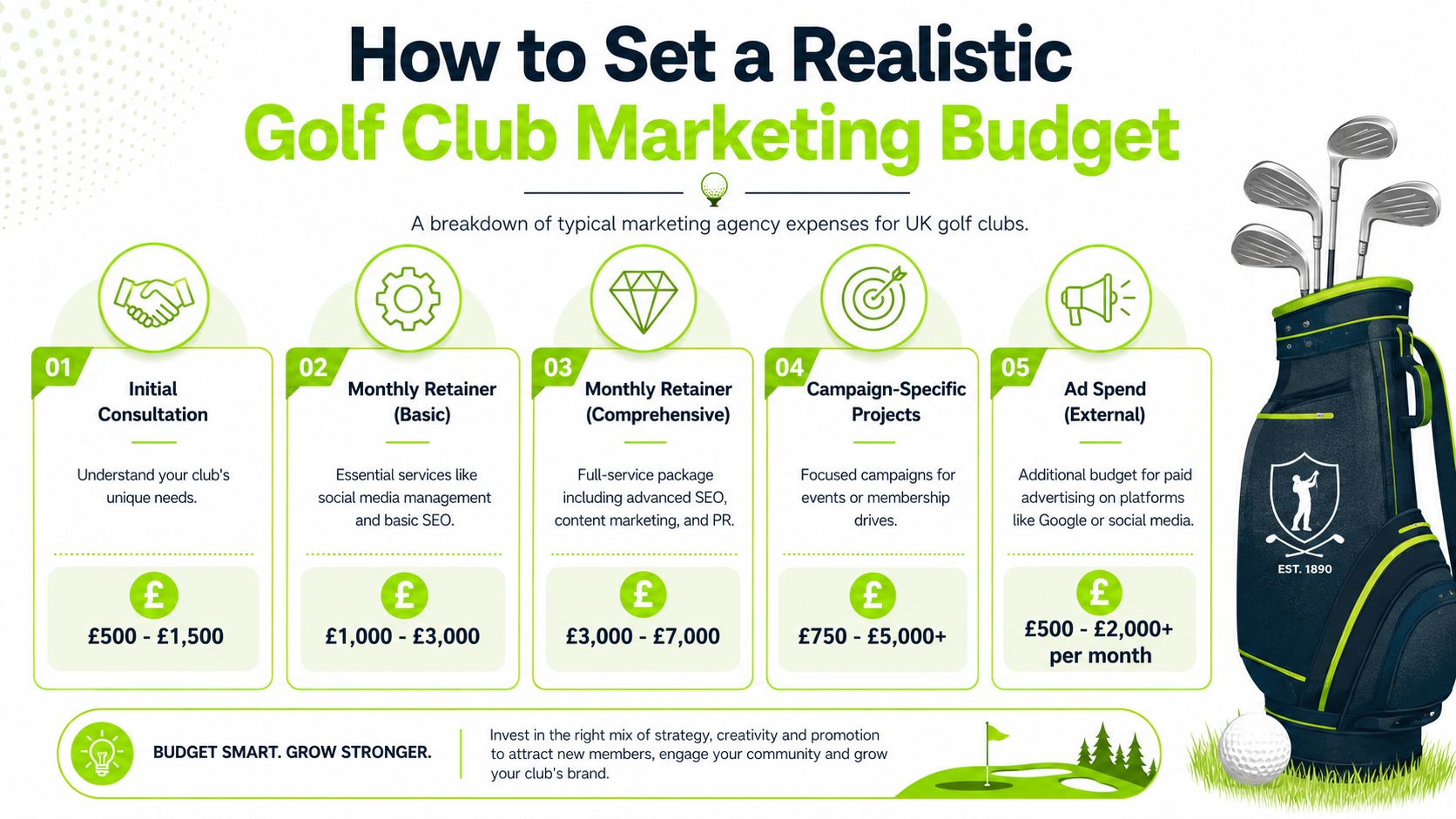
What the budget usually needs to cover
The visible spend is rarely the whole story. Clubs tend to focus on ad spend because it feels tangible, but the actual cost sits across setup, tracking, content, search visibility, follow-up processes, and reporting.
Use this as a planning model:
| Budget area | What it should cover | Why it matters |
|---|---|---|
| Strategy and setup | Offer positioning, tracking, forms, CRM process, reporting structure | Without this, lead quality and attribution stay unclear |
| Search visibility | Local SEO, Google Business Profile work, website intent pages | This captures demand already in market |
| Content and nurture | Emails, landing pages, follow-up sequences, membership messaging | Many clubs lose warm leads through weak communication |
| Paid acquisition | Google Ads, social campaigns, retargeting where appropriate | Useful when the offer and sales process are already sound |
| Operational support | Lead handling, response standards, internal ownership | This is where many clubs under-budget and then under-convert |
If you want a more detailed view of how clubs approach this commercially, GolfRep's article on how much golf club marketing costs breaks down the thinking in practical terms.
Spend where intent is strongest
Not every pound should go into interruption-based marketing.
For many clubs, search-led demand is the higher quality opportunity because the golfer is already looking. That's why a lot of sensible planning starts with local visibility, conversion paths, and nurture before expanding into broader acquisition campaigns.
A weak website with no follow-up process doesn't become profitable just because the ad budget increases.
A tight budget with proper tracking and disciplined follow-up usually beats a larger budget spent into a broken process.
Match budget to delivery capacity
This is the trade-off clubs often miss.
If your secretary, membership manager, or pro shop team can't respond consistently, increasing lead volume may make performance worse, not better. More enquiries create the illusion of progress while exposing the fact that no one is managing the pipeline.
Before approving budget, ask:
- Who owns new enquiries: one named person, not a general inbox
- How fast do prospects hear back: immediately, same day, or when someone gets time
- What happens after first contact: consultation, tour booking, email nurture, or nothing consistent
- How will the club review results: revenue-linked reporting or marketing screenshots
A realistic budget isn't just about agency fees. It's the cost of building a reliable acquisition and conversion process that your club can operate.
Evaluating a Golf Club Marketing Agency
Many clubs evaluate agencies the wrong way. They look at website design, social media style, or whether the agency has worked with a golf business before. Those things aren't irrelevant, but they don't tell you whether the partner can help your club grow in a controlled, measurable way.
The better test is this: can the agency explain how a prospect moves from awareness to retention, and who owns each stage?
One useful benchmark comes from Level Up Leads' golf club marketing framework, which describes a 4-stage journey and recommends a budget split typically weighted 50 to 60% toward SEO, local SEO, and AI search. Even if you never use that exact model, a competent agency should be able to map the full journey clearly, not just the traffic stage.
Ask questions that expose the operating model
When a club interviews a golf club marketing agency UK prospects are often shown campaign examples before they've seen the system behind them.
Ask sharper questions:
- How do you handle lead capture? If the answer is just “we send the form to your inbox”, keep digging.
- What happens in the first hour after an enquiry? This reveals whether they understand conversion, not just lead generation.
- How do you track booked tours, consultations, and joined members? If they can't answer this easily, reporting will stay shallow.
- How do you adapt for committee-led clubs or volunteer bottlenecks? UK golf clubs rarely operate like standard businesses.
- How do you protect premium positioning without turning everything into offers and discounts? That matters for private clubs in particular.
A club that hosts open days, trial evenings, or member guest experiences may also benefit from ideas borrowed from immersive event marketing strategies when those activities are tied into a proper follow-up flow rather than treated as standalone events.
Generic agency vs growth partner
The difference becomes obvious.
| Criterion | Generic Marketing Agency | Specialist Growth Partner (like GolfRep) |
|---|---|---|
| Primary focus | Traffic, clicks, impressions | Enquiries, booked visits, memberships, retention |
| Lead handling | Sends leads to email inbox | Builds process for capture, routing, visibility, and follow-up |
| Reporting | Channel metrics | Pipeline metrics connected to commercial outcomes |
| Understanding of club operations | Limited | Built around staff capacity, seasonality, committees, and sales workflow |
| Approach to offers | Often campaign-led | Tied to brand fit, member value, and conversion quality |
| Accountability | Marketing activity | Full-funnel performance |
If you want to compare agency models in more depth, GolfRep has a practical piece on choosing a golf club marketing agency.
If an agency can talk at length about ads but can't explain your lead journey after the form is submitted, it's not solving the main problem.
Red flags worth taking seriously
Some warning signs are easy to miss because they sound polished in a pitch.
Watch for:
- Vanity-first reporting: lots of reach, engagement, and impressions, but no joined-up sales visibility
- One-size-fits-all packages: the same plan for a private club, resort, and municipal-style facility
- Discount dependency: a fast route to weak-fit leads and damaged perception
- No operational curiosity: they never ask who follows up, how tours are booked, or where leads currently get lost
A good partner should make your internal process visible. If they don't ask difficult questions, they probably won't fix difficult problems.
Why Your System Is More Important Than Your Website
A modern website helps. It doesn't close the gap on its own.
Many clubs overestimate the value of design and underestimate the value of process. They rebuild pages, improve imagery, and refine copy, yet the same underlying issue remains. Enquiries arrive, then disappear into manual handling.
That's why the system matters more than the site itself.
This process is what most clubs need to make visible:
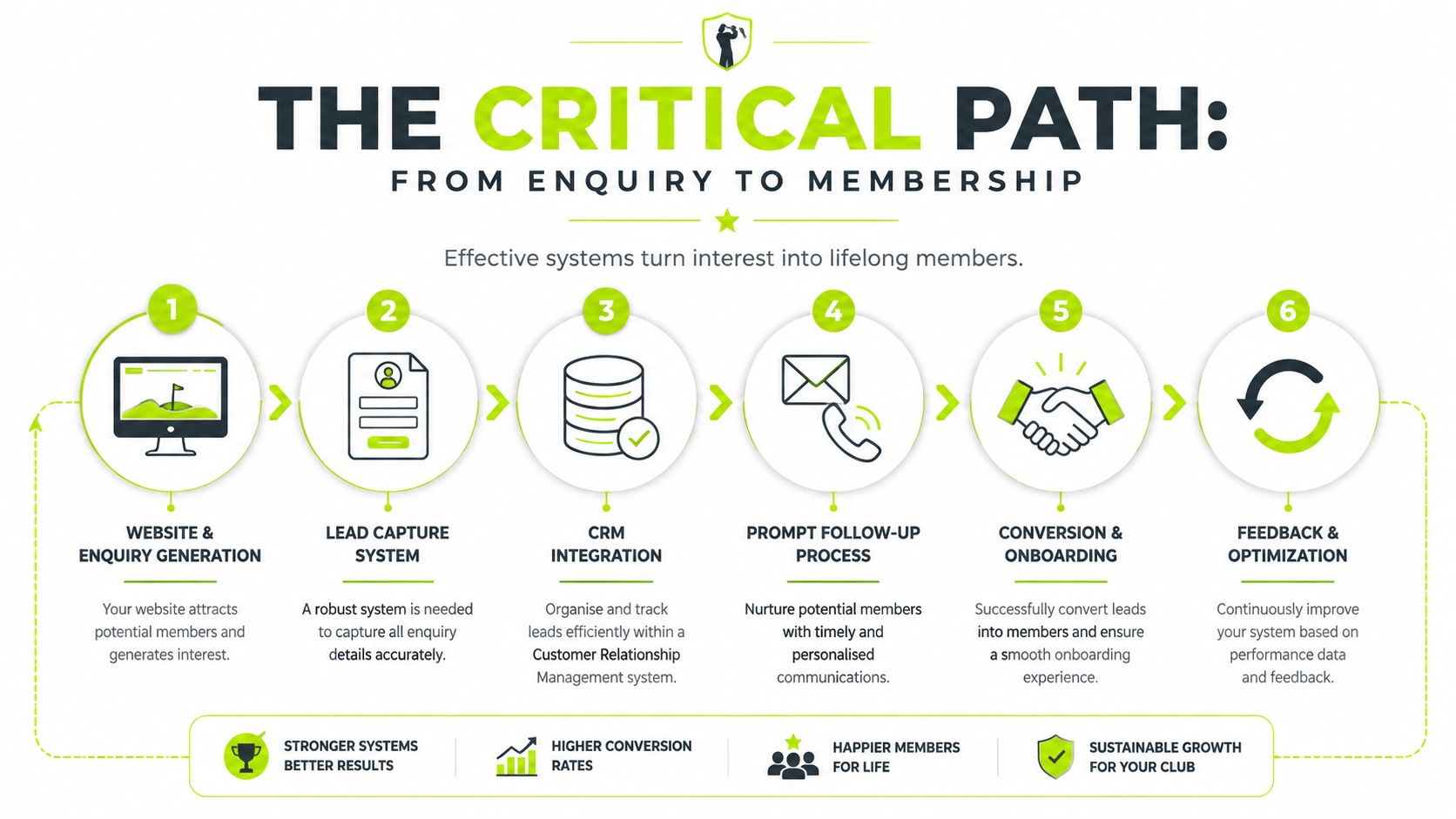
The leak is usually after the enquiry
The core issue isn't always lack of demand. It's what happens next.
As Marketing Golf notes in its discussion of golf club lead handling, for many clubs the main bottleneck is follow-up, not traffic, and the difference between contacting a lead instantly versus hours later can mean the difference between a booked tour and a lost opportunity. That principle holds because intent fades quickly, especially when a golfer is comparing multiple clubs.
A website can only do two things well. Create interest and capture details. After that, the club needs a process.
A website without a follow-up system is a brochure with a leak in the bottom.
What the system needs to do
A proper setup should make every enquiry visible from day one.
That means:
- Capture the source: so you know whether the lead came from search, paid media, referrals, or another channel
- Route the lead properly: so one person owns the next action
- Trigger an immediate response: even if staff are busy, on the course, or in a meeting
- Track status clearly: new, contacted, booked, toured, undecided, joined, lost
- Nurture over time: because not every serious prospect is ready on day one
A CRM stops being a technical extra and becomes a commercial necessity.
A club can use different tools to do this, but the principle is the same. The system must reduce dependence on memory, inboxes, and staff goodwill. One option clubs consider is GolfRep's CRM and automation-led growth system, which is built around lead capture, automated follow-up, and pipeline visibility for golf clubs. The important point isn't the brand. It's the structure.
Why manual follow-up fails
Manual processes fail unnoticed.
A lead comes in during a busy Saturday morning. The notification is seen but not actioned. Someone means to call on Monday. By then the golfer has already visited another club, or lost momentum, or decided to stick with their current arrangement. Nobody records the loss because the club never had real pipeline visibility in the first place.
The committee then concludes that the campaign “didn't really work”.
In reality, the campaign may have worked. The operating system didn't.
Technology should protect tone, not replace it
Some clubs worry that CRM and automation will make the club feel impersonal. That only happens when the setup is clumsy.
Used properly, automation handles speed, consistency, reminders, and visibility. Staff still handle conversations, tours, objections, and relationship building. The technology removes dead time and dropped handovers so the human part of the process can happen more often and at the right moment.
That's a much better use of your team than asking them to remember every incoming lead manually.
Measuring Performance and Onboarding for Success
A club should know very quickly whether a new agency relationship is producing clarity or confusion.
Good onboarding creates confidence because everyone understands the commercial aim, the tools being used, and how success will be measured. Bad onboarding creates noise. Forms start going live before tracking is right. Campaigns launch before staff know who owns what. Reports arrive, but they don't answer the questions the committee asks.
This is the standard to expect from the outset:

Measure the pipeline, not the applause
Most clubs don't need more dashboards. They need better ones.
A meaningful reporting view should answer:
- How many enquiries came in
- How quickly they were contacted
- How many booked a visit, call, or consultation
- How many converted
- Which channels produced the strongest outcomes
- Where leads stalled
That's more useful than hearing that a post performed well or an advert had a strong click-through rate. Those signals have some value, but they don't tell a club whether revenue is becoming more predictable.
The right report should let a manager see where growth is slowing without having to chase three different people for answers.
Onboarding should fix fundamentals first
The early phase matters because it's when weak setups get exposed.
A serious onboarding process usually includes:
Commercial alignment
The club and partner agree what counts as a qualified lead, what the offer is, and which revenue lines matter most.Tracking and attribution setup
Forms, calls, landing pages, and campaign sources need to be traceable.CRM and lead stages
Every enquiry should sit in a visible pipeline with clear next steps.Response process design
Who replies first, how quickly, and what happens after that should be agreed in writing.Tone and brand calibration
Private clubs, resort venues, and member-owned clubs all need different language and pacing.Review rhythm
Regular commercial reviews should look at outcomes, not just channel activity.
Use case studies properly
Case studies are useful, but only if you read them critically.
One UK example from The Revenue Club reported 32% growth in visitor green-fee revenue in six months after combining dynamic pricing with consistent email and social activity, alongside benchmarking against the wider market, as outlined in its golf club revenue management case study. That's a valuable proof point because it ties marketing activity to commercial outcome rather than surface metrics alone.
But there's an important caveat. A result in visitor revenue doesn't automatically mean the same approach should be used for membership acquisition. Clubs still need to ask whether the strategy fits their brand, inventory, pricing philosophy, and internal sales process.
The best onboarding conversations account for those trade-offs early. They don't copy tactics from one context into another without pressure-testing them.
Your Agency Decision Checklist
By the time a club reaches the final shortlist, most agencies sound broadly similar. They all mention strategy, digital marketing, content, and lead generation. That's why the final decision should come down to operating fit, commercial clarity, and whether the partner strengthens the whole system rather than one channel.
The UK market is large enough to support specialist expertise. IBISWorld estimates there were 2,510 golf-course businesses in the United Kingdom in 2025, with industry market size reaching £2.8 billion in 2026. In a mature sector of that scale, small improvements in enquiry handling and conversion can matter materially.
Use this checklist at manager level or in a committee meeting. It will expose weak proposals quickly.
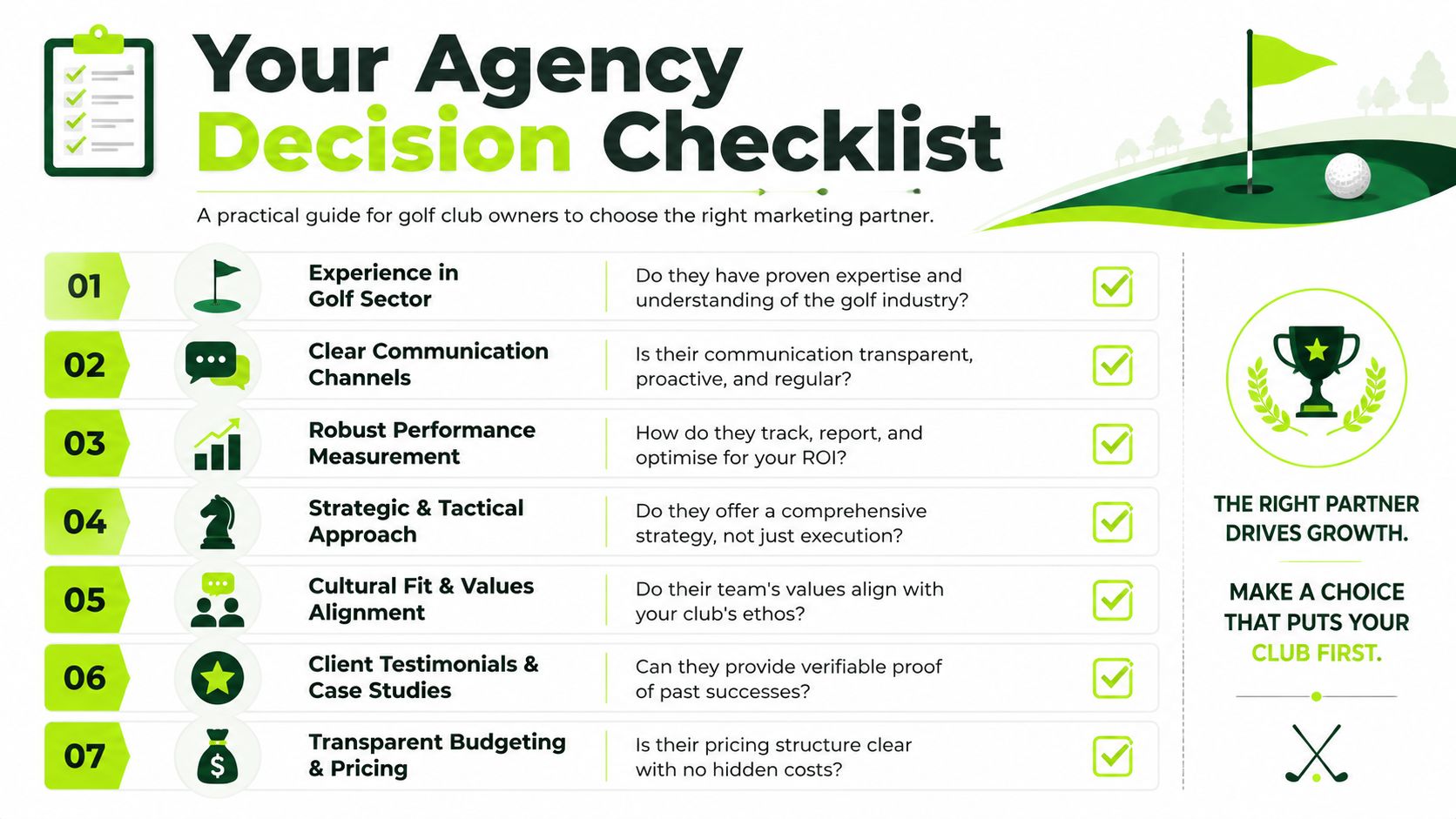
The shortlist questions that matter
Do they talk about the full journey?
Awareness matters, but so do response, booking, consultation, conversion, and retention.Can they show pipeline visibility?
You should be able to see where every lead sits and what action is due next.Do they understand club operations?
A good plan for a committee-led members' club won't look identical to a plan for a resort group.Will they protect your pricing position?
If every solution is an offer, the club may gain noise and lose value perception.Do they report on outcomes the board cares about?
Enquiries, booked visits, joined members, and commercial contribution matter more than social engagement.
The practical test
Ask each agency to explain, in plain English, what happens from the moment a golfer submits a membership enquiry to the moment that person either joins or is marked lost.
If the answer is fuzzy, over-technical, or mostly about ad platforms, keep looking.
If the answer includes ownership, response timing, CRM stages, nurture, consultation, reporting, and review loops, you're probably speaking to someone who understands the actual job.
A club rarely needs more marketing noise. It needs a cleaner system for turning interest into revenue.
The strongest agency decision is usually the least glamorous one. Choose the partner who makes your growth process more visible, more disciplined, and less reliant on memory. That's how clubs build stable pipelines instead of chasing sporadic campaigns.
If your club wants a clearer view of where enquiries are being lost, GolfRep helps UK golf clubs build predictable membership pipelines through lead generation, CRM visibility, and structured follow-up systems that fit how clubs operate.
Ready to tap into our proven growth system?