Golf Club Facebook Ads: A Practical Growth Playbook
Most advice on golf club Facebook ads is wrong at the point that matters most. It tells clubs to chase more leads, lower cost per lead, and wider reach. That sounds sensible until the enquiries start landing and nobody responds properly, nobody tracks what happened, and nobody can tell which forms turned into members.
That's the problem. Golf clubs rarely fail because Facebook couldn't generate interest. They fail because the handoff after the click is weak. If you want paid social to produce members rather than admin, you need a system that starts with ad structure and ends with a signed application.
The market has moved that way already. In England, 75% of golf clubs were using social media to promote their business in 2016, while 25% still were not using social media at all, and 89% regularly used their website as a marketing tool according to England Golf's membership questionnaire covering 602 clubs and reported by Bunkered's coverage of golf club social media usage. By 2023/24, 79% of proprietary clubs were using social media according to the Hillier Hopkins annual golf club survey. Social adoption isn't the issue now. Operational follow-up is.
Why Most Golf Club Facebook Ads Fail Before They Start
Most clubs launch golf club Facebook ads with the wrong definition of success. They count leads. They celebrate cheap forms. Then they wonder why the membership board still looks flat.
A lead is not a result. A qualified membership enquiry is a result in progress. That means the person fits the club's catchment, shows real intent, and can be moved into a visit, taster round, or membership conversation by staff who know what they're doing.
Cheap leads are often expensive
One documented UK campaign generated 46 qualified leads from £120 ad spend, which works out at £2.61 per lead, and the same analysis reported a 2.53% CTR for lead generation campaigns that was 61% higher than standard traffic campaigns according to GolfRep's UK golf club Facebook ads case study reference. That sounds good. It is good, if those leads are visible, followed up, and worked properly.
It's useless if the form goes into a shared inbox and sits there.
Practical rule: Treat cost per lead as a vanity number until you can connect it to booked visits, attended taster rounds, and completed membership applications.
The failure usually sits after the form
I see the same operational mistakes repeatedly:
- Forms ask too much: Clubs build long lead forms that feel like a committee application instead of a first enquiry.
- Nobody owns the lead: The secretary assumes the manager will call. The manager assumes the pro shop has it.
- The CRM is missing or ignored: Leads arrive without tags, source data, or pipeline stages.
- Follow-up stops after one attempt: A missed call becomes a dead lead.
These aren't ad problems. They're process problems.
A club that wants predictable membership growth should define three things before spending a pound. First, what counts as a good enquiry. Second, who responds first. Third, what happens in the first few minutes after the form lands. If you don't have that plumbing, the ad account won't save you.
For clubs tightening response handling, a customer support AI platform can be useful as part of the wider workflow, especially when human cover is patchy and response visibility matters.
Build the campaign backwards
Start at the outcome and work in reverse.
If your club wants more full members, the campaign shouldn't optimise for curiosity. It should optimise for the kind of enquiry your team can convert. That usually means a simpler first step, clear offer framing, and a proper handoff into a tracked process.
The ad only starts the job. Your internal system finishes it.
Building the Right Audience Without Wasting Spend
Most clubs either target far too broadly or far too narrowly for the wrong reason. Broad targeting fills the inbox with weak enquiries. Over-complicated targeting starves delivery and gives you no learning. The answer is disciplined local targeting built around actual travel behaviour.
The catchment should reflect repeat weekly journeys, not fantasy reach. One UK playbook recommends a 50km radius, while another suggests 20 to 30 miles, but neither comes with a broader UK benchmark in the published guidance. The more useful view is in this UK golf club Facebook ads playbook, which argues that catchment quality matters more than raw reach and that clubs should judge the radius by booked visits, show-up rate, and movement through the pipeline.
Start local, then layer intent
I'd build the audience in this order:
- A tight local radius around the club based on realistic drive time.
- A lookalike audience from existing member or customer data, if the club has enough clean records.
- Interest and behaviour layers that sharpen intent rather than inflate volume.
The common mistake is opening with a huge area because the audience looks bigger in Ads Manager. Bigger isn't better if the secretary can't qualify the names or the prospect won't travel often enough to join.
What to include and exclude
Use exclusions aggressively. Existing members should never see acquisition ads. Nor should recent enquirers who are already in follow-up. Staff and recent purchasers should also come out of prospecting audiences.
If you're unsure how to think about these audience groups, GolfRep's guide on market segmentation for clubs is a useful framework because it forces you to separate likely joiners from casual interest.
Here's the blunt trade-off.
| Audience Layering Options for Golf Clubs | Reach | Typical CPL | Enquiry Quality |
|---|---|---|---|
| Tight local radius only | Lower | Higher or unstable | Stronger if the offer is clear |
| Local radius plus member lookalikes | Moderate | More controlled | Usually better than interest-only targeting |
| Local radius plus golf interest stack | Moderate to broad | Often cheaper at the top of funnel | Mixed quality |
| Broad local plus loose interests | Broad | Often looks cheap | Weak, inconsistent, admin-heavy |
I'm not assigning hard numbers to every row because clubs differ wildly in pricing, geography, and membership proposition. But the pattern is consistent. Quality rises when geography is realistic and exclusions are clean.
Build to staff capacity, not ad account ambition
The right audience size isn't set by budget first. It's set by what your team can handle this week.
- If admin cover is light: Keep the audience tighter and the offer narrower.
- If follow-up is strong: You can test wider interest layers without drowning the team.
- If the club has waiting-list pressure: Shift the message toward fit and timing, not pure volume.
The audience should reflect the club's operational capacity. If your office can properly work a limited number of fresh enquiries, don't build campaigns that produce more than that and call it success.
Choosing Ad Formats and Creative That Produce Real Enquiries
Single image ads often look tidy in committee meetings. They rarely do the heavy lifting on their own. Golf is visual, social, and local. People want to see the course, the clubhouse, and the kind of member experience they'd be buying into.
The creative job isn't to win design awards. It's to make the right golfer think, “I can see myself there.”
What usually works best
A short walkthrough video tends to do more than a polished poster-style membership ad because it gives context fast. Show the entrance, practice areas, clubhouse, and members using the place. If the club has a strong social side, show that too. If the product is quieter and more premium, lean into that instead.
A taster-day angle usually outperforms a blunt “join now” message because it lowers friction. You're asking for a first step, not a life decision.
Carousel ads have a place when the club needs to explain different routes in. They work well for:
- Membership tiers: Full, flexible, off-peak, or introductory pathways
- Family and junior pathways: When the club wants to signal that it isn't only for one type of golfer
- Society and visitor routes: Especially if visitor traffic feeds later membership interest
Stop polishing. Start proving relevance
User-generated style content usually feels more believable than over-produced creative. A member filming a quick clubhouse clip or a short reel with the pro often lands better than a glossy campaign that looks generic.
That doesn't mean sloppy. It means real.
Show the club as it is on a good day, not as a brochure concept.
A few practical rules matter here:
- Hook early: The first few seconds need to earn attention.
- Use on-screen captions: Plenty of people watch with sound off.
- Match creative to offer: Taster-day creative for taster-day campaigns. Membership breakdowns for warmer audiences.
- Refresh before fatigue sets in: Local audiences don't need to see the same ad forever.
Format should follow intent
Different formats serve different points in the funnel.
| Format | Best use | Main risk | Best for enquiry quality |
|---|---|---|---|
| Short video | Cold local audiences | Weak opening loses attention | High when paired with a low-friction offer |
| Carousel | Mid-funnel explanation | Too many messages in one ad | Good for segmented offers |
| Single image | Retargeting or simple local reminders | Can look flat and generic | Better for warmer audiences than cold ones |
| Member-shot reel | Social proof and relatability | Inconsistent execution | Strong when the club atmosphere is a selling point |
Creative decisions should be made by what happens after the click. If a format brings lots of curiosity but poor-fit enquiries, cut it. If another format brings fewer leads but stronger conversations, keep it.
That's the trade. Less volume, better intent.
Budget, Bidding and Tracking That Hold Up in Reality
Most clubs either underfund Facebook or spend without control. Both are expensive. If the budget is too small, the campaign never learns. If the tracking is weak, the club can't tell what it bought.
I'd rather see a modest, well-tracked account than a larger budget run on guesswork.
Work from funnel stages, not wishful thinking
A clean monthly budget should split across proven demand, warmer retargeting, and controlled testing. If a club is spending £1,200 per month, the split below is sensible because it protects what already works while still creating room to learn.
For the tracking side, every club should at least have the basics in place. GolfRep's guide to conversion tracking setup is useful here because it explains how to structure reporting around actual actions, not just ad-platform activity.
| Sample monthly budget split for a UK golf club at £1,200/month | Spend % | Monthly £ | Target CPL | Expected Leads |
|---|---|---|---|---|
| Retargeting | 60% | £720 | Qualitative target based on historical lead quality | Depends on form quality and follow-up |
| Lookalikes | 30% | £360 | Qualitative target based on member fit | Depends on source-data quality |
| Creative and audience testing | 10% | £120 | Higher volatility is normal | Expect learning before consistency |
I'm not putting invented lead counts into that table because they vary too much by club proposition, form friction, and follow-up quality. Any article that gives fixed expected leads from that budget without your own historical data is guessing.
Bidding and exclusions need discipline
Use simple bidding first. Lowest cost is usually the right place to start when the account is still learning. If lead quality drops or acquisition costs drift beyond what the club can justify, tighten the audience and revisit the offer before you start forcing the bid strategy.
The more important control is exclusion.
- Remove current members: Paying to show acquisition ads to paying members is waste.
- Remove staff and internal lists: They distort performance.
- Remove recent enquirers and recent purchasers: They belong in follow-up or retention, not prospecting.
- Keep spend inside the true catchment: Local acquisition breaks when geography gets lazy.
Tracking gaps quietly ruin judgement
A golf club Facebook ads campaign needs proper event tracking from the website and from lead forms. If forms are being used, the submission should be visible inside your reporting stack and your CRM. If website actions matter, those events need to be captured consistently. If server-side tracking is missing, you'll often undercount outcomes and make bad optimisation decisions.
If a form submits and your CRM doesn't know about it, the campaign report is incomplete.
One operational option can help. GolfRep is one example of a golf-specific system that combines lead generation with CRM tracking and follow-up workflows, which matters more than media buying alone.
A club shouldn't scale spend until it can answer three basic questions with confidence. Which ad created the enquiry. Which enquiries booked a visit. Which visits turned into members. If those answers aren't visible, the budget isn't under control.
Speed to Lead and CRM Integration That Actually Convert
Creative gets attention. Response speed gets conversations. Systems get members.
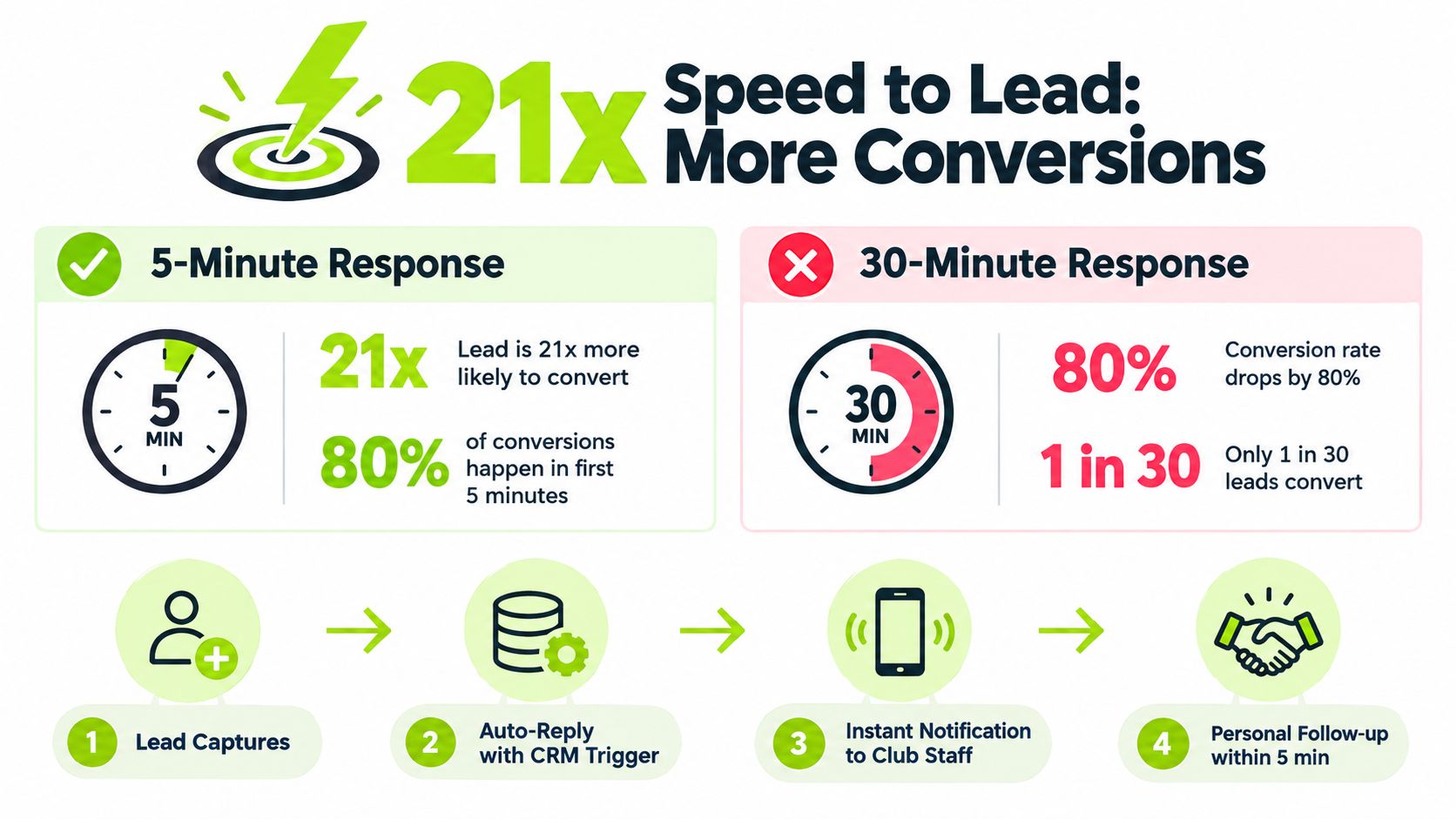
A UK-focused follow-up source says conversion rates are 8x higher when a business responds within five minutes of an enquiry, while waiting 30 minutes makes the lead 21 times less likely to qualify, and only 0.1% of UK businesses respond within five minutes according to Nirox AI's lead follow-up analysis. That should end the debate. If your club replies slowly, your ad creative isn't the main problem.
A second UK source says local service leads should receive an initial response within five to fifteen minutes during business hours, and that after an hour the chance of conversion drops sharply. It also recommends three to four follow-up touches over five to seven days in B4Mind's guide to local enquiry follow-up.
The handoff must be automatic
Manual lead handling kills momentum. A UK CRM integration article explains that syncing social ad data directly to a CRM removes manual lead transfer and cuts response times from hours to minutes, and it gives an example where lead-to-contact time fell from 14 hours to under 2 minutes after automated lead sync was introduced in this CRM sync article for Surrey SMBs.
That's the standard clubs should aim for. Not because automation is fashionable, but because speed changes who you speak to.
If you want a practical framework for this side of the process, GolfRep's guide on golf club speed to lead is worth reading.
What should happen after the form lands
A proper flow looks like this:
- Instant confirmation: The prospect gets a message confirming receipt and setting expectation.
- Immediate internal routing: The lead is assigned to a named owner, not a generic mailbox.
- Fast first contact: Call, SMS, or email should go out while the interest is still live.
- Structured nurture: If there's no answer, the follow-up continues rather than stopping at one attempt.
The first response should make the next action easy. Offer a callback, a club visit, a taster-day place, or a simple reply option. Don't send a wall of text.
Fast response beats clever copy once the enquiry exists.
Audit your process without flattering yourself
Ask these questions and answer them.
- Does every Meta lead form land in the CRM automatically?
- Is the lead source tagged clearly?
- Is there a duplicate rule in place?
- Does someone own the lead within minutes?
- Is there a follow-up sequence if the prospect ignores the first contact?
If any answer is no, the ads aren't the bottleneck. Your sales process is.
Reporting, Optimisation and the Weekly Review Loop
Golf clubs waste money on Facebook ads by reporting the easy numbers and ignoring the numbers that decide revenue. Reach, clicks and raw lead volume are useful diagnostics. They are not a verdict on whether the campaign is working.
The weekly review should answer one question. Which ads produced people who moved through the pipeline and bought membership?
That means your reporting has to join Meta data to CRM outcomes. If those systems stay separate, you end up optimising for cheap forms, not signed members. Clubs then blame Facebook, even though failure sits in reporting logic and follow-up visibility.
Track the numbers that expose the real bottleneck
Use a short KPI set. Tie every metric to a commercial decision.
| KPI | What it shows | Weekly target | What to do if it slips |
|---|---|---|---|
| CPM | Whether audience costs are rising | Stable against your recent average | Check fatigue, audience size and local overlap |
| CTR | Whether the ad earns attention | Stable or improving | Replace the hook, image or offer framing |
| Cost per lead | Top-of-funnel efficiency | Within your member value range | Tighten geography, age bands or offer quality |
| Lead-to-visit rate | Whether enquiries turn into booked club visits or taster rounds | Improving over time | Review form quality, call handling and booking process |
| Visit-to-member rate | Whether the sales process closes | Improving over time | Audit the visit experience and membership pitch |
| Cost per acquired member | Actual acquisition cost | Commercially acceptable for year-one value | Cut weak ad sets and fix the stage losing people |
| Year-one revenue by campaign | Which campaign makes money | Clear positive return | Reallocate budget to the campaigns producing members |
| 90-day retention | Whether paid social is bringing in the right fit | Stable or improving | Rework the offer, expectations and onboarding |
Two of those numbers matter more than the rest for most UK clubs. Lead-to-visit rate and cost per acquired member. They tell you whether the problem is ad quality, sales follow-up, or both.
A campaign with a low cost per lead and a weak lead-to-visit rate is not efficient. It is filling the CRM with people who will not progress. Stop praising it.
Run the review the same way every week
Keep it tight. Thirty minutes is enough if the tracking is clean.
- Pull reports on the same day each week: random spot checks create noise and bad decisions.
- Read campaign results against CRM stages: submitted, contacted, booked, attended, joined.
- Pause ads that produce poor downstream movement: weak leads get expensive fast.
- Change one variable at a time: headline, offer, image, or audience. Never all four.
- Log every change in one sheet: if results move, you need to know what changed.
The review should produce actions, not commentary. Pause this ad set. Increase this budget by 20 percent. Replace this creative. Shorten this form. Fix this source tag.
If your reporting setup is messy, fix that before you touch creative again. This guide on how to turn API chaos into insights is useful for sorting out the reporting layer behind cleaner weekly decisions.
Judge ads by stage movement, not platform claims
Meta will always show you platform-side success. Your CRM shows whether that success survives first contact, booking and the club visit.
That is the standard. If 40 leads came in, 12 were contacted, 5 booked a visit and 1 joined, the issue is no longer “we need more leads.” The issue is stage loss. Weekly optimisation should focus on the stage with the worst drop-off.
Clubs either get sharper or keep burning budget. Good operators do not ask, “Which ad got the cheapest lead?” They ask, “Which ad source produced members at a cost we would willingly repeat?”
A Walkthrough Campaign and Final Checklist
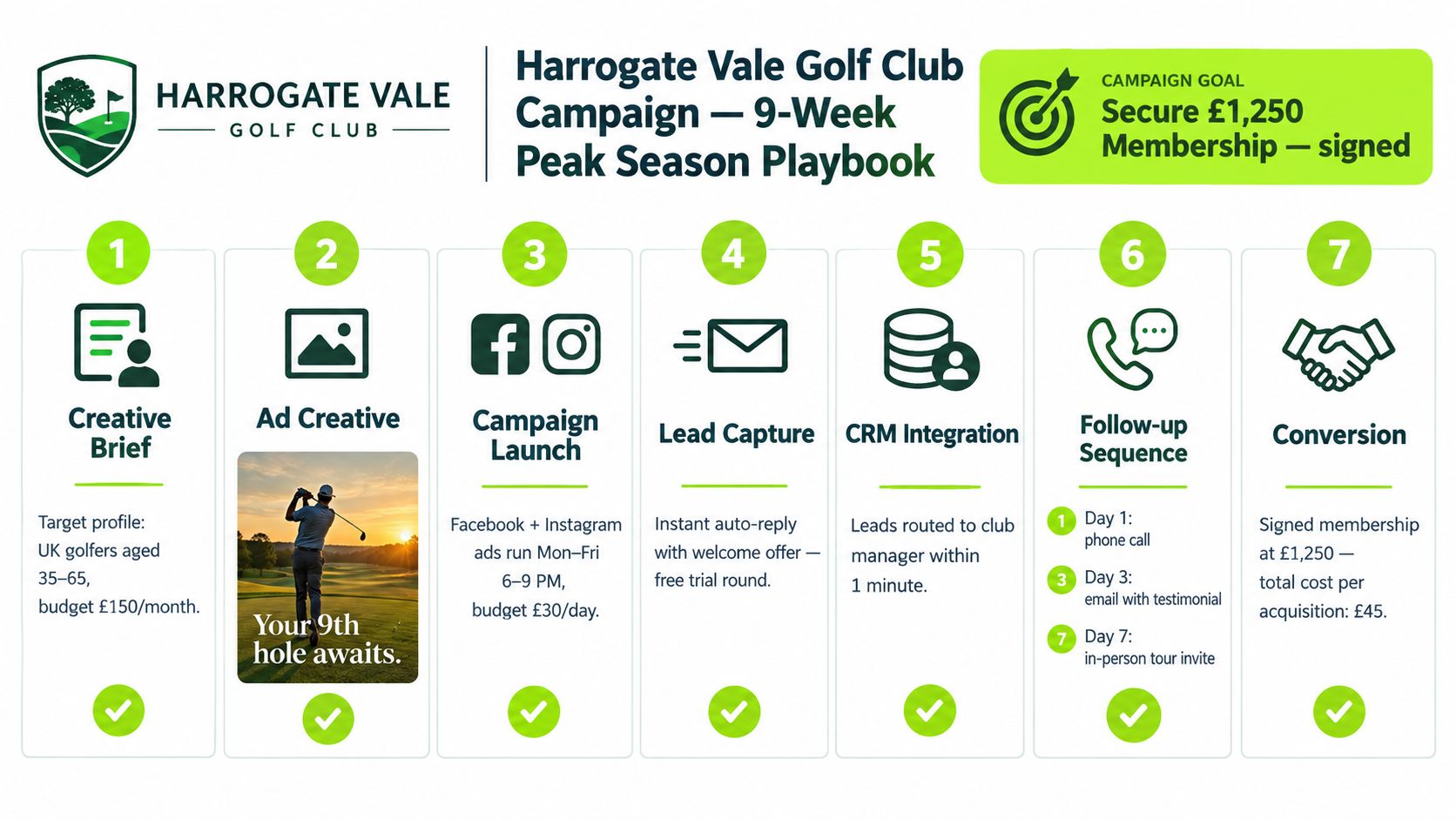
Let's use a representative club rather than pretend every account behaves the same way. Harrogate Vale Golf Club is fictional, but the operating logic is real. It has 450 members, a 9-week peak season, and wants to sell a £1,250 membership. The campaign budget is £1,800. The split is £900 to a local lead generation set aimed at golfers within 15 miles, £600 to retargeting for site visitors and video viewers, and £300 to a lookalike test.
The campaign produces 41,000 impressions, 1,380 link clicks, 62 form submissions, 18 booked taster rounds, and 9 signed memberships. The auto-reply lands in 11 seconds, the CRM handoff happens at minute four, and the 48-hour follow-up sequence recovers four enquiries that first looked cold.
Those numbers make the point clearly. The ads generated interest, but the system converted it.
What this campaign gets right
The strongest decision is not the targeting. It's the follow-up discipline.
A prospect submits the form and gets a fast acknowledgement. A named staff member gets the record quickly. The club follows up again after the first contact if needed. That turns an ad campaign into a working pipeline.
The second smart choice is the budget split. Most clubs overspend on cold prospecting and underinvest in retargeting. Harrogate Vale doesn't. It keeps enough money on warm audiences to bring back people who already showed intent.
Use this checklist before launch
If a club can't tick these off, it shouldn't launch yet.
- Objective chosen properly and matched to the enquiry action.
- Catchment defined by realistic travel, not vanity reach.
- Existing members excluded from acquisition campaigns.
- Recent enquirers excluded from cold prospecting.
- Lead form kept short enough to encourage genuine completion.
- Offer framed clearly around the next step.
- At least several creative variants prepared so one weak ad doesn't stall the campaign.
- Tracking tested from click to form submission.
- CRM fields mapped so source data lands correctly.
- Lead owner assigned before launch.
- Initial response workflow prepared for office hours.
- Follow-up sequence written for no-answer and ghosted enquiries.
- Weekly reporting routine scheduled with ad and CRM views together.
- Decision rules agreed for pausing weak ads and keeping strong ones live.
A club doesn't need a bigger ad budget first. It needs fewer blind spots.
That's the practical playbook. Strong local targeting. Creative that earns the click. Tracking that tells the truth. Follow-up that happens quickly enough to matter. Get those parts right and Facebook stops being a gamble.
GolfRep helps golf clubs build this properly, from local lead generation to CRM-connected follow-up and reporting that shows what became a member. If you want a clearer system for golf club Facebook ads, visit GolfRep and see how the pipeline is structured end to end.
Ready to tap into our proven growth system?