Golf Club Digital Marketing: A Practical Growth Playbook

Most golf club digital marketing advice starts in the wrong place. It tells clubs to post more often, improve their website, or increase advertising spend. Those activities matter, but they don't solve the commercial problem I see most often at UK clubs: an interested golfer makes contact, then waits too long for a useful response.
A club can have a strong course, a respected name and a steady flow of online demand, yet still lose prospective members because nobody owns the next step. GolfRep approaches growth from the other direction. We start with the outcome, such as a booked visit or completed membership application, then build the tracking, routing, advertising and follow-up systems needed to produce it consistently.
Why Most Golf Club Marketing Quietly Leaks Revenue
A paid enquiry left unanswered for two days has little practical value. A club could spend £1,500 a month on Google Ads, but if staff don't call a serious prospect within the first hour, the club is buying traffic rather than building membership.
That leak usually sits between the form submission and the first meaningful conversation. Common failure points include out-of-hours web forms, generic club email addresses, a secretary trying to respond between operational tasks, no lead priority, and no planned follow-up after the first courteous email. Our guidance on how clubs lose enquiries focuses on that overlooked gap.
The problem isn't limited to membership. A society organiser submitting a form on Saturday may hear nothing until Monday. A visitor asking about a tee time may receive a reply after booking elsewhere. A corporate organiser may be passed between the general manager, events team and golf operations without a clear owner.
Practical rule: every enquiry needs a named owner, a response deadline and a recorded next action.
The wider UK picture makes this more important. Online tee booking systems were used by 73% of members' clubs in 2024/25, up from 64% in 2023, while usage among proprietary clubs reached 90%, compared with 88% in 2023. The Revenue Club's survey summary shows that digital booking infrastructure is now part of normal club operations.
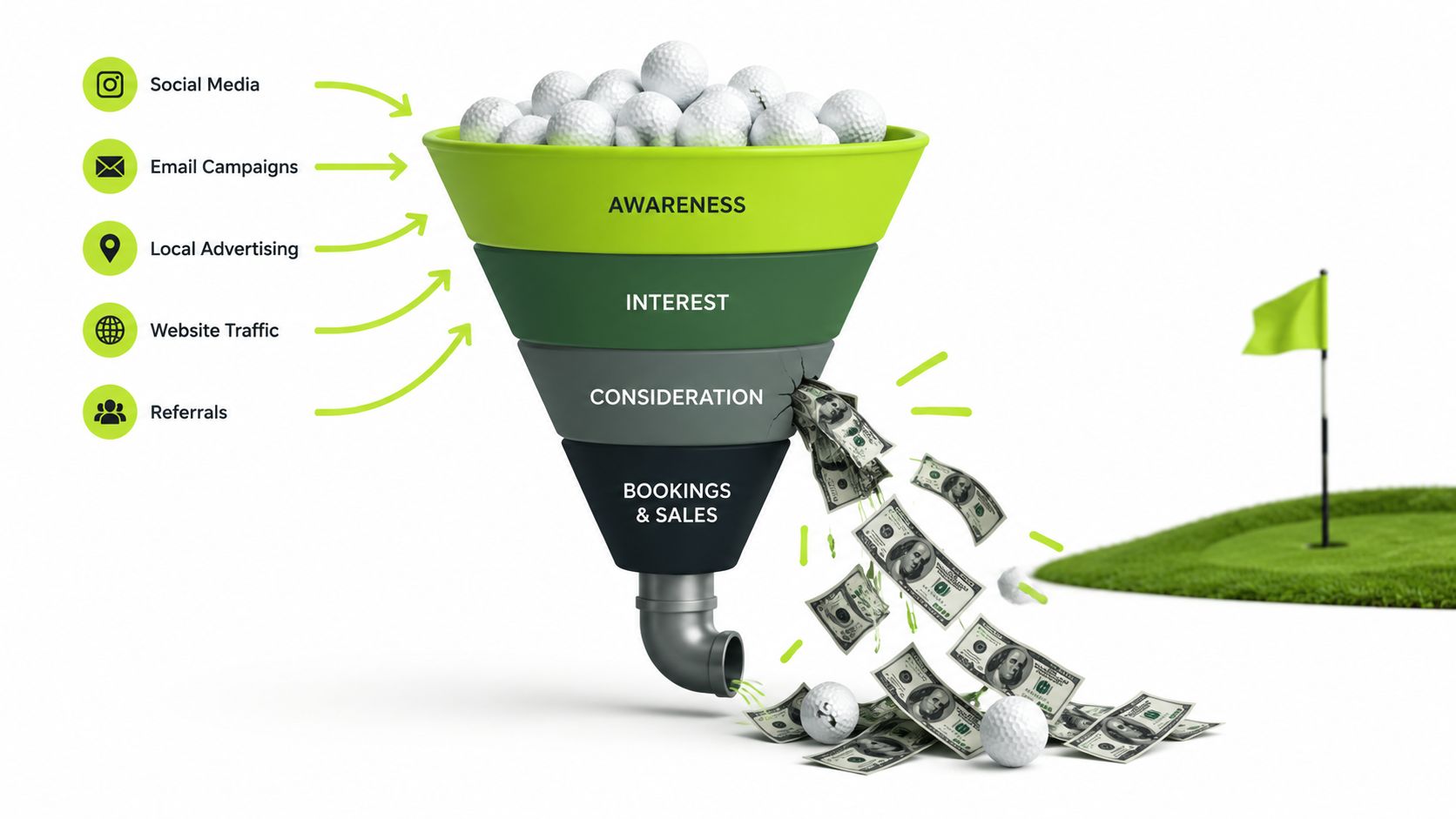
That creates an opportunity, but only if promotion connects to measurable actions. The useful question isn't just how many people saw an advert. It's how many enquiries became conversations, visits, trial rounds and signed memberships.
England Golf's earlier questionnaire found that 89% of 602 surveyed clubs used a website regularly for marketing, while 75% used social media, according to the survey summary published by The Revenue Club. Those channels create visibility. They don't, by themselves, create a reliable sales process.
The fix is a connected system: define the revenue goal, track each stage, send the right traffic, route enquiries quickly, nurture people who aren't ready, and measure booked-visit outcomes rather than celebrating clicks.
Set Clear Growth Goals Before Spending a Penny
“Get more members” sounds sensible, but it's too broad to guide decisions. A private club, resort or proprietary venue normally sells several different products, and each one needs a distinct audience, message and follow-up process.
Start by separating the commercial lanes:
- Full membership: local golfers considering a long-term home club.
- Flexible or category membership: players who need different access, pricing or playing patterns.
- Visitor golf: golfers planning a round, often with a shorter decision cycle.
- Corporate and society packages: organisers, employers and hospitality buyers evaluating a specific event.
A Yorkshire club aiming for 18 new full members a year can work backwards from visits, applications and qualified enquiries. A Buckinghamshire club asking for “more awareness” can't make the same decisions because it hasn't defined the result.
Audience definition should be practical, not decorative. Map the club's drive-time catchment by postcode, then consider household income band, handicap range, playing frequency and life stage. A family category may need different language from a premium full-membership offer. A corporate day should speak to the person arranging the event, not to a golfer looking for a weekend tee time.
| Revenue Streams and Audience Targeting for UK Golf Clubs | Target Audience | Avg Enquiry Value | Primary Channel |
|---|---|---|---|
| Full membership | Local golfers seeking a long-term club | Varies by joining structure and category | Google Search and targeted Meta |
| Flexible or category membership | Golfers needing access that fits work or family commitments | Varies by category | Google Search, Meta and email |
| Visitor green fees | Golfers planning a round within the club's catchment or travel route | Varies by booking and package | Google Search and booking partnerships |
| Corporate or society packages | Business organisers, venue bookers and society captains | Varies by event scope | LinkedIn, search and direct outreach |
Channel choice should follow intent. Google Search captures people already looking for membership or golf near a location. Meta can introduce a relevant open day or category offer to lapsed or lightly engaged golfers. LinkedIn is more appropriate for corporate hosts than a broad Facebook campaign.
For clubs reviewing wider paid acquisition principles, these small business ad strategies from Veo3 AI offer useful context, although golf clubs still need to adapt the approach to local catchments and seasonal demand.
Write the goal into the CRM before launching the campaign. Define the audience, landing page, enquiry event and commercial owner together. That discipline is also central to the real ROI of golf club marketing, because revenue can't be assessed accurately if every offer enters one undifferentiated pipeline.
Build the Tracking and CRM Backbone First
Advertising can't compensate for missing data. Before launching a campaign, a club should know what counts as an enquiry, where it enters the business, who receives it and which later action proves that the marketing created value.
Begin with a clean measurement layer:
- GA4: configure key journeys and use cross-domain tracking where the website hands users to a booking or membership portal.
- Google Tag Manager: record form submissions, brochure downloads, click-to-call actions and important booking interactions.
- Call tracking: use a distinct number for each meaningful channel so phone enquiries aren't attributed to “direct”.
- CRM: use a platform such as HubSpot, Salesforce or Clubhouse Solutions to store the source, offer, owner, stage and next action.
A useful event vocabulary might include:
form_submit, brochure_download, phone_call, booked_visit, trial_round, application_started, and member_signed.
The names matter less than consistency. If one member of staff records “tour booked”, another records “visit”, and a third keeps the outcome in a spreadsheet, the reporting will remain unreliable.

Route every enquiry to the right person
Routing rules should reflect commercial urgency and operational responsibility. For example:
- A new full-membership enquiry goes to the membership secretary within 30 minutes.
- A society-day enquiry goes to the events manager within two hours.
- A visitor green-fee enquiry goes directly to online booking where the answer is already available.
- Every lead is copied into a shared inbox with an owner, status and service-level timer.
These are operating rules, not theoretical targets. UK businesses average a 47-hour response time, while only 7% respond within five minutes, according to UK speed-to-lead research. A separate UK lead-response study found that only nearly 10% of firms replied within five minutes and over 46% replied within an hour, with the first hour identified as the important response window in Survey Booker's analysis.
Use lawful basis and clear consent capture under UK GDPR. Forms should explain why contact details are collected, separate service communications from marketing permission where appropriate, and provide a straightforward way to withdraw consent.
Without this backbone, paid media is judged on last-click activity. With it, the club can see which source produced a booked visit and which category ultimately signed. Our practical guide to golf club CRM covers the operational principles in more detail.
Run Paid Media Campaigns That Match Each Revenue Goal
One campaign rarely serves every commercial objective well. Membership, visitor golf, corporate hospitality and society days differ in audience, location, decision process and follow-up requirement. Combining them under one campaign makes budget performance difficult to interpret.
Membership campaigns should usually combine Google Search with carefully targeted Meta activity within the club's realistic local catchment. Search captures active demand such as “golf membership near me” or “join a golf club in [location]”. Meta can support open days, category offers and re-engagement, particularly when the audience needs to see the club experience before making contact.
Visitor campaigns need a different frame. Focus on booking intent, availability and practical information. A golfer travelling to an area may respond to search or a relevant hotel-concierge partnership, while a local resident may be a poor audience for a visitor-only offer if the aim is to sell travel golf.
Corporate and society campaigns should lead with the event outcome. LinkedIn and direct B2B outreach are more suitable than broad Facebook awareness when the buyer is arranging a team day, delegate package or society event. The landing page should answer questions about capacity, facilities, food, timings and the booking process.
Use seasonality without letting it dictate everything
The supplied UK planning guidance identifies January to March for membership acquisition, June to August for visitor revenue, and September to November for society bookings. Those periods should inform testing and budget weighting, but they shouldn't replace weekly performance review. A campaign can fatigue, lose relevance or generate poor-quality enquiries at any time.
| Paid Media Lanes for Golf Clubs | Primary Channels | Audience Targeting | Suggested Budget Split |
|---|---|---|---|
| Membership | Google Search and Meta | Local prospects, lapsed golfers and category audiences | Set separately from visitor and event budgets |
| Visitor green fees | Google Search and concierge partnerships | Travelling golfers and high-intent bookers | Weight towards visitor demand periods |
| Corporate hospitality | LinkedIn and direct B2B outreach | Local employers, organisers and venue buyers | Fund around package value and sales capacity |
| Society days | Search, partnerships and outbound contact | Society captains and event organisers | Increase ahead of society planning periods |
Give each lane its own landing page, form questions and conversion event. Review weekly, not only monthly. Weekly analysis catches search-term waste, creative fatigue, slow response patterns and poor-quality lead sources before they become an expensive reporting surprise.
The Hillier Hopkins survey found that member referrals were the most-used marketing method at 71%, while email campaigns were used by only 14% of clubs and direct mail by 12%. The survey report points to a practical imbalance: clubs often have a strong source of interest but limited nurture after the referral arrives.
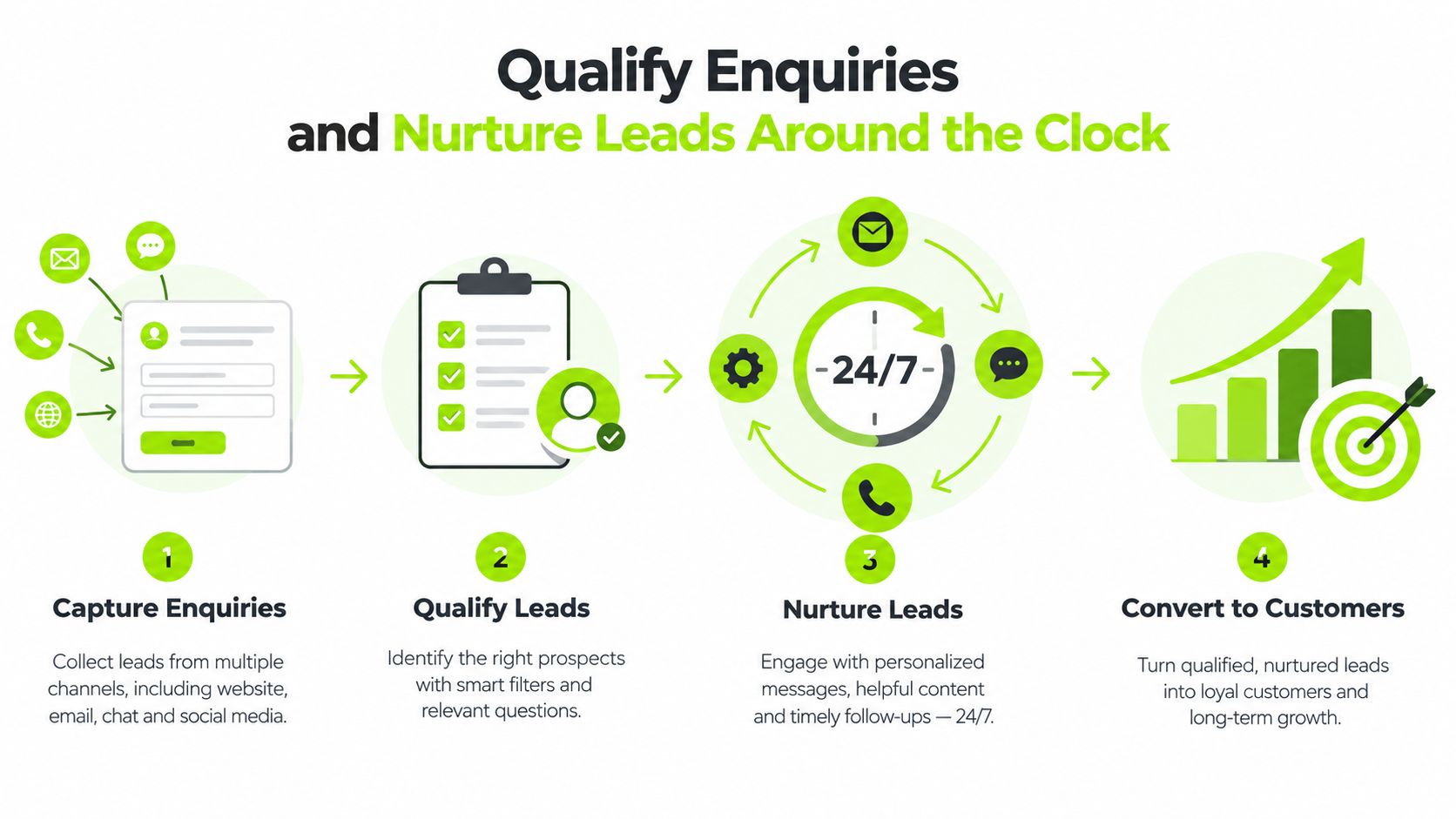
Qualify Enquiries and Nurture Leads Around the Clock
A club's office hours rarely match a golfer's decision-making hours. A prospect may submit a form after work, compare two clubs that evening and book a visit with the one that responds clearly first.
The first automation should be immediate and useful. Send an SMS acknowledging the enquiry, name the person responsible, state when the prospect can expect a call and include a direct booking option where appropriate. Don't make the message sound like a ticketing system. It should reassure the golfer that a real person has visibility.
Next, create separate nurture paths rather than one general newsletter:
- Membership prospects: course access, category options, member benefits and visit invitations.
- Corporate enquiries: package details, facilities and examples of how the day can run.
- Society organisers: planning information, available formats and a downloadable organiser resource.
A 12-touch sequence can be spaced across the buying cycle, with helpful content rather than repeated requests to “book now”. Use behaviour to adjust the path. Someone who clicks category information needs a different follow-up from someone who only downloaded a brochure.
Reactivate without sounding desperate
For leads older than 30 days with no booked visit, use a reactivation flow. Offer a taster day, open event or a direct conversation that helps answer the objection. The message should acknowledge the earlier interest and make the next step easy.
A chatbot has a limited but useful role. It can answer simple questions about green-fee prices, dress code and directions, then pass qualified interest to a human within 15 minutes. It shouldn't pretend to replace a membership secretary or handle nuanced questions about joining.
The response-time evidence is strong enough to change staffing routines. UK SME research reports that leads contacted within five minutes were 2.6 times more likely to convert, while the average business took 47 hours to reply and half of leads were never contacted, according to the DigiSurf Agency study.
For clubs formalising these sequences, lead nurturing best practices for 2026 from Voicedial.ai provide useful background on timing, segmentation and automation. Every SMS, email, call and booking action should feed the CRM, so the person handling the next conversation sees the full history.
Turn Booked Visits Into Paying Members
A booked taster round isn't a membership sale. It's a sales conversation in a golf setting, and the club still has to prepare for it properly.
Consider a typical prospect. They submit a membership enquiry, receive an automated confirmation within five minutes, and get the prospectus by email and post. The visit is scheduled at a quieter time, allowing the host to walk the course or clubhouse without rushing. Before the prospect arrives, the host can see why they want to join, what they value and whether they have mentioned a previous club.
Three points often undermine the experience:
- No confirmation call the day before: the prospect isn't sure who will meet them or what to expect.
- A generic welcome: the host starts from nothing instead of using the information already collected.
- No defined next step: the prospect leaves with a pleasant impression but no proposal, follow-up date or route to application.
A practical club process fixes each point without making the interaction feel scripted. Confirm the appointment, remind the host of the prospect's stated priorities and agree the next action before the visitor leaves. That might be an application discussion, a second visit, a trial round or a conversation about category options.
Treat objections as useful data
Send a same-day follow-up email while the visit remains fresh. Add a short survey asking what appealed, what remains unclear and what could prevent the prospect from joining. The answers should be visible in the CRM, not trapped in an individual inbox.
Within 48 hours, send a clear proposal covering the joining fee, monthly subscription and relevant category options. Don't force every prospect into the full-membership route if a flexible category is a better fit. The objective is an informed decision, not a hurried close.
Track booked visit to signed membership by category. A single club-wide average can conceal a strong full-membership process and a weak flexible-membership process, or the reverse.
Visibility also starts before the form submission. Accurate location details, useful photos and a well-managed Google presence make it easier for golfers to find and evaluate the venue. This practical guide to attracting players with Google Maps is a useful reference for that discovery stage, but discovery only matters when the club can handle the resulting enquiry.
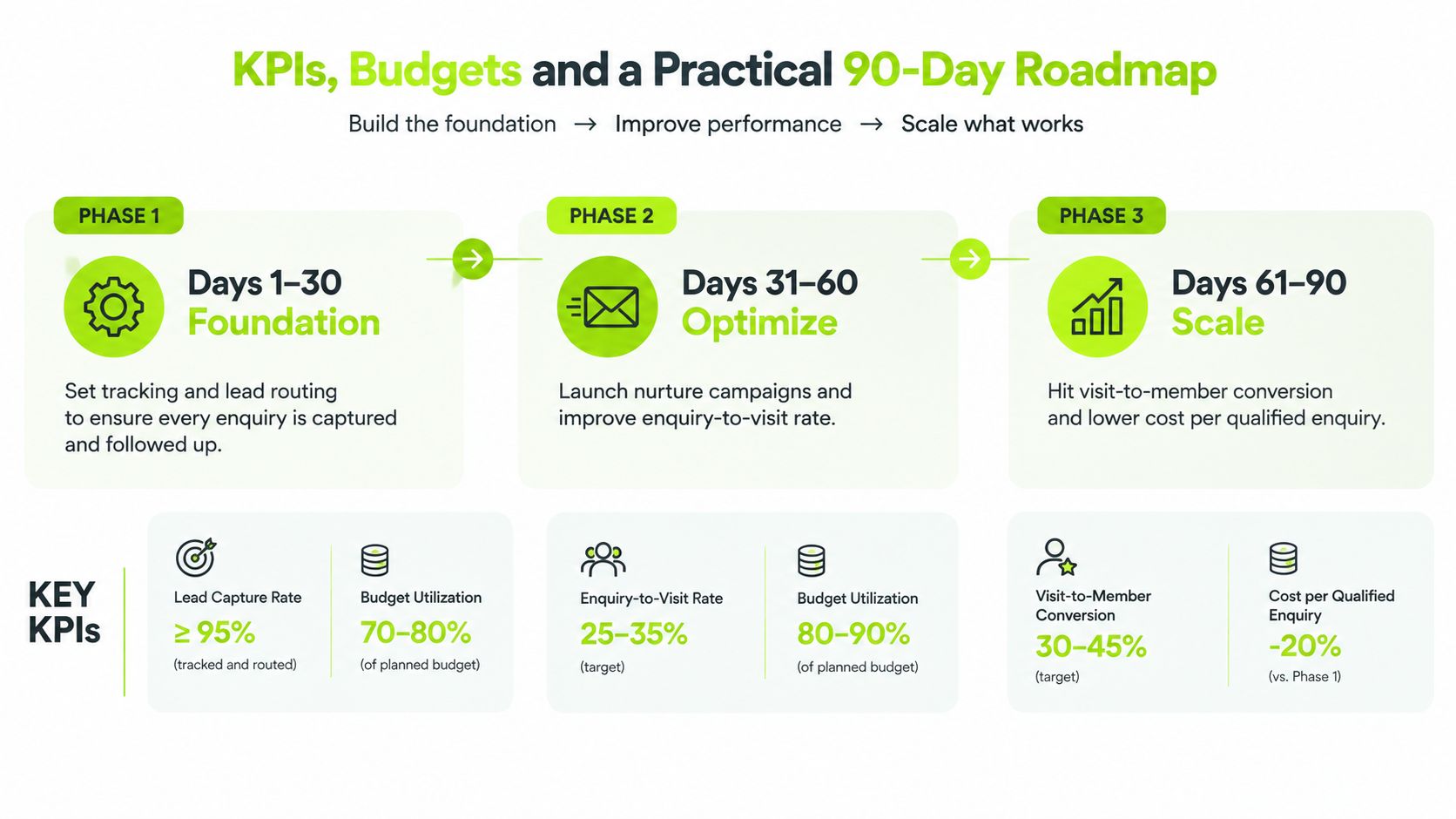
KPIs, Budgets and a Practical 90-Day Roadmap
A useful dashboard should connect marketing activity to club outcomes. Start with four measures:
- Enquiry-to-visit rate: target 25% to 35%.
- Visit-to-member conversion: target 30% to 45%.
- Cost per qualified enquiry: compare channels using the same qualification definition.
- Time to first response: aim for under 15 minutes during office hours.
These targets are management controls, not promises. If enquiry volume rises while enquiry-to-visit performance falls, the issue may be lead quality, slow handling or weak qualification. If visits are healthy but membership conversion is poor, inspect the host experience, offer structure and follow-up rather than automatically increasing advertising.
A typical UK private club may allocate £1,500 to £4,000 per month across paid search, paid social, retargeting and creative. In the first 90 days, I wouldn't push all available budget into acquisition. Measurement, CRM routing, landing-page clarity and creative testing deserve priority until the club can see what happens after the form submission.
Days 1 to 30
The general manager or operations lead should own the foundation. Configure GA4 and Tag Manager, document the conversion events, connect the CRM, set response rules and launch baseline campaigns for the clearest revenue priority.
The membership secretary should confirm the pipeline stages and required information. The secretary manager should approve ownership and escalation rules, particularly for out-of-hours enquiries.
Days 31 to 60
The marketing owner can launch the segmented nurture sequences, retargeting audiences and landing-page tests. The membership and events teams should review lead quality and record objections consistently.
At this point, compare cost per qualified enquiry by channel, not just cost per form submission. A cheaper source that produces no booked visits is not necessarily efficient.
Days 61 to 90
Scale the channels that create qualified visits and signed applications. Improve the pages and forms that lose people, refine the first response, and establish a monthly report that shows source, stage, owner, response time and final outcome.
GolfRep combines targeted advertising with automated follow-up and CRM-enabled nurture, but a club can build the same operating discipline using tools that fit its existing systems. The important point is accountability. Marketing owns traffic and measurement, membership owns response and conversion, events owns corporate and society enquiries, and the secretary manager ensures the process is followed.
The first action on Monday morning is simple: export the last month of enquiries and record the source, submission time, first response time, owner, booked-visit status and final outcome. That audit will show whether the club has a traffic problem or a conversion leak.
GolfRep helps golf clubs connect paid search and paid social with structured lead routing, automated follow-up and CRM visibility from first enquiry to booked visit and membership sign-up. Visit GolfRep to discuss a practical growth system built around your club's revenue goals and existing operations.
Ready to tap into our proven growth system?