Golf Club Franchise Models: A UK Guide for Owners
Most advice on a golf club franchise gets the issue backwards. Committees are told to find the right operator, outsource the awkward bits, and let a proven model sort the rest. That sounds tidy. It rarely is.
In the UK, the issue usually isn't a lack of interest in golf clubs. It's weak commercial execution after interest appears. A club can sign a catering franchise, appoint a management company, or license a programme, yet still struggle because enquiries sit in inboxes, follow-up depends on one busy staff member, and no one can clearly see what turns into visits, trials, and memberships.
That matters because the market is worth taking seriously. IBISWorld projects the UK Golf Courses industry to reach £2.8 billion in 2026 across 2,510 businesses, after 0.3% CAGR from 2020 to 2025 (IBISWorld industry outlook). There is opportunity here, but it isn't forgiving. The same source also points to the 60% failure rate of standalone golf franchise ventures within 3 years, which tells you something important. A badge, a concept, or a partner doesn't remove operational complexity.
What a Golf Club Franchise Really Means
A committee that says it wants a golf club franchise usually means one of three very different things. That confusion is expensive.
In the UK, a true franchise is uncommon at full-club level. Very few clubs are buying a complete, replicable business format with strict brand rules, operating manuals, training, and central support across the whole operation. What usually gets called a franchise is something narrower: outsourced catering, a teaching brand, a simulator concept, a management company, or a specialist growth partner brought in to fix one commercial problem.
That difference is not technical. It changes who controls the member journey, who carries the operational risk, and who gets blamed when results disappoint.
For committees that want general context on how franchise systems are structured, Franchise Foundry is a useful reference point. Apply those lessons carefully. A UK golf club has a membership base, governance friction, seasonal demand, and a local reputation to protect. It does not behave like a standard retail unit.
UK clubs usually need clarity, not a franchise badge
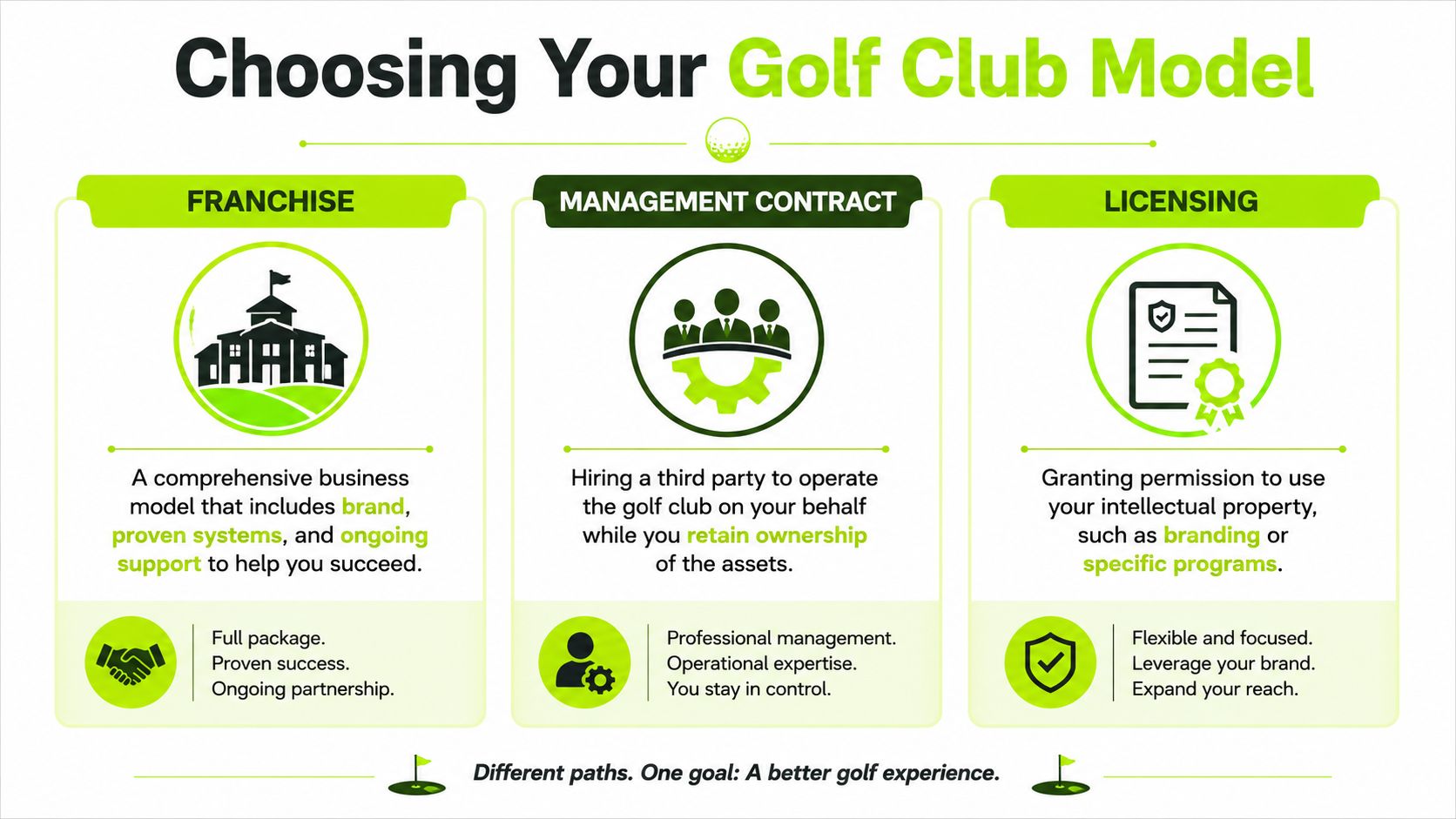
The label matters less than the operating reality. If an external partner sets the brand, playbook, systems, and standards across the club, you are close to a franchise model. If they run the site on your behalf, you are closer to a management contract. If they let you use a brand, programme, or process while your team still does the work, that is licensing.
Many committees miss the commercial point. The key question is not whether the arrangement sounds modern or professional. The critical question is where responsibility sits for sales follow-up, member service, staffing standards, and budget control.
That is where deals succeed or fail.
A club can outsource food and beverage and still lose prospective members because nobody calls back website enquiries. A club can appoint a management operator and still struggle because the sales pipeline is unclear, trial visits are handled inconsistently, and reporting stops at vanity numbers. A club can license a coaching concept and gain activity without turning any of it into long-term membership revenue.
The brochure sells structure. The club still has to convert demand.
This is the part committees should focus on first. In the UK golf context, the commercial bottleneck is usually not the absence of a partner. It is poor conversion of existing interest into visits, trial rounds, membership conversations, and signed direct debits.
A partner can improve standards, add expertise, and tighten execution. It cannot rescue a club that has no ownership of enquiries, no response discipline, and no clear view of conversion from first contact to joining date.
That is why the franchise debate often wastes time. Committees compare brand names before they define the operating problem.
For a more grounded view of the commercial issues clubs wrestle with, GolfRep's golf business articles are closer to day-to-day committee decisions than generic franchise commentary.
If you remember one point from this section, use this one. In UK golf, "franchise" is usually the wrong word. The right question is which model gives your club better execution, clearer accountability, and stronger membership enquiry conversion.
Franchise vs Management Contract vs Licensing
If your committee can't define the model in plain English, you shouldn't sign anything.
Franchise
A franchise is the closest thing to a packaged business. You operate under another organisation's brand and system. They provide the model, the operating rules, and some level of support. You follow their playbook.
For golf clubs, this is uncommon as a full club model in the UK. It is more plausible in satellite formats, coaching concepts, retail, simulator venues, or tightly branded service offers attached to golf.
What matters commercially is this: a franchise trades some flexibility for structure. If you want local freedom, a true franchise often frustrates you.
Management contract
A management contract is more common. The club still owns the business or asset, but it hires a third party to run some or all operations. That can include golf operations, food and beverage, events, sales, and staffing.
This model suits committees that want professional oversight without selling the club or changing legal ownership. It can also create distance between decision-makers and day-to-day delivery. That distance becomes a problem when service slips and nobody knows who is accountable.
Licensing
A licensing arrangement is narrower. The club gets permission to use a brand, programme, system, or intellectual property without handing over the whole business. Think branded coaching academies, specialist booking software, or a named event concept.
Licensing is often the cleanest route when the club wants a targeted uplift rather than wholesale operational change. It is also the easiest model to underestimate. A poor licence agreement can create confusion over standards, data ownership, and member communication.
A simple comparison
| Model | Who controls operations | What the club gets | Main risk |
|---|---|---|---|
| Franchise | The franchisor sets the system | Brand, process, support | Loss of flexibility |
| Management contract | Third-party operator runs the club | Operational expertise | Blurred accountability |
| Licensing | Club keeps control, uses approved IP or programme | Specialist capability | Weak integration |
The catering example most committees get wrong
Food and beverage is where this gets very practical. Clubs often talk about "franchising catering" when they're really outsourcing or licensing an operating concept. That language sounds harmless. It isn't.
The bigger issue is oversight after the agreement is signed. According to analysis on outsourced golf club catering, 20% to 30% of clubs lack clear operational oversight post-franchising, leading to member dissatisfaction and financial loss (The Golf Business on outsource or in-house catering). That is exactly what happens when committees assume the contractor owns the problem.
Committee rule: If members complain about food, service, or clubhouse standards, they won't blame the contract structure. They'll blame the club.
A catering operator can improve standards. It can also damage your reputation if the agreement is vague, reporting is weak, and service expectations aren't enforced. If you don't define standards, review cycles, communication rules, and failure triggers at the start, you're not outsourcing a headache. You're storing one up.
Evaluating the Potential Gains and Pitfalls
External partners can help. They can also lock a club into years of frustration. The decision isn't about whether outside support is good or bad. It's about whether the upside outweighs the loss of control.
Where a partner can genuinely improve the club
A good partner usually brings three things that committees struggle to maintain on their own.
- Operating discipline: Professional operators tend to run tighter reporting, clearer staff structures, and more consistent daily standards.
- Specialist skill: A strong food and beverage operator knows menus, labour scheduling, stock control, and service design better than most volunteer-led committees ever will.
- Commercial focus: Outside partners often push pricing, utilisation, and sales activity harder than clubs do internally.
That can be useful where the club has been coasting. It is especially useful where the committee knows the problem but doesn't have the time or depth to fix it.
What clubs give up in return
The downside is never theoretical. It shows up in member sentiment, slower decisions, and contract tension.
A partner may standardise service in ways that flatten club character. They may favour efficiency over member nuance. They may also chase revenue lines the committee doesn't want prioritised. None of that makes them wrong. It means their incentives and your culture might not match.
Here are the common trade-offs:
- Control drops: The club no longer decides everything at pace.
- Exit becomes harder: Long contracts are easy to sign and painful to unwind.
- Upside may be capped: Profit-share and fee arrangements can limit how much benefit the club keeps if performance improves strongly.
The contract is where most problems begin
Many committees negotiate commercial terms and skim over operating detail. That's backwards. The operational clauses decide whether the relationship works when pressure arrives.
Useful legal guidance on developing robust franchise agreements is worth reviewing before any negotiation, not after the first dispute. The principle applies far beyond formal franchising. Service levels, data access, brand standards, break clauses, and dispute routes should be drafted with precision.
The wrong partner can still look impressive in a board paper. The warning signs usually sit in the detail nobody wanted to argue about in the meeting.
A blunt test for committees
Ask four hard questions before you proceed:
- Do we need expertise, or are we trying to outsource accountability?
- Will this partner strengthen the club's economics, or just make the reporting look tidier?
- If standards fall, who has the right to act and how quickly can they act?
- Would we still sign this agreement if we had to live with it for years, not months?
If those questions make the room uncomfortable, that's useful. Better discomfort before signature than regret after handover.
Navigating the Practical Requirements
Good intentions don't protect a club. Paperwork, numbers, and operating discipline do.
Legal and property detail first
Most clubs rush to discuss headline fees and miss the underlying obligations. Start with the legal mechanics. Who employs staff after the change? What happens under TUPE? Who owns customer data? Who controls signage, booking systems, supplier relationships, and member communications?
Property issues matter too. If the arrangement affects clubhouse use, lease areas, exclusivity, parking, storage, or repair obligations, get specialist advice early. Practical reading from Commercial property insights can help committees understand the sort of site and occupancy issues that often get overlooked in operating deals.
Financial scrutiny needs proper KPIs
A professional operator will talk in metrics. Your club should too. One of the clearest is Revenue per Available Tee Time, or RevPATT, which is calculated by dividing total greens and cart fee revenue by total available tee times. It matters because tee time utilisation and rounds played yield variance are primary drivers of cost efficiency (Bobby Jones Links on top golf club revenue KPIs).
That metric forces better questions:
- Are peak slots being sold properly?
- Are low-yield periods being ignored or managed?
- Is the operator improving revenue quality, not just activity?
If a prospective partner can't explain how they monitor commercial performance at that level, they're not ready for your club.
Operational integration is where promises get tested
The hardest work starts after signature. Systems need to connect. Staff need new reporting lines. Members need a consistent experience. If the club uses separate spreadsheets, manual replies, and disconnected booking data, a new partner won't magically fix that.
For clubs operating more than one site, the challenge gets bigger. Different teams, different local habits, and inconsistent follow-up create avoidable leakage. That's why multi-site operators should think carefully about standardised systems and central visibility, not just local operators. Practical examples in GolfRep's guide to golf marketing for multi-site operators show why process consistency matters across a portfolio.
A club should insist on three essential requirements before launch:
- Defined reporting: weekly, monthly, and quarterly reviews with named owners.
- Clear thresholds: service failures, financial underperformance, and member complaint triggers should be written down.
- Exit logic: the contract must explain how the club gets out if the arrangement doesn't work.
Why Growth Stalls Even with a Partner
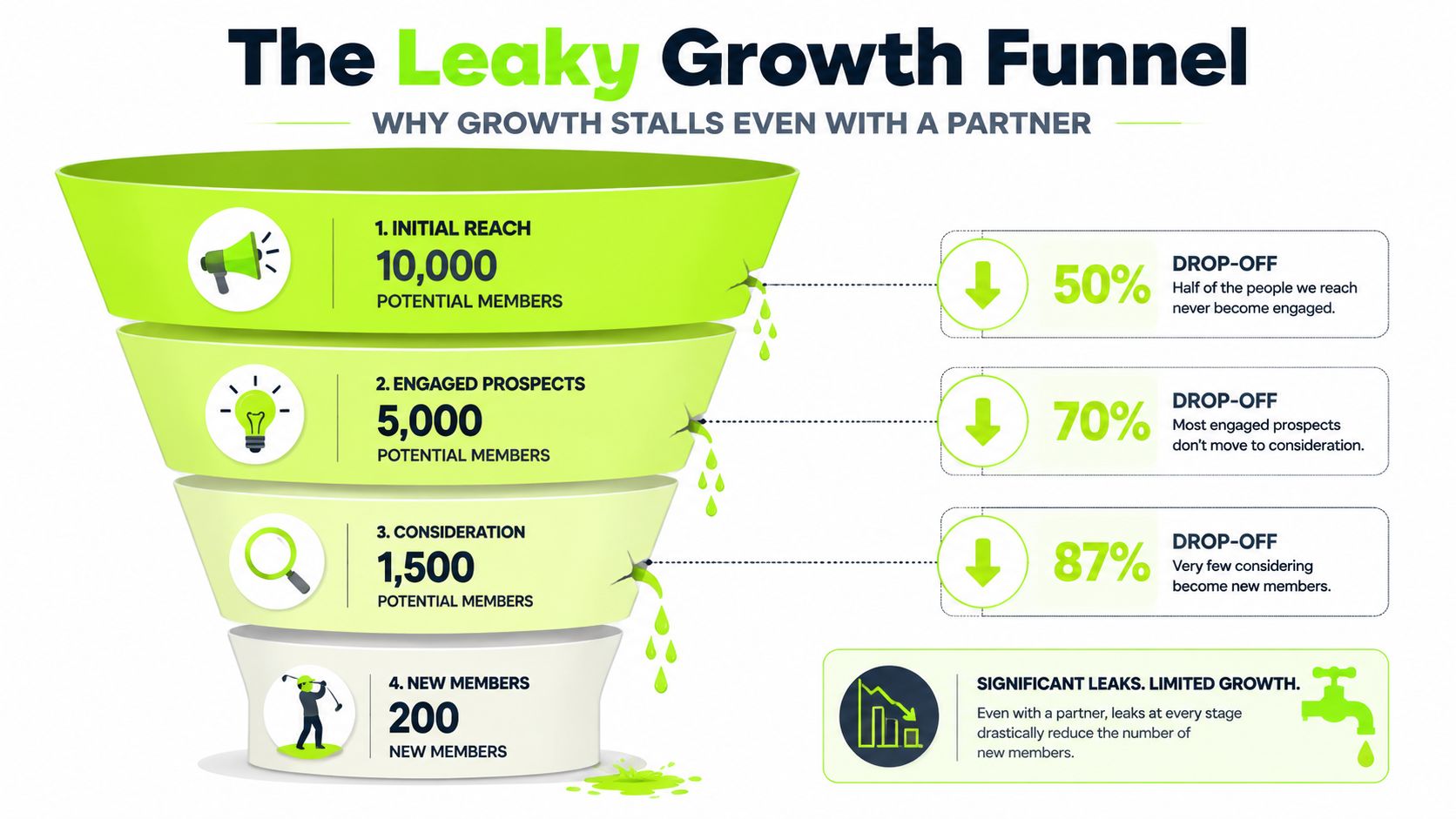
Clubs often assume growth will improve once a partner is appointed. It won't, unless the club fixes the sales process around membership enquiries.
The real bottleneck is response and follow-up
Across a network of 50+ UK golf clubs using HubSpot as a solutions partner, the average response time to membership enquiries is 30 hours, and faster response times are consistently linked to higher enquiry conversion rates (The Revenue Club on club growth performance).
That number should worry every committee member in charge of growth. A prospect who asks about membership doesn't want a reply next week. They want a clear answer, a reason to visit, and a simple next step while interest is still fresh.
Most clubs don't fail because they have no demand. They fail because demand arrives and then sits unmanaged.
Manual handling creates invisible losses
The common process still looks like this. An enquiry lands by web form, email, phone, or social media. A manager is on the course, in a meeting, or covering another task. Someone plans to reply later. Later turns into tomorrow. Tomorrow turns into a generic response. No one records the source, the urgency, or whether the prospect ever visited.
That isn't a marketing issue. It's an operational failure.
Practical rule: If the club can't see every enquiry, assign ownership instantly, and track the next action, it doesn't have a pipeline. It has a pile of missed chances.
What clubs need to monitor properly
Growth only becomes predictable when the club tracks the full journey from first contact to signed member. That means visibility, not anecdotes.
A sensible conversion framework includes:
- Lead visibility: one place where every enquiry is captured, regardless of source.
- Response accountability: named staff ownership and service standards for first reply.
- Conversion tracking: enquiry, visit, trial, proposal, join. Every stage should be visible.
- Follow-up discipline: scheduled reminders and automated nurture so nobody gets forgotten.
A management company may improve operations. A caterer may improve the clubhouse. A licence partner may improve one programme. None of those automatically fix the commercial leak between enquiry and membership.
The committee question that matters most
Ask your current team one simple question: how many membership enquiries did the club receive recently, how many booked a visit, and how many joined?
If the answer is fuzzy, delayed, or spread across three spreadsheets and two inboxes, that's your issue. Not brand. Not franchise structure. Not website traffic. Process.
Building a Predictable Membership Pipeline
The clubs that grow steadily don't rely on heroic admin effort. They build systems that catch, qualify, and progress every serious enquiry.
The market is there, but systems decide who captures it
According to the 2023/24 Members' and Proprietary Golf Clubs' Survey by Hillier Hopkins, only 24% of clubs reported more leavers than joiners, which means 76% experienced net membership growth. That tells you the market is not dead. Clubs can grow. The difference is usually execution.
The mistake is to think that more enquiries alone solve the problem. They don't. More enquiries without structure only create a larger unmanaged backlog.
A predictable pipeline has four moving parts
The clubs that handle growth properly usually build around four components.
- Targeted acquisition: attract the right type of prospective member rather than chasing broad, low-intent attention.
- Immediate qualification: identify whether the enquiry fits the club, the category, and the likely joining timeline.
- Structured nurture: follow up consistently with useful prompts, visit invitations, and timely reminders.
- Closed-loop reporting: measure what turns into tours, applications, and recurring dues revenue.
This is why specialist growth partnerships are often more effective than broad management solutions when the main issue is membership acquisition and conversion. They focus on the narrow commercial engine that many clubs neglect.
Why this model fits the UK club market
Most clubs don't need someone else to run the whole property. They need a reliable system for turning interest into revenue. That's a different brief.
A club with strong golf operations but weak enquiry handling should not default to a full operational handover. It should fix the pipeline. The practical thinking behind that approach is covered well in this guide to building a predictable revenue pipeline for golf clubs.
Clubs grow more safely when they improve the point between enquiry and decision, not when they hand away control of everything else.
The commercial logic is simple. If membership demand exists and the club can retain members well enough, the highest-return improvement is often better conversion discipline. That's less glamorous than a big partnership announcement, but it's usually the smarter move.
Is a Golf Club Franchise or Partner Right for You
The right answer depends on the problem you're trying to solve. Many clubs say they need a golf club franchise or outside operator when they really need cleaner accountability, faster response, and better conversion systems.
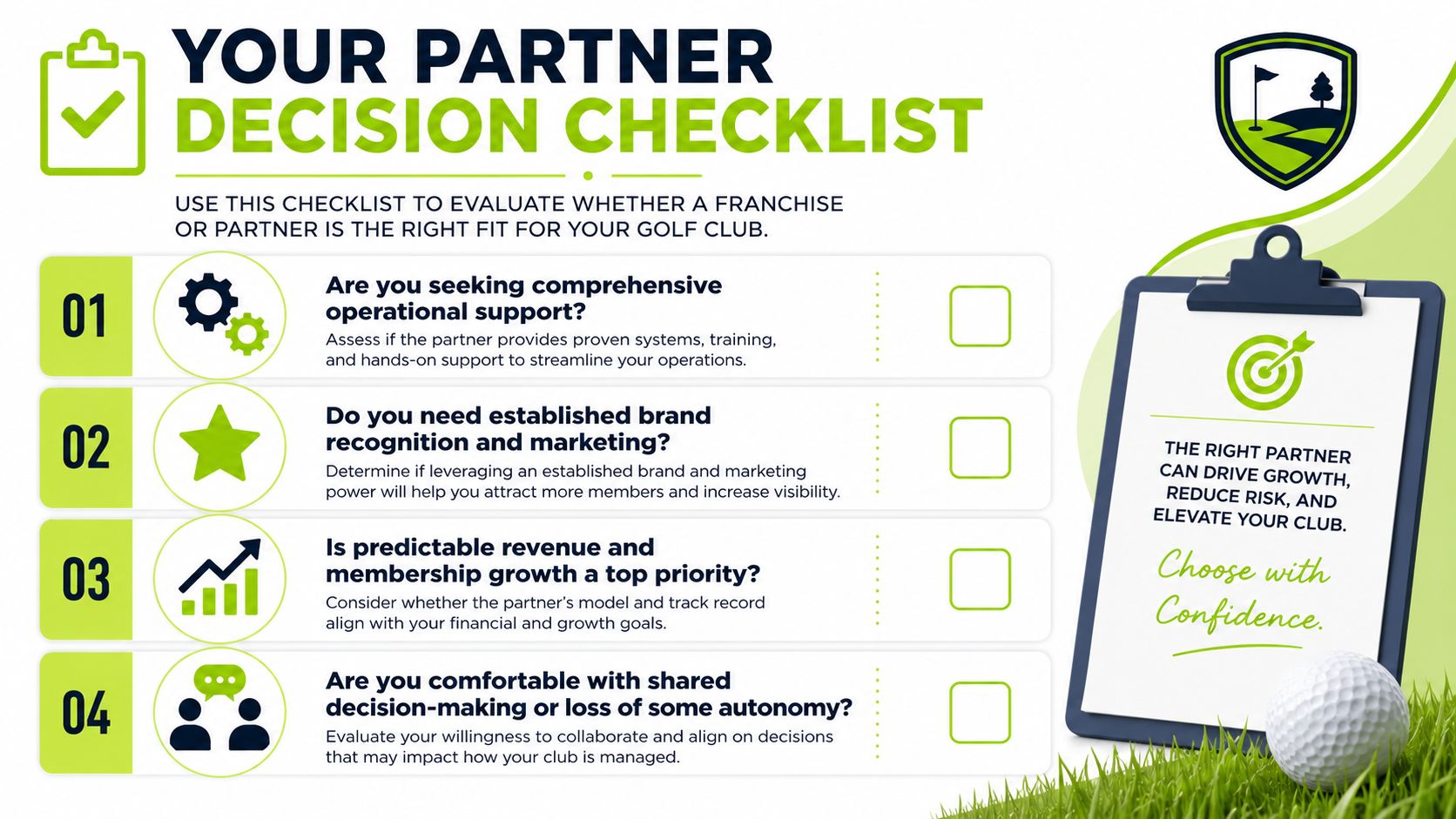
Use this committee checklist
- Operational gap: Are you struggling to run the club day to day, or just failing to manage growth activity properly?
- Control tolerance: Are you comfortable with shared decision-making and less autonomy once the deal starts?
- Commercial clarity: Can you define success in measurable terms before appointing anyone?
- Systems readiness: Does the club already have a way to track enquiries, response times, visits, and joins?
- Member impact: Will this arrangement improve the member experience, or just move responsibility to someone else?
A good market still needs disciplined execution
The broader backdrop is encouraging. In 2025, overall membership growth in the UK golf sector rose by nearly 10 percentage points year-on-year, while 77% of golfers plan to renew their membership next year (Golfshake on the health of golf club membership in 2025). That means clubs have real retention potential if they handle new enquiries properly at the front end.
If your club needs full operational expertise, a management contract may be justified. If you need a narrower specialist function, licensing or outsourced delivery might fit. If the primary weakness is member acquisition and conversion, don't overcomplicate it with the wrong structure.
Choose the model that solves the actual constraint. Not the one that sounds most impressive in the minutes.
If your club wants a more reliable way to turn membership interest into booked visits, signed members, and recurring revenue, GolfRep helps UK golf clubs build that pipeline with structured follow-up, CRM systems, and clear conversion tracking. It's a practical growth model for clubs that want better results without handing over control of the whole operation.
Ready to tap into our proven growth system?