Mastering Golf Club Social Media Marketing in 2026

Most advice on golf club social media marketing starts in the wrong place. It starts with reach, followers, posting frequency, or which platform is currently fashionable. That misses the commercial problem.
For most UK clubs, the issue isn't a total lack of interest. It's that interest isn't being handled properly once it appears. A prospect sees a post, clicks through, fills in a form, sends a message, or asks about membership. Then the enquiry sits in an inbox, gets forwarded between staff, or disappears into a spreadsheet no one owns. Social media gets blamed, but the actual problem lies further down the line.
That matters because clubs often assume they need more top-of-funnel activity when what they really need is a cleaner process from first touch to signed member. If your follow-up is weak, more enquiries only create more waste. If your follow-up is organised, even modest social activity can produce reliable revenue.
This is the lens that matters. Social media should support a system, not operate as a stand-alone task for whoever has time that week. If you're seeing activity but not enough members, the problem probably isn't content alone. It's the gap between attention and conversion, which is exactly where most club marketing fails in practice, as discussed in why most golf club marketing fails.
Introduction The Real Challenge in Golf Club Marketing
Golf club managers are often told to post more. More photos, more videos, more updates, more personality. That advice sounds sensible, but it rarely fixes the core issue.
A club can post regularly and still struggle to grow membership. Another club can post less often and still outperform because it treats every enquiry like revenue in progress. That's the difference between marketing activity and a working acquisition system.
The strongest social media strategy in the world won't rescue poor follow-up. If a prospect asks about joining and waits too long for a reply, the value of the original post drops to almost nothing. That is why golf club social media marketing needs to be judged by what happens after the click, not by what happens on the platform.
What most clubs get wrong
Many clubs still use social media like a noticeboard. They publish results, announce events, and upload a few course photos. That content has a place, especially for current members, but it doesn't create a predictable growth model on its own.
The practical question is simpler than many committees make it. Can your club take interest from Facebook or Instagram and move it into a visible process that ends in tours, trial rounds, and memberships?
Practical rule: If your team can't see every enquiry, assign an owner, and follow up quickly, your social media isn't a revenue channel yet.
What a better approach looks like
A better model links three things:
- Visibility: Social content and paid promotion create local awareness.
- Capture: Every serious prospect gets moved into a form, lead ad, direct message process, or phone enquiry.
- Conversion: A structured follow-up system turns interest into visits and visits into members.
That shift changes the conversation. You're no longer asking whether social media "works". You're asking whether the club has built a process that can convert attention into income.
From Social Noise to a Predictable Pipeline
Most clubs don't have a social media problem. They have a pipeline problem.
A course update gets likes. A competition photo gets comments. A member spotlight gets shared. None of that is useless, but none of it tells you whether your club is building future revenue. Social activity only becomes commercially useful when it feeds a sequence that staff can monitor and improve.
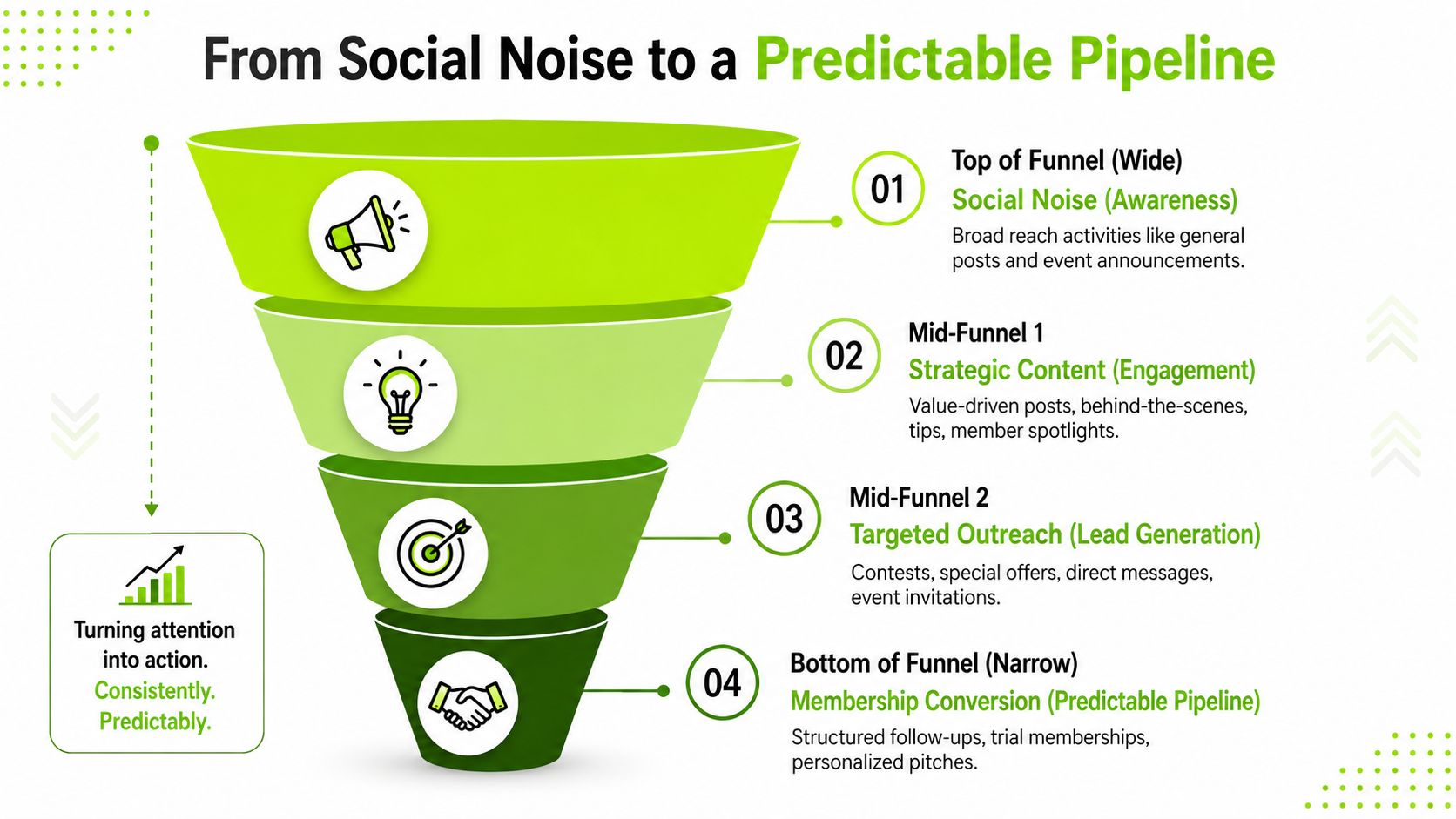
A predictable pipeline gives structure to what otherwise feels random. Instead of hoping that posts somehow create members, you define the stages and manage each one. That's the thinking behind a predictable revenue pipeline for golf clubs.
The stages that matter
A practical pipeline for golf club social media marketing usually looks like this:
| Stage | What the prospect is doing | What the club must do |
|---|---|---|
| Awareness | Seeing posts, ads, or local mentions | Show the course, club atmosphere, and reasons to care |
| Consideration | Checking the website, social pages, reviews, and membership details | Remove doubt with clear information and recent content |
| Enquiry | Filling in a form, sending a message, or asking for details | Capture the lead cleanly and notify the right person |
| Conversion | Booking a tour, trial, or follow-up conversation | Keep momentum with fast, consistent contact |
Most clubs over-focus on awareness because it's public. Likes are visible. Reach is visible. Comments are visible. The harder part happens behind the scenes, where enquiries need ownership, urgency, and a proper workflow.
Stop measuring the wrong things
Vanity metrics can hide weak sales performance. A post can "do well" and still generate no meaningful pipeline. Equally, a quiet post aimed at the right local audience can produce an enquiry that becomes a full annual subscription.
So the working numbers aren't social metrics first. They're operational metrics.
- Enquiry volume: Are serious prospects coming in from social activity?
- Response speed: How fast does someone reply once an enquiry arrives?
- Show rate: How many prospects attend a club visit or call?
- Conversion rate: How many become members?
The club that knows these numbers will make better decisions than the club that celebrates engagement screenshots.
What changes when you think in pipelines
This change in mindset affects everything. Content becomes purposeful. Ads become easier to judge. Staff know what counts as a lead. Committee discussions get clearer because people can see where prospects stall.
It also exposes a common truth. Many clubs don't need to double their posting output. They need to tighten the route from social interaction to human follow-up.
That is what turns social noise into something useful. Not more activity for its own sake, but a system that moves prospects from interest to action with less guesswork and fewer dropped opportunities.
Platform and Audience Strategy for UK Golf Clubs
Trying to win on every platform is one of the quickest ways to waste time. Most clubs don't have an in-house content team, and they don't need one. They need focus.
For most private member clubs in the UK, Facebook still deserves first priority. A foundational 2011 survey revealed that 55 percent of members within British golf clubs were actively using social media, establishing Facebook as the dominant platform. A subsequent 2012 survey confirmed that the majority of golfers aged 50 to 64 had established Facebook profiles and viewed content there as more trustworthy, according to this Golf Business analysis of social media use in golf clubs.

That historical data still matters because it reflects how many clubs manage their sales. Membership decisions in private golf aren't usually made by someone browsing random trends. They're made by adults comparing local options, watching how a club presents itself, and deciding whether it feels established, welcoming, and worth the fee.
Where each platform fits
Facebook is usually the main working platform for clubs that want membership and society enquiries. It handles local targeting well, supports events, carries trust with the traditional member base, and works for both organic updates and Meta ads.
Instagram plays a different role. It helps a club look alive. Good visuals of course condition, practice facilities, clubhouse atmosphere, and people enjoying the venue can strengthen the impression created elsewhere.
A simple split works well for many clubs:
- Facebook: Use it for member communication, local awareness, events, enquiries, and paid targeting.
- Instagram: Use it to reinforce quality, show the club's environment, and make the brand feel current.
- LinkedIn: Keep it selective. It can help for corporate golf days or business-facing activity, but it isn't the main membership engine for most clubs.
If you're considering paid social, it's worth understanding how Meta ads for golf clubs differ from general organic posting. The targeting and follow-up requirements aren't the same.
Match the platform to the member you want
The biggest mistake is copying what looks good at another venue without asking who that club is trying to reach. A private members' club in a commuter area, a resort course, and a volunteer-run local club won't have the same audience mix.
Use a straightforward decision filter:
- Who pays for your ideal membership? Start with the people who can and do buy.
- Where do they already spend attention? Prioritise the platforms they trust.
- What proof do they need? For many prospects, it's course condition, club atmosphere, and evidence that members are active.
- What can your team maintain? Two well-run channels beat five neglected ones.
Choose the platform that fits your commercial reality, not the one that gives the marketing volunteer the most novelty.
What this means in practice
If your club serves an older, established catchment, Facebook should carry the weight. If you want to support that with a more visual layer, add Instagram. If your team can't keep both updated properly, start with Facebook and do it well.
Golf club social media marketing works best when platform choice reflects buyer behaviour, not internal enthusiasm. Clubs rarely fail because they ignored the newest channel. They fail because they spread effort too thinly and never built depth where their best prospects already were.
A Content Strategy That Actually Generates Enquiries
The question isn't "what should we post?" The better question is "what would help a local golfer feel confident enough to enquire?"
That change matters because most club content is descriptive rather than persuasive. It reports what's happened, but it doesn't reduce uncertainty for someone considering joining. Good content doesn't just fill a feed. It answers the silent questions a prospect is asking before they make contact.
Contemporary guidance for UK clubs suggests putting 50 to 60 percent of marketing effort into search visibility, while using social media as a secondary channel to validate the brand with content such as course condition photos and member stories, posted consistently around three times per week, as outlined in this golf club marketing guidance focused on search visibility.
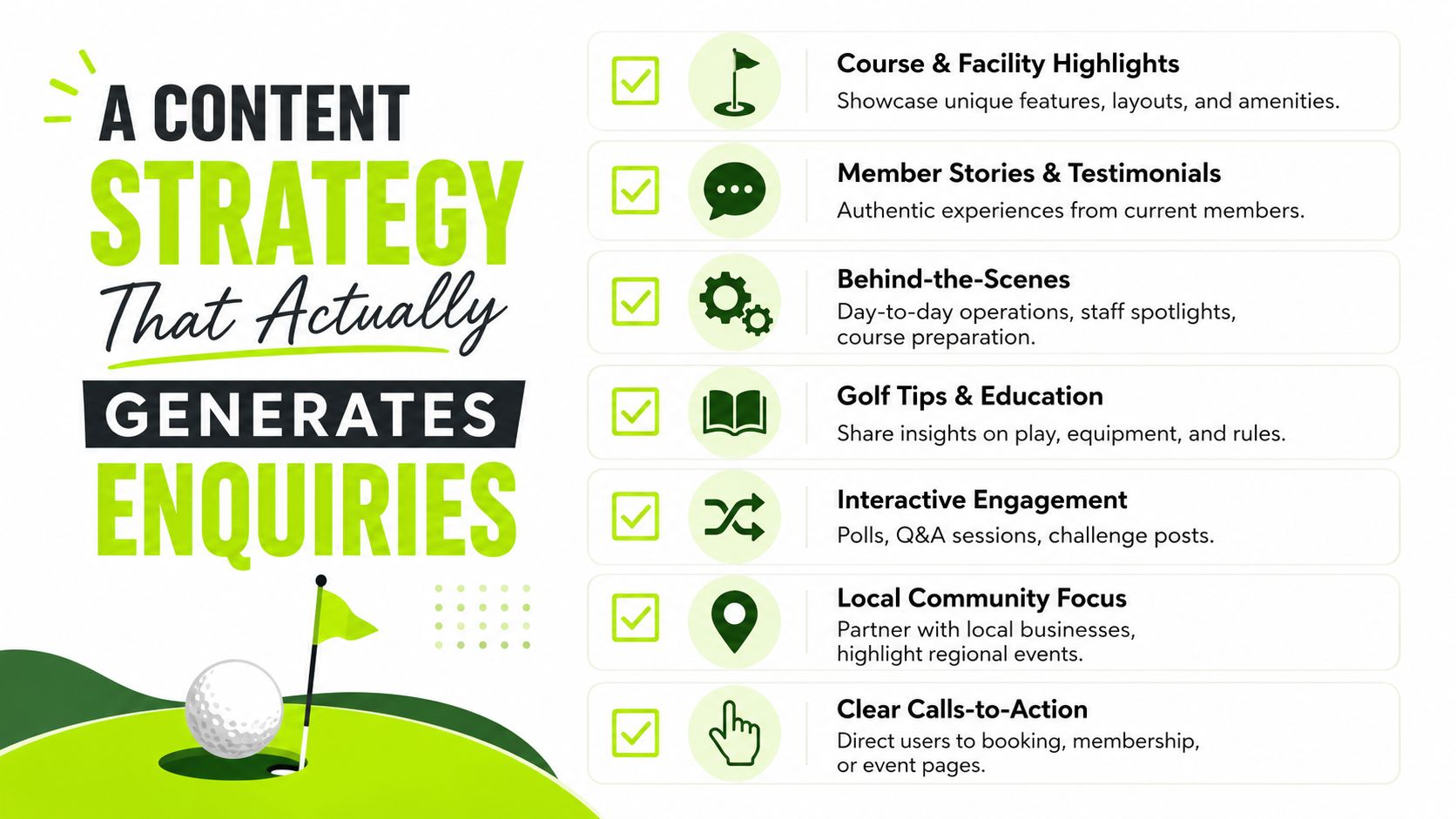
That means your feed should support what a prospect finds when they search your club name, look at your website, or compare you to a nearby competitor. Social isn't carrying the whole acquisition job. It's helping the right person say, "This looks like a club worth contacting."
Three content pillars that pull their weight
A simple structure keeps content useful without making it repetitive.
Validation
This content proves the club is credible and current. Course condition updates, practice areas, clubhouse spaces, coaching facilities, and recent images all belong here.
Monday morning course condition posts are especially practical because golfers actively look for them. They aren't glamorous, but they answer a real question. That makes them commercially stronger than many polished brand posts.
Community
Prospects don't only buy the course. They buy the experience around it. Member stories, mixed competitions, junior activity, staff introductions, volunteer moments, and event highlights show whether the club feels active and welcoming.
This is also where behind-the-scenes content works well. Greenkeeping clips, preparation before an event, or a short update from the pro add texture and make the club feel real rather than staged.
Invitation
Many clubs go quiet on this front. They post plenty of proof but rarely ask for action. Invitation content gives people a next step.
Examples include:
- Membership open days: Invite prospects to visit, not just admire from a distance.
- Trial round prompts: Give interested golfers a low-friction reason to experience the club.
- Tour requests: Ask directly if someone would like to see the facilities and discuss options.
- Beginner or family entry points: Highlight coaching, junior activity, or inclusive club events where relevant.
What works better than generic posting rules
Many clubs get trapped by content formulas that sound tidy but don't help a manager make decisions. A more useful filter is this short checklist:
- Does this post build trust? If not, it may be noise.
- Does it show the club as it is now? Old images create doubt.
- Does it help a prospect picture themselves there? If not, it may only serve existing members.
- Does it point to a next step? If not, don't expect enquiries.
Operational view: The best social content usually does one of two things. It validates a search decision or starts a sales conversation.
A workable weekly rhythm
Clubs often ask how often they should post. The better answer is to build a rhythm your team can sustain.
A practical weekly mix might include one validation post, one community post, and one invitation post. That lines up well with the guidance to post around three times a week, but the key value is consistency. Sporadic bursts followed by silence make the club look unmanaged.
You don't need every post to be clever. You need the feed to reassure prospects that the club is active, relevant, and easy to approach. That's what turns social content from background noise into an enquiry asset.
Turning Ad Spend into Membership Revenue
Organic posting has limits. Even strong content won't always reach the local golfers most likely to join. That's where paid social becomes useful, especially on Facebook and Instagram, if the campaign is built to create qualified enquiries rather than cheap clicks.
The biggest mistake clubs make with paid social is treating it like boosted awareness. They spend money to "get the word out" without deciding what action they want, how the lead will be captured, or who will follow up once it arrives.
A better campaign starts with the membership journey, not the advert.
Build the campaign backwards
Start with the final action you want. Usually that means a membership enquiry, a booked visit, or a conversation with the club. Once that is clear, build everything else around it.
That usually means:
- Define the audience carefully. Focus on geography first, then age, then golf-related interests where appropriate.
- Write one clear promise. Don't cram every club feature into one ad.
- Send people to one action. A dedicated form or lead capture route beats a vague website visit.
- Make follow-up immediate. Fast contact matters more than ad cleverness.
Some clubs use landing pages. Others use native lead forms inside Meta. If you're comparing options, this guide to Facebook lead forms is a useful reference because it explains when built-in forms can reduce friction and when you may want a more controlled follow-up path.
Tracking is not optional
A critical technical step is implementing UTM parameters on Meta ads so you can track where leads came from and what they turned into. Without that, ad reporting becomes guesswork. You may know that people clicked, but you won't know which campaign produced members.
That matters because when clubs track conversions directly to spend and use precise audience segmentation, they can achieve benchmark conversion rates of approximately 30% from enquiry to member, with campaigns yielding around £25,000 in new membership revenue, as shown in this Westerhope Golf Club case study on tracked Meta campaigns.
What good targeting looks like
Good targeting isn't about making the audience huge. It's about making the audience relevant.
A club usually gets better outcomes by narrowing around:
- Location: People within realistic travelling distance.
- Profile fit: Age ranges that match the product you're selling.
- Interest signals: Golf interests, relevant equipment brands, and comparable behaviours.
- Message match: Creative that speaks to the actual audience segment.
A seven-day membership category, a flexible membership route, and a premium full member package should not all use the same advert copy. When the message is broad, lead quality usually drops.
Paid social works when the audience, offer, tracking, and follow-up all line up. If one piece is missing, spend leaks quickly.
Budget decisions that make sense
A small budget can outperform a larger one if it is measured properly. Clubs don't need to spend blindly to prove that Meta can work. They need clean campaign structure, disciplined targeting, and an agreed process for what happens once the enquiry lands.
If your committee asks whether the adverts are working, the answer shouldn't be "the post reached a lot of people". It should be tied to tracked leads, attended visits, and eventual memberships. That's when ad spend stops being a gamble and starts looking like a controllable input into revenue.
The System That Converts Enquiries into Members
Most golf club social media marketing efforts break down precisely when a club creates interest, captures an enquiry, then handles it manually and inconsistently. By the time someone replies, the prospect has moved on.
For UK golf clubs, the average response time to membership enquiries is 47 hours and 32 minutes. Responding within 5 minutes makes conversion rates 98% higher, and new leads are 10 times less likely to respond after just 5 minutes have passed, according to GolfRep's analysis of golf club enquiry response times.
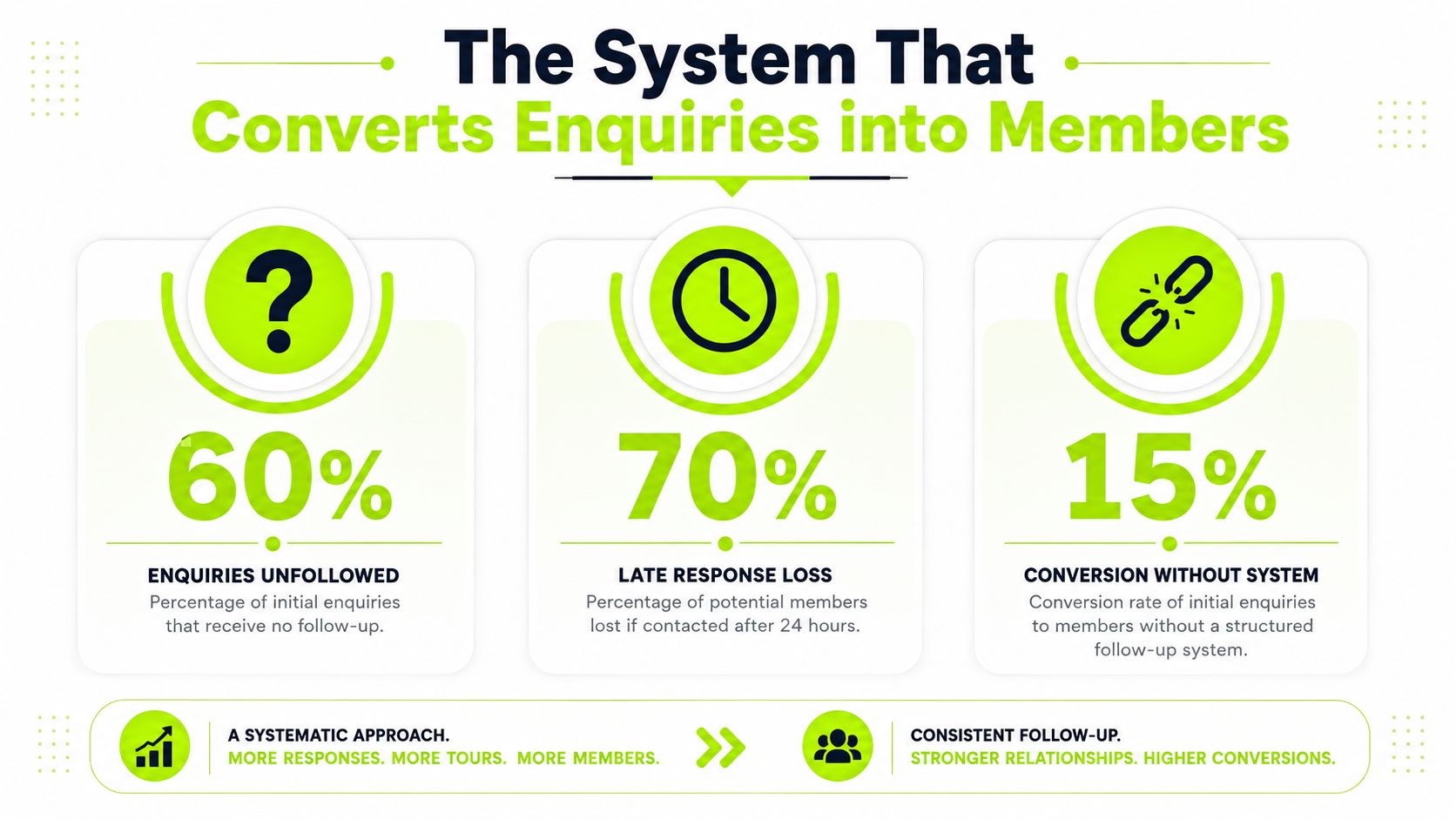
Those numbers change the conversation. The challenge isn't only how to generate leads from Facebook, Instagram, or paid ads. The challenge is whether the club can see every enquiry, respond at speed, and keep contact moving without relying on memory or staff availability.
What a working system includes
You don't need a complicated stack. You need a reliable one.
At minimum, the club should have:
- Central lead capture: Website forms, Meta lead forms, and direct enquiries need to land in one visible place.
- Instant acknowledgement: An automatic message should confirm receipt and set expectations immediately.
- Assigned ownership: One person must own the next action.
- Follow-up sequence: Prospects need multiple touchpoints, not one reply and then silence.
- Pipeline visibility: Staff should be able to see who enquired, who replied, who booked, and who stalled.
This is where CRM matters. Not because the software is magical, but because manual follow-up breaks under even light volume. Email chains, notebooks, and shared inboxes don't create accountability.
Speed matters, but structure matters more
Many clubs hear the five-minute rule and assume it means someone has to be on call constantly. That's not the lesson. The lesson is that systems need to do the first part instantly and make the next step obvious.
A practical flow looks like this:
| Step | What happens |
|---|---|
| Enquiry arrives | The lead enters the CRM automatically |
| Immediate response | The prospect gets a confirmation and helpful next step |
| Task created | The right staff member is alerted to call or message |
| Follow-up continues | Reminders, emails, and status updates keep the lead active |
That approach is common in stronger sales environments outside golf as well. If you want to see how structured sequences reduce drop-off, this piece on effective B2B lead nurturing is useful because the core principle is the same. Fast acknowledgement, consistent follow-up, and clear ownership convert more interest into revenue.
A social media lead is not valuable because it exists. It becomes valuable when the club responds quickly, follows through, and keeps the opportunity visible until a decision is made.
What managers should challenge internally
If you're a manager, secretary, or committee member, ask these questions:
- Where do membership enquiries go first?
- Who sees them immediately?
- What happens in the first five minutes?
- How many follow-up attempts happen after day one?
- Can anyone see the full pipeline without chasing staff for updates?
If those answers are unclear, your marketing system is underbuilt. More posting won't fix that. More ad spend won't fix it either.
The clubs that create predictable growth don't just attract attention. They install a process that protects every enquiry from being ignored, delayed, or forgotten. That's what turns social activity into measurable membership revenue.
GolfRep helps golf clubs build that full system. Not just lead generation, but the CRM, automations, tracking, and follow-up structure that turn enquiries into booked visits and long-term members. If your club wants a more predictable pipeline instead of another year of disconnected marketing activity, explore GolfRep.
Ready to tap into our proven growth system?