Lead Generation vs Lead Nurturing for Golf Clubs
The membership report is on the committee table. Enquiries are coming in, the marketing spend is visible, and yet booked visits remain thin. The usual response is to ask whether the club needs more leads. That question is too blunt to be useful.
Lead generation and lead nurturing are separate commercial control points. They need different owners, different budgets and different measures. A club can have a demand problem, a conversion problem, a staffing problem or a capacity problem. The right investment depends on which constraint is binding now.
Why Golf Clubs Confuse Lead Generation and Nurturing
At a committee meeting, the debate often starts with a number of enquiries. The marketing report shows website forms, calls and social responses, so the campaign is declared successful. The membership secretary then reports that only a small proportion became visits, applications or new members. The two reports may both be accurate, but they describe different parts of the commercial process.
A 2025 survey of more than 100 UK fractional chief marketing officers illustrates why acquisition activity changes while the underlying job remains the same. Email outreach fell from 72% of respondents in 2024 to 30% in 2025, while paid search increased from 20% to 36% and content marketing rose from 16% to 30% (The Marketing Centre on UK lead-generation tactics). Those channels create fresh demand. They don't establish whether a golfer is ready to visit, compare memberships or join.
Two systems, not one report
Lead generation creates a relevant pool of new prospects. Lead nurturing turns those prospects into conversations, visits, decisions and, ultimately, members. Generation usually sits with marketing or an external acquisition partner. Nurturing sits with the membership team, general manager, PGA professional or whoever owns the sales process.
The time horizons differ too. A campaign can produce an enquiry today, while the decision to join may follow after a course visit, a conversation about playing rights or a comparison with another club. If the club reports only enquiry volume, it rewards the activity that is easiest to count rather than the activity that produces membership revenue.
Commercial rule: Never increase lead-generation spend until someone has shown that the club can contact, qualify and progress the enquiries it already receives.
GolfRep's position is direct. Demand generation without a conversion system creates waste, while a strong conversion system without enough demand cannot create growth. The commercial director's job is to identify the current constraint, improve it and then move to the next one.
What Lead Generation and Lead Nurturing Actually Mean
Lead generation is the work of attracting and capturing new demand from golfers who could become customers. For a golf club, that can include local search, paid search, paid social, content, partnerships, open days, referrals and targeted campaigns for membership, societies, visitor golf or indoor bays.
The output is not a click. It is a trackable enquiry with useful context, such as source, preferred membership type, playing frequency, location, budget, timing and the action that prompted the contact. Generation should be judged by the quality and commercial relevance of those opportunities, not by reach alone.
Lead nurturing begins when the contact enters the club's system. It includes the instant acknowledgement, qualification questions, personal call, information, reminders, visit booking, objection handling and follow-up that move the prospect towards a decision. Lower-intent contacts may enter an education or reactivation sequence, while a golfer ready to tour should be routed to a person immediately.
Generation creates opportunity
The generation function answers questions such as:
- Are we reaching golfers within the club's realistic catchment?
- Which channels produce enquiries that match the membership proposition?
- What does each enquiry cost?
- Are campaigns creating demand for the right product and availability?
The GolfRep guide to golf-club lead generation covers the acquisition side in more detail. The important boundary is simple: generation ends when a prospect is captured and correctly recorded.
Nurturing progresses the opportunity
Nurturing answers a different set of questions:
- Was the enquiry contacted promptly?
- Does the club know what the golfer wants?
- Has a suitable next step been offered?
- Is there a named owner?
- What happens if the prospect isn't ready this week?
A short, well-designed form is part of this handoff. Clubs that want to reduce friction should review guidance on how to optimise your lead capture UX, particularly the information requested and the clarity of the next step.
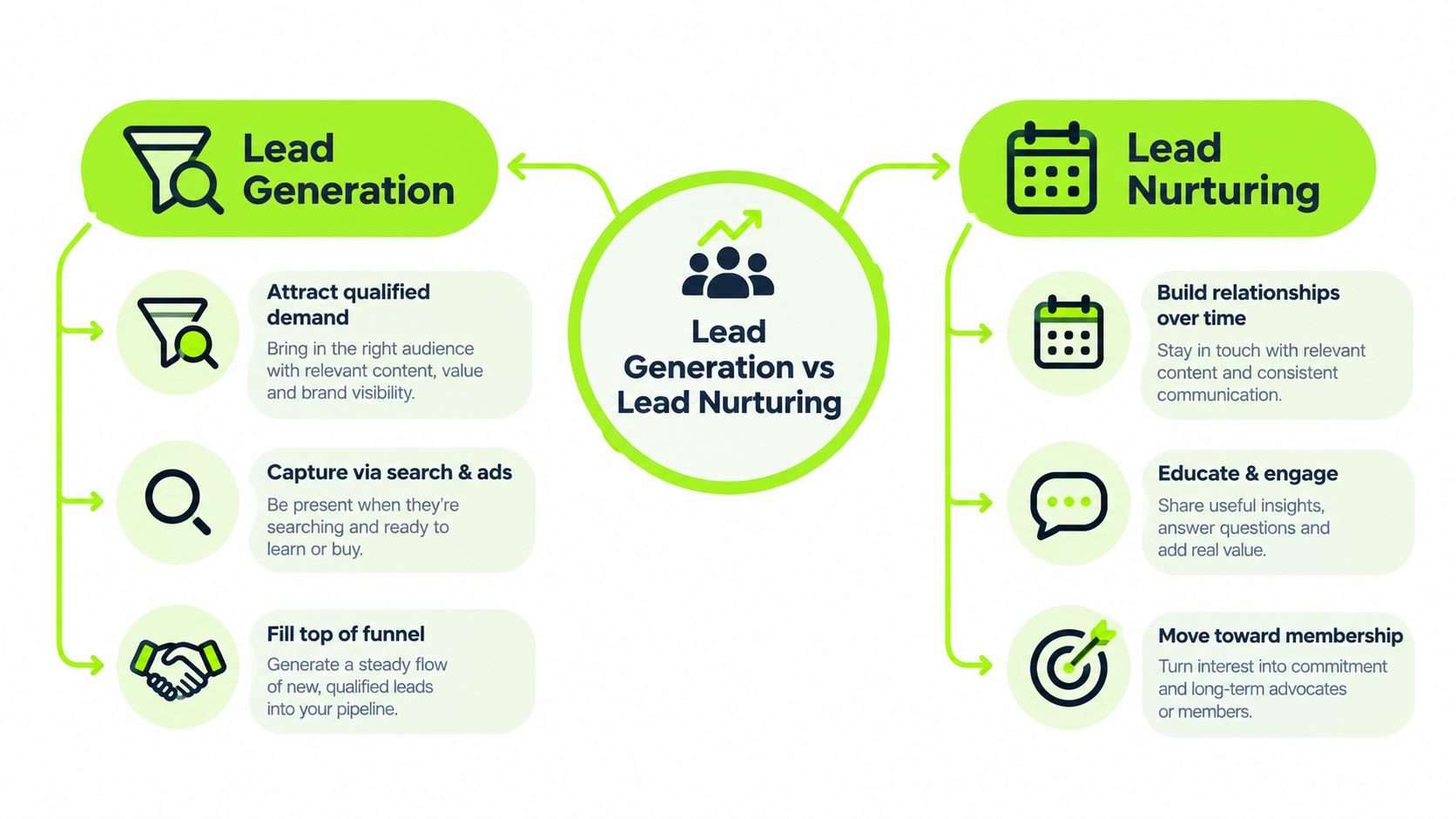
The distinction gives the club a shared vocabulary. Generation fills the pipeline. Nurturing develops the pipeline. If the committee asks for more leads when the failure is slow contact or weak qualification, it funds the wrong control point.
Generation and Nurturing Side by Side
The two functions often share data, but they don't share the same commercial responsibility. A club should be able to identify the budget, owner and report for each one.
| Criterion | Lead Generation | Lead Nurturing |
|---|---|---|
| Primary goal | Attract relevant golfers and create new enquiries | Move captured prospects towards a visit, decision and membership |
| Time horizon | Campaign-led and focused on creating fresh demand | Immediate response followed by structured progression over time |
| Main channels | Search, paid social, content, partnerships, referrals and open days | CRM workflows, calls, email, WhatsApp, visit reminders and personal follow-up |
| Commercial owner | Marketing lead, commercial manager or acquisition partner | Membership secretary, sales owner, general manager or trained club team |
| Budget line | Media, creative, landing pages, content and acquisition tools | CRM, staff time, automation, training and sales process improvement |
| Core success measures | Cost per enquiry, source quality, qualified-lead rate and channel yield | Response time, contact rate, booked visits, conversion and revenue per lead |
Different decisions need different owners
The person controlling paid search shouldn't decide whether a membership secretary has enough time to call every new enquiry. Equally, a membership team shouldn't be judged on a campaign's cost per click when it doesn't control targeting or media spend.
A practical arrangement gives generation an acquisition budget and nurturing an operating budget. The first funds attention and capture. The second funds the human and technical work required to convert that attention into revenue.
UK benchmark data reinforces the separation. In a benchmark covering more than 30 teams, visitor-to-lead conversion averaged 2% to 4%, while lead-to-marketing-qualified-lead conversion averaged 30% to 40%. Marketing-qualified-lead-to-sales-qualified-lead conversion averaged 13%, compared with 39% to 40% among top-performing teams using behavioural lead scoring (White Hat SEO's lead-generation benchmark). A club should therefore record both the quantity of enquiries and the quality of progression.
The GolfRep guide to golf-club lead nurturing is useful when the challenge sits after capture. The central management question remains: which team owns the next commercial movement?
The Metrics Each Function Should Report
A useful report separates what the club bought from what the club did with it. Generation reporting explains whether acquisition is producing suitable opportunities. Nurturing reporting explains whether staff and systems are converting those opportunities.
The generation dashboard
Track:
- Cost per enquiry: What the club spends to create a new contact, split by channel.
- Source quality: Whether search, social, referral, content or partnership enquiries match the intended membership proposition.
- Qualified-lead rate: The share of enquiries that meet agreed criteria, such as location, membership fit, timing or playing needs.
- Channel mix: How demand is distributed and whether the club is over-dependent on one source.
- Qualified-lead volume: The number of opportunities the membership team can realistically handle.
The UK evidence on channel performance shows why source matters. GolfRep reports an average website-visit-to-lead conversion rate of 5.13% across more than 5 million tracked conversions in 13 industries, with channel figures of 5.4% for paid search, 5.8% for AI referrals, 4.9% for email, 4.9% for organic search, 2.23% for organic social and 2.11% for paid social (GolfRep's lead-generation tracking guidance). These figures aren't a promise for an individual club. They demonstrate why channel-level reporting is more useful than one blended enquiry total.
The nurture dashboard
Track:
- Median time to first human contact: Automation can acknowledge an enquiry, but a person should own the commercial conversation.
- Contact rate: Whether the team reaches prospects.
- Qualified-to-visit rate: Whether suitable golfers book a tour, trial round or membership conversation.
- Visit-to-member rate: Whether the club's proposition and sales process work in person.
- Revenue per enquiry: The final commercial value of each source and cohort.
The speed gap is material. UK research reports an average lead-response time of roughly 47 hours, with only 7% of organisations responding within five minutes. Organisations responding within one hour were reported as seven times more likely to qualify leads than those waiting two hours, and 60 times more likely than those waiting at least 24 hours (UK lead-response crisis report).
Reporting rule: A campaign isn't commercially healthy because it produces cheap enquiries. It is healthy when those enquiries become qualified conversations, visits and members at an acceptable cost.
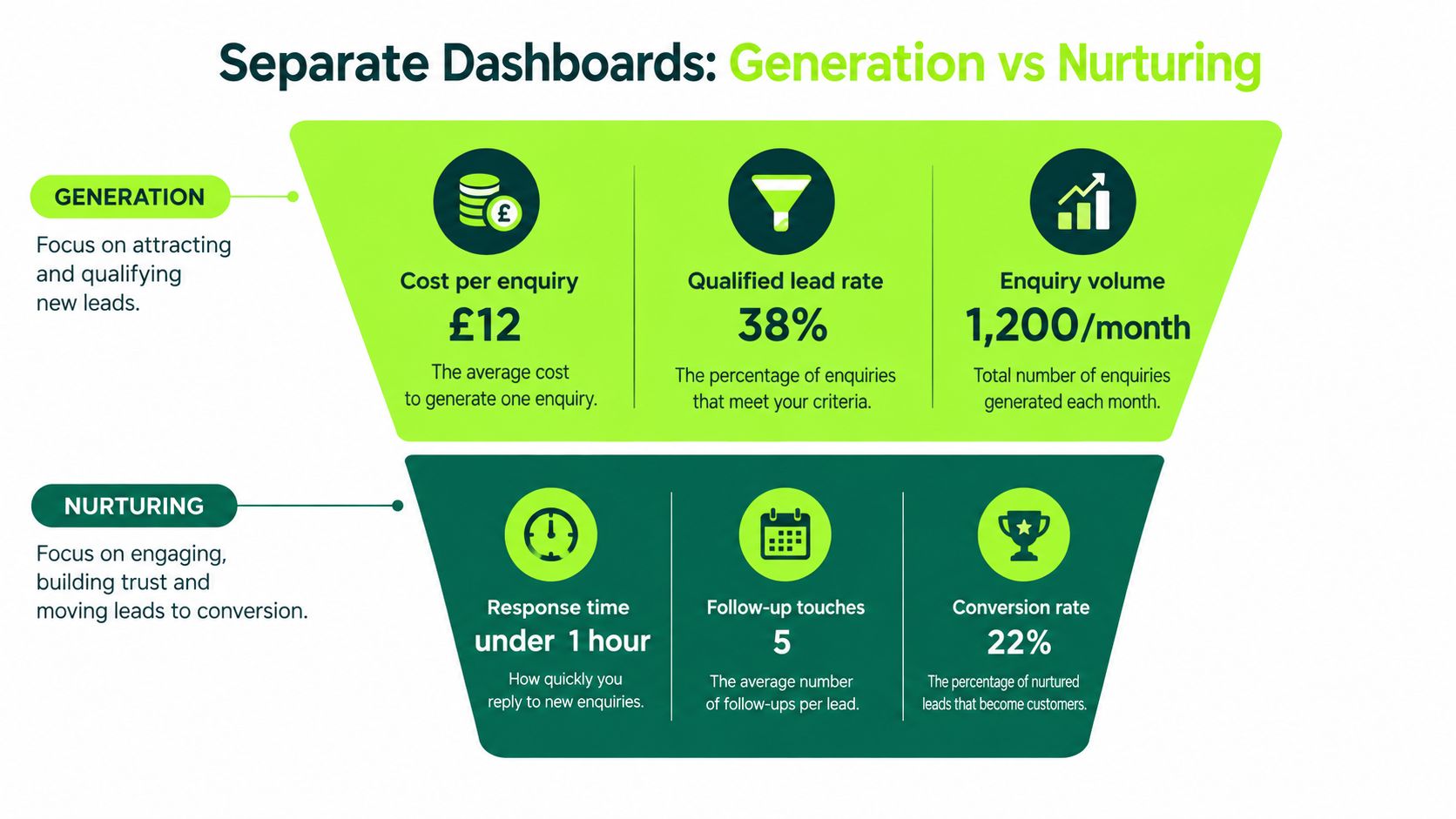
The two reports should meet at source-to-member yield. That single view stops the club rewarding a channel that produces volume but weak membership outcomes.
When More Leads Are the Wrong Answer
More enquiries sound positive until the club has to handle them. If the membership secretary is already struggling to return calls, tours are limited and the committee has not agreed who owns follow-up, a larger campaign can reduce service quality rather than improve revenue.
The wider UK golf market doesn't justify a blanket assumption that every club needs more demand. England had more than 730,000 club members across 1,735 clubs in 2024, while average member age fell from 56.18 to 54.99 (The Golf Business on golfers and clubs in England). That points to a broad and changing acquisition market, but each club still has its own joining capacity, tee-time position and staffing constraint.
Capacity changes the commercial answer
Golfshake's 2025 survey found that 77% of golfers planned to renew their membership. It also reported that 30% of golfers said their club had a waiting list, up from 27% in 2024, while 39% of clubs charged a joining fee, up from 37% (Golfshake's 2025 golf-club membership survey). For a club with restricted places, the job isn't to persuade everyone with a discount. It is to explain access clearly, qualify fit and allocate scarce capacity well.
Hillier Hopkins reported that 76% of member clubs had more joiners than leavers in its 2023/24 survey. Clubs welcomed an average of 94 new members during 2023, while the proportion operating a waiting list fell from 52% to 46% and the average waiting list declined from 61 people to 51 (Hillier Hopkins survey reported by GolfRep). The commercial lesson is not that every club should chase a particular number. It is that membership growth depends on the relationship between joiners, leavers, capacity and the sales process.

Use a constraint test
Before adding acquisition spend, ask:
- Can the club contact every suitable enquiry promptly?
- Can the team offer enough tours, trial rounds or membership meetings?
- Is there room for the type of member being acquired?
- Can the club explain waiting lists, joining fees and playing rights clearly?
- Will higher volume improve member value, or merely increase administrative work?
If the answer is no, targeted generation and prioritised nurture are safer than indiscriminate volume. A committee-led club must be especially careful. Volunteers and part-time staff can be overwhelmed quickly, and a neglected prospect won't distinguish between a capacity problem and a lack of interest.
The Enquiry to Visiting Member Workflow
A private club can turn a website enquiry into a booked tour without making the process complicated. It needs a clear handoff, a named owner and a next action recorded at every stage.
The first message should acknowledge the enquiry and set an expectation. The CRM should capture the source, timestamp, membership interest, preferred contact method and any relevant response. It should then ask one or two useful questions, such as whether the golfer wants immediate membership or is comparing clubs, and whether they want a course visit.
The first hour
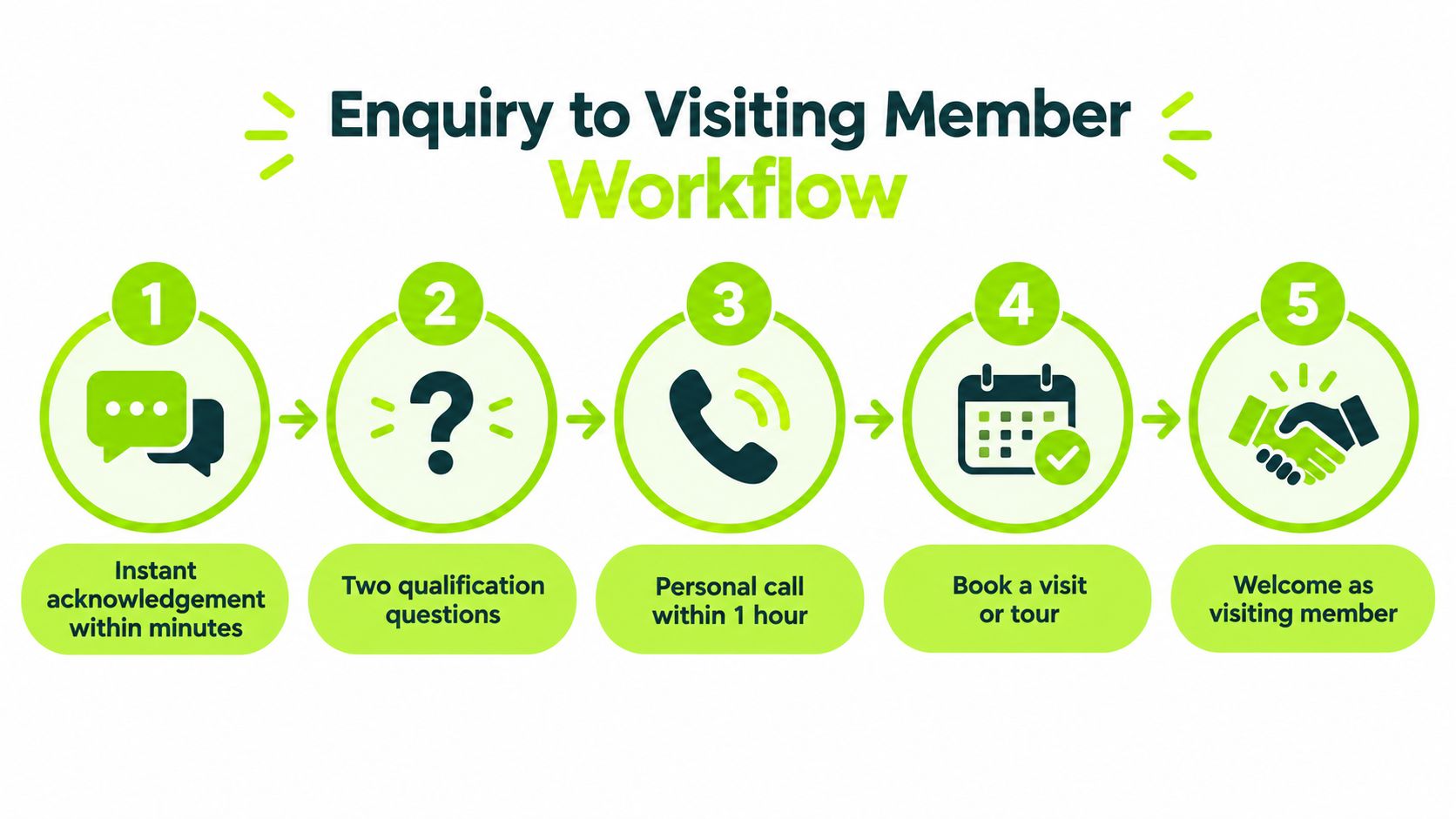
The workflow should look like this:
- Acknowledge immediately. Send a clear confirmation that the enquiry has been received, with a realistic indication of when a member of the team will make contact.
- Ask for context. Keep qualification focused. Playing frequency, membership type, timing and visit preference are more useful than a long form.
- Assign ownership. One person, not a shared inbox, owns the next action.
- Make a personal contact attempt. Call within the club's agreed response standard, then record whether the contact was made.
- Book the next step. Offer a tour, trial round, fitting, PGA conversation or membership meeting. If the golfer isn't ready, place them in the relevant nurture branch.
Consider a golfer who submits a membership form on Monday morning. The system records a paid-search source and a preference for a playing membership. An immediate acknowledgement asks whether the golfer is available for a tour. The membership secretary receives the task, calls within the agreed window and learns that the golfer is comparing two local clubs before making a decision.
That prospect shouldn't receive the same message as someone who wants to join immediately. The first belongs in a comparison and value sequence, supported by a visit invitation. The second needs a prompt route to a tour and a conversation about available membership options. A lapsed member may need a reactivation conversation, while a waiting-list enquiry needs transparent information about timing and access.
The handoff that loses the opportunity
If that same form sits in a shared inbox for two days, the campaign can still report a successful conversion. The commercial process has failed, though. No owner has been assigned, intent hasn't been captured and the golfer may already have visited another club.
After a first visit, the club should continue the relationship without pushing a generic sales message. Guidance on email ideas for new guests can help the team structure useful post-visit communication. Clubs should also make the booking step obvious online, using a process such as booking a visit online where it suits the operation.
The workflow should stop or change when the golfer books, joins, declines, asks to pause or enters a waiting list. Automation should support ownership, not hide the fact that someone must make the commercial decision.
Diagnosing Your Club's Binding Constraint
The general manager can diagnose the priority with three comparisons. The point isn't to create a complicated dashboard. It is to identify where demand stops moving.
Compare volume with contact capacity
Start with the number of new enquiries against the number the team can contact properly during the period. If enquiry volume is below capacity and the team is still responding well, generation may be the constraint. If volume is above capacity, adding more leads is irresponsible until routing, staffing or qualification improves.
Compare contact with qualification
A low contact rate means the handoff, ownership or response process is failing. A strong contact rate with a weak qualified-lead rate points elsewhere. The campaign may be attracting golfers who don't fit the proposition, the form may be capturing poor context or the membership offer may be unclear.
For clubs that receive calls outside staffed hours, an automated call answering service can provide continuity, but it must connect to the club's ownership and CRM process. Answering a call without recording the next action only moves the gap to another part of the funnel.
Compare visits with membership decisions
A strong booked-visit rate with a weak visit-to-member rate usually indicates a proposition, pricing, access or in-person sales problem. The club may be attracting the right golfers but failing to show why membership fits their lives.
Use the following decision table in the monthly commercial meeting:
| Finding | Likely constraint | First action |
|---|---|---|
| Enquiry volume below realistic contact capacity | Generation | Improve local acquisition and source quality |
| Enquiry volume sufficient, contact rate weak | Handoff and response | Assign ownership, set response standards and monitor completion |
| Contact rate strong, qualified rate weak | Targeting or proposition | Tighten audience, form questions and membership messaging |
| Qualified leads book few visits | Nurture process | Improve qualification, invitations and booking access |
| Visits are healthy, joins are weak | Sales proposition or experience | Review tour, pricing explanation, objections and next steps |
| Enquiries exceed available places or staff time | Capacity | Slow broad acquisition and prioritise high-fit prospects |
This is the operating principle GolfRep uses: find the current constraint, fix it, measure the movement and only then fund the next constraint.
Which Should Your Club Prioritise First
Start with the simplest rule.
If enquiry volume is below the club's realistic contact capacity, prioritise lead generation. The club needs more relevant demand, provided the proposition and handoff are ready.
If enquiry volume is sufficient but contact, qualification or visit rates are weak, prioritise lead nurturing. More acquisition will only increase the number of prospects the club fails to progress.
If both are weak, fix the reporting line and handoff before spending heavily on either. The club needs reliable source data, clear ownership and agreed stages before it can tell whether the problem is demand or conversion.
Two commercial examples
Take a private club with 1,200 members. It has a steady flow of membership enquiries, staff can contact them, but few prospects book tours and the visit-to-member rate is poor. The correct first move is nurturing. The club should review its qualification questions, booking route, tour experience, proposition and follow-up ownership.
Now consider a newer or less established club with a quiet membership pipeline. Its team responds promptly, tours are available and the joining process is clear, but too few suitable golfers enquire. That club should prioritise generation through local search, paid campaigns, partnerships, content and referrals. Improving nurture won't create enough opportunities by itself.
A club should also resist the temptation to compare itself with another club's headline enquiry total. A waiting-list club, a seasonal visitor operation, an indoor facility and a committee-led member club have different capacity economics. The meaningful question is whether the current source-to-member yield supports the club's membership and revenue plan.
Lead generation and lead nurturing aren't rivals. They are two control points with separate owners and separate failure modes. Commercial management improves when the club knows which point is binding this quarter, funds that point properly and measures the result beyond raw enquiry volume.
GolfRep helps golf clubs map the full path from acquisition and enquiry capture through CRM ownership, follow-up, booked visits and membership outcomes. If you want to identify whether generation or nurturing is limiting your club's growth, visit GolfRep to discuss a practical commercial review.
Ready to tap into our proven growth system?